Exchange
Doctoral Dissertations Graduate School
5-2013
An Investigation of Faculty Development Center
Staff Evaluators Perceptions of Processes, Theory,
and Models Used in Evaluating Faculty
Development
Thelma Mae Woodard
This Dissertation is brought to you for free and open access by the Graduate School at Trace: Tennessee Research and Creative Exchange. It has been accepted for inclusion in Doctoral Dissertations by an authorized administrator of Trace: Tennessee Research and Creative Exchange. For more information, please [email protected].
Recommended Citation
Woodard, Thelma Mae, "An Investigation of Faculty Development Center Staff Evaluators Perceptions of Processes, Theory, and Models Used in Evaluating Faculty Development. " PhD diss., University of Tennessee, 2013.
I am submitting herewith a dissertation written by Thelma Mae Woodard entitled "An Investigation of Faculty Development Center Staff Evaluators Perceptions of Processes, Theory, and Models Used in Evaluating Faculty Development." I have examined the final electronic copy of this dissertation for form and content and recommend that it be accepted in partial fulfillment of the requirements for the degree of Doctor of Philosophy, with a major in Educational Psychology and Research.
Gary J. Skolits, Major Professor We have read this dissertation and recommend its acceptance:
Jennifer A. Morrow, John M. Peters, Jennifer K. Richards
Accepted for the Council: Dixie L. Thompson Vice Provost and Dean of the Graduate School (Original signatures are on file with official student records.)
A Dissertation Presented for the
Doctor of Philosophy
Degree
The University of Tennessee, Knoxville
Thelma Mae Woodard
May 2013
Copyright © 2012 by Thelma Woodard All rights reserved.
Dedication
The author Henry Miller said, “Dedication is not what others expect of you, it is what you can give to others.” Well, Mom, I made a decision to be right where I am today……and yeah, I’m happy! So, I’m dedicating this dissertation to you.
My mother passed away while I endeavored to realize my educational dream, and get through my doctoral program. Anyone who knew Corine Woodard was certain she was irrefutably devoted to me and my older sister, Norma. Humble by nature, and sometimes unassuming, my Mom would transform into an unapologetic, prideful recipient in response to all compliments she received about her daughters. Mom would always respond to the compliments about her
daughters with, “I know. You’re absolutely right.” When I asked Mom why she didn’t just say “thank you” in response to the compliments, she would say, “I just want them to know they got it right, and I wholeheartedly agree!” In her eyes, there was no one greater than the two daughters she raised to adulthood.
Mom was dedicated to living life and making the best of it. If I heard her say it once, I heard it a million times, “Happiness is what counts.” There is no bigger proponent of believing in your personal decisions about life and living it to the fullest than was my mother. She was always proud, and supportive, of my life decisions even when she preferred that I live the way she would have lived. I knew Corine was proud of me. After 93 years of living life her way, she transitioned into an energy that continues to transmit the same love for me, and devotion to me. I am grateful that I can still feel it.
Acknowledgements
To the members of my dissertation committee, I offer my sincere thanks to each of you.
Dr. Gary Skolits, thank you for your helpful comments and suggestions, and for providing guidance during this study. I feel fortunate to have had a published and distinguished
faculty member as my committee chair.
Dr. Jennifer Morrow, thank you for your helpful comments and suggestions during this study. Thank you for your advice and leadership during my first year in the Evaluation, Statistics and Measurement program; it has left an indelible impression on me.
Dr. John Peters, thank you for your helpful comments and suggestions. I appreciate the extra time you took to review preliminary chapters of this study and provide feedback; and thank you for generously sharing your knowledge and giving me the opportunity to learn more about reflective practice.
Dr. Jennifer Richards, thank you for your helpful comments and suggestions. I especially thank you for helping me align the research questions with the purpose of this study.
To my colleagues, peers, and friends, I offer my heartfelt appreciation to each of you. Dr. David Schumann and Dr. Taimi Olsen at the Tennessee Teaching and
Learning Center (TTLC), thank you for the opportunity to work at TTLC. It was a wonderful experience for me and was undeniably a major part of my professional growth.
My dear colleagues, Ferlin McGaskey and Kelly Ellenburg, thank you for critically reflecting together with me about all sorts of educational topics and allowing me to develop my reflective practice; those conversations mean the world to me.
My dear colleagues, Jason Black and Jeral Kirwan, thank you both for your suggestions, ideas, answers to my statistics questions, and just being good friends.
Carol Price, for contributing your time, insight, and wisdom to this experience, and
providing the guidance and valuable feedback I truly needed. Just know that your support and encouragement meant the world to me and I will never forget how much you helped me.
Billy Gibbs, for upgrading me on many, many levels during this process. You are generous.
To my family, I could not have made it this far without your support and love.
Dad, who has always been a stickler for setting goals and have the tenacity to reach them, I want to thank you for all the advice, prayers and love you have given me.
My sister Norma, who has been by my side since my first day on earth, thank you for growing, sharing, caring, and evolving with me. The love we have for each other is unparalleled.
My son, Drew, thank you for being my son. I enjoyed looking after you as a boy, and I now enjoy looking up to you as a man.
Abstract
The purpose of this research was to explore evaluator perceptions of the processes they engage in when evaluating faculty development programs; their use of program theory; and the evaluation models they use to design faculty development program evaluations. Due primarily to the fact that most faculty development centers were established during the last twenty years, (Wright, 2011), previous research has shown a lack of widespread knowledge of program
evaluation, and its application to faculty development interventions. Studies indicate a gap in the literature exploring program evaluation in faculty development centers from the evaluator’s standpoint. This study was interested in the processes evaluators engage in when they evaluate various programs in faculty development; the extent to which evaluators link evaluations to short, medium, and long term outcomes; and the use of standard evaluation models in faculty development.
A descriptive qualitative method utilizing semi-structured interview questions was used to collect data about the perceptions of evaluators concerning their experiences with program evaluation in faculty development. Five primary themes and one secondary theme emerged from the data analysis of information offered by each participant. The primary themes that emerged were: (a) purposeful selection of programs to evaluate, (b) careful planning of the evaluation methodology, (c) understanding that it takes considerable time to evaluate programs, (d) strategically linking program outcomes to center goals, and (d) implicit application of a utilization-focused approach to planning evaluation; a secondary theme emerged: (a) thinking critically about how to evaluate programs. These themes reflect consistent elements and patterns in participants’ comments on programs they select to evaluate, methods used in program
Implications of the findings are that program evaluators in the faculty development field should familiarize themselves with the evaluation processes, program theories, and evaluation models available in the literature and utilize them in faculty development evaluation. For future study, a descriptive case study of evaluation in faculty development programs is recommended. The suggested study design would include onsite observations, interviews with stakeholders, plus document review and analysis.
Table of Contents
Chapter 1 Introduction... 1
Statement of the Problem ... 2
Purpose Statement ... 3
Overview Of Study Design and Conceptual Framework ... 3
Significance of the Study ... 4
Assumptions ... 5
Limitations ... 5
Definition of Terms... 6
Chapter Summary ... 7
Chapter 2 Literature Review ... 8
Program Evaluation in Faculty Development ... 8
Program Evaluation Models ... 12
Professional Development Evaluation Models ... 17
Program Theory ... 20 Conceptual Framework ... 25 Chapter Summary ... 27 Chapter 3 Methods ... 29 Introduction ... 29 Research Questions ... 29
Study Design and Rationale ... 29
Participants ... 31
Centers and Participants ... 32
Sources of Data ... 40
Interviews ... 40
Data Analysis ... 43
Coding and Thematic Analysis ... 44
Establishing Trustworthiness ... 45 Worthy Topic ... 45 Rich Rigor ... 46 Sincerity ... 47 Resonance ... 48 Significant Contribution... 49 Ethics... 49 Meaningful Coherence ... 50 Chapter Summary ... 50 Chapter 4 Findings ... 52 Introduction ... 52 Research Questions ... 53 Chapter Summary ... 88
Chapter 5 Conclusions and Recommendations ... 89
Findings... 89
Conclusions ... 90
Discussion ... 92
Recommendations for Future Research ... 96
Summary ... 97
References ... 99
Appendices ... 108
Appendix A Informed Consent Statement ... 109
Appendix B Letter to Participants... 111
Appendix C Interview Protocol ... 112
Appendix D Research Audit Trail ... 113
List of Tables
Table 2.1 Posavac’s Evaluation Models ... 15
Table 2.2 Patton’s Types of Evaluation Approaches ... 16
Table 3.1 Demographics of Faculty Development Centers ... 36
Table 3.2 Research Questions Mapped with Interview Questions and Question Types ... 42
Table 4.1 Selection of Programs and Planning of the Evaluation ... 55
Table 4.2 Understanding That It Takes Considerable Time to Evaluate Programs ... 69
Table 4.3 Thinking Critically About How to Evaluate Programs ... 71
Table 4.4 Strategically Linking Program Outcomes To Center Goals ... 81
Table 4.5 Implicit Application Of A Utilization-Focused Approach To Planning Evaluation .... 87
List of Figures
Chapter 1 Introduction
During the 1970s, scholars began to discuss the issue of program evaluation as a process in faculty development programs. Evaluation of such programs is now, of course, a perquisite of measuring effectiveness of any formal or informal professional development intervention. Forty years ago, in an educational venue wherein outcome measures were becoming a greater factor in funding and support for any faculty development programs, identifying and assessing the
evaluation needs of faculty development centers was a growing area of interest.
At the same time, there was a concern that faculty development centers might soon become extinct if the staff did not learn to evaluate their own programs, thereby demonstrating that they effectively manage their centers, resulting in more productive and engaged faculty members (Centra, 1976). Complicating the situation was the lack of widespread knowledge of program evaluation and its application to faculty development interventions. This lack of understanding of the use of program evaluation in faculty development remains a challenge. This ongoing challenge is due primarily to the fact that most faculty development centers established during the last twenty years, basically in the period from 1990 to 2010 (Wright, 2011).
For many faculty development centers the primary goals are a) to have participating instructors retain and apply ideas presented in center programming and b) to motivate change in instructors’ behavior. The cascading result of realizing those goals will be to improve student retention rates, promote more effective student learning, and directly impact student outcomes (Sorcinelli, 2006).
Recent faculty development evaluation studies have focused on particular intervention strategies, and these studies have sometimes included evidence that the programs are having an impact on the participants or the institution, or both. However, these studies typically present vague ideas about program theory or evaluation frameworks (Dwyer, 1996; Metcalfe, Aitken, & Gaff, 2008; Stinson & Wilkinson, 2004). In addition, very few of the evaluation studies reported in the literature utilize an evaluation model (Krebera & Brook, 2001). Having a specific process for and model of how a professional development program is designed to work can help program staff members’ work together and focus on those activities that are most important for program success.
Statement of the Problem
A review of faculty development literature reveals that much of the research on faculty development has been conducted quantitatively. Further, the literature review indicates that faculty development program evaluations have failed to address the evaluator’s perspective in the evaluation process. Basically, the research ignores the role of the evaluator, and the evaluation process itself, in the evaluation of faculty development programs. Studies of
evaluation in faculty development are sparse in the literature published since 1976, and many of the studies prior to 2011 relied on survey methods to investigate this topic (Centra, 1976; Nelson, 1979; Shore, 1976; Sorcinelli, 2006). Faculty development centers have mainly been engaged in evaluation of singular activities (Light, Calkins, Luna & Drane, 2008). However, recent
literature does provide evaluation studies using specific evaluation models (Armstrong & Barsion, 2006; Cilliers & Herman, 2009) and program theory (Megdal, Engle, Pakenas, Albert, Peters, & Jordan, 2005).
More recent studies by Hines (2011) and Wright (2011) are indications of a recent shift in the research approach because they investigated or detailed factors contributing to “how”
program evaluation is conducted at faculty development centers; however, very little is known about the evaluation process and methods for conducting program evaluation at a faculty development center from the evaluators’ perspective. Resulting studies indicate a gap in the literature exploring program evaluation in faculty development centers from the evaluator’s standpoint. Therefore, the significance of this study lies in its descriptive perspective and its potential ability to address a gap in the literature.
Purpose Statement
The purpose of this research was to explore evaluator perceptions of the processes they engage in when evaluating faculty development programs; their use of program theory; and the evaluation models they use to design faculty development program evaluations.
Overview Of Study Design and Conceptual Framework
This study utilized a descriptive qualitative methodology to answer three research questions:
1. What process do evaluators engage in when they evaluate various programs in faculty development?
2. To what extent and how do evaluators link evaluations to short-, medium-, and long-term outcomes?
3. To what extent and how do evaluators use the standard evaluation models in faculty development?
To answer the research questions, a semi-structured interview was undertaken to explore the experiences of evaluators in faculty development. Posavac’s (2011) evaluation planning process,
which explains how evaluators can plan evaluations, was used as the conceptual framework for this study.
This research was conducted in compliance with the policies established by the
Institutional Review Board (IRB) of The University of Tennessee and the researcher subscribed to the principles and standards of professional ethics in all research, development, and related activities involving this study. The IRB review encompassed the research protocol, the informed consent document signed by participants, announcement used in recruiting participants, and other relevant documents (Appendix A). In carrying out its review, the IRB ensured that: (a) any risks to participants that may be incurred were warranted in relation to the anticipated benefits; (b) informed consent documents clearly conveyed the risks and the true nature of research; (c) announcements were not misleading; and (d) the selection of participants was equitable and justified.
Significance of the Study
This study offers three significant contributions for understanding evaluations of faculty development programs. First, evaluators of faculty development centers offer a rich and in-depth description of their experiences of the evaluation process. The results of this study thus provide insights for faculty developers interested in evaluating their programs; they also show how program theory and evaluation models are currently applied to evaluation in the field of faculty development. Second, the findings of this study provide a foundation for future studies and examination of factors related to program evaluation and its application to faculty development. Finally, qualitative methodology proposes a new approach for helping faculty developers
offering insight about program theory and evaluation models that may increase the likelihood of establishing a successful evaluation design and implementation plan.
Assumptions
This study has been conducted based on the following assumptions:
Responding evaluators were willing to share their true perceptions of the evaluation process.
The interview questions were worded appropriately to generate responses relevant to the research questions.
Participant responses were honest and representative of individuals’ experiences with program evaluation.
Limitations
This study was conducted based on the following limitations:
Faculty development centers employing staff designated to conduct program evaluations were the focus of data collection.
Faculty development centers operating for at least five years were included in data collection.
A descriptive qualitative study design preludes generalizing the findings.
Only faculty development centers employing staff whose job responsibility included program evaluation were included in the study.
This study is limited by the number of center evaluators willing to participate in an interview.
Definition of Terms
For the purposes of this study, the following definitions are being used. Terms will be further defined in the literature review to clarify application to the specifics of this research project, as appropriate.
Assessment: the measurement of one or more variables related to the current condition, ability, status, or knowledge of an individual or program (Wright, 2008). Assessment and evaluation is often used interchangeably; however, evaluation involves “discovering the value and worth of something, the purposes and methodologies are quite different” (Posavac, 2011, p. 3).
Evaluation Model: conception or approach or sometimes a method (e.g., naturalistic evaluation, goal-free evaluation) of doing evaluation (Scriven, 1991).
Faculty Development: programs that focus on the individual faculty member and or graduate student; used interchangeably in the literature to indicate educational and professional development.
Faculty Development Centers: centers that provide programs for faculty and/or graduate students focused on improving teaching in higher education classrooms; also referred to as Teaching and Learning Centers and Instructional Development Centers.
Program Theory: a set of assumptions about the relationships between the strategy and tactics a program has adopted and the social benefits it is expected to produce (Rossi, Freeman, & Lipsey, 1999, p. 98). Each program in an organization may operate under a different set of assumptions; for instance, the strategy and tactics utilized in faculty development in one-on-one consultations with faculty members are different from those utilized in a workshop, and
planning and evaluation models. In program planning, the process of the program is detailed; evaluation models are used to analyze questions that the evaluation can answer. On the other hand, program theory examines the process of the program and its value.
Chapter Summary
Chapter 1 presents the introduction to this study and the development of program evaluation in faculty development. Since the development of program evaluation in faculty development, centers have mainly evaluated workshop activities. Studies of program evaluation are sparse and very little is known about how evaluation is conducted in faculty development. Assumptions related to this study are that the interview questions are worded appropriately and participants in this study are truthful. Often, assessment and evaluation are used interchangeably and program theory is often confused with program planning theory. This chapter provides definition of terms related to this study. Overall, the need for a study to describe experiences of program evaluators in faculty development centers was explored.
Chapter 2 reviews the literature on program evaluation in faculty development, program theory, and program evaluation models. Chapter 3 focuses on the research design and the methods for collecting and analyzing the data and includes information about the selection of participants as well as the method for establishing trustworthiness. Demographic data and findings are presented in Chapter 4, and Chapter 5 details implications for research and practice.
Chapter 2 Literature Review
The literature related to the research questions of this study includes a review of program evaluation conducted at faculty development centers in higher education, program evaluation models, and program theory literature. Stufflebeam (2001) defined an evaluation as “a study designed and conducted to assist some audience to assess an object’s merit and worth” (p. 11). Thus, program evaluation assesses the value of a specific program. The evaluation process is a set of activities that provides data about the program; specific methods used to gather and interpret data depend on the purpose of the evaluation, which can be formative or summative. Formative evaluation is conducted during the program to assess the implementation process or development of the program and provide data relative to the improvement of the program; summative evaluation is conducted at the end of the program to determine the program’s worth or effectiveness (Scriven, 1991).
Program Evaluation in Faculty Development
Most faculty development centers were established in the period from 1990 to 2010 (Wright, 2011). Faculty development centers design programs specific to the needs of their campus and which delivered through workshops, seminars, institutes, consultations, and observations; in addition to faculty development some centers also focus on instructional technology expertise, administer course evaluations, teach assistants, and supply grants to support faculty projects. The primary goals for many faculty development centers are to have instructors retain and apply program ideas presented and to change instructors’ behavior in order to promote more effective student learning and retention (Sorcinelli, 2006; Wright, 2011). The Professional and Organizational Development in Higher Education (POD Network) supports a
network of over one thousand faculty and teaching assistant developers, faculty, administrators, and consultants in higher education. The POD network website lists sixty-five faculty
development centers with websites in the United States.
In the late 1970s it was predicted that if faculty development centers did not soon learn to evaluate their programs and demonstrate that they successfully manage their center by educating the teaching faculty to produce more effective and satisfied faculty members, they might soon become extinct (Centra, 1976). Also during the 1970s, scholars began to identify and assess the evaluation needs of faculty development centers. Shore (1976) emphasized that centers should determine who would conduct evaluations, how often those evaluations will be conducted, and what would happen to the results. Centra (1978) and Nelson (1979) also drew attention to the need for program evaluation in faculty development and argued that evaluation is an essential indicator of program effectiveness. At around the same time, Hoyt and Howard (1978) differentiated among the three types of data useful in evaluation studies: that which describes how participants feel about the experience, that which describes behavioral change, and that which provides direct evidence of improvement in instructional effectiveness (p. 26).
Faculty development literature from the 1970s was scattered with descriptions of evaluations but lacked evidence about the impact of the programs on participants or their
institutions (Gaff & Morstain, 1978). In the early 1980s, faculty developers began to implement evaluation methods for evaluating impact. Levinson-Rose and Menges (1981) reported that the strongest index of program effectiveness is impact on students and the weakest is self-reporting by participants attending faculty development programs. In addition, Van Note Chism and Szabo (1997) offered a method for conducting program evaluation in faculty development after they observed that evaluation could be performed at three levels: Level one determines how
satisfied participants are with the programs; level two determines the impact of the program on the participant’s teaching practices and on their attitudes toward teaching; level three determines the impact of the program on the learning accomplished by the participants’ students. Levinson-Rose and Menges (1981) found that most program evaluations conducted at faculty development centers only reflected superficial levels of experience and allowed only speculation about the cognitive and developmental experiences of program participants.
Even though Van Note Chism and Szabo (1997) offered an evaluation method for faculty development, the most common types of faculty development program evaluation currently found in the literature are needs assessments and post-workshop evaluations. For example, Milloy and Brooke (2004) described a faculty development needs assessment used to focus a center’s programming and guide decision-making. Other studies described needs assessment studies that inform programming (Sorcinelli, 2002; Sorenson & Bothell, 2004; Travis, Hursh, Lankewitz, & Tang, 1996). Over time, research studies mainly described or reported on the evaluation of singular initiatives (Centra, 1976; Ferren & Mussell, 1987; Hines, 2011; Wright, 2011). For instance, faculty and teaching assistants who participated in one-on-one consultations were surveyed to assess the long-term value and effects of consultations (Jacobson, Wulff, Grooters, Edwards, & Freisem, 2009). The survey found that consultations contributed to the development of participants’ teaching. This evaluation study is helpful for learning more about the ongoing effects of the consultation service, but it may not be applicable to other centers because not all development programs provide one-on-one consultations.
Other evaluations of singular activities found in the literature includes reporting on learning communities (Light, Calkins, Luna, & Drane, 2008), return on investment (Bothell & Henderson, 2004), teaching assistants (Way, Carlson, & Piliero, 2002), and Science,
Technology, Engineering and Mathematics (STEM) (Connolly & Millar, 2006). Light et al. (2008) demonstrated a positive relationship between key constructs of an extended model of teaching and learning using a mixed-method approach for a year-long development program designed for pre-tenure faculty. Bothell and Henderson’s (2004) evaluation study indicated a positive return on investment based on student retention in a freshman seminar program taught by teachers involved in faculty development. Way et al. (2002) evaluated workshops designed for teaching assistants to determine transfer of training and reported that participants who attend training perceived that their peers who did not attend training scored lower on performance evaluations. Connolly and Millar (2006) evaluated faculty development workshops in the STEM field to determine ways of measuring the impact of workshops in order help workshop providers design better workshops and assist prospective participants in choosing appropriate workshop programs. All of the studies reported that making the connection between a workshop and changes in student learning is daunting and costly.
Many of the substantial faculty development evaluations have been conducted in medical and nursing schools (Metcalfe, Aitken, & Gaff, 2008; Sarikaya, Kalaca, Yegen, & Cali, 2010; Stinson & Wilkinson, 2004; Sullivan, Lakoma, Billings, Peters, & Block, 2005). These
evaluations have often gone farther than the satisfaction surveys found in other higher education journals and report the behavioral changes resulting from faculty development. For instance, Sullivan et al. (2005) evaluated the effectiveness of faculty development in a palliative care program at Harvard Medical School and found that preparation for teaching end-of-life care increased and respondents reported behavioral changes in patient care and teaching as a result of participation in the program.
The ultimate goal of teaching is subsequent learning, so the ultimate measure of
effectiveness of a teaching workshop is the improvement in the participant’s students’ learning that can be attributed to the workshop (Wright, 2011). However, Levinson-Rose and Menges (1981) noted that workshops and seminars are probably the most frequent but least evaluated instructional improvement activity, which raises questions about the lack of literature describing the assessment of merit and worth of specific faculty development programs. Improvements in students’ learning cannot be assumed to follow from their teachers’ satisfaction with a workshop and may only be inferred indirectly from the changes in the teachers’ instructional practices following workshop attendance (Felder & Brent, 2010). Additionally, according to limited studies, in the late 1990s faculty development centers lacked a systematic approach to evaluation (Hines, 2009). More recent literature has observed that program evaluation is an ongoing
concern for faculty developers (Hines, 2009).
Faculty development literature now offers many recommendations on how to evaluate faculty development programs; however, there are few examples of how these centers actually conduct program evaluation. To date, the literature has provided a report of a singular event or recommendations about the need for program evaluation. More useful would be a description of the process they engage in when evaluating faculty development programs, the evaluation model used, or explanations of the program’s theory of change. The following section discusses
program evaluation models and program theory.
Program Evaluation Models
Evaluation models provide a method for designing and planning for the examination of desired outcomes, program delivery methods and measurement approaches (Patton, 2008). These models may be utilized by centers employing evaluators, although they may be
unpublished. Evaluation models can aid in systematically assessing the impact of faculty development programming on college campuses.
Early in the field of program evaluation, evaluation models were named after the
individual who developed them. For instance, the Tyler (1942), Metfessel and Michaels (1973), and Hammond (1973) evaluation models were used to evaluate curriculum and educational programs. There are still a few evaluation models named for their developers, such as Scriven’s goal-free evaluation model, Stufflebeam’s CIPP evaluation model, and Guskey’s (1999) and Kirkpatrick’s (1994) professional development evaluation models, however, as the program evaluation field grows, numerous models have emerged based on alternative approaches.
Recently, the different types of evaluations point to different questions and focus on different purposes. Posavac (2011) provided a general overview of thirteen evaluations models with different approaches, types, and/or areas of focus. Table 2.1 provides the name and
description of the six of the thirteen model listed by Posavac (2011). The other models not listed in the table include:
Traditional
Social science research Industrial inspection Black box evaluation Accountability Expert opinion
Naturalistic or qualitative
The above models are not included in Table 2.1 because they either relate closely to research methods or they are models relevant to an industry unrelated to faculty development. For
example, the black box evaluation model listed above is a consumer model often used to evaluate manufactured objects. These models are not the only evaluation models available for use in planning program evaluations. Patton (2008) listed seventy-nine evaluation models with different approaches, types, and/or areas of focus. Of the evaluation models listed by Patton, many are appropriate for faculty development program evaluation (Table 2.2). Table 2.2 provides a list of nine evaluation models that include the evaluation focus, defining questions and approach to using each model in faculty development. Posavac (2011) and Patton (2008) provide fifteen evaluation models appropriate for use in evaluating faculty development
programs, however, with the exception of Cilliers and Herman (2009), very few of the evaluation studies reported in faculty development literature have utilized an evaluation model.
Table 2.1 Posavac’s Evaluation Models
Model Defining Questions or Approach
Fiscal Calculations of the financial investment needed to support the program and the return on that investment
Goal-free Involves studying the program as administered, the staff, the clients, the setting, and the records to identify all the positive and negative impacts of the program
Improvement-focused Program improvement is the focus rather than particular methodologies
Objectives-based Emphasizes working with clearly stated program goals and objectives so that the degree to which such goals and objectives are achieved can be measured
Success Case Provides detailed information from participants who have benefitted from the program
Traditional Have resources been appropriately used to accomplish intended results? Key issue: Who is accountable to whom for what?
Table 2.2 Patton’s Types of Evaluation Approaches
Type of Evaluation Defining Questions or Approach
Accountability focus Have resources been appropriately used to accomplish intended results?
Effectiveness focus To what extent is the program effective in attaining its goals?
Effort focus What are the inputs into the program in terms of number of personnel, staff/client ratios, and other descriptors of levels of activity and effort in the program?
Formative evaluation How can the program be improved?
Improvement focus Program improvement is the focus rather than particular methodologies
Mission focus To what extent is the program or organization achieving its overall mission? How well do outcomes of departments or programs within an agency support the overall mission?
Program theory Making explicit and testing the program’s theory of change: What is the programs theory of change and to what extent do empirical findings support the theory in practice?
Theory of change approach What are the linkages and connections between inputs, activities, immediate outcomes, intermediate outcomes and ultimate impacts?
Utilization-focused evaluation What information is needed and wanted by primary intended users that will actually be used for program improvement and decision- making?
Professional Development Evaluation Models
Both the Guskey (1999) and Kirkpatrick (1994) models may be appropriate for
evaluating faculty development because they are designed for evaluating employee training and professional development (Zepeda, 2008). A recent evaluation study used Kirkpatrick’s
professional development evaluation model to examine the impact of faculty development efforts in order to determine the level of impact a faculty development program had on faculty
members’ teaching practice over time (Cilliers & Herman, 2009).
Kirkpatrick’s professional development evaluation model includes four levels of evaluation to identify a return on expectations: The first level addresses the degree to which participants react favorably to the training; the second addresses the degree to which participants acquire the necessary knowledge, skills, attitudes, confidence, and commitment based on their participation in a training event; the third addresses the degree to which participants apply what they learned during training once they are back on the job; the fourth addresses the degree to which targeted outcomes occur as a result of the training event and subsequent reinforcement. By utilizing interviews and surveys with program participants, the data showed high-level impact when rated according to Kirkpatrick’s framework (Zepeda, 2008), including “changes to
individual behavior and organizational practice, benefits to academics and perceived benefits to their students” (Bates, 2004).
Guskey’s (1999) professional development evaluation model, which is popular in K-12 educational settings (Zepeda, 2008), is based primarily on the work of Kirkpatrick (1959), whose model is very popular in business training settings. Guskey’s (1999) model involves five levels of planning and evaluation to improve professional development: participants’ reactions,
skills, and student learning outcomes. The levels are arranged hierarchically, with each
succeeding level building on previous levels and becoming increasingly more complex. In other words, success at one level is necessary for success at the levels that follow (Guskey, 1999). The first level is the most common and simplest form of program planning and evaluation, and it is the level at which program developers have the most experience.
The first level is designed to capture the participants’ reactions to the professional development experience. According to Guskey (1999), it is also the easiest type of information to gather and analyze. Assessment at this level would include addressing whether participants enjoyed the program, whether they thought their time was well spent, whether the materials made sense, and whether it was useful. In addition, other considerations would include whether the facilitator was helpful and knowledgeable and the refreshments and room temperature were acceptable. Usually at this level questionnaires are administered at the end of the session to determine initial satisfaction with the program. Data collected at this level is used to improve program design and delivery.
The second level focuses on measuring the knowledge, skills, and attitudes participants gained from their professional development experience. This level is designed to capture
participants’ learning. Assessment at this level would include focusing on collecting data on the extent to which faculty participants learned the intended material. Assessment at this level would include questioning faculty participants’ reactions to the training experience to determine whether participants acquired the intended knowledge and skills; the new knowledge and skills of participants are also assessed. Information at level two can be obtained by using paper and pencil instruments, simulations, demonstrations, participant reflections, and participant
portfolios. Data collected at this level is used to improve program content, format, and organizations (Guskey, 1995).
The third level focuses on organizational characteristics and attributes necessary for success, two of the more complicated aspects of planning and evaluation, and assesses
organization support and change. At the third level, assessment establishes the extent to which the organization supports professional development training. In addition, evaluation questions might focus on the impact faculty development had on the organization. Data gathered at this level would be derived from university records, follow-up meetings, questionnaires, structured interviews with administrators, and participant portfolios. The organization’s advocacy, support, accommodation, facilitation, and recognition are measured, and data is used to document and improve organization support and inform future changes.
The fourth level focuses on whether participants are making use of their new knowledge and skills on the job. Assessment at this level would include questioning the extent to which faculty the skills learned during the course of the program transferred to the classroom by discovering whether participants applied their new knowledge and skills. Data at this level is obtained using questionnaires, structured interviews with participants and their supervisors, participants’ portfolios, direct observation, and video and audiotapes. The degree and quality of implementation is measured, and the information is used to document and improve the
implementation of program content.
Building on previous levels, the fifth level focuses on assessing the impact professional development has on students by asking whether the program affected student performance or achievement, if it influenced students’ physical or emotional well being, whether students were more confident learners, and if student attendance improved. The fifth level is designed to
capture information on student learning outcomes, and thus assessment at this level would include determining the extent to which students learning change. To answer these questions, student records, questionnaires, structured interviews, and a portfolio of work samples are planned and implemented; in addition, cognitive, affective, and psychomotor student learning outcomes are measured. Data gathered at this level is used to focus and improve all aspects of program design, implementation, and follow-up and to demonstrate the overall impact of faculty development.
Both the Kirkpatrick and Guskey professional development evaluation models are more in-depth than the Van Note Chism and Szabo (1997) program evaluation model for faculty development. Whereas Van Note Chism and Szabo (1997) observed that evaluation of a faculty development program could be performed at three levels—satisfaction, impact of the program on teaching practices and attitudes toward teaching, and impact of the program on student
learning—Kirkpatrick (1959) and Guskey (1999) increased the number of evaluation levels. However, none of these three models include a level devoted to program theory in which it is necessary to assess the evaluability of a program by constructing a logic model and showing how the elements of that program lead to the expected changes in program participants. The next section addresses the program theory and logic model literature.
Program Theory
Having a common model for a professional development program can help program staff work together and focus on those functions that are most important for program success. A well-developed and validated theory like the program theory evaluation approach can be used to develop propositions about ideal outcomes; the program is then compared to the theoretical model. Making explicit the underlying assumptions about how programs are expected to work,
describing the program theory, and then using theory to guide the evaluation can provide the tool necessary for documenting program impact. According to Patton (2008), “before undertaking an evaluation, the program should be clearly theoreticalized as some identifiable set of activities that are expected to lead to some identified outcomes…the linkage between those activities and outcomes should be both logical and testable” (p. 334).
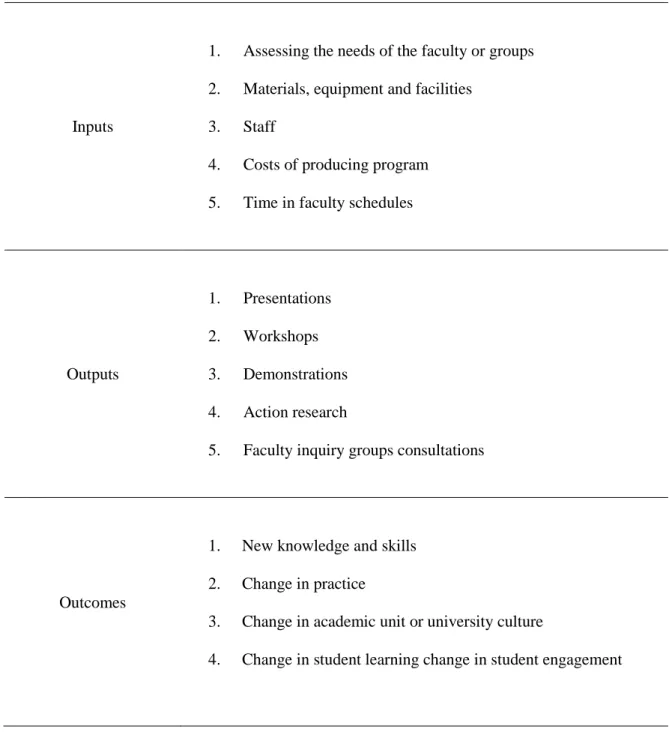
Building a plausible model of how the program is meant to work can help directors; staff and other stakeholders identify the most important processes or outcomes on which to focus their measurement and attention. The logic model provides a hypothesis of how the program is supposed to work in order to achieve the desired results (Fig. 2.1). Descriptions and examples of the use of logic models are found in Frechtling (2007) and Knowlton and Phillips (2009). Variations of the logic model are identified different names: “chains of reasoning,” “theory of action,” “performance framework,” and “logical framework” (McLaughlin & Jordan, 1999).
According to Chen (1990), program theory distinguishes how the program is understood to work and how the program actually works, and the theory should be both prescriptive and descriptive. The logic model and these variations are all names for what evaluators term “program theory” (McLaughlin & Jordan, 1999). Another example is the development of a faculty development program theory based on the mission of the center or the development of a logic model for each program. Logic models are useful for identifying projects that are critical to attaining goals or which have inconsistent or implausible linkages among program elements. Figure 2.1 depicts the logic model components that include inputs, activities, outputs, and impacts. Each of these components can also help centers communicate underlying assumptions about how their programs are expected to work and then situate faculty development within the organization if stakeholders are included in the development.
Figure 2.1 Logic Model
The hypothesis is that if assumptions about contextual factors remain correct and the program uses these resources with these activities, then it will produce these short-term outcomes for identified participants who will use them, thus leading to longer term outcomes (Frechtling, 2007). In order to check the validity of a logic model, the program logic can be described as a linked hypothesis and mapped graphically with a series of “if-then” statements about the program. Using an earlier example, if faculty members participate in a learning community for one semester, then they will be more collegial with participating colleagues. The validity of a program theory can also be tested through pattern matching, which is the idea that theoretical patterns can be compared with the observed pattern, and a strong match between the two
supports the theory. Yin (1989) described pattern matching as an important tool for the delivery and impact of a program.
Program theory can provide detailed information about the aspects of a program and identify what leads to success in order to replicate programs in new and varied settings (Hacsi, 2000); however, the program theory must be tested in order to fully accrue the benefits (Mark, 1990). According to Megdal et al. (2005), the problem with most educational interventions is that their efficacy is not firmly established, meaning that there is a lack of evidence that the intervention is effective. According to Weiss (2000), social science literature and the beliefs of program stakeholders are the two major sources of program theory. Both are credible sources as long as they are made explicit in terms of a specific program. One theory might develop based
Inputs/Res ources Activities/ Processes Outputs Short-term Outcomes Long-term Impacts
on the beliefs of stakeholders associated with the program; for example, participation in a learning community enhances collegiality.
Another theory might be based on plausibility; for example, if teachers learn Bloom’s taxonomy they will be able to design their own course using the taxonomy. Many faculty
development program developers may assume that providing information to program participants will lead to a change in their knowledge, and increased knowledge will lead to positive change in behavior. This theory is the basis for many faculty development programs. With so much effort expended in providing information in order to change behavior, careful investigation of this theory is warranted. Studies have shown that information can lead to change in knowledge and attitudes but rarely to change in behavior (Hacsi, 2000; Mark, 1990; Weiss, 2000). Young (1987) highlighted the fact that many program evaluations in higher education focus on describing the process and products of programs and very few systematically look at program goals in advance of implementing and assessing a program.
Using a methodological framework to interpret data is a critical tool in evaluation (Chen, 1990; Rogers, 2007). In addition to using a framework to interpret data, a framework may be used to plan and design the evaluation. For instance Wright (2011) utilized a matrix in which key evaluation questions are listed and the methods for answering each question are described as a means to evaluate the center’s impact on the university, faculty and student body. The
Metcalfe et al. (2008) study compared the evaluations of an education intervention, a needs assessment, and community education program in genetics counseling and thus provides a glimpse of the program theory of professional development. This study emphasized the diverse applicability of program evaluation.
More recent literature has described the importance of evaluating impact. For instance, Sarikaya et al. (2010) used program evaluation to determine the impact of faculty development on medical educators from clinical disciplines. They found that participants modified their teaching activities and that the faculty training programs did have long-term impact on the faculty, learning environment, and culture at their institutions. Stinson and Wilkinson (2004) used Dwyer’s (1996) logic model framework to plan, implement, and evaluate a clinical extern program, and they reported that the logic model allowed them to expand the program, increase the number of participants, and improve retention, while keeping patient safety a top priority. Armstrong and Barsion (2006) used an outcomes-logic-model approach to examine the impact on faculty members participating in a faculty development program. The researchers used structured telephone interviews and logic model pattern matching (McLaughlin & Jordan, 1999; Yin, 1989) as a tool to study how well the program mission and plan were implemented and whether outcomes had been attained. The researchers also examined outcomes such as greater use of active learning principles. Building and using a logic model provided a structure to examine the degree to which the desired outcomes, program delivery methods, and measurement approaches were aligned.
Felder and Brent (2010) described the design of an evaluation study to test the hypothesis that a three-day teaching workshop that had met once a year for 19 years met its goals. Institute goals were to improve participants’ teaching effectiveness, promote engagement in scholarly teaching and educational scholarship, and motivate participants to engage in instructional development on their home campuses (Felder & Brent, 2010). A web-based survey was
administered to alumni of the workshop to identify those factors in the workshop’s structure and delivery that might have contributed to its success. Data were interpreted using adult motivation
theory and revealed that the workshop did “motivate its participants to adopt or increase their use of proven teaching strategies known to correlate with improved student learning; made them more student-centered, scholarly, and reflective in their teaching practice; and induced many of them to engage in instructional development and educational scholarship” (Felder & Brent, 2010, p. 4).
Conceptual Framework
This study will address the experiences of program evaluators in faculty development by using Posavac’s (2011) evaluation planning process, which explains how evaluators can plan evaluation. Posavac’s (2011) evaluation planning process is a popular process in the evaluation field and is a conceptual framework used to train novice evaluators about the evaluation planning process. The process involves several steps.
The first step in the evaluation planning process is to review evaluation models. Posavac (2011) found that “one value of thinking about models lies in developing an appreciation of the range of questions evaluators can consider. The specific questions being addressed by an
evaluation or the specific aspects of the program setting often make one or another of the models especially useful” (p. 24). The second step in the evaluation planning process identifies the program to evaluate. Evaluators should obtain a complete program description because it
“makes a difference whether and evaluation is proposed for a new program or a well-established, whether the program is locally managed or offered at many sites and whether the program theory is well articulated or based on common sense” (p. 30). The third step identifies relevant
stakeholders; stakeholders include program personnel, program sponsors, and program clients. The fourth step in the process includes ascertains information needs. The evaluator should answer the following questions: “Who wants the evaluation? What should be the focus of the
evaluation? Why is the evaluation wanted? When is the evaluation wanted? What resources are available?” (p. 31). In addition, it is necessary to assess the evaluability of the program by constructing a logic model showing how the elements of the program lead to the expected changes in the program’s participants.
After the information needs are identified, the evaluator should examine the relevant literature before designing or developing new instruments so as to provide “a picture of the methodological, political, and practical difficulties” of in the field (p. 36). Evaluators should:
Keep several key questions in mind: In what ways is the program evaluated similar to the program being considered for evaluation? What research designs were used? What research designs were used? Can some of the measures of the outcome criteria be adapted? How reliable and valid were the measures? What statistical analyses were used? Is there a consensus among the reports? Are there are conflicting findings; are these conflicts due to different approaches to sampling, design, or interpretation? What issues were not addressed? (Posavac, 2011, p. 38).
The evaluation methodology should be planned, giving careful thought to how the evaluation is to be reported to stakeholders. Finally, the evaluation plan is written.
Although several evaluation planning process models exist in the literature, Posavac’s (2011)model is an appropriate choice for this study. The steps described above provide a framework for analyzing the process evaluators engage in when they evaluate various programs in faculty development (i.e. workshops, one-on-one consultations, and learning communities). Posavac’s (2011)evaluation planning process model is particularly useful in this study as each
faculty development program has different goals related to a theory of change; therefore, activities, objectives, and processes are possibly quite different on every college campus. The model offers a systematic way to examine the process in which evaluators engage.
While ideally all evaluators in this study would evaluate programs according to the Posavac’s (2011)model, evaluators may not necessarily utilize each step. Evaluators may engage or emphasize various steps and in different order by programs. However, the model still provides an appropriate lens through which to view this study and the proposed research
questions.
Chapter Summary
Although most faculty development professionals value the importance of monitoring their programs’ impact, systematic evaluation is still not common and often relies on inference measures such as extent of participation and satisfaction (Krebera & Brook, 2001). Evaluation models, outcome logic models, and program theory are rarely reported in evaluation of faculty development literature. Very few describe alignment of focus (i.e., consultations, workshops) with the desired change; the intervention strategies used to bring about such change, as well as the mission of the center and university exist in the literature. However, the theory about how and why the program works or should work must be explicit so that other centers may benefit. Suggestions for improved program evaluation in faculty development include selecting appropriate data sources, stakeholder involvement, and including context in the evaluation (Wright, 2011). Improvements or impacts relevant to the theory of change are often implicit in the evaluation studies reported in the literature. However, explicit program theories of
professional development are absent from medical literature. Recent faculty development evaluation studies have focused on particular intervention strategies and include evidence that
these programs are having an impact on their participants and/or institutions, but they do not offer a definitive model of the program theory or evaluation framework (Armstrong & Barsion, 2006; Cilliers & Herman, 2009; Felder & Brent 2010; Krebera & Brook 2001; Wright, 2011).
Chapter 3 Methods Introduction
This chapter introduces and describes the methods and procedures that are used to conduct this study, including the methods used to explore evaluator perceptions of the processes they engage in when evaluating faculty development programs; their use of program theory; and the evaluation models they use to design faculty development program evaluations. Three research questions identify the objectives of the study.
Research Questions Three research questions guided this study:
1. What process do evaluators engage in when they evaluate various programs in faculty development?
2. To what extent and how do evaluators link evaluations to short-, medium-, and long-term outcomes?
3. To what extent and how do evaluators use standard evaluation models in faculty development?
Study Design and Rationale
Hines (2011) indicated that an in-depth study using qualitative methodology is necessary to gain further insight into assessment at faculty development centers. Hence, the focus of this study is to understand and describe the evaluation processes and methods used by evaluators involved in faculty development. Qualitative research allows the researcher, as well as readers and participants, to interpret results and advance understanding. Qualitative research is also interpretative research (Creswell, 2007); therefore, this study on perceptions of evaluation in
faculty development centers does not stipulate an approved method for how program evaluation should be conducted in faculty development. Instead, it is a study of evaluators’ perceptions of how they conduct evaluation of faculty development programs. Using a qualitative method allows for the exploration and description of the evaluation processes at faculty development programs and takes into account the program theories and models that have been applied. The topic of program evaluation, including the research questions raised, lends itself to a qualitative approach.
Maxwell (1996) outlined five areas that are suitable in qualitative studies, and each area is consistent with the overall focus of this study. The first area involves understanding the participants’ perspectives; a review of faculty development reveals that much of the research on faculty development did not investigate program evaluation from the perspective of the
evaluators’ experiences, and this study will explore those perceptions. Second, qualitative research augments understanding the context of the participants’ experiences and how this context affects their actions. In addition, the literature often describes evaluations of particular intervention strategies but does not help us understand the context of the participants; this study will illuminate the evaluation process within the context of faculty development. Third, the researcher can discover new or unplanned occurrences that can lead to new theories or areas for future study. Fourth, qualitative studies assist in understanding the process of how the events and actions of the participants take place; this study focuses on the process rather than the outcome, hence the need for a qualitative design. Last, qualitative research is useful in developing causal explanations or logic for how events and different process can lead to particular results.
This study employed a qualitative descriptive design and, while exploring the
phenomenon of program evaluation in faculty development centers that employ evaluators, the researcher gained an understanding of the process the participants engage in when they evaluate programs in faculty development from knowledgeable representatives of each organization.
Participants
Criterion sampling is a purposive method for picking all cases that meet some criterion (Patton, 1990) and was used to find participants for this study. Eligible participants met two criteria: (a) responsible for evaluation and assessment in faculty development, and (b) employed by a center established for five years or longer. Using a purposive criterion sampling strategy, a search of the sixty-five faculty development centers found on the Professional and
Organizational Development in Higher Education (POD) website revealed only seven faculty development centers employing program evaluators. All seven centers were invited to participate in this study.
The evaluators were initially contacted by email (Appendix B), which conveyed the nature of this research project, how each potential participant was identified, and the
confidentiality of the research. Three evaluators immediately responded by email and agreed to participate. Another evaluator who responded did not meet the criteria for this study. Three potential participants did not respond to any of three email invitations to participate in this study. The third email attempt was followed by a telephone call that left a short message describing the study and inviting each of the three evaluators to participate in this study; none of these contacts elicited a response.
Program evaluation in faculty development is a new phenomenon, and it is uncommon to find a large number of full-time employed evaluators at faculty development centers. Due to the
low participation response, snowball sampling was used to identify additional participants engaged in conducting evaluation and assessment in faculty development. The snowball
sampling method requires identifying people who may know anyone who could be a good source (Patton, 1990). Each of the participating evaluators was asked if he or she knew of other
evaluators in faculty development; this yielded five evaluators who were invited by email to participate in this study. Four responded immediately by email and agreed; one participant did not respond, and there was no response to a follow-up telephone call.
Centers and Participants
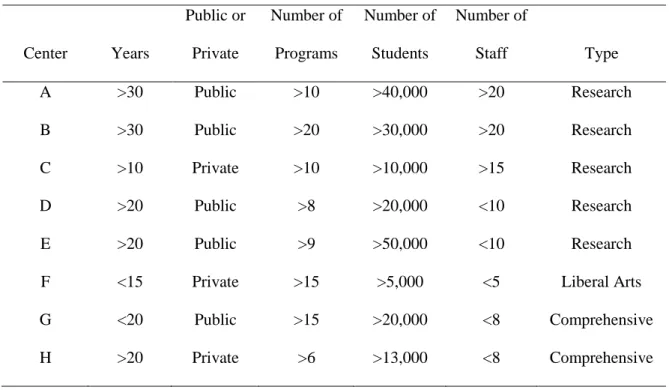
Eight program evaluators, from eight different faculty development centers, participated in this study. Descriptions of each center and each participant’s background are provided. All of the centers and evaluators were assigned pseudonyms to protect their anonymity. Therefore, some details about the evaluators were not included in the description. For example, providing educational disciplines for each of the evaluators may identify participants due to the small number of faculty development evaluators. The demographics of the faculty development centers, and data regarding the number of students attending the university, institution type, and the number of programs and staff supported by the centers was also identified.
Centers
Center A is situated in a public university in the Western Pacific region of the United States. The university has an enrollment of over 35,000 students, of whom 64% are
undergraduates and 36% are graduate students. The Center employs approximately 24 staff members and promotes 10 instructional development programs, as well as a variety of smaller short-term programs. The center serves approximately 4,000 faculty members, graduate student instructors, graduate students (including non-teaching), postdoctoral faculty and administrators
each year. The mission of the Center is to support the instructional mission of the university and enhance teaching and learning opportunities on campus.
Center B is situated in a public university, also in the Western Pacific region of the United States. The university has an enrollment of over 37,000 students, 69% of whom are undergraduates and 31% graduate students. The Center employs approximately 15 staff members, promotes major programs, and serves approximately 4,000 faculty members,
instructors; graduate teaching assistants, graduate students, and postdocs each year. The mission of the Center is to promote teaching practice grounded in pedagogical scholarship.
Center C is situated in a private research university within the Midwestern region of the United States. The university has an enrollment of over 16,000 students, divided between 51% undergraduate and 49% graduate students. The Center employs approximately 16 staff
members, promotes 14 instructional development programs, and offers many other programs addressing undergraduate student teaching and learning. The mission of the Center is to provide professional development experiences that enhance the academic culture and encourage
innovation and excellence in teaching.
Center D is situated in a public research university within the Eastern region of the United States. The university has an enrollment of close to 23,000 students, of whom 68% are undergraduates and 36% are graduate students. The Center employs approximately nine staff members, promotes eight instructional development programs, and serves tenured and non-tenured faculty members, instructors, graduate teaching assistants, graduate students, and postdocs each year. The mission of the Center is to implement teaching innovations and best practices and promote understanding of the learning process on the university campus.
Center E is situated in a public research university in the Midwest. It has an enrollment of over 60,000 students consisting of 89% undergraduates and 20% graduate students. The Center employs approximately nine staff members, promotes 13 instructional development programs and is available to anyone who teaches at the university, approximately 7,500 people; however, the Center actually serves about 2,000 individuals each year. The mission of the Center is to promote academic excellence on the university campus and contribute to local, national, and international conversations about faculty development.
Center F is situated in private liberal arts university in the South. The university has an enrollment of about 6,000 students, with 88% of them being undergraduates and 12% being graduate students. The Center employs approximately five staff members, promotes 10 instructional development programs, and serves approximately 700 faculty members and instructors each year. The mission of the Center is to promote excellence and innovation in teaching on the university campus.
Center G issituated in a public comprehensive university within the Eastern region of the United States. The university has an enrollment of about 20,000 students, consisting of 91% undergraduate and 9% graduate students. The Center employs approximately five staff members, promotes 15 instructional development programs, and serves approximately 1,700 instructional faculty members each year. The mission of Center is to assist all the university’s teachers to excel.
Center H is situated in a private comprehensive university in the South. The university has an enrollment of approximately 13,000 students, almost evenly divided between
undergraduate students (52%) and graduate students (49%). The Center employs approximately eight staff members, promotes eight instructional development programs, and serves
approximately 1,200 instructional faculty members each year. The mission of the Center is to promote understanding of the teaching and learning process, cultivate dialogue about teaching and learning, and create and disseminate best practices in teaching and learning.
Table 4.1 below, provides a snapshot of the demographics of each faculty development center, and data regarding the number of students attending the university, institution type, and the number of programs and staff supported by the centers.
Table 3.1 Demographics of Faculty Development Centers Center Years Public or Private Number of Programs Number of Students Number of Staff Type A >30 Public >10 >40,000 >20 Research B >30 Public >20 >30,000 >20 Research C >10 Private >10 >10,000 >15 Research D >20 Public >8 >20,000 <10 Research E >20 Public >9 >50,000 <10 Research
F <15 Private >15 >5,000 <5 Liberal Arts
G <20 Public >15 >20,000 <8 Comprehensive