Efficient Transaction Processing for
Short-Lived Transactions in the
Cloud
bySharon Choy
A thesis
presented to the University of Waterloo in fulfillment of the
thesis requirement for the degree of Master of Mathematics
in
Computer Science
Waterloo, Ontario, Canada, 2013
c
I hereby declare that I am the sole author of this thesis. This is a true copy of the thesis, including any required final revisions, as accepted by my examiners.
Abstract
The cloud, in the past few years, has become the preferred platform for hosting web applications. Many of these web applications store their data in a distributed cloud storage system, which greatly simplifies application development and provides increased availabil-ity and reliabilavailabil-ity. However, with increasing user demand for web applications, these cloud storage systems often become the performance bottleneck. To address the cloud’s performance demands, many storage system features, such as strong consistency and trans-actional support, are often omitted in favour of performance. Nonetheless, transactions remain necessary to ensure data integrity and application correctness.
In this thesis, we introduce CrossStitch, which is an efficient transaction processing framework for distributed key-value storage systems. CrossStitch supports general trans-actions, where transactions include both computation and key accesses. It is specifically optimized for short-lived transactions that are typical of cloud-deployed web applications. In CrossStitch, a transaction is partitioned into a series of components that form a trans-action chain. These components are executed and the transtrans-action is propagated along the storage servers instead of being executed on the application server. This chained structure, in which servers only communicate with their immediate neighbours, enables CrossStitch to implement a pipelined version of two-phase commit to ensure transactional atomicity. CrossStitch is able to eliminate a significant amount of setup overhead using this structure by executing the transaction and the atomic commit protocol concurrently. Therefore, CrossStitch provides low latency and efficient transactional support for cloud storage sys-tems. Our evaluation demonstrates that CrossStitch is a scalable and efficient transaction processing framework for web transactions.
Acknowledgements
Firstly, I would like to thank my supervisor Prof. Bernard Wong for his guidance, support, and patience during the course of my Master’s degree program and in the prepa-ration of this thesis. I would also like to thank my thesis readers Prof. Ken Salem and Prof. David Taylor. I greatly appreciate their helpful comments and feedback as their insight has allowed me to significantly improve the quality of this thesis. I am thankful for Xiaoyi Liu who helped me with the experimental evaluation of CrossStitch. Furthermore, I am grateful for the friendships that I have formed with all the members of the Shoshin Lab. I am blessed to have such caring and supportive brothers and sisters at Kitchener-Waterloo Chinese Alliance Church. Finally, I am forever thankful and grateful for my family (my mother - Marie Choy, my father - Robin Choy, and my brother - Ehren Choy) as their unconditional love and encouragement have brought me here today.
Dedication
“So whether you eat or drink or whatever you do, do it all for the glory of God.” - 1 Corinthians 10:31 (NIV)
Table of Contents
List of Figures ix
1 Introduction 1
1.1 Towards a Framework for Supporting Short-Lived Transactions in the Cloud 2
1.1.1 Characteristics of Transactions in Web Applications . . . 2
1.1.2 Requirements for a Transaction Processing System . . . 3
1.2 CrossStitch: An Efficient Transaction Processing Framework for Short-lived Transactions . . . 4
2 Background and Related Work 8 2.1 Transactions . . . 8
2.1.1 Motivation for Transactions . . . 9
2.1.2 Existing Transaction Processing Systems . . . 10
2.1.3 Multi-phase Atomic Commit Protocols . . . 11
2.2 Existing Cloud Storage Systems . . . 13
2.2.1 Storage Models . . . 14
2.2.2 Consistency Models . . . 14
2.2.3 Providing Reliability . . . 15
2.3 Existing Distributed Transaction Systems . . . 15
2.3.1 Commercially Available Systems . . . 16
2.3.3 Using Shared Memory to Provide Transactional Support . . . 17
2.3.4 Snapshot Isolation and Timestamp-Related Mechanisms . . . 18
2.3.5 Transaction Coordination Systems . . . 19
2.3.6 Separating Transaction Processing from the Database . . . 19
3 CrossStitch: An Efficient Transaction Processing Framework for Web Applications 22 3.1 Basics of a CrossStitch Transaction . . . 22
3.1.1 Implementing a Transaction . . . 22
3.1.2 CrossStitch Timestamps . . . 23
3.1.3 CrossStitch Concurrency Control . . . 24
3.1.4 Timestamp Related Abort Cases . . . 24
3.1.5 Non-timestamp Related Abort Cases . . . 26
3.1.6 CrossStitch’s Supported Operations . . . 27
3.2 An Example Transaction . . . 28
3.2.1 Launching and Running a Transaction . . . 30
3.2.2 Basic Messaging Chain . . . 31
3.2.3 CrossStitch Messages . . . 33
3.3 Managing the Transaction on the Server . . . 34
3.3.1 Server Configuration . . . 35
3.3.2 Maintaining State Machines . . . 35
4 Liveness and Safety 39 4.1 Liveness Properties . . . 39
4.1.1 Liveness Properties of the Server . . . 39
4.1.2 Liveness Properties of the Client . . . 46
4.2 Safety Properties . . . 47
4.2.1 Providing Isolation . . . 47
5 Handling Failures 51
5.1 Timeout Mechanisms . . . 52
5.2 Failure Model . . . 52
5.2.1 Client Failure . . . 53
5.2.2 Intermediate Server Failure . . . 54
5.2.3 End Server Failure . . . 59
5.2.4 End Replica Server Failure . . . 63
6 Evaluation 66 6.1 Experimental Setup . . . 66
6.2 Contention in CrossStitch . . . 67
6.3 Transactional Latency in CrossStitch . . . 70
6.4 Scalability of CrossStitch . . . 73
6.5 CrossStitch for Geographically Distant Servers . . . 74
7 Conclusion 76
List of Figures
3.1 An Example Transaction . . . 28
3.2 An Example Transaction’s Implementation. . . 29
3.3 Instantiating a CrossStitch Client . . . 30
3.4 API Call to Start a Transaction . . . 30
3.5 Creating and Launching a Transaction . . . 31
3.6 CrossStitch’s Messaging Pattern . . . 32
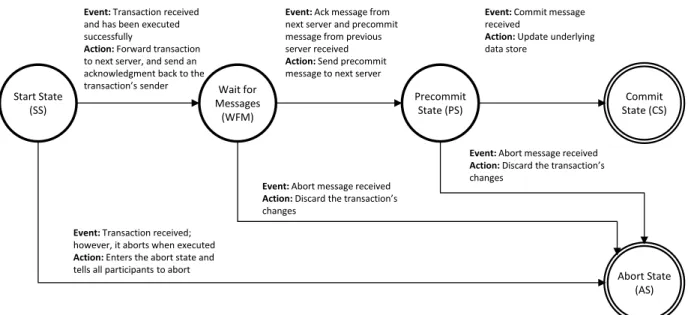
3.7 Intermediate Server’s State Machine. . . 37
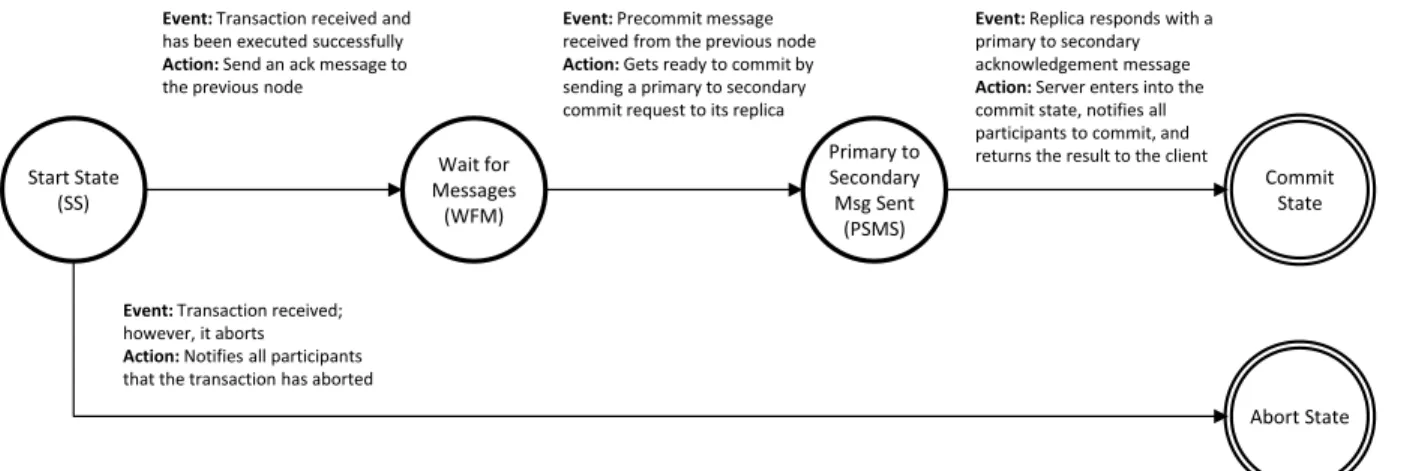
3.8 End Server’s State Machine . . . 38
4.1 Server State Transition from the SS to the WFM . . . 40
4.2 Server State Transition from PSMS to CS . . . 41
4.3 Server State Transition from WFM to PSMS . . . 42
4.4 Server State Transition from WFM to PS . . . 43
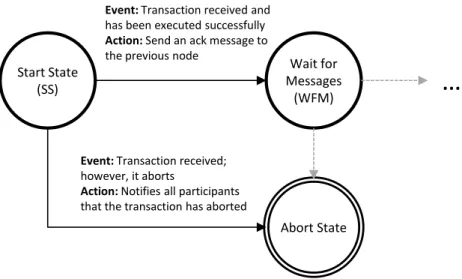
4.5 Server State Transition from SS to WFM . . . 44
4.6 Client State Machine . . . 46
4.7 Server State Transition from PS to CS . . . 48
5.1 Client Failure: Case 1. . . 53
5.2 Client Failure: Case 2. . . 53
5.3 Client Failure: Case 3. . . 54
5.5 Intermediate Server Failure: Case 1 . . . 55
5.6 Intermediate Server Failure: Case 2 . . . 55
5.7 Intermediate Server Failure: Case 3 . . . 55
5.8 Intermediate Server Failure: Case 4 . . . 56
5.9 Intermediate Server Failure: Case 5 . . . 56
5.10 Intermediate Server Failure: Case 6 . . . 57
5.11 Intermediate Server Failure: Case 7 . . . 57
5.12 Intermediate Server Failure: Case 8 . . . 57
5.13 Intermediate Server Failure: Case 9 . . . 58
5.14 Intermediate Server Failure: Case 10 . . . 58
5.15 Intermediate Server Failure: Case 11 . . . 59
5.16 End Server Failure: Case 1 . . . 59
5.17 End Server Failure: Case 2 . . . 60
5.18 End Server Failure: Case 3 . . . 61
5.19 End Server Failure: Case 4 . . . 62
5.20 End Server Failure: Case 5 . . . 62
5.21 End Server Failure: Case 6 . . . 63
5.22 End Server Replica Failure: Case 1 . . . 64
5.23 End Server Replica Failure: Case 2 . . . 64
5.24 End Server Replica Failure: Case 3 . . . 65
6.1 Number of Successful Transactions versus the Number of Concurrent Threads 69 6.2 Number of Successful Transactions versus Alpha Value . . . 69
6.3 Number of Successful Transactions versus the Percentage of Reads . . . 70
6.4 Transaction Completion Time versus Number of Threads . . . 71
6.5 Transaction Completion Time versus Alpha Value . . . 72
6.6 Transaction Completion Time versus Percentage of Reads. . . 72
6.8 Throughput versus Number of Servers . . . 74 6.9 Latency versus Chain Length . . . 75
Chapter 1
Introduction
In recent years, web applications have emerged as a popular alternative to traditional client-side applications. The rise in popularity of web applications is partially due to the pervasiveness and availability of web browsers, which greatly reduce the barrier to deploying web applications by eliminating the need to download a separate application binary. Users are able to access web applications without concerning themselves with security patches or software upgrades. Web applications offer end-users platform independence as they can be deployed on any web browser and also on any computer. Their popularity has resulted in a demand for highly scalable infrastructure that is able to service a large number of concurrent users. Furthermore, these applications must serve client requests quickly as previous studies [11] have demonstrated that even a small increase in access latency can significantly reduce the user traffic volume.
The scalability and performance requirements of web applications have made the cloud the preferred application hosting platform for most developers. Web applications running in the cloud can quickly increase their resource allocation, which can be used to run additional web or application servers, to handle increased client demand. However, these applications may still experience scalability problems when accessing and updating shared data in a cloud storage system. For example, the storage mechanism responsible for hosting a shopping cart application must remain highly available and allow consumers to add and remove items efficiently. As a result, many NoSQL systems, which provide their end users with simple key-value interfaces, have been developed in response to the need for high scalability and performance. These storage systems trade off rich functionality in favour of performance. For example, features such as strong consistency, which ensures that all replicas are up-to-date, are often omitted. This concession is made in order to improve performance for applications that can accept weaker consistency models.
In addition to the omission of a strong consistency model, many cloud storage systems also lack support for general transactions. Distributed transactional support has tradi-tionally been complicated and expensive due to the coordination that is required between different servers. The required coordination results in many message round trips between participating servers. Therefore, providing transactions results in additional system com-plexity that hinders performance. Nonetheless, transactions remain critical for many web applications because they are needed to ensure the correctness of the application and the integrity of the storage system. Currently, since many commercially available NoSQL systems do not offer support for transactions, most applications requiring transactions implement transactional support at the application layer; thus, the burden of providing transactions rests on the application developer. This method for providing transactions is error prone since the application’s implementation may be done poorly, inefficiently, or in an ad-hoc manner. Alternatively, developers may use existing cloud storage systems that provide transactional support; however, these systems have significant limitations. For example, some systems (e.g., [12]) require that all key accesses be within a certain range. Other systems may experience significant latency for certain operations. For example, Megastore [9] has a write latency of 100ms-400ms, whereas its read latency is in the tens of milliseconds.
1.1
Towards a Framework for Supporting Short-Lived
Transactions in the Cloud
We consider characteristics of typical transactions found in web applications in order to build an efficient transaction processing framework. Moreover, we need to consider the performance requirements for hosting such a framework in the cloud.
1.1.1
Characteristics of Transactions in Web Applications
Most web transactions exhibit the following properties:
• Web transactions are short-lived: A typical web transaction must complete quickly (i.e., on the order of milliseconds). These transactions generally access and update only a few items in the datastore. Consider the example of an e-commerce web application where a buyer wishes to purchase an item from the seller. A transaction is necessary for the payment of the items to ensure that a debit can occur (i.e., the
buyer has enough funds to purchase the item) and that the seller’s account is credited. Because a web transaction is short-lived, the overhead in setting up the transaction may account for a significant fraction of the transaction’s execution time. Therefore, a transaction processing system for web transactions should aim to minimize this overhead.
• Most web transactions are executed sequentially: Many key accesses in a web transaction depend on the current state of the application or on computation that depends upon the result of previous key accesses. We consider an application that adds interest to a bank account. The application must first retrieve the account type and country of residence in order to determine the interest rate. Afterwards, the application obtains the current account balance, calculates the new balance, and writes the new value into the datastore. Another example is a data indexing application that uses transactions to ensure data consistency and integrity. In this application, an index is keyed on a secondary data attribute, called the secondary key, and each index entry contains the primary keys of data items that share the same secondary key. Accessing a data item using an index requires an index lookup followed by at least one primary key lookup. These lookups are dependent on each other and must be performed sequentially. Therefore, a transaction processing system for web applications must efficiently support transactions that execute sequentially and determine their key accesses dynamically rather than at the start of the transaction. • Web transactions may request data that is distributed across many dat-acenters: Client data may be partitioned and distributed across multiple dat-acenters. Therefore, a transaction processing framework must be able to handle transactions that span more than one datacenter. Additionally, application servers and storage servers may be geographically distant from each other, or they may be in different parts of the same datacenter network; thus, these servers may experience additional latency when communicating with each other. Therefore, a transaction processing framework should also minimize the number of round-trips between dis-tant servers.
1.1.2
Requirements for a Transaction Processing System
In addition to considering the characteristics of web transactions, a transaction processing system must also account for the cloud’s performance requirements. Firstly, it must be scalable and handle workloads that are typically found in a web application. These work-loads include serving many end-users concurrently. Existing commercial databases (e.g.,
[3,5,6]) require a coordinator to setup and finalize a transaction. The use of a transaction coordinator often results in a bottleneck at a single node, which could hinder the scalabil-ity of a transactional system. Therefore, an efficient transaction processing system should ideally avoid having a centralized coordinator.
Secondly, a transaction processing framework needs to be highly available, as a service outage can result in a significant loss of revenue for the application developer. Therefore, such a system must be able to handle node failures and its transactions must be able to make forward progress (i.e., determine if the transaction needs to commit or abort) despite the presence of such failures. In traditional database systems, servers detect failures and ensure that a transaction does not make forward progress in the event of a failure. More-over, data is synchronously written into persistent storage in order to provide durability, which enables data to be retrieved and the failed server to recover. In these systems, data may not be replicated across multiple servers. Although such a system provides durability, it does not provide high availability as a transaction will need to wait for a failed server to recover. Conversely, NoSQL systems use replication as an alternative to synchronous writes, which eliminates the waiting time required for data to be written to persistent storage. Most cloud storage systems provide high availability and reliability through repli-cation and do not provide durability through synchronized writes to persistent storage. Therefore, a transaction processing framework that is hosted in the cloud should provide similar reliability and availability guarantees as cloud storage systems.
Lastly, a transaction processing framework must be able to provide low latency for its end-users since latency significantly affects end-user experience. As stated in [11], a latency that is greater than 100ms may cause a customer to seek alternative service providers. Since the transaction processing framework is deployed in the cloud, we may need to consider a scenario where the application server is geographically distant from the datacenter that hosts the storage servers. In traditional transactional systems, there is substantial communication between the application server and storage servers. Therefore, if application servers and storage servers are geographically distant from each other, there may be significant delay in completing the transaction.
1.2
CrossStitch: An Efficient Transaction Processing
Framework for Short-lived Transactions
In this thesis, we introduce CrossStitch, which is an efficient transaction processing frame-work for distributed key-value storage systems that is optimized for web transactions.
CrossStitch supports general transactions for key-value stores, where transactions include computation and key accesses. CrossStitch transactions do not require the transaction writer to know all key accesses prior to the execution of the transaction. Moreover, key requests do not have any restrictions on their physical location or on any other character-istic. For example, CrossStitch key requests are not limited to a single node or a single datacenter, whereas other systems such as G-Store [20] require all keys to reside on a single node.
CrossStitch introduces a novel execution method where a transaction is partitioned into a series of components that form a chain. These components are executed on storage servers instead of application servers. The transaction comprises a series of components that form a chain and is propagated from server to server. Each CrossStitch component is characterized by a key request and application-defined computation. Each component also takes in as a parameter the result of the previous component as an input parameter. For each occurrence of a key request, the execution transitions from one component to another. And during each transition, the key request and the transaction’s implementation code is delivered to the key’s storage server and executed.
In a traditional transaction processing system, clients (e.g., application servers) are responsible for registering the transaction with a transaction coordinator, for issuing key requests to servers, and for notifying the transactional coordinator once the transaction has completed all of its key requests and is ready to commit. Unlike a traditional transaction processing system, a CrossStitch client is not responsible for requesting every key access from remote servers and performing the computation. Instead, a CrossStitch client sends its transaction to the server that hosts its first key access. Afterwards, each CrossStitch server executes a single component in the transaction chain and forwards the transaction to the next server that is responsible for the key request. The final server sends the result to the client. As a result, CrossStitch eliminates multiple round trips between the client and servers. Therefore, since there may be significant delay between application and storage servers due to geographical distance, CrossStitch is able to reduce the amount of latency that is normally incurred by traditional transaction processing systems.
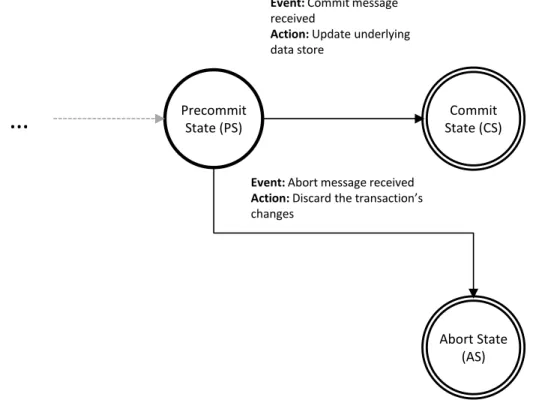
By having a chained structure for a CrossStitch transaction, we can perform additional optimizations such as pipelining the traditional two-phase commit protocol and eliminating the need for a transaction coordinator. Upon receiving a transaction, each CrossStitch server executes its assigned component and queries the previous server (or the client) in the transaction chain to determine if the previous server can commit. If a CrossStitch server can confirm that the previous server can commit and that the next server has received the transaction, it enters a precommit state, which indicates that it is ready to commit. When the final server completes the transaction, it notifies all participating servers to commit the
transaction’s operations. By performing the two-phase commit protocol in line, CrossStitch introduces minimal latency to the transaction’s execution.
We show the liveness and safety properties of CrossStitch’s pipelined two-phase commit protocol by providing an exhaustive enumeration of execution states. We first consider the case where there are no server failures in a CrossStitch transaction chain. We show that a CrossStitch transaction always progresses to completion when there are no server failures. We further extend this argument to show that a CrossStitch transaction terminates in the presence of a single server failure. This thesis makes three contributions:
• Low-latency for cross-datacenter transactions: CrossStitch’s execution pat-tern eliminates the use of a transaction coordinator and thereby eliminates the setup overhead that occurs in a traditional transaction. Moreover, CrossStitch’s chained-message structure reduces messaging between application servers and storage servers. By eliminating setup overhead and reducing the number of messages, we can signifi-cantly reduce the latency of transactions. These performance improvements are sig-nificant in an environment where a transaction spans multiple, geographically-distant servers.
• Pipelined two-phase commit: CrossStitch introduces a pipelined two-phase commit protocol for ensuring the atomicity of a transaction. This protocol eliminates the requirement of a separate coordinator and it executes concurrently with the transaction. As a result, it provides CrossStitch with lower latency when completing a transaction.
• Liveness and safety properties of CrossStitch’s protocol: We demonstrate that CrossStitch transactions, even in the presence of a single server failure, offer liveness. In other words, all CrossStitch transactions either commit or abort. More-over, we show the safety of CrossStitch’s pipelined two-phase commit protocol by demonstrating that it provides atomicity.
In our deployment, we find that CrossStitch is efficient and scalable. As expected, our experimental results demonstrate that the time to complete a transaction scales linearly with the chain length. Similarly, the number of concurrent threads also scales linearly with a transaction’s completion time. We also find that by increasing the number of CrossStitch servers, CrossStitch is able support more clients. Our experiments show that a single client requires 14 ms to complete a transaction with five key accesses. We also find that CrossStitch provides significant latency improvements when a transaction accesses geographically distant servers. For a transaction with eight key accesses, we find that using
CrossStitch can provide up to a 39% improvement in latency over a traditional transaction processing system. Therefore, by offering an efficient and low-latency alternative to current transaction processing systems, CrossStitch has the potential to radically change how we perform transaction processing for web applications in cloud storage systems.
Chapter 2
Background and Related Work
In this chapter, we provide the background and motivation for CrossStitch. We further explore existing transaction processing systems and the mechanisms they use to provide transactional properties. Moreover, we look at current distributed storage systems and the motivation for their design and creation. We also describe the challenges that are present when providing transactions in modern cloud storage systems. Lastly, we explore current NoSQL transactional systems.
2.1
Transactions
As defined by Jim Gray [25], a transaction is a collection of operations on the physical and abstract application state that have the following (”ACID”) properties:
• Atomicity: All of the transaction’s operations and changes are applied, or none of the operations are applied.
• Consistency: A transaction does not violate any system invariants.
• Isolation: Transactions that execute concurrently appear to be executed sequen-tially.
• Durability: Once a transaction completes successfully or commits, the changes that it made persist in the event of a failure.
ACID properties for transactions are essential in ensuring application correctness. They ensure that all operations within a single transaction either complete or fail, that system invariants are not violated, and that the execution of a transaction appears to be in isolation from other transactions.
2.1.1
Motivation for Transactions
Transactions are desirable in many applications since they help ensure application correct-ness. A banking transaction is a canonical example that demonstrates how transactions can help to provide application correctness. Suppose one client wishes to transfer funds to another client. Atomicity is critical since one must ensure that the entirety of the transac-tion’s operations are either executed or not executed. In particular, incorrect application behaviour would include debiting one account without crediting another account. Further-more, a system invariant might include that a client’s account balance cannot be negative. An application developer can use transactions to make certain that all system invariants are not violated. Furthermore, isolation is necessary to ensure that transactions accessing other accounts do not affect the correctness of our example. Lastly, once the transaction completes, durability is required to guarantee that changes to the clients’ bank account persist in the event of failures.
In addition to the example banking transaction, many web applications can benefit from having transactions. As many web transactions are short and sequential in nature, a framework that provides low overhead when executing transactions is valuable. Further-more, such a framework can contribute to ensuring application correctness. For example, ticket purchasing applications need to ensure that they do not double book patrons into the same seat and that the correct admission amount is transferred between the patron and seller. Moreover, many online games are deployed as web applications and many of these games involve purchasing in-game items or trading items among players. In order to achieve fair game play, transactions are necessary to ensure that no items are lost or inad-vertently gained. Auction systems also require transactions as they need to ensure that the highest bid wins and that the correct amount is debited from the buyer and credited to the seller. We can imagine that any application that involves finances can benefit from having transactions, as transactions ensure that there is no loss of money, or unearned gain of money, for all parties involved. In addition to financial applications, any application that needs to ensure correctness of an operation can benefit from a transaction. For example, an internal messaging system, such as those found in social networking sites or business accounts, needs to ensure messages have been sent and received by the intended parties.
2.1.2
Existing Transaction Processing Systems
The focus of the cloud is to provide high scalability and reliability for its users. As a result, client data may be replicated at many locations or client data is sharded over various servers to provide reliability. Partitioning of data is necessary to ensure that the cloud is able to handle high volumes of data and client requests. Consequently, there is a need for distributed transactions in order to correctly operate upon client data. We define a distributed transaction to be a collection of operations that have ACID properties and are executed on more than one server. A common distributed transaction processing standard is the X/Open transaction processing model [4]. In this model, there are three primary components in a distributed transaction system: the application, the transaction manager, and resource managers. An application is responsible for defining a transaction’s set of operations. An application may partition its work, such as retrieving data, into multiple client-server requests. However, transactions found in web applications typically consist of a single client that wishes to obtain information from various servers. As a result, we model an application as a single client that performs key accesses. Intuitively, a transaction program is implemented using the following steps:
• Begin the transaction: Upon beginning a transaction, the client contacts a trans-action coordinator/manager to arrange timestamps and identifier.
• Execute the transaction’s operations: The client contacts resource managers to access necessary resources.
• Verify the transaction is successful: Upon completion of all key accesses, a trans-action manager or coordinator determines if all parties involved in the transtrans-action can commit. If so, we commit the transaction.
• Abort the transaction if necessary: If one or more participants, such as resource managers, are unable to commit, the transaction manager or coordinator aborts the transaction.
When beginning a transaction, the application registers the transaction with the trans-action manager in order to obtain a unique transtrans-action identifier. In addition to providing transaction identifiers, a transaction manager is responsible for monitoring the transaction and determining if a transaction can commit or abort. After the transaction has begun, the application requests resources from the resource manager. A resource manager provides access to resources such as databases and is also responsible for ensuring that ACID prop-erties are provided. Upon a resource request from an application, the resource manager
notifies the transaction manager that it is participating in the transaction. Consequently, the aforementioned resource manager participates in the decision of whether or not the transaction will commit or abort.
In order to ensure that transactions occur in isolated environments and that they do not conflict with each other, transactional systems need to employ concurrency control mechanisms. Many systems employ locking to ensure that only one transaction accesses a data object at any given time and to prevent other transactions from seeing uncommitted updates. In order to manage locks across distributed resources, a lock manager must be provided to resource managers in order to provide isolation. Although locks can be used to provide isolation, the transaction processing system’s performance can significantly degrade if there is contention for resources. An alternative to locking is to use optimistic concurrency control. This model relies on the assumption that most transactions do not conflict with each other. However, in order to detect conflicts, an optimistic concurrency control scheme depends on a validation phase in order to determine if a transaction can commit. In the event of a conflict, the transaction is required to abort and the state of the system needs to be rolled back. An example of an optimistic concurrency control mechanism is multi-version timestamp ordering where many versions of a data object are maintained in order to provide a consistent view of data at a given time.
In addition to providing a lock manager, a transactional framework must also provide a log manager in order to ensure a consistent view of the system in the event of a failure. A log manager is responsible for recording all changes made by transactions; thus, it is able to reconstruct the system’s state upon restarting, should a component of the system fail. The use of a log manager assumes that data is stored on one server; therefore, logs are required to reconstruct a server’s state. However, in the case of NoSQL stores, reliability is provided through the existence of many replicas.
Once all of the resource managers have completed the application’s requests, the trans-action manager queries them to determine if the transtrans-action is consistent and complete. In many systems, a multi-phase atomic commit protocol is employed to determine if there is a consensus among all participating resource managers. The transaction manager acts as the coordinator in two-phase commit and the resource managers are the participants.
2.1.3
Multi-phase Atomic Commit Protocols
Multi-phase atomic commit protocols are responsible for notifying all participants (resource managers) to commit or abort a transaction. If all participants in the transaction agree to commit a transaction, then the changes made by the transaction are applied locally on
the resources. Otherwise, if one or more participants decide to abort the transaction, then none of the transaction’s changes are applied
Two-phase Commit
In order to determine if all participants are able to commit, many systems employ the two-phase commit protocol, which consists of a voting phase and a commit/abort phase. We describe the phases and the messages that are sent between the participants and co-ordinator using terminology similar to [36]. In the first phase, the coordinator will send a
vote request to all participants in the transaction. Upon receipt of avote request, a partic-ipant replies to the coordinator with avote commit if it is able to commit. Otherwise, the participant sends avote abort to the coordinator. After the voting phase, the coordinator is responsible for determining if all of the participants were able to reach a consensus. Unless every participant voted to commit the transaction, the coordinator sends a global abort message to the participants. If every participant voted to commit the transaction, then the coordinator sends a global commit message to the participants. If a participant receives aglobal abort message, then it ignores the transaction’s changes and rolls back to its previous state. If a global commit message is received, then the participant applies the transaction’s changes.
Although two-phase commit can atomically determine if all of the participants are able to reach a consensus, it has certain properties such that it is not suitable for web applications that demand low latency. Firstly, there is a significant amount of messaging overhead that is incurred between all participants and the coordinator, which in turn increases the transaction’s latency.
Secondly, the coordinator in two-phase commit can also pose a performance bottleneck. As the coordinator blocks until all votes from participants are received (or there is a timeout), it becomes a source of contention if there are many entities (i.e., clients and servers) that wish to contact the coordinator. If there is a single transaction manager in a system, the transaction manager becomes a bottleneck when coordinating transactions between many clients and servers. Although a transaction may have its own coordinator, we find that many system implementations use a single entity for coordinating transactions. For example, systems such as ElasTras [18] use a single instance of ZooKeeper [26] in order to manage transactions’ metadata and to provide coordination.
Lastly, a coordinator crash would render the participants unable to come to a consensus; thus, participants will have to wait for the coordinator to recover. In order to reduce the
need for participants to remain blocked until the coordinator recovers, three-phase commit was introduced.
Three-phase Commit
Similar to two-phase commit, three-phase commit [36] includes a voting phase where vote request messages are sent to all participants. However, unlike two-phase commit, a par-ticipant enters a state that indicates it has sent a vote commit message (call this the precommit state). Similarly, once the coordinator sends out a global commit message, it also enters the precommit state. If the coordinator fails, a participant that has not yet received a vote request can query other participants to see if they are in the precommit state. If so, then the transaction can be committed. Otherwise, the transaction is aborted. By maintaining an additional state and having participants query other participants in the case of a coordinator failure, three-phase commit trades off latency for resilience.
Paxos Consensus Protocol
In addition to two-phase commit and three-phase commit, Paxos [29] may also be used to determine if all participants are able to reach a consensus. Paxos is a quorum based consensus protocol that involves the use of proposers, acceptors, and learners. Proposers send prepare requests, which comprise a value and a request number, to acceptors. An acceptor may or may not accept the proposer’s value depending on whether or not it has accepted a value which has a greater request number. If the proposer receives a majority of accept responses from the acceptors, then it issues accept messages to the the acceptors. As a result, acceptors receiving an accept message will accept the proposer’s value. Once a value has been accepted, learners must determine that a proposal has been accepted by a majority of acceptors. This can be done by having an acceptor send the value to learners, or finding out from other learners the acceptor’s response. In [24], Gray and Lamport show that two-phase commit is a special case of the Paxos commit algorithm.
2.2
Existing Cloud Storage Systems
Since the cloud is designed to be highly scalable and available, it has become the preferred platform for hosting web applications. The effectiveness of the cloud’s underlying storage system has a significant impact on its overall performance. Most cloud storage systems
are designed as key-value stores where data is identified using a primary key. A key-value store is designed to allow users to retrieve and store information that is associated with a single key. In this section, we provide a description of key-value stores that are employed in industry.
2.2.1
Storage Models
Key-value stores generally partition data as a means to balance load across multiple servers. One method of partitioning data is consistent hashing [27] where each object is mapped to a single point on a line or ring. Subsequently, the line or ring is partitioned into multiple sections by some distance metric and each section is mapped to a server. An insertion or deletion of a single server does not require all keys to be remapped. Instead, a node insertion or deletion only affects keys in its neighbouring nodes. Systems such as Dynamo [21] (Amazon’s key-value store) and Cassandra [28] (Facebook) use consistent hashing to distribute load. Other key-value stores, such as Bigtable [12] and Yahoo!’s PNUTS [13], use a directory service where different parts of the key-space are mapped to different servers. The use of a directory service will require load balancing to occur periodically. Many of these key-value stores allow for schemas which provide a structure for the data that is stored. For example, PNUTs organizes data into tables of records that have attributes and a key is required in order to index into a table. Similarly, Bigtable uses a distributed multi-dimensional sorted map where data is indexed using three dimensions: rows, columns, and timestamps.
2.2.2
Consistency Models
In order to achieve high availability and scalability, many cloud storage systems opt to omit strong consistency, which ensures that all replicas have the same state and see all updates. Although synchronous replication techniques provide strong consistency, they may not be appropriate for cloud storage systems. For example, read operations may need to be performed at the primary, which results in the primary server becoming a bottleneck. Moreover, writes need to be propagated synchronously to replicas, thereby causing the transaction to incur additional latency. In order to address the issues associated with synchronous replication mechanisms, a cloud storage system may employ asynchronous replication techniques where data is replicated in the background and use secondary nodes to serve requests, thereby providing eventual consistency. In other words, if no additional updates are made to an object in the database, all accesses would eventually obtain the latest version of the object [38].
For example, Amazon’s Dynamo provides eventual consistency by asynchronously up-dating replicas, because it needs to maintain high availability for writes in order to service its shopping cart application. As a result, Dynamo uses vector clocks in order to as-sign versions to each read. In order to provide consistency, differing versions are resolved using vector clocks and quorums are used when executing get and put operations. In some cases, clients will read two versions and the client is responsible for reconciling the differing versions. Instead of eventual consistency, PNUTS provides per-record timeline consistency which guarantees that all updates are applied to all replicas of a given key in the same order. This ensures that a read or get operation will return a consistent view with respect to a record’s timeline; however, this model is weaker than strong consistency. Finally, Cassandra [28] uses quorums to achieve consistency. Write requests are sent to a quorum of replicas that acknowledge the completion of writes. Depending on the client’s requirements, a read request may be performed by one or many replicas.
2.2.3
Providing Reliability
The underlying systems for hosting web applications must be highly reliable as the inability to serve end-users, even for short periods of time, results in loss of revenue and customer trust. As a result, many systems employ multiple replicas for fault tolerance and reliability purposes. In Amazon’s Dynamo, data is replicated overN nodes, where N is the number of copies for a key. This list of nodes, which is responsible for storing a particular key, is called a preference list. In the event of a node failure, Dynamo uses a sloppy quorum where read and write operations are performed on the firstN healthy nodes, as opposed to the first N nodes on the preference list. Bigtable [12] uses Google File System [23] to store logs and data. Bigtable leverages the Google File System for maintaining multiple replicas of each file. Yahoo!’s PNUTS uses asynchronous replication in order to provide low latency. One copy of a record in PNUTS is designated as a master, and all updates are propagated to non-master replicas using a message broker service. Yahoo! chose this mechanism since their workloads exhibit write locality. In Cassandra, each data item is replicated at N hosts and a coordinator is in charge of data replication. In the event of a node failure, Cassandra relaxes quorum requirements for read and write operations.
2.3
Existing Distributed Transaction Systems
In this section, we survey existing storage systems that provide transactions. Firstly, we look at commercially available systems and we find that these systems utilize transaction
managers and coordinators to facilitate a transaction. Secondly, we describe key-value stores that provide transactional properties. Lastly, we outline works that provide transac-tions using various mechanisms including a shared memory model, timestamps, and other methods for providing transactional support.
2.3.1
Commercially Available Systems
There are various commercial databases that are able to provide distributed transactions. Such databases include Oracle [6], IBM’s DB2 [3], and Microsoft’s SQL Server [5]. All of these systems use a transaction coordinator to execute the transaction and two-phase commit to commit or abort the transaction.
Most commercially available databases follow the X/Open Distributed Transaction Pro-cessing Model, which we described in Section 2.1.2. IBM’s DB2 follows the X/Open Dis-tributed Transaction Processing Model in its transaction manager products. Microsoft’s SQL Server does not inherently support transactions. Instead, transactions are provided through Microsoft Distributed Transaction Coordinator (DTC), which closely follows the X/Open Distributed Transaction Processing Model.
Oracle’s system is a slight departure from the X/Open model. It comprises clients, database servers, global coordinators, local coordinators, and commit point sites. Sup-pose an application that wishes to access data on a remote server initiates a distributed transaction to access data that is stored on the database server. The server on which the application initiates the transaction is called the global coordinator. A global coordinator is responsible for sending the distributed transaction’s SQL statements and executing re-mote procedure calls. Furthermore, a global coordinator may also be a local coordinator, since a local coordinator is defined as a node that must reference data on other nodes in order to complete its part of the distributed transaction. Once the global coordinator has completed the transaction, it notifies the commit point site, which is a node that commits or rolls back the transaction as instructed, to commit a transaction. In order to commit, Oracle’s system employs two-phase commits.
The use of a coordinator in Oracle, DB2, and Microsoft’s SQL server may result in greater latency as applications may need to continuously communicate with transaction and resource managers before proceeding with the transaction. The use of a coordinator introduces a single point of failure, thereby decreasing robustness. Furthermore, a cen-tralized coordinator may hinder the scalability of a system as it introduces a performance bottleneck.
2.3.2
Transactional Key-Value Stores
In addition to commercially available database systems, other works such as G-Store [20] and Megastore [9] provide transactions by grouping and/or partitioning keys. These works restrict transactions to certain partitions and key groups.
G-Store provides transactions on multi-key accesses by using a key group abstraction that defines a relationship between a group of keys. G-Store’s key grouping protocol uses a key group to transfer ownership of all keys in a group to a single node. Within a key group, G-store assigns a leader key, which is used as part of the identity of the key group, and the remaining keys are follower keys. The node that owns the leader key is assigned ownership of the key group and can guarantee consistent access to keys in the key group without distributed synchronization. Consequently, the size of a key group is limited to the number of keys that can be hosted on a single node. At any given time, a key can be a part of a single key group; however, a key may be a part of multiple groups over its lifetime. As a result, a transaction’s key requests are limited to keys that are stored in a single node. G-Store also employs write-ahead logging to achieve durability. Using this key group abstraction, G-Store offers transactional multi-key access guarantees over a non-overlapping group of keys within a key-value store.
Similar to G-Store, Megastore [9] provides ACID semantics within fine-grained parti-tions of data. Megastore partiparti-tions the data-store and replicates each partition separately; thus, Megastore is able to have transactional guarantees within a single partition; how-ever, it can only offer limited consistency guarantees across the partitions. In order to scale throughput and localize outages, Megastore partitions data into a collection of en-tity groups that are synchronously replicated over a wide area. Entities within an enen-tity group are mutated with ACID transactions, and the commit record is replicated via Paxos. Operations across entity groups rely on two-phase commits, which are relatively expensive. Therefore, by partitioning data, systems such as G-Store and Megastore are able to provide transactions over a well-defined partition. However, both systems require knowl-edge of all key accesses in order to create key groups or entity groups so that transactions may be executed efficiently.
2.3.3
Using Shared Memory to Provide Transactional Support
Instead of partitioning data into fine-grained modules so that transactions may occur, other work such as Sinfonia [8] uses a shared memory model. Sinfonia removes message passing protocols between distributed systems and simply allows developers to manipulate data
structures and allow applications to share data. As a result, Sinfonia presents lightweight minitransactions, which are primitives that applications can use to access and modify data. A minitransaction consists of a compare items set, a read items set, and a write items set. During its execution, a minitransaction checks data as indicated by the compare items set, and if all comparisons succeed, the minitransaction returns the memory locations of the read items and write items. The minitransaction is piggybacked onto the first phase of the two-phase commit protocol. The Sinfonia infrastructure consists of application nodes, where applications are run, and memory nodes, which hold application data. Sinfonia primarily targets infrastructure applications (e.g., cluster file systems, lock managers, and group communication servers) instead of typical applications that are found in the cloud.
2.3.4
Snapshot Isolation and Timestamp-Related Mechanisms
Systems such as Spanner and Walter use timestamp-related mechanisms to provide transac-tional support. Spanner [15] is Google’s multi-version database that is globally-distributed, synchronously-replicated, and designed for long lived transactions. Spanner stores data in tablets, where a tablet is a collection of mappings that map a key and timestamp to a string. Spanner assigns global commit timestamps which are used to reflect serialization order. Thus, it is able to provide externally consistent reads and writes and globally-consistent reads across the database at a given timestamp. Spanner supports read-write transactions, read-only transactions, and snapshot reads. Write transactions in Spanner are buffered at the client until the transaction commits, and once a client has completed all reads and buffered writes, it executes the two-phase commit protocol. Currently Spanner is used to serve Google’s advertising back-end.
Walter [35] is a key-value store that supports transactions and asynchronously replicates data across distant sites. Walter utilizes a new property called parallel snapshot isolation (PSI) to replicate data asynchronously while providing strong guarantees within each site. Walter uses preferred sites to implement PSI and prevent write-write conflicts. Parallel snapshot isolation enforces causal ordering of transactions and allows different commit orderings at different sites. Causal ordering is defined as follows: if a transactionT2 reads
information from T1, then T1 is ordered before T2 at every site. Walter utilizes preferred
sites where each object is assigned a preferred site and writes to the object at the preferred site can be committed without checking other sites for write conflicts.
2.3.5
Transaction Coordination Systems
Systems such as Cloud TPS [39] and Granola [17] utilize a transaction coordination sys-tem in order to execute transactions. In Cloud TPS, the authors observe that a centralized transaction manager would become a bottleneck, as it must execute all incoming trans-actions, and it would run out of storage space since a transaction manager needs to keep a local copy of all data accesses. The intuition behind Cloud TPS is that it splits the centralized transaction manager into a number of local transaction managers. Similar to CrossStitch, Cloud TPS aims to provide transactions for web applications. Cloud TPS implements a transaction as a group of subtransactions. If subtransactions, within a single transaction, have data conflicts, then the subtransactions are executed sequentially. Cloud TPS requires that the application provide the primary keys of all data items that a single transaction wishes to access.
Granola is another transaction coordination infrastructure that specifically supports independent transactions, which are transactions that execute atomically across a set of participants and do not require locking since they do not contend with other transactions. Granola serializes these transactions using its own timestamp-based coordination mecha-nism in order to provide lower latency and higher throughput. There is a single round of communication between the client and a set of repositories (participants). These one-round transactions do not allow for interaction with the client (which means that client cannot execute multiple sub-statements or queries). One-round transactions must also execute to completion at each repository (participant) with no communication to other reposito-ries. Granola’s repositories execute transactions and communicate with one another to coordinate the transaction.
2.3.6
Separating Transaction Processing from the Database
There have been many works which separate transactional processing from the data stor-age layer. ElasTraS [19] is a light-weight data store that supports a subset of operations that are supported by traditional database systems. ElasTraS uses a key-value store for data storage and uses a two-level hierarchy of transaction managers in order to provide transactional guarantees. ElasTraS allows data to be partitioned statically or dynami-cally. If an ElasTraS data store is partitioned statically, it can provide ACID transactional guarantees for transactions limited to a single partition. If an ElasTras data store is parti-tioned dynamically, it only supports minitransactions, which have restricted transactional semantics, ensuring recovery but not global synchronization. Similar to other decoupled architectures, ElasTraS partitions functionality into various layers: the data storage layer,
owning transaction managers, and higher level transaction managers. The data storage layer is responsible for replication and fault tolerance. The owning transaction managers are responsible for the execution of transactions on the partitions of databases, concur-rency control, and recovery functionality. The higher level transaction managers absorb all read-only transactions and cache a subset of the database for read-only purposes.
Other works such as Lomet et al. [31] propose providing transactions by factoring a cloud storage engine into two layers: a transactional component and a data component. The transactional component works at a logical level and a data component is responsi-ble for the physical storage structure. The transactional component is responsiresponsi-ble for the locking, concurrency control, and logging, for the purposes of durability. Only the data component has knowledge of the pages; thus, the transactional component must invoke operations for the data component. The transactional component is responsible for en-suring isolation, transactional atomicity, and logging. Similarly, the data component is responsible for providing atomic operations on the data, maintaining indexes and storage structures (e.g., if data is stored in a structure such as a B-tree) , and providing cache man-agement. The notion of unbundling the transactional component and data component is also found in Deuteronomy [30]. Deuteronomy supports ACID transactions by decompos-ing the database into a transactional component and a data component. A transactional component is responsible for managing transactions, concurrency control, and recovery. A data component maintains a cache and accesses data. When a client wishes to execute a transaction, the transactional component performs all operations that are necessary for the transaction (e.g., logging/locking), and routes data update operations to the correct data component.
Another transactional system that uses a modularized approach is Calvin [37], which provides transaction scheduling and a data replication layer. Calvin is designed to run alongside a non-transactional storage system. In order to reduce contention, Calvin servers determine how to handle a transaction before acquiring locks and beginning to execute a transaction. Once all Calvin servers have determined how to handle a transaction, the transaction must be executed to completion. Thus, Calvin consists of a sequencing layer that intercepts transactional inputs and places them into a global transactional input pat-tern. During every epoch, which refers to a 10 ms time frame where a server collects transaction requests from clients, Calvin’s sequencer collects and replicates the transac-tional requests. Afterwards, a message is sent to the scheduler on every partition for the purposes of replication. Calvin’s scheduling layer is then responsible for the execution of the transaction and it uses a deterministic locking scheme to guarantee equivalence to the serial order that is specified using the sequencing layer. The storage layer handles the physical data layout. Calvin does not support transactions that must perform reads in
order to determine their full read/write set. This is due to Calvin’s deterministic locking protocol which requires advance knowledge of all transactions’ read/write sets.
Chapter 3
CrossStitch: An Efficient Transaction
Processing Framework for Web
Applications
In this chapter, we provide an overview of the CrossStitch transaction processing system. We describe the structure of a CrossStitch transaction and its operations. We also illustrate the method for implementing a CrossStitch transaction. We then explain CrossStitch’s messaging protocol and the servers’ messaging pattern. Lastly, we outline the CrossStitch architecture and detail its design.
3.1
Basics of a CrossStitch Transaction
CrossStitch is a transaction processing framework that adds transactional support for key-value stores. CrossStitch clients submit their transactions to CrossStitch servers which are responsible for maintaining the transaction’s changes until the transaction commits. Moreover, CrossStitch ensures the atomicity of a transaction and that a transaction aborts if any isolation or consistency constraints are violated.
3.1.1
Implementing a Transaction
As discussed in Section1.2, CrossStitch transactions are structured as a series of compo-nents, where each components consists of a single key access (i.e., get, put and delete) and
additional computation. We refer to the series of components as a transaction chain. Intu-itively, a component is analogous to a link in a chain. A CrossStitch transaction proceeds to the next component when a key access is executed; therefore, the transaction’s next component is specified each time one of these operations is called. The terminating com-ponent of a transaction chain is identified by the lack of a key access. A detailed example of how to implement a transaction is provided in Section3.2.
Each key operation produces a value that is used as a parameter to the subsequent component in the transaction chain. A get operation retrieves the value in the key-value store and this value is passed as a parameter into the next component in the transaction chain. Delete and put operations produce an empty value that is generally unused by the subsequent component. The terminating component’s return value is the final value that is returned by the transaction; this value is also sent to the client.
In our CrossStitch implementation, a transaction is implemented as a class that inher-its from a base class that implements the transaction’s operations. Each method in the transaction class represents a single transaction component that comprises a key access and some computation. We use Python in our CrossStitch implementation.
3.1.2
CrossStitch Timestamps
CrossStitch assigns a client-specified timestamp to each transaction in order to determine ordering. CrossStitch uses a variant of multi-version timestamp ordering to provide se-rializability; thus, a transaction’s timestamp is used to determine which version of data is retrieved and it serves as metadata when writing an item to the key-value store. All CrossStitch servers and clients need to be loosely time synchronized in order to allow for timestamp comparison. The system time of servers determines the ordering of transactions and it determines if a transaction is too stale and needs to be rejected. Therefore, using clients and servers with vastly different clocks significantly impacts transaction ordering and results in a greater abort rate. However, the differences between client and server clocks do not affect correctness as the ordering of all transactions is reflected on all servers. Since multiple transactions can begin at the same time, a CrossStitch timestamp also combines a client identifier and a transaction identifier to ensure uniqueness. Client iden-tifiers uniquely identify each client in the system and transaction ideniden-tifiers are unique within each client. Therefore, a transaction as a whole is uniquely identified by the time, client identifier, and transaction identifier. CrossStitch maintains additional state in order to ensure that the pipelined two-phase commit protocol, as we describe in Section 3.2.2,
proceeds correctly. As mentioned previously, a CrossStitch transaction consists of mul-tiple, sequential components that form a chain and more than one component may be executed on a single server. Therefore, in order to uniquely identify each component in the transaction chain, we also use a chain identifier, which refers to the nth component of
the transaction. Therefore, a CrossStitch timestamp of an individual component (i.e., key access and computation) comprises system time, a client identifier, a transaction identifier and a chain identifier.
3.1.3
CrossStitch Concurrency Control
CrossStitch uses multi-version timestamp ordering that provides optimistic concurrency control. Every version of an item in CrossStitch’s datastore maintains a read timestamp and a write timestamp. The write timestamp indicates when the object was created. The read timestamp indicates the most recent time that the object was accessed. Both timestamps are used to determine if a transaction needs to abort.
CrossStitch maintains multiple versions of an item in order to provide concurrency control. When executing a key operation such as a get, put, or delete, the transaction’s timestamp is compared with the timestamp of items found in the underlying data store in order to determine the version of the item that is retrieved. This comparison is done immediately when a transaction arrives and is executed at the server since a CrossStitch component consists of a key access followed by computation. When a transaction retrieves an object that is associated with a given key, it invokes the get operation. CrossStitch returns the version (call this v) of the object that satisfies the following two conditions:
• The write timestamp of the committed returned version (v) is earlier than the trans-action’s timestamp.
• There does not exist another committed version of the object that has a write times-tamp more recent than v and earlier than the transaction.
3.1.4
Timestamp Related Abort Cases
As the CrossStitch transaction chain progresses, all pending get, put, and delete operations are maintained by the server executing the key request. Upon the receipt of a commit message, the server will write the pending operations into the underlying datastore. As CrossStitch utilizes multi-version timestamp ordering, it maintains multiple versions of an
object in its datastore. Each version of each object x has an associated read timestamp (rts) and a write timestamp (wts). An object’s rts and wts are unaffected by pending operations. However, once a pending read or write is committed, the object ’s rts orwts is updated accordingly. In order to ensure that a transaction’s view of an object is consistent, CrossStitch’s transaction processing layer verifies that a write operation does not invalidate a read operation. If a transaction violates any of the timestamp conditions as described in this section, then it is aborted. A server immediately determines whether or not a key operation aborts once the transaction arrives. The component’s execution comprises a key access, followed by computation. The key access and the check for timestamp violations are performed before any additional computation. If the key access results in a timestamp violation, then the transaction is aborted.
For this section, let rts(x) denote the read timestamp of object x, and let wts(x) de-note the write timestamp of object x, where x is a version of an item. We use the terms
previous pending read (PPR) andprevious pending write (PPW)to denote the most recent (i.e., highest timestamp value) pending get and put operations that are before the transac-tion’s timestamp. Similarly, previous committed read (PCR)and previous committed write (PCW) refer to most recent committed get and put operations that are before the execut-ing transaction’s timestamp. Suppose a transaction wishes to access key x. CrossStitch aborts for the following read-write and write-write conflicts:
• Reading an uncommitted write: The transaction aborts when a get operation attempts to read a version of an item that has not been committed. If tsP CW < tsP P W < tstransaction, then the transaction may read a value that is later aborted. As
a result, we abort the transaction. Our multi-version timestamp ordering concurrency control implementation aborts if a read would access an uncommitted write. This allows for a simpler implementation at the expense of an increased abort rate. This is a simplification of the traditional multi-version timestamp ordering mechanism that blocks until the transaction containing the uncommitted write operation completes. • Invalidating a read: Letts(Ti) denote our transaction’s timestamp, andTi wishes
to write to the key x. Let xprev be a previous committed version of the object
that is referenced by x. If x does not exist in the datastore (i.e., it has not been written to), then rts(xprev) = −∞. The transaction aborts if rts(xprev) is more
recent than ts(Ti) since Ti will invalidate a read operation that is performed by
another transaction. LetN P R(next pending read) denote a pending read operation such that ts(Ti) < ts(N P R). If there does not exist a committed write (CW) such
that ts(Ti) ≤ ts(CW) ≤ ts(N P R), then Ti aborts since the read operation N P R
CrossStitch aborts a transaction if the transaction’s timestamp is older than the oldest version of the requested item. It maintains a limited number of versions in its datastore to bound storage requirements and keeps the most recent version of items in its datastore. In addition to our variation of the multi-version timestamp ordering mechanism (i.e., reading an uncommitted write causes an abort), we have already begun exploring a new variant of this optimistic concurrency control mechanism in order to lower CrossStitch’s abort rate. In order to prevent reads from aborting, a read operation may need to block and wait for a pending write to be committed. However, this may not be appropriate for web transactions since they are sensitive to latency. As a result, our new variant of multi-version timestamp ordering allows a transaction to continue by performing the read operation on an uncommitted write. However, a server does not indicate that it is ready to commit until the pending write operation has been committed. The trade-off is that if the transaction for the pending write operation is aborted, it may cause a cascading abort for the transaction that contains the read operation. Preliminary results demonstrate that this variant of multi-version timestamp ordering results in a lower abort rate for high contention workloads. This more complex variant is not described in this thesis and is left as future work.
3.1.5
Non-timestamp Related Abort Cases
In addition to the abort cases described in the previous section, a transaction may also be aborted if it violates certain system conditions (e.g., incorrect implementation or the transaction chain forms a loop) or if the application (e.g., end user) wishes to abort.
System Conditions Violated
A client can create an infinite loop in the transaction by creating component transitions that occur in a cycle. In the event of an infinite loop, the transaction does not complete, and it would consume resources, making them unavailable to other transactions. As a result, a transaction aborts after it has reached a predetermined number of hops or operations. This number is significantly greater than our expected web transaction so that transactions do not unnecessarily abort.
Users Requesting Termination
Users may also request the transaction to be aborted by calling the abort function in the transaction’s underlying base class. A user may want to do this when its logical constraints are violated. For example, in a bank transaction, a user’s account may not be negative after a debit operation occurs. Suppose a client’s balance is retrieved, and it does not have sufficient funds to make the requested withdrawal. The client needs to be able to abort the transaction.
3.1.6
CrossStitch’s Supported Operations
CrossStitch supports three primitive operations: get, put, and delete. Upon the arrival of a transaction, the server immediately executes the get, put, or delete operation that is associated with its assigned component in the transaction chain. When the key operation is executed, CrossStitch determines if the transaction needs to be aborted due to timestamp violations, which were described in Section 3.1.4. After executing the key operation, the server maintains, or buffers, the operation and the operation’s corresponding timestamp until the operation’s transaction commits. Once a transaction commits, all of its operations (i.e., gets, puts, deletes) are applied to the datastore with the corresponding timestamp.
An end-user invokes a get operation by calling the function below. transaction.get(next_component, parameters, key)
next component indicates the next user-defined component in the transaction chain that will be run by the server once the get operation completes. A user-defined component is a method that implements a part of the transaction’s function. The client specifies a finite-sized list called parameters, which is used as input for the next component in the transaction chain. Lastly,key refers to the key that the end-user desires to access.
When executing a put operation, CrossStitch adds an object into the datastore that is indexed using the provided key. The write timestamp indicates an object’s version. A put operation is called by the end-user as follows:
transaction.put(next_component, parameters, key, value)
The next component, parameters, and key parameters are as described for the get op-eration. The put operation also specifiesvalue, which is the object that is written into the datastore and is indexed usingkey.
A delete operation is implemented using the put operation, which was described pre-viously. However, instead of specifying a value, CrossStitch writes a pre-defined empty object, which is used to indicate that a key’s value has been deleted, into the datastore using the transaction’s timestamp. The delete operation’s parameters are identical to the parameters of the get operation. A delete operation is called by the end-user as follows:
transaction.delete(next_component, parameters, key)
3.2
An Example Transaction
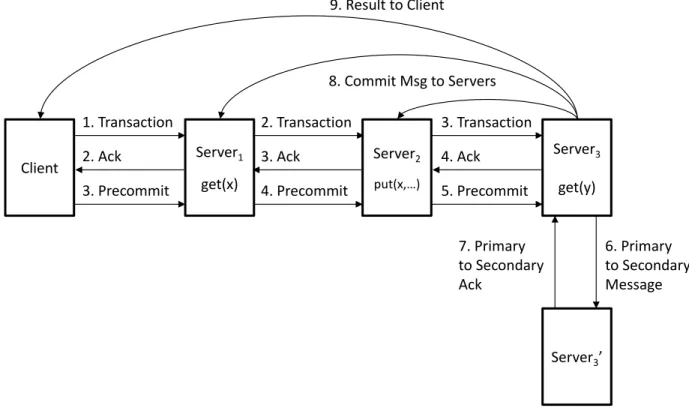
In this section, we provide an example transaction to explain the structure of a CrossStitch transaction, illustrate the messages that are sent between CrossStitch servers and demon-strate how CrossStitch transactions are executed. Suppose we want to implement a trans-action that accesses keyx and increments its value by one. The transaction also adds the value ofyto the value ofxbefore it was incremented in order to construct its return value. Intuitively, a transaction would be implemented in the followin