THE RIGHT TO LEARN
Community participation
Cover photo: Each Saturday, Malati reads stories, draws pictures and learns new songs and words at a Save the Children-supported reading camp in her village in Nepal.
THE RIGHT TO LEARN
Community participation
Save the Children USA 54 Wilton Road
Westport, Connecticut 06880 1-800-728-3843
www.savethechildren.org
© Save the Children, December 2013 All rights reserved.
ISBN: 1-888393-27-0
Acknowledgements
This report was written and produced by Kate Kenny, Philippa Lei, Will Paxton, Meredy Talbot-Zorn and Adrienne Henck. We would like to thank the following people for their contributions to the report: Virginia Morrow, Emma Wilson and the Young Lives Team at Oxford University, Sara Ruto from Uwezo, Yoliswa Dwane from Equal Education, Claudia Bandeira and Luis Felipe Soares Serrao from Ação Educativa, Rukmini Banerji from ASER India and Baela Raza Jamil, Safyan Jabbar, Imtiaz A Nizami and Sahar Saeed from ASER Pakistan.
We would also like to thank the following Save the Children colleagues: Mariko Shiohata, Gerd-Hanne Fosen, Heather Simpson, Jenny Russell, Will Postma, Kate Dooley, Alison Holder, Lynne Benson, Sylvi Bratten, Desmond Bermingham, Davinia OvettBondi and Jenny Bloxham.
Many thanks to colleagues working in countries included in this report, particularly Shireen Miller, Sanjeev Rai, David Skinner, Elson Mkhoma, Denise Cesário, Abimbola Jidearemo, Fatima Aboki, Els Heijnen-maathuis, Barbara Burroughs, Cleopatra Nzombe Chipuriro, Brian Hunter, Martha Hewison, Steve Thorne and
Duncan Harvey
We would also like to thank Allison Anderson at the Center for Universal Education at Brookings,
Laura Henderson at Women Thrive Worldwide and Sarah Beardmore at Global Partnership for Education for their feedback on drafts of the report. Lastly, we would like to thank the Hewlett Foundation for their generous support of this project.
Save the Children is the leading independent organization for children in need,
with programs in 120 countries, including the United States. We aim to inspire
breakthroughs in the way the world treats children, and to achieve immediate
and lasting change in their lives by improving their health, education and
economic opportunities. In times of acute crisis, we mobilize rapid assistance to
help children recover from the effects of war, conflict and natural disasters.
Nosheen, 10, studying at Save the Children supported Government Girls Primary School, village Darkhanwala, union council Ghousabad.
CONTENTS
Foreword
7Executive Summary
9Recommendations 9
Introduction
11Securing the right to learn for every child 11
Chapter 1
13Hearing from parents: perspectives on school quality and learning 13
Conclusion 15
Chapter 2
17Overcoming the barriers: making education accountable to parents 17
Information on entitlements 17
Power to demand change 17
Conclusion 18
Chapter 3 – Uwezo
19Information on learning outcomes as a catalyst to spur citizens to act: examples
from Tanzania, Uganda and Kenya By Sara Ruto. 19
Chapter 4 – Equal Education
22Equal Education (EE) in South Africa: campaigning for minimum standards all
schools should meet By Yoliswa Dwane 22
Chapter 5 – Ação Educativa
25Collective action to improve the quality of education in Brazil
By Claudia Bandeira, and Luis Felipe Soares Serrao 25
Chapter 6 – ASER India
28Learning for all: the challenge of taking everyone along By Rukmini Banerji 28
Chapter 7 – ASER Pakistan
32Citizens and governments must take action to improve the quality of education: The Annual Status of Education Report (ASER) in Pakistan
By Baela Raza Jamil, Safyan Jabbar, Imtiaz A Nizami, and Sahar Saeed 32
Chapter 8
35Strengthening local accountability: lessons from the South 35
Conclusion and recommendations 39
Hatiabo Haji Somir Uddin Community School, Gazipur District, Bangladesh. Proteeva Project: Pre-primary school student Kawser uses a bottle and funnel to pour water during an exercise designed to promote numeracy.
Consider that, in some African countries, as many
as 40 percent of young adults are illiterate even
though they have completed five years of schooling.
Yet this stark reality is not confined to a few
countries, or even to just one continent. During my
recent work with the United Nations High Level
Panel on the Post-2015 Development Agenda, I
observed there was a global crisis of too many poor
quality schools and increasingly alarming trends in
learning. A course correction is needed, which
should be reflected in improved national education
policy as well as the set of goals to follow the
Millennium Development Goals (MDGs) when they
expire in 2015.
The leadership of governments is critical to
improving the quality of education. To complement and enhance this, we must also harness the power and demand for improved education from parents, students, and community leaders around the world. Many communities remain dissatisfied with their local schools and are disappointed with the poor learning outcomes of their children. Many parents move their children into private schools at the first opportunity. But we ignore the voices of those who struggle with these issues daily at our peril. Without a significant change in the accountability of governments and schools to parents and communities, we will fail to achieve the
transformational force of education in the places where it is most needed.
In my 30 years of work in development policy, I have observed the transformative power of education. A good education generates multiplier effects for national development. It provides a skilled workforce needed for economic growth and creates more informed civil society which can enrich national debates. However, to yield sustained benefits at the national level we must ensure that education is about learning outcomes, not just years of schooling. If children lack basic literacy and numeracy skills, they will not be able to benefit from further learning in their teen years and then prosper as adults. If youth are not able to develop the necessary practical and technical skills, then the impact of such an education system on economic growth will be very limited. With Africa’s growing youth population, the continent can experience a demographic dividend if we are able to improve the learning outcomes of our children.
Through our endeavors to improve learning, our focus must also be on reducing the educational inequality that remains unacceptably high in countries around the world. While girls’ access to schooling has improved, many disparities persist behind the national averages. There is a gender divide: young girls are less likely to learn than young boys. There is a rural-urban divide: rural populations are less likely to learn than urban populations. And there is a wealth divide: the poor are less likely to learn than the wealthy. If we are to prevent today’s inequalities in education from becoming tomorrow’s inequalities of income, wealth, and power, then every child must have the opportunity to learn. It is clear that we need a paradigm shift in education, and the way forward is to improve learning outcomes by strengthening accountability of governments and schools to parents and communities. We also need to focus on equitable learning, ensuring that the poorest and most
disadvantaged children are not excluded, and that all children are both in school and learning. We need to listen to the voices of the parents, communities, and civil society organizations, who struggle with these issues daily.
To achieve this paradigm shift in education, action and change for greater accountability over learning outcomes must take place in our communities, and must be reflected in our national and global policies. Robust mechanisms for local stakeholders to define priorities and monitor intermediate and learning outcomes are necessary for education planning processes and should be explicitly linked to an equitable learning goal in the post-2015 global development framework.
This report takes on the debate by arguing for the rallying of the citizens of the world to call for equitable learning for all. Changing our education systems and engendering a paradigm shift is not the work of the education ministry or even the
government alone; it involves every one of us – parents, teachers, students, and civil society. I call upon all of us to use this moment, when we are determining the next global development agenda, to seize the opportunity to make a difference.
Dr. Ngozi Okonjo-Iweala
Co-ordinating Minister for the Economy and Minister of Finance
Federal Republic of Nigeria
FOREWORD
8
Four-year-old Manisha works on a puzzle at the Seto Gurans Bal Batika Early Childhood Development Center in Baglung, Nepal.
The Millennium Development Goals
(MDGs) and the Education for All (EFA)
goals have been the catalyst for progress
in ensuring access to education. Since
governments first endorsed these goals in
2000, around 45 million children
1who
previously did not have access to education
have enrolled in primary school and gender
parity in primary education has improved
significantly. With 2015 deadlines fast
approaching, the world must now assess the
considerable work that remains to be done
and negotiate an ambitious yet achievable
successor framework.
It is now widely recognized that we are facing a global crisis in learning. 250 million children – or a staggering 40 percent of the world’s primary school age children – are unable to read, write, or demonstrate basic numeracy by fourth grade.2It is the poorest, most marginalized children, including those living in areas affected by conflict, who are most at risk of being out of school or being in school but learning very little.
As we draw closer to the MDGs deadline, there is growing consensus amongst UN-led thematic, country and global consultations that the focus must move from enrolment to learning. Today, the conversation is not just about whether a child gets a seat in the classroom, it’s about what they learn when they get there – as well as before they arrive and after they leave. For that reason, an equitable learning agenda must be central to the post-2015 development framework. This should extend beyond a narrow focus on inputs, such as the need for books and teacher training, to include processes for stimulating learning, measuring learning
outcomes, and bolstering accountability to local stakeholders.
The failure by too many schools to provide good quality education and learning outcomes for all children is not just an issue for meeting rooms and international conferences. It is an issue affecting the lives of millions of children and parents around the
world each day. And it is an issue on which they have something to say.
If an equitable learning goal is to be attained globally, the framework must be supported by stronger accountability to children, caregivers, and communities. These stakeholders – including innovative civil society organizations with deep roots in local communities which we hear from in this report – are uniquely positioned to hold education providers to account and to bring about lasting change. Ensuring processes of accountability to families and communities will be critical to upholding the right to learn for every child. This must be central to the post-2015 framework. Parents and communities play a key role in holding schools to account for learning, both directly through direct accountability relationships and through feedback to district and national level duty-bearers. Harnessing the potential power of such relationships involves:
•
Fostering the engagement and participation of ordinary citizens, including the most marginalized;•
Reaching agreement on minimum standards for learning outcomes and school-level inputs;•
Collecting and communicating local data to genuinely inform and empower;•
Empowering communities to create their own solutions to local issues and acknowledge their roles in improving learning;•
Linking local accountability to national system reform.Recommendations
It is Save the Children’s hope that by hearing from parents, communities and civil society organizations themselves, international and national action on education in a post-2015 framework will both respond to and channel local voices to shape and fulfill global commitments. To that end, we provide the following recommendations for UN institutions and member states as they negotiate a post-2015 framework on education:
EXECUTIVE SUMMARY
1. UN Member States should advance an ambitious equitable learning goal in the post-2015 agenda that provides a
framework for national level targets and minimum standards for learning against which governments and education providers can be held to account. This global goal should include:
•
Learning targets aimed at “getting to zero” (i.e. eradicating) and “narrowing the gap” (e.g. reducing wealth, gender gaps) to ensure that every child, regardless of circumstance, is able to complete primary education with reading, writing, and numeracy skills that are in line with nationally defined minimum learning standards.•
Disaggregation of all targets and indicators by age, gender, ethnicity, disability, geography, and income and tracking progress in learning across all groups. Further, targets should only be considered met when they’ve been achieved across all socio-economic groups.•
A commitment to targeted action, including funding, to reach the most marginalized children. This will include the development of out-of-school policies that improve the home learning environment and provide opportunities to learn in the community.2. As the Open Working Group begins drafting a post-2015 goal framework and intergovernmental negotiations progress, UN Member States should ensure citizen voices from the Global South – especially civil society – inform the process by:
•
Prioritizing, convening, and funding national levelconsultations that target input from parents and communities, particularly those representing the most marginalized children.
•
Supporting the development and dissemination of information on the post-2015 process in formats and languages that are accessible for marginalized groups.3. Member States should ensure that any post-2015 framework is accompanied by a stand-alone goal to advance open, accountable and inclusive governance, including:
•
A formal global accountability and reporting mechanism and complementary national level mechanisms, which provide channels for accountability to poor and vulnerable people.•
The preservation of legal and political space for the free and independent operation of civil society, including a mechanism to support and facilitate civil society’s ability to monitorindicators and targets, keeping progress on track.
4. UN Member States should ensure that a post-2015 learning goal is accompanied by strengthened national and local
accountability frameworks through which education provision and learning outcomes can be monitored by parents and
communities, by:
•
Taking steps to improve institutional frameworks for accountability to ensure parents andcommunities can hold schools and governments to account, such as through joining the Open Government Partnership (OGP), an international platform for domestic reformers set up in 2011 to ensure their governments are more
accountable, open, and responsive to citizens. Participating countries should include improving local accountability in education in their OGP National Action Plans.
•
Supporting better collection and disaggregation of data on learning to foster parent, teacher, and citizen engagement at global, national, and local levels. This should include support for existing initiatives, such as those highlighted in this report.•
Working with all stakeholders to reachagreement on contextually appropriate minimum standards for schools and learning, against which they can be held to account. This should be complemented with strategies to foster
supportive out-of-school mechanisms for learning.
10
“They [the children] go to school but they
don’t know how to read or write even a
word. We see their slates, and they don’t
write anything at all.”
A mother in Andhra Pradesh, India
As we approach the 2015 deadline for the Millennium Development Goals (MDGs) and the Education for All (EFA) targets, there is much to celebrate. Since 2000, when the MDGs and the EFA goals were set, around 45 million children3who previously did not have access to education have enrolled in primary school, and gender parity in primary education has improved significantly. Yet the work ahead is urgent and formidable. 250 million children – or around 40 percent of all primary school age children in the world – either never enroll in school, fail to make it to the fourth year of their education or, if they do manage this, are not learning to read even basic sentences.4It is the poorest, most marginalized children, including those living in countries affected by conflict, who are most at risk.
It should therefore come as no surprise that parents are frustrated. They want nothing more than for their children to learn, to grow, and to thrive as citizens. As we hear in this report from parents in Andhra Pradesh, India, and other parts of the world, getting to school is the beginning, not the end, of the task. These parents place great value on their children’s learning.
In addition to this, the global development and education communities are united in emphasizing the right to learn as the centerpiece of the post-2015 agenda, not only because learning is a powerful end in itself but also because it is an effective
pathway towards achieving a diverse range of desirable goals.5
The impact of education cannot be measured in the number of students enrolled, or the number of hours in a classroom. It must be measured in the mastery of knowledge and skills that are relevant to the lives of students.
Save the Children believes that by 2030 all children should have access to publically funded primary schools and be achieving good learning outcomes. In other words, the full realization of the right of every child to receive a free, primary education can be achieved.6But this will only happen by putting equity and learning at the front and center of the post-2015 agenda and strengthening effective and accountable governance at global, national, local and school levels.
Drawing on case studies from national civil society organizations across seven countries and original research from “Young Lives” in Andhra Pradesh, India, this report demonstrates how communities, and in particular parents, have the potential to drive change and improve learning outcomes for their children. In doing so, it aims to provide a platform for those closest to the issues to have their opinions heard, recognizing the often untapped, transformative potential of parental engagement in education debates and delivery mechanisms. It is Save the Children’s hope that in hearing from parents themselves, international and national action on education in a post-2015 framework will be responsive to local voices in order to shape and fulfill global commitments.
The report begins, in Chapter 1 draws on findings from interviews with a small sample of parents in the state of Andhra Pradesh, India, where gains in enrollment have been met with declining levels of learning, to amplify parents’ opinions about what is important in education quality. In doing so, it highlights the unique role those so closely connected to the school can play in transforming the learning experience for their children.
INTRODUCTION
i The key principles of the right to education – availability, acceptability, adaptability and accessibility – inform our approach to post-2015 education goals. The term “right to learn” in this report is used to highlight a current, pressing challenge in the full realization of the right to education, though it should be understood in the context of all key inter-related aspects of the right to education, focused on guaranteeing free, universal primary education for all boys and girls.
While parents and other caregivers7are the focus of this report, we also recognize the important role of other local stakeholders, such as teachers and students, in increasing accountability for quality education for all. Although the report does not include in-depth analysis of their specific
contributions to greater accountability, it does refer to the role of these stakeholders throughout. Chapter 2 uses the findings from Andhra Pradesh, India, to illustrate some of the barriers parents experience in holding education providers to account.
Chapters 3-7 are written by local civil society organizations from all over the world that are working with parents and other stakeholders to increase accountability for learning opportunities and outcomes. All of the organizations highlighted – from Southern Africa (Equal Education), Eastern Africa (UWEZO), India (ASER-India), Pakistan (ASER-Pakistan), and Brazil (Ação Educativa) – are different. Yet they share a common desire to improve children’s learning by improving the accountability of schools.
Chapter 8 draws on these examples to identify a number of lessons for enhancing accountability of governments and schools to parents. It concludes by pointing towards the need for global, national, and local education frameworks to better harness the transformative power of parents in a post-2015 world, and provides recommendations for doing so. Several intergovernmental processes are currently underway to help define the post-2015 agenda, including the UN Open Working Group on Sustainable Development Goals (OWG) and the African Union’s High Level Committee of African Heads of State and Government on Post-2015. As government representatives gather in cities around the world to determine what lies ahead, it is imperative that voices of parents, channelled through civil society organizations such as those highlighted in this paper, continue to inform thinking at all levels.
In the pages that follow, we present their stories, struggles, and aspirations. These are their words. These are their voices. Let us learn from them.
12
THE RIGHT TO LEARN
Save the Children
Patience, an eleven-year-old primary school student in Kachamaenza, rural Zimbabwe, reads at the front of her classroom. With help from her teacher, she can now read in her native Shona language and English.
“People…want to give their children
whatever they missed in their childhood
and they want their children to attain
that position which they failed to get.”
A mother in Andhra Pradesh, India
This chapter explores perspectives on schools and learning, of a small sample of parents from the state of Andhra Pradesh, India. As a part of its wider research exploring childhood poverty in Ethiopia, India, Peru, and Vietnam, Young Lives (see Box below) interviewed 30 parents of children aged 9-10 years in three areas of Andhra Pradesh. For the purposes of anonymity we have numbered them: Area 1, an urban and coastal region; Area 2, a poor forested tribal area; and Area 3, a remote rural area.8Common to all three contexts is the
existence of both free government-run schools and private fee-based schools, and high levels of poverty. Young Lives collected the data mid-2011 through semi-structured interviews. The responses of the
parents were then transcribed, translated, and cross-checked by three researchers to ensure the trustworthiness of data. The interviews focused on several key questions around how parents viewed quality in their children’s schools.9
Although the Young Lives sample is small, the experiences of these parents who are confronted with poor quality education and limited public accountability is likely to resonate with those of parents across India and in other low and middle income countries, who face similar challenges. The parents interviewed highlighted several factors they considered valuable in assessing the quality of their children’s schools. Chief among these were
standards of teaching and learning. Other factors included availability of information on children’s progress, quality of resources and the school environment, distance of school from their home,10 and whether the English language was taught. Here we highlight what this sample of parents in Andhra Pradesh, had to say on the most important of these factors.
CHAPTER 1
YOUNG LIVES
An international study of childhood poverty
Young Lives is a study of childhood poverty globally, involving 12,000 children in four countries over 15 years. It is led by a team from the Department of International Development at Oxford University in the UK, which works in collaboration with partners in the four countries: Ethiopia, India (Andhra Pradesh), Peru, and Vietnam.11
The research seeks to inform policies and programs for children. It follows two sets of children, one born in 2001-02 and the second born in 1994-95. The methods of collecting data include:
•
A large-scale household survey of the children and their primary caregiver;•
More in-depth interviews, group work and case studies with a sub-sample of the children, their parents, teachers, and community representatives. The Young Lives team collected data on the social and material circumstances of the children as well as their perspectives on environmental and social issues within their communities. Through this data Young Lives will be able to examine how the children have grown up, taking into account comparisons across rural, urban, poverty, and gender divides as well as a variety of other factors.Hearing from parents: perspectives on school quality
and learning
Standards of teaching and learning
“However the school may be,
the teaching must be good.”
A father in Andhra Pradesh, India
A number of parents highlighted that in order to thrive in the future children needed to learn relevant skills in school. For example, parents in Area 1 emphasized the importance of learning computer skills. As one mother said:
“Nowadays most of the jobs are computer-based jobs. And for working with computers one needs good education. So unless we have good school education we cannot go for higher studies. If we educate our children in good school they will get good jobs and this means getting a fat salary and leading a nice life… We are struggling hard to meet both ends as we did not get good education and we don’t want our children to suffer like us.”
Quality of learning was strongly linked to the standard of teaching. As such, “good teaching” was at the center of the kind of education that parents wanted for their children. For parents, factors that contributed to “good teaching” were: teacher qualifications, proper implementation of the curriculum, teacher attendance, and teachers and schools “taking care” of children. This latter term meant that teachers should not be indifferent to students; they should be concerned about children attending school and not misbehaving; monitor children’s progress and performance; and be kind and give attention to children. “Taking care” was also sometimes taken to include a concern for children being well fed and well clothed, and teachers’ communication with parents, including informing them about their children’s progress. One mother in Area 1 was not satisfied with the standard of teaching and care in government-run schools:
“In Government schools, the teachers are not at all bothered whether the students turn up or not to school… Nobody bothers in the government school... They are not at all bothered whether a child has done homework or not… They do not motivate the child to study well…”
In Area 3, another mother said this of a government-run school:
“They never taught anything there…there was a [teacher who was a] drunkard and he used to come to the class drunk…he is not there anymore…the children used to shout and do mischief, and the other teachers used to take tuitions privately.”
One mother of a child in Area 1 suggested that teaching and learning standards had fallen in government schools:
“…the teaching imparted is below par. The teachers are indifferent to the plight of the students as they are paid good salaries from the Government, so they are secure and do not bother about anything. They do not pay individual attention to the students. The classes are not held regularly and the lessons are not taught properly. They do not teach the whole lesson but they just skim through it and they also do not give the answers to most of the questions and leave the children in a quandary. If the children have any doubts the teachers do not clarify that. The teaching is haphazard and there are no explanations… the teaching is not at all effective. They are blatantly letting the children mug up the subject matter [learn it by rote]. The students are learning blindly without any insight into the subject.”
As well as this general linking of teachers’
performance to learning, poor literacy and reading were often used as a marker of the low levels of learning taking place. A mother in Area 2 explained that children are not learning anything at school:
“They [the children] go to school but they don’t know how to read or write even a word. We see their slates, and they don’t write anything at all.”
Moreover, a mother raised concerns about
inadequately trained teachers leading to poor levels of learning in the government-run school, saying:
“The case of our village, all teachers are only
Intermediate qualified…” Another mother in Area 2
said, “these teachers…are not bothering about how
much the boys have learnt…only very few are working sincerely.”
Teacher absenteeism is a widely held concern in India, as it is in a number of other countries.11 Parents described circumstances where teachers did not stick to school timetables or teach their lessons, and often referred to teachers not turning up to work. Absenteeism was also often raised in conjunction with, or linked to, concerns over the standard of care teachers demonstrated.
14
For example, a mother in Area 2, who had no formal schooling herself, and has four daughters, complained about teacher absenteeism in the village government school:
“One teacher comes, he stays for an hour, then he says he has to apply for something [do some administrative work] and he goes off...[then he] comes and signs [takes the attendance register] and when the bus comes, he leaves...”
Another mother in Area 3 recalls:
“The children used to fight. My co-sister’s son also used to study there; he always used to get hurt and come [home], the other children use to beat him. When we ask, ‘what [did] the teacher do?’ he says they [the teachers] were inside, then when I asked him why didn’t he inform them, he says they will be sleeping.”
Information on children’s progress
Parents valued openness and transparency, in particular, access to information on children’s progress and updates on exam and test results. One mother in Area 1 discussed what she liked about her child’s school:
“In private schools, they give us progress report and conduct tests regularly.”
Another mother from Area 2 indicated that regular updates and academic progress are signs of a good school:
“Studies are better…they conduct exams periodically…send the results… they also write letters indicating the performance/improvement between 1st test and 2nd test…if we go and meet them, they will tell ‘how your son is studying’…whether studying well or not.”
Quality of resources and school environment
The third factor mentioned relates to school facilities, availability and quality of resources including food, and the appearance of school buildings. A father in Area 3 described his vision of a good school and included facilities as well as teaching in his definition:
“The classroom should have facility for the children to sit, with boards all around, and the teachers teaching well and clearly. Then it will be a good classroom.”
A mother in Area 3 explained how she had moved her child from Government school, to private school, and back again to Government school as her daughter had wanted to go to the same school as her friends. The mother said of the government-run school:
“...and everything was nice and neatly
maintained...There are lots of teachers there [the Government school]. They are nice. They teach her well.”
Another mother from Area 1 raised concerns about the infrastructure and quality of facilities such as bathrooms:
“The atmosphere is not good…that is the toilets will not be clean, all the surroundings also.”
In the two rural sites, parents frequently mentioned schools providing food as a factor. A mother in Area 2 explained a range of factors that make a good school, including food:
“It should have everything… It should give good food. They should teach properly and all the facilities should be good. Then it is a good school.”
A father in Area 2 listed a range of qualities relating to infrastructure including the provision of facilities for girls:
“There is everything there, they have every facility there even for girls if they get stomach pain or headache…their clothes are clean and neat, the books and other things will be within their reach…”
This chimes with the prominence given to well-being and child safety as an aspect of “good teaching”. It is not just what happens in the classroom or the state of that classroom that matters to parents, but where the classroom is.
Conclusion
These findings illustrate the complexity of identifying factors that constitute a quality education. However, they also show that learning in order to secure a good future is central to parents’ views of what constitutes a good education and a good school, and that this is strongly related to the quality of teaching.
Many of the parents interviewed are dissatisfied with the government run schools and were “voting with their feet”12 by moving their children into the private school system, despite evidence that oftentimes the learning outcomes in these schools are no better.13 As we have noted elsewhere,14such action often has the effect of further undermining quality in public schools, thus increasing growing quality gaps between public and private provision, widening inequalities in learning outcomes, and exacerbating wider societal inequity. In order to stem this tide it is essential that parents are encouraged and supported to channel the
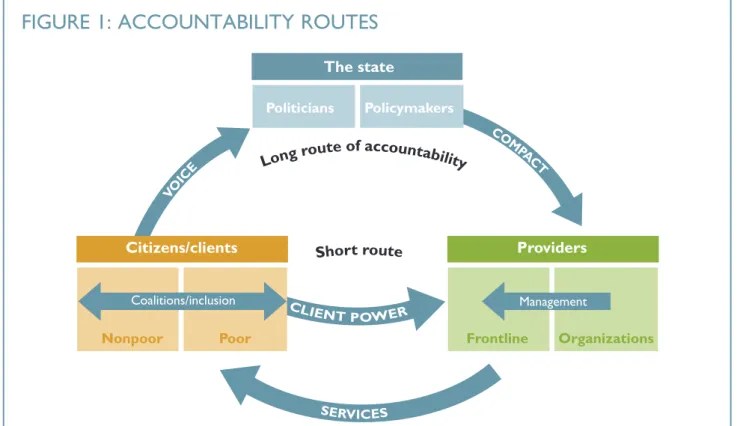
Coalitions/inclusion Citizens/clients The state Providers Frontline Organizations Politicians Policymakers Nonpoor Poor Management Long route of accountabilit y Short route VO ICE COM PAC T
dissatisfaction they often feel towards education providers into demanding change in those aspects of provision that matter most, such as learning outcomes and teaching quality, including teacher accountability.
Local level accountability can play a critically
important role in driving improvements in education provision. This is not a new concept. Indeed,
ensuring that schools and local governments listen
and respond to parents and communities has been regarded as important for some time, with the World Bank’s 2004 World Development Report highlighting the “short” accountability route between empowered citizens and responsive providers (Figure 1).15As education delivery and financing become increasingly decentralized, these “short” accountability relationships take on added importance.16
With current debates on a post-2015 development framework often happening at a global or national level, it is important to renew emphasis on the role, and the right of local “service users” to shape the provision of education in ways that are contextually relevant and responsive to local need. There is evidence to suggest that strengthening these “short” accountability routes could have significant impacts on improving intermediate outcomes in education, which in turn can catalyze improvements in learning outcomes and efforts to leave no one behind.17 Enhancing accountability relationships between parents and schools can also strengthen longer
accountability relationships through which engaged and organized citizens hold the primary duty-bearer – the state – to account for education provision and learning outcomes.
The remainder of this report draws on research from Andhra Pradesh, India, and the experiences of a number of local civil society organizations to identify challenges to greater local accountability between schools and parents and ways in which these can be overcome. In doing so, it also begins to identify how such local accountability can be
harnessed for national level reform.
16
THE RIGHT TO LEARN
FIGURE 1: ACCOUNTABILITY ROUTES
“What can we ask or do? We are small
people. Those who are well off put their
children in private school.”
A father in Andhra Pradesh, India
The research undertaken by Young Lives in Andhra Pradesh, India, though drawing on just a small sample of parents, illustrates the two primary barriers often faced by communities in holding service providers to account: lack of information regarding entitlements, and feelings of
powerlessness to demand change.
INFORMATION ON ENTITLEMENTS
Young Lives asked parents where they source information on school quality. The research demonstrates that many of the parents rely on informal sources of information and their own experience to judge school quality rather than against a more objective set of minimum standards. However, it also demonstrates important
differences in access to information between parents in rural and urban settings and by gender. Parents in the rural settings cited listening to the views of family members or friends and their own personal experience of schools as their main
sources of information. This can be contrasted with the parents in the more urban area who sourced information by visiting the school. The majority of parents interviewed did not mention government, civil society organizations or community groups as sources of information on where to send their children or on the quality of schools. Instead, sources of information tended to be more informal. Mothers may defer to more educated male relatives for advice on matters related to education. In Area 3, a mother explains that her brother-in-law used to take the children to school:
“He would go to school and oversee everything. Since he is educated, he would oversee.”
Another mother in Area 3 mentioned that her father-in-law knew someone who recommended a
particular school. When asked about who enquired about the school, she replied:
“Yes, he enquired and he only got him [the child] admitted”. And in terms of asking about the school she replied, “What can we say? Wherever he says, we will join [enroll the child].”
POWER TO DEMAND CHANGE
The research in Andhra Pradesh found that the parents’ sense of power to demand improved education from service deliverers was related to their socio-economic status and whether or not they were directly paying for education provision. Parents in the poorer, rural areas who had low levels of education felt they were unable to ask about their children’s schooling. A mother in Area 3, when asked what she thought about private schools, replied, “How would I know all these things,
madam, will I make any enquiries?” When asked what
her son’s marks were like, she said, “We never asked”…” Another mother when asked to describe
“a good school” said, “What do I know? …You know things better…”
In contrast, some mothers from the urban site were more comfortable approaching teachers and schools for information and as such were very informed about their children’s schools. One mother explained that she can tell whether a school was good or not “by keeping the children in view [keeping
an eye on the children].” She says she often goes to
visit the school. The interviewer asked, “You mean
you decided according to the marks?” The mother
replied, “Not only by the marks but by the way of her
reading also.”
Most strikingly, however, parents who were sending their children to fee-paying schools felt they were more entitled to hold these schools to account as they were directly paying for the service.
One mother in Area 2 explained:
“For private schools, we pay money, we can question them [the teachers] if children come home early or if they don’t study well. If they don’t teach properly, we won’t send the children to their school, but in
CHAPTER 2
Overcoming the barriers: making education
accountable to parents
Government [schools] the teachers come and teach for the sake of their salaries, so they just come and go daily.”
Another, in Area 3, sends her son to private school and her daughter to the government school. When asked about her daughter’s school, she said:
“That is a government school. In a private school, if they do not teach well…we can ask them strongly about it. But that is not the case with the government schools. They might ask us something in turn…but I am an illiterate…so we just leave it like that. But here because we pay, we have the right to ask.”
Conclusion
The research with parents in A.P., India implies two important findings with regards to barriers to greater accountability of schools to parents. First, parents often judge quality subjectively rather than from an understanding of the minimum standards of provision and outcomes they are entitled to expect in relation to education. And, second, payment gives parents a sense of entitlement to demand quality, which is not as prevalent among parents in the public funded system.
This points to the importance of ensuring parents know they have the right to monitor schools against a set of minimum standards with regards to quality, and underscores the need to increase the sense of
entitlement among caregivers to hold schools accountable to children’s right to learn, irrespective of whether or not they are directly paying for provision.
In the next five chapters we profile the work of inspiring civil society organizations that are finding ways to overcome these barriers. All are different, yet they have much in common.
The five increasingly powerful organizations – situated in South Africa, East Africa (Kenya, Tanzania and Uganda), India, Pakistan and Brazil – are having a significant impact working with communities and parents to improve the quality of education and children’s learning outcomes by improving the accountability of public schools. Their simple, yet innovative approaches shine the spotlight on national levels of learning and school quality, using this knowledge to influence education policy and practice. In the process of spreading awareness of children’s learning levels among parents and communities, they increase the community sense of responsibility, elevate the importance of learning in education dialogues, and stimulate the momentum for widespread social change locally and nationally. In the clamour of global dialogue, civil society organizations such as these, from low resource settings, often go unheard. Here, we let the organizations speak for themselves.
18
THE RIGHT TO LEARN
Information on learning outcomes as a catalyst to
spur citizens to act: examples from Tanzania,
Uganda, and Kenya.
By Sara Ruto
CHAPTER 3 – UWEZO
UWEZO OVERVIEW
Set up in 2009, Uwezo is currently running in three East African countries: Kenya, Tanzania, and Uganda. The Uwezo model follows that of the ASER-India model: measure to understand, understand to communicate, and communicate to change.
Uwezo aims to shift the dominant focus in education from infrastructure and enrollment to improving levels of learning for all children in Kenya, Tanzania, and Uganda.
Key data from Uwezo:
•
20 percent of children cannot read basic sentences or perform simple numeracy tasks•
Children from poorer households perform worse than children from richer households•
In its first four years Uwezo has aimed to improve levels of literacy and numeracy by 10 percentThe Uwezo initiative aims to draw public attention to educational challenges by researching and reporting on actual learning levels of children living in East Africa. Inspired by the Annual Status of Education Report established by Pratham, one of India’s biggest NGOs, the Uwezo approach is simple. Uwezo conducts annual household
assessments of basic literacy and numeracy levels in Kenya, Tanzania, and Uganda. The tests are based on the Class [Grade] 2 curriculum expectations of each country. Every year, Uwezo partners with over 350 local organizations to mobilize and train over 22,000 citizens to conduct the survey. In 2012, the Uwezo army of citizen volunteers assessed a total of 343,104 children in 124,627 households across 362 districts in East Africa. The annual assessments collect data that, once analyzed and shared, is used to promote countrywide conversations and debates about learning. It is the hope of Uwezo that these conversations and debates will eventually spur citizens to act in order to improve the quality of education in their local communities.
Child with John Mugo, Kenya. Photo: Uwezo
20
THE RIGHT TO LEARN
This is the story of Anna, a young mother who lives in the foothills of Mount Kenya. Anna has two children, four-year-old Hamisi and two-year-old Maria. Anna’s main source of income is a 2-acre farm that belongs to her parents. The farm is cultivated in every corner so every day Anna has a long list of jobs and chores, from harvesting potatoes to caring for livestock. Anna’s chief concern is to give her children the best opportunity to succeed in life. For her, this means investing the income from her family’s farm in formal education.
Anna and her mother work on the farm to raise school fees for both Hamisi, who is enrolled in a private pre-school, and for Anna’s sister, who attends a local secondary school. Anna could easily have taken the simpler path, by enrolling her child in the local, free public primary school that she attended. But for Anna, this was not an option. Anna explains that the quality of
education is very low in government schools, and teachers and some parents do not care. The quality is so lacking that she will do whatever it takes to raise the US$36 needed per term to ensure her son attends the private nursery school.
It is no easy feat. Every day, she must walk her son almost five kilometers to get to the private school and when she returns she must continue with her daily chores. Once Hamisi has gained basic competencies in reading and math, perhaps in Class [Grade] 5 or 6, she might consider transferring him to the public school. Anna’s vision of what she must do to ensure her child gets the best quality education is very clear and she represents a growing group of involved parents who want a better education for their children.
No matter their literacy or education levels, parents like Anna can play a significant role in
improving the quality of education in public and private schools. Yet, too often, this role has not been defined or brought to prominence. Forums that discuss and deliberate what parents can do to support and promote learning exist, but they are largely inaccessible to most parents. Only a small elite group of parents, for example, will attend School Management Committees. Parents like Anna often do not sit in these sessions, perhaps because they are viewed as too young, or simply because they cannot spare the time. Yet she represents the groundswell that can give momentum to bring the needed changes in the education sector. Though she does not voice it in these words, it is clear that problems such as quality of education, accountability levels and apathy amongst teachers in public schools worry her. Quality of the school buildings and other infrastructural concerns are of secondary interest to her, in comparison to what happens within the classroom, and whether or not her child is learning.
Community engagement has enormous potential in tackling issues of teacher and student
absenteeism, ensuring education providers are held to account, and demanding more from the system, which annually receives one of the highest budgetary allocations in Kenya’s public sector. Key to unlocking this potential is to ensure parents and caregivers are equipped with the information that will enable them to demand change, with pupils’ learning levels as the
measure of success.
Anna is one of the Uwezo data collectors who annually assess children in her village. As a data collector, Anna is trained in basic research principles and with information that improves her own perception of educational provision. She is part of a group that is already energized, has agency, and is motivated to drive large-scale change.
ANNA’S HOPE: QUALITY EDUCATION FOR HER CHILD IN KENYA
The majority of parents in Kenya, Tanzania, and Uganda are not like Anna. Many believe once they have enrolled their children in government schools, it is the responsibility of educational professionals to take over. Some parents may also be disillusioned. They attended school, but have nothing to show for it, so do not see how it will be any different for their children. Or perhaps they want to engage with schools but lack the know-how, because the effects of their own experiences of school, illiteracy, and economic disadvantage have disempowered them. As the Uwezo evidence confirms, the vast majority of public schools and also many private schools, have failed to provide children with the skills to progress in life. Across East Africa, less than one third of Class [Grade] 3 children possess basic literacy and numeracy competencies at Class [Grade] 2 level. Two in ten Class [Grade] 7 pupils do not have Class [Grade] 2 level competencies in literacy and numeracy. After having conducted three rounds of national assessments over three years, the evidence has remained largely unchanged.
Parents involved with the data collection for Uwezo are exposed to the education challenges that exist in their local area. However, there are millions of parents and citizens throughout East Africa who also have a right to know how their children are
performing, and how well they are learning. Ever since Uwezo started collecting data in 2009, it has been committed to communicating its findings. Communication, in simple and accessible formats, is at the core of all Uwezo activities. Information has to be easy to understand, meaningful, and
memorable. If all parents in a particular village are equipped with statistics showing, for example, that seven out of every ten Class [Grade] 3 children in the community was functionally illiterate, they would be armed with information that would lead to discussion and debate. Eventually local discussions would feed into a national conversation that policymakers would have to listen to. Every parent wants the best education and opportunities for his or her child. It is this desire that ignites the agency existing within people to make a change that will enable their children to learn, and therefore, to succeed.
In communicating its findings, Uwezo shares information in meaningful ways rather than merely producing technical reports and policy briefs. To engage people in meaningful discussions on
education, the organization presents its findings in a variety of formats. Radio has proven to be a powerful medium of mass communication. Uwezo strives to produce engaging radio content that both creates awareness around the Uwezo findings and captures the attention of listeners. Owezo’s focus is on programs that already have audience share, using popular forms such as stories, discussions and drama, in the languages that are most familiar and comfortable for audiences.
Uwezo does not offer recommendations or solutions. This is because Uwezo believes that concerned citizens – whether parents or politicians, teachers or technocrats – are best placed to be able to create their own solutions to local issues.
Uwezo has seen that, when citizens have a clear incentive to take action to create change in their own communities, locally grown solutions and answers are often innovative and unique.
Following on this maxim, Uwezo believes that the drive for more accountability will ultimately come if parents, as the largest constituency of concerned citizens, are able to be involved and participate in the success of the school. This could mean a number of different things. If parents were to visit the school during scheduled parents’ days and open days, get to know their child’s teacher, plan to join the parent-teacher association or school
management committee, or just do something as simple as ask their child what they learned at school today, conversations would begin to take place that create the foundations for change.
If this is met by a responsive school that demands “success”, and by educational professionals who continually seek to ensure that institutions “educate rather than school”, then Anna might be convinced that the public school can offer her child a
meaningful learning experience.
22
Equal Education (EE) in South Africa: Campaigning
for minimum standards in all schools
By Yoliswa Dwane
CHAPTER 4 – EQUAL EDUCATION
EQUAL EDUCATION OVERVIEW
Equal Education (EE) was set up in 2008 and has been campaigning to ensure quality and equal education in South Africa. Through analysis of issues facing schools the campaigns are led by the activism of students, teachers, parents and community members. Equal Education has followed several methods to ensure country wide support, including:
Youth led campaigning;
•
Activities to increase support such as marches, photo competitions, radio broadcasts’ and rallies;•
Use of the Courts to hold government ministers accountable when they fail to deliver their legal obligations;•
Collecting data and information to showcommunities the extent of problems facing schools.
EE is a movement of learners, parents, teachers and communities fighting for equality and quality education in the South African education system. Many may ask why there is a need for an
organization of this nature after liberation and the attainment of democracy in South Africa. With this thinking in mind, many international donors have reduced their financial support to organizations in South Africa or withdrawn it altogether. This has resulted in some civil society organizations having to reduce their reach or close down their operations, leaving many causes unsupported. Our education system is failing the youth of South Africa. Many children are not able to read, write and count. As communities have become more dissatisfied with non-delivery, corruption, and a weak state, the government has introduced new and repressive legislation, such as the Traditional Courts Bill and Protection of Information Bill, which are designed to silence citizens, especially vulnerable groups such as women, children and youth. Political attacks against civil society organizations and activist movements demonstrate the increasing hostility towards the demand for improved conditions. This is the context in which EE is tackling educational issues and
accountability. It has become increasingly necessary to hold government accountable to its promises.
This chapter offers a brief overview from South Africa showing how ordinary people can pressure the government into meeting its Constitutional obligations and promises.
Education in South Africa is marked by inequality and poor quality resulting from the discriminatory policies that were implemented by the repressive and racist Apartheid regime. Amongst the systematic issues we face today as a result of this unjust past, is a school infrastructure crisis. Research shows (and as can be seen from EE campaign photos [images 1 and 2]) that many schools in South Africa have inadequate
infrastructure and facilities, and are under-resourced and overcrowded. This has a significantly negative effect on academic performance.
The South African Schools Act requires the Education Minister to set legally binding minimum norms and standards that will define what a school requires. Although, the Act is liberal, we believe that the magnitude of the infrastructural challenges and the urgent need to fulfill the right to basic education requires the state to act decisively and immediately. Equal Education’s strategy to tackle this issue began by building support among learners, parents, communities, and the broader South African public.
This was necessary to gain the widest support. Mobilizing learners and communities with key demands that are informed by research and evidence is essential. Through this process, young people and children were enabled to raise their voices in the opportunities they were given to write to newspapers, send letters to the Minister of Basic Education, and speak about their experiences of the infrastructural condition in their schools and the impact that this had on their learning and rights to dignity and equality. In the public domain, this campaign has already been won. After campaigning for two years, and after many official promises to promulgate the school infrastructure regulations, the Minister refused to fulfill these political commitments. At this point, EE approached the courts. This forced the Minister to sign a
settlement, which she later did not fulfill. Campaign activists were angered by the Minister’s blatant disrespect, her disregard of the conditions they were facing in schools and her failure to honor the political commitment she had made.
Equal Education ran a social media campaign to draw the public’s attention to the Minister’s delay tactics, and simultaneously approached its legal team on the matter of returning to court against the breach of the settlement agreement. We also organized over 2,000 school learners to march to the Minister’s office in Pretoria in July 2013, and the court ordered the Minister to promulgate minimum norms and standards for school infrastructure in line with the Schools Act. Although, we have criticisms of this draft, it is a significant improvement on the draft that the Minister released in January. We have to keep an open mind about the outcome of this process. The next step will be to ensure that the court order is implemented fully and that the regulations on school infrastructure are put in place. This will require Equal Education to provide
information on the norms and standards in the court order to schools and communities, so they can monitor implementation and respond to challenges when they arise.
THE FIRST CAMPAIGN:
500 BROKEN WINDOWS
Khayelitsha is a working-class community in Cape Town with a population of approximately 700,000 people, and 54 schools. It was here that Equal Education mounted its first campaign, 500 Broken Windows. Researchers from EE had been working closely with many schools in Khayelitsha, monitoring all the difficulties teachers and learners faced in providing and accessing quality education. They
encouraged students to take photographs of conditions in their schools that impacted on
learning. One photograph depicting broken windows stood out as representing the terrible infrastructural conditions at many of these schools. There were 500 broken windows in total at the school. Teachers and learners complained that it was very difficult to concentrate in the cold classrooms and that this was a barrier to learning. The problem of broken windows represented well, the importance of a school environment that is conducive to learning.
In response, Equal Education set up meetings with the school management, teachers, learners, and the Western Cape Education Department (WCED). However, the WCED was slow to provide support. EE created a petition calling for the windows to be replaced and also for learners to keep them that way, which garnered 2000 signatories.
To gain further public support, EE organized a rally of 450 Khayelitsha learners in Cape Town. Members of the EE youth group, high school students known as Equalizers, supported the action. They wrote articles for the local press, gave interviews on local radio stations, and spread the news of the campaign to their family and friends. Those taking part in the rally made placards and wrote poems and songs to get their messages across.
Equal Education also wrote letters to the WCED calling for a timeline of planned work, and arranged a meeting attended by 200 members of the
community and education department officials. After six months of continuous campaigning and considerable community support, the windows were finally fixed – a great victory in the campaign for quality education.
MOVING FORWARD: EVIDENCE
BASED, COMMUNITY ACTIVISM
The 500 Broken Windows campaign provided important lessons. Most notably, Equal Education realized that more must be done to encourage the community, particularly parents and teachers, to get involved in changing the conditions at their schools. Since 2008, the organization has pursued evidence based, community led campaigns to address problems in schools. The approach starts with research and uses the evidence acquired to educate and empower activists, gather support and push for change. Equal Education’s Policy, Communications, and Research Department produces in-depth research, which is circulated to members,
politicians, and the public. Key messages from this research are communicated to the public using national and local press, television, and radio. Marches, demonstrations and pickets are organized to expose the issues and emphasize the need for political and public involvement.
Equalizers, EE’s most active members, are at the center of much of its work. These high school students are from predominantly poor and working class areas. They engage with the organization through a variety of activities ranging from weekly youth groups, mass meetings, camps and marches. Equalizers play a leading role in the activities of the organization. They work with EE, along with parents, teachers, activists, and community
members, to improve schools in their communities. They set an example to their peers through their dedication to their own education, and in addition to boosting EE’s growing youth support, has helped to mobilize the support of parents and communities. Parent networks ensure that parents are informed and given a platform to support the advancement of equal and quality education in South Africa.
Many parents have experienced negative or harmful school environments, having been educated under Bantu Education. These parents often felt
intimidated and were less aware of what to expect from schools and government. To develop
understanding of educational issues among parents and to encourage their support and action, Equal Education has run educational workshops with parents and involved them in campaigns, advocacy work and school based projects, such as supervised after-school homework classes.
Equal Education has secured tangible victories with regards to textbooks in Khayelitsha, broken windows, improving student punctuality, and infrastructural conditions in poor schools. The organization has compelled the Minister to issue norms and standards for school infrastructure, an ongoing campaign that will yield significant and far-reaching results. It has succeeded in keeping schools open that the Western Cape government wanted to close, and in securing places for learners who were facing discrimination on the grounds of language, race or religion.
Equal Education develops understanding of the educational system, whilst drawing attention to problems faced by schools and communities. By equipping ordinary citizens with this knowledge, EE offers them a new way for to participate in the democratic process and effect change in the education system and society at large. Today, the state of our education system is at the very forefront of the political agenda, and it is the most talked about issue in South Africa. This heightened public awareness around education is largely due to the impact of Equal Education’s work.
24
THE RIGHT TO LEARN
Image 1: Mud-Hut School in South Africa. Photo: Equal Education
Image 3: 20,000 Equal Education activists march on Parliament on Human Rights Day, 2011. Photo: Equal Education
Image 2: Students outside their Junior Secondary School in South Africa. Photo: Equal Education
Collective action to improve the quality of education
in Brazil
By Claudia Bandeira and Luis Felipe Soares Serrao
CHAPTER 5 – AÇÃO EDUCATIVA
EDUCATION AND DEVELOPMENT
IN THE CONTEXT OF BRAZIL
Recently the United Nations Development Programme (UNDP) revealed that Latin America and the Caribbean is the region with the most economic, educational, and overall inequities in the world. Despite limited progress in reducing poverty over the years, inequalities remain. This is largely a result of heavily relying on economic growth to reduce poverty prior to the crisis of 2007 and 2008 (UNDP, 2010, p. 25). In Brazil, in the first decade of
the millennium, 40 million people escaped poverty. However, data from the last Census in 2010 showed that the poorest 60 percent accounted for only 19.23 percent of the Brazilian income, while the richest 10 percent accounted for 48.9 percent. It is no wonder, then, there was only a small decrease of 6.2 percent of the Gini index, which ranged from 0.63 in 2000 to 0.60 in 2010. In light of this inequality, civil society in Brazil has played a key role in the struggle for guarantees and for the expansion of rights. Education is a key factor in the development of a more just, equitable, and environmentally sustainable society. However, it is clear that more structural changes to society and education policies must be articulated within a wider sphere of policies tackling resource
distribution and power, and considering factors such as income, gender, and race/ethnicity.
In the context of improving education quality, a holistic approach is needed that also addresses wider inequality. It is necessary for the government to introduce social policies that are adequately financed to improve the wages of professional educators, encourage public action in the
educational field, tackle inequalities, and establish participatory and democratic processes of defining educational policies.
The Ação Educativa is a non-governmental
organization active in the areas of education, youth and culture, developing formation activities, consulting, research, information, networking, and joint organizing in campaigns and advocacy actions. Founded in 1994, its mission is to promote
educational rights and youth, aimed at social justice, participatory democracy and sustainable development. As a part of its wider aims, Ação Educativa set up the Indicadores da Qualidade da Educação (Quality Indicators in Education) in 2003. The Indicators work in the following way:
•
They set up groups of local community members;•
The group encourages the whole community to participate in self-evaluation of the problems facing their schools;•
The data is collected;•
Using the data, the group develops an action plan;•
Actions are then taken to improve schools.Key Facts
The Indicators have shown that the school community has a vital role to play in the
development of quality education. The indicators have had an impact in communities, including the following outcomes, among others:
•
Implementation of action plans with the participation of the school community expanded dialogue between the schools and the organs of the educational system.•
The work has encouraged increased fundingfor schools.
Existing education quality indicators in Brazil’s Index of Basic Education Development (IDEB) have focused on school access and student performance. But access and performance only give part of the picture and education quality should be assessed in a more holistic and contextualized way, addressing inequalities, inputs, and processes on top of access and performance.
The Brazilian IDEB led to increased pressure on education providers to achieve goals and outcomes. With respect to educational management, this measure encourages ranking and competition between schools, and helps to deepen inequalities in the system and educational networks.
AÇÃO EDUCATIVA’S INDICADORES
DA QUALIDADE DA EDUCAÇÃO
(QUALITY INDICATORS IN
EDUCATION)
Without replacing existing national indicators or belittling their value as tools for monitoring
educational quality, Ação Educativa has designed and implemented Indicadores da Qualidade da Educação (Quality Indicators in Education). These offer a complementary instrument more directly engaged with school communities and more effective as an incentive to support the engagement of collective action to improve the quality of education. The Quality Indicators in Education have been developed by Ação Educativa in order to build and disseminate a set of qualitative education indicators that are easy to understand. They involve the different stakeholders of the school community – students, teachers, administrators, family members, employees, representatives, organizations, and social movements – in a participatory self-evaluation of school quality. From the perspective of creating effective conditions for the democratization of the school, the methodology was designed so that the community gathered to assess their reality, identify priorities, establish and implement action plans, and monitor their results. In short, the initiative
facilitates an environment in which the community gathers to identify issues impacting on quality within their local school. This then leads to the creation of an action plan to address the issues raised.
For the collection of indicators under the Quality Indicators in Education, there are several steps that must be carried out. They are:
1. Preparation of material and setting up the initial stages: It is important that the whole school
community understands the dimensions, indicators, and methodology proposed prior to the evaluation.
A group of local representatives or a commission is elected to oversee the process. They meet and discuss how to engage with the community and begin to set up initial processes such as the
dissemination of information on the indicators, and to organize meeting rooms and materials.
2. Mobilization of the school community:
The local representatives, composed of different members of the school community, need to create communication strategies to invite the community to participate in the assessment in school.
3. Assessment day: All those who wish to be
involved are organized into groups to discuss the indicators. Depending on the size of the school and the number of participants, groups are divided. Smaller groups tend to facilitate better participation and engagement of all group members. Groups are made up of different stakeholders such as staff, members of municipal councils, students, and their families from the surrounding community. This allows several actors to give opinions and discuss the meaning of educational quality in the context of their community, and the country or state. The results of the group discussions are discussed in