ARROW@TU Dublin
ARROW@TU Dublin
Articles Learning,Teaching & Technology Centre
2012-10
A Theoretical Framework for Serious Game Design: Exploring
A Theoretical Framework for Serious Game Design: Exploring
Pedagogy, Play and Fidelity and their Implications for the Design
Pedagogy, Play and Fidelity and their Implications for the Design
Process
Process
Pauline Rooney
Technological University Dublin, [email protected]
Follow this and additional works at: https://arrow.tudublin.ie/ltcart
Part of the Cognition and Perception Commons, Graphics and Human Computer Interfaces Commons, and the Instructional Media Design Commons
Recommended Citation Recommended Citation
Rooney, P (2012) 'A Theoretical Framework for Serious Game Design: Exploring Pedagogy, Play and Fidelity and their Implications for the Design Process' International Journal of Game-based Learning, 2 (4) 41-60. DOI: 10.4018/ijgbl.2012100103
This Article is brought to you for free and open access by the Learning,Teaching & Technology Centre at
ARROW@TU Dublin. It has been accepted for inclusion in Articles by an authorized administrator of ARROW@TU Dublin. For more information, please contact
[email protected], [email protected], [email protected].
This work is licensed under a Creative Commons Attribution-Noncommercial-Share Alike 3.0 License
October-December 2012, Vol. 2, No. 4
E
ditorialP
rEfacE
i Patrick Felicia, Department of Computing, Mathematics and Physics, Waterford Institute of Technology, Waterford, Ireland
r
EsEarcha
rticlEs1 Arm Chair Activism: Serious Games usage by INGOs for Educational Change
Payal Arora, Department of Media and Communication, Erasmus University Rotterdam, Rotterdam, The Netherlands
Sorina Itu, Department of Media and Communication, Erasmus University Rotterdam, Rotterdam, The Netherlands
18 Playability Guidelines for Educational Video Games: A Comprehensive and Integrated Literature Review
Amer Ibrahim, Video Games and E-learning Research Lab (LIVE), GEDES Research Group, Department of Software Engineering, University of Granada, Granada, Spain
Francisco Luis Gutiérrez Vela, Video Games and E-learning Research Lab (LIVE), GEDES Research Group, Department of Languages and Computer Systems, University of Granada, Granada, Spain
Patricia Paderewski Rodríguez, Video Games and E-learning Research Lab (LIVE), GEDES Research Group, University of Granada, Granada, Spain
José Luís González Sánchez, Video Games and E-learning Research Lab (LIVE), GEDES Research Group, University of Granada, Granada, Spain
Natalia Padilla Zea, Video Games and E-learning Research Lab (LIVE), GEDES Research Group, University of Granada, Granada, Spain
41 A Theoretical Framework for Serious Game Design: Exploring Pedagogy, Play and Fidelity and their Implications for the Design Process
Pauline Rooney, Dublin Institute of Technology, Dublin, Ireland
61 Applying Serious Games to Motor Learning in Sport
Josef Wiemeyer, Institute of Sport Science, Technische Universität Darmstadt, Darmstadt, Germany Philipp Schneider, Institute of Sport Science, Technische Universität Darmstadt, Darmstadt, Germany
74 Introducing Cool School: Where Peace Rules and Conflict Resolution can be Fun
Mark Young, President, Rational Games, Inc., Berlin, Germany
Melanie Killen, Department of Human Development and Quantitative Methodology, University of Maryland, College Park, MD, USA
Jennie Lee-Kim, Department of Human Development and Quantitative Methodology, University of Maryland, College Park, MD, USA
Yoonjung Park, Children’s Defense Fund, Washington, D.C., USA
Table of Contents
i
nternational
J
ournal
of
G
ame
-B
ased
l
earninG
Copyright
The International Journal of Game-Based Learning (ISSN 2155-6849; eISSN 2155-6857). Copyright © 2012 IGI Global. All rights, including translation into other languages reserved by the publisher. No part of this journal may be reproduced or used in any form or by any means without written permission from the publisher, except for noncommercial, educational use including classroom teaching purposes. Product or company names used in this journal are for identification purposes only. Inclusion of the names of the products or companies does not indicate a claim of ownership by IGI Global of the trademark or registered trademark. The views expressed in this journal are those of the authors but not necessarily of IGI Global.
The International Journal of Game-Based Learning is currently listed or indexed in: Bacon's Media Directory; Cabell's Directories; DBLP; Google Scholar; INSPEC; JournalTOCs; MediaFinder; ProQuest Advanced Technologies & Aerospace Journals; ProQuest Computer Science Journals; ProQuest Illustrata: Technology; ProQuest SciTech Journals; ProQuest Technology Journals; The Standard Periodical Directory; Ulrich's Periodicals Directory
Keywords: Design, Engagement, Experiential Learning, Fidelity, Game-Based Learning, Motivation, Problem-Based Learning, Serious Games, Situated Learning
INTRODUCTION
While games have been used for educational purposes for some time (Levine, 2006), they have attracted increasing interest among educa-tors in recent times due to the exponential rise of digital gaming in popular culture, and claims regarding the potential of games for facilitating engagement, motivation and student-centred learning. Such claims have led to the coinage of the term “serious games”: a term which, although subject to some conceptual debate
(Ritterfield et al., 2009), is used in this paper to denote digital games that have ulterior non-entertainment motives such as teaching, training and marketing (Johnson et al., 2005).
It is widely acknowledged that such games can provide an engaging, motivating and “fun” experience for students. However an enter-taining game does not necessarily constitute a meaningful, valuable learning experience. For this reason, experts in the field espouse the importance of underpinning serious games with a sound theoretical framework which in-tegrates and balances theories from two (often competing) fields of practice: pedagogy and
A Theoretical Framework
for Serious Game Design:
Exploring Pedagogy, Play and Fidelity and
their Implications for the Design Process
Pauline Rooney, Dublin Institute of Technology, Dublin, Ireland
ABSTRACT
It is widely acknowledged that digital games can provide an engaging, motivating and “fun” experience for students. However an entertaining game does not necessarily constitute a meaningful, valuable learning experience. For this reason, experts espouse the importance of underpinning serious games with a sound theoretical framework which integrates and balances theories from two fields of practice: pedagogy and game design (Kiili, 2005; Seeney & Routledge, 2009). Additionally, with the advent of sophisticated, im-mersive technologies, and increasing interest in the opportunities for constructivist learning offered by these technologies, concepts of fidelity and its impact on student learning and engagement, have emerged (Aldrich, 2005; Harteveld et al., 2007, 2010). This paper will explore a triadic theoretical framework for serious game design comprising play, pedagogy and fidelity. It will outline underpinning theories, review key literatures and identify challenges and issues involved in balancing these elements in the process of serious game design.
game design (Kiili, 2005; Seeney & Routledge, 2009). While a sound pedagogical framework is considered essential to their effectiveness as learning tools, equally important is the integra-tion of game play elements which harness and sustain player engagement. Additionally, with the advent of sophisticated and immersive technologies, as exemplified in the virtual worlds of contemporary games, and increasing interest in the opportunities for constructivist learning offered by these worlds, concepts of fidelity, and its impact on student learning and engagement, have emerged (Aldrich, 2005; Harteveld et al., 2007, 2010).
This paper will explore this triadic theo-retical framework for serious game design, outlining underpinning theories, reviewing key literatures and identifying associated challenges and issues (Figure 1). The paper begins by reflecting on pedagogical theories commonly utilised to conceptualise game-based learn-ing, focusing on three constructivist theories. Following this, attention switches to theories used to conceptualise players’ engagement with digital games, and thus inform effective, engaging and “fun” game design. As a key component of engaging and pedagogically ef-fective game design, the concept of fidelity, and how it relates to game design and game-based learning, is discussed. The paper will conclude
by reflecting on issues and challenges involved in balancing these components when designing serious games.
Pedagogical Underpinnings
Over recent years, a growing body of literature has emphasised the importance of underpinning serious game design and game-based learn-ing strategies with established instructional strategies and pedagogical theories (Kebritchi & Hirumi, 2008). According to this argument, serious game design (as an example of instruc-tional design) should be underpinned by a clear conceptualisation of how people learn and what it means to learn (Lainema & Saarinen, 2010).
A wide range of theories have been pro-posed to explain the learning that takes place within games and as a result, to underpin serious game design. At a most basic level, it is argued that some games, for example ca-sual games — which allow players to acquire knowledge and practice skills in an engaging environment — embody behaviourist principles (Kebritchi & Hirumi, 2008). According to this epistemological perspective — which focuses on the measurable, behavioural outcomes of learning (Jarvis et al., 2003) — knowledge is conceptualised as an abstract decontextualised “substance,” with game play and the learning
experience seen as an individualistic process of information transfer between game and player (Ruben, 1999). Central to behaviourism is the drill and practice model, where the repetition of stimulus-response patterns strengthens ob-servable habits and behaviours (Ormrod, 1999). Many casual games embody this through the unlimited opportunities they provide for repeti-tion and practice in a virtual environment and through their capacity for immediate feedback (or reinforcement) (Mayo, 2009).
As digital games have increased in complexity, the pedagogical theories utilised to underpin their use and design as learning tools have diversified, with most resting on constructivist principles. While encompass-ing a wide range of theoretical approaches to learning, constructivism rests on the epistemo-logical assumption that knowledge and skills are constructed by learners as they attempt to make sense of their experiences (Driscoll, 2000). A dominant theme of constructivism is the importance of creating an “authentic” learning environment — “authentic” in the sense that it replicates what the learner would face in a real-life situation. According to this view, many complex digital games (such as role-playing games and massively multiplayer games) provide such authenticity, allowing play-ers to experience situations and assume roles that may be inaccessible in the real world. By facilitating such immersion, it is argued that these games provide an authentic and engag-ing environment in which to develop critical 21st century skills such as problem-solving,
decision-making, collaborative/social skills and so on (Van Eck, 2006; Oblinger, 2004; de Freitas & Griffiths, 2007; Klopfer et al., 2009). Those who adopt this view frequently situate the learning process within a framework of pedagogical theories such as situated learning (Lave & Wenger, 1991), problem-based learn-ing (Savin-Baden & Howell-Major, 2004) and experiential learning (Kolb, 1984).
This paper recognises the complex, con-structivist nature of learning and acknowledges that a wide variety of constructivist theories have been used to underpin and explain
game-based learning, including inquiry-game-based learning (Barab et al., 2005), generative learning theory (Trespalacious & Chamberlain, 2010), activity theory (Peachey, 2010) and more recently trans-actional theory (de Freitas & Maharg, 2011). Recognising the complex, constructivist nature of learning and the importance of underlining serious game design with established theories which help explain how people learn, this paper provides an overview of three key constructiv-ist theories commonly utilised to conceptualise game-based learning, and it highlights the challenges involved when using them to inform serious game design.
Situated Learning
Many writers espouse the educational value of serious games as residing in their potential to facilitate situated learning (Prensky, 2001; Kirriemuir & McFarlane, 2004; Van Eck, 2006). Theories of situated cognition refute the premise on which cognitivism is based, which states that knowledge is an abstract “substance” independent of context. Conversely, situated learning theorists claim that knowledge can-not be abstracted from the situation in which it is learned and used because it is inherently situated: in other words, its meaning is derived in part from its context of use (Brown et al.,
1989). Consequently it is argued, the process of learning is necessarily situated whereby for effective learning to take place, it must be embedded in an activity which makes use of the learner’s social and physical context. Brown et al. (1989) clarify situated cognition theory through a “tool” metaphor. Describing conceptual knowledge as a “set of tools,” they state that, while one may easily acquire a tool, it does not necessarily follow that one knows how to use it. In the same way, a person may acquire conceptual knowledge but they may be unable to apply it in real-life, authentic situations. Situated learning, it is proposed, offers a solution to this dilemma by integrating declarative knowledge (‘knowing that’) with procedural knowledge (‘knowing how’) into one pedagogical framework (Driscoll, 2000, p. 154).
Additionally, whereas cognitivist theories view learning as an individual process (taking place within an individual’s head), situated theories posit that learning cannot be pinned down to such a level because the context of learning — including the physical and social environment — is an integral part of the learning process (Derry & Steinkuehler, 2003). Accord-ing to this perspective, cognition is stretched beyond the mind of the individual to encompass not only the task and social tools or artifacts used during the task, but also the social context and its participants (Derry & Steinkuehler, 2003). Essentially, the learner is viewed as a member of a community of practice which they actively participate in and contribute to (Lave & Wenger, 1991). These communities may be conceptualised as local or they may encompass wider spheres, such as an entire profession (Shaffer et al., 2005). In either case, it is argued that each community of practice generates the practices, social/cultural norms, values, goals and identities of its members, thus echoing nondualist ontological claims that the meaning of the mind, the individual and the world are not natural, standalone entities per se but are historical and cultural products, determined by human practices and constituted through human activity (Derry & Steinkuehler, 2003).
According to this perspective, communi-ties of practice are key to the learning process (Lave & Wenger, 1991), whereby learning can only take place by participating and interacting with this community — described as a process of ‘enculturation’ or ‘apprenticeship’ (Brown
et al., 1989, p. 33; Lave & Wenger, 1991, p. 32). “Scaffolding” is an important component within this learning approach where novice participants are supported and coached as they become familiar with the community’s norms, values and practices: such scaffolding is gradu-ally removed, as the participant moves from novice to expert during their ‘apprenticeship’ (Young, 1993, p. 47).
With regard to serious games, it is argued that this medium offers extensive opportunities for situated learning. The virtual worlds of such games allow players to become immersed in,
and participate in, a virtual “community of practice,” without the barriers and risks of the real world. Multiplayer games and massively multiplayer online games (MMOGS) provide new opportunities to engage with even wider communities of practice (de Freitas & Griffiths, 2007). However, while situated learning offers many possibilities, it also creates challenges for those designing games underpinned by this learning approach. A key issue regards transfer. Specifically, it is argued that learning that is inherently situated or context-specific is unlikely to transfer to new contexts (Ormrod, 1999). When using serious games, questions regarding transfer widen to encapsulate vir-tual and real-world contexts. In other words, will students be able to transfer information/ skills learned in the virtual world to a real-life scenario? In favour of the situated approach, research has shown that several factors influ-ence the likelihood that information or skills learned in one context will transfer to another. Firstly, the more similar two situations are, the greater the potential for transfer of learning from one to the other (Ormrod, 1999; Singley & Anderson, 1989, as cited in Anderson et al.,
1996). Secondly, the more thoroughly or mean-ingfully something is learned, the more likely it is to transfer to new contexts (Ormrod, 1999; Anderson et al., 1996). Thus it is important that learners are given numerous, varied examples and opportunities to practice new skills. Ad-ditionally, some argue that transfer problems can be overcome by encouraging “meaningful learning” (whereby the student demonstrates understanding as opposed to memorisation) and by developing critical skills such as problem-solving, critical thinking and decision-making (Ormrod, 1999). Finally, it has been shown that transfer is enhanced when learners are encour-aged to reflect on the potential for transfer during the learning process (Anderson et al.,
1999). With regard to situated learning through serious games, researchers have suggested that reflecting on the links between the gaming environment and real life through debriefing enhances the likelihood that transfer will occur (Pivec, 2007).
Problem-Based Learning
Originating in medical schools in the United States and Canada in the 1950s/60s, PBL was conceptualised in response to educators’ con-cerns that traditional didactic methods were failing to equip students with skills and char-acteristics needed in the medical profession, such as problem-solving, decision-making, communicating and team-playing (White, 1996, as cited in Uden & Beaumont, 2006, p. 30). It was envisaged that PBL would facilitate the development of such skills by shifting the focus from teaching (via didactic instruction) to student learning via active participation in problem-solving activities. According to PBL, knowledge is complex rather than prepositional and it changes in response to problem-solving actions and behaviours in real-world com-munities (Uden & Beaumont, 2006). Thus this approach might be seen as an ideology rooted in the experiential learning tradition (Savin-Baden & Howell Major, 2004). While PBL can be implemented in various ways, it is characterised by several key features. As the title indicates, it is epitomised by the fact that the curriculum is constructed entirely around problems, as opposed to the traditional dissemi-nation of subject matter (Boud & Feletti, 1991): students acquire and develop knowledge, skills and understandings as they strive to solve these problems, drawing on support from various sources including subject materials and tutors’ guidance. The role of the tutor becomes one of facilitator, coach or modeller, instead of expert (Uden & Beaumont, 2006). In a similar vein to cognitive apprenticeship models described in the previous section, scaffolding plays an integral part in supporting learners as they develop metacognitive skills. Authenticity is another key trait of PBL, whereby it is argued that problems must engage students in situations as near as possible to real life in order to stimu-late problem-solving behaviours employed by practicing professionals (Savery & Duffy, 1996). Similarly, one of the core premises of
PBL is its emphasis on contextuality, where it is believed that problems can only be understood and solved in context.
Proponents of PBL argue that it holds sig-nificant potential for learning. Research with higher education (HE) students suggests that it is highly effective in developing learners’ understanding of domain-specific principles (Gijbels et al., 2005). A major advantage is that it can aid with problems of transfer by affording students the opportunity to apply knowledge to real-life problems (Delisle, 1997). Another cited advantage is that PBL encourages self-directed learning and learner independence (Savery & Duffy, 1996). To progress through a PBL programme, students must explore a problem, formulate questions in response, identify and acquire relevant information, and use this information to answer their questions and solve the problem at hand. Through such activities, students are encouraged to develop higher order cognitive skills such as problem-solving, decision-making and critical thinking: 21st century skills which are considered essential
in today’s knowledge economy (Uden & Beau-mont, 2006; Klopfer et al., 2009).
With regard to serious games, PBL under-pins most design strategies in the form of goals or missions which the player must strive to accomplish (Kiili, 2005, 2007). PBL strategies within serious games can encompass varying degrees of complexity — from single-player games which require the player to complete tasks in a linear fashion, to massively multiplayer games where players face a range of problems and decision-making scenarios, in a collabora-tive environment. In all cases, games can be seen as a complex problem comprising multiple problems or goals (Van Eck, 2007; Tuzun, 2007). For educators and students, serious games offer expanded and enhanced PBL opportunities. Highly realistic three-dimensional (3D) envi-ronments may provide for more authentic and immersive representations of real-life problems. Games provide extensive opportunities for scaffolding through supplementary tools and
resources, in-game character feedback and nar-rative game design (Ma et al., 2007). However, PBL also presents challenges for learners, tutors and game designers. For the latter, devising authentic problems/scenarios can be difficult, particularly when trying to cater for different student groups or needs. For learners, transfer problems may arise: because problem-solving is considered domain-specific — and cannot be taught as a set of abstract principles or rules (Van Eck, 2007) — students may develop new knowledge and skills in one context but face difficulties transferring them to new scenarios (McKeachie, 2002). To overcome such prob-lems, it is recommended that students are given multiple opportunities to practice problem-solving in different domains (Larkin, 1989). Ad-ditionally, PBL requires self-directed learning: some students, particularly younger learners, may have difficulty with this and will require additional scaffolding or support throughout the problem-solving process (Williams et al.,
2007). While gaming environments can provide such scaffolding through careful pedagogical design and selected game features, the question arises, how much scaffolding should the game provide? Ideally, games should provide just enough support to allow the learner to
prog-ress, and no more (Van Eck, 2007). However, for designers, making the judgment on what is “just enough” can be difficult.
Experiential Learning
For many years, researchers and educators have espoused the centrality of experience to the learning process. As a philosophy of learning, experiential learning underpins many peda-gogical approaches including situated learning and problem-based learning (Boud & Feletti, 1991). Some academics have emphasised this link further stating that experience forms the basis of all learning (Beard & Wilson, 2002).
As a theoretical model, experiential learn-ing was first defined by Kolb (1984, p. 41) as ‘the process whereby knowledge is created through the transformation of experience.’ While various models of experiential learning have been proposed, Kolb’s model — which has foundations in the philosophical traditions of Dewey, Lewin, and Piaget — is a central work in the field (Kolb, 1984; Kiili, 2005) (Figure 2). According to Kolb’s model, learn-ing is a cyclical process which consists of four main stages. Beginning with a concrete experience, the learner makes observations on,
and reflects on, this experience. On the basis of these reflections, he/she draws conclusions and makes generalisations on how their new knowledge can be used in other scenarios. Finally the learner tests these generalisations and hypotheses through experimentations and further experiences. Kolb argues that while the learning process often begins with a concrete experience, it can begin at any one of the four points, and that it should really be approached as a continuous spiral. Thus Kolb’s model emphasises the continuous nature of learning, and the belief that learning and understandings are derived from, and modified through, experi-ence. Central to this model is the certainty that feedback, reflection and action are necessary features of meaningful learning.
Kolb’s model has been subjected to various criticisms and elaborations. Jarvis et al. (2003) claim that it fails to acknowledge the complex nature of experience: by focusing on episodic experience, it ignores the fact that experience is also a lifelong phenomenon and it fails to consider different types of experience, such as primary experience (a direct experience of the
external world), secondary experience (a medi-ated experience), real experience (experience of actual context), and artificial experience (a created form of experience, for example a simulation). Holman et al. (1997) argue that Kolb’s sequential four stage cycle is too sim-plistic, failing to reflect the complex process of learning which, they describe as ‘a process of argumentation in which thinking, reflecting, experiencing and action are different aspects of the same process’ (p. 145). Miettinen (2000) claims that Kolb’s model is overtly cognitive and places too much emphasis on the indi-vidual construction of knowledge, thus failing to acknowledge the importance of social inter-action to the learning process. In the same vein, Miettinen (2000) criticises Kolb’s failure to acknowledge that individual reflection has limitations — it may result in false conclusions and may not help us understand or explain new experiences.
In an attempt to account for these weak-nesses and to capture the complexity of ex-periential learning, Jarvis et al. (2003) have expanded Kolb’s model (Figure 3). While it
appears complex, it highlights some pertinent factors. Firstly it differentiates between the to-tality of experience and episodic experience(s), acknowledging that lifelong experience has a major impact on how learners respond to, and learn from, an episodic experience. Secondly, it acknowledges that different types of learning — cognitive, physical and emotional — result from experience and it asserts that reflection is not a pre-requisite for all types of learning, such as preconscious learning (where learn-ing occurs at the periphery of consciousness), memorisation and learning of skills.
Beard and Wilson (2002) elaborate on the concept of preconscious learning through their description of perception in experiential learn-ing (Figure 4). Drawlearn-ing from the work of Piaget and Bloom, they describe the ‘cocktail party phenomenon’ whereby on encountering a new social situation our brains quickly scan the environment (p. 18). They posit that while consciously focused on one stimuli (for ex-ample listening to a colleague, completing a specific task), at a subconscious level we are constantly taking in others such as wall pictures, surrounding conversations and so on. As these are filtered and registered (consciously and subconsciously), we interpret them by relating them to previous experience: an interpretive process resulting in either (a) assimilation into existing mental schema, (b) accommodation of schema to take into account of new experience
or, (c) rejection. Additionally, it is argued that this response can be behavioural, affective or cognitive.
For many years, experiential learning has been promoted in formal education with role plays, field trips and internships providing op-portunities to participate in, and experience, the workings of a real-life environment. Re-cently, serious games have provided new op-portunities for experiential learning in a vir-tual environment, allowing students to become immersed in, and participate in experiences that may be inaccessible in the real world (Dal-garno & Lee, 2009). While providing addi-tional learning opportunities, serious games can also provide a safe environment in which to learn from mistakes — an important facet of experiential learning (Beard & Wilson, 2002).
Designing games which maximise the potential for experiential learning is extremely challenging however. Because serious games essentially provide an artificial view of the real world, it is important that this environment and associated tasks are authentic in order to evoke real-world experiences (Barab et al., 2000). A reasonable assumption would therefore be that gaming environments should replicate reality as closely as possible. However research has shown that such high-fidelity aspirations are not always appropriate and, in fact, simplifications are often required in order to avoid cognitive overload and thereby maximise learning and
engagement (Kiili, 2007). However achieving a balance between authenticity and simplicity — an issue which will be discussed later in this paper — is a difficult task. Another difficulty results from the need to maintain an appropriate level of challenge for the learner, which is im-portant if the learner’s motivation and interest is to be sustained (Csikszentmihalyi, 1990). While challenges should ideally adapt to the learner’s skill level, this is difficult as it is impossible to predict how quickly a player/learner’s skills will develop. Developing games that adapt to a player’s behaviour is one solution, although this too is far from simple (Kiili, 2005). Theoretical Underpinnings of Game Play
Adams (2010) states that “the goal of a game is to entertain through play” (p. 30) with the essence of game play comprising the challenge/ action relationship whereby a player is permitted to take various actions in order to address the challenges underpinning the game. With serious games where the non-entertainment objectives of educating and informing enter the game de-sign process, most experts argue that achieving an effective balance of play and pedagogy is key to their effectiveness (de Freitas, 2007; Seeney & Routledge, 2009).
Underpinning game design strategies are theories of engagement, motivation and flow. With the advent of highly sophisticated virtual worlds, concepts of immersion and its relation-ship to player engagement have also emerged in game design literature (Brown & Cairns, 2004; McMahon & Ojeda, 2008). This section will provide an overview of these underpinning theories, and will identify design strategies commonly utilised to effect engagement, flow and immersion in digital games.
Engagement, Motivation, Flow, and Immersion
The ability of digital games to powerfully en-gage and intrinsically motivate players is well documented (Rosas et al., 2003; Dickey, 2005; de Freitas, 2007; Hoffman & Nadelson, 2010).
Gamers frequently spend hours playing digital games, often returning to the same game many times. They invest huge amounts of time and energy in mastering game rules and strategies, many of which are complex (Lim et al., 2006). While some have expressed concerns about the time and energy devoted to playing games in contemporary culture (Frangoul, 2010), the power of games to motivate and engage players — combined with research linking engagement and motivation to effective learning — has led many educators to explore their potential for learning (Prensky, 2001; Kiili, 2005; Van Eck, 2007; Whitton, 2009).
Motivation theory has a long history and takes various forms. Described as ‘an internal state that arouses us to action, pushes us in particular directions, and keeps us engaged in certain activities’ (Ormrod, 1999, p. 407), mo-tivation theorists distinguish between intrinsic and extrinsic motivation. Extrinsic motivation occurs when the source of motivation is external
to the individual and performance task — when engaging in an activity is seen as a means to an end. Intrinsic motivation exists when the source of motivation lies within the individual and task — when one is motivated to engage in activity for its own sake (Pintrich & Schunk, 1996). While both motivation types are important determinants and drivers of student learning, the quality of learning and performance varies depending on whether one is acting for primarily extrinsic versus intrinsic reasons (Ryan & Deci, 2000). In this regard, research has shown that intrinsic motivation has numerous advantages over extrinsic motivation (Ormrod, 1999; Ryan & Deci, 2000). For example, intrinsically moti-vated learners are more likely to pursue a task on their own initiative, persist in the face of failure, seek out opportunities to pursue the task and show creativity in performance (Ormrod, 1999). Additionally, intrinsic motivation is linked to cognitive engagement in learning (because it keeps the learner’s attention focused), learning information in a meaningful way (as opposed to rote learning) and achieving at high levels (Ormrod, 1999).
Closely linked to theories of motivation and engagement is flow theory: a term coined by Csikszentmihalyi to depict the state of mind experienced when one is completely absorbed by, and focused on an activity, to the point where all sense of time and external environment is lost (Csikszentmihalyi, 1990). Although initially thought to result from only play and leisure pursuits, Csikszentmihalyi showed that flow can be created through any activity including work. The flow experience has various features. Firstly, people report that their concentration is solely and intensely focused on the challenge at hand. Because they are so engrossed in the activity, they have few cognitive resources left, leading to a loss of self-consciousness: the person will not only temporarily forget their problems but will also lose awareness of their self in the real world. They may also experience a distorted sense of time: while it may fly or drag, one’s perception bears little relationship to the reality of the clock. People in a flow state report feeling a sense of control over the activity at hand, although this may be more a
sense of having control than actually having control (Csikszentmihalyi, 1990). Additionally, in most flow experiences, it is notable that the activity is seen as rewarding in and of itself and is not undertaken with the expectation of future benefit or reward, thus delineating linkages with intrinsic motivation.
Research has distinguished various features and antecedents of the flow experience (Csik-szentmihalyi, 1990; Kiili & Lainema, 2008). One of the main emphases is on the balance between the individual’s skill levels and the dif-ficulties of tasks: for a person to experience flow, he/she should perceive that there is something for him/her to do (a challenge), and that he/she is capable of doing it. Thus every activity can engender flow, but for it to be maintained, the balance between challenge and skill must be maintained: as the person’s skills improve, the tasks must become more complex to maintain an appropriate level of challenge. The goals of these activities or challenges should be clearly defined so that the person has a strong sense of what they need to do. Throughout an activity,
clear feedback should be provided quickly and regularly, allowing the person to see if they are succeeding in their task.
Closely related to theories of engage-ment and flow is that of immersion. While it is generally acknowledged that immersion is a powerful experience of game play — and is an important factor in facilitating flow and engagement (Brown & Cairns, 2004; Jennett et al., 2008) — conceptualisations of immersion vary. Brown and Cairns (2004) define immer-sion as the user’s degree of involvement with a computer game, categorising it into three levels. In the lowest level (which must precede all others) — termed “engagement” — the user is interested in the game and wants to keep playing. A player progresses to the second level of immersion — termed “engrossment” — when their emotions are directly affected by the game and controls become invisible. Finally, “total immersion” (while a fleeting experience) occurs when the player feels cut off from reality to the extent that the game is all that matters (demonstrating parallels with the flow experience). Taking a different slant, Lombard and Ditton (1997) conceptualise im-mersion in a 3D gaming environment in two ways: psychological immersion and perceptual immersion. Psychological immersion refers to the player’s mental absorption in the gaming world/activities. In other words, the player is drawn into the world via their imagination. Perceptual immersion, on the other hand, refers to the extent to which a player is immersed in an environment via their senses. It is posited that when both levels of immersion are attained, ‘situated immersion’ (Alexander et al., 2005, p. 6), ‘total immersion’ (Brown & Cairns, 2004, p. 1297) or ‘presence’ (Bartle, 2007, p. 8) can occur: at this level of involvement the player has the subjective experience of actually exist-ing within a virtual world even when he/she is physically situated in another.
For many years, gamers have experienced immersion and flow in their game-playing activities. With digital gaming generally ac-knowledged as a highly engaging, motivating, immersive and flow-inducing activity, many
educators have begun to explore their potential as learning tools in an attempt to harness player engagement for educational purposes. However, the task of creating an engaging, motivating, “flow” experience within a serious gaming en-vironment is difficult, with research delineating multiple strategies (Sweetser & Wyeth, 2005; McMahon & Ojeda, 2008; Qin et al., 2009). The next section will provide an overview of key design strategies, thereby linking theory with practice.
Relating Theory to Design
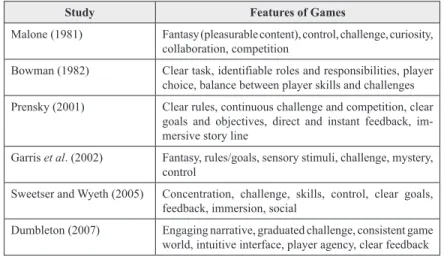
Extensive research has attempted to shed light on game features which generate engagement, motivation and flow. In his study of intrinsic motivation, Malone (1981) found that fantasy (or pleasurable content), control, challenge and curiosity were the primary features that mattered most. He later refined this model to include collaboration and competition (Malone & Lepper, 1987). Bowman (1982) evaluated the motivational supports in the well-known commercial game, Pac-Man, concluding that player flow and motivation can be sustained by supplying players with a clear task, iden-tifying roles and responsibilities, providing player choices and balancing learner skills with progressive challenges. Prensky (2001) has
outlined similar factors as being important to the creation of engaging computer games: clear rules, continuous challenge and competition, clear goals and objectives, direct and instant feedback, and an immersive story line. Garris
et al. (2002) have described game characteris-tics that facilitate player motivation as falling into six main categories: fantasy, rules/goals, sensory stimuli, challenge, mystery and control. Using Csikszentmihalyi’s flow elements as a basis, Sweetser and Wyeth (2005) have created a “Gameflow” model which outlines eight core elements of games which facilitate player enjoy-ment and engageenjoy-ment: concentration, challenge, skills, control, clear goals, feedback, immersion and social. Thus while opinions vary on the features of games which engage players, many common threads can be identified (Table 1).
In more recent times, digital games have become increasingly sophisticated in design. While early digital games such as Pac-Man
involve simple one-dimensional puzzles, con-temporary games are frequently situated in complex, multiplayer virtual worlds or ‘micro-worlds’ (de Freitas, 2007, p. 11). As techno-logical possibilities have advanced, the strate-gies by which game designers engage and motivate players have also developed. While multiple approaches are taken, Dickey’s tri-adic framework (2005) — which comprises
Table 1. Summary of game features identified as key to player engagement
Study Features of Games
Malone (1981) Fantasy (pleasurable content), control, challenge, curiosity, collaboration, competition
Bowman (1982) Clear task, identifiable roles and responsibilities, player choice, balance between player skills and challenges Prensky (2001) Clear rules, continuous challenge and competition, clear
goals and objectives, direct and instant feedback, im-mersive story line
Garris et al. (2002) Fantasy, rules/goals, sensory stimuli, challenge, mystery, control
Sweetser and Wyeth (2005) Concentration, challenge, skills, control, clear goals, feedback, immersion, social
Dumbleton (2007) Engaging narrative, graduated challenge, consistent game world, intuitive interface, player agency, clear feedback
player positioning, narrative and interactive design — provides a useful summary of design strategies for engagement in contemporary games.
Player Positioning
Player positioning refers to placement of the player within the game world, rather than exter-nal to it. In many contemporary games, this is achieved by adopting a first person perspective where the camera (or player view on screen) takes the position of the player/character’s eyes. A third person perspective (where the player can see their character on screen) is also commonly used. It is argued that both perspectives have the advantage of allowing the player to become more immersed in the game world (McMahan, 2003; Adams & Rollings, 2007).
Narrative
The use of narrative in game design has a long history and is part of an ongoing debate among the game design community. While proponents claim that a strong narrative can create a more immersive and engaging game play (Catania, 2009), opponents argue that the linear nature of narrative detracts from the central feature of game play that is interaction (Juul, 1998). Part of the reason for such contrasting views is that narrative in game design is conceptualised in various ways. Some designers view narrative as the non-interactive, presentational part of the story (Adams & Rollings, 2007). Conversely, Jenkins (2004) and Qin et al. (2009) argue that narrative is an important architectural compo-nent of game play and game designers are not storytellers but narrative architects: according to this perspective, the game serves as a frame for a story that is co-authored by the interac-tion of the player and the game. Similarly, Carson (2000) conceptualises narrative as “environmental storytelling,” where narrative is an all encompassing notion, a big picture of the world that is being created. He argues that rather than pause game play to narrate a story, game designers convey much of their “story”
through various elements within the physical game space — such as colour, lighting, texture, characters and props. In this way, rather than spelling out a story, the player is invited to explore and discover the “story.” As Carson (2000) states, the most important thing is that players feel in control, even though the designer has orchestrated the environment. This is rein-forced by Dickey (2005) who argues that the challenge for designers is to engage players in a narrative while giving them power to change that narrative through game play choices.
Interactive Design
As the title implies, interactive design refers to multiple design elements which span the game setting, characters and interactions, all of which, it is argued, play an important part in player immersion and engagement (Dickey, 2005). Firstly, it is posited that the physical representa-tion of characters within the game (including player and non-player characters (NPCs)) and characters’ dialogue significantly impact player immersion and thus engagement (McMahan, 2003; Dickey, 2005). Ultimately, the player should be able to identify with their character so that a psychological bond between the two is achieved (Bartle, 2007). Secondly, as previ-ously suggested, the interaction of player and game (via tasks, challenges, choices and so on), and consequent feedback has been highlighted by many as crucial to player engagement and motivation. Dickey refers to the mechanisms by which such interaction is facilitated as “hooks”: Howland (2002, as cited in Dickey, 2005) further classifies these into (1) action hooks (such as quests/missions), (2) resource hooks (such as ammunition and funds), (3) tactical and strategic hooks (such as decisions regarding resource allocation or strategy), and (4) time hooks (time restrictions imposed on the player). Thirdly, the game setting which comprises various elements — including the physical appearance of the game world, the role of time within the game, and the types of emo-tions that the game is designed to evoke — is
highlighted as an important factor in engaging players and providing a sense of immersion (Adams & Hollings, 2007).
The advent of highly realistic and sophis-ticated virtual worlds has, according to many developers, enhanced opportunities for im-mersion by giving players the sense of being surrounded by a completely different reality (Qin et al., 2009). In their quest for such im-mersion, and in an effort to exploit the new graphic possibilities, many developers aim to simulate visual reality as closely as possible, as evidenced in the highly realistic visuals in many contemporary commercial games (Wages
et al., 2004; Masuch et al., 2005; Becta, 2006; Chalmers & Debattista, 2009). While such visual fidelity is often prized by developers — due to the belief that greater fidelity leads to enhanced perceptual immersion — in the realm of serious games, fidelity is also aspired to by many educators in the belief that replicating real world scenarios will enhance transfer from the virtual to the real world (Chalmers & Debattista, 2009). However the relationship between fidel-ity, engagement and learning is not so simple, as will be discussed in the next section. Fidelity in Serious Games
In the context of serious game design, the concept of fidelity refers to the extent to which the game emulates the real world (Alexander et al., 2005). Although subject to various defini-tions (Maran & Glavin, 2003), it is commonly conceptualised on two levels. Physical fidelity refers to the degree to which the game envi-ronment looks, sounds and feels like the real world. Thus the physical fidelity of a game is determined by factors including visual display, controls, audio and physics models driving these variables. Functional fidelity is defined as the extent to which the game environment acts
like the real world in terms of its response to player actions, thus encompassing the elements of game narrative and interactivity (Alexander
et al., 2005).
The rationale for fidelity in serious games stems from the dual gaming/pedagogical objec-tives of (a) engaging and immersing players and (b) providing an effective learning experience. From a pedagogic perspective, it is often argued that the high levels of fidelity afforded by the 3D worlds of many serious games can lead to enhanced transfer of knowledge from the virtual world to the real (Chalmers & Debattista, 2009; Dalgarno & Lee, 2009): an argument which is underpinned by the belief that the more similar two situations are the greater the potential for transfer (Ormrod, 1999). Additionally, from the perspective of experiential learning, high fidelity purports to ensure greater authentic-ity: an important factor in the drive to evoke real world experiences. With regard to player engagement, fidelity, particularly physical fidelity, is a common goal of game designers, many of whom believe that the more realistic the physical environment, the more believable and psychologically immersive the experience (Wages et al., 2004). This is reinforced by the fact that in the commercial games market, realism and effect sell (Halff, 2005). In light of the highly sophisticated visuals of many commercial games, some believe that serious games must demonstrate similar levels of fidel-ity if they are to compete with their commercial counterparts and meet players’ expectations (Tuzun, 2007).
However, the relationship between fidelity, engagement/immersion and learning in serious games is not a simple one. From a visual per-spective, in contrast to widely held assumptions, research suggests that the more photorealistic the computer-generated environment, the less believable it becomes (Wages et al., 2004): a phenomenon commonly known as the “uncanny valley.” Coined by Mori (1970) and reinforced by later research (Brenton et al., 2005; Tinwell & Grimshaw, 2009), this phenomenon was first discovered during research into human re-sponses to human-like robots. Mori discovered that up to a certain level, as robots (or
computer-generated characters) demonstrate greater vis-ible similarity to a human, the more appealing they become to the observer. However, when they become disconcertingly human-like, there is a strong drop in believability, comfort and empathy: known as the “valley.” Various ex-planations for this valley have been proposed. Brenton et al. (2005) suggest that as a character becomes increasingly realistic, it is constrained to the physical attributes and behaviour of a real person (in the viewer’s eyes): the more visually human-like the character, the greater the viewer’s expectation. However, despite huge advances in graphic development, true photorealism is still unachievable (Edwards, 2009). Consequently, it is argued that virtual environments which aim for high visual fidelity risk undermining players’ tolerance for inaccu-racies or deviations in appearance and behaviour (Brenton et al., 2005). As Wages et al. (2004) state, ‘the “recognition of reality” awakens our “wardens of reality” …who instantly detect the incongruities’ (p. 220).
As this phenomenon, and the link between fidelity and immersion, has come under increas-ing scrutiny, more designers are now beginnincreas-ing to acknowledge that a game’s visuals play a minor role in sustaining player engagement and immersion. Instead it is argued that good game play and a strong narrative are more important: that is, psychological immersion is paramount (Bartle, 2007). Masuch et al. (2005) argue that the quality of immersion depends on believabil-ity, rather than realism of depiction. Thus they argue that consistency in graphical presentations and behaviour of game world objects is more important than true-to-life representations. In-deed Masuch et al. (2005) make a convincing case for non-photorealistic rendering (such as cartoon-like imagery). They state that such ren-dering can be used to highlight and emphasise certain parts of an image without breaking the atmosphere. Additionally, non-realistic graphic features can be used to support the game nar-rative and give extra information to the player. All this, they argue, can be achieved without “bursting the immersion bubble.” Indeed, from an educational perspective, Masuch et al.’s
design strategy has significant advantages as it allows designers to emphasise important points and provide scaffolding through additional graphic/text-based features. Wages et al. (2004) reinforce the argument for non-photorealistic rendering stating that as humans filter out more than 90% of sensory stimuli, including nones-sential information through photorealistic detail is a pointless endeavour.
The representation of reality (and the re-alism versus abstraction debate) also arises in discussions regarding the pedagogical frame-works of serious games. Underpinned by a long history of research into fidelity in simulation design (Hatzipanagos, 2009), aspirations for high fidelity on both physical and functional levels commonly derive from the belief that such fidelity is required to evoke a real-world experience, and thereby maximise transfer of learning (Dalgarno & Lee, 2009). However, research has shown that higher levels of fidel-ity do not necessarily translate into enhanced learning, but can in fact hinder learning with unnecessary complexity leading to cognitive overload (McKeachie, 2002). Consequently, it is recommended that serious game design involves ‘the extrapolation from reality of as-pects relevant to the educational task’ (Barton & Maharg, 2007, p. 117). Alexander et al. (2005) elaborate, suggesting that the appropriate level of fidelity depends on the learning objectives underpinning the game/simulation. Where these involve targeted skill training (such as learning to fire a weapon), high levels of physical fidel-ity may be appropriate. Conversely if abstract conceptual learning is the goal, functional fi-delity should arguably be prioritised. Similarly, Jentsch and Bowers (1998) argue that design-ers must prioritise those components which require a high-fidelity, depending on training requirements.
Determining which components to fore-ground can be difficult however, particularly because of the need for play elements in serious game design: many of which may not fit with a high-fidelity simulation approach. This is highlighted by King (2005) who, in his analy-sis of Full Spectrum Warrior (a military game
originally designed as a U.S. Army training aide and later released as a commercial game), describes the tensions between replicating real-ity and achieving playabilreal-ity. While the training version aimed for functional realism, it lost out on playability by omitting game play features such as save options, status icons and additional ammunition: conversely, the commercial release retained such features. King argues that while this may be a less “authentic” depiction of the real world, it is a more “playful” and therefore pleasurable experience. From a pedagogic perspective, it might also be argued that such play elements aid in scaffolding students: an important feature of situated learning and problem-based learning approaches (Young, 1993; Ma et al., 2007). While King does not explore the relationship between fidelity and pedagogy, he highlights important tensions in the design of game-based learning regarding the balancing of fidelity with the dual objectives of pedagogy and play.
CONCLUSION
This paper has explored a triadic theoretical framework for serious game design, compris-ing the elements of play, pedagogy and fidel-ity. It has outlined underpinning theories and key literatures and it has identified associated challenges and issues. These literatures provide a rich theoretical basis for the serious game design process, however it is clear that due to the inherent incongruities between game design (which prioritises entertainment), simulation design (which prioritises fidelity), and peda-gogy (which prioritises education), difficulties persist in balancing these elements during the design process and indeed in reconciling these elements into one coherent theoretical frame-work for serious game design: as evidenced by numerous failed attempts (Dumbleton, 2007; Aldrich, 2005; Harteveld et al., 2010; Harteveld, 2011). A further challenge results from the inherent multidisciplinary nature of serious game design: while it frequently entails collaboration among multiple team members
from different disciplines (for example technical versus pedagogic parties), conflicting interests, perspectives and priorities of designers from different backgrounds can also complicate the “balancing” process (Lynch & Tunstall, 2008; Pulman & Shufflebottom, 2009; Rooney, 2011). While these reported difficulties have led many to conclude that serious game design is an art as opposed to a science (Aldrich, 2010; Klopfer et al., 2009), previous studies have also suggested that developing guidelines for integrating these components in serious games would be a useful addition to the literature (Rooney, 2011). Indeed, such guidelines may prove particularly crucial for educators in HE who may be keen to embark on such ventures but may be unaware of the “tradeoffs” involved and how to achieve them.
REFERENCES
Adams, E. (2010). Fundamentals of game design. Upper Saddle River, NJ: Pearson Education. Adams, E., & Rollings, A. (2007). Game design and development: Fundamentals of game design. Upper Saddle River, NJ: Pearson Education.
Aldrich, C. (2005). Learning by doing: A compre-hensive guide to simulations, computer games, and pedagogy in e-learning and other educational experiences. San Francisco, CA: Pfeiffer.
Aldrich, C. (2010, June 18). Game elements: A spoon-ful of sugar if you can avoid hypoglycemic shock [Web log comment]. Retrieved from http://clarkaldrich. blogspot.com/2007/03/game-elements.html Alexander, A. L., Brunye, T., Sidman, J., & Weil, S. A. (2005). From gaming to training: A review of studies on fidelity, immersion, presence, and buy-in and their effects on transfer in PC-based simulations and games. DARWARS Training Impact Group. Retrieved from http://www.darwars.bbn.com/press/ research.html
Anderson, J. R., Reder, L. M., & Simon, H. A. (1996). Situated learning and education. Educational Researcher, 25(4), 5–11.
Barab, S., Thomas, M., Dodge, T., Carteaux, R., & Tuzun, H. (2005). Making learning fun: Quest Atlantis, a game without guns. Educational Tech-nology Research and Development, 53(1), 86–107. doi:10.1007/BF02504859
Barab, S. A., Squire, K. D., & Dueber, W. (2000). A co-evolutionary model for supporting the emergence of authenticity. Educational Technology Research and Development, 48(2), 37–62. doi:10.1007/ BF02313400
Bartle, R. (2007). Presence and flow: Ill-fitting clothes for virtual worlds. Techne: Research in Philosophy and Technology, 10(2), 1–22.
Barton, K., & Maharg, P. (2007). E-Simulations in the wild: interdisciplinary research, design, and imple-mentation. In Gibson, D., Aldrich, C., & Prensky, M. (Eds.), Games and simulations in online learning: Research and development frameworks. Hershey, PA: Information Science Reference.
Beard, C., & Wilson, J. P. (2002). Experiential learning: A best practice handbook for educators and trainers. London, UK: Kogan Page.
BECTA. (2006). Engagement and motivation in games development processes. Coventry, UK: BECTA. Retrieved from http://www.freewebs.com/ pamsgamelearning/BECTA-games.pdf
Boud, D. (1998). Challenge of problem-based learn-ing. London, UK: Kogan Page.
Bowman, R. F. (1982). A “Pac-Man” theory of moti-vation: Tactile implications for classroom instruction.
Educational Technology, 22(9), 14–17.
Brenton, H., Gillies, M., Ballin, D., & Chatting, D. (2005, September). The uncanny valley: Does it exist? In Proceedings of the 19th British HCI Group Annual Conference: Workshop on Human-Animated Character Interaction, Edinburgh, UK. Retrieved from http://citeseerx.ist.psu.edu/viewdoc/ summary?doi=10.1.1.160.6952
Brown, E., & Cairns, P. (2004, April). A grounded investigation of game immersion. In Proceedings of the Conference on Human Factors in Comput-ing Systems, Vienna, Austria. Retrieved from http:// portal.acm.org/citation.cfm?id=986048
Brown, J. S., Collins, A., & Duguid, P. (1989). Situated cognition and the culture of learning. Edu-cational Researcher, 18(1), 32–42.
Carson, D. (2000, March 1). Environmental storytell-ing: Creating immersive 3D worlds using lessons learned from the theme park industry. Retrieved from http://www.gamasutra.com/features/20000301/ carson_pfv.htm
Catania, A. (2009) Les jeux sont fait! Immersiveness and the manageability of game narratives. E|C Serie Speciale, 3(5) 37-40. Retrieved from http://www. ec-aiss.it/monografici/5_computer_games/4_cata-nia.pdf
Chalmers, A., & Debattista, K. (2009, March). Level of realism for serious games. In Proceedings of VS Games: Games and Virtual Worlds for Serious Ap-plications, Coventry, UK (pp. 225-232).
Csikszentmihalyi, M. (1990). Flow: The psychol-ogy of optimal experience. New York, NY: Harper Perennial.
Dalgarno, B., & Lee, M. J. W. (2009). What are the learning affordances of 3-D virtual environments?
British Journal of Educational Technology, 41(1), 10–32. doi:10.1111/j.1467-8535.2009.01038.x De Freitas, S. (2007). Learning in immersive worlds: A review of game-based learning. Bristol, UK: JISC. Retrieved from http://www.jisc.ac.uk/media/ documents/programmes/elearninginnovation/gam-ingreport_v3.pdf
De Freitas, S., & Griffiths, M. (2007). Online gam-ing as an educational tool in learngam-ing and traingam-ing.
British Journal of Educational Technology, 38(3), 535–537. doi:10.1111/j.1467-8535.2007.00720.x De Freitas, S., & Maharg, P. (2011). Digital games and learning: Modelling learning experiences in the digital age. In De Freitas, S., & Maharg, P. (Eds.),
Digital games and learning. London, UK: Continuum International.
Delise, R. (1997). How to use problem-based learning in the classroom. Alexandria, VA: Association for Supervision and Curriculum Development. Derry, S. J., & Steinkuehler, C. A. (2003). Cognitive and situative theories of learning and instruction. In Nadel, L. (Ed.), Encyclopedia of cognitive science. London, UK: Nature.
Dickey, M. D. (2005). Engaging by design: How engagement strategies in popular computer and video games can inform instructional design. Edu-cational Technology Research and Development,
53(2), 67–83. doi:10.1007/BF02504866
Driscoll, M. (2000). Psychology of learning for in-struction. Needham Heights, MA: Allyn and Bacon.
Dumbleton, T. (2007). Games to entertain or games to teach? In Emerging technologies for learning (Vol. 2). Coventry, UK: BECTA. Retrieved from http:// partners.becta.org.uk/page_documents/research/ emerging_technologies07_chapter5.pdf
Edwards, B. (2009, May 26). Epic’s Sweeney: Games are ‘factor of 1000’ off from graphical real-ism. Retrieved from http://gamasutra.com/php-bin/ news_index.php?story=23742
Frangoul, A. (2010, April 15). Logged on and switched off. The Sunday Times Magazine. Re-trieved from http://www.thesundaytimes.co.uk/sto/ Magazine/Features/article261638.ece
Garris, R., Ahlers, R., & Driskell, J. E. (2002). Games, motivation and learning: A research and practice model. Simulation & Gaming, 33(4), 441–467. doi:10.1177/1046878102238607
Gijbels, D., Dochy, F., Bossche, P. V. D., & Segers, M. (2005). Effects of problem-based learning: A meta-analysis from the angle of assessment.
Review of Educational Research, 75(1), 27–62. doi:10.3102/00346543075001027
Halff, H. (2005, July). Adventure games for science education: Generative methods in exploratory envi-ronments. In Proceedings of the 12th International Conference on Artificial Intelligence in Education, Amsterdam, The Netherlands. Retrieved from http:// halffresources.com/files/Adventure%20Games%20 for%20Science%20Education.pdf
Harteveld, C. (2011). Triadic game design. London, UK: Springer. doi:10.1007/978-1-84996-157-8 Harteveld, C., Guimaraes, R., Mayer, I. S., & Bidarra, R. (2007, June). Balancing pedagogy, game and reality components within a unique serious game for training levee inspection. In Proceedings of the 2nd International Conference on Technologies for e-Learning and Digital Entertainment, Hong Kong, China (pp. 128-139). Retrieved from http://portal. acm.org/citation.cfm?id=1772194
Harteveld, C., Guimaraes, R., Mayer, I. S., & Bidarra, R. (2010). Balancing play, meaning and reality: the design philosophy of Levee Pa-troller. Simulation & Gaming, 41(3), 316–340. doi:10.1177/1046878108331237
Hatzipanagos, S. (2009, June). Hiding something from the learner? A framework for designing com-puter simulation interfaces. In Proceedings of the World Conference on Educational Multimedia, Hy-permedia and Telecommunications, HI (pp. 986-993).
Hoffman, B., & Nadelson, L. (2010). Motivational en-gagement and video gaming: A mixed methods study.
Educational Technology Research and Development,
58(3), 245–351. doi:10.1007/s11423-009-9134-9 Holman, D., Pavlica, K., & Thorpe, R. (1997). Rethinking Kolb’s theory of experiential learn-ing in management education: The contribu-tion of social construccontribu-tionism and activity theory. Management Learning, 28(2), 135–148. doi:10.1177/1350507697282003
Jarvis, P., Holford, J., & Griffin, C. (2003). The theory and practice of learning. London, UK: Kogan Page. Jenkins, H. (2004). Game design as narrative archi-tecture. In Wardrip-Fruin, N., & Harrigan, P. (Eds.),
First person: New media as story, performance, game. Cambridge, MA: MIT Press.
Jennett, C., Cox, A. L., Cairns, P., Dhoparee, S., Epps, A., Tijs, T., & Walton, A. (2008). Measuring and defining the experience of immersion in games.
International Journal of Human-Computer Studies,
66(9), 641–661. doi:10.1016/j.ijhcs.2008.04.004 Jentsch, F., & Bowers, C. A. (1998). Evidence PC-based simulations in studying aircrew coordination.
The International Journal of Aviation Psychology,
8(3), 243–260. doi:10.1207/s15327108ijap0803_5 Johnson, W. L., Vilhjalmsson, H., & Marsella, M. (2005, July). Serious games for language learning: How much game, how much AI? In Proceedings of the Twelfth International Conference on Artificial Intelligence in Education, Amsterdam, The Neth-erlands. Retrieved from http://www.ru.is/faculty/ hannes/publications/AIED2005.pdf
Juul, J. (1998, November). A clash between game and narrative. In Proceedings of the Digital Arts and Culture Conference, Bergen, Norway. Retrieved from http://www.jesperjuul.net/text/clash_between_ game_and_narrative.html
Kebritchi, M., & Hirumi, A. (2008). Examining the pedagogical foundations of modern educational computer games. Computers & Education, 51(4), 1729–1743. doi:10.1016/j.compedu.2008.05.004 Kiili, K. (2005). Digital game-based learning: To-wards an experiential gaming model. The Internet and Higher Education, 8(1), 13–24. doi:10.1016/j. iheduc.2004.12.001
Kiili, K. (2007). Foundation for problem-based gam-ing. British Journal of Educational Technology, 38(3), 394–404. doi:10.1111/j.1467-8535.2007.00704.x