International Journal of Research and Review
www.ijrrjournal.com E-ISSN: 2349-9788; P-ISSN: 2454-2237
Research Paper
Secondary School Students’ Perception of Teachers’ Attitude towards
Learning in Mathematics in Wukari Metropolis, Taraba State, Nigeria
Dr. P. I. Anyagh, Mr. O. Hanmane, Mr. J. A. Abah
Department of Science Education, University of Agriculture, Makurdi, Nigeria
Corresponding Author: Dr. P. I. Anyagh
ABSTRACT
This study was designed to investigate secondary school students’ perception of their teachers’ attitude towards them in the learning of mathematics. The study adopts a survey research design on a sample of 242 Senior Secondary School Two (SSS2) students randomly drawn from a population of 1210 SSS2 students in Wukari Metropolis, Taraba State, Nigeria. The analysis of data obtained via the researcher-developed questionnaire indicates that teachers have displayed negative attitude towards their students in the learning of mathematics. The results implied that students’ mathematics learning is highly influenced by the actions and inactions of the teacher, consequently building in them wrong disposition towards the subject. Based on the findings of this study, it was recommended that students’ evaluation of their teachers’ teaching should be considered as one of the main tools for evaluating teachers’ teaching and effectiveness.
Keywords: Attitude, Teacher evaluation, Mathematics education, Gender difference INTRODUCTION
The study of Mathematics in Nigeria has continued to generate a great deal of interest. The fact that an average Nigerian child under-achieved in mathematics is a source of serious concern to stakeholders, parents and the general public. The importance of mathematics to nation building has led the Federal Government of Nigeria to making the subject core both at the basic and secondary education level (FGN, 2014). Despite the importance attached to mathematics as key subject in
realizing the nation scientific and
technological aspiration, it has experienced a flood of persistent high failure (Imoko & Isa, 2015).
The recent debate on the falling standards of students’ achievement in mathematics has triggered the growing attention for researchers, parents and education authorities in their quest for the
way forward over the last two decades. The teaching and learning of mathematics has therefore been an issue of considerable concern for some time now (Ampadu, 2012). In response to this demand,
researchers, educators and other
stakeholders in the education sector have advanced educational arguments supporting the need for scientific evidence into the issue and the way forward. This also informed why the government and other stakeholders in the education sector have introduced a number of initiatives to promote effective teaching and learning of mathematics with the aim of making the subject more enjoyable.
In recent time, several studies have been conducted and have identified factors responsible for students’ low achievement in mathematics. For example Lamb and Fullarton (2012) identified three different
mathematics teaching and learning, which are personal, classroom and school related
factors. Lamb and Fullarton further
classified individual personal factors as believes and attitude, preparedness and willingness to learn; home factors as socio-economic status, parents’ educational background and occupation and classroom and school factors as the school physical environment, learning resources, teaching and learning strategies. Also, Ajai and Iyekekpolor (2016) opines that mathematics teachers are not interested in helping their students by way of catering for their individual differences and needs.
Despite the importance of these different but interrelated factors, the core of the interplay between the learner and what is learned is accredited to the teacher (Ampadu, 2012). A number of studies on teacher related factors on students’ learning and their achievement (Kravitz, 2013; Ajai & Iyekekpolor, 2016) have shown that teachers’ subject contend knowledge impacts on their teaching. Ajai and
Iyekekpolor (2016) established that
although mathematics teachers’ subject contend knowledge plays a vital role in their
teaching, merely knowing more
mathematics does not ensure that one can teach in the way that promote students conceptual understanding. Lam (2011) explained that good subject knowledge and the kind of perception that the teacher have toward mathematics determines how he or she teaches. Lam further argued that the way a teacher teaches is immensely influenced by the teacher’s theoretical perspective and more particularly his/her beliefs and perception toward the subject. It is in view of this that the impact of teacher related factors on students’ learning and achievement in mathematics has become imperative.
Research about teacher’s beliefs and perceptions of their teaching has been receiving considerable attention for some time now (Ampadu, 2012). Perception is the way people judge others with whom they are in contact (Ramzi, 2014). Ahmad and
Aziz (2009) argued that information from students regarding their teachers’ teaching provides a more meaningful insight of what their teachers does. Ahmad and Aziz further argued that the information from students about their teachers’ teaching is valuable since their perceptions are coloured by challenging and interesting experiences that allow them to observe learning and teaching behaviours more intimately than their teachers. That is, students perception of their teacher ‘s teaching contribute very much in improving the teaching and learning of the subject as it provides valuable suggestions and directions for the teacher’s future improvement. Students develop conceptual understanding of the concept presented when they perceive their
teachers’ classroom environment as
cooperative rather than competitive.
In describing students perception regarding their mathematics teachers’ teaching, Rawnsley (2010) established that students develop a more positive attitude toward their mathematics lessons where the teacher is considered to be highly supportive and gives the students the chance to play an integral role in the teaching-learning process. Skaalvik and Federici (2014) reported research findings that have
consistently indicated that positive
perceptions of teachers are associated with positive educational outcomes, such as students’ engagement (Patrick, Ryan,&
Kaplan, 2007), academic initiative
(Danielsen, Wiium, Wilhelmsen, &Wold, 2010), higher self-esteem and lower levels of anxiety (De Wit, Karioja, Rye, &Shain, 2011).
Gender-related differences in
students’ perception of teacher behaviour by Kim, Fisher and Fraser (2010) found significant differences between boys and girls. Empirical studies support the view that students’ perceptions of support are
developmentally consequential (Sidhu,
2009). Adolescents’ perceptions of social
support predict improvement in
psychosocial adjustment, even when these perceptions are not consistent with more
objective data (Kessler & Mcleod, 2005; Mcelhaney, Antonishak, & Allen, 2008). These findings have led researchers to conclude that perceived support may be as important to students’ adjustment as enacted support (Murray, &waas, 2008). There are other studies that report positive concurrent association between students’ perceptions of teacher support and their sense of attachment to, liking for, and involvement in school (Gest, Domitrovich, & Welsh, 2010;Murray, Murray & Waas, 2008). An extensive body of research emanating from social cognitive theory (Bandura, 1986) indicates that children do better and are more motivated to seek challenging tasks and to be persistent in the face of challenges when they believe that they are capable of accomplishing these tasks.
Assessing teachers using students’ ratings and feedback has proved to be reliable and one of the best methods of measuring teachers’ instructional practices by a number of studies (Fuller, 2009; Collins, 2011). Mathematics education
researchers have recently begun to
investigate students’ perceptions of their classroom learning environments using adaptations of instrument widely used in science education (Yang, 2013). However, there are limited studies that have investigated teachers’ teaching practices by examining students’ perceptions of their teachers’ teaching. Furthermore within the context of Nigerian educational system, studies that evaluate teachers’ instructional practices through students’ ratings are scanty.
Purpose of the Study
The purpose of this study was to determine the extent students’ perceived teachers’ attitudes as a factor that influence teaching and learning of mathematics in
senior secondary schools in Wukari
Metropolis, Taraba State.
Significance of the Study
This study, in its unique way, investigated secondary school students’ perception of their teachers’ attitude towards them in learning mathematics. This
study is significant in different ways. Firstly, the study reveals information about teachers’ attitude towards their students’, in mathematics, by examining students’ perceptions as they are the only actual witnesses of what happens in the classroom. Furthermore, the study may lead to further research in understanding mathematics teachers’ teaching practices and their attitudes towards their students. Besides that, the results may provide useful
information to the educational
administrators in providing new systems of assessing teachers’ teaching.
Research Question and Hypothesis
The study is guided by a research question and hypothesis which was tested at 0.05 level of significance.
Research Question: To what extent do students perceived their teachers’ attitudes toward them in learning mathematics?
Hypothesis: There is no significant difference between the male and female students’ perceptions of their teachers’
attitudes toward them in learning
mathematics?
METHODOLOGY
The research design for this study
was cross-sectional survey design.
However, the study was conducted in Wukari Metropolis, Taraba State, Nigeria. The population of the study was 1,210 Senior Secondary School two (SS 2) students from nine government-owned Secondary Schools in the study area. From this, 242 students were sampled using simple random sampling of hat and draw. This was made up of 121 male and 121 female students. The choice of senior secondary school two was purposive. This was basically because they were in their 2nd year in senior secondary school and had acquainted and adapted themselves to the school environment. Also, they have been study mathematics as a school subject long enough to provide judgment about their teachers’ attitudes toward mathematics. The instrument for data collection was a questionnaire about students’ perception of
their teachers’ attitudes toward mathematics, with each statement on a four-point Likert-type scale (Strongly Agree, Agree, Disagree, and Strongly Disagree). It
was validated by measurement and
evaluation experts. The instrument has a reliability index of 0.81, established using Cronbach alpha reliability test. Allocation of scores to scale are 4, 3, 2, 1 for responses SA, A, D, SD respectively for items designated as positive (+) while 1, 2, 3, 4 for responses SA, A, D, SD for items designated as negative (-). The average (mean) is therefore 2.5. This was arrived at by adding the point scale (4+3+2+1=10) and dividing the sum by 4 (i.e. 10/4). Based on the way the items were structured in the instrument that is, negatively toned: high mean therefore stands for negative attitude while low mean stands for positive attitude. The interpretation for the mean scores is such that low mean (1.00 – 2.00) stands for
positive attitude, since most items were in negative form, while high mean (2.51 – 4.00) is taking as negative attitude. Mean scores of between 2.01 and 2.50 is taken as being undecided (although not in the scale). Also, reject non-hypothesis if t-calculated is greater than table-value. Otherwise do not reject. Data collected were analyzed using mean, standard deviation and t-test at 0.05 level of significant. The choice of t-test for the test of hypothesis was based on its ability to determine if there exists a different or not while comparing two group means.
RESULTS
The results are presented according to the research question and hypothesis.
Research Question: To what extent do students perceived their teachers’ attitudes toward them in learning mathematics?
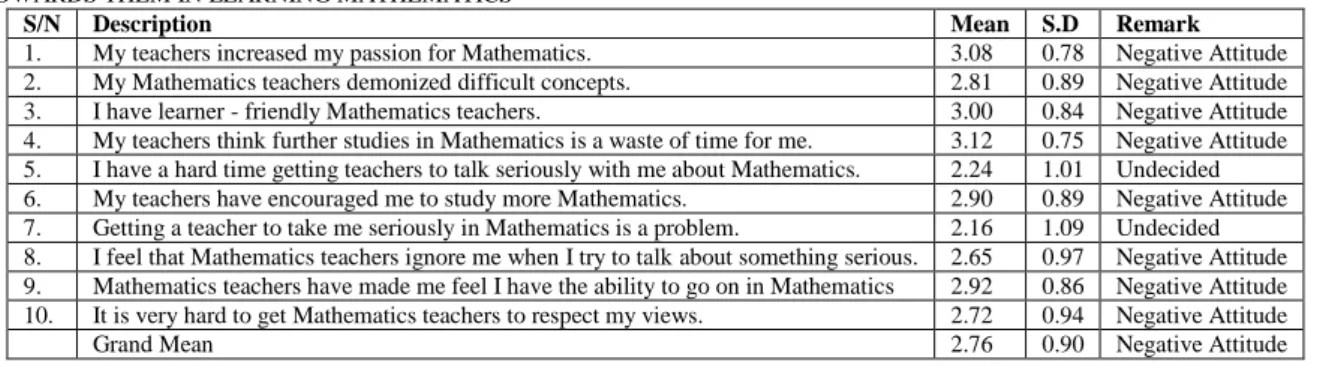
TABLET 1: MEAN AND STANDARD DEVIATION RATINGS OF STUDENTS’ PERCEPTION OF TEACHERS’ ATTITUDE
TOWARDS THEM IN LEARNING MATHEMATICS
S/N Description Mean S.D Remark
1. My teachers increased my passion for Mathematics. 3.08 0.78 Negative Attitude 2. My Mathematics teachers demonized difficult concepts. 2.81 0.89 Negative Attitude 3. I have learner - friendly Mathematics teachers. 3.00 0.84 Negative Attitude 4. My teachers think further studies in Mathematics is a waste of time for me. 3.12 0.75 Negative Attitude 5. I have a hard time getting teachers to talk seriously with me about Mathematics. 2.24 1.01 Undecided 6. My teachers have encouraged me to study more Mathematics. 2.90 0.89 Negative Attitude 7. Getting a teacher to take me seriously in Mathematics is a problem. 2.16 1.09 Undecided 8. I feel that Mathematics teachers ignore me when I try to talk about something serious. 2.65 0.97 Negative Attitude 9. Mathematics teachers have made me feel I have the ability to go on in Mathematics 2.92 0.86 Negative Attitude 10. It is very hard to get Mathematics teachers to respect my views. 2.72 0.94 Negative Attitude
Grand Mean 2.76 0.90 Negative Attitude
Table 1 reveals the mean of students’ perception on their teachers’ attitudes towards them in mathematics learning. The grand mean of 2.76, in this case, is above the criterion mean of 2.50, a clear indication that students perceived their teachers as having negative attitudes towards them in learning mathematics.
Hypothesis: There is no significant difference between the male and female students’ perceptions of their teachers’
attitudes toward them in learning
mathematics?
TABLE 2: MALE AND FEMALE STUDENTS’ PERCEPTION OF THEIR TEACHERS’ ATTITUDES TOWARDS THEM IN
LEARNING MATHEMATICS.
Gender Mean SD Df t-value Sig(2-tailed) Remark
Male 28.04 4.49 240 1.98 .917 Not significant Female 28.10 5.15
Table 2 shows the t-calculated of 0.917 was less than the table-value of 1.98. Since the t-calculated of 0.917 was less than
the table-value of 1.98, the null hypothesis of no significant difference was not rejected. It means that there was no statistical
significant difference between male and female students’ perception of their teachers’ attitudes towards them in learning mathematics.
DISCUSSION OF FINDINGS
The results of this study have shown that teachers had negative attitude toward their students in the learning of mathematic. The finding of the study is in tone with that of Yang (2013), where students perceived that they ‘less than often’ receive help from their mathematics teacher. This finding is also in agreement with Yang (2013) who observed that mathematics teachers do not offer sufficient support for effective mathematics learning.
The submission of this finding is in agreement with Ajai and Iyekekpolor (2016), that mathematics teachers are not interested in the subject and do not help their students by way of catering for their individual differences and needs. Rawnsley (2010) had early posited students develop a
more positive attitude toward their
mathematics lessons where the teacher is perceived to be highly supportive, equitable and gives the students the chance to play an integral role in the teaching-learning process. The situation would be however different, going by the finding of this study. This is because students perceived their teachers as not supportive but rather
discouraging them from learning
mathematics.
The result of this study also affirms there is no significant difference between the mean rating perception of male and female students on their teachers’ attitude towards them in learning mathematics. This however, is at variance with Shadrek (2012) where male and female students differ in their perceptions. Finding of this study is similar to Rajoo (2013), that there is no significant difference between students’ perception based on gender. The reason for no significant difference between the perception of male and female students may not be unconnected with the fact that both saw themselves as equals capable of
competing and collaborating in classroom activities. This is an affirmation that students’ perception is a function of
orientation rather than gender. The
implication of this study shows that students’ learning is highly influenced by the actions and inactions of the teacher since the teacher controls the students’ learning experiences by telling them what to do and what not to do (Ampadu, 2012).
Recommendations
Based on the findings of this study, the following recommendations were made: 1. Students should be enlightened on how
best to rate and evaluate their teachers’ teaching practices and effectiveness.
2. Teachers should conduct regular
evaluation of their teaching by asking their students to rate and evaluate their teaching practices.
3. Students’ evaluation of their teachers’ teaching should be considered as one of the main tools for evaluating teachers’ teaching and effectiveness.
CONCLUSION
Students’ participation in the instructional process is critical and their perception can aid the teacher to reflect upon and adjust his teaching strategies and dispositions towards students, to enhance students’ understanding and achievement.
Furthermore, knowing students’
perceptions, the teacher can reformulate the best approach that will portray him as a friend of the students to provide an ideal mathematics learning environment and ensure better achievement.
REFERENCES
Ahmad, F., and Aziz J. (2009) Students’ perception of their teachers’ teaching of
literature communicating and
understanding through the eyes of the audience. European Journal of Social Science, 7(3) 17-26.
Ajai, J. T. and Iyekekpolor, S. A. O. (2016). Remedial Students’ Perception of Teachers’ Attitude Towards Learning
in Mathematics in Taraba State
Mathematical Association of Nigeria,
41(1), 256-264.
Ampadu, E. (2012). Students’
perceptions of their teachers’ teaching of mathematics: The case of Ghana.
International Online Journal of Educational Sciences, 4(2), 351-388. Bandura, A. (1986). Social foundation
of thought and action: A social cognitive theory. Englewood Cliffs, NJ: Prentice Hall.
Collins, M., (2011) Reflective faculty evaluation: Enhancing teaching and determining faculty effectiveness. San Francisco: Jossey-Bass.
Danielson, A.G., Wiinum, N.,
Wihelmsen, B.U., &Wold, B. (2010). Perceived support provided by teachers and classmates and students’ self-reported academic initiative. Journal of School Psychology, 48(3), 247-267. http://dx.doi.org/10.1016j.jsp.2010.02.0 02.
De Wit, D. J., Karioja, K., Rye, B.J., &
Shain, M. (2011).Perception of
declining classmates and teacher support following the transition to high school. Portential correlates of increasing students mental health difficulties. Psychology in the Schools, 48(6), 556-572.Retrieved on 6th March,
2017 from
http://dx.doi.org/10.1002/pits.20576. Federal Republic of Nigeria - FGN
(2014). National Policy on Education. Lagos: Federal Government Press. Fuller, P. K., (2009) Student ratings of
teaching: The research revisited. IDEA Paper No. 32,IDEA Center, Kansas State University.
Gest, S.D., Domitrovich, C.E. & Welsh, J.A. (2010). Peer academic reputation in elementary school: Association with changes in self-concept and academic
skills. Journal of Educational
Psychology, 97, 337-346.
Imoko, B.I. &Isa, S.A. (2015). Impact
of computer Genues on pupils
achievement in mathematics in primary achievement in mathematics in primary school Lafia Local Government Area: A tool for technological development. Proceedings of September 2015 Annual
National Conference of Mathematical Association of Nigeria. pp 63-71. Kessler, R.C. & Mcleod, J.D.
(2005).Social support and mental health in community samples. In S. Cohen (ed.), Social Support and Health. New York, NY: Academic Press. pp.219-240.
Kim, H., Fisher, D. & Fraser, B.
(2010).Classroom environment and
teacher interpersonal behavior in secondary science classroom in Korea.
Evaluation and Research in Education, 14, 3-22.
Kravitz, C. (2013). Why math is important. Retrieved on 10th July 2013 from
www.slideshare.net/chelseakravitz/why-math-is-important.
Lam, P. (2011). The impact of beliefs on the teaching of mathematics. In P. Lam (ed.), Mathematics Teaching: The State of The Art. London: Falmer Press: 249-254.
Lamb, S., & Fullarton, S., (2012) Classroom and school factors affecting
mathematics achievement: A
comparative study of Australia and the United States using TIMSS, Australian Journal of Education, 46,154-171. McElhaney, K.B., Antonishak, J &
Allen, J.P.(2008). They like me, they like me not: population and adolescents’
perception of acceptance. Child
Development 7,493-513.
Murray, C., Murray, K.M. &Waas, G.A. (2008). Child and teacher reports of
teacher-students relationships:
Concordance of perspectives and
association with school adjustment in urban kindergarten. Journal of Applied Development Psychology, 29,49-52. Patrick, H., Kaplan, A., & Ryan, A.M.
(2007). Positive Classroom
Motivational Environments:
Convergence between mastery goal structure and classroom social climate.
Journal of Educational Psychology, 10(2), 367-382. Retrieved on 7th March
2017 from
http://dx.doi.org/10.1037/A002331
Rajoo, M.A. (2013). Students
perception of mathematics classroom
achievement: A study in sipitang, Sabah, Malaysia. ICSSR E-Journal of Social Science Research, 2013,325-343. Ramzi, R. A. (2014). Mobile digital
devices: Dipping your toes in
technological waters. Teacher
Librarian, 39(1), 22-26.
Rawnsley, D.G. (2010). Learning
environment in mathematics classroom and their association with students and learning. Paper presented at the Australian Association for research in
Education Conference, Adaliade,
Australia. Retrieved on 4th March, 2017 from
http://www.aare.edu.au/98pap/fis98269. htm
Shadrek, M. (2012).Zimbabwe science students’ perception of their classroom learning environment and their attitude
towards science. Mediterranean Journal of Social Science 3(11), 415-425. Skaalvik, E.M. & Federici, R A.
(2014).Students perception of emotional and instrumental teacher support:
Relations with motivational and
emotional responses. International Education Studies, 7 (1), 21-36.
Sidhu, E.F. (2009). The relation between stressful life events and
adjustment in elementary school
children: The role of social support and social problems-solving skills. Child Development, 60,1412-1423.
Yang, X. (2013).Investigation of junior secondary students’ perceptions of
mathematics classroom learning
environment in China. Eurasia Journal of Mathematics, Science Technology Education, 2013
******
How to cite this article:Anyagh PI, Hanmane O, Abah JA. Secondary school students’ perception of teachers’ attitude towards learning in mathematics in wukari metropolis, Taraba state, Nigeria. International Journal of Research and Review. 2018; 5(5):69-75.