Exploring Teacher Readiness to Integrate Information and
Communication Technologies into the Teaching and Learning Process: A
Case Study of Two Gauteng Schools.
BY
TINIKA NAICKER
(556916)
A research report submitted to the School of Education, Faculty of
Humanities, University of the Witwatersrand, in partial fulfilment of the
requirements for the degree of Master of Education.
DECLARATION
I declare that this research report is my own unaided work. It is submitted for the degree of Master of Education at the University of the Witwatersrand, Johannesburg. It has not been submitted before for any other degree or examination to any other University.
……….
Tinika Naicker August 2017
SUPERVISORS' STATEMENT
This research report has been submitted wit~ our approval
en Dlamini (Co-Supervisor)
DEDICATION
I dedicate this research study to my beloved parents, Jessy and Lorraine Naicker. You have both been a source of inspiration and a guiding light throughout my life. You have made sacrifices and have dedicated your life to ensuring that your children succeed. Thank you for allowing me to explore my horizons by giving me unbridled opportunity. You have instilled in me the importance of education. Forever shall I remain indebted to you.
ACKNOWLEDGEMENTS
The culmination of my Master’s journey is largely attributed to the support received by the following individuals, to whom I am immensely grateful:
To Lorenzo Ephraim, I cannot thank you enough for being so supportive and understanding throughout my research journey. You have always shown interest in my research and have dedicated time to offering me advice, assistance and continuous encouragement. Thank you for helping me to succeed.
My sisters Larissa and Tiasha and brothers-in-law Merlin and Vieolin, you have all been my support system and have encouraged me to persevere and never give up. You have allowed me to rejuvenate when I needed to clear my mind. Thank you for being so understanding when many events were attended by both my computer and I.
To my dearest Meera Pather, you have become my whole world in the short space of two years. You have been my source of motivation and have helped me to remain determined during the completion of my research. Your company, heart-warming smiles, and hugs have constantly fuelled my research journey. I hope that, in turn, I have fuelled your spark to welcome all the knowledge that unravels as you journey into this world.
To all my aunties, uncles, cousins, and friends, thank you for your continuous support and concern throughout my studies. You have motivated me to achieve my goals.
My supervisor Dr Siphiwe Mthiyane, you have been a knowledgeable mentor who has offered me guidance, clarity and support. Thank you for your continuous effort throughout this journey. You have offered me useful and insightful feedback. To my co-supervisor, Dr Reuben Dlamini, thank you for your support.
ABSTRACT
The Department of Education (2004) stipulated in the White Paper on e-Education policy document that all teachers (including Gauteng teachers) were to be Information and Communication Technology (ICT) capable by the year 2013. This research study was targeted at exploring how ready the teachers from the researched schools were to integrate ICTs into the teaching and learning process. In exploring teachers’ readiness, the study focused upon four areas, namely teachers’ ICT knowledge (informed by Mishra and Koehler’s (2006) TPACK model), teachers’ ICT attitudes (informed by Parasuraman’s (2000) TRI), the ICT training received, and the role played by school principals in contributing to teachers’ ICT readiness. By exploring these areas information was obtained on how teachers were prepared and whether they were prepared, which gave insight into how ready they were for the ICT integration process. In order to gain the relevant data, ten teachers from two Gauteng schools were interviewed and administered a questionnaire to complete. In addition, the school principal from each school was interviewed. It was found that the majority of the research participants had a positive attitude towards the integration of ICTs into teaching and learning. These teachers also had a good leadership influence, which provided support and conditions that were also essential in facilitating the ICT integration process. However, it was found that the training that majority of the teachers received was not instrumental in providing them with the required ICT knowledge. Consequently, based on these two areas (ICT knowledge and ICT training) serving to be problematic, it is concluded that the teachers at the researched schools were not adequately prepared and thus predominately not ready to integrate ICTs effectively into the teaching and learning process in their schools. The findings of the study, the literature reviewed, and the theoretical foundations central to this study were used to develop a teacher ICT preparation framework. This framework was developed to inform the preparation that teachers receive for the ICT integration process. The framework could contribute to teachers being more ready to integrate ICTs effectively into the teaching and learning process in their schools.
Keywords: ICT Knowledge, ICT Attitude, ICT Training, Role of School Principal, ICT Readiness
TABLE OF CONTENTS
Declaration...ii
Supervisors’ statement ... iii
DEDICATION... iv
ACKNOWLEDGEMENTS ... v
Abstract ... vi
List of Acronymns ... xi
List of Tables ...xii
List of Figures ... xiii
List of Appendices ... xiv
Chapter One : Introduction to the Study ... 1
1.1 Introduction and background ... 1
1.2 Problem statement ... 2
1.3 Purpose and rationale for the study ... 3
1.4 Significance of the study ... 4
1.5 Aims of the study ... 5
1.6 Primary research question ... 6
1.6.1 Sub-research questions ... 6
1.7 Theoretical foundations ... 6
1.7.1 Technological Pedagogical and Content Knowledge (TPACK) model ... 6
1.7.2 Parasuraman’s (2000) Technology Readiness Index (TRI) ... 8
1.8 Delimitations of the study ... 9
1.9 Outline of the study ... 9
1.10 Chapter summary ... 10
Chapter Two : Literature Review and Theoretical Framework ... 11
2.1 Introduction ... 11
2.2 The integration of Information and Communication Technologies ... 11
2.3 The affordances of ICTs ... 12
2.4 The role of ICT policy ... 14
2.6 Teachers’ ICT knowledge ... 19
2.7 Teachers’ attitudes towards ICT integration ... 24
2.8 The state of ICT teacher development ... 27
2.9 The role of school principals in contributing towards teachers’ ICT readiness ... 32
2.10 Theoretical framework ... 34
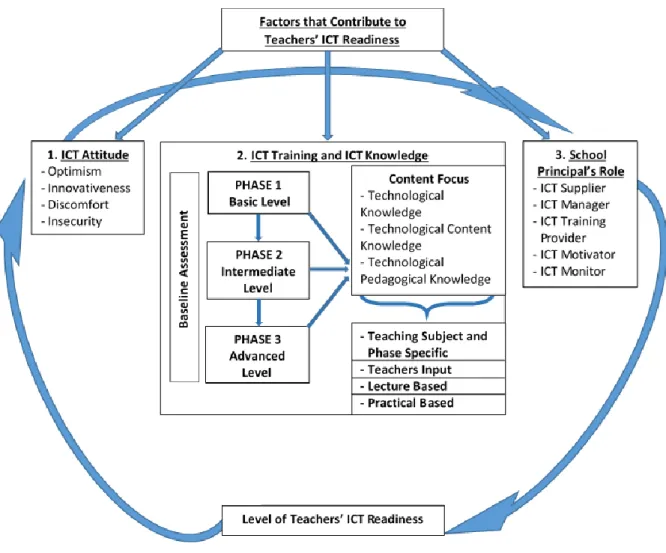
2.10.1 Understanding the theoretical framework ... 36
2.10.1.1 ICT attitude ... 37
2.10.1.2 ICT training and ICT knowledge ... 37
2.10.1.2.1 Baseline assessment ... 37
2.10.1.2.2 Phase 1... 37
2.10.1.2.3 Phase 2... 38
2.10.1.2.4 Phase 3... 38
2.10.1.2.5 Content focus... 38
2.10.1.2.6 Teaching subject and phase specific ... 39
2.10.1.2.7 Teacher input ... 39
2.10.1.2.8 Lecture- and practical-based ... 39
2.10.1.3 School principal’s role ... 39
2.11 Chapter summary ... 40
Chapter Three : Research Design and Methodology ... 41
3.1 Introduction ... 41 3.2 Research paradigm ... 41 3.2.1 Epistemology ... 41 3.2.2 Ontology ... 42 3.2.3 Methodology ... 42 3.3 Research design ... 42 3.4 Research methodology ... 44 3.5 Research Sampling ... 46
3.6 Data generation methods ... 48
3.6.1 Questionnaires ... 48
3.6.2 Semi-structured interviews ... 49
3.7 Pilot phase ... 50
3.8 Data analysis ... 51
3.8.2 Questionnaire data analysis ... 52
3.9 Trustworthiness of the study ... 54
3.9.1 Credibility ... 54 3.9.2 Transferability ... 55 3.9.3 Dependability ... 56 3.9.4 Confirmability ... 57 3.9.5 Authenticity ... 57 3.10 Ethical issues ... 58
3.11 Limitations of the study... 60
3.12 Chapter summary ... 61
Chapter Four : Data Presentation and Analysis ... 62
4.1 Introduction ... 62
4.2 Data presentation and analysis ... 62
4.2.1 Profile of the researched schools ... 62
4.2.2 Profile of the research participants ... 63
4.2.3 Teachers’ level of ICT knowledge ... 64
4.2.3.1 Technological Knowledge ... 64
4.2.3.2 Technological Content Knowledge... 68
4.2.3.3 Technological Pedagogical Knowledge ... 70
4.2.3.4 Analysis of data presented ... 73
4.2.4 Teachers’ attitudes towards ICT integration into the teaching and learning process ... 79
4.2.4.1 Analysis of data presented ... 86
4.2.5 The type of training that teachers attended to acquire the requisite ICT knowledge ... 90
4.2.5.1 Analysis of data presented ... 96
4.2.6 The role of school principals in contributing towards teachers’ ICT readiness .... 100
4.2.6.1 Analysis of data presented ... 104
4.3 Chapter summary ... 107
Chapter Five : Study Summary, Conclusions, Recommendations and Implications for further research ... 108
5.1 Introduction ... 108
5.3 Conclusions ... 109
5.3.1 Teachers’ level of ICT knowledge ... 109
5.3.2 Teachers’ attitudes towards ICT integration ... 110
5.3.3 Teacher ICT training ... 111
5.3.4 The role of school principals in ICT integration ... 111
5.3.5 Teachers’ ICT readiness ... 112
5.4 Recommendations ... 113
5.4.1 Recommendation One ... 113
5.4.2 Recommendation Two ... 115
5.4.3 Recommendation Three ... 116
5.4.4 Recommendation Four ... 117
5.5 Implications for further study ... 118
5.5.1 Implication for policymakers... 118
5.5.2 Implication for district offices ... 119
5.5.3 Implication for school principals ... 120
5.5.4 Implication for teachers ... 120
5.5.5 Implications of the study ... 120
5.6 Overall summary of the study ... 126
5.7 Chapter summary ... 1266
LIST OF ACRONYMNS
CK- Content Knowledge DoE- Department of Education
ICT- Information and Communication Technology ICTs- Information and Communication Technologies PCK- Pedagogical Content Knowledge
PK- Pedagogical Knowledge
TCK- Technological Content Knowledge TK- Technological Knowledge
TPACK- Technological Pedagogical and Content Knowledge TPK- Technological Pedagogical Knowledge
LIST OF TABLES
Table 1: Profile of the researched schools ... 63
Table 2: Profile of the research participants ... 63
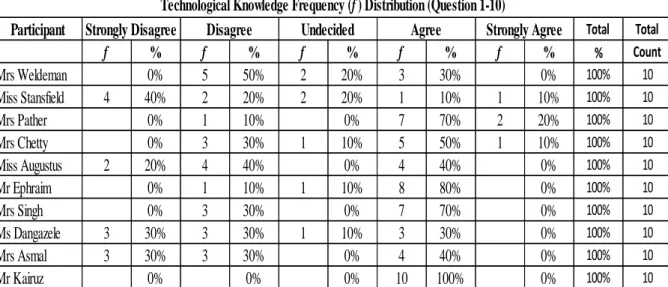
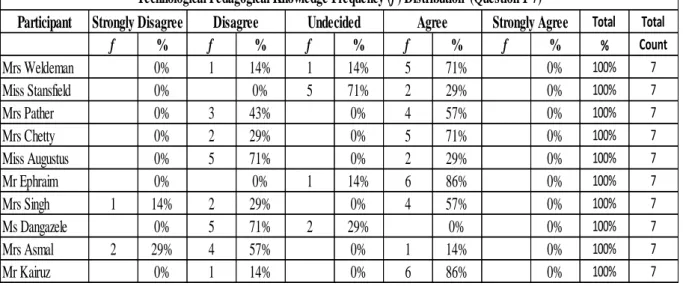
Table 3: Technological Knowledge Frequency Distribution ... 67
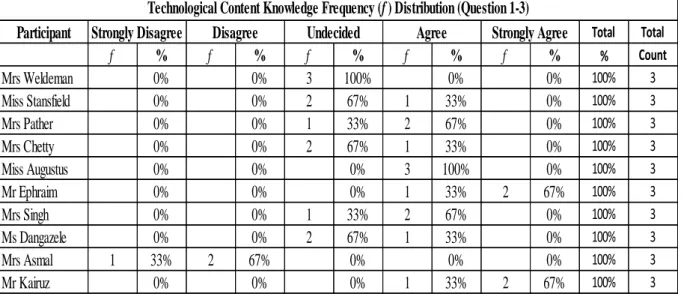
Table 4: Technological Content Knowledge Frequency Distribution ... 70
Table 5: Technological Pedagogical Knowledge Frequency Distribution ... 73
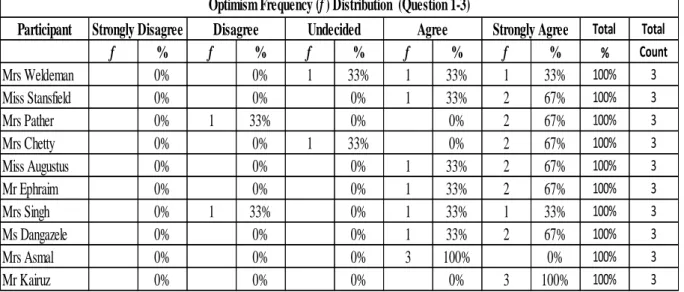
Table 6: Optimism Frequency Distribution ... 82
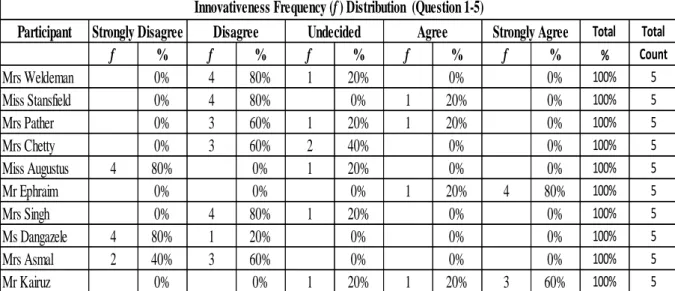
Table 7: Innovativeness Frequency Distribution ... 83
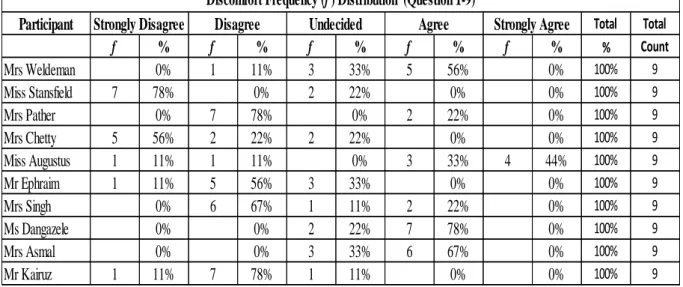
Table 8: Discomfort Frequency Distribution ... 84
Table 9: Insecurity Frequency Distribution ... 85
LIST OF FIGURES
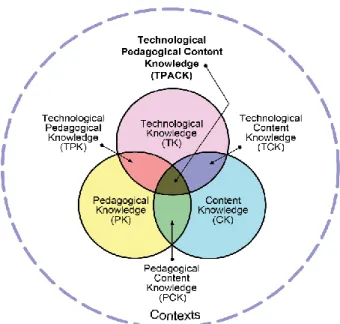
Figure 1: Mishra and Koehler’s (2006) Technological Pedagogical Content Knowledge (TPACK) model ... 7 Figure 2: Theoretical framework adapted from Mishra and Koehler’s (2006) TPACK model
LIST OF APPENDICES
Appendix A: Questionnaire ... 137
Appendix B: Teacher interview schedule ... 143
Appendix C: Principal interview schedule ... 145
Appendix D: Cronbach’s Alpha measurement ... 147
Appendix E: University of the Witwatersrand ethical clearance ... 150
Appendix F: Gauteng Department of Education approval letter ... 151
Appendix G: Information sheet and letter for permission from principals ... 153
Appendix H: Information sheet and letter for permission from Teachers ... 157
CHAPTER ONE:
INTRODUCTION TO THE STUDY
1.1Introduction and background
It has become a truism that we live in a digital age and that large proportions of the world operate most aspects of their lives through various forms of Information and Communication Technologies (ICTs) (Kumar, Rose, & D’Silva, 2008). ICTs refers to the networks, hardware and software of a technological device, which is also a means of communicating, collaborating, engaging, teaching, learning and researching to create and share information and knowledge (Carbová & Betáková, 2013; Department of Education, 2004). The integration of ICTs into schools worldwide is rapidly increasing (Clark & Luckin, 2013; Sackstein, 2014), with South Africa being no exception. The implementation of ICTs into education is a fast-growing trend and has been identified as a priority area (Howie & Blignaut, 2009), which highlights the need to explore its integration in greater detail.
The White Paper on e-Education, a policy document established by the Department of Education (DoE) to explain their response and plan regarding the introduction of ICTs into schools, has identified ICTs as a priority area (Department of Education, 2004). According to the National Development Plan, one of the major reasons for the introduction of ICTs into education is the belief that ICTs will bring about great advancements and improvements for education (National Planning Commission, 2011). One of the policy goals stipulated in the White Paper is that all teachers were to be ICT competent by 2013 (Department of Education, 2004). ICTs are thought to enhance the teaching and learning process (Department of Education, 2004; Summak, Bağlıbel, & Samancıoğlu, 2010); however, Summak et al. (2010) state that being able to integrate ICTs successfully to enhance teaching and learning is an intricate process. This implies that integrating ICTs is not a one-step process, but entails various dimensions.
Teachers are considered one of the primary enabling executors of ICT integration and play a crucial role in its success or failure (Aremu & Adediran, 2011; Hlatshwayo, 2005; Kumar et al., 2008; Summak et al., 2010). Therefore, it is vital that teachers are prepared and ultimately ready to integrate ICTs into the teaching and learning process effectively. This is so as to enhance teaching and learning in their classrooms. Teacher ‘readiness’ for ICT integration
relates to the necessary knowledge required in order to use ICTs effectively, as well as the attitude an individual has towards the use of ICTs (Aremu & Adediran, 2011; Department of Education, 2004; Kumar et al., 2008). ICTs are considered to be effectively integrated and used when teachers have the necessary ICT knowledge, and when they value and have a positive attitude towards ICT integration. Based on this understanding of teacher readiness, and with a specific interest in the South African educational climate, this research study adopted a case study approach to explore whether teachers from two Gauteng schools were ready to integrate ICTs into the teaching and learning process.
1.2Problem statement
Teachers have vastly different personal experiences with ICTs, and consequently have different aptitudes and attitudes, which play a role in how they embrace and integrate technology in their teaching (Ertmer & Ottenbreit-Leftwich, 2010; Inan & Lowther, 2010). If teachers fail to embrace technology in their teaching, learners and teachers will not benefit from the enhancements in teaching and learning that ICTs may afford, nor will they be introduced to new teaching and learning opportunities. In addition to this, teachers and learners may be deprived of essential technological preparation required to function in the 21st century (Department of Education, 2004). Teachers should thus be encouraged and prepared to embrace technology use. In this study, an ICT teacher preparation framework was developed to provide insights regarding how teachers should be prepared.
The Department of Education (2004) maintains that efforts have been made to prepare the majority of teachers by providing them with training to acquire ICT knowledge. This preparation was aimed at enabling teachers to integrate ICT devices into their teaching. The challenge appears to be that teachers receive and complete training, which is often once-off, and then revert to traditional teaching approaches which can be considered largely passive and teacher-centred (Hlatshwayo, 2005; Kumar et al., 2008). This can be attributed to insufficient ICT training received, lack of continuous support and specialised technological knowledge required in the process of integrating ICTs into their classrooms.
Teachers’ reliance on traditional teaching approaches could be a factor hindering the Department of Education’s effort to integrate ICTs into schools. To help teachers successfully use ICTs and avoid reverting to traditional teaching approaches, Mishra and Koehler (2006) present the Technological Pedagogical and Content Knowledge (TPACK)
model. The key theoretical underpinning of the TPACK model, which is explored in more detail later in this chapter, is that teachers require and should develop different types of knowledge. This is considered essential to capacitating them to implement ICTs as instruments to enhance teaching and learning. Many teachers, particularly in-service teachers, may have content knowledge (knowledge relating to their teaching subject) and pedagogical knowledge (knowledge relating to methods of teaching and learning). The concern is that many teachers may not necessarily have the necessary ICT knowledge (knowledge relating to how to operate technology) and, most significantly, knowledge on how to combine their knowledge of technology with their content and pedagogical knowledge (Ertmer & Ottenbreit-Leftwich, 2010). In other words, teachers may not necessarily know how to use ICTs as instruments that can enhance their content knowledge and pedagogical knowledge, ultimately enhancing teaching and learning. This study explored whether teachers have knowledge gaps relating to how to use ICTs successfully as instruments that can enhance teaching and learning.
Not knowing how to integrate ICTs effectively can lead to teachers developing negative attitudes towards technology integration. This may result from them not being aware of how ICT devices may represent and enhance subject content; allow teaching and learning to occur at any time and space; enable easy storing and sharing of information; or allow for more collaborative, interactive and personalised teaching and learning; among many other potential benefits of using ICTs in the classroom (Clark & Luckin, 2013). The negative attitudes of teachers may lead to teachers’ becoming frustrated at the idea of intergrating ICTs in their classrooms. All of the aforementioned challenges may be considered a key barrier to teacher readiness and successful technology integration (Carbová & Betáková, 2013; Hlatshwayo, 2005; Howie & Blignaut, 2009) and may be an atrributing factor to why some teachers seem to be resorting to their traditional teaching methods. The White Paper on e-Education stipulated a policy goal of achieving ICT competency in all teachers by 2013, yet in reality many Gauteng teachers do not seem sufficiently prepared for ICT adoption. This makes this study, which explored these challenges in greater depth, especially necessary.
1.3Purpose and rationale for the study
Exploring teachers’ ICT readiness is due to a personal interest in the integration of ICTs into the education system, which emerged from visiting schools and finding many teachers reluctant to use ICTs to improve teaching and learning in their classrooms. Many teachers
consider having the necessary knowledge, confidence, and attitude as enough to encourage and enable them to integrate ICTs into their classrooms meaningfully (Ertmer & Ottenbreit-Leftwich, 2010). Therefore, it is necessary to determine which factors related to equiping teachers with the required ICT knowledge, and attitude are vital to their readiness. These factors include the ICT training approaches offered to teachers and the role played by school principals in contributing to teachers’ ICT readiness, which form part of the areas that this research analysed. Exploring these factors are necessary in a context where the literature (Aremu & Adediran, 2011; Hlatshwayo, 2005; Howie & Blignaut, 2009; Inan & Lowther, 2010; Summak et al., 2010) suggests that many teachers do not feel ready to integrate ICTs.
1.4Significance of the study
In South Africa, and particularly in relation to Gauteng’s ICT integration process, the Department of Education’s (2004) White Paper on e-Education policy document contained a defined implementation plan. Within this plan were various phases that set out a programme of action and specific deadlines for their completion. These phases were to take place over a nine-year period, from 2004–2013. In the final year, 2013, one of the major policy goals was that ICTs were to be incorporated into the teaching and learning process by all schools, and that all teachers were to be ICT-capable (Department of Education, 2004).
A previous study conducted by Hlatshwayo in 2005, explored whether teachers from Gauteng were ICT capable. The researcher views Hlatshwayo’s (2005) study as being prematurely conducted as the policy in question had been introduced only a year before. Consequently, it could be expected that the selected teachers were not ICT-capable, as the findings suggested. The policy stipulates that the Department of Education (2004) had until 2013 to prepare for the integration of ICTs into the teaching and learning process, and any policy implementation needs to be given sufficient time before its effectiveness is fairly evaluated. This furthers the relevance of this study because it explored the developments since the policy was introduced in 2004. As the phrase goes, one swallow does not make a summer and we cannot rely on a single study to evaluate the degree to which the Department of Education’s (2004) policies had or have been successfully implemented. This study therefore contributed more insight into whether teachers from the researched schools were in fact ICT-capable and ready to integrate ICTs into their teaching and learning process.
There is currently a scarcity of research, even in Gauteng, exploring teachers’ readiness to integrate ICTs into teaching and learning. As such, the present research study can offer significant and valuable insight to the research area relating to the integration of ICTs into schools. The study was significant as it targeted and examined the ICT readiness of teachers from the researched schools, situated in the Gauteng province, in relation to four areas. The first was an analysis of teachers’ ICT knowledge; the second was exploring teacher’s attitudes towards ICT; the third was identifying the training provided and/or received; and the fourth was examining the role played by the school principal in ensuring teachers’ ICT readiness. These areas are not widely explored in relation to teachers’ ICT readiness and this research aimed to contribute to this gap in current literature.
The significance of this study was that it was largely informed by Mishra and Koehler’s (2006) TPACK model, which is useful as it lays out the specialised types of knowledge that teachers need. In addition, it adopted Parasuraman’s (2000) Technology Readiness Index (TRI) to provide insight into teachers’ attitudes towards technology use. This research study considered that ICT training programmes and the role of the school principal should be centred on equipping teachers with specialised types of knowledge, and ensuring that teachers have a positive attitude towards ICT use. If teachers have the required ICT knowledge and a positive attitude this could contribute towards an effective ICT integration process.
The knowledge gained from this study has the potential to inform stakeholders involved in ensuring teacher ICT readiness. These stakeholders can be informed regarding which efforts and training interventions have been effective or ineffective. Exploring the role of the school principal is also significant. At a school level, insight can be gained regarding the influence that school leadership has and how school leadership can help move towards more effective achievement of set goals, particularly related to ICTs at a national, departmental, and school level.
1.5Aims of the study
The aim of this study was to explore teachers’ readiness to integrate ICTs into the teaching and learning process. The intention was to explore teachers’ ICT readiness in relation to the required ICT knowledge, teachers’ ICT attitudes, the ICT training received and the role played by the school principal. By exploring these areas, the overall aim was to provide
understanding with regards to more effective approaches to preparing, training, and supporting teachers. Moreover, informed by the literature reviewed and the findings gained by conducting this study, an ICT preparation framework was developed, aimed at creating an enabling ICT teacher development environment.
1.6Primary research question
Given the aims set out above in conducting this study, the following key research question underpinned the study: How ready are the teachers in the two researched schools to integrate ICTs into the teaching and learning process?
In addition to this, and to assist in answering the primary research question, four sub-research questions were developed, as follows:
1.6.1Sub-research questions
1. What are teachers’ level of Technological Knowledge, Technological Content Knowledge and Technological Pedagogical Knowledge?
2. What are teachers’ attitudes towards ICT integration into the teaching and learning process?
3. What type of training have in-service teachers received to acquire the requisite ICT knowledge necessary to integrate ICTs into teaching and learning?
4. What role have the school principals played in contributing towards teachers’ ICT readiness?
1.7Theoretical foundations
In order to explore teachers’ readiness to integrate ICTs into the teaching and learning process at two Gauteng schools, this research study was informed by two key theoretical dimensions. These dimensions are Mishra and Koehler’s (2006) Technological Pedagogical and Content Knowledge (TPACK) model and Parasuraman’s (2000) Technology Readiness Index (TRI), which are explored in more detail in the sections that follow.
1.7.1Technological Pedagogical and Content Knowledge (TPACK) model
The Technological Pedagogical Content Knowledge (TPACK) model proposed by Mishra and Koehler (2006) encapsulates a key argument proposed by this research study: that teachers require specialised types of knowledge to integrate ICTs effectively in the
classroom. In exploring the problem statement, it is apparent that there is a knowledge gap among teachers that needs further examination.
In order to target this knowledge gap, the TPACK model proposes that teachers need Content Knowledge (knowledge regarding the subject that they teach), Pedagogical Knowledge (knowledge regarding methods of teaching and learning), and Technological Knowledge (knowledge regarding how to operate technology) as the base forms of knowledge needed to integrate ICTs into teaching and learning. The interaction of these three bodies of knowledge results in additional forms of knowledge, namely Pedagogical Content Knowledge (knowledge regarding how to teach subject content so as to enhance learning and in relation to a unique teaching and learning context), Technological Content Knowledge (knowledge regarding how to use technology to teach subject content), and Technological Pedagogical Knowledge (knowledge regarding how to implement technology to enhance methods of teaching and learning) (Koehler, Mishra, & Cain, 2013; Koehler, Mishra, Kereluik, Shin, & Graham, 2014). When all of these knowledge forms are integrated with each other, the result is Technological Pedagogical Content Knowledge (TPACK), which is the main underpinning of the TPACK model. Figure 1 below shows the TPACK model and its various interrelations between the knowledge types.
Figure 1: Mishra and Koehler’s (2006) Technological Pedagogical Content Knowledge (TPACK) model
TPACK entails skilled and effective teaching with ICTs, by knowing how to present subject content and concepts using ICTs, adopting pedagogical methods that use ICTs for effective teaching and learning, knowing how ICTs can facilitate clarification of learner misunderstanding, knowing how ICTs can build on learners’ prior knowledge to build new knowledge, and knowing how to use ICTs in different teaching and learning contexts (Koehler et al., 2013; Koehler et al., 2014). This research study focused on developing teachers’ ICT knowledge, and consequently an assumption was made that in-service teachers have adequate levels of Content Knowledge, Pedagogical Knowledge and Pedagogical Content Knowledge. The TPACK model was used to explore teachers’ level of ICT knowledge by focusing on their Technological Knowledge (TK), Technological Content Knowledge (TCK) and Technological Pedagogical Knowledge (TPK). The researcher considered that capacitating teachers with these knowledge forms (TK, TCK and TPK) is essential to integrating ICTs into teaching and learning effectively and should be the key focus of ICT training courseware and initiatives.
1.7.2Parasuraman’s (2000) Technology Readiness Index (TRI)
The second theoretical dimension that was adopted for this study is Parasuraman’s (2000) Technology Readiness Index (TRI). The TRI recognises four different dimensions of an individual’s attitude towards ICT use, which are either influencers or inhibitors of their ICT readiness. Level one (optimism) and level two (innovativeness) are considered influencers of technology readiness. Level three (discomfort) and level four (insecurity) are considered inhibitors of technology readiness (Parasuraman, 2000). The first dimension is optimism, which entails having a positive view of technology and a belief that technology offers individuals greater control, flexibility and effectiveness. The second dimension is innovativeness, which entails an inclination towards being a technology innovator and leader. The third level is discomfort, which entails a recognised lack of control over technology and a sense of being overwhelmed by it. The last level is insecurity, which entails an individual distrusting technology and being sceptical about the reliability of the devices. This research study adopted the TRI in order to identify the dimension (optimism, innovativeness, discomfort, or insecurity) with which teachers related. In doing so, insights were gained regarding what teachers’ attitudes towards ICT integration were, and whether this influenced or inhibited their ICT readiness and integration in the classroom. The two theoretical foundations discussed, TPACK and TRI, played a vital role in answering the research
questions of this study and were fundamental in the establishment of the theoretical framework that informed this study, which is discussed in Chapter Two.
1.8Delimitations of the study
Delimitations refer to certain elements that restrict the scope and specify the boundaries of a research study (Simon, 2011). This research study was a small-scale study and was limited to just two schools (one primary and one high school). While the suggested findings and recommendations offer useful insights, they are not generalisable beyond the researched schools and selected participants.
1.9Outline of the study
An outline of the study and structure of the manuscript is given below:
Chapter One: Introduction to the Study. This introductory chapter explored various components such as: an introduction to the study, the research problem, the purpose and rationale, the significance of the study, the aim, the critical research questions, the theoretical foundations, the delimitations, and an outline of the study. Discussing these components were aimed at introducing the research study.
Chapter Two: Literature Review and THEORETICAL Framework. In this chapter, existing literature relating to the research focus is reviewed and explored, including international, continental, and national literature. In the next half of this chapter the theoretical framework that underpinned and informed this research study is discussed.
Chapter Three: Research Design and Methodology. In this chapter the research paradigm, design, and methodology are discussed, along with the selected participants, data generation, and data analysis methods. In addition, issues of trustworthiness and ethical considerations are explored.
Chapter Four: Data Presentation and Analysis. In this chapter the generated data is presented and analysed. This was with the purpose of obtaining evidence and insight in order to answer the main research question.
Chapter Five: Study Summary, Conclusions, Recommendations and Implications for Further Research. In this chapter, the presented and analysed data from the previous chapter was used to summarise key findings, draw conclusions, present recommendations and identify implications of the study.
1.10Chapter summary
The first chapter focused on introducing the research study. The overall background, intention, direction, reasoning, and structure of the study were explored. In the next chapter, existing literature relating to the research area is reviewed and the study is situated within the reviewed body of literature. In addition, the theoretical framework that informed this study is introduced.
CHAPTER TWO:
LITERATURE REVIEW AND THEORETICAL FRAMEWORK
2.1Introduction
The previous chapter introduced the study, which was focused on exploring teacher readiness to integrate ICTs into the teaching and learning process at two Gauteng schools. In this chapter, current literature relevant to the research study is explored. The literature explored speaks directly to certain themes that play a significant role in understanding teacher readiness to integrate ICTs into teaching and learning in more depth. These thematic areas include: the integration of ICTs, the role of an ICT policy, the affordances of ICTs, teacher ICT readiness, teacher ICT knowledge, teacher attitude towards ICT integration, teacher ICT training, and the role of school principals in contributing towards teachers’ ICT readiness. In exploring these themes, reference is made to existing literature from three main perspectives, being international, continental, and national literature. Exploring such literature will provide insights into the status of teachers’ ICT readiness on the international, continental, and national stage, with particular reference to the Gauteng province. Once these themes are explored, the next section of this chapter introduces the theoretical framework that informed this research study. The theoretical framework was fundamental in providing insight into exploring the research problem and questions that underpinned this study. In order to understand teachers’ ICT readiness, it is useful first to explore what is entailed by integrating ICTs into the classroom. The first section of the literature review focuses on the integration of ICTs in relation to what is meant by the term ICT integration. Next, reasons for the push to adopt and integrate ICTs into schools are explored.
2.2The integration of Information and Communication Technologies
Integrating ICTs into teaching and learning is also known as electronic learning or e-learning (Ouma, Awuor, & Kyambo, 2013). ICT integration entails using old and new technological devices, in relation to their hardware, software and various applications to support teaching and learning through electronic means (Carbová & Betáková, 2013; Department of Education, 2004; Ouma et al., 2013). Technological devices that have been widely integrated as teaching and learning tools, and that have been explored and recognised across the literature include multimedia projectors (Mengtao, 2001), computers/laptops (Fried, 2008; Hermans, Tondeur, van Braak, & Valcke, 2008), mobile phones (Thornton & Houser, 2004;
Yerushalmy & Ben-Zaken, 2004), smartboards (Gursul & Tozmaz, 2010; Preston & Mowbray, 2008) and tablet technology (Neumann, 2014; Rafiki, 2015), among many others. It is evident that there are a variety of old and new technological devices that can be integrated, which implies that relevant stakeholders such as teachers and learners would need to be continuously exposed to technological advancements and trends. This research intended to explore teachers’ overall readiness to integrate ICTs (old and new) into their classroom. There are various reasons why teachers should be ready to integrate ICTs into the teaching and learning process. A possible and major reason for the shift towards ICT integration is that among the literature there is large recognition internationally (Badri, Mohaidat, & Rashedi, 2013; Isaacs, Vosloo & West, 2012; Shaffer, Nash, & Ruis, 2015; Summak et al., 2010), continentally (Farrell & Isaacs, 2007) and nationally (Department of Education, 2004; Department of Education, 2010) that ICTs have huge potential for education as a whole. The potential offered by ICTs is mainly highlighted in relation to three key areas: the ability of ICTs to decrease the digital divide between teachers, learners, and schools (Department of Education, 2007; Department of Education, 2010; Farrell & Isaacs, 2007); improve management and administration tasks (Department of Education, 2010; Isaacs et al., 2012); and enhance the quality of teaching and learning (Department of Education, 2004; Department of Education, 2007; Department of Education, 2010; Isaacs et al., 2012; SchoolNet SA, 2015; Shaffer et al., 2015; Summak et al., 2010). It can be said that the potential benefits offered by ICTs are far-reaching, as they have the ability to improve various dimensions of the educational system. It would follow that schools should take advantage of the benefits offered by ICTs and should consequently ensure that ICTs are integrated effectively. Specifically, in relation to being able to enhance teaching and learning, it is evident that this is widely recognised across the literature. The ability of ICTs to enhance teaching and learning can be understood in relation to exploring the potential affordances that ICTs offer teachers and learners, which are explored in greater depth to show why ICT integration is a trend worth following.
2.3The affordances of ICTs
There are various perceptions regarding the definition and explanation of the concept affordances (John & Sutherland, 2005), which was originated by Gibson (1986). The concept of affordances became relevant to the practice of integrating ICTs into education, specifically in relation to Gibson’s (1986) understanding of the term as entailing the potential
opportunities and limitations of ICTs, which could influence a teacher’s pedagogy (method of teaching and learning) (Hammond, 2010). Conole and Dyke (2004) argue that having an understanding of the various affordances of ICTs can provide insight, which can help teachers make informed decisions regarding which ICT device to use and how to implement the device in ways that support teaching and learning. Essentially, it can be said that the fundamental principle is that ICTs should not simply be integrated arbitrarily, but that the integration process should be informed by preparation, support, and specialised knowledge in order to ensure effective use of ICTs. Some of the affordances that can be exploited by teachers are explored in the sections that follow.
Accessibility is considered an affordance of ICTs (Conole & Dyke, 2004; Department of Education, 2010). The opportunity of this affordance is that by using ICTs, teachers and learners may have easier access and different means of accessing continuously growing stores of information. This means that learners would easily be able to access different representations of difficult subject content in order to enhance their understanding. Easier and different means of accessing information can also allow teaching and learning to occur at any time and space, and not be confined to the classroom, which relates to the next affordance, flexibility (Clark & Luckin, 2013; Department of Education, 2007; Laurillard, 2007). However, the limitation of these two affordances can be that flexibility and easier access to information may lead to an overload of information, which requires information to be critically evaluated, quality assured and selected appropriately by teachers and learners (Conole & Dyke, 2004). The implication is that if teachers are to implement ICTs into the classroom, they would need to know how to ensure that ICTs do not hamper the teaching of their subject content, but rather serves to enhance specified teaching content in accordance with curriculum goals.
Another affordance is communication and collaboration, which makes it possible for teachers and learners to communicate, engage and share information in new and quicker ways than before, which may result in enriched learning and teaching (Conole & Dyke, 2004, Melhuish & Falloon, 2010). This new way of sharing information and communicating can allow teachers and learners to refer back constantly to shared information, knowledge and data, which can be used to clarify misunderstandings and improve practice. In addition, another affordance of ICTs is that they allow for individualised experiences, where ICTs can be suited to cater to personal needs and preferences (Conole & Dyke, 2004; Melhuish &
Falloon, 2010; Hu, 2011; Shaffer et al., 2015). The opportunity of this affordance is that ICTs make it possible for learners and teachers to engage in more individualised paths and forms of learning and teaching (Conole & Dyke, 2004). However, the implication is that teachers and learners may need the necessary skills and knowledge to explore, as well as ensure that alternative forms of learning and teaching are indeed effective. Exploring some of the affordances of ICTs was only briefly touched upon and should be a research area that is given more attention and larger weight.
It can be seen that the potential affordances offered by ICTs are plenty and bring to light the benefits that ICTs can have for teaching and learning. However, it is considered that in practice not much is understood by teachers regarding how the affordances of ICTs can be exploited in their classroom, which could hamper the effective use of ICTs (Conole & Dyke, 2004). This stresses the importance of exploring teachers’ level of knowledge relating to ICT use, specifically with regards to whether they are aware of the pedagogical affordances of ICTs and know how to use ICT devices effectively – the very issue that this research aimed to explore. Knowing this information can help inform teacher ICT training, enabling specific areas of ICT knowledge to be targeted and developed among teachers. In this complex process of preparing teachers, having policies and plans in place is useful to direct and inform the ICT implementation process. The role of ICT policy is explored in the next section.
2.4The role of ICT policy
The literature reviewed recognises the usefulness of having ICT plans and policies in place (see Farrell & Isaacs, 2007; Mndzebele, 2013; Shaffer et al., 2015). ICT policy plays a significant role and acts as an impetus for the development of ICT in a country and within the educational environment. Consequently, the literature shows that ICT policies and plans are formulated and implemented at an international (Kumar et al., 2008), continental (Aremu & Adediran, 2011; Farrell & Isaacs, 2007) and national level (Department of Education, 2004; Howie & Blignaut, 2009). Looking specifically at Farrell and Isaacs’ (2007) study, which was a summary report informed by 53 African country questionnaires, it was found that 48 of the participating countries had national ICT policies in place or were involved in establishing one. It was also found that 39 of these countries had education sector ICT policies and strategies in place or were involved in establishing one. This implies that ICT integration and development is a priority area for African countries and that efforts are being made to make both countries and schools ready for the integration process.
Knowing that ICT policies are in place can raise questions regarding what the role of policy is and how it influences the ICT integration process. It is considered that one of the central purposes of national policy is to provide a deliberate, thought-out roadmap that aims to provide guidance to address a particular public concern or goal (Torjman, 2005). Essentially, policies are considered to entail a desired objective with various targets to be met, a pathway to achieve the objective, and an approach to measure achievement of the stated objective (Torjman, 2005). It can be said that policies offer direction and Tondeur, Van Keer, van Braak, and Valcke (2008) found that, specifically in relation to the targeted goal of implementing ICTs into schools, an ICT-related policy has a large impact on the use of ICTs in teaching and learning. The finding by Tondeur et al. (2008) implies that ICT policy plays a significant role in ensuring that the necessary conditions are in place, which in turn can influence the extent to which teachers use ICTs in their classroom. Understanding the role of policy in ICT integration is explored in more detail by discussing the ICT policy landscape in South Africa.
The White Paper on e-Education developed by the Department of Education (2004) can be considered a major policy targeted at the ICT integration process in South African schools (including those in Gauteng). Particular focus was placed on how the White Paper on e-Education policy (Department of Education, 2004) speaks to and promotes the integration of ICTs and teacher ICT readiness. Within this policy document there were three main phases of implementation. Phase One, titled “Enhance system-wide and institutional readiness to use ICTs for learning, teaching and administration” (Department of Education, 2004, p. 39), among other things, focused largely on providing schools with access to technological devices, developing a framework for teacher ICT development and ensuring that teachers and managers had access to basic ICT training. This training was to focus on how to operate an ICT device, how to integrate it into teaching and learning and how to solve technical problems. These were some of the measures that were to take place in Phase One, which was to commence in 2004 and be achieved by the end of 2007 (Department of Education, 2004). It can be said that Phase One was targeted at providing a foundation for teacher ICT competencies, through ensuring that the necessary conditions, such as access to ICTs and the provision of training, were in place.
Phase Two, titled “System-wide integration of ICTs into teaching and learning”, focused largely on teachers’ integration of ICTs into the curriculum (Department of Education, 2004,
p. 40). In this phase, it was expected that 50% of teachers would have received training on the basic integration of ICTs into the teaching and learning process. In addition, it was expected that teachers would be given opportunities to attend technical support training on ICTs, and that all schools would have a teacher serving the role of a digital champion, who would facilitate the use of ICTs into their schools. Phase Two was to start in 2007 and be achieved at the end of 2010 (Department of Education, 2004). It is evident that Phase Two was targeted at ensuring that a majority of teachers would by 2010 have adequate knowledge to enable them to integrate ICTs into their classrooms. In addition, Phase Two also focused on ensuring that efforts were made at a school level, through having a staff member dedicated to contributing towards teachers’ ICT readiness. Phase Two suggests that schools were also expected to play an instrumental role in preparing teachers and equipping them with the competencies needed to integrate ICTs.
The final phase was titled “ICTs integrated at all levels of the education system-management, teaching, learning and administration” (Department of Education, 2004, p. 41). In this phase, it was expected that all teachers would be ICT capable, and that all schools would have integrated ICTs into the teaching and learning process. Phase Three was to begin in 2010 and be achieved at the end of 2013. The targets set in Phase Three imply that the first and second phase were practical and achievable stepping stones that would eventually ensure that all schools and teachers would be sufficiently prepared for the ICT integration process. Essentially, Phase Three was the culmination of all efforts directed at system-wide ICT integration, in order to achieve the key vision of ensuring that all schools and teachers (including those in Gauteng) were ICT ready. By exploring the White Paper on e-Education policy document, it can be seen that through the stated use of resources, the outline of expectations and various targets to be met and the strategies laid out, policy plays a significant role in moving towards stated objectives, especially that of successfully integrating ICTs into schools and ensuring teacher readiness to do so.
It has been identified that policy does help in moving towards the achievement of stated objectives. However, despite Tondeur et al.’s (2008) finding that ICT related policy has a large influence on the use of ICTs in the classroom, it was also found that ICT policies are underdeveloped and underused. This raises huge concern, especially because it was also found that policy goals are not always achieved. For example, Aremu and Adediran’s (2011) study particularly targeted Nigeria’s ICT policy, and explored the policy goal stating that
Nigeria was to be an ICT-capable country by 2005. However, it was found that five years after this stipulated target, ICTs were still not adequately integrated into the teaching and learning process in the majority of Nigerian schools. In addition, another area of concern is that there is not always commitment to the ICT integration process, as shown in Howie and Blignaut’s (2009) study. Howie and Blignaut (2009) found that only two of the nine South African provinces, which included Gauteng, were committed to the ICT integration process. Commitment was shown by these provinces having the applicable policies and plans in place to move towards this process. These studies suggest that the uptake and implementation of ICTs, as well as the achievement of ICT policy goals, is not always a clear-cut process.
Having policies that are underused and underdeveloped, not achieving stated policy goals, and not being committed to the ICT integration process can highlight the need for policy analysis. Policy analysis entails a systematic evaluation of a policy or policies (Walker, 2000), which would allow a critical review to ensure that the implementation process speaks to the real needs of schools and is feasible and effective (Mndzebele, 2013).It is considered that policies should be explored and evaluated in relation to whether they are or were successful or unsuccessful in achieving their intentions and goals (Walsh, 2006). Policy failure can be explained as an existing policy that fails to achieve its stated objectives (McConnell, 2010; Mantino, 2013; Walsh, 2006) in relation to various aspects such as spending inefficiencies (Mantino,2013), resources not being used effectively (McConnell, 2010), or taking a longer time to achieve objectives (McConnell, 2010). In contrast, policy success is considered as a policy that achieves its stated objectives (McConnell, 2010) in relation to aspects such as engaging relevant stakeholders and using their input to inform the implementation process, having an implementation process that is in check with stated objectives, and creating benefits for the target group (McConnell, 2010). Reviewing a policy implies that there are various component parts of a policy that determine its success or failure, such as the manner in which resources are/were used, time management, and the extent to which goals were achieved, among others.
Policy success can be evident in some policy dimensions and policy failure can be evident in other dimensions [within the same policy] (McConnell, 2010). The argument presented by Walsh (2006) is that policy failure should create pressure and lead to change on the basis of understanding past policy failures. Three vital steps form part of policy analysis. The first involves identifying the policy problem, which focuses on aspects such as identifying what
constraints were evident and which stakeholders will be affected. The second step is identifying the goals of the new policy, which are to be targeted at solving the initial policy problem. The third step is identifying a criterion which will be able to measure the costs required to carry out a policy and the degree to which the new policy achieves stated objectives (Walker, 2000). This would mean that change can entail replacing policies that were unsuccessful, modifying existing policies, or using alternative policies that will most likely achieve stated objectives. In addition, it would require policymakers to relook the “probable effectiveness, potential cost, resources required for implementation, political context and community support” (Torjman, 2005, p. 4), which are considered integral factors to successful policy implementation and achievement of stated objectives. Change on the basis of failure is considered essential as government is considered accountable and should make an effort to overcome criticism by society and maintain political influence (Walsh, 2006). Consequently, it can be said that the Department of Education has huge responsibility in ensuring that the necessary conditions are in place, which include capacitating the relevant stakeholders, providing resources, and ensuring that deadlines and expectations are met.
In addition, simply developing ICT policies does not guarantee that they will implemented effectively or yield the desired results. Instead, the management, maintenance and implementation process is largely dependent on the support received. The literature highlights support in terms of government action (Department of Education, 2010; Farrell & Isaacs, 2007) and government commitment to the ICT drive in schools (Farrell & Isaacs, 2007). In addition to support, in order to implement ICT policies and plans sucessfully, it is considered vital that key stakeholders such as national, provincial and district officials, as well as school principals and teachers among other relevant stakeholders are ready for the integration process. The focus of the section that follows turns to teachers’ ICT readiness.
2.5Teachers’ ICT readiness
In this section, specific focus is placed on teachers, who have a primary role to play and are key to the success or failure of the integration of ICTs (Kumar et al., 2008). In order to ensure effective integration, teacher ICT readiness is crucial.
In order to understand teachers’ level of ICT readiness, it is important first to understand what the term ICT readiness means. The concept ICT readiness has been explored by various studies conducted internationally, continentally, and nationally. An international study
conducted in the United Arab Emirates by Badri, Mohaidat, and Rashedi (2013, p. 2672) mention that, “teachers’ embrace, and willingness to adopt, directly affect their success in technology readiness”. Similarly, a continental study conducted in Nigeria by Aremu and Adediran (2011, p. 181) states that “[r]eadiness or preparedness has to do with awareness, knowledge of use, attitude to use as well as getting skilled in the use of information technology.” Likewise, a study conducted in Kenya by Ouma, Awuor, and Kyambo (2013, p. 97) also mention that “[t]eachers’ and students’ computer literacy as well their perceptions and attitude towards technology were significant measures of e-learning implementation readiness.” Specifically, in South Africa, “[t]he readiness of learners, teachers and communities in terms of the necessary background knowledge as well as their attitudes towards ICT needs to be carefully monitored before implementation can be effectively and efficiently achieved” (Department of Education, 2004, p.33). The common link between all of these explanations; and among international, continental, and national literature; is that there seems to be some sort of consistency in the areas in which teachers’ ICT readiness is measured. Reference is particularly made to two key elements, being ICT knowledge and attitude. In this study, teacher ICT readiness was explored in relation to these two key elements, which are believed to influence teachers’ ability to integrate and use ICTs. It is important to explore the literature related to the areas of teachers’ ICT knowledge and attitude in more depth, so as to gain insight into the status of teachers’ ICT readiness. Teachers’ ICT knowledge is explored in the following section.
2.6Teachers’ ICT knowledge
Although ICTs present new opportunities to teaching and learning, it simultaneously places huge demands on the knowledge required by teachers (Department of Education, 2007). Among the international (Inan & Lowther, 2010), continental (Aremu & Adediran, 2011; Ouma et al., 2013) and national (Department of Education, 2004) literature, teachers’ ICT knowledge is considered a determining factor of ICT readiness. This is in relation to the type and level of teachers’ ICT knowledge, which can serve as a facilitator or inhibitor of ICT integration in the classroom (Farrell & Isaacs, 2007). In addition, across the literature (see Aremu & Adediran, 2011; Badri et al., 2013; Department of Education, 2004; Department of Education, 2007; Ertmer & Ottenbreit-Leftwich, 2010; Kumar et al., 2008; Shaffer et al., 2015; Mndzebele, 2013; Ouma et al., 2013) it is largely acknowledged that ICTs will not be transformative by themselves, and consequently both high school and primary school teachers (Department of Education, 2004) should be capacitated with the required knowledge
to use and integrate ICTs effectively. This research study argued that the necessary knowledge needed by teachers is comprised of Technological Knowledge, Technological Content Knowledge and Technological Pedagogical Knowledge, which form part of Mishra and Koehler’s (2006) TPACK model, presented in Chapter One.
It is particularly important that teachers have the required ICT knowledge, because teachers have mixed expertise (Department of Education, 2004; Oliver, 2010). Mixed expertise can also be referred to as the knowledge divide, which is explained as a divide between those who are more ICT knowledgeable and those less so. Howie and Blignaut (2009) highlight the knowledge divide as a major problem that is experienced in South Africa. It is therefore considered crucial to address the knowledge divide by equipping teachers with the required ICT knowledge but this raises an important question: what exactly constitutes the necessary ICT knowledge required by all teachers?
There seems to be great debate among the literature regarding what constitutes the ICT knowledge that teachers require to enable them to integrate ICTs into the curriculum. This has been conceptualised in a number of ways. One view presented by the literature (Ertmer & Ottenbreit-Leftwich, 2010; Shaffer et al., 2015) is that if teachers wish to integrate ICTs successfully, they need to expand their existing knowledge forms. Expected existing knowledge forms of in-service teachers include Content Knowledge (CK), Pedagogical Knowledge (PK) and Pedagogical Content Knowledge (PCK) (Ertmer & Ottenbreit-Leftwich, 2010; Mndzebele, 2013; Shaffer et al., 2015). In other words, if teachers have a deeper understanding of their subject content and different teaching and learning methods, it is argued that this can help teachers make informed decisions and select the most suitable technological device to allow learners to achieve their learning goals (Ertmer & Ottenbreit-Leftwich, 2010). Essentially, this implies that having deeper CK, PK and PCK enables teachers to have a more extensive understanding of the teaching and learning process.
Another view presented is that teachers require knowledge of various technological devices (Department of Education, 2004; Department of Education, 2007; Ertmer & Ottenbreit-Leftwich, 2010; Hew & Brush, 2007; Inan & Lowther, 2010; Ouma et al., 2013). Having knowledge of technological devices entails knowing what the affordances and constraints of the device are, how to operate the device, and how to solve technical issues. This view is
expected, particularly due to the fact that if teachers are to integrate ICTs they need to have a good understanding of various technological devices.
Still another view presented by the literature (Ertmer & Ottenbreit-Leftwich, 2010; Hew & Brush, 2007; Mndzebele, 2013; Shaffer et al., 2015) is that teachers need to apply their Content Knowledge and Pedagogical Knowledge in relation to their knowledge of technological devices. This means that teachers need to think about how to teach their subject content and how to select various teaching and learning approaches directly in relation to various technological devices and their affordances and constraints. It can be said that this view is a combination of the first and second views discussed above. These views can be considered some of the necessary types of knowledge that teachers should have when integrating ICTs.
In relation to the views presented on the required ICT knowledge, it is important to explore the status of teachers’ ICT knowledge. There seem to be two major problems identified among the literature, which can be considered complementary to each other. The first problem is that it appears that many teachers do not have adequate technological knowledge relating to how to use a device in terms of its software, hardware, affordances, and constraints (Ertmer & Ottenbreit-Leftwich, 2010). The second problem is that having knowledge about various technological devices, although important, is not enough. Instead, teachers also need knowledge relating to how to use ICT devices as instruments that can enhance teaching and learning, which a majority of teachers do not know how to do (Carbová & Betáková, 2013; Ertmer & Ottenbreit-Leftwich, 2010; Farrell & Isaacs, 2007; Howie & Blignaut, 2009; Mndzebele, 2013). This is considered extremely problematic, especially because teachers need to be able to use technological devices in specific ways oriented to education. This is particularly in relation to specific content areas, learning grades, and learning goals, among others (Ertmer & Ottenbreit-Leftwich, 2010), which can contribute to enhanced teaching and learning and essentially teachers’ being able to use ICTs effectively and appropriately. These problem areas highlight the need to have a well-thought-out approach to inform teacher ICT preparation, which was the target of this research study.
The inadequate teacher ICT knowledge and skills expressed in the literature is supported by various studies. For example, an international study conducted by Hakkarainen et al. (2001) was targeted at assessing Finland teachers’ ICT skills within the classroom. From the 600
primary and high school teachers who were respondents of the study, it was discovered that the majority of the teachers (the exact percentage was not given) did not have adequate ICT skills, despite having access to ICT devices in their schools. Another international study, which was carried out by Alazam, Bakar, Hamzah, and Asmiran (2013), was aimed at assessing the level of Malaysian teachers’ ICT skills and usage. Of the 329 teacher respondents, it was found that majority of teachers (the exact percentage was also not stated) had moderate levels of ICT skills. Studies have been conducted within the African continent, such as that of Buabeng-Andoh (2012), which was aimed at exploring Ghanaian teachers’ level of technological skills in the classroom. From the 231 teachers, who were respondents of the study, it was found that teachers did not have a wide variety of ICT skills. Instead, they were moderately proficient in certain ICT skills, such as word processing, and less proficient in others, such as database systems used to capture and analyse data. Overall, the study inferred that teachers need to be proficient in a variety of ICT skills to allow for successful ICT integration, which was found not to be the case in this study.
Similarly, another study was conducted by Aremu and Adediran (2011), which was aimed at exploring Nigerian teachers’ level of ICT knowledge. The study surveyed 470 teachers, consisting of 232 primary school teachers and 238 high school teachers. The findings show that 250 teachers (54%) had below average ICT knowledge, with the remaining 220 (46%) with above average knowledge. Of the 220 teachers with above average knowledge, 118 of these teachers were high school teachers, which suggested that high school teachers were more ICT knowledgeable when compared to primary school teachers. A study carried out by Ouma et al. (2013) was also a national study aimed at exploring teachers’ technical competency. From the 72 Kenyan teachers who were part of the study, it was found that 48.8% of teachers were not very ICT competent, whereas 47.2% of participants were considered ICT competent. In this case, there seems to be a fine line between those who are considered ICT competent and those who are less competent.
However, from the studies conducted it can be said that an overall majority of teachers have ICT knowledge that ranges from below average to moderate. There appeared to be limited studies that gave a different account and portrayed teachers as having high levels of ICT knowledge. In addition, a common correlation was that teachers’ level of ICT knowledge influenced their level of ICT usage in the classroom (Alazam et al., 2013; Hakkarainen et al., 2001; Howie & Blignaut, 2009). Particularly in South Africa, Howie and Blignaut’s (2009)