No. 2006/08
Bank Mergers, Competition and Liquidity
Elena Carletti, Philipp Hartmann,
and Giancarlo Spagnolo
Center for Financial Studies
The
Center for Financial Studies
is a nonprofit research organization, supported by an
association of more than 120 banks, insurance companies, industrial corporations and
public institutions. Established in 1968 and closely affiliated with the University of
Frankfurt, it provides a strong link between the financial community and academia.
The CFS Working Paper Series presents the result of scientific research on selected
topics in the field of money, banking and finance. The authors were either participants
in the Center´s Research Fellow Program or members of one of the Center´s Research
Projects.
If you would like to know more about the
Center for Financial Studies
, please let us
know of your interest.
* We would like to thank Franklin Allen, Giuseppe Bertola, Ulrich Bindseil, Urs Birchler, J¨urg Blum, Vittoria Cerasi, Hans Degryse, Fiorella De Fiore, Mark Flannery (the editor), Charles Goodhart, Martin Hellwig, Cornelia Holthausen, Haizhou Huang, Roman Inderst, Andreas Irmen, Simone Manganelli, Loretta Mester, Bruno Parigi, Rafael Repullo, Jean-Charles Rochet, Richard Rosen, Martin Ruckes, Rune Stenbacka, Andy Sturm, J¨urgen Weigand for comments and suggestions. Thanks also to participants at a number of seminars and conferences. We appreciated the excellent research assistance by Andres Manzanares and Sandrine Corvoisier. Any views expressed are only the authors’ own and do not necessarily coincide with the views of the ECB or the Eurosystem.
1 Center for Financial Studies and Wharton Financial Institutions Center; email: [email protected]
2 European Central Bank, DG Research, and CEPR; email: [email protected]
CFS Working Paper No. 2006/08
Bank Mergers, Competition and Liquidity*
Elena Carletti
1, Philipp Hartmann
2,
and Giancarlo Spagnolo
3March 6, 2006
Forthcoming in the Journal of Money, Credit and Banking
Abstract:
We model the impact of bank mergers on loan competition, reserve holdings and aggregate
liquidity. A merger changes the distribution of liquidity shocks and creates an internal money
market, leading to financial cost efficiencies and more precise estimates of liquidity needs.
The merged banks may increase their reserve holdings through an internalization effect or
decrease them because of a diversification effect. The merger also affects loan market
competition, which in turn modifies the distribution of bank sizes and aggregate liquidity
needs. Mergers among large banks tend to increase aggregate liquidity needs and thus the
public provision of liquidity through monetary operations of the central bank.
JEL Classification:
D43, G21, G28, L13
Keywords:
Credit Market Competition, Bank Reserves, Internal Money Market, Banking
System Liquidity, Monetary Operations
1
Introduction
The last decade has witnessed an intense process of consolidation in the financial sectors of many industrial countries. This ‘merger movement’, documented in a number of papers and official reports, was particularly concentrated among banking firms and occurred mostly within national borders.1 As shown in Figure 1, in countries like Canada, Italy and Japan more than half of the banks combined forces over the 1990s.
[FIGURE 1 ABOUT HERE]
As a consequence, many countries (e.g., Belgium, Canada, France, the Netherlands, and Sweden) reached a situation of high banking concentration or faced a further deterioration of an already concentrated sector. As can be seen from Table 1, a small number of large banks often constitutes more than 70 per cent of the national banking sector.
[TABLE 1 ABOUT HERE]
This extensive consolidation process raises a number of important questions, including the effects on a nation’sfinancial stability. The conventional wisdom is that consolidation may lower liquidity needs and reduce activity in the interbank market. For example, according to the G-10 ‘Report on Financial Sector Consolidation’, ‘...by internalizing what had pre-viously been interbank transactions, consolidation could reduce the liquidity of the market for central bank reserves, making it less efficient in reallocating balances across institutions and increasing market volatility’ (Group of Ten, 2001, p. 20).2 However, this statement may not survive in a moderately general model. Merging banks may either increase or decrease their demand for reserve assets. Moreover, mergers affect loan markets as well as deposit markets, and loan market competition also affects the demand for reserves.
1See, e.g., Boyd and Graham (1996), Berger et al. (1999), Hanweck and Shull (1999), Dermine (2000), ECB (2000), OECD (2000) and Group of Ten (2001).
2
The effects of consolidation on interbank market liquidity are of course most pronounced in smaller countries with national money markets, such as Denmark, Sweden or Switzerland. For example, the Swiss banking system is now dominated by two main players. In order to moderate adverse effects on liquidity, the Swiss National Bank considerably facilitated foreign banks’ access to the Swiss franc money market. “With this opening the influence of the main banks on the conditions in the money market was reduced. Their share of total outstanding liquidity transactions declined from more than 80% to now around 50%” (quote from the SNB Board Member Bruno Gehrig at the Jahresend-Mediengespr¨ach of 8 December 2000, see http://www.snb.ch/d/aktuelles/referate/ref 001208 bge.html; translation by the authors).
To better understand the effects of bank consolidation, we develop a model that allows us to investigate the joint impact of mergers on credit market competition, banks’ demand for reserves and the functioning of the interbank market. Banks raise deposits at date 0, and invest in long-term loans to entrepreneurs and liquid short-term reserves. On the loan market banks compete in prices and retain some market power through differentiation. Reserves are needed to cope with the uncertainty about depositors’ time of withdrawals. As in Klein (1971) and Diamond and Dybvig (1983), deposits are stochastic as a fraction of them is withdrawn prematurely at date 1. If deposit withdrawals (also, demand for liquidity) exceed a bank’s reserve holdings, the bank incurs a cost to obtain from the interbank market the liquidity needed to satisfy depositors. Thus, a bank’s demand for reserves depends on its uncertainty about deposit withdrawals and the relative cost of refinancing, i.e., the ratio of the cost of borrowing on the interbank market in case of liquidity shortage to the cost of raising more deposits and keeping more reserves initially. The interbank market redistributes reserves from banks with excess reserves to banks with shortages. However, when there is aggregate excess demand on the interbank market, the central bank must intervene to provide the missing liquidity and smooth outfluctuations in the banking system. Aggregate liquidity supply and central bank intervention can be thought of in terms of private versus public liquidity, in the spirit of Holmstrom and Tirole (1988). In this sense, the risk of aggregate illiquidity and the expected liquidity needs represent the intensity with which central banks monitor and intervene in the interbank market.
A merger affects banks’ behavior with respect to both reserve management and loan market competition. As regards the former, the merger modifies the uncertainty about deposit withdrawals, and creates an internal money market where the merged banks can reshuffle reserves. Thus, besides the typical diversification effect related to the pooling of idiosyncratic liquidity shocks, the merger induces an internalization effect, which increases ceteris paribus the marginal value of each unit of reserves that can now be used to meet withdrawals at any of the two banks. The demand for reserves of the merged banks balances these two effects. We find that the internalization effect is stronger when the relative cost of refinancing is low, while the diversification effect dominates and banks reduce reserve holdings when the relative cost of refinancing is high. The intuition behind this result hinges on the relationship between the marginal value of one unit of reserves, the initial value of
reserves and the precision with which banks can estimate the probability of needing liquidity at date 1. The merger changes the distribution of shocks the merged banks face and makes them less uncertain about their future liquidity needs. As a consequence, when the relative cost of refinancing is low and banks keep a low level of reserves, the merged banks increase their reserves as they are more certain to need them at date 1. The opposite happens in case of high relative cost of refinancing. In all circumstances, however, the merged banks improve their liquidity situation, having lower liquidity risk and expected liquidity needs. Moreover, by lowering refinancing costs, the internal money market generates endogenousfinancial cost efficiencies, which reduce, ceteris paribus, the anti-competitive effects of mergers between banks. These results suggest that merged banks benefit from scope economies in their liquidity management by raising deposits in two imperfectly correlated deposit markets. This last result finds empirical support in Hughes et al. (1996), who show that banks active in imperfectly correlated deposit markets have lower costs of controlling liquidity risk, especially after consolidation.
Mergers affect market power and therefore change both loan rates and market shares in our imperfectly competitive loan market. As known from the industrial organization literature, the overall effect of a merger on loan rates depends on how strong the increase in market power is relative to potential efficiency gains. Loan rates increase when the market power effect dominates, and they decrease when the cost efficiency effect prevails. The novelty here is that the merger may generate efficiency gains through the re-optimization of their reserve holdings as well as through a potential reduction in lending costs.
The changes the merger induces in banks’ reserve holdings, loan competition and bal-ance sheets affect also the interbank market and aggregate liquidity. We can disentangle again two channels. The first one, which we denote as reserve channel, originates directly from the changes induced in merged banks’ reserve holdings as described above. A merger leads to higher aggregate liquidity supply and thus lower expected aggregate liquidity needs when banks increase their reserve holdings; whereas the opposite holds when banks’ re-serves are reduced. The second channel, the so-calledasymmetry channel, relates instead to the distribution of balance sheet sizes across banks. A merger inducing greater asymmetry among banks increases the variance of aggregate liquidity demand, thus increasing ceteris paribus expected aggregate liquidity needs. In contrast, mergers inducing smaller
asymme-try reduce both the variance of aggregate liquidity demand and expected aggregate liquidity needs. The impact of consolidation on aggregate liquidity depends on the interaction be-tween the reserve and the asymmetry channel. In particular, whether the two effects work in the same or opposite directions depends on the size of the relative cost of refinancing and on how mergers affect the asymmetry of banks’ balance sheets.
The model delivers several insights, which can be interpreted according to size of merger and type of country or financial system. First, mergers between large banks leading to a ‘polarization’ of the banking system with large and small institutions are more likely to lead to higher aggregate liquidity needs than mergers involving small banks, since they increase the asymmetry in banks’ balance sheets. This result is particularly noteworthy in light of Table 1, which suggests that the banking sector consolidation of the 1990s may have led to greater asymmetry in the size of banks in most industrialized countries. In particular, in Belgium, Canada, France, the Netherlands and Sweden, the five top players enlarged their market shares significantly to very high levels. Second, mergers are more likely, ceteris paribus, to increase aggregate liquidity needs in developing countries than in industrial ones, since they induce lower individual reserve holdings in less efficient markets, where banks face higher refinancing costs. Third, the effects of consolidation on loan competition and aggregate liquidity tend to be complementary in industrial countries but not in developing ones. In fact, whereas mergers are likely to affect competition and liquidity in the same direction when the cost of refinancing is low (i.e., mergers between large banks are likely to increase both loan rates and expected aggregate liquidity needs, and vice versa for mergers involving small banks), they always push towards larger expected liquidity needs when the cost of refinancing is high, independently of the effect on loan competition. Finally, the impact of bank mergers on reserve holdings and aggregate liquidity may depend on the phase of the business cycle. Mergers happening in upturns may affect reserves and private aggregate liquidity more negatively than mergers happening in downturns, at least in the short run.
Relation with the literature
Our approach to study the joint implications of bank mergers for competition, individual and aggregate liquidity combines elements of the industrial organization literature on the
implications of exogenous mergers under imperfect competition with thefinancial intermedi-ation literature characterizing banks as liquidity providers. As in Deneckere and Davidson (1985) and Perry and Porter (1985), banks have incentives to merge to acquire market power. Unlike these papers, however, in our model banks’ incentives to merge are also driven byfinancing cost advantages related to size, and in particular, by the gains from the optimal adjustment of reserve holdings due to the presence of an internal money market. In this sense, our paper also links the industrial organization literature on mergers with the contributions of Yanelle (1989, 1997) and Winton (1995, 1997) on the relation between competition and diversification infinite economies.
Thefield of research studying the role of banks as liquidity providers started with Dia-mond and Dybvig (1983). More recently Kashyap, Rajan and Stein (2002) describe the links between banks’ liquidity provision to depositors and their liquidity provision to borrowers through credit lines; and Diamond (1997) discusses the relationship between the activities of Diamond-and-Dybvig-type banks and liquidity offinancial markets. Concerning liquidity provision by public authorities, Holmstrom and Tirole (1998) analyze the role of government debt management in meeting the liquidity needs of the productive sector. However, this lit-erature has not considered one of our main concerns here: The implications of imperfect competition and financial consolidation for private and public provision of liquidity.
Several authors have studied the rationale for an interbank market and its effect on reserve holdings. For example, Bhattacharya and Gale (1987) show that banks can optimally cope with liquidity shocks by borrowing and lending reserves; but they also argue that moral hazard and adverse selection lead to under-investment in reserves. Bhattacharya and Fulghieri (1994) add that with some changed assumptions reserve holdings can also become excessive. These authors argue that the central bank has a role in healing these imperfections. Allen and Gale (2000) and Freixas et al. (2000) analyze how small unexpected liquidity shocks can lead to liquidity shortages in the banking system and thus, in the absence of a central bank, to contagious crises. We discuss how the likelihood and the extent of such shortages vary with changes in market structure when a central bank stands ready to offset private market liquidity fluctuations through monetary operations.
The paper is also related to the literature on internal capital markets. Gertner et al. (1994) and Stein (1997) discuss the efficiency-enhancing role of these internal markets. While
Scharfstein and Stein (2000) and Rajan et al. (2000) warn that they might also become inefficient if internal incentive problems and power struggles lead to excessive cross-divisional subsidies, the empirical results of Graham et al. (2002) suggest that ‘value destruction’ in
firms is not related to consolidation, supporting the idea of efficiently functioning internal capital markets. Concerning banks, Houston et al. (1997) provide evidence that loan growth at subsidiaries of US bank holding companies (BHCs) is more sensitive to the holding company’s cash flow than to the subsidiaries’ own cash flow; and Campello (2002) shows that the funding of loans by small affiliates of US BHCs is less sensitive to affiliate-level cash flows than independent banks of comparable size. Focusing on short-term assets, we show how the creation of an internal money market can cushion external liquidity shocks and how it affects banks’ reserve choices and banking system liquidity. We also show that the financing cost advantages associated with the internal money market lead the merged banks, ceteris paribus, to be more aggressive on the loan market.
The remainder of the paper is structured as follows. Section 2 sets up the model. Section 3 derives the equilibrium before a merger (‘status quo’). The subsequent section characterizes the effects of a merger on individual banks’ behavior; and Section 5 looks at its implications for aggregate liquidity. Section 6 contains a discussion of the different scenarios for competition and liquidity effects of bank consolidation. Section 7 concludes. All proofs are in the Appendix.
2
The Model
Consider a three date (T = 0,1,2) economy with three classes of risk neutral agents: N banks (N >3), numerous entrepreneurs, and numerous individuals. At date 0 banks raise funds from individuals in the form of retail deposits, and invest the proceeds in loans to entrepreneurs and in liquid short-term assets denoted as reserves. Thus, the balance sheet for each bank iis
Li+Ri=Di, (1)
where Li denotes loans, Ri reserves, andDi deposits.
Banks offer differentiated loans and compete on price. The differentiation of loans may emerge from long-term lending relationships (see, e.g., Sharpe, 1990; Rajan, 1992), special-ization in certain types of lending (e.g., to small/large firms or to different sectors) or in certain geographical areas. Following Shubik and Levitan (1980), we assume that each bank ifaces a linear demand for loans given by
Li =l−γ rLi − 1 N N X j=1 rLj , (2)
where riL and rjL are the loan rates charged by banksi and j (with j= 1, ..., i, ..., N),and the parameterγ≥0 represents the degree of substitutability of loans. The largerγthe more substitutable are the loans. Note that expression (2) implies a constant aggregate demand for loansPNi=1Li=N l, as in Salop (1979).
Processing loans involves a per-unit lending cost c, which can be thought of as a set up cost or a monitoring cost. Loans mature at date 2 and yield nothing if liquidated before maturity.
Deposits, individual liquidity shocks and reserve holdings
Banks raise deposits inN distinct ‘regions’. A region can be interpreted as a geographical area, a specific segment of the population, or an industry sector in which a bank specializes for its deposit business. There is a large number of potential depositors in every region, each endowed with one unit of funds at date 0. Depositors are offered demandable contracts, which pay just the initial investment in case of withdrawal at date 1 and a (net) rate rDat
date 2. The deposit rate rD can be thought of as the reservation value of depositors (the return of another investment opportunity), or, alternatively, as the equilibrium rate in a competition game between banks and other deposit-takingfinancial institutions.
As in Klein (1971) and Diamond and Dybvig (1983), deposits are subject to liquidity shocks. A fractionδi of depositors at each bank develops a preference for early consumption,
and withdraws at date 1. The remaining 1−δidepositors value consumption only at date 2,
and leave their funds at the bank until then.3 The fraction δ
i is assumed to be stochastic.
3
The fractionδican also be interpreted as a regional macro shock. For example, weather conditions may
change the general consumption needs in a region, so that each depositor withdraws a fractionδiof his initial
Specifically, δi is uniformly distributed between 0 and 1, and it is i.i.d. across banks.4
This introduces uncertainty at the level of each individual bank and in the aggregate. All uncertainty is resolved at date 1, when liquidity shocks materialize.
Given the structure of liquidity shocks, each bank faces a demand for liquidityxi =δiDi
at date 1 and uses its reservesRi to satisfy it. Reserves represent a storage technology that
transfers the value of investment from one period to the next. We may think of cash, reserve holdings at the central bank, or even short-term government securities and other safe and low yielding assets. (The interest rate on reserves need not be zero.) The stochastic nature of δi means that the realized demand for liquidity xi may exceed or fall short of Ri, thus
introducing the need for a market where liquidity can be traded at date 1, as described more below. Denoting as f(xi) the density function of xi, at date 0 each bank faces a liquidity
risk −the probability to experience a liquidity shortage at date 1− given by
φi=prob(xi > Ri) =
Z Di Ri
f(xi)dxi, (3)
and has anexpected liquidity need −the expected size of liquidity shortage that needs to be refinanced at date 1−equal to
ωi=
Z Di Ri
(xi−Ri)f(xi)dxi. (4)
Interbank refinancing and aggregate liquidity
At date 1 an interbank market opens where banks can either borrow or lend depending on whether they have shortages (xi < Ri) or excesses (xi > Ri) of reserves. We focus
on the ultra-short interbank or money market, such as the unsecured market for wholesale deposits, where both banks and the central bank operate.5 Since in this market rates are always in between the policy rates at which sound individual banks may receive(give) overnight deposits from(to) the central bank (e.g., the marginal lending and the deposit
4We assume for simplicity that liquidity shocks are independent across banks, but all our results remain valid as long as liquidity shocks are not perfectly correlated.
5
The most relevant and largest ultra-short market is the overnight market, in which banks exchange liquidity at the so-called ‘overnight’ or ‘Fed funds’ rates (e.g., bid and ask rates). Most central banks stabilize those market rates around an ‘official rate’ (e.g., the Fed Fund target rate in the US, and the minimum bid rate in the euro area) by adjusting the supply of liquidity to changes in the aggregate demand. Recent evidence indicates that central banks control overnight rates quite successfully (e.g., Carpenter and Demiralp, 2005; P´erez Quir´os and Rodr´iguez Mendiz´abal, forthcoming).
rates in the euro area, and the rate on primary credit in the US; see, e.g., Hartmann et al., 2001; and ECB, 2004), we assume that banks can borrow at a rate rIB and lend at a rate rIL, independently of the counterparty. Our focus is on the amount of public liquidity the banking system may need.
Given the presence of aggregate uncertainty, there may be an aggregate shortage or an aggregate excess of private liquidity on the market. An aggregate shortage of private liquidity occurs whenever banks’ aggregate demand for liquidity is higher than the aggre-gate supply of private liquidity represented by the sum of individual banks’ reserves, i.e., whenever N X i=1 xi> N X i=1 Ri. (5)
Denoting as Xi =PNi=1xi=PNi=1δiDi banks’ aggregate demand for liquidity with density
function f(Xi), we express the probability with which an aggregate shortage of private
liquidity occurs through the aggregate (or systemic) liquidity risk as
Φ=prob à Xi > N X i=1 Ri ! = Z P Di PR i f(Xi)dXi, (6)
and its expected size through the expected aggregate (or systemic) liquidity needs as
Ω= Z P Di P Ri à Xi− N X i=1 Ri ! f(Xi)dXi. (7)
The aggregate liquidity risk (6) and the expected aggregate liquidity needs (7) can then be interpreted as measures of the degree to which the banking system depends on the public supply of liquidity, in the spirit of Holmstrom and Tirole (1988). Formulated differently, they are indicators of the frequency and the size of central bank operations in the implementation of monetary policy, and more generally of the attentiveness that the central bank has to exert to implement monetary policy and ensure the stability of the interbank market.
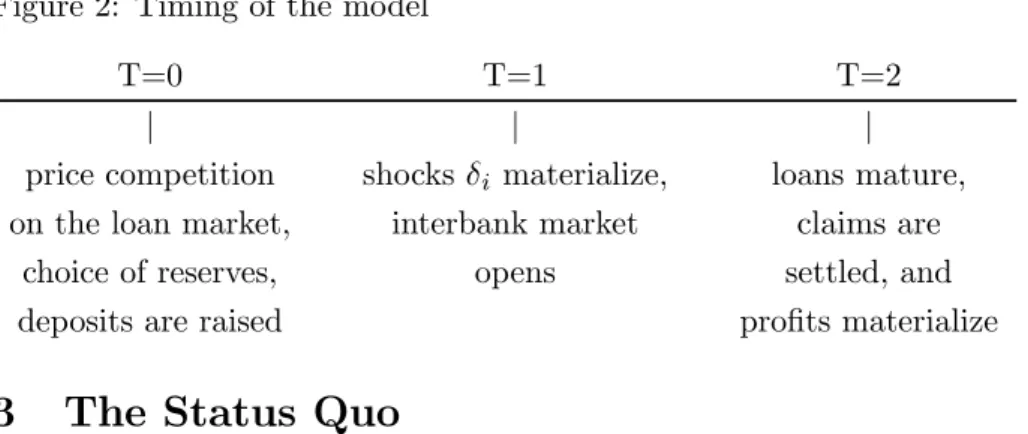
The timing of the model is summarized in Figure 2. At date 0 banks compete in prices on the loan market, choose reserve holdings, and raise deposits. After liquidity shocks materialize at date 1, the interbank market opens. At date 2 loans mature, and remaining claims from deposits and the interbank market are settled.
Figure 2: Timing of the model
T=0 T=1 T=2
| | |
price competition shocks δi materialize, loans mature,
on the loan market, interbank market claims are choice of reserves, opens settled, and deposits are raised profits materialize
3
The Status Quo
In this section we characterize the equilibrium when all banks are identical. We start with noting two features of the model. First, bank runs never occur in this model. The illiquidity of loans together with rD > 0 guarantees that depositors withdraw prematurely only if hit by liquidity shocks. Second, we assume that the loan market is sufficiently profitable (differentiated) for banks to borrow in the deposit and interbank markets. So, we can directly focus on the date 0 maximization problem.
With these considerations in mind, at date 0 each bank ichooses the loan rate rLi and the reserves Ri so as to maximize the following expected profit, where for simplicity the
intertemporal discount factor is normalized to one:
Πi= (riL−c)Li+ Z Ri 0 rIL(Ri−xi)f(xi)dxi− Z Di Ri rIB(xi−Ri)f(xi)dxi−rDDi(1−E(δi)). (8) The first term in (8) represents the profit from the loan market, the second term is the expected revenue from interbank lending at date 1 when the bank is in excess of reserves, the third term is the expected cost of refinancing at date 1 when the bank faces a shortage of reserves, and the fourth term is the expected repayment to depositors leaving their funds until date 2. Taken together, the last two terms represent bank i’s financing costs.
For expositional convenience and without loss of generality, we setrIL = 0 and denote rIB simply asrI. (No qualitative result depends on this simplification, which also captures the stylized fact that the interbank market is relatively ‘passive’ in that banks do not keep reserves to make profits, but only to protect themselves against liquidity shocks.) This simplifies (8) as follows:
Πi = (rLi −c)Li−
Z Di Ri
where the third term, RDi Ri r I(x i−Ri)f(xi)dxi = R1 Ri Di rI(δ iDi−Ri)f(δi)dδi, indicates that if
a bank’s demand for liquidity, xi =δiDi, exceeds its reserves Ri, the bank incurs the cost
rI on each unit of liquidity needed to satisfy depositors from the interbank market. Thus, as in Klein (1971), reserves are kept for precautionary reasons. In choosing the amount of reserves Ri at date 0, a bank trades off the cost of satisfying the expected liquidity needs
at date 1, RDi Ri r
I(x
i−Ri)f(xi)dxi, with the cost rD of raising more deposits and keeping
more reserves at date 0. As a consequence, a bank’s demand for reserves depends on the uncertainty about deposit withdrawals and on the costs incurred to borrow liquidity at date 1 and of keeping reserves initially. The more uncertain the date 1 demand for liquidity xi
and the more costly raising liquidity at date 1 (i.e., the higherrI), the higher is the demand
for reserves at date 0.
The following proposition characterizes the symmetric equilibrium in the status quo.
Proposition 1 The symmetric status quo equilibrium is characterized as follows:
1. Each bank sets a loan rate rsqL = l
γ(NN−1)+csq, where csq=c+
√
rIrD;
2. It has a loan market shareLsq =l;
3. If rI > rD, it keeps reserves Rsq =
µq
rI rD −1

Lsq, and raises deposits Dsq =
Lsq
q
rI rD.
The differentiation on the loan market implies that the loan rate rL
sq exceeds the total
marginal costcsq via the mark up γ(Nl−1
N )
. This decreases with both the number of banksN and the loan substitutability parameterγ, while it increases with the level of loan demand l. The total marginal cost includes the loan lending cost c and the marginal financing cost √rIrD, i.e., the sum of the expected cost of refinancing and of raising deposits.
Equilibrium reserve holdingsRsq balance the marginal benefit of reducing the expected
cost of refinancing with the marginal cost of increasing deposits, as explained above, and they are positive as long as rI > rD. We restrict our attention to this plausible case. Reserves increase with the demand for loansLsqand with the interbank refinancing costrI,
while they decrease with the deposit raterD. The intuition is simple. When the demand for
loansLsq is high, banks face ceteris paribus higher deposit withdrawals at date 1 and wish
keep more reserves initially, since this is less costly than obtaining the missing liquidity from the interbank market at date 1. In this sense, the ratio rrDI can be defined as the relative
cost of refinancing, which will help us later on to distinguish various scenarios for liquidity effects. It is a measure of how costly refinancing at date 1 is relative to raising deposits and reserves at date 0.6
Two further implications of Proposition 1 are important for comparing this equilibrium with the post-merger equilibrium in the next section. First, using the balance sheet equality (1), we can express equilibrium reserve holdings in terms of anoptimal reserve-deposit ratio as ksq = Rsq Dsq = Ã 1− r rD rI ! . (10)
Note that, whereas the equilibrium reserve holdings in Proposition 1 depend on the loan market outcome, the reserve-deposit ratio in (10) does not. To exploit this, in what follows we will mostly focus on this ratio. In practice, the ratios of liquid assets to customers’ sight deposits or of liquid assets to total assets are among the most frequently used indicators by banks to assess their own liquidity situation (see, e.g., ECB, 2002, p. 22). Second, Proposition 1 implies the following corollary.
Corollary 1 In the status quo equilibrium, each bank has liquidity risk φsq =
q
rD rI and
expected liquidity needs ωsq= r D
2rIDsq = L2sq
q
rD rI.
The equilibrium liquidity risk φsq and the expected liquidity needs ωsq are increasing
in the deposit rate rD and decreasing in the refinancing cost rI. Banks keep low reserves when rD is high and rI is low, because raising more deposits is expensive while borrowing additional liquidity at date 1 is not. Thus, banks’ demand for reserves decreases with the ratio rrDI, and banks’ liquidity risk and expected liquidity needs increase with it.
4
The E
ff
ects of a Merger on Individual Banks’ Behavior
In this section we analyze what happens at the individual bank level when a merger takes place. The behavior of the merged banks changes in several ways. First, they can exchange
6IfrIL>0, the ratio would be rIB−rIL rD−rIL .
reserves internally, which changes how they insure against liquidity risk. Second, this ‘in-ternal money market’ gives them a financing cost advantage, whose size is endogenously determined. Third, the merged banks may enjoy cost efficiencies that reduce their lending costs to β, where β < 1. Fourth, they gain market power in setting loan rates. All these factors affect banks’ equilibrium balance sheets and, in turn, the demand and supply of liquidity. We begin with discussing how the merger modifies banks’ reserve holdings, and then we turn to its effects on costs and loan market competition.
4.1
Internal Money Market and Choice of Reserves
We notefirst that the merger does not affect the optimal reserve-deposit ratio of the N−2 competitors. As they have the same cost structure as in the status quo, they still choose their reserve-deposit ratios according to (10), i.e.,kc=ksq. This implies also that they have
the same per-unit financing costs√rIrD as in the status quo (from Proposition 1).
By contrast, the merged banks, say bank 1 and bank 2, choose a different reserve-deposit ratio, because the merger modifies the distribution of their liquidity shocks and also allows them to pool their reserves to meet the total demand for liquidity. Thus, as long as the two banks continue to raise deposits in two separate regions, the merger leaves room for an internal money market in which they can reshuffle reserves according to their respective needs. For simplicity, we assume a ‘perfect’ internal money market, so that exchanging reserves internally involves no cost, but all qualitative results go through as long as the internal money market is less costly than the interbank one. Proceeding in this way is motivated by recent empirical research suggesting that internal capital markets function relatively efficiently (see, e.g., Graham et al., 2002; Houston et al.,1997; and Campello, 2002).
Let xm =δ1D1+δ2D2 be the total demand for liquidity of the merged banks at date 1, Rm = R1+R2 be their total reserves and Dm =D1+D2 be their total deposits. The combined profits of the merged banks are then given by
Πm = (r1L−βc)L1+ (rL2 −βc)L2−
Z Dm Rm
rI(xm−Rm)f(xm)dxm (11) −rD[D1(1−E(δ1)) +D2(1−E(δ2))] .
The first two terms in (11) represent the combined profits from the loan market, with β
is the total expected cost of refinancing, and the last one is the total expected repayment to depositors. The operation of the internal money market can be seen in the third term of (11), where the total demand for liquidity,xm=δ1D1+δ2D2, and reserves,Rm=R1+R2, are pooled together.
A preliminary step before deriving the optimal reserve-deposit ratio of the merged banks is to understand their ‘deposit market policy’. Whether they raise equal or different amounts in both regions affects the distribution of the demand for liquidity xm, and thus the size of
the expected cost of refinancing. We have the following lemma.
Lemma 1 The merged banks raise an equal amount of deposits in each region, i.e., D1 = D2= D2m.
Lemma 1 shows that the merged banks not only raise deposits in both regions, but they even do it symmetrically. Choosing equal amounts of deposits in both regions minimizes the variance ofxmand maximizes the benefits of diversification, thus reducing the expected
refinancing cost. (We will come back to this point in Section 5 when studying the effect of the merger on aggregate liquidity demand.)
GivenD1=D2, the merged banks choose reservesRm so as to maximize their combined
profits in (11). Letkm = DRmm be the reserve-deposit ratio for the merged banks and recall
that ksq is the one for banks in the status quo defined in (10). The following proposition
compares these two ratios.
Proposition 2 The merged banks choose a lower reserve-deposit ratio than in the status quo (km< ksq) if the relative cost of refinancing is higher than a threshold ρ(r
I
rD >ρ), and
a higher one otherwise.
Proposition 2 contains the first main result of the paper indicating that the merged banks may have a higher or a lower optimal reserve-deposit ratio than individual banks. The result depends on the relative strength of two effects:
• A diversification effect that reduces the probability of extreme shocks for the merged banks;
• An internalization effect consisting in the possibility to use any unit of reserves to cover a deposit outflow at either of the banks that make up the merged bank. This
increases ceteris paribus the marginal value of one unit of reserves and has a positive impact on the demand for reserves.
Whether the merged banks choose a higher reserve-deposit ratio depends on which of the two effects dominate. Proposition 2 suggests that the internalization effect dominates when the relative cost of refinancing is low, whereas the diversification effect prevails when it is high. The intuition behind this result can be explained in terms of the link between the marginal value of reserves, the initial level of reserves and banks’ ability to estimate future liquidity needs.7
The marginal value of reserves depends on the amount of reserves a bank has at date 0 and on the probability it will need more liquidity at date 1. The merged banks face less uncertainty about future liquidity needs than the individual banks, because their demand for liquidity is more concentrated around the mean. This means that at low initial level of reserves, a marginal increase of reserves is worth more to the merged banks than to the individual banks who are less certain of needing more liquidity at date 1. Conversely, when banks keep high levels of reserves, a marginal increase of reserves is worth less to the merged banks than to the individual banks, since the merged banks know they will be less likely to need liquidity at date 1. Whether the merged banks increase their reserve holdings compared to before merging depends on the relative cost of refinancing rrDI.When this ratio is low, all
banks keep low reserves because refinancing is not very expensive. Then the merged banks increase their reserves relative to before merging, since they have a higher marginal value of further reserve units. The opposite happens when rrDI is high. In this case reserves are
high, and the merged banks value further increases of reserves less than individual banks, because they are more confident that they will not need them.
The readjustment of the merged banks’ reserve holdings changes also their refinancing costs relative to the status quo, and we have the following.
Corollary 2 The merged banks have lowerfinancing costs than the competitors.
This cost advantage for the merged banks is endogenous to the model in that it is determined not only by diversification, but also by the optimal reserve readjustment. In
7
this sense, this result provides a new bank-specific motive to merge, in addition to the well-known market power and diversification motives.
To sum up, the possibility for merged banks to estimate more precisely their liquidity needs allows them to better assess the reserve-deposit ratio they should hold and adjust it accordingly. Furthermore, the possibility for the merged banks to exchange reserves in the internal money market implies that banks can benefit from scope economies in their liquidity management by raising deposits in two imperfectly correlated deposit markets. This result is consistent with Hughes et al. (1996), whofind that banks active in imperfectly correlated deposit markets −especially as a result of consolidation−can reduce the cost of controlling liquidity risk by appropriately adjusting deposit collection and reserve holdings. In this respect, our result is also related to Kashyap et al. (2002), who show that combining the activities of lending and deposit taking produces synergies that allow banks to reduce the volume of liquid assets that banks need to hold to satisfy their customers’ unexpected demands. However, whereas in their paper such an advantage in providing liquidity arises as a consequence of two imperfectly correlated markets on different sides of the balance sheet, in our model it emerges from two imperfectly correlated markets on the same side of the balance sheet.
4.2
Choice of Loan Rates and Balance Sheets
We now examine how the merger modifies the loan market equilibrium and banks’ balance sheets. The effect of the merger on loan rates depends on how it affects banks’ market power and cost structures. As already noticed, competitors have the same total costs as in the status quo. By contrast, the total costs of the merged banks change. As stated in Corollary 2, their financing costs are lower than competitors’. Furthermore, their lending costs reach βc, where the parameter β ≤1 represents the potential non-financial efficiency gains that the merger induces for granting loans. The lower the parameter β the greater are the efficiency gains. The idea is to include, for example, the possibility for economies of scale, which are often put forward by bank managers in favor of mergers and have been questioned in the literature, as we discuss in Section 6.8
8We could also allow forβ>1, in which case the merger would even lead to diseconomies. Already the market power of merged banks tends to increase loan rates, andβ>1 would only strengthen this effect. So, none of our results would be qualitatively altered by further generalizingβ.
The following proposition describes the post-merger equilibrium with symmetric behav-ior within the ‘coalition’ (merger) and among competitors.
Proposition 3 The post-merger equilibrium withrL1 =rL2 =rmL andrLi =rcLfori= 3, ..., N is characterized as follows:
1. Each merged bank sets a loan rate rLm =
³ 2N−1 N−2 ´ l 2γ + (N−1) 2N cc+ (N+1) 2N cm, and each competitor sets rcL= ³ N−1 N−2 ´ l γ + (N−1) N cc+ 1 Ncm;
2. The merged banks have a total loan market shareLm =
¡2N−1
N
¢
l+γ(N−1)(N2N−2)(cc−cm),
and each competitor has Lc= (N−1)
2
N(N−2)l−γ (N−1)
N2 (cc−cm);
3. The merged banks raise total deposits Dm = 1−1kmLm, and each competitor raises
Dc= 1−1kcLc;
where cm, cc are the total marginal costs of the merged banks and of the competitors,
and km and kc are their respective optimal reserve-deposit ratios.9
Since banks compete in strategic complements, the merged banks drive the loan rate movements in the market and the competitors move in the same direction. The effect of a merger on loan rates depends on the relative strength of a market power effect and a cost efficiency effect. The first refers to the higher market power banks enjoy after a merger because of the lower number of active banks (which reduces fromN toN−1). The second derives from the lower total marginal costs cm that the merged banks enjoy relative to
competitors. Post-merger equilibrium loan rates increase when the merger induces small cost advantages relative to the increase in market power, whereas they decrease otherwise.
Loan market shares across banks change in line with loan rates. As the merged banks change their loan rates by more than competitors, their total loan market share shrinks when loan rates increase and it expands otherwise, i.e., Lm <2Lsq <2Lc when rLm > rcL,
and Lm >2Lsq >2Lc otherwise.
The modification of loan market shares together with the change in the optimal reserve-deposit ratio described in Proposition 2 determines the effects on the size of banks’ balance sheets (as measured by the amount of deposits). In the present set-up the merger breaks
9The expressions forcm,ccare in the proof of this proposition; those forkmandkc are, respectively, in the proof of Proposition 2 and in equation (10).
the symmetry in banks’ balance sheets. Whereas in the status quo all banks have the same depositsDsq, the merged banks have now in general different deposit sizes than competitors,
i.e., Dm
Dc 6= 2. This is what we assume here, although the opposite could also happen: starting
from a situation of an asymmetric banking system, the merger could reduce the asymmetry among banks and make the system more homogenous.
4.3
Individual Banks’ Liquidity Risk and Expected Needs
The effects of the merger on both banks’ reserve holdings and loan competition affect also banks’ liquidity risks and expected liquidity needs. The results for competitor banks are quite straightforward. As they follow the same optimal reserve rule as in the status quo, they face the same liquidity risk φc = φsq =
q
rD
rI (see Corollary 1). Their expected
liquidity needs, however, change with their balance sheet, as ωc = r D
2rIDc. The merged
banks experience more far reaching changes in probability of facing a liquidity shortage and in the size of the expected needs.
Corollary 3 The merged banks have lower liquidity risk than a single bank in the status quo.
This result derives directly from the readjustment of the merged banks’ reserve holdings. As stated in Proposition 2, when the relative cost of refinancing is below the threshold ρ, the merged banks increase their reserve-deposit ratio and their liquidity risk goes down. In the other case, although they choose a lower reserve-deposit ratio than in the status quo, they still keep it sufficiently high to decrease the liquidity risk. This effect is so strong that the liquidity risk of the merged banks is not only lower than the risks of two banks in the status quo, but it is even lower than that of a single bank.
Corollary 4 The merged banks have lower expected liquidity needs than in the status quo if Dm
Dsq < h, where 2< h≤4, and higher ones otherwise.
The merger changes the merged banks’ expected needs for three reasons. First, it creates the internal money market, which reduces ceteris paribus expected liquidity needs. Second, the merger modifies the merged banks’ optimal reserve-deposit ratio, which reduces ceteris paribus expected liquidity needs when the relative cost of refinancing is low. Third, the
merger changes the merged banks’ deposits, and hence the size of their demand for liquidity. Corollary 4 shows that thefirst effect dominates unless cost advantages (efficiency gains and reducedfinancing costs) and competition in the loan market (degree of loan differentiation
γand number of banksN) are so strong that the merged banks increase their balance sheets substantially relative to two banks in the status quo. From an empirical perspective, such a strong balance-sheet expansion seems to be a less plausible scenario.
5
The E
ff
ects of a Merger on Aggregate Liquidity
Now that we have seen how a merger affects the behavior of individual banks, we can turn to its implications for the banking system as a whole. To see this, we analyze how changes in banks’ reserve holdings and in loan market competition modify the aggregate supply and demand of liquidity, as represented respectively by the sum of all banks’ reserves and of their demands for liquidity at date 1 when shocks materialize.
We identify two channels. The first one we call reserve channel, as it works through changes in reserve holdings. When looking at the system as a whole, the distinction be-tween the internal money market of the merged banks and the interbank market is blurred, and the total supply of liquidity is composed of the sum of all banks’ reserve holdings. Nevertheless, the existence of the internal money market affects the total supply of liquidity through the change in the reserve holdings of the merged banks. The second channel is an asymmetry channel, which affects the distribution of the aggregate liquidity demand. This channel originates in the asymmetry of balance sheets across banks, which−as shown above− depends on both the different amounts of reserves and the different loan market shares that banks have after the merger.
We start with analyzing each of the two channels in isolation. Then we examine how they interact in determining aggregate liquidity risk and expected aggregate liquidity needs.
5.1
Asymmetry Channel without Internal Money Market
To isolate the working of the asymmetry channel, we assume for a moment that the merged banks cannot make use of the internal money market. In this case, they do not have any
financing cost advantages, and they choose the same optimal reserve rule as their competi-tors. As a consequence, the asymmetry in banks’ balance sheets originates only from the
different distribution of market shares resulting from loan competition.
As all banks continue to choose reserves according to (10) and as the aggregate demand for loans is inelastic, the merger does not affect the total amounts of reserves and deposits, thus leaving the aggregate supply of private liquidity unchanged. The asymmetry of banks’ balance sheets, however, modifies the aggregate liquidity demand, which changes fromXsq=
PN
i=1δiDsq in the status quo to Xm =δ1
Dm
2 +δ2
Dm
2 +
PN
i=3δiDc after the merger. Both XsqandXmare weighted sums ofN uniform random variables, but in thefirst case weights
are equal and in the second case they differ (according to deposit sizes Dm
2 and Dc). This brings us to the main result about the asymmetry channel.
Proposition 4 Suppose the merged banks do not exchange reserves internally. Then, the aggregate liquidity effects of the merger are as follows:
1. The merger decreases aggregate liquidity risk if the relative cost of refinancing is below a threshold σ (rrDI <σ<ρ), and increases it otherwise;
2. The merger always increases expected aggregate liquidity needs.
The intuition behind Proposition 4 is similar to that one behind Lemma 1. Moving from a uniformly weighted sum of random variables (in the status quo) to a heterogeneously weighted sum of random variables (after merger) increases the variance of the total sum. Thus, as Figure 3 illustrates, the distribution of Xsq gives lower probability to extreme
events —very low and very high realizations of the aggregate liquidity demand— than that of Xm.
This change in the distribution ofXm reduces the aggregate liquidity risk if the relative
cost of refinancing is low (below the thresholdσ), because it increases the probability that the aggregate liquidity demand is below the total private supply. This is illustrated in Figure 3, where total reserves —indicated by the vertical linePNi=1Ri— are low and the area 1−Φm
is larger than the diagonally striped area 1−Φsq. The opposite happens when the relative
cost of refinancing is high.
[FIGURE 3 ABOUT HERE]
Proposition 4 also states that the merger always increases the expected amount of public liquidity needed. The reason is that the expected aggregate liquidity needs depend not only
on the frequency with which aggregate liquidity demand exceeds aggregate supply, but also on the magnitude of each excess. As noted earlier, the merger increases the variance of the distribution ofXm and thus the probability of events with very low and very high demands.
If banks do not hold reserves, these increases offset each other and the expected aggregate liquidity needs are the same before and after the merger. By contrast, when banks hold positive reserves, they can cover the events with low aggregate liquidity demand. Hence, the higher probability of extreme events with high aggregate liquidity demand is not outweighed any more by the higher frequency of low demand events, and the expected aggregate liquidity needs grow.
Note that the results of Proposition 4 crucially depend on the fact that we are focusing on mergers that lead to more asymmetry in banks’ balance sheets, like those among large banks. Of course, mergers may also have the opposite effect of making banks more symmetric. This could happen, for example, when mergers involve smaller banks. In such a case, the functioning of the asymmetry channel is reversed and mergers reduce expected aggregate liquidity needs. We need to keep this in mind when discussing our results further below.
5.2
Interaction with the Reserve Channel
In this section we reintroduce the possibility for the merged banks to use the internal money market. We first analyze how this affects aggregate liquidity through the reserve channel. Denote as Km= Rm+PNi=3Rc Dm+ (N −2)Dc = kmDm+ PN i=3kcDc Dm+ (N −2)Dc (12)
the aggregate reserve-deposit ratio after the merger. Since competitors choose the same ratio as in the status quo (kc=ksq), the change inKm is solely determined by the change in the
merged banks’ reserve-deposit ratio. Hence, it follows from Proposition 2 thatKm increases
when the relative cost of refinancing is relatively low (because then km > ksq), whereas
it decreases otherwise. The following lemma describes how the change in the aggregate reserve-deposit ratio alone affects aggregate liquidity.
Lemma 2 Suppose the merger does not cause any asymmetry in banks’ balance sheets (Dm = 2Dc). Then, it decreases aggregate liquidity risk and expected aggregate liquidity
When the merger does not generate asymmetry across banks’ balance sheets, it affects aggregate liquidity only through the reserve channel. The aggregate supply of private liq-uidity changes, whereas the aggregate liqliq-uidity demand remains the same. Thus, the merger reduces both aggregate liquidity risk and expected aggregate liquidity needs when the ag-gregate supply of private liquidity increases through the higher reserve-deposit ratio of the merged banks. The opposite happens when the aggregate liquidity supply falls.
When the merger generates the internal money market and modifies bank sizes, both the asymmetry and the reserve channel are at work. Depending on the size of the relative cost of refinancing, the two channels can reinforce or offset each other. Therefore, we consider the cases of high and low relative cost of refinancing separately.
Proposition 5 If the relative cost of refinancing is above ρ(rrDI >ρ), the merger increases
both aggregate liquidity risk and expected aggregate liquidity needs.
When the relative cost of refinancing is rather high, the asymmetry channel and the reserve channel work in the same direction. The asymmetry channel increases the variance of the aggregate liquidity demand, and the reserve channel reduces the aggregate liquidity supply through the lower reserve holdings of the merged banks. Both these effects make the system more vulnerable to liquidity shortages and thus more dependent on public liquidity provision.
Proposition 6 If the relative cost of refinancing is below ρ (rrDI < ρ), then the following
holds:
1. There exists a critical level of the relative cost of refinancing g∈ (σ,ρ) such that the merger reduces aggregate liquidity risk if the cost of refinancing is below such critical level, and increases it otherwise;
2. For any small level of asymmetry induced by the merger, there exists a setGof values of the relative cost of refinancing, with G⊂(1,ρ), for which the merger reduces expected aggregate liquidity needs.
When the cost of refinancing is relatively low, the reserve and the asymmetry channels drive aggregate liquidity in opposite directions, and the net effect depends on their relative
strength. As shown in Lemma 2, the reserve channel reduces both aggregate liquidity risk and expected liquidity needs. This occurs because the banking system has more reserves in aggregate through the higher reserve holdings of the merged banks. As stated in Proposition 4, however, the asymmetry channel always increases expected aggregate liquidity needs, whereas it reduces aggregate liquidity risk only if the relative cost of refinancing is sufficiently low.
Thus, when the two channels interact, the merger reduces aggregate liquidity risk for a larger range of parameter values than in Proposition 4, where only the asymmetry channel is active. Similarly, it increases aggregate liquidity risk in a larger range of parameter values than in Lemma 2, where only the reserve channel is present.
As for the expected aggregate liquidity needs, the reserve channel dominates when the asymmetry induced by the merger is sufficiently small. Thus, there is a range of values of the relative cost of refinancing for which the merger reduces expected aggregate liquidity needs. The larger the asymmetry in banks’ balance sheets, the larger is this range of parameters in which the merger increases expected aggregate liquidity needs. Taken together, the results in Proposition 6 suggest that central banks have to be more attentive to the liquidity
fluctuations of the interbank market and intervene more often after a consolidation process that leads to higher aggregate liquidity risk and higher expected liquidity needs.
How relevant are these different scenarios for changes in aggregate liquidity? One way to proceed is to associate the level of the relative cost of refinancing with different countries or
financial systems. For example, in industrial countries with relatively sizable and developed
financial systems one would expect this cost to be rather low. In contrast, in developing or emerging countries with less developedfinancial systems this cost may be quite high. Then, Proposition 5 suggests that in the latter group of countries bank consolidation may lead to a deterioration of aggregate liquidity. Proposition 6 indicates instead that the impact of mergers on aggregate liquidity in industrial countries crucially depends on whether the reserve or the asymmetry channel dominates. The asymmetry channel may dominate when consolidation takes the form of mergers between large banks leading to a ‘polarization’ of the banking system. Table 1 suggests that something like this seems to have happened in a number of industrial countries during the 1990s. For example, in Belgium, Canada, France, the Netherlands, and Sweden, consolidation enlarged substantially the share of the largest
players, thus increasing the asymmetry among banks. Differently, in countries like Australia and Germany, the weight of the largest banks hardly changed. So it may be possible that the reserve channel may have dominated in those countries, thus leading to an improvement in aggregate liquidity. A similar result may have occurred in Japan and the UK, where
−according to Table 1− consolidation has even led to a more symmetric banking system and thus to a reversed functioning of the asymmetry channel.
Note that we primarily address the structural effects of bank mergers on loan compe-tition, reserve holdings and aggregate liquidity, but in practice business cycles may affect some of our variables. In particular, the relative cost of refinancing is affected by trading conditions in the interbank market and the level of interest rates, and it may behave pro-cyclically. This implies that bank mergers involving large banks may affect reserve holdings and private liquidity more negatively in upturns than in downturns. Our results above have therefore to be interpreted as the “average” (or structural) effects of mergers over time. It would be interesting to extend our model in future research to explicitly cover macroeco-nomic features and analyze in depth how reserve holdings and aggregate liquidity change over the business cycle.
6
The Relationship between Competition and Aggregate
Liq-uidity
We now discuss more in detail how loan market competition and reserve choices interact in determining loan rates and aggregate liquidity (for simplicity, here interpreted only as expected aggregate liquidity needs), and how liquidity effects relate to competition effects.
At the individual bank level, the loan market equilibrium affects banks’ reserve holdings (in absolute terms) by determining the amount of deposits required to finance loans, and hence the size of liquidity demands at any given level of reserves. Equilibrium reserve holdings determine banks’ financing costs —the sum of the expected cost of refinancing and of the expected repayment to depositors—, and thereby influence the loan market equilibrium. At the aggregate level, loan market competition affects the degree of asymmetry in banks’ balance sheets through the distribution of equilibrium loan market shares.
Table 2 summarizes the possible effects of mergers on both loan rates rLand expected aggregate liquidity needs Ω, as described in Propositions 3, 5 and 6. The rows of the table
indicate whether a merger is characterized by low or high efficiency gains in terms of both reduced loan provision costs and lower financing costs (cm
cc high or low); the two columns
show the cases of high and low relative cost of refinancing rrDI.
[TABLE 2 ABOUT HERE]
As Table 2 shows, the model predicts several scenarios, depending on the value of the parameters. The effect of mergers on expected aggregate liquidity needs is ambiguous when the relative cost of refinancing is low, whereas it is always negative when the relative cost of refinancing is high. Concerning competition, mergers increase loan rates when the cost efficiency effect, as measured by the ratio cm
cc, is small relative to the increased market power,
and, vice versa, decrease loan rates when cost efficiencies dominate.
What can we say about the plausibility of the different scenarios displayed in Table 2? As already indicated above, one may associate for example low refinancing costs with industrial countries and high refinancing costs with developing or emerging countries. Moreover, one may relate the magnitude of efficiency gains to the size of mergers. Even if there is an ongoing debate in the literature on whether efficiency gains (and, in particular, scale economies) exhaust at large or small sizes of output, the empirical consensus seems still to be that mergers between small banks produce larger efficiency gains than mergers between large banks.10
One plausible scenario in industrial countries (low rrDI) is therefore the occurrence of
mergers between large banks leading to higher loan rates and expected aggregate liquidity needs, as they do not realize sufficient efficiency gains and induce greater asymmetry in the banking system (one case in cell I). Differently, the occurrence of mergers between small banks in industrial countries is likely to reduce both loan rates and expected aggregate liquidity needs, as smaller mergers may realize more efficiency gains relative to the increase in market power and make the banking system more homogenous (one case in cell II). For developing countries (high rrDI), cells III and IV suggest that mergers would always increase
10A substantial amount of empirical research has been spent on measuring the efficiency gains generated by bank mergers, but results are not unanimous (see, e.g., the surveys of Carletti et al., 2002; and Rhoades, 1994 and 1998). Whereas the mainstream literature suggests that banks exhaust potential scale economies at modest levels of size (see, e.g., Berger et al., 1987; Berger and Humphrey, 1991; and Wheelock and Wilson, 2001), other studies (e.g., Berger and Mester, 1997; and Hughes et al., 2001)find that there are scale economies also at large balance sheet sizes if one takes changes in risk into account.
expected aggregate needs, whereas the effect on loan rates may still depend on their sizes. The interesting features of these results are that mergers are likely, ceteris paribus, to increase expected aggregate liquidity needs more in developing countries than in industrial ones, as they lead to lower reserve holdings for higher cost of refinancing; and that there is more complementarity between competition and liquidity in industrial countries than in developing ones. In terms of policy implications, these results suggest that policies aiming at promoting loan market competition may also prevent the adverse effects of consolidation for interbank liquidity in industrial countries, but not necessarily in developing countries.
7
Conclusions
This paper analyzes the impact of bank mergers on credit market competition, reserves and banking system liquidity. A merger creates an internal money market, which modifies merged banks’ optimal choice of reserves holdings, either decreasing them through a diver-sification effect or −more surprisingly− increasing them through an internalization effect. In both situations, merged banks benefit from a better estimate of future shocks and scope economies in their liquidity management, and they lower their financing costs and liquidity risk.
The change in merged banks’ reserve holdings, together with the change in the size of banks’ balance sheets due to altered loan competition, affect the functioning of the interbank market. Changes in reserve holdings modify the aggregate supply of private liquidity, while increased balance-sheet asymmetry raises aggregate liquidity needs by altering the distribu-tion of the aggregate liquidity demand. These reserve and asymmetry channels can work in the same or in opposite directions, depending on the cost of refinancing in the money market as compared to the cost offinancing through retail deposits. We conclude that mergers are more likely to increase aggregate liquidity needs when they involve large banks leading to a ‘polarization’ of the banking system. Moreover, the risk of adverse liquidity effects of bank consolidation is likely to be more relevant when the ratio of interbank to deposit funding costs is high. In this case there is also a lower complementarity between competition and liquidity, so that the effects of consolidation on loan rates and aggregate liquidity do not necessarily go hand in hand. These results have important implications for central banks’ money market operations.
The model implies some empirical hypotheses, which would be interesting to test in fu-ture research. While the competition effects of bank mergers are already quite well covered in the empirical literature, the same does not apply to the liquidity effects. At the individual level it would be interesting to estimate the effects of mergers on reserve holdings, and in particular the role of refinancing costs for the sign of reserve changes. At the aggregate level, it would be important to examine how asymmetry in bank sizes relates to liquidityfl uctua-tions. Moreover, it could be tested whether countries with relatively high refinancing costs experiencing banking consolidation display a deterioration in aggregate liquidity, whereas others don’t. Finally, it could be interesting to examine econometrically whether countries with greater bank competition face larger or smaller aggregate liquidity fluctuations.
Some features of the model deserve further discussion. The interbank market works in a very simple way. In the ultra-short interbank market, the central bank adjusts the liquidity supply to accommodate changes in the aggregate demand, and banks can always meet the repayment to depositors without suffering any liquidity crisis. In a similar spirit, long-term loans are totally illiquid, or, equivalently, the costs of liquidation are higher than the relative cost of refinancing. This framework allows us to focus on pure liquidity issues, and isolate reserve management from other considerations. An interesting extension of this model would be to analyze the functioning of other, longer term interbank markets, where the central bank would not be active and banks could modify the liquidity supply only by selling their long-term assets. We leave this for future research.
Appendix
Proof of Proposition 1
Using Leibniz’s rule and (1), from (9) we obtain the first order conditions with respect to the choice variables riL andRi:
∂Πi ∂riL =Li+ (r L i −c) ∂Li ∂rLi − · rI 2 L2i + 2LiRi (Li+Ri)2 +r D 2 ¸ ∂Li ∂rLi = 0, fori= 1...N, (13) ∂Πi ∂Ri =rD(Li+Ri)2−rIL2i = 0, fori= 1...N. (14)
Solving (14) for Ri gives
Ri = Ãr rI rD −1 ! Li. (15)
Solving (13) forriLin a symmetric equilibrium whererLi =rLsqfori= 1...Nafter substituting (2) and (15) gives
l+ (rsqL −c−√rIrD)(−γN −1
N ) = 0,
from whichrsqL and csq follow. Substituting thenrLsq in (2) givesLsq, and through (15)Rsq.
Substituting Rsq andLsq in (1), we obtainDsq. Q.E.D.
Proof of Corollary 1
Solving (3) and (4) givesφi = 1−Ri
Di andωi =
(Ri)2
2Di −Ri+ Di
2 . Substituting the expressions forRsq and Dsq, we obtainφsq and ωsq as in the corollary. Q.E.D.
Proof of Lemma 1
We proceed in two steps. First, we show that the variance of the liquidity demand xm of
the merged banks is minimized when deposits are raised symmetrically in the two regions. Second, we show that the expected liquidity needs of the merged banks (and therefore their refinancing costs) are lower when deposits are symmetric.
Step 1. Define the liquidity demand of the merged banks as xm=δ1αDm+δ2(1−α)Dm,
whereα∈[0,1] indicates the fraction of deposits that the merged banks raise in one region and (1−α) the fraction they raise in the other region. Sinceδ1 andδ2 are independent and V ar(δ1) =V ar(δ2), the variance of xm is simply
V ar(xm) = α2Dm2V ar(δ1) + (1−α)2D2mV ar(δ2) = V ar(δ1)[α2Dm2 + (1−α)2Dm2].
Differentiating it with respect toα, we obtain
∂V ar(xm) ∂α = 2D
2V ar(δ
1)(2α−1) = 0, which has a minimum at α= 12.
Step 2. Define now the liquidity demand of the merged banks as
xma=δ1αDm+δ2(1−α)Dm, when α6= 12, and as xms =δ1 Dm 2 +δ2 Dm 2
when α = 12. Applying the general formula in Bradley and Gupta (2002) to our case, the density functions of xma and xms can be written as (assume α < 12 without loss of
generality): fma(xma) = xma α(1−α)D2 m forxma≤αDm 1 (1−α)Dm forαDm < xma≤(1−α)Dm Dm−xma α(1−α)D2 m forxma>(1−α)Dm, fms(xms) = 4xm D2 m forxms≤Dm/2 4(Dm−xms) D2 m forxms> Dm/2. (16)
Since α < 12, fma(xma) is steeper than fms(xms) both for xma ≤ αDm and for xma >
(1−α)Dm. This implies that the two density functions do not cross in these intervals,
whereas they do it in two points in the intervalαDm< xma≤(1−α)Dm. Given that they
are symmetric around the same mean Dm/2 withV ar(xma)> V ar(xms), it is:
Fma > Fms forRm < Dm 2 , (17) Fma < Fms forRm > Dm 2 , where Fma= Pr(xma< Rm) and Fms= Pr(xms< Rm).
Denote now as ωma and ωms the expected liquidity needs of the merged banks with
asym-metric deposits and symasym-metric deposits respectively. We have
ωma−ωms = Z Dm Rm (xma−Rm)fma(xma)d(xma)− Z Dm Rm (xms−Rm)fms(xms)d(xms) = Z Dm Rm xmafma(xma)d(xma)− Z Dm Rm xmsfms(xms)d(xms) (18) −Rm(1−Fma(Rm)) +Rm(1−Fms(Rm)).
Differentiating (18) with respect toRm gives d(ωma−ωms) dRm = −Rmfma(Rm) +Rmfms(Rm)−(1−Fma(Rm)) +Rmfma(Rm) + (1−Fms(Rm))−Rmfms(Rm) = Fma(Rm)−Fms(Rm). From (17) it follows d(ωma−ωms) dRm > 0 for Rm < Dm 2 and d(ωma−ωms) dRm < 0 otherwise. This,
along with ωma−ωms = 0 both forRm = 0 and for Rm =Dm implies ωma−ωms >0 for
all Rm ∈[0, Dm]. Q.E.D.
Proof of Proposition 2
The demand for liquidity of the merged banks, xm =δ1D2m +δ2Dm2 , has density function as in (16). Using Leibniz’s rule, the equalityDm =Rm+L1+L2,and the ratiokm= DRmm,
from (11) we can express the first order condition ∂Πm
∂Rm = 0 as 8 3k3m−4k2m+ 1 = r D rI forkm≤1/2 8 3(1−km)3= rD rI forkm>1/2. (19)
The term on the LHS of the equalities is the marginal benefit of increasing the reserve-deposit ratio, that is the reduction in the expected need of refinancing induced by a marginal increase of the reserve ratio. The term on the RHS of the equalities is the ratio between the