Neighborhood-based in-library use performance measures
for public libraries: A nationwide study of
majority–minority and majority white/low income
markets using personal digital data collectors
Christie M. Koontz
a,*, Dean K. Jue
a, Keith Curry Lance
b aGeoLib Program, Florida Resources and Environmental Analysis Center, Florida State University, C2200 University Center, Tallahassee, FL 32306, USA
b
Library Research Service, Colorado State Library and University of Denver, 201 East Colfax Avenue, Suite 309, Denver, CO 80203, USA
Available online 28 January 2005
Abstract
The practice of aggregating public library use data to a system-wide level (central library and branches) can mask the library needs of more specific groups of users. This article introduces a study that addressed this need, by identifying libraries serving majority White/low income and majority– minority markets, and surveying those populations to identify types and levels of use. The study is critical for current library research and practices for these reasons: (1) the increasing diversity in race/ ethnicity and languages spoken in U.S. communities; (2) low circulation rates exacerbated by increased Internet use; (3) mere existence of a library is critical to optimize use by populations without the library and reading experience; and (4) the recent release of the U.S. Public Library Geographic Database (http://www.geolib.org/PLGDB.cfm) with neighborhood level census and library use data for all U.S. library jurisdictions. The methodologies developed offer potential for the collection of critical data for the public librarian of today.
D2004 Elsevier Inc. All rights reserved.
0740-8188/$ - see front matterD2004 Elsevier Inc. All rights reserved. doi:10.1016/j.lisr.2004.09.003
* Corresponding author.
1. Introduction
At the turn of this new century, an estimated 10% of America’s 16,000 public library outlets serve populations of 50,000 or more, nearly half serve fewer than 5000. Public library facilities in rural and densely populated urban neighborhoods are often the only facilities truly open to the public within the travel distance of vulnerable populations such as the poor, new immigrants, children, and the elderly. The value of professionally staffed libraries in these communities cannot be overestimated. The public library remains one of the most well-established resources supporting lifelong learning in most communities. Public libraries are self-mandated to provide equal access to a wide range of educational and informational materials based upon an analysis of the immediate population’s unique characteristics (Public Library Association, 1979). Readily available data on neighborhood-level use and users and the tools needed to analyze it are critical for optimal service provision. This article describes a project that developed a methodology to collect neighborhood-level data as well-provided insights into the need for the collection of such user data.
1.1. Smallest to largest libraries measure materials circulation
The most universally collected statistic is circulation. Virtually every library records how many items are checked out and by whom to ensure that materials are eventually returned. Larger libraries have automated circulation systems, but some very small libraries still keep these records manually. Therefore, little additional effort is required to calculate an annual circulation value for a library. If the library has more than one outlet (e.g., a branch or bookmobile), data are often aggregated by the jurisdiction’s automated system, where such systems are in use, or to comply with reporting purposes of local and state funders, in the absence of automated systems. This aggregated data then provide a summary of library use (circulation) at the jurisdiction level. Because of its widespread availability, these data are often used to measure the effectiveness and value of library service to a community.
While this simplified picture of public library use and collection of library use statistics worked well when books were the primary medium of information transfer and communities were more homogeneous, this approach is not effective today as it ignores information that could be key in making critical decisions about today’s public libraries. This is due to four major reasons:
! Starting in the late 1980s, two library organizations, the Public Library Association (PLA) and the Federal State Cooperative System (FSCS) of the National Center for Education Statistics,1 began requesting library systems to systematically collect data beyond circulation including reference and program attendance.
1
Since 1988, PLA has published thePublic Library Data Service Statistical Report, which offers annual data on both central libraries and branches (i.e., aggregating branch data separately from central libraries) for virtually all major metropolitan and suburban library jurisdictions as well as a sampling of smaller nonmetropolitan jurisdictions. The Federal-State Cooperative System (FSCS) for Public Library Data offers annual use figures for all libraries at the jurisdiction level.
! Burgeoning use of various new media formats such as audio and video, CD-ROM, and eventually electronic resources, such as subscription databases and free Web sites. This complicated the measurement of blibrary use,Q and many libraries continue to struggle with systematic methods and procedures of counting these uses (Janes, 2003). Thus, many libraries still rely on circulation statistics.
! Beginning in the latter half of the 20th century and continuing today, neighborhoods across America changed from majority-White to majority–minority (where the majority of the residents belong to one or more racial/ethnic minorities such as Asian Pacific, Hispanic, or African Americans). The research that is available indicates that public library services needed in majority–minority and lower income areas differ from traditional majority-White library markets, which are often characterized by higher levels of education and income (Koontz, 1997, pp. 44–54). Two studies found that minorities used reference services and attended library programs more than they checked out books (Koontz, 1990, 1993). These and other studies illuminated the need to more widely identify and categorize how nontraditional markets (non-White and lower income) are using the library. Documenting any such difference is important. Although circulation is the library field’s largest, tried, and true measure of library use, libraries serving primarily those who use the library in ways that do not involve checking out books can appear less used and as a result may be underfunded or even closed.
! Additional measures are also critical at a time when many public libraries are facing budgetary constraints. In reaction to reduced funds, public libraries are merging, resiting, or closing outlets. Available evidence indicates that actions such as merging, resiting, or closing a public library branch disproportionately reduce access to information resources and lifelong learning opportunities for minority and low-income groups (Chu, 1998; Hayes & Palmer, 1983; see alsoKoontz, 1997,pp. 44–54). When members of these groups do not have the library and reading experience like their more educated or experienced peers (Van House, 1983), the mere existence of a nearby library then becomes critical to optimize the possibility of library use (Coughlin, Taieb, & Stevens, 1972; International Research Associates, 1963; Koontz, 1990; Shoham, Hershkovitz, & Metzker, 1990).
1.2. U.S. public libraries play a significant role in lifelong learning
In the United States, the growth of poverty and joblessness, new immigrant populations, and the ubiquitous need for technical literacy continue to increase the significance of the public library’s role in lifelong learning (Brown & Ormes, 2003; Chu, 1998). Public libraries are one of the few if not only public information resources in areas having a high concentration of low-income individuals. Those individuals have fewer options for education and less access to information resources, often lacking computers and workspace at home. Research indicates that public libraries are vital in diminishing the information gap between the technical elite and the technical poor (Jue, Koontz, Magpantay, Lance, & Seidl, 1999). Given the demographics of this century’s potential new library users, it is critical that public library decision makers have data that enable them to measure performance and use, and assess needs, in vulnerable and diverse neighborhoods.
1.3. Neighborhood level customer statistics, an uncommon but critical need
The common practice of aggregating public library use statistics can mask particular usage patterns and unmet needs of minority or low-income neighborhoods. There are also few standardized measures that measure many types of in-library use. While most librarians may agree with the need, it is also recognized these measures are difficult to collect in an everyday library-operating environment, requiring extra time and staff effort. This is often exacerbated by the staff lacking understanding of how the data may be used for improving services. Yet the need for customer and library use data at the neighborhood level can be critical.
1.4. User diversity increases, while circulation slows or stagnates and budgets decline
The dissemination of the results from this U.S. Department of Education-funded study is perhaps even more critical in the current public library environment because
! Public library users are becoming more diverse. According to the 1990 Census, over 41 states had double digit increases in minority populations since 1980. This trend continues, according to the 2000 U.S. Census.
! Better measures of library use are desirable even for libraries with relatively high levels of circulation. Circulation may be declining for some libraries because of increased Internet use. As a result, more comprehensive measures of library use and impact are being demanded by local government and library administrators.
! Many public libraries face more severe budgetary constraints than in a generation. It is important that library advocates be able to document the demand for library services to avoid branch closures.
In light of the current environment, the development and refinement of library performance measures specific to a particular outlet and its users would facilitate better service, regardless of demographic diversity.
2. Problem statement
This need for library use at the neighborhood level is the subject of several research studies by the principal investigators.2 This project,3 starting in early 1997, and completed in fall
3
Market-Based Adult Lifelong Learning Performance Measures for Public Libraries Serving Lower Income and Majority Minority Markets, sponsored by U.S. Department of Education, Office of Educational Research and Improvement, National Institute on Postsecondary Education, Libraries and Lifelong Learning, September 1, 1996–August 31, 1999.
2
Related research projects include:Assessing Public Library Service in Majority Minority Markets, American Library Association (ALA), Carroll Baber Research Award, 1992 (C. M. Koontz);Library Service Area Determinations through User Address Data and Use of Geographic Information Systems, ALA Loleta Fayan Award, 1999 (D. K. Jue and C. M. Koontz);
Marketing Research: A Practical Approach for Public Librarians, Institute of Museum and Library Services, National Leadership Grants (IMLS/NLG), 1998 (C. M. Koontz and D.K. Jue);Counting on Results, IMLS/NLG, 1999 (K. C. Lance); and
Integrating Public Library Datasets Onto a Digital Basemap for Enhanced Library Services and Research, IMLS/NLG, 2002 (C. M. Koontz, D. K. Jue, C. McClure, and J. Bertot).
1999, was designed to research, demonstrate, and validate the critical need for bneighborhood-levelQ library data to assist public librarians in assessing and addressing the needs of their particular library outlet’s bmarket area.Q4 The project’s primary goal was to demonstrate the value of collecting alternative measures of library use and develop standardized methodologies for collecting such data at the outlet level. There were three major questions that the collected data were designed to address:
! What are differences in library use within library markets, with special emphasis on majority–minority and majority White/low income markets?
! What new library performance measures can be developed to capture these alternative and different uses?
! Is it possible to develop a generalized yet customizable data collection system that can be standardized across different public libraries?
An initial key experimental design decision was made to place higher priority on demographically diverse and geographically dispersed library participation rather than to collect the many pieces of data required to control for all the data collection variations among the libraries. Therefore, a detailed statistical breakdown of most of the collected data would not further the project’s primary goal or help develop answers to the research questions stated above.
3. Procedures
In this nationwide study of public libraries in diverse neighborhoods, the research design was necessarily multifaceted. The overall design involved several major sets of activities, including the following:
! Identifying public libraries serving majority–minority and majority White/low-income populations;
! Developing a survey questionnaire and final selection of participating outlets; ! Selecting demonstration and test sites;
! Developing new performance measures; ! Piloting a new data collection system;
! Introducing geographic information system (GIS) software into selected public library sites; and
! Conducting an exit survey to determine what impact the project had on participating libraries.
3.1. Identifying public libraries serving majority–minority and majority White/low-income populations
The first step in the project was to identify neighborhoods in the United States with majority–minority and majority White/low-income populations. Using 1990 United States census data and school enrollment figures from the National Center for Educational
4
Statistics, bneighborhoodQ was defined as a census tract or group of census tracts. bMinorityQ groups included in this study included African Americans, Hispanics, Asians and Pacific Islanders, and American Indians and Alaskan Natives. bMajority White low incomeQ was defined as those census tracts that were majority White and living below the poverty level.
The initial universe for this study included all public library outlets5 with one or more census tracts within a 1-mile radius of the outlet in which one of the abovementioned minorities or low-income Whites comprised the majority of the population in the census tract. The radius approach to identify market areas for traveled-to facilities is standard for national studies in which researchers are off-site. The 1-mile radius was chosen, as research indicates that 2 miles is the average distance a library user will travel to a library (Palmer, 1981). While a half-mile might be truer in a neighborhood where individuals walk, it was felt that the distance would be too small to garner a national sample. Again, and optimally, each library must establish the extent of its own geographic market area (Koontz, 2001; Koontz, Jue, & Hodge, 2002).
The identification of that sample was facilitated by the use of geographic information system (GIS) software in conjunction with digital map files (TIGER files) and population data from the 1990 U.S. Census. GIS software is designed for collecting, storing, and analyzing spatial objects (e.g., public library service area boundaries) relative to other spatial data (e.g., the average distance a library user traveled to reach a public library branch).
The sample of public libraries identified using GIS software included 3536 public library outlets—or over 20% of the nation’s 16,000 library outlets. The minority group with the largest representation in the initial selection of public libraries was African Americans, with 2297 outlets. The representation of other minority groups included Hispanics with 932 outlets, Asians/Pacific Islanders with 166, American Indian with 74, other races with 317, and majority White/low income with 864 outlets.
Next, a stratified sample of majority–minority and majority White/low income neighborhoods was designed to represent the four major U.S. regions (Northeast, South, Midwest, and West), and within each region the metropolitan status of the libraries (i.e., central city, suburban, and rural). Because this study desired participation by outlets serving major minority groups, a nonproportional sampling was selected from the initial universe to avoid both over- and underrepresentation of any of the groups. This subuniverse of 495 outlets was then further narrowed by adding a requirement that a library have a majority–minority in at least two of the minority groups (i.e., African American, American Indian/Native Alaska or Hawaiian, Asian/Pacific Islander, Hispanic, or majority White/low-income) within the census tracts within a 1-mile radius of the library.
5
3.2. Developing a survey questionnaire and final selection of participating outlets
After selection of the sample universe of 495 outlets, the investigators designed a survey questionnaire to identify and collect data primarily on existing data collection practices. This questionnaire was mailed to each of the selected public libraries.
The categories of primary baseline data collected by the questionnaire included basic input data, annual library use statistics, and library roles.6The questionnaire also asked the librarian to confirm the identification of the majority–minority or majority White/low income group(s) surrounding the library outlet because the U.S. Census data were collected in 1989.
Nonrespondents were sent second mailings, if required, and follow-up telephone calls were made to determine willingness to participate in the study. Those declining to participate were replaced randomly with another library outlet selected from the same sample cell (i.e., same region and type of area). Returning a completed questionnaire was one of the requirements for further participation in the study, and an initial 177 libraries responded.
Despite initial agreement, there were various reasons that libraries were self-eliminated over the 2-year project. These reasons included lack of staff—specifically technical support—or, for whatever reason, failure to participate actively. The research team, realizing the added workload of the project, never asked a library to drop out. A final group of 92 libraries participated throughout the study. This final number of libraries, characterized by the desired demographic diversity and geographic dispersion, was considered adequate by the research team to develop answers to the initial research questions and provide a picture of library use in majority–minority and low-income/White markets.
3.3. Selecting demonstration and test sites
This project’s primary goal was to demonstrate the value of collecting alternative measures of library use and develop standardized methodologies for collecting such data at the outlet level. To assure that the data collection would be reasonable to perform in an everyday public library environment, the researchers chose to pretest their design with a select group of volunteers.
Five demonstration sites were established. These included outlets of Chicago Public Library, Denver Public Library, Los Angeles County Public Library, Charlotte-Mecklenberg County Public Library (NC), and Robeson County Public Library (Lumberton, NC). Prior to the direct involvement of the demonstration sites, the Southwest Georgia Public Library System’s outlet in Bainbridge, Georgia, was used as a local pretest site.
6
The survey instrument garnered much detailed information. Only that portion that is most relevant to the primary goals of the study is reported here.
3.4. Developing new performance measures
Adaptations of existing and new performance measures were developed from the survey results, interviews with staff at the demonstration sites, and the training and experience of the research team. The survey questionnaire indicated that most outlets (95%) could report basic statistics (e.g., circulation, input data, electronic access infrastructure, and in-library program attendance). Less well-reported but still widely collected types of use included newly registered borrowers, visits, reference questions, in-library use, and off site program attendance (75–85%). Poorly reported types of use included Web site hits and electronic connects to other databases. The majority of participating outlets reported bCurrent Topics and TitlesQ(61%) and bGeneral InformationQandbFormal Learning SupportQ(59% each) as their primary roles (Himmel & Wilson, 1998). The survey results also suggested there was a lot of bestimatingQ on most library use measurements (except for circulation) as many responses ended with two or more zeroes. This gave further indication that more precision was needed in collecting standard as well as new library use statistics. More systematic methodologies and technological assistance were intended to improve this precision.
3.4.1. Measures to supplement statistics being collected
The procedures were designed to identify performance measures that would supplement statistics already being collected. Several iterations of these new measures were developed and refined by the five demonstration sites prior to actual deployment to all participating libraries.
The final categories selected for data collection represent a compromise between what would ideally be collected and what can be reasonably collected by a librarian in, often times, a one- or two-person branch. Some already-defined library measures (e.g., in-library use of materials) were redesigned to provide an unprecedented level of detail by collecting either the Dewey Decimal or Library of Congress classification for each book used. The language for materials used in the library (English, Spanish, Other) was also collected.
3.4.2. Specific performance measures for abneighborhoodQ
Perhaps most importantly, in each of the categories, there were precoded and scannable use categories that the library could define. This feature offered the potential for discrete statistics on local programs, materials, and uses that were not captured in the standardized data sheets. For example, in addition to Spanish- and English-language materials, a library could self-define, bVietnamese, or Croatian.Q Question type could be bassistance with income tax return,Qor an item format could be music sheets or artwork. This methodology allowed for standardization of many counts, while still offering the flexibility of additional bneighborhood-levelQcounts created by the library.
3.4.3. Three categories of in-library use data
In its final form, there were three categories of data collected about in-library use by this project. Each category of data was placed on a laminated code sheet for ease of data
collection. A breakdown of the data type collected within each of the three categories of data follows:
Data Category 1: In-library use of materials
1. Material format (e.g., book, magazine, newspaper) 2. Quantity
3. Language of material (e.g., Spanish, English) 4. Circulation status (i.e., circulating, noncirculating)
5. Material type (e.g., easy, juvenile, young adult, large-print)
6. Dewey decimal (100’s and 10’s) or Library of Congress (first two letters) Data Category 2: Library assistance data
1. Transaction type (i.e., in person, by phone, over computer) 2. Age of user (e.g., preschool, juvenile, young adult)
3. Assistance question type (e.g., travel, science project, genealogy) 4. Time to answer question (e.g., 1–5 min, 6–15 min)
Data Category 3: Observed library user activity data
1. Library location of activity (e.g., adult area, homework center)
2. User activity (e.g., reading, browsing, using computer, library program) 3. Computer software used (if applicable)
4. Number of users in activity 5. Age of user (e.g., preschool)
3.5. Developing the data collection system
A major objective of this research project was also to demonstrate both the possibility and the reasonability of using handheld technology to simplify and standardize the data collection process. If the data collection process could be simplified, it would be possible to collect more detailed library use data than would be possible using a manual method.
When this study was conducted, today’s wireless networks, personal digital assistants (PDAs), and tablet PCs were not yet available. In addition, the research team felt that a barcode-scanning technology would be the most efficient method of quickly and accurately inputting library use data. Subsequently, the research team settled upon portable data collectors (PDCs) with a built-in barcode scanner as the data collection instrument of choice for this study.
3.5.1. Barcoded sheets with categories and the PDC
To collect data, the librarian would turn on the PDC and start up the data collection program for one of the three categories. The librarian had laminated sheets with barcodes assigned to each of the predefined answers for the specific library use measures being collected. Using the PDC’s built-in barcode scanner merely required pushing a button to scan
a barcode. After data collection was completed for the day, the librarian would then hook-up the PDC to the library’s computer, upload the data from the PDC to the library computer, and ship the data file to the research team for analysis.
3.5.2. Manual reviewing output measures and purpose of data collection
To help ensure uniformity and standardization of data collection, the research team wrote a PDC training manual for the data collection process.7The manual included two sections. The first section was an overview of the output measures as well as a review of the purpose of data collection. The second section described the technology being used and contained instructions on how to use the equipment to collect data and how to transfer the data from the PDC to a local computer.
The research team wrote the customized library data collection programs that were downloaded into each of the PDCs prior to its shipment to a participating library. The entire data collection process, barcode page layout, and training manual was pretested at the local site as well as actively used at the five demonstration sites. After being further refined, the entire package was shipped to the other participating library outlets.
Each of the participating libraries was then asked to collect library use statistics for the three data categories at quarterly intervals over the course of a year. The manual offered a schedule for quarterly collections to assist participants in selecting dates randomly. After each quarterly collection was completed, participants were asked to send the collected statistics to the research team. The research team sent a summary of the library’s quarterly data results back to the participating libraries. A short information sheet was also included that offered suggestions regarding how to use the library data to optimally to improve service.
3.6. Introducing geographic information system (GIS) software into selected public library sites
The five demonstration sites were provided GIS software for use in their own libraries during year 2 of this project. The participating libraries were originally selected based upon the research team’s analysis of socioeconomic and demographic profiles of neighborhoods or market areas. The intent was to help demonstrate to library managers the utility of GIS: (1) to identify selected target populations (just as the research team did for this project); and (2) to manipulate local data to explore how alternative decisions might affect selected demographics of the library’s market area or user access to a particular library outlet. Examples of data sets that might be employed in such analyses include population projections, locations of schools, and mass transit routes.
3.7. Conducting an exit survey of participants
An exit survey was sent during the final 4 months to all participating libraries, asking for responses in three broad areas: (1) prestudy data collection practices; (2) information gained
7
about users and nonusers via the project’s methodologies; and (3) future data collection recommendations and plans. Of the 92 full participants, 59 libraries responded to this exit survey.
4. Analysis of library use data
This project collected a wealth of data over an 18-month timeframe.8 The data could be analyzed as a single data set. However, the original premise of this project was that the value of the collected data is in examining the disaggregated data in light of the specific needs of diverse library users. The project was not designed to answer how or why the data varied— but rather to substantiate that these do vary. For this particular study, minority and low-income users were the focus for reasons discussed earlier.
While the ultimate value of the study was to demonstrate the feasibility of collecting and analyzing neighborhood-level statistics, it would be excessive to report 92 individual case studies. Alternatively, the data may be analyzed separately for each of the major groups of library users that was a subject of this study (i.e., racial and ethnic groups, age groups, low-income households), just as an individual library might describe its major user groups.
This choice of data presentation calls for some explanation. Many participating libraries served more than one category of library users (e.g., both African Americans and Hispanics, both Asian Americans and majority White low-income households, or even three or four of the groups under study).
As reported earlier, local library staff was asked to confirm the specified racial/ethnic majority minorities served by each outlet. If a library branch was identified as serving over 50% Native Americans and Asian Americans, then the collected data were utilized in conducting analyses for each of those groups. Part of the rationale for this decision was that a librarian could not be certain that a user was, for example, a low-income user without directly asking. Nor could an observer be certain that an Asian-appearing individual was not also Hispanic. This type of double counting was deemed acceptable in this study for the following reasons: ! The study was designed to test the feasibility of a certain type of data collection, not to
produce representative, statistically significant totals. The data collection tools and methods are the study’s results.
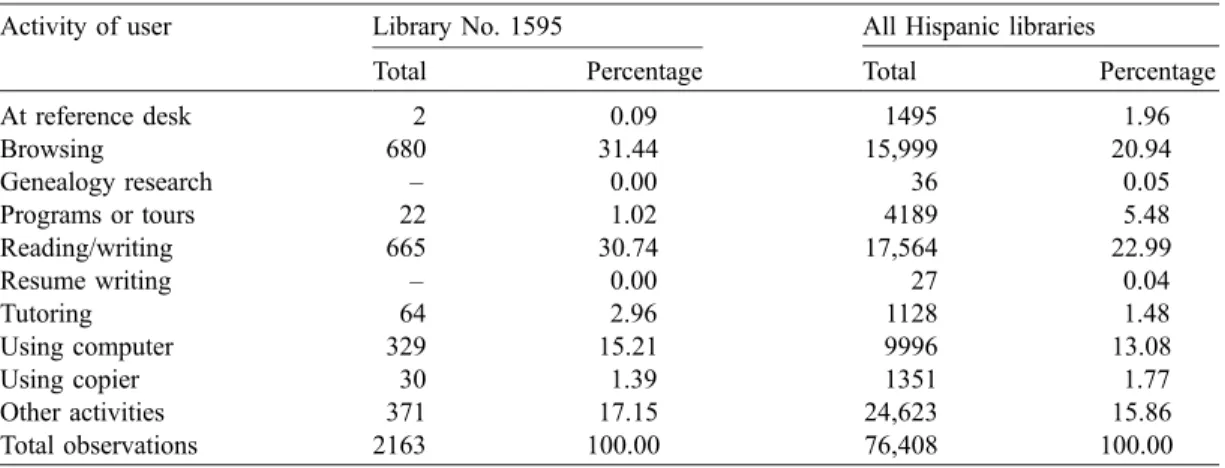
! While the differences among groups of library users are somewhat masked by the inclusion of users from a different group (e.g., Hispanic users in a library branch that also serves African Americans), overall trends are not. Table 1 illustrates this point for a specific branch that serves just a single user group (Hispanics) relative to the overall pattern observed for all library branches that serve populations of Hispanics. There is overall similarity in user activity patterns (e.g., noticeably higher browsing and reading/ writing than computer usage, and lower numbers for both genealogy and resume writing).
8
Much of the data are available for download at the project Web site,http://www.geolib.org/projects.cfm, underbCompleted Projects, Department of Education.Q
Although the data were aggregated to more concisely present the results, the value of this study is its development and demonstration of methodologies for acquiring a more detailed and accurate description of in-library use by different user groups.
4.1. In-library use of materials
In-library use of materials was collected on a sample basis. Library staff asked users to not reshelve library materials used within the library during the sampling period. Library staff then scanned in data about the materials (e.g., its format, whether it was intended for adults, young adults, or children), including, if appropriate, the Dewey decimal or Library of Congress classification.
Table 2identifies the two primary types of materials used within the library by racial or ethnic group as well as by intended audience (i.e., adults, juveniles, young adults, large print, blind/handicapped).
Reviewing the table by racial/ethnic group, the top two classifications for three of the racial groups (African American, Asian American, and Hispanic) are fiction and technology with almost equal percentages. By contrast, libraries serving Native Americans and those with majority White low incomes ranked fiction as the top classification.
Another finding from this study is the use of natural science and mathematics materials by children. The heavy use of these materials at the library was not characteristic of young adults or adults. These are two examples of in-library use data that might be used to justify reallocating collection development funding.
Table 3 reports computer software use by racial/ethnic group and majority White low-income status. For every group, the highest ranking type of computer use was for Internet or e-mail. Also reported is the higher use of word processing software in public libraries serving African Americans and majority White low-income users relative to libraries serving other minority groups. On-line catalog usage is lower in public library Table 1
Library use at a majority Hispanic library branch relative to all other Hispanic library branches Activity of user Library No. 1595 All Hispanic libraries
Total Percentage Total Percentage
At reference desk 2 0.09 1495 1.96 Browsing 680 31.44 15,999 20.94 Genealogy research – 0.00 36 0.05 Programs or tours 22 1.02 4189 5.48 Reading/writing 665 30.74 17,564 22.99 Resume writing – 0.00 27 0.04 Tutoring 64 2.96 1128 1.48 Using computer 329 15.21 9996 13.08 Using copier 30 1.39 1351 1.77 Other activities 371 17.15 24,623 15.86 Total observations 2163 100.00 76,408 100.00
Table 2
Comparison of top of two classification for in-library use for each age group within differing library majority–minority markets
Age groups African American Asian American Hispanic Native American Majority-White,
low income
Adults Technology (17%) Fiction (19%) Fiction (19%) Fiction (28%) Fiction (31%)
Fiction (16%) Technology (16%) Technology (19%) Generalities (12%) Technology (16%)
Juveniles Fiction (42%) Fiction (45%) Fiction (40%) Fiction (30%) Fiction (42%
Natural Science/ mathematics (14%) Natural Science/ mathematics (16%) Natural Science/ mathematics (16%)
Technology (19%) Natural Science/ mathematics (14%)
Young adults Fiction (41%) Fiction (36%) Fiction (44%) Fiction (35%) Fiction (57%)
Social Sciences (10%) The Arts (19%) The Arts (11%) The Arts (17%) Technology (7%)
Large print materials Fiction (60%) Fiction (85%) Fiction (61%) Fiction (50%) Fiction (90%)
Biography (13%) Biography (8%) Religion (6%) Generalities (50%) Biography (3%)
Blind or handicapped materials
Fiction (16%) Biography (44%) Biography (25%) – Fiction (76%)
Biography (40%) Religion (28%) Social Sciences (22%) – Social
Sciences (24%) C.M. Koontz et al. / Library & Information Science Resear ch 27 (2005) 28–50
Table 3
Comparison of software usage within differing library majority–minority markets
Computer software African American Asian American Hispanic Native American Majority-White low income
Total Percentage Total Percentage Total Percentage Total Percentage Total Percentage
Internet/e-mail 6231 39.33 1545 41.52 3966 39.60 187 37.10 4195 42.28 On-line catalog 2372 14.97 955 25.67 2509 25.05 154 30.56 1654 16.67 Word processing 2973 18.77 302 8.12 836 8.35 46 9.13 1560 15.72 Educational software 1312 8.28 350 9.41 826 8.25 4 0.79 823 8.29 Computer games 1522 9.61 251 6.75 1035 10.34 35 6.94 905 9.12 On-line databases 805 5.08 134 3.60 273 2.73 25 4.96 355 3.58 Other 628 3.96 184 4.94 569 5.68 53 10.52 430 4.33
Total software uses 15,843 100.00 3721 100.00 10,014 100.00 504 100.00 9922 100.00
Koontz et al. / Library & Information Science Resear ch 27 (2005) 28–50 41
outlets serving African Americans and majority White low-income groups, while educational software ranked lower for public library outlets serving Native Americans. While the reasons for these variable usage rates cannot be determined with certainty from the methodology used in this national study, a librarian on site can use this type of data collection methodology in combination with experience and information derived from customers to develop neighborhood-level profiles of library use.
4.2. Librarian assistance
Librarian assistance data were collected on a sample basis. Rather than having a simple count of the number of questions being asked by users, staff was asked to record the general category of the question (e.g., computer use, or genealogy) and the amount of time required to answer the user’s inquiry.
Table 4 reports primary user questions broken down by the minority, ethnic, and low-income groups participating in this study. Education and homework questions were most frequent in outlets serving Asian American communities, followed by outlets serving communities with high numbers of Hispanics. Computer usage questions represented the most common questions in outlets serving African Americans as well as majority White low-income households. Most of the questions asked by Native Americans were in the leisure and/or entertainment category. More genealogy questions were asked in Native Americans library outlets than in outlets serving other groups under study.
Why did these differences exist? Notably, no attempt was made to control for the variable resources available within the different outlets. The real lesson inTables 3 and 4is that there are differences in the way different groups use the library. Library managers and directors must understand the location of the library and the specific user populations a library is serving in order to optimize library services to the potential user population.
4.3. Library use activity
Library use activity data were also collected on a sample basis by library staff. At a designated time, the staff member would walk through the entire library and note what each library user was doing. Sampling periods were chosen to represent activity during all hours the library was open.
Table 5 provides a breakdown of the major activity observed within public libraries serving different types of users. Across all groups, reading/writing or browsing the stacks constituted the major activity, accounting for one-third to one-half of library activities. On a percentage basis, in this study, computer usage is lowest among Native Americans and Asian Americans.
Table 6provides a breakdown of the major activities by age group. The results corroborate the conventional information about library use by different age groups. Most preschool-age users come to attend a library program. Young adults are more likely to be found using the library’s computers than other age groups. Genealogical research is conducted primarily by adult and elderly users.
Table 4
Comparison of selected user questions within differing library majority–minority markets
User question African American Asian American Hispanic Native American Majority White low income
Total Percentage Total Percentage Total Percentage Total Percentage Total Percentage
Computer usage 5274 16.43 2260 19.17 3864 15.17 178 7.18 4031 19.46 Education/homework 4653 14.49 2568 21.78 4990 19.59 337 13.60 2752 13.29 Leisure/entertainment 2276 7.09 1013 8.59 2656 10.43 437 17.64 1322 6.38 Reader’s advisory 1711 5.33 443 3.76 1082 4.25 112 4.52 1057 5.19 Business 798 2.49 262 2.22 546 2.14 77 3.11 531 2.56 Genealogy 190 0.59 65 0.55 134 0.53 122 4.92 380 1.83 Other 17,203 53.58 5177 43.92 12,198 47.89 1215 49.03 10,642 51.37 Total questions 32,105 100.00 11,788 100.00 25,470 100.00 2478 100.00 20,715 100.00 Koontz et al. / Library & Information Science Resear ch 27 (2005) 28–50 43
Table 5
Comparison of selected user activities within differing library majority–minority markets
Activity of user African American Asian American Hispanic Native American Majority White low income
Total Percentage Total Percentage Total Percentage Total Percentage Total Percentage
Reading/writing 16,784 18.74 10,107 27.27 17,564 22.99 1098 16.83 12,561 18.68 Browsing 15,200 16.97 8321 22.45 15,999 20.94 1802 27.63 12,487 18.57 Using computer 15,814 17.65 3713 10.02 9996 13.08 496 7.60 9893 14.71 Checking out/ library card 8309 9.28 3693 9.96 7944 10.40 761 11.67 7826 11.64 Library program/tours 6109 6.82 1441 3.89 4189 5.48 387 5.93 4737 7.05 Sitting alone/ socializing 5261 5.87 2714 7.32 4471 5.85 316 4.84 3956 5.88 Schoolwork 5629 6.28 1176 3.17 3254 4.26 160 2.45 1870 2.78 Nonlibrary program 2774 3.10 328 0.88 1158 1.52 23 0.35 2563 3.81 Other activities 13,694 15.29 5574 15.04 11,473 15.02 1480 22.69 11,343 16.87 Total observations 89,574 100.00 37,067 100.00 76,408 100.00 6523 100.00 67,236 100.00 C.M. Koontz et al. / Library & Information Science Resear ch 27 (2005) 28–50
Table 6
Comparison of selected user activities among different age groupsa
Activity of user Adult Juveniles Young Adult Elder Preschool
Total Percentage Total Percentage Total Percentage Total Percentage Total Percentage
Reading/writing 16,922 24.11 6042 14.20 4436 17.84 2473 35.91 757 7.78
Browsing 14,778 21.06 7645 17.97 3876 15.59 1314 19.08 1270 13.06
Using computer 9030 12.87 7084 16.65 5437 21.86 442 6.42 440 4.52
Checking out/library card 14,778 21.06 4607 10.83 1968 7.91 868 12.61 609 6.26
Library program/tours 2252 3.21 1904 4.48 687 2.76 235 3.41 2752 28.29 Sitting alone/socializing 4384 6.25 1093 2.57 1647 6.62 375 5.45 384 3.95 Schoolwork 633 0.90 4644 10.92 3024 12.16 36 0.52 73 0.75 Genealogy research 423 0.60 2 0.00 53 0.21 112 1.63 1 0.01 Other activities 6980 9.95 9521 22.38 3742 15.05 1031 14.97 3442 35.38 Total observations 70,180 100.00 42,542 100.00 24,870 100.00 6886 100.00 9728 100.00 a
The total number of observations in this table (154,206) does not sum to the total number of observations in this study (155,218) because of 1012 observations with an age category ofbunknownQ.
Koontz et al. / Library & Information Science Resear ch 27 (2005) 28–50 45
As with librarian assistance, the actual activities that are occurring within a library can depend not only on the racial, ethnic, or income characteristics of the population being served, but in combination with other characteristics such as age.
5. Project discussion
This was a first-time snapshot of standardized in-library use in different majority–minority and low-income markets of diverse public libraries. The data collected in this study substantiates that there are indeed differences in the types and amount of in-library use in libraries serving nontraditional library users (i.e., those libraries serving majority–minority or majority White low-income residents).
While it is plausible to examine and analyze the differences shown in this study in greater detail, the research team would argue that to do so wouldblose sight of the forest for the trees.QThe much more important finding from this study is the critical need for local library managers and other decision makers to collect and analyze public library data at the outlet level. This study also demonstrates the feasibility of collecting alternative in-library use performance measures and subsequent value in ensuring that critical decisions about library service are not based on circulation statistics alone.
Clearly, library service to particular neighborhoods can be more effective if targeted to the specific groups that comprise the individual outlet’s bmarket,Q rather than to the fictional baverage library userQat a nonexistentbaverage libraryQin a multi-outlet jurisdiction.Table 7
supports this position. It compares use at one library with the sum of all other libraries in the study. The increased level of reading, writing, and tutoring in this predominately Hispanic library is of interest to the director and staff of this library jurisdiction. This insight would have been lost in thebseaQof jurisdiction-level data. This problem is accentuated when the library user group of concern constitutes a small percentage of the total user population of its jurisdiction.
Table 7
Library No. 1595: use relative to all libraries
Activity of user Library No. 1595 All libraries
Total Percentage Total Percentage
At reference desk 2 0.09 3765 2.43 Browsing 680 31.44 29,346 18.91 Genealogy research – 0.00 567 0.37 Programs or tours 22 1.02 10,715 6.90 Reading/writing 665 30.74 29,682 19.12 Resume writing – 0.00 441 0.28 Tutoring 64 2.96 1705 1.10 Using computer 329 15.21 23,418 15.09 Using copier 30 1.39 3592 2.31 Other activities 371 17.15 51,987 33.49 Total observations 2163 100.00 155,218 100.00
In the past, the manipulation of detailed outlet-level data was cumbersome and labor intensive. Today’s computer technology overcomes most of those problems and permits rapid aggregation and regrouping of such data. Public library managers and other decision makers should not permit past limitations to hinder the collection of data that could prove extremely valuable in understanding and meeting the needs of today’s diverse library users.
5.1. Project impact on participating libraries
Collecting detailed in-library use data involves staff time that is often at a premium. Most public library directors are enthusiastic about collecting data that will inform decisions leading to better service for their users. This is the key to the future of the type of data collection demonstrated in this study. As part of this project, it was critical to provide a benefit by returning quarterly data analysis reports to the library’s director. For most directors, collecting in-library use data was nothing new, but it was not something attempted systematically, or with any apparent benefit.
5.1.1. Exit survey results
The majority of the libraries (over 90%) responding to the exit survey indicated prior to this project sporadically and nonsystematically collecting data on in library use, walk-up and phone-in reference, and program attendance. The practice of countingbobservedQlibrary user activity was not implemented by any of the participating libraries in this study. Recommendations from participants included providing some benefit or incentive for data collecting staff and more training to use the PDC (or other successor technologies) to collect data.
The second category, information about users and nonusers, included very disparate data that were idiosyncratic to each library. General answers as to bHow did the project help identify service gaps and barriers to useQ are shown inTable 8.
Another question in this category wasbHas the project prompted you to seek any of the following?QResponses from participating libraries that responded to the exit survey indicated that collection of in-library use data did have an impact on their library services after just 1 year.Table 9reports actions taken as a result of the data collected for this study. Other actions that do not fall into the categories shown in Table 9 include increasing part-time hours, change of buying habits, and collection management reviews.
Table 8
How project data identified gaps
Category Libraries (N = 59)
Enhancing awareness of who nonusers are 17
Enhancing awareness of reasons for not using the library 9
Enhancing awareness of user needs in general 16
Enhancing awareness of needs of specific user groups 18 Improving staff understanding of library use patterns 22
Thus, a minimum of 20% of the libraries in this study reportedly used the data to improve library services after just 1 year of baseline data collection.
That number would possibly increase over time as trend analyses identify other actions that should be taken to improve library services. These reports suggest the utility of data measuring all types of library use—not just circulation—in designing library services that better meet the needs of the specific neighborhoods or market areas served by particular library outlets. Today, less expensive, more compact, and more adaptable wireless technology can expedite such data collection efforts and reduce staff time and workload.
Regarding future data collection, out of 59 respondents, 27 said they would continue the data collection, 21 said no, and one stated bmaybe.Q Fifteen responded they would like to continue to conduct research with the team in the future. These responses were not unanticipated. Throughout the study, participating outlets with few staff and unusually high user traffic communicated to the research team a desire to have their daily workbcounted,Q despite the additional workload associated with collecting new data.
5.1.2. Introduction of geographic information systems
The introduction of GIS was problematic. It was determined by the research team near the project’s conclusion that use of GIS by library staff was not reasonable or practical due to the steep learning curve associated with GIS and the priority that daily library duties must take. It was concluded that knowledge of what questions could be asked and answered, using GIS, was of greater importance. For example, a library manager needs to know the extent of a library outlet’s geographic market area, its demographics, and changes in those population characteristics over time. GIS can rapidly answer these questions. Most local governments at the time of the study—and virtually all today—have planning departments that use GIS for other public agency planning (i.e., fire and police). Continuing education regarding market research techniques was designated as a primary goal for future research. Two subsequent projects built upon the findings of this project to facilitate access to geographic decision making data for library managers and decision makers.9
Table 9
How project data were used by libraries
Category Libraries (N= 59)
General budget increases 9 libraries (2 pending)
Additional staff 6 libraries
Materials budget increase 7 libraries
Technology budget increase 9 libraries
Increased programming 14 libraries
Increased outreach activity 18 libraries
Building renovation/expansion 6 libraries
New building 2 libraries
9
Institute of Museum and Library Services National Leadership Grants, 1998 (C. M. Koontz and D. K. Jue) and 2002 (C. M. Koontz, D. K. Jue, C. McClure, and J. Bertot).
6. Conclusion
This first nationwide snapshot of in-library use in majority–minority and majority White/ low-income markets clearly demonstrates the need for continued refinement and collection of such data. As the U.S. population becomes increasingly diverse, public libraries serving special populations unfamiliar with the concept of a public library must have alternative use measures available to be on equal footing with libraries serving more traditional (i.e., high-circulation) markets. The study also emphasizes the value of maintaining and using such neighborhood-level data in order to more precisely identify and respond to the information wants and needs of the community served. To optimally determine these needs, the authors affirm geographic market areas must be determined for each facility in the US.
Better measures of library use are also critical even for libraries with relatively high levels of circulation. Circulation is declining for some library branches; many believe because of increased Internet use. As a result, more comprehensive measures of library use are being demanded by local government and library administrators.
As public libraries across the United States face increasingly severe budgetary constraints, it is imperative that all libraries be able to document the value of services to residents of the library’s neighborhood or market area. If a library outlet is not able to do so, it is vulnerable to funding cuts or perhaps even closure.
Although the data items suggested in this study were complicated to collect in a systematic manner a few years ago, this is changing. Barriers to such data collection efforts are rapidly breaking down due to advances in computing technology, combined with recent Web-based library research projects that are freely available to library managers (Koontz & Jue, 2004; McClure & Bertot, 2001). The methodologies developed in this project, combined with the wireless technology of the 21st century, offer the necessary tools for today’s public librarian to collect the critical data needed to better serve America’s diverse neighborhoods.
References
Brown, L., & Ormes, S. (2003). Equality of access. In Sara Ormes (Ed.),EARL Networked Policy Taskgroup of The Library Association. London: Library Association. Available:http://www.ukoln.ac.uk/public/earl/issuepapers/ equality.html. Accessed August 15, 2003.
Chu, C. M. (1998). Expanding the literacy of linguistic minorities: Coping skills and successful transition across diverse communities. In 64th IFLA General Conference, August 16–August 21, 1998. Available: http:// www.ifla.org.sg/IVifla64/070-153e.htm. Accessed August 26, 2003.
Coughlin, R. E., Taieb, F., & Stevens, B. H. (1972).Urban analysis for branch library system planning. Westport, CT7Greenwood Press.
Hayes, R., & Palmer, E. S. (1983). The effects of distance upon use of libraries: Case studies based on a survey of users of the Los Angeles Public Library central library and branches.Library Research,5, 67 – 100. Himmel, E., & Wilson, W. J. (1998).Planning for results: A public library transformation process, a guidebook.
Chicago, IL7American Library Association.
International Research Associates. (1963).Access to public libraries: A research report. Chicago, IL7American
Library Association.
Jue, D. K., Koontz, C., Magpantay, J. A., Lance, K. C., & Seidl, A. M. (1999). Using public libraries to provide technology access for individuals in poverty: A national analysis of library market areas using geographic information system.Library & Information Science Research,21, 299 – 325.
Koontz, C. (1990).Market-based modeling for public library facility location and use forecasting. Unpublished doctoral dissertation, Florida State University, Tallahassee.
Koontz, C. (1993).Assessing public library service in majority–minority markets.Unpublished Carroll Preston Baber Research Grant report. American Library Association.
Koontz, C. (1997).Library facility siting and location handbook. Westport, CT7Greenwood Press.
Koontz, C. (2001). Technology-pied piper or playground bully, or, creating meaningful measures using emerging technologies.Proceedings of the 4th Northumbria International Conference on Performance Measurement in Libraries & Information Services, Pittsburgh, PA (pp. 31 – 36). Washington, DC7Association of Research
Libraries.
Koontz, C., & Jue, D. K. (2004). Unlock your demographics.Library Journal,129(4), 32.
Koontz, C., Jue., D. K., & Hodge S. K. (2002, April).The vital role of public libraries in America and subsequent need for a unique methodology for determining e-rate discounts for public libraries: A white paper. Tallahassee, FL: GeoLib. Available:http://www.geolib.org/whitepap.htm. Accessed September 2, 2004. McClure, C. R., & Bertot, J. C. (2001).Evaluating networked information services: Techniques, policy and issues.
Medford, NJ7Information Today.
Palmer, E. S. (1981). The effect of distance on public library use: A literature survey.Library Research, 3, 315 – 334.
Public Library Association. (1979). Goals, guidelines, and standards committee, the public library mission statement and its imperatives for service. Chicago, IL7 Public Library Association/American Library
Association.
Shoham, S., Hershkovitz, S., & Metzer, D. (1990). Distribution of libraries in urban space and its effect on their use: The case of Tel Aviv.Library & Information Science Research,12, 167 – 181.
Van House, N. A. (1983). A time allocation theory of public library use.Library & Information Science Research,