First Principles Study on Solid Oxygen Using
Van der Waals Density Functional
著者
Obata Masao, Hamada Ikutaro, Oda Tatsuki
journal or
publication title
Physics Procedia
volume
75
page range
771-778
year
2015-01-01
URL
http://hdl.handle.net/2297/45906
doi: 10.1016/j.phpro.2015.12.100First principles study on solid oxygen using van der Waals
density functional
Masao Obata
1, Ikutaro Hamada
2, and Tatsuki Oda
1,31 Graduate School of Natural Science and Technology, Kanazawa University, Kakuma, Kanazawa
920-1192, [email protected]
2 International Center for Materials Nanoarchitectonics (WPI-MANA), National Institute for
Materials Science (NIMS), Tsukuba 305-0044, Japan
3 Institute of Science and Engineering, Kanazawa University, Kakuma, Kanazawa 920-1192, Japan
Abstract
We introduce scaling parameters for the spin-polarization dependent gradient correction to the local correlation in the van der Waals density functional, which enable us to tune the magnetic interaction between atoms and molecules. We have applied the method to solid oxygen and found that by using an optimal choice of the parameters, the structural parameters are significantly improved over the ones obtained in the previous work. We discuss the generic features of the proposed approach.
Keywords: Oxygen, Magnetism, van der Waals Force, Density Functional Theory
1
Introduction
Oxygen, which is one of abundant elements, has several unique characteristics. It is well known that the oxygen molecule has the spin triplet ground state. Competition between orbital and magnetic interactions gives rich varieties of structural, electronic, and magnetic phases in the wide ranges of temperature and pressure, or under magnetic field [1, 2, 3, 4, 5]. In these sys-tems, construction of the pair potential between molecules promotes a development on material physics as well as a modeling on microscopic interaction [6, 7]. In addition, the magnetism of oxygen systems is particularly interesting, as the magnetic configuration is sensitive to the relative distance and direction between molecules. As a result, it has been shown that oxy-gen molecular systems have complex magnetic interaction potential depending on the structure [8, 9, 10, 11, 12, 13].
The method which can describe accurately both molecular and magnetic interactions, has been required to analyze the system. Density functional theory (DFT) may be suitable for these purposes, however the local density approximation (LDA) or generalized gradient approxima-tion (GGA), which are commonly used, can not reproduce a long-range electron correlaapproxima-tion. The van der Waals density functional (vdW-DF) method, which is one of promising methods
First principles study on solid oxygen . . . Obata, Hamada and Oda
to overcome the problem in LDA and GGA, has been proposed and succeeded to reproduce structural properties in a wide range of materials [14, 15, 16]. In this context, we proposed an practical extension of vdW-DF to spin-polarized (magnetic) systems, dubbed vdW-DF with spin-polarization-dependent gradient correction (vdW-DF-SGC). This enabled to describe crys-tal structure more accurately than the LDA/GGA and the original vdW-DF on the oxygen systems of molecular pair and solid oxygen [17, 18]. We found that the structural properties were determined by a delicate balance of magnetic interaction and vdW interaction. How-ever, the error in the structural properties of solid oxygen obtained with vdW-DF-SGC is still considerably large and there is a room for further improvement. During computing magnetic interaction, we implied that one of the reasons for a deviation from the experimental result is an overestimation of antiferromagnetic interaction [18].
In order to analyze properties of magnetic molecular system, development of an accurate potential is essential. There have been several accurate electronic structure methods, such as adiabatic connection fluctuation dissipation theorem, quantum Monte Carlo, which requires enormous computational resources. Nevertheless, these were not suitable for the study that requires a large amount of computation, such as the analysis of structure phase transition or large size systems like biological system. In contrast, vdW-DF-SGC is suitable to analyze such systems, as the computational cost is comparable to that of a conventional DF calculation. In this paper, we proposed a technique to improve correlation energy functional in spin-polarized systems within the vdW-DF-SGC method, reducing an overestimation of antiferromagnetic in-teraction. We show that by using a set of optimal parameters, calculated structural parameters and energetics of solid oxygen are improved.
2
Methods and Systems
We briefly review the vdW-DF-SGC method and explain the way of improving the correlation functional. In the method, the exchange correlation energy functional is composed of exchange, local correlation, nonlocal correlation, and spin-polarization-dependent gradient correction en-ergy functionals:
Exc[n↑, n↓] =ExGGA[n↑, n↓] +ELSDAc [n, ζ] +Ecnl[n] +αGC(EGGAc [n, ζ]−EcGGA[n, ζ = 0]). (1)
The last term in parentheses is estimated as follows:
EcGGA[n, ζ]−EcGGA[n, ζ= 0] =
Z
drn(r){H(rs, ζ, t)−H(rs,0, t)}. (2)
whereH,rs,ζ, andtare the gradient contribution, Seitz radius (n= 3/4πrs3), the relative spin
polarization, and the dimensionless density gradient proportional to|∇n|, respectively [19]. In this work, the scaling parameterαGChas been introduced, which was set to unity in the previous
works [17, 18]. The vdW-DF-SGC reduces the overestimation of antiferromagnetic interaction compared to the original vdW-DF, indicating that spin-polarization-dependent gradient cor-rection (SGC) term [the last term in Eq.(1)] has an effect of destabilizing antiferromagnetic coupling [17, 18]. Indeed, in an H-type molecular pair the electron density at the intermediate region between molecules was found to be much reduced from the antiferromagnetic pair to the ferromagnetic one. This behavior can be justified by the Pauli’s exclusion principle. As a consequence, there appeared no energy change of SGC term at the displacement of molec-ular distance in the ferromagnetic pair, whereas for the antiferromagnetic pair the repulsive behavior appeared from the SGC term, as discussed below. Thus, we propose to introduceαGC
to optimize SGC term to reduce the difference between ferromagnetic and antiferromagnetic states, as one of improving methods. Note that the present functional is reduced to the original vdW-DF in the absence of spin polarization.
As another way, we propose to scale the relative spin polarization to optimized the stability of antiferromagnetic interaction as follows:
ζ→αζζ. (3)
whereαζ is scaling factor ofζ. In both the local correlation energy functional and SGC term,ζ
is used as an argument of spin scaling function (SSF)φ(ζ) = [(1−ζ)2/3+(1+ζ)2/3]/2 which was
derived within the random-phase-approximation [20]. As a consequence, scaledζ is equivalent to what scales the SSF. Note thatαζ does not exceed unity.
In this work, we have examined the effects of these two scalings parameters in H-type oxygen molecular pair and solid oxygen at ambient pressure. We used plane wave basis set and ultrasoft pseudopotential [21, 22]. For exchange and local correlation energy functions,
Ex and ELSDAc , we used the versions of revPBE and PW92, respectively [23, 24]. In the
pseudopotential construction, we neglected the nonlocal correlation (Enl
c ) and employed the
semilocal exchange and correlation functionals. Because the nonlocal correlation vanishes in spherical atomic calculation, these treatments have been justified [25]. To compute the nonlocal correlation energy efficiently, we took an order N log N method [26, 27]. In the method, we used the cutoff 8 a.u. for wave numberqand 31 forq-mesh (qα). The latter mesh is constructed
by a logarithmic mesh except near qα = 0. We have already confirmed a reliability of these
parameters in previous studies [14, 18, 26, 27]. The kinetic energy cutoffs of 40 Ry and 350 Ry were used for the wave function and charge density, respectively, in the H-type cluster calculation. Since the potential energy surface is very sluggish in the solid oxygen and the convergence of pressure tensor is achieved, we used large energy cutoffs for the plane wave basis (160 Ry and 960 Ry) in the crystal calculation. We optimized the lattice parameters of solid oxygen to converge within a pressure of 0.05 GPa. The cubic box with a dimension of 10.6 ˚
A was used in the cluster calculation. In the cluster calculations, optimized bond length of the isolated molecule was used (1.232 ˚A), which is slightly larger than the experimental value (1.207 ˚A [28]).
3
Results and Discussions
First, we have investigated scaling parameters αGC and αζ in the H-type oxygen molecular
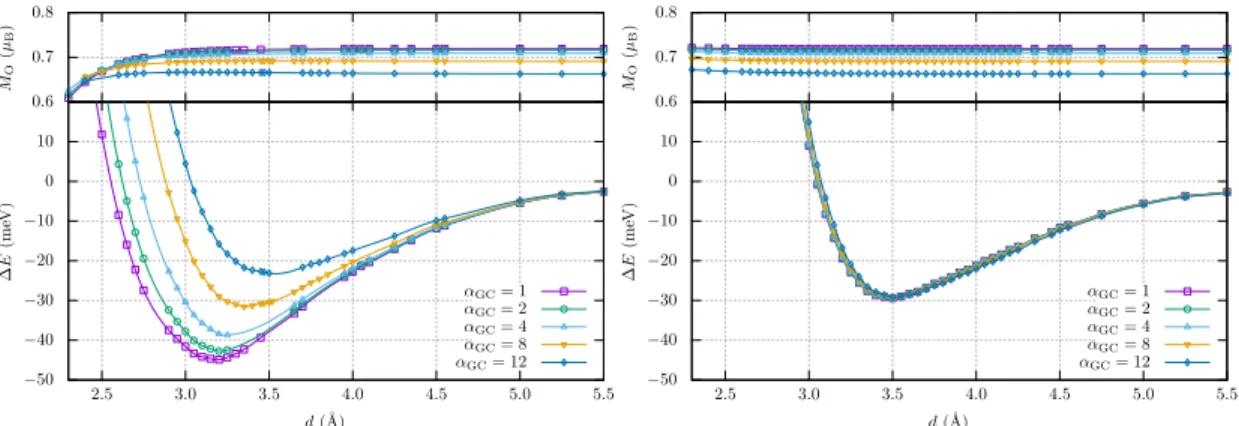
system. Figure 1 shows theαGCdependence of the binding energy as a function of the distance
between centers of molecules (d) for both antiferromagnetic and ferromagnetic states. Using the original vdW-DF-SGC (αGC=αζ = 1), the potential energy curve of antiferromagnetic pair has
the equilibrium distance of 3.20 ˚A and the binding energy at 45 meV. The equilibrium distance agrees well with the accurate data from the quantum chemistry approaches but the binding energy is larger [8, 11]. For ferromagnetic pair, the potential energy curves have a slightly large equilibrium distance with a slightly high binding energy, compared with the quantum chemistry approaches [8, 11]. As implied in the previous study [18], the antiferromagnetic state is destabilized and the equilibrium distance becomes larger as αGC is increased, whereas the
interaction energy curve for the ferromagnetic state is unchanged. Thus, theαGC plays a role
to tune the stability of the antiferromagnetic state only. Figure 1 also shows the magnetization of oxygen atom. By increasing αGC, atomic magnetic moment decreases, implying that the
First principles study on solid oxygen . . . Obata, Hamada and Oda
Figure 2 shows the magnetic coupling constantJ, defined by the energy difference between ferromagnetic and antiferromagnetic states; J = EF−EAF. The figure indicates a stability
of antiferromagnetic state in a wide range ofαGC’s and d’s. The strength of J decreases as
increasingαGC or d and becomes comparable to those estimated in the methods of quantum
chemistry (CASSCF, RCCSD(T))[8, 11] when αGC = 8 and d = 3.3 ˚A. Unlike the quantum
chemistry approaches, there is a region where the ferromagnetic state is more stable (negative
J) at the largerαGC’s (αGC= 8,12) and largerd’s in the present frame work of vdW-DF-SGC.
Such ferromagnetic stability can come from a direct exchange interaction between the orbitals on the molecules. However, these interactions should be very small atd∼4 ˚A.
Figure 3 shows the dependence of the binding energy curve on αζ for antiferromagnetic
and ferromagnetic states. Asαζ is decreased, energy difference between antiferromagnetic and
ferromagnetic states decreases. In this case the equilibrium distance does not change, but the repulsive nature of potential curves becomes strong. As shown in Fig. 3, the magnetic moment slightly increased when the antiferromagnetic state was destabilized. This is an opposite trend, compared with the case ofαGC.
Since magnetic energy of the electron correlation is estimated as a local relative spin polariza-tion in Eq.(1), it is unable to distinguish stability between antiferromagnetic and ferromagnetic states. Nevertheless once the difference of spin dependent charge densities is generated in mag-netic states, through self-consistent field calculations, the system can converge to the respective magnetic state.
Next, we have combinedαGCandαζ and applied them to solid oxygen at ambient pressure.
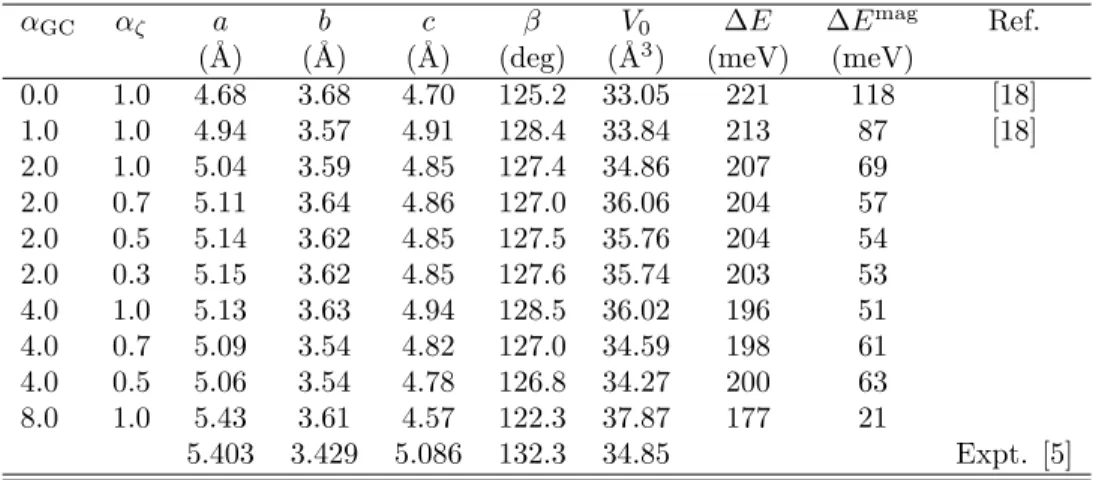
The crystal structure belongs to aC2/m(monoclinic) space group and its magnetic unit cell contains two molecules with an antiferromagnetic coupling. The molecular axis has been known to tilt from thez-direction perpendicular toabplane by a few degrees within theac-plane. This effect can be negligible in this work. In Table 1, we report optimized structural parameters, crystal binding energy, and magnetic energy for typical sets of scaling parametersαGCandαζ.
We have found that by applying αGC, the lattice parameters are improved as compared with
the previous theoretical result. For example, by settingαGC = 4 andαζ = 1, we obtain the
nearest neighbor distance between molecules of 3.14 ˚A, which is larger than that of 3.05 ˚A with
αGC= 1 andαζ = 1. The effects ofαζ appeared also in the lattice parametera, but the detail
trend depends largely on αGC; when αGC = 2 (αGC= 4), aincreased (decreased). However,
the overall effect ofαζ is not so large, compared with those ofαGC.
When αGC = 8 and αζ = 1, in Table 1, the lattice parameter ais in excellent agreement
with the experiment. However, other lattice parameter deviate from the experimental values. In our optimization about αGC and αζ, the potential curves of ferromagnetic molecular pair
do not change. This may limit a region of searching space for exchange and correlation energy functionals. In the previous works [29], the weak repulsive nature was realized by optimizing the exchange functional, whereas the original functional shows a stronger repulsive nature at short distances [14]. The potential energy of ferromagnetic pair is also important in determining the structural parameters in solid oxygen as well as those of antiferromagnetic pair. Because there are ferromagnetic molecular pair at the next nearest neighbors withinabplane, the structural details might depend on the ferromagnetic potentials of molecular pairs. Another importance in ferromagnetic potential of molecular pair may be related with the phase transition toδphase at the high pressure, at which the nearest neighbor magnetic coupling between molecules of neighboringabplanes is changed from antiferromagnetic to ferromagnetic one [2].
The binding and magnetic energies, as expected from the results of H-type molecular pair, were reduced as αGC increases. In particular, the magnetic energy at αGC = 8 and αζ = 1
0.6 0.7 0.8 M O ( µB ) −50 −40 −30 −20 −10 0 10 2.5 3.0 3.5 4.0 4.5 5.0 5.5 αGC= 1 αGC= 2 αGC= 4 αGC= 8 αGC= 12 d(Å) ∆ E (me V) 0.6 0.7 0.8 M O ( µB ) −50 −40 −30 −20 −10 0 10 2.5 3.0 3.5 4.0 4.5 5.0 5.5 αGC= 1 αGC= 2 αGC= 4 αGC= 8 αGC= 12 d(Å) ∆ E (me V)
Figure 1: Binding energy (∆E) curves for H-Type configuration as a function of the distance connecting the center of molecules (d) for severalαGC’s. The left and right panels show
anti-ferromagnetic and anti-ferromagnetic cases, respectively. The atomic magnetic moments (MO) are
shown on the upper parts.
−10 0 10 20 30 40 2.5 3 3.5 4 4.5 5 5.5 αGC= 1 αGC= 2 αGC= 4 αGC= 8 αGC= 12 J (me V) d(Å)
Figure 2: Magnetic interactionJ(=EF−EAF) as a function of the distance between molecules
for severalαGC’s.
magnetic interaction energy of oxygen molecule (2µB) under the large experimental magnetic
field (∼200T)[4]; 23 meV. Structural properties at high magnetic fields are under consideration with taking into account a giant magneto-volume effect in solid oxygen [30].
4
Summary
We have introduced the scaling parametersαGCandαζ in the correlation energy functional of
vdW-DF-SGC to improve the description of the magnetic interaction in spin-polarized systems. In the H-type oxygen molecular pair, the antiferromagnetic state is destabilized as the αGC
increases or theαζ decreases. The structural parameters of solid oxygen were improved in some
choices ofαGC’s. It was also found that our treatment reduced both the binding and magnetic
First principles study on solid oxygen . . . Obata, Hamada and Oda 0.6 0.7 0.8 M O ( µB ) −50 −40 −30 −20 −10 0 10 2.5 3.0 3.5 4.0 4.5 5.0 5.5 αζ= 1.0 αζ= 0.9 αζ= 0.8 αζ= 0.7 αζ= 0.5 αζ= 0.3 d(Å) ∆ E (me V) 0.6 0.7 0.8 M O ( µB ) −50 −40 −30 −20 −10 0 10 2.5 3.0 3.5 4.0 4.5 5.0 5.5 αζ= 1.0 αζ= 0.9 αζ= 0.8 αζ= 0.7 αζ= 0.5 αζ= 0.3 d(Å) ∆ E (me V)
Figure 3: Binding energy (∆E) curves for H-Type configuration and atomic magnetic moment (MO) as a function of distance of molecules for several αζ’s. The left and right panel show
antiferromagnetic and ferromagnetic case, respectively.
Table 1: Optimized lattice parameters (a,b,c, andβ), equilibrium volume (V0), binding energy
of molecule (∆E), and magnetic energy per molecule (∆Emag). Experimental values are also
shown for comparison.
αGC αζ a b c β V0 ∆E ∆Emag Ref.
(˚A) (˚A) (˚A) (deg) (˚A3) (meV) (meV)
0.0 1.0 4.68 3.68 4.70 125.2 33.05 221 118 [18] 1.0 1.0 4.94 3.57 4.91 128.4 33.84 213 87 [18] 2.0 1.0 5.04 3.59 4.85 127.4 34.86 207 69 2.0 0.7 5.11 3.64 4.86 127.0 36.06 204 57 2.0 0.5 5.14 3.62 4.85 127.5 35.76 204 54 2.0 0.3 5.15 3.62 4.85 127.6 35.74 203 53 4.0 1.0 5.13 3.63 4.94 128.5 36.02 196 51 4.0 0.7 5.09 3.54 4.82 127.0 34.59 198 61 4.0 0.5 5.06 3.54 4.78 126.8 34.27 200 63 8.0 1.0 5.43 3.61 4.57 122.3 37.87 177 21 5.403 3.429 5.086 132.3 34.85 Expt. [5]
the energetics of spin-polarized vdW systems. Although the new approach developed in this work has adjustable parameters, further investigation on the correlation energy functional may reveal applicability and limitation for an application range on real material.
It is well recognized that the density functional approach can construct one of starting points for analyzing real materials, sometimes for designing new materials. This is true regardless of spin-polarized and non-polarized systems. For non-polarized systems, the number of research works related with non-empirical vdW force increases abruptly and abundantly. This is because there was a large area of materials hidden by a poor description on vdW interaction before the development of non-empirical vdW. As similar to non-spin polarized cases, we can expect the new area of magnetic materials, in which vdW force plays an important role in structural, magnetic, and energetic properties.
5
Acknowledgements
The computation in this work was performed using the facilities of the Supercomputer Center, Institute for Solid State Physics, University of Tokyo, Japan. This work was partly supported by JSPS KAKENHI (Grant Numbers 22104012, 26400312, and 15K05165), the Strategic Programs for Innovative Research (SPIRE), MEXT, Japan, the Computational Materials Science Initia-tive (CMSI), Japan, and the World Premier International Research Center InitiaInitia-tive (WPI) for Materials Nanoarchitectonics, MEXT, Japan. M.O. acknowledges JSPS Research Fellowships for Young Scientists (Grant No. 27-4610).
References
[1] I. N. Goncharenko, O. L. Makarova, and L. Ulivi, Phys. Rev. Lett.93, 055502 (2004). [2] I. N. Goncharenko, Phys. Rev. Lett.94, 205701 (2005).
[3] S. Klotz, Th. Str¨assle, A. L. Cornelius, J. Philippe, and Th. Hansen, Phys. Rev. Lett.104, 115501 (2010).
[4] T. Nomura, Y. H. Matsuda, S. Takeyama, A. Matuo, and K. Kindo, Phys. Rev. Lett.112, 247201 (2014).
[5] R. J. Meier and R. B. Helmholdt, Phys. Rev. B29, 1387 (1984).
[6] R. Kitaura, S. Kitagawa, Y. Kubota, T. C. Kobayashi, K. Kindo , Y. Mita, A. Matsuo, M. Kobayashi, H. Chang, T. C. Ozawa, M. Suzuki, m. Sakata, and M. Takata, Science 298, 2358 (2002).
[7] A. Hori, T. C. Kobayashi, Y. Kubota, A. Matsuo, K. Kindo, J. Kim, K. Kato, M. Takata, H. Sakamoto, R. Matsuda, and S. Kitagawa, J. Phys. Soc. Jpn.82, 084703 (2013).
[8] K. Nozawa, N. Shima, and K. Makoshi, J. Phys. Soc. Jpn.71, 377 (2002).
[9] K. Nozawa, N. Shima, and K. Makoshi, J. Phys., Condens. Matter20, 335219 (2008).
[10] R. Hern´andez-Lamoneda, M. Bartolomei, M. I. Hern´andez, J. Campos-Mart´ınez, F. Dayou, J. Phys. Chem. A109, 11587 (2005).
[11] M. Bartolomei, E. Carmona-Novillo, M. Hern´andez, J. Campos-Mart´ınez, and R. Hernandez-Lamoneda, J. Chem. Phys.128, 214304 (2008).
[12] Y. Crespo, M. Fabrizio, S. Scandolo, E. Tosatti, Proc. Natl. Acad. Sci. USA111, 10427 (2014). [13] M. Obata, I. Hamada, and T. Oda, JPS Conf. Proc.5, 011011 (2015).
[14] M. Dion, H. Rydberg, E. Schr¨oder, D. C. Langreth, and B. I. Lundqvist, Phys. Rev. Lett. 92, 246401 (2004) [Erratum95, 109902 (2005)].
[15] K. Lee, ´E. D. Murray, L. Kong, B. I. Lundqvist, and D. C. Langreth, Phys. Rev. B82, 081101(R) (2010).
[16] O. A. Vydrov and T. Van Voorhis, Phys. Rev. Lett.103, 063004 (2009).
[17] M. Obata, M. Nakamura, I. Hamada, and T. Oda, J. Phys. Soc. Jpn.82, 093701 (2013). [18] M. Obata, M. Nakamura, I. Hamada, and T. Oda, J. Phys. Soc. Jpn.84, 024715 (2015). [19] J. P. Perdew, K. Burke, and M. Ernzehof, Phys. Rev. Lett.77, 3865 (1996).
[20] Y. Wang and J. P. Perdew Phy. Rev. B43, 8911 (1991). [21] D. Vanderbilt, Phys. Rev. B41, 7892 (1990).
[22] K. Laasonen, A. Pasquarello, R. Car, C. Lee, and D. Vanderbilt, Phys. Rev. B47, 10142 (1993). [23] Y. Zhang and W. Yang, Phys. Rev. Lett.80, 890 (1998).
[24] J. P. Perdew and Y. Wang, Phys. Rev. B45, 13244 (1992). [25] M. Callsen and I. Hamada, Phys. Rev. B91, 195103 (2015).
First principles study on solid oxygen . . . Obata, Hamada and Oda
[27] J. Wu and F. Gygi, J. Chem. Phys.136, 224107 (2012).
[28] K. P. Huber and G. Herzberg, Molecular Spectra and Molecular Structure IV. Constants of Di-atomic Molecules(Van Nostrand Reinhold Company, New York, 1979) p. 490.
[29] I. Hamada, Phys. Rev. B89, 121103(R) (2014).
[30] K. Katsumata, S. Kimura, U. Staub, Y. Narumi, Y. Tanaka, S. Shimomura, T. Nakamura, S. W. Lovesey, T. Ishikawa, and H. Kitamura, J. Phys.: Condens. Matter17, 235 (2005).