Calhoun: The NPS Institutional Archive
Theses and Dissertations Thesis Collection
2014-09
Automated cyber threat analysis and specified
process using vector relational data modeling
Kelly, Ryan Forrest
Monterey, California: Naval Postgraduate School
NAVAL
POSTGRADUATE
SCHOOL
MONTEREY, CALIFORNIA
THESIS
Approved for public release; distribution is unlimited AUTOMATED CYBER THREAT ANALYSIS AND SPECIFIED PROCESS USING VECTOR RELATIONAL
DATA MODELING
by
Ryan Forrest Kelly September 2014
Thesis Advisor: Shelley Gallup
Co-Advisor: Thomas S. Anderson
REPORT DOCUMENTATION PAGE Form Approved OMB No. 0704–0188 Public reporting burden for this collection of information is estimated to average 1 hour per response, including the time for reviewing instruction, searching existing data sources, gathering and maintaining the data needed, and completing and reviewing the collection of information. Send comments regarding this burden estimate or any other aspect of this collection of information, including suggestions for reducing this burden, to Washington headquarters Services, Directorate for Information Operations and Reports, 1215 Jefferson Davis Highway, Suite 1204, Arlington, VA 22202–4302, and to the Office of Management and Budget, Paperwork Reduction Project (0704–0188) Washington, DC 20503.
1. AGENCY USE ONLY (Leave blank) 2. REPORT DATE
September 2014
3. REPORT TYPE AND DATES COVERED
Master’s Thesis
4. TITLE AND SUBTITLE
AUTOMATED CYBER THREAT ANALYSIS AND SPECIFIED PROCESS USING VECTOR RELATIONAL DATA MODELING
5. FUNDING NUMBERS
6. AUTHOR(S) Ryan Forrest Kelly
7. PERFORMING ORGANIZATION NAME(S) AND ADDRESS(ES)
Naval Postgraduate School Monterey, CA 93943–5000
8. PERFORMING ORGANIZATION REPORT NUMBER
9. SPONSORING /MONITORING AGENCY NAME(S) AND ADDRESS(ES)
N1 Naval Operations through the NPS Naval Studies Program - Cyber Threat Detection and Cyber Hunting (Project Number: 14–0245)
10. SPONSORING/MONITORING AGENCY REPORT NUMBER
11. SUPPLEMENTARY NOTES The views expressed in this thesis are those of the author and do not reflect the official policy or position of the Department of Defense or the U.S. Government. IRB Protocol number ____N/A____.
12a. DISTRIBUTION / AVAILABILITY STATEMENT
Approved for public release; distribution is unlimited
12b. DISTRIBUTION CODE
13. ABSTRACT (maximum 200words)
Computer network defense systems should be sufficiently integrated to pull data from any information source, model an expert cyber analyst’s decision process, continuously adapt to an evolving cyber threat environment, and amalgamate with industry standard network hardware. Unfortunately, cyber defense systems are generally stovepipe solutions that do not natively integrate disparate network systems. Correlation engines are generally limited in capability, extensibility, and do not evolve with a dynamic cyber threatscape. Current network defense systems mitigate known vulnerabilities, but effective methods of traffic analysis capable of detecting unknown exploits and identifying advanced persistent threats have yet to be developed. Expert analysts can isolate threats by manually aggregating data sources and distinguishing patterns that indicate a compromise, but there are insufficient skilled analysts available to combat the problem. This work demonstrates a process control configuration that can emulate the investigative process of a human cyber security expert into a pseudo cognitive apparatus capable of accessing several network available data sources, determining a network threat, and terminating a connection, in minutes. The investigative process to detect a PHPMyAdmin attack and issue a response was entirely configured in a vector relational data modeling environment. The configuration could detect and respond to multi-part threat specifications.
14. SUBJECT TERMS Executable information configuration, cyber threat analysis, advanced
persistent threats (APT), cyber defense, Vector Relational Data Modeling (VRDM), semi-sentient, decision making, computer network defense, cyber protection, configured solution.
15. NUMBER OF PAGES 149 16. PRICE CODE 17. SECURITY CLASSIFICATION OF REPORT Unclassified 18. SECURITY CLASSIFICATION OF THIS PAGE Unclassified 19. SECURITY CLASSIFICATION OF ABSTRACT Unclassified 20. LIMITATION OF ABSTRACT UU
NSN 7540–01–280–5500 Standard Form 298 (Rev. 2–89)
Approved for public release; distribution is unlimited
AUTOMATED CYBER THREAT ANALYSIS AND SPECIFIED PROCESS USING VECTOR RELATIONAL DATA MODELING
Ryan Forrest Kelly
Captain, United States Army Reserve B.B.A., University of West Alabama, 2003
M.B.A., Samford University, 2007
Submitted in partial fulfillment of the requirements for the degree of
MASTER OF SCIENCE IN CYBER SYSTEMS OPERATIONS from the
NAVAL POSTGRADUATE SCHOOL September 2014
Author: Ryan Forrest Kelly
Approved by: Dr. Shelley Gallup Thesis Advisor Dr. Thomas S. Anderson Co-Advisor Scott McKenzie Second Reader Dr. Cynthia Irvine
ABSTRACT
Computer network defense systems should be sufficiently integrated to pull data from any information source, model an expert cyber analyst’s decision process, continuously adapt to an evolving cyber threat environment, and amalgamate with industry standard network hardware. Unfortunately, cyber defense systems are generally stovepipe solutions that do not natively integrate disparate network systems. Correlation engines are generally limited in capability, extensibility, and do not evolve with a dynamic cyber threatscape. Current network defense systems mitigate known vulnerabilities, but effective methods of traffic analysis capable of detecting unknown exploits and identifying advanced persistent threats have yet to be developed. Expert analysts can isolate threats by manually aggregating data sources and distinguishing patterns that indicate a compromise, but there are insufficient skilled analysts available to combat the problem. This work demonstrates a process control configuration that can emulate the investigative process of a human cyber security expert into a pseudo cognitive apparatus capable of accessing several network available data sources, determining a network threat, and terminating a connection, in minutes. The investigative process to detect a PHPMyAdmin attack and issue a response was entirely configured in a vector relational data modeling environment. The configuration could detect and respond to multi-part threat specifications.
TABLE OF CONTENTS
I. INTRODUCTION...1
A. RESEARCH MOTIVATION ...2
B. PURPOSE AND SCOPE ...2
C. THESIS ORGANIZATION ...3
II. BACKGROUND ...5
A. INTRODUCTION...5
B. CYBER THREATSCAPE...5
C. INTRUSION DETECTION AND PREVENTION SYSTEMS ...7
D. TAXONOMY OF CYBER EXPLOITATION TECHNIQUES ...10
1. Concealment ...10
2. Reconnaissance ...12
3. Denial of Service ...13
E. NETWORK SECURITY MONITORING ...15
1. Collection ...15
2. Detection ...17
3. Analysis ...19
F. INTRUSION KILL CHAIN...20
G. INTEROPERABILITY ...22
H. VECTOR RELATIONAL DATA MODELING (VRDM) ...31
1. Concept ...33 2. Source ...36 3. Semantic ...40 4. Visual ...47 5. Security ...51 I. CONCLUSION ...53
III. CYBER THREAT DETECTION AND RESPONSE CONFIGURATION ...55
A. INTRODUCTION...55 B. INPUTS ...56 C. DECISION PROCESS ...63 1. Accumulator ...65 2. Threat Monitor...78 3. Responder ...78 D. CONCLUSION ...80
IV. TEST AND DISCUSSION ...81
A. APPARATUS ...81
1. Cyber threat analysis ...84
B. RESULTS ...86
V. CONCLUSION ...89
A. DISCUSSION ...89
APPENDIX A. SNORT DATABASE LOGGING IMPLEMENTATION ...93
APPENDIX B. APACHE LOGGING IMPLEMENTATION ...97
APPENDIX C. NMAP SCANNER WITH DATABASE...101
APPENDIX D. EVENTLOG AND SYSLOG DATABASES ...105
APPENDIX E. GINA ...109
LIST OF REFERENCES ...117
LIST OF FIGURES
Reengineering interoperability model. Code for multiple systems is Figure 1.
rewritten into a single composite integrated suite. Lack of scalability, time and cost overruns, and systemic error susceptibility are common consequences of this model. ...25 Ad-hoc interoperability model. Code is written into each system to Figure 2.
communicate with every other system. Cost and time scalability increases ~n2 for each n systems. ...26 Standards-based interoperability model. Middleware is programmed in the Figure 3.
core for each communicating system type. Similar to ad-hoc integration but middleware translators exist at the hub. ...27 Data warehouse interoperability model. Backend databases are Figure 4.
standardized with middleware at each node and aggregated into one resource intensive database architecture in the core. This model requires code intensive middleware on each node to support integration of disparate systems. ...28 VRDM interoperability model. System APIs and backend databases can Figure 5.
be directly accessed and virtually aggregated. Data configurations can be accessed in a web based interface or emulated as directly connected data sources common to all nodes on the network. ...30 Complexity per number of systems for traditional service oriented Figure 6.
architecture (SOA) approach (blue diamond) and VRDM approach (red square). Complexity correlates with both time and cost associated with expanding a system. The GINA framework allows for a linear growth in complexity as the systems grows and changes. As a SOA becomes more complex, a VRDM configuration is transparent and reconfigurable. Note that the lin-log scale is required to allow the geometric data to plot in view. ...31
X-types organize elements into relationships created by Vectors. Each red Figure 7.
box represents a Vector that relates Elements (blue boxes). Each Element
is mapped to a column in a table. The relationship between Elements is visualized in a form. ...35 Access Code configuration is converted into an object by giving the Figure 8.
authentication pair a name which can be applied to database connections. ....36 The Connection supplies the network location of a data source, the Figure 9.
authentication format of the data source, and specifies an Access Code (Figure 8). The combined properties form a Connection object which is given a name. ...37 Connection type is the format of authentication strings that are used for Figure 10.
remote data sources. Here, the string is passed to a MySQL ODBC connector. The Connection type object is used to format data Access Code (Figure 8) and Connection (Figure 9) objects for each data source type. ...37
Source configuration in UI. The Content Server, in this case Figure 11.
“SQLContentServer,” is already constructed as an object entity, is specified by a drop down tab. ...38 Columns in a remote database table are also Columns in a VRDM Source. Figure 12.
The Source Column must be the same name of the database table column. The red arrow points to an example of a multipart column. ...39 Data sources are accessed through a series of objects (Access Code, Figure 13.
Connection, Source, and Column) that together define the path and credentials to access information in the data source. ...40 X-types are objects where relationships, information, and actions are all Figure 14.
defined. An X-type is like a table of Elements and references to other Elements. ...41 The properties of elements are configured in a single screen. They can be Figure 15.
mapped to a persistent column, reference other elements, or be a mathematical function of two elements. ...42 An X-type’s Element can be a mathematical function comprised of other Figure 16.
Elements. Here, Element C is specified as Element A plus Element B for each row in the X-type. This is analogous to a formula in Excel. ...43 Apache and Snort X-types are at the top, an X-type with Reference Figure 17.
Elements is in the middle and a form that displays the X-type with Reference Elements is at the bottom. Here, the timestamp Reference Element is analogous to a window from the Snort type to the Apache X-type where Elements can be manipulated as if they were in the Apache X-type. ...44 Vectors are assigned to an X-type and filter by References. References are Figure 18.
Elements in the X-type that are assigned in the Vector. ...46 Above are two tables in two databases. Each table is assigned to a Source Figure 19.
and columns in the tables are assigned to elements. A Collection Vector filters out the one-to-many relationship between database 1 and database 2. The result of the relationship is viewed in a Collection window. ...48 Queries are displayed in a form that is common to web based information Figure 20.
management systems. Queries can be customized as a configuration in a graphical user interface. This query shows Accumulator values for a particular IP address. ...49 A Command is a button that is attached to a form. The Command Figure 21.
properties define the form where the button will appear and the Service the button will launch. ...49 The Service configuration window names the Service, defines what the Figure 22.
Service does, and where the Service is located...50 The Transform configuration defines how an Element is modified. The Figure 23.
transform above adds the value in the TotalWeight Element to the Total
Element. ...51 Directives are computational operations; they can be chained together as a Figure 24.
single object, or applied individually. Above are a few of the directives that are preconfigured in the UI. ...51
Above is a CTRC SoS hyper graph. The network available system Figure 25.
components are represented as spheres whose native information may be utilized as component objects in a VRDM information configuration. Configurations are represented as ellipses and show interactions between system components. ...56 In the Cyber Threat Response Configuration. Packet capture, system logs, Figure 26.
and web logs are checked for threshold values and pattern matches. The Accumulator ensures that the decisions can be weighted without the requirement of programming complex logic trees. The configuration can be rapidly reconfigured in a user interface. ...62 The above directory traversal detection sequence searches for common Figure 27.
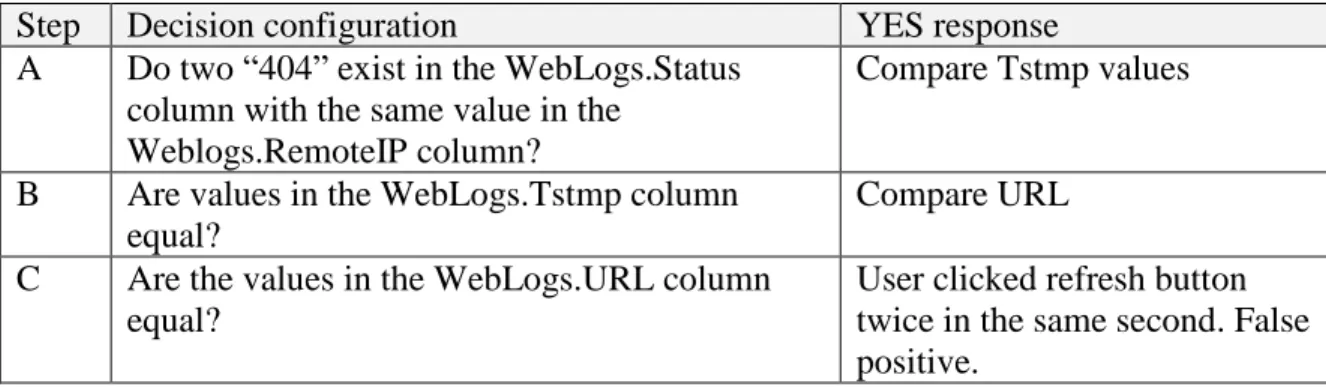
characteristics of brute force website scanning. This configuration maintains an X-type in memory with a Service that checks for two 404 strings in the status column in a WebLogs table of a web log database that both have the same source IP value, timestamp value, and do not have the same URL value. If found the configuration will increment the CTRC Accumulator by 1. ...67 Above is a spoof detection sequence configuration. It uses information Figure 28.
between two tables to determine if source IP address is spoofed by checking for an “ack” in the packet capture. When no ack exists recorded from the outgoing interface to match a TCP connection on an incoming interface, then spoofing is highly suspected. ...69 Logs from two test connections to a web server. The red box shows port Figure 29.
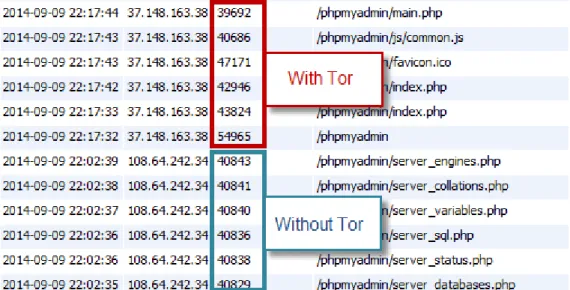
numbers from a computer that connected to a web server using Tor. The blue box shows port numbers from the same computer without Tor. The blue port numbers are less random and the red ones are more random. ...73 CTRC information process - The red circles show where passive and Figure 30.
active data are combined to create new data. The green circles show where arithmetical functions are performed on passive data to create new data. The red arrows traversing the same X-types together are a vector. All tables use timestamp as a Vector reference (not shown for simplicity). Purple arrows indicate calculated data. The database on the right is a VRDM integrated database that stores values from all decision configurations and calculations thereof. ...74 A weighted obfuscation detection sequence. Each decision has a weight Figure 31.
consummate with a theoretical degree of suspicion. When the threshold value of 4 is reached, obfuscation network traffic is suspected. ...77 VRDM SoS network interaction concept. Consists of a DMZ (red) and a Figure 32.
protection SoS controlled by a GINA server (blue). A GINA server in blue could send SSH commands to the various network components and initiate command line reconfigurations of group policy and registry keys. The system could send emails from the DNN environment and populate text files for reporting. Logs were automatically generated by the CTRC. ...82 This virtual test environment consisted of eight virtual machines all Figure 33.
connectivity, the black lines indicate intranet connectivity, and the red lines indicate direct connections. ...84 A Google search of my web server IP address proved that automated Figure 34.
crawlers index servers for vulnerabilities. The image from http://un1c0rn.net/host/207.140.106.47 showed database name, table names, and the user account of the web server. ...87 Earlier versions of Snort have this database option during install. This step Figure 35.
in the install process creates the output plugin and database schema file for database logging. Newer versions do not have this option because they are integrated with Barnyard that communicates directly with SQL servers. ...93 MSSQL Server Management Studio is the graphical user environment Figure 36.
database management. This graphic shows that a snort-db database was created as a result of the create_mssql.sql schema code. ...94 The Snort.conf file contains only the lines necessary to log a full packet Figure 37.
capture to the database. Rules and alerts are also defined in this file. ...95 MSSQL database is populated with packet capture as soon as Snort is Figure 38.
started. Snort will not start if the database is not properly configured or is offline. ...96 The salient portions of an Apache database logging solution are shown in Figure 39.
the web server configuration file (httpd.conf). The order of the directives matter because the plugins are interdependent. ...98 Logs from database access are inserted into the database in real time. The Figure 40.
database can log as many different attributes as allowed by the combined log format of the Apache server. ...99 ScanPBNJ uses the YAML program to communicate with a MySQL Figure 41.
database and must be configured in ./pbnj-2.0/config.yaml. ...102 The ScanPBNJ Database populates two tables: Machines and Services. Figure 42.
The Services table has a many to one relationship to the Machines table and enumerates the services in operation per each IP address. ...103 Communication to a MySQL database is locally specific by default. In Figure 43.
order to allow a GINA server to communicate, the /etc/mysql/my.cnf file must be modified...104 The EventScavenger files are listed on the left and the result of the Figure 44.
installation script is shown in SQL Server Management Studio on the right. A MSSQL database is added to the Snort database (for simplicity) and event tables are created. ...105 EventScavenger was configured to send event data to the Snort database Figure 45.
server because an instance of MSSQL existed and could be reused. An additional source was defined in GINA using the same database Connection. ...106 The creation of the database schema can be done by copying and pasting Figure 46.
the created.sql code into a query window in mysql-workbench. ...106 The /etc/rsyslog.conf file defines the credentials for logging to a database Figure 47.
and what should be logged. In the above example *.* means log
The ODBC configuration manager is located on the GINA IIS server. It Figure 48.
contains configuration details for all ODBC connections to remote databases. ...109 The ODBC data source administrator creates data sources for each ODBC Figure 49.
connection. Each “Name” of a data source is the “table” name in a VRDM Source configuration. The ODBC connection is transparent to a GINA Source. ...110 ODBC Drivers are specified in the data source, once the MySQL ODBC Figure 50.
driver program from 5 i) was executed, the driver automatically populated in this window. ...110 The mysql driver includes an interface for configuring connection Figure 51.
parameters. The test button verifies connectivity from the GINA IIS server to the remote mysql database. ...111 Connection errors are common in system integrations. It is important to Figure 52.
ensure that access authorization is granted before configuring a connection. ...111 Access permissions can be granted by both command line and the mysql-Figure 53.
workbench GUI. ...112 An ODBC test success message is the proper result of this configuration ....112 Figure 54.
GINA database access codes are saved in a MSSQL table. MSSQL Figure 55.
supports SSL and IPSec to secure the credentials in transit. ...113 This GINA database connection specifies the connection name from the Figure 56.
ODBC connector as the location instead of a server name or IP address. In effect, a local connection is made to the ODBC driver and the driver forwards the requests to a remote mysql server. ...113 The Source defines the table in the remote database and gives it a friendly Figure 57.
name for the VRDM environment. Here, the Apache_log table is named
Apachelogs. ...114 A view is simple in MySQL. Once a view is created, VRDM can access Figure 58.
the view as if it were a persistent data source. inet_aton is a function that converts a dotted quad IP address to a coded decimal (the same format as Snort logs IP addresses to databases. ...115 The MySQL view shows the IP address conversion from dotted quad to Figure 59.
LIST OF TABLES
Table 1. Directory traversal sequence ...67 Table 2. Spoof detection sequence ...69 Table 3. Obfuscation detection sequence ...77
LIST OF ACRONYMS AND ABBREVIATIONS
ACL access control list
API application programming interface
CAN campus area network
CONOPs concept of operations
CTPM cyber threat protection management
CTR cyber threat response
CTRC Cyber Threat Response Configuration
DIDS distributed intrusion detection systems
DNN Dot Net Nuke
DOD Department of Defense
DoS denial of service
FPC full packet capture
GINA Global Information Network Architecture
GUI graphical user interface
HIDS host-based intrusion detection systems IDPS intrusion detection and protection system
IDS intrusion detection system
IP Internet Protocol
IPS intrusion protection system
IPSec Internet Protocol Security
MAC media access control
NAT network address translation
NIDS network-based intrusion detection system
NMAP network mapper
NPS Naval Postgraduate School
NSM Network Security Monitoring
NTFS New Technology File System
ODBC Open Database Connection
ODC Obfuscation Detection Configuration
OSI Open Source Interconnect
PCAP packet capture (format)
RDP Remote Desktop Protocol
RSA Rivest, Shamir, Adleman
RTT round trip time
SSH Secure Shell
SSL Secure Sockets Layer
SOA Service Oriented Architecture
SOL speed of light
SoS system of systems
TCP Transmission Control Protocol
TTL time to live
TOR The Onion Router
UI user interface
VIRT valued information at the right time
EXECUTIVE SUMMARY
This thesis describes an information modeling approach to aggregating any number of cybersecurity systems into a common cyber picture, modeling the decision-making of expert cyber analysts and automating system behavior.
A semantics-based executable information model is presented within a configurable information modeling framework as a method for the rapid development and deployment of a secure, automated, all-source cyber threat analysis and response capability. The continuous evolution of advanced persistent threats (APT) and the increase in number of cyber-attacks continue to outpace cyber defense due to limitations in technology, funding and human resources.1 The current approach to network security is disparate and ad hoc, and human dependent, or at best, consists of a rigid software solution, many times proprietary.2 It addresses known threat types, which, in turn, starts the threat evolution cycle again yielding new threats. Vector Relational Data Modeling (VRDM) was used to configure an information specification to aggregate network available data from servers and systems as object components, execute decision making and enable semi-sentient system behavior and processes for near real-time computer network defense. Cyber protection systems, information and operational process were researched and incorporated into an information configuration for decision making and subsequent process execution in an iterative fashion. This approach offered a viable
1 Chris Sanders and Jason Smith, Applied Network Security Monitoring (Waltham, MA: Elsevier,
2014), 6; Executive Office of the President of the United States, Fiscal Year 2012 Report to Congress on the Implementation of The Federal Information Security Management Act of 2002 (Washington, DC: White House, March 2013), http://www.whitehouse.gov/sites/default/files/omb/assets/egov_docs/fy12_fisma.pdf; “Cyber Security Overview,” Department of Homeland Security, accessed April 29, 2014,
https://www.dhs.gov/cybersecurity-overview; Tom Colburn, “Memo to Senate Permanent Subcommittee on Investigations, Senate Committee on Homeland Security & Governmental Affairs: FISMA Spending, Historical Trends,” Congressional Research Service, accessed July 29, 2014,
http://www.coburn.senate.gov/public//index.cfm?a=Files.Serve&File_id=33d705f2-6629-4ee2-8be0-50965da651b3; Karen Evans and Franklin Reeder, “A Human Capital Crisis in Cyber Security: Technical Proficiency Matters,” CSIS Commission on Cybersecurity for the 44th Presidency, November, 15, 2010, http://csis.org/files/publication/101111_Evans_HumanCapital_Web.pdf.
2 “Continuous Diagnostics and Mitigation,” Department of Homeland Security, accessed April 28,
2014, http://www.dhs.gov/cdm; Toby Kohlenberg et al., Snort IDS and IPS Toolkit (Burlington, MA: Syngress, 2007), 18; Chris Sanders and Jason Smith, Applied Network Security Monitoring (Waltham, MA: Elsevier, 2014), 13, 424; Winn Schwartau, Time Based Security (Seminole, FL: Interpact Press, 1999), 113; Rafeeq U. Rehman, Intrusion Detection with Snort (Upper Saddle River, NJ: Prentice Hall, 2003), 1.
solution within a DOD network certified framework capable of keeping pace with the cyber threat evolution cycle.
This cyber domain use-case information specification was configured within the Global Information Network Architecture (GINA), an executable, component-based, platform agnostic, and model-driven framework.3 The framework provides the necessary data, information, knowledge, and interoperability4; and is a viable approach to devise an information configuration that enables services for a cyber threat response (CTR) system of systems. The salient properties of this network-based decision-making system emphasized the central role of actionable information and emergent knowledge processes in a dynamic environment. From a system design and development perspective, the defining property of information-driven Enterprise Knowledge Platform is that requirements are not always identified in advance but rather emerge from the environment. In the case of a cyber threat response (CTR) system this demands an agile system development methodology with a flexible semantic system interoperability approach.
A cyber threat response configuration (CTRC) specification for detecting and responding to PHP Hypertext Preprocessor (PHP) attacks as a network environment implementation with a concept of operations (CONOP) automated analysis is demonstrated in this thesis. This CONOP is an exemplar of the application of an executable information configuration to perform suspicion based intrusion detection through integrated, interoperating information technologies functioning within a complex, heterogeneous system with a dynamic topology. A test of the core concept of a
3 Daniel Dolk et al., “GINA: System Interoperability for Enabling Smart Mobile System Services in
Network Decision Support Systems,” IEEE, accessed July 21, 2014, doi: 10.1109/HICSS.2012.293, http://ieeexplore.ieee.org/stamp/stamp.jsp?tp=&arnumber=6149063&isnumber=6148595; Thomas S. Anderson and Frank Busalacchi, “Understanding Interoperability and the GINA advantage,” USACE ERDC CRREL, BKT, January 2013; Kenneth A. Stewart, “Researchers, Commanders Partner on Potential Networking Revolution,” (Naval Postgraduate School, November 2, 2012),
http://www.nps.edu/About/News/Researchers-Commanders-Partner-on-Potential-Networking-Revolution.html.
4 Gary Langford, “GINA Network-Centric Assemble-to-Description Architecture,” (Naval
Postgraduate School, February, 2014),
https://calhoun.nps.edu/bitstream/handle/10945/40315/Langford_GINA_NMIO_TB_VOL_6.pdf?sequence =1.
weighted decision configuration demonstrated that a VRDM configuration could detect and respond to multi-part threat specifications.
ACKNOWLEDGMENTS
I am humbled by God’s mercy and am beholden to our Lord, Jesus Christ, who, through the Holy Spirit, has given me grace. Any good that comes from this thesis is credited to Him. I must also acknowledge the efforts of USACE ERDC CRREL’s Dr. Thomas Anderson and the Naval Postgraduate School (NPS) Distributed Information System Experimentation’s (DISE) Mr. Scott McKenzie who have given me opportunity and guidance during the preparation of this document. I thank American taxpayers for my opportunity to attend the Naval Postgraduate School though their funding of the Information Assurance Scholarship Program. This research was funded by N1 Naval Operations through the NPS Naval Studies Program under the purview of Captain Roy Petty. In addition, I am grateful to the Cyber Academic Group Chair, Dr. Cynthia Irvine, for her meticulous review of this document and Mr. Garrett McGrath for his guidance on database logging implementation. Lastly, I must credit my wife, Leigh Ann, who has taken care of my home and my son, Maximus Alexander, and provided me ample time to complete this thesis.
I.
INTRODUCTION
Cybersecurity analysts are unable to keep pace with modern cyber threats, evidenced by cyber espionage going unnoticed for years.1 Victims of cybercrime are sometimes unaware that an attack occurred until months later.2 Compromises generally take 87 days to detect and around seven days to contain.3 Much of the problem can be attributed to the lack of available intellectual capital to combat the problem.4 Hackers have used this window of opportunity to download terabytes of data from military networks.5 A new approach to cyber defense is needed to mitigate these attacks.
The persistent vulnerability in cybersecurity has been attributed to the lack of available intellectual capital to combat the constantly evolving problem.6 That is, current approaches to specific threats are brittle, human intensive, and do not scale well to meet the changing malicious tactics, nor do they utilize the potential power of network available data. A new approach discussed here is Vector Relational Data Modeling
1 Siobhan Gorman “Chinese Hackers Suspected in Long-Term Nortel Breach,” Wall Street Journal,
February 14, 2012.
http://online.wsj.com/news/articles/SB10001424052970203363504577187502201577054?mg=reno64-wsj&url=http%3A%2F%2Fonline.wsj.com%2Farticle%2FSB100014240529702033635045771875022015 77054.html; “APT1: Exposing One of China's Cyber Espionage Units” Mandiant, February 18, 2013, http://intelreport.mandiant.com/Mandiant_APT1_Report.pdf; Ministry of Justice of Georgia, “Cyber Espionage against Georgian Government” paper presented at Symposium on Cyber Incidents and Critical Infrastructure Protection, Tallin, Estonia, June 18, 2012,
http://dea.gov.ge/uploads/CERT%20DOCS/Cyber%20Espionage.pdf; Martin C. Libicki, “A Matter of Degree: Who Can Authorize a Cyberattack?” RAND blog, January 8, 2013,
http://www.rand.org/blog/2013/01/a-matter-of-degree-who-can-authorize-a-cyberattack.html.
2 Cybersecurity: Responding to the Threat of Cyber Crime and Terrorism, United States Senate (April 12, 2011) (statement of Gordon Snow, Assistant Director, Cyber Division, Washington, D.C.),
http://www.fbi.gov/news/testimony/cybersecurity-responding-to-the-threat-of-cyber-crime-and-terrorism. 3 Trustwave, “2014 Trustwave Global Security Report” (Chicago: Trustwave, 2014),
http://www.secretservice.gov/Trustwave_WP_Global_Security_Report_2014.pdf.
4 Karen Evans and Franklin Reeder, “A Human Capital Crisis in Cyber security: Technical Proficiency Matters,” CSIS Commission on Cybersecurity for the 44th Presidency, November, 15, 2010,
http://csis.org/files/publication/101111_Evans_HumanCapital_Web.pdf.
5 “Significant Cyber Incidents Since 2006,” Center for Strategic and International Studies, last modified March 10, 2014,
http://csis.org/files/publication/140310_Significant_Cyber_Incidents_Since_2006.pdf.
6 Karen Evans and Franklin Reeder, “A Human Capital Crisis in Cyber security: Technical Proficiency
Matters,” CSIS Commission on Cybersecurity for the 44th Presidency, November, 15, 2010, http://csis.org/files/publication/101111_Evans_HumanCapital_Web.pdf.
(VRDM), an information modeling approach that models the behavior of a system through a configurable specification, and has the attributes that can change the cyber battlescape. These attributes include being data standards agnostic, utilizing expert systems and information as component objects, making data actionable through decision-making, and specifying and executing processes.
A. RESEARCH MOTIVATION
Modern computer intelligence is insufficient to characterize unknown and sophisticated cyber threats.7 As a result, human analysts are necessary to investigate cyber threat events to determine impact.8 This is because no one security product will ever exist capable of impenetrable security.9 A combination of systems is necessary for a comprehensive security posture.10 Analysts generally investigate cyber threat events through the use of multiple information sources with a subjective methodology, but “a codified, systematic analysis process” would contribute immensely to the cyber threat investigative procedure.11
B. PURPOSE AND SCOPE
The purpose of this thesis is to develop an executable information configuration that can implement a cyber threat analyst’s investigative process to identify cyber-attacks, distinguish false positives, and mitigate cyber intrusions in near real time. The scope of the work entails
Defining traditional computer network defense
Understanding the modern threat space
7 Chris Sanders and Jason Smith, Applied Network Security Monitoring (Waltham, MA: Elsevier, 2014), 6.
8 Toby Kohlenberg et al. , Snort IDS and IPS Toolkit (Burlington, MA: Syngress, 2007), 18; Chris Sanders and Jason Smith, Applied Network Security Monitoring (Waltham, MA: Elsevier, 2014), 13, 424.
9 Winn Schwartau, Time Based Security (Seminole, FL: Interpact Press, 1999), 113.
10 Rafeeq U. Rehman, Intrusion Detection with Snort (Upper Saddle River, NJ: Prentice Hall, 2003), 1; Winn Schwartau, Time Based Security (Seminole, FL: Interpact Press, 1999), 113.
11 Chris Sanders and Jason Smith, Applied Network Security Monitoring (Waltham, MA: Elsevier, 2014), 422.
Using component technologies
o Apache
o Snort
o VRDM
A prototype configuration that can rapidly extend to adapt to the changing landscape of cyber threats where we most need to be responsive is presented. An experimental interconnection of Windows event logs, Linux syslogs, Apache web logs, network scanner, and Snort packet captures is documented to determine the feasibility of using Vector Relational Data Modeling (VRDM) as a means of aggregating multiple cybersecurity systems. A process control configuration was derived to emulate the human investigative process, and determine appropriate responses to cyber threats.
C. THESIS ORGANIZATION
This thesis consists of five chapters and appendices. Chapters I and II contain the introduction, a literature review that surveys cybersecurity threats, defense technologies, and implications, and a thorough examination of VRDM and its implementation in the GINA framework that is required to understand this thesis. The Cyber Threat Response Configuration is presented as an automated capability to reduce the time required to mitigate PHPMyAdmin cyber threats in Chapter III. The test and discussion, conclusion, and recommendations for further work are in Chapter IV and V. The appendices contain details on configuration of the various component technologies that were employed.
II.
BACKGROUND
A. INTRODUCTION
In this chapter, a broad review of the state of cyber security, packet analysis, cyber protection technology, data analysis methodologies, computer network defense procedure, systems integration, and VRDM is presented.
B. CYBER THREATSCAPE
The Federal government is attacked thousands of times a day in cyberspace.12 Responsibility for protection against these threats was promulgated to federal agencies “commensurate with the risk and magnitude” in 2002.13 Compliance “commensurate with threat risk and magnitude” can be measured relative to the estimated $6B investment in Continuous Diagnostics and Mitigation (CDM), overseen by the Department of Homeland Security in 2013.14 Blanket Purchase Agreements with 17 industry partners accents the diversity of security solutions in the fragmented market.15 Potential for large purchase agreements attracted personnel from large corporate firms such as IBM, McAfee, RSA, and Symantec who gave government attendees “the information they would need to choose the best products and services.”16 The number of choices presented during phase one of the CDM award highlights the notion that best practices for network security are still being developed.
12 Cybersecurity: Next Steps to Protect Our Critical Infrastructure: Hearing Before the Committee on Commerce Science and Transportation, United States Senate, 111th Cong. 2 (February 23, 2010) (statement of Vice Admiral Michael McConnell, USN (Retired), Executive Vice President, National Security
Business, Booz Allen Hamilton), http://www.gpo.gov/fdsys/pkg/CHRG-111shrg57888/pdf/CHRG-111shrg57888.pdf,18.
13 Information Security, Federal Agency Responsibilities, 44 U.S. Code § 3544.
14 General Services Administration, “Continuous Diagnostics and Mitigation,” last reviewed, September 18, 2014, http://www.gsa.gov/cdm.
15 Department of Homeland Security, “Continuous Diagnostics and Mitigation,” accessed April 28, 2014, http://www.dhs.gov/cdm.
16 SANS (Systems Administration Network and Security), “Using the DHS Continuous Diagnostics and Mitigation Contract to Make Real Advances in Security,” November 13, 2013,
http://www.sans.org/security-trends/2013/11/13/using-the-dhs-continuous-diagnostics-and-mitigation-contract-to-make-real-advances-in-security.
U.S. government information technology security spending increased from $5.5B in 2006 to $14.6B in 2012 “yet cyber intrusions and attacks have increased dramatically.”17 Cybersecurity legislation, smart card authentication, continuous monitoring, and security configuration standardization are some of the security solutions implemented, but “the number of incidents reported by federal agencies … has increased 782 percent” in the same time.18 The number and sophistication of attacks continue to increase in lock step with demand for production of advanced threat detection solutions. It may be cost prohibitive to continue investments in advanced security solutions as attack complexity continues to increase. A distributed system that combines the strength of multiple current systems is needed as a cost-effective means to eliminate the weaknesses of any one system. The requirement is a “system of systems” (SoS) that aggregates network logs, alerts, statistics, and anomalies into a single system, which supports an overarching, multi-faceted, cybersecurity mission. The new capability should include a master system that draws from the subordinate systems and support the overarching mission and automation thereof. It should also include a master graphical user interface (GUI) that may include a lightweight, all source, common operating picture (COP). Multiple security systems may contribute to the strength of the whole by inherently adding layers to a defense-in-depth strategy without creating new, costly, or cumbersome security systems.
Cyber-attacks can be extremely rapid and subtle at the same time. Cyber-attacks occurring at computer speeds render the human element of detection ineffective. Intelligent cyber-attacks designed to stay within the bounds of expected network traffic may yield system alerts that are not robust enough to use as detection triggers and thus, as
17 Executive Office of the President of the United States, Fiscal Year 2012 Report to Congress on the Implementation of The Federal Information Security Management Act of 2002 (Washington, DC: White House, March 2013), http://www.whitehouse.gov/sites/default/files/omb/assets/egov_docs/fy12_fisma.pdf; Department of Homeland Security, “Cyber Security Overview,” accessed April 29, 2014,
https://www.dhs.gov/cybersecurity-overview; Tom Colburn, “Memo to Senate Permanent Subcommittee on Investigations, Senate Committee on Homeland Security & Governmental Affairs: FISMA Spending, Historical Trends,” Congressional Research Service, accessed July 29, 2014,
http://www.coburn.senate.gov/public//index.cfm?a=Files.Serve&File_id=33d705f2-6629-4ee2-8be0-50965da651b3.
18 Government Accountability Office, “Cybersecurity,” accessed April 30, 2014, http://www.gao.gov/assets/660/652169.pdf.
singletons, are ineffective as a threat defeat mechanism. Organizations are generally ill-prepared to deal with an evolving threat scenario because traditional security protection techniques once deemed effective can be subverted and threats can go undetected.19 As a result, “over 95% of companies [that happen to be compromised] are compromised with malware that is not detected by anti-virus or IPS signatures.”20 An integrated solution is required to defeat the cyber threat.21
C. INTRUSION DETECTION AND PREVENTION SYSTEMS
Central to cyber systems operations knowledge is an understanding of protection systems, their limitations, and the methods that threat actors use to circumvent them. Firewalls generally exist as in-line access control systems that allow packet traversal based on packet header information.22 Firewalls apply access control lists (ACL) that specify packet header values, which are allowed (i.e., whitelisted) or disallowed (i.e., blacklisted). Firewalls capable of deep packet inspection (DPI) allow access control at the application layer23 by interpreting packet payload similar to an intrusion detection system (IDS).
IDSes can be grouped into three basic categories: network-based intrusion detection systems (NIDS), host-based intrusion detection systems (HIDS), and distributed intrusion detection systems (DIDS).24 Snort, OSSEC, and Arc Sight, are popular software
19 Lawrence Pingree and Neil MacDonald, “Best Practices for Mitigating Advanced Persistent
Threats,” Gartner, January 18, 2012, http://www.trendmicro.de/media/wp/gartner-best-practices-for-mitigating-apts-whitepaper-en.pdf.
20 Naresh Venkat, “Rise in APT Attacks Calls for New Defenses Against Advanced Malware,” Dell
Computer, March 8, 2013, http://www.secureworks.com/resources/blog/general-apt-attacks-new-defenses-against-advanced-malware/.
21 Ashar Aziz, “The Evolution of Cyber Attacks and Next Generation Threat Protection,” FireEye,
presented at the RSA Conference 2013, San Francisco, CA, October 2013,
https://www.rsaconference.com/writable/presentations/file_upload/spo1-r31_spo1-r31.pdf. 22 Wendell Odom, Cisco CCENT/CCNA ICND1 Official Exam Certification Guide, 2nd ed, (Indianapolis: Cisco Press, 2008), 155.
23 An overview of the OSI and TCP/IP model layers can be found in James Michael Stewart, Ed Tittel,
and Mike Chapple, Certified Information Systems Security Professional Study Guide, 4th ed., (Indianapolis: Wiley, 2008), 87.
24 Toby Kohlenberg, Raven Alder, Everett F. Carter Jr. and James C. Foster, Snort IDS and IPS Toolkit (Burlington: Syngress Publishing, 2007), 5; Chris Sanders and Jason Smith, Applied Network Security Monitoring (Waltham, MA: Elsevier, 2014), 193.
examples of each category. IDS are either signature-based or anomaly-based and associate threats with known pattern matches or deviations from normal traffic.25 When an IDS detects a threat, an alert is generated in the form of a database record or an email to inform a network analyst of the threat. IDSs can be configured to allow only “known good” traffic and to create alerts for all other traffic; however, such systems are prone to false alarms. Thus, the alert on “known bad” approach is the model for most IDS.26 Alerts can trigger active or passive responses (e.g., disrupting suspect traffic or generating a log entry). An IDS with active response can disrupt malicious activity by issuing TCP resets to the sender and/or receiver, or by updating a firewall block list.27 FWSnort and SnortSAM are programs that provide active responses of TCP resets and firewall block lists, respectively.28
Intrusion prevention systems (IPS) are a subcategory of IDS whereby packets must travel through an inline device. Snort_Inline is a program that provides IPS functionality to Snort.29 The drawbacks of an application like Snort IPS include complexity of configuration and the possibility of an IPS-induced network denial of service (DoS), e.g., Snort requires kernel recompilation to provide IPS functionality. Furthermore, the IPS can create a network bottleneck.30
“Logging is intrusion detection,”31 and at least the first line of alerting on network behavior. System and network log files provide the data that allow the human analyst to investigate alerts from an IDS. System logs are generated by system events, HIDS alerts, and a variety of host application software. Network logs come in two basic forms: full packet capture (FPC) and session data. FPC includes session data and all the
25 Ibid., 150.
26 Toby Kohlenberg, Raven Alder, Everett F. Carter Jr. and James C. Foster, Snort IDS and IPS Toolkit (Burlington: Syngress Publishing, 2007), 9.
27 Ibid., 26.
28 Ibid., 570; Ibid., 576. 29 Ibid., 604.
30 Ibid., 606
31 Marcus J. Ranum, “SCADA,” Firewall Wizards (mailing list), Seclists.org, April 16, 2009, http://seclists.org/firewall-wizards/2009/Apr/132.
contents of a packet. Session data is a communication summary that includes source addresses, destination addresses, protocols, and ports.32 FPC is desired because it is an exact copy of all the data that traversed the network, vice session data, which only reveals
who was talking and in what language. There is an exclusive tradeoff between the two because the size of an FPC limits retention to hours or days instead of months or years as with session data.33
In 2013, researchers found an average of 13 new vulnerabilities a day.34 Constantly changing cyber threats demand a dynamic cyber defense that can pull from every available information source and fully investigate all details of an event. Chris Sanders, a noted cybersecurity expert, postulated that in 99% of investigations, analysts could find enough information to make determinations by referencing logs from within ten minutes before and after the time of an event.35 Sanders’s “Rule of 10” is a predefined window of time that can be used to prune the amount of information to a manageable size. Ideally, databases can maintain full, all source, sensor data within a small window of time, the investigation processes can be automated, and responses can be reduced to minutes. Ultimately, in cybersecurity, packet analysis and system monitoring is essential because “prevention eventually fails.”36Analysts must mine and examine log files in a labor intensive, non-standard manner using complex reasoning and situational information. Currently, there is no IDS that can replace the human analysts who determine if alerts are false positives or indications of true network threats.37
32 Chris Sanders and Jason Smith, Applied Network Security Monitoring (Waltham, MA: Elsevier, 2014), 75-76.
33 Ibid.
34 Lev Grossman. “The Code War,” Time, July 21, 2014, 25.
35 Chris Sanders and Jason Smith, Applied Network Security Monitoring (Waltham, MA: Elsevier,
2014), 442.
36 Chris Sanders and Jason Smith, Applied Network Security Monitoring (Waltham, MA: Elsevier,
2014), 7.
37 Toby Kohlenberg, Raven Alder, Everett F. Carter Jr. and James C. Foster, Snort IDS and IPS Toolkit (Burlington: Syngress Publishing, 2007), 18.
D. TAXONOMY OF CYBER EXPLOITATION TECHNIQUES
“Cyber threats cover a wide range of malicious activity that can occur through cyberspace,” but it is the flaws in the target system, which enable a cyber-attack.38 Threats generally have both the capability and the intent to exploit vulnerabilities in a target asset.39 Theoretically, there is no threat to an invulnerable target; however, invulnerable systems are impractical as security and usability are often mutually exclusive.40 There is a lucrative market for vulnerabilities, as evidenced by the $25M NSA allocation to remain current on emerging vulnerabilities.41 In the “vulnerability” industry, “Zero-days” are highly valued because they have not been previously encountered and consequentially, no mitigation exists for them.42 “Zero-Day” vulnerabilities, if unidentified may persist for years without detection.43
There are many types of cyber exploitation techniques, but there are three that are generally employed as part of an advanced cyber-attack. Concealment, reconnaissance, and denial of service enable online anonymity, network enumeration, and protection circumvention.
1. Concealment
It is hard, if not impossible, to establish attribution in cyberspace when the attacker has taken steps to obfuscate his identity.44 Absence of attribution empowers a
38 Caitlin Hayden, spokeswoman for the White House National Security Council, quoted in The Verge, February 14, 2013, http://cambridgeriskframework.com/getdocument/21, p. 4; Martin C. Libicki, “Brandishing Cyberattack Capabilities,” RAND National Defense Research Institute, 2013.
http://www.rand.org/content/dam/rand/pubs/research_reports/RR100/RR175/RAND_RR175.pdf, vii. 39 Chris Sanders and Jason Smith, Applied Network Security Monitoring (Waltham, MA: Elsevier, 2014), 3.
40 Winn Schwartau, Time Based Security (Seminole, FL: Interpact Press, 1999), 26. 41 Lev Grossman, “The Code War,” Time, July 21, 2014, 18-25.
42 Ibid.
43 Michael Riley. “NSA Said to Exploit Heartbleed Bug for Intelligence for Years,” Businessweek, April 12, 2014, http://www.businessweek.com/news/2014-04-11/nsa-said-to-have-used-heartbleed-bug-exposing-consumers.
44 James A. Lewis, “Conflict and Negotiation in Cyberspace,” Center for Strategic & International Studies, February 2013, http://csis.org/files/publication/130208_Lewis_ConflictCyberspace_Web.pdf, 47.
hacker to launch attacks with impunity. Online identity concealment can be achieved by techniques such as onion routing, spoofing, and camouflage.
Onion routing conceals the identity and location of an online user.45 It works by relaying connections across several encrypted tunnels over the Internet and ejecting the traffic with a source IP address common to many other users.46 International jurisdiction barriers can prevent law enforcement from gaining access to data that could establish a network identity. Regardless, international transmission cannot conclusively imply anonymous intent. Onion routing provides anonymity by design. The most common network that employs onion routing is Tor.47 It requires installation on a host computer as well as an intentional connection to the anonymity network.
Spoofing occurs when a network identity masquerades as a different identity by modifying packet source addresses. Address resolution protocol (ARP) spoofing occurs when changes are made to the source media access control (MAC) address of a frame, and Internet protocol (IP) spoofing occurs when changes are made to the source IP address of a packet. “Engage Packet Builder” and “Scappy” are common programs employed for this purpose.48 Source address spoofing can be used to create packets with header information that specifically matches whitelist criteria or avoids blacklist filters. Spoofing is also an effective way to perform “man-in-the-middle” attacks and impersonate legitimate network users.49
45 Department of Homeland Security, “Secretary Johnson Highlights Results of Operation That Dismantled Underground Child Exploitation Enterprise on TOR Network,” March 18, 2014, http://www.dhs.gov/news/2014/03/18/secretary-johnson-highlights-results-operation-dismantled-underground-child.
46 TOR, “Tor: Overview,” accessed July 30, 2014, https://www.torproject.org/about/overview.html.en.
47 Paul Syverson, “A Peel of Onion,” Center for High Assurance Computer Systems, U.S. Naval Research Laboratory, accessed August 9, 2014,
http://www.acsac.org/2011/program/keynotes/syverson.pdf.
48 Chris Sanders, Practical Packet Analysis, (San Francisco: No Starch Press, 2007), 152; Tian Fu and Te-Shun Chou, “An Analysis of Packet Fragmentation Attacks vs. Snort Intrusion Detection System,”
International Journal of Computer Engineering Science (IJCES) 2, no. 5 (May 2012): 66-68.
49 A “man in the middle” attack is occurs when an attacker impersonates both sender and receiver and works as a proxy between them.
Attackers can bypass firewalls by camouflaging malicious traffic within legitimate communication channels. It is common practice to use a compromised HTTP server as a network pivot because traffic to the server can be hidden through a port 80 that is necessarily allowed by perimeter router and firewall ACL. Commands to the server can be disguised as web traffic unless the firewall or IDS was specifically configured for deep packet inspection and protocol analysis.
2. Reconnaissance
Network intruders generally scan networks to determine what services are present in order to discover vulnerabilities associated with these services.50 Network systems provide services by design and weaknesses in those services present vulnerabilities. Vulnerability scanners such as “Nessus” are automated programs that can detect known vulnerabilities in services.51 They operate by sending special packets (viz., probes) over the network to invoke a response from a service. The responses allow an attacker to enumerate vulnerabilities. An attacker can manipulate vulnerabilities to invoke undesired functionality. The method of manipulation is known as an exploit.52 Metasploit is a software title that packages scan and exploit capabilities together as an effective tool for gaining access to vulnerable systems. Automated tools can quickly scan a server, enumerate vulnerabilities, and deploy pre-written buffer overflows to bypass authentication and security mechanisms. An attacker can easily upload, and in some cases “drag and drop,” readily available malware (viz., Zeus botnet) to fully compromise a server without any programming skills and limited experience. The tools are powerful, but also noisy. Scanning and enumeration activity can identify an attacker in the initial phases of attack and serve as an opportunity to begin defensive cyber operations to mitigate the attack.
50 Rafeeq U. Rehman, Intrusion Detection with Snort (Upper Saddle River, NJ: Prentice Hall, 2003), 134.
51 Ibid., 2.
52 David Kennedy, Jim O'Gorman, Devon Kearns and Mati Aharoni, Metasploit: The penetration Tester's Guide (San Francisco: No Starch Press, 2011), 36.
3. Denial of Service
DoS attacks generally occur as a result of an attacker “flooding” a network.53 A DoS attack is usually considered a cowardly attack tantamount to a nuisance, but sophisticated attacks can integrate an unsophisticated DoS attack as a way to circumvent network security.54 DoS attacks are not always intended to completely disrupt connectivity; instead an attacker may DoS a particular network component. DoS attacks can target server processes as well as network bandwidth. It is possible for a single computer to generate a formidable DoS attack by filling buffer queues or using other systems to amplify an attack.55 Some methods include half-open TCP connections (viz., SYN flood), incomplete fragmentation sessions (viz., “IP fragment incomplete datagram”), and induction of traffic from other computers (viz., Smurf attack or botnet distributed DoS). Analysts who disregard DoS attacks as insignificant may overlook the intent of the attack. MAC flooding can appear as an unsuccessful DoS attack, but will result in a switch “hubbing out” such that all traffic from any computer attached to the switch can be seen by the attacker.56 Likewise, an influx of false positives may not bring down a network, but will confuse an IDS enough that a true positive can be hidden in the noise and circumvent detection.57 EtherFlood and Stick are readily available tools that perform MAC flooding and IDS confusion, respectively.58
IDS can be defeated by using DoS attacks. Snort uses a preprocessor named “Stream” that maintains a state table of packet fragments, which enables it to reconstruct
53 “Understanding Denial-of-Service Attacks,” United States Computer Emergency Readiness Team, November 4, 2009, modified February 06, 2013, https://www.us-cert.gov/ncas/tips/ST04-015.
54 Richard A Clarke and Robert K. Knake, Cyber War (New York: Harper-Collins, 2010).
55 Common DoS attacks are defined in the National Cybersecurity and Communications Integration
Center DDoS Quick Guide at
https://www.us-cert.gov/sites/default/files/publications/DDoS%20Quick%20Guide.pdf , 2.
56 Kimberly Graves, Certified Ethical Hacker Study Guide (Indianapolis: Wiley, Inc., 2010), 164. 57 Chris Sanders and Jason Smith, Applied Network Security Monitoring (Waltham, MA: Elsevier, 2014), 249.
58 Etherflood is detailed at
http://www.symantec.com/security_response/writeup.jsp?docid=2006-050314-4438-99; Stick is explained in Toby Kohlenberg, Raven Alder, Everett F. Carter Jr. and James C. Foster, Snort IDS and IPS Toolkit (Burlington: Syngress Publishing, 2007), 249.
payload and search for a malicious signature.59 “IP fragment incomplete datagram” can use the Snort Stream preprocessor to DoS the IDS by overwhelming the memory resources of the underlying IDS hardware.60
Bandwidth DoS attacks are extremely effective against IDS because of the nature of port spanning. A SPAN (Switched Port Analyzer) port relays all traffic on a set of ports to another port or set of ports.61 Each port in a switched gigabit Ethernet environment is capable of two gigabits per second (Gbps) of total throughput (one Gbps in each direction).62 A sensor would require two gigabit ports to fully monitor each full duplex port during a DoS attack or else it would be impossible to capture all the traffic.63 In addition to network bandwidth considerations, there are also limitations to hard drive transfer rates and bus bandwidth. Each Gbps of network throughput requires 125 megabytes per second (MBps) hard drive throughput to archive sensor data. With the current technology, both hard disk drives and solid state drives can be overwhelmed by a relatively small number of span ports.64 Any time network data rates exceed the transfer and write throughput of a sensor, data will be discarded. Furthermore, an overwhelming volume of data could cause an archive to be overwritten when available space is exceeded. In each case, DoS attacks can thwart collection of evidence of an advanced attack.
A DoS attack against the analyst can be most effective and easiest to perform because there is no need for bandwidth or system resource exhaustion. An attacker would need to only ensure that an IDS generate enough false positive alerts, that a human
59 Toby Kohlenberg, Raven Alder, Everett F. Carter Jr. and James C. Foster, Snort IDS and IPS Toolkit (Burlington: Syngress Publishing, 2007), 238.
60 Tian Fu and Te-Shun Chou. “An Analysis of Packet Fragmentation Attacks vs. Snort Intrusion Detection System.” International Journal of Computer Engineering Science (IJCES) 2, no. 5 (May 2012): 66-68.
61 Toby Kohlenberg, Raven Alder, Everett F. Carter Jr. and James C. Foster, Snort IDS and IPS Toolkit (Burlington: Syngress Publishing, 2007), 136.
62 Chris Sanders and Jason Smith, Applied Network Security Monitoring (Waltham, MA: Elsevier, 2014), 55.
63 Ibid., 623.
64 Hard Disk Drives (HDD) generally demonstrate transfer rates of 250 Mbps and Solid State Drives (SSD) generally demonstrate transfer rates of 550 Mbps at the time of this writing.
analyst would dismiss a true positive as a false positive. Some implementations of the attack exist that create false positives for nearly every rule in a Snort rule set.65 There are five basic attacks against an IDS that can mislead an analyst and circumvent statistical anomaly detection systems. The attacks include noise masked attacks (overwhelming number of alerts), attack misdirection (spoofed source addresses), evidence reputability attacks (strategically implanted false positives), target conditioning attacks (create false positives until the attack looks like normal traffic), and statistical poisoning attacks (slowly increase the benchmarks of statistical anomaly IDS with near threshold attacks).66 Easily accessible programs such as Sock_Raw, Nemesis, and Libnet are well known tools commonly used to generate false positives and manipulate statistical benchmarks.67
E. NETWORK SECURITY MONITORING
Investigations generally have a process e.g., in criminal investigations, a detective will work to establish means, motive, and opportunity. An analogy to this in the cyber domain is the network security monitoring (NSM) cycle. NSM is a framework that contains three phases: collection, detection, and analysis.68
1. Collection
Collection from as many relevant data sources as feasible is necessary to create a common cyber picture. Network correlation programs implement security information and event management (SIEM) to aggregate syslogs, network sensor events, host-based sensor events and alerts from multiple disparate programs such as Alienvault Open Source Security Information Manager (OSSIM). There are also popular proprietary systems such as McAfee e-Policy Orchestrator (ePO) and Symantec Endpoint Protection
65 Samuel Patton, William Yurick and David Doss, “An Achilles' Heel in Signature-Based IDS: Squealing False Positives in SNORT,” Illinois State University, accessed August 2, 2014,
http://people.scs.carleton.ca/~soma/id-2007w/readings/patton_yurcik_doss_raid2001.pdf. 66 Ibid, 4.
67 Ibid.
68 Chris Sanders and Jason Smith, Applied Network Security Monitoring (Waltham, MA: Elsevier, 2014), 10.
Management (SEPM) that combine the features of antivirus, firewall, and host based IDS. Currently there is no one software product that aggregates all information sources and integrates all network assets and it is not practical to log everything at all times. The Applied Collection Framework (ACF) is a four-step methodology for reducing information collection to a manageable set of components.69 ACF requires a master analyst to define threats, quantify risk, identify data feeds, and narrow focus.
Threats can be identified by surmising the worst case scenario for a particular network asset. Systems sometimes require different levels of confidentiality, integrity, and availability and as such, threats to one system may be orthogonal to threats to another system. Threats should be refined relative to the asset (viz., a disgruntled employee who may steal information or a database compromise via an Internet facing web server).
Risk can be quantified by calculating the product of probability and impact.70 A likely event with a small impact can represent more risk than an unlikely event with a big impact. Impact is relative to the asset. Assets are the hardware and software components of network architecture. Risk is relative because “all assets are not created equal, and do not deserve equal protection.”71
Data feeds are pertinent to each asset. Data pathways must be identified in order to determine the impact of a breach. Data feeds are generally network based and host based. Network based data feeds include full packet captures, session data, throughput statistical data, signature based network IDS alert data, anomaly based IDS alert data, and firewall log data.72 Host based data feeds include operating system log data, antivirus alert data, and host based IDS alert data.73
Focus is necessary to distinguish valued data feeds from data feeds of relatively little value. If there were unlimited storage and management available, there would be
69 Ibid. 70 Ibid., 30.
71 Winn Schwartau, Time Based Security (Seminole, FL: Interpact Press, 1999), 82.
72 Chris Sanders and Jason Smith, Applied Network Security Monitoring (Waltham, MA: Elsevier, 2014), 32.