Analyzing Text Complexity and Text Simplification: Connecting Linguistics, Processing and Educational Applications
D i s s e r t a t i o n zur
Erlangung des akademischen Grades Doktor der Philosophie
in der Philosophischen Fakultät der Eberhard Karls Universität Tübingen
vorgelegt von
Sowmya Vajjala Balakrishna aus
Vijayawada, Indien
Gedruckt mit Genehmigung der Philosophischen Fakultät der Eberhard Karls Universität Tübingen
Dekan: Prof. Dr. Jürgen Leonhardt
Hauptberichterstatter: Prof. Dr Detmar Meurers
Mitberichterstatter: Prof. Dr Katharina Scheiter, Prof. Dr Harald Baayen
Tag der mündlichen Prüfung: 27. Juli 2015
Abstract
Reading plays an important role in the process of learning and knowledge acqui-sition for both children and adults. However, not all texts are accessible to every prospective reader. Reading difficulties can arise when there is a mismatch be-tween a reader’s language proficiency and the linguistic complexity of the text they read. In such cases, simplifying the text in its linguistic form while retain-ing all the content could aid reader comprehension. In this thesis, we study text complexity and simplification from a computational linguistic perspective.
We propose a new approach to automatically predict the text complexity using a wide range of word level and syntactic features of the text. We show that this approach results in accurate, generalizable models of text readability that work across multiple corpora, genres and reading scales. Moving from documents to sentences, We show that our text complexity features also accurately distinguish different versions of the same sentence in terms of the degree of simplification performed. This is useful in evaluating the quality of simplification performed by a human expert or a machine-generated output and for choosing targets to simplify in a difficult text. We also experimentally show the effect of text complexity on readers’ performance outcomes and cognitive processing through an eye-tracking experiment.
Turning from analyzing text complexity and identifying sentential simplifica-tions to generating simplified text, one can view automatic text simplification as a process of translation from English to simple English. In this thesis, we propose a statistical machine translation based approach for text simplification, exploring the role of focused training data and language models in the process.
Exploring the linguistic complexity analysis further, we show that our text complexity features can be useful in assessing the language proficiency of En-glish learners. Finally, we analyze German school textbooks in terms of their linguistic complexity, across various grade levels, school types and among differ-ent publishers by applying a pre-existing set of text complexity features developed for German.
Acknowledgements
I start any piece of literature - be it fiction or scientific research, reading the ac-knowledgements section. Now, the time has come for me to write one. Several people supported me at various points of time from the beginning till the end of this thesis.
I would like to first thank my advisor Detmar Meurers for all the support, advice, encouragement and lively discussions during the past 4.5 years. I learnt a great deal working with him, which will definitely be useful for me in my future career as a researcher. I thank my second advisor Katharina Scheiter for the timely feedback. All the discussions with her taught me a great deal about doing inter-disciplinary research and communicating it. I am thankful to Haraald Baayen for reviewing the thesis and for introducing me to Generalized Additive Mixed Models patiently, with infectious enthusiasm. I also thank Doreen Bryant and Andrea Weber for being on my thesis committee.
I thank all the faculty members, PhD students, postdocs and administrative staff at LEAD for all the fun at Gartenstraße offices, and lively discussions at the retreats and in the weekly colloquium. This surely is a unique experience and I could not have learnt what I learnt here anywhere else. I would also like to thank the CLARA1 project administration and all its members for a friendly and stimulating research network that helped me get started with my research in T¨ubingen in 2011. I am very thankful to the administrative staff in CLARA/SfS and LEAD for their efficiency and promptness in responses.
I thank my current and ex-colleagues in SfS - Petra Augursky, Adriane Boyd, Serhiy Bykh, Julia Hancke, Julia Krivanek, Kaidi L˜oo, Jianqiang Ma, Niels Ott, Jochen Saile and Ramon Ziai for a friendly work environment and for all the
versations about work and non-work. Jochen should be specially mentioned for keeping me focused by asking for daily updates about the thesis. Special thanks to Magdalena Wolska and Mart´ı Quixal not only for the informative discussions about research but also for all those long endless conversations and emails on life, literature, nonsense fiction and everything under the sun (and also for the very special post-defense hat!)
My collaborators outside SfS - Elena Volodina and Ildik´o Pil´an (Gothenburg University), Karin Berendes, Doreen Bryant and Alexander Eitel should be spe-cially thanked for making all these collaborations work successfully. I have been fortunate enough to work with and mentor several bachelors and masters students in T¨ubingen. I thank Doreene Amati, Ido Freeman, Sabrina Galasso, Spyridoula Georgatou, Dorothee Hoppe, Tobias Kolditz, Ulla K¨onig, Lilyana Nikolova, Eyal Schejter, and several others with whom I interacted less. Attempting to answer their questions several times gave me more clarity about several research and im-plementation issues apart from teaching me a lot about people management. I also thank all the students who were a part of the seminars I co-taught - discussions in the seminar sessions immensely helped me with my research.
Several of my colleagues and friends, spread across multiple locations in Eu-rope, reviewed parts of this thesis. I found their comments coming from multiple backgrounds and perspectives immensely helpful in presenting the work clearly. I thank Hector Mart´ınez Alonso, Petra Augursky, Serhiy Bykh, Xiaobin Chen, Sim´on Ruiz Hern´andez, Thomas L¨osch, Jianqiang Ma, Carla Parra, Ildik´o Pil´an, Robert Reynolds, Mart´ı Quixal, Anne-Kathrin Schumann, Mich`ele Suhlmann and Ramon Ziai for all the useful comments. I promise to return the favor when the time comes!
Let me now move on to people beyond my academic life now. Thanks to all my friends - Indu aka Madhuravani, Lorenzo, Madhura Panse, Purnima, Rahul, Santosh Raju, Sinem Erisken, Suneetha and Varun, for lending an ear to my rants about research and life several times. Special thanks to Lorenzo for spreading that contagious curiosity about everything and for making me read Astrophysics abstracts! Thanks to Pratibha Rani (IIIT-H) who always provided me the pdfs of locally inaccessible articles, almost instantly. Gita Ramaswamy of Hyderabad
Book Trust and Narayana Sarma of Kottapalli2, a Telugu Childrens Magazine, need to be thanked for giving me opportunities to write, providing a welcome distraction from research. The readers and writers at pustakam.net should be re-membered here for keeping me occupied in good and bad times over the past 4.5 years. I cannot thank Anu and Vara Mullapudi enough, for bringing out audio books of ”Koti Kommacchi”, the autobiographical trilogy written by Mullapudi Venkata Ramana3. More than anything, this ensured I did not feel homesick in Germany and listening to his words everyday surely made me wiser. :-).
Nothing would have been possible without the silent support from my mother Geethamani. Nothing I worry about seems to worry her and thus, she remains my pillar of strength. She has been the only one to date who never asked ”How long do you need to graduate?”. My brother Halley, my aunts, uncles and cousins have all been incredibly kind and supportive all through. This is the time to remember my late father, Balakrishna, who encouraged us (me and Halley) even as children to think, question and look for answers by ourselves. Lastly (but most importantly), I thank my husband Sriram, for everything. Without him in my life, I would have neither come to T¨ubingen to start my PhD nor would have managed to stay till the end!
Now, for everyone else, who all these days worried more than me, my advisors and my family about my thesis: Here it is, and be ready to take an oral exam from me 2 months later!!
2http://kottapalli.in/
Publications
Parts of this thesis appeared in the following peer-reviewed publications:
1. Sowmya Vajjala & Detmar Meurers, Readability-based Sentence Ranking for Evaluating Text Simplification, under review. 2015.
2. Sowmya Vajjala & Detmar Meurers, Readability Assessment for Text Sim-plification: From Analyzing Documents to Identifying Sentential Simpli-fications. International Journal of Applied Linguistics, Special Issue on Recent Advances in Automatic Readability Assessment and Text Simplifi-cation. 65:2. John Benjamins Publishing Company. 2014. (pp. 194–222). 3. Sowmya Vajjala & Detmar Meurers, On assessing the reading level of
in-dividual sentences for text simplification. In Proceedings of the 14th Con-ference of the European Chapter of the Association for Computational Lin-guistics. Association of Computational Linguistics. 2014. (pp 288–297). 4. Sowmya Vajjala & Detmar Meurers, Exploring Measures of ”Readability”
for Spoken Language: Analyzing linguistic features of subtitles to identify age-specific TV programs. Proceedings of the 3rd Workshop on Predict-ing and ImprovPredict-ing Text Readability for Target Reader Populations (PITR). Association of Computational Linguistics. 2014. (pp. 21–29).
5. Sowmya Vajjala & Detmar Meurers, On The Applicability of Readability Models to Web Texts. Proceedings of the 2nd Workshop on Predicting and Improving Text Readability for Target Reader Populations (PITR). Associ-ation of ComputAssoci-ational Linguistics. 2013. (pp. 59–68)
6. Serhiy Bykh, Sowmya Vajjala, Julia Krivanek & Detmar Meurers, Com-bining Shallow and Linguistically Motivated Features in Native Language Identification. In Proceedings of the 8th workshop on Innovative Use of NLP for Building Educational Applications (BEA8). Association of Com-putational Linguistics. 2013. (pp. 197–206).
7. Sowmya Vajjala & Detmar Meurers, On Improving the Accuracy of Read-ability Classification using Insights from Second Language Acquisition,
Proceedings of the 7th Workshop on Innovative Use of NLP for Building Educational Applications (BEA7). Association of Computational Linguis-tics. 2012. (pp 163–173).
8. Julia Hancke, Sowmya Vajjala & Detmar Meurers, Readability classifica-tion for German using Lexical, Syntactic and Morphological features. In Proceedings of the 24th International Conference on Computational Lin-guistics (COLING). Association of Computational Linguistics. 2012. (pp. 1063–1080)
Funding
My research has been funded by:
• 2013-2015: LEAD Graduate School (GSC 1028), a project of the Excel-lence Initiative of the German federal and state governments.
(http://purl.org/lead)
• 2011-2013: Early Stage Researcher fellowship under European Commis-sion’s 7th Framework Program, grant agreement 238405.
Contents
1 Introduction 1
1.1 Automatic Readability Assessment . . . 2
1.2 Validity of Readability Assessment Approaches . . . 4
1.3 Text Simplification . . . 6
1.4 Other Applications of Text Complexity Analysis . . . 7
1.5 Research Questions . . . 7
1.6 Terminology . . . 8
1.7 Approach and Key Contributions . . . 8
1.8 Outline of the Thesis . . . 10
I Readability Assessment and Text Simplification
11
2 Literature Review 13 2.1 Introduction . . . 132.2 Automatic Readability Assessment (ARA) . . . 15
2.2.1 Early Work and Traditional Readability Formulae . . . 15
2.2.2 Validity of Readability Formulae: . . . 17
2.2.3 Computational Modeling of Readability - English . . . 19
2.2.4 Readability and Non-English languages . . . 22
2.2.5 Applications of Readability Assessment . . . 26
2.2.6 This thesis and readability assessment . . . 29
2.3 Automatic Text Simplification (ATS) . . . 30
2.3.1 What is simple text? – corpus and user studies . . . 31
2.3.3 Data-driven approaches . . . 35
2.3.4 Evaluation of Text Simplification . . . 40
2.3.5 Text Simplification and this Thesis . . . 41
3 Automatic Readability Assessment: Approach and Evaluation 43 3.1 Overview . . . 44
3.2 Corpora . . . 45
3.2.1 WeeBit . . . 45
3.2.2 Common Core Standards Corpus . . . 47
3.2.3 TASA corpus . . . 48
3.2.4 BBC Subtitles corpus . . . 48
3.3 Features . . . 49
3.3.1 Lexical Richness and POS Features . . . 49
3.3.2 Syntactic Complexity Features . . . 51
3.3.3 Word Characteristic Features . . . 52
3.4 Experimental Setup . . . 58
3.4.1 Modeling Method . . . 58
3.4.2 Evaluation Measures . . . 59
3.5 Regression Model . . . 60
3.6 Generalizability of Readability Model . . . 61
3.7 Generalizability of Feature sets . . . 63
3.8 Genre Effects in Readability Models . . . 64
3.9 Genre Specific Readability Models . . . 66
3.9.1 Effect of text size and training data size . . . 72
3.10 Topic Differences . . . 75
3.11 Chapter Summary . . . 75
3.11.1 Outlook . . . 76
4 Understanding the effect of text complexity on readers: An Eye-tracking Study 77 4.1 Introduction . . . 78
4.1.1 Our Study . . . 80
4.3 Experimental Method . . . 82 4.3.1 Participants . . . 82 4.3.2 Texts . . . 83 4.3.3 Experimental Procedure . . . 84 4.3.4 Dependent Variables . . . 85 4.3.5 Independent Variables . . . 87
4.4 Data Analysis Methods . . . 89
4.4.1 Fixed and Random Effects in GAMMs . . . 90
4.4.2 Model Comparison . . . 90
4.4.3 Mediation Analysis . . . 91
4.5 Results . . . 91
4.5.1 Online Processing Variables . . . 92
4.5.2 Outcome Variables . . . 97
4.5.3 Mediation Analysis . . . 100
4.6 Discussion . . . 101
4.6.1 Conclusions . . . 103
4.6.2 Outlook . . . 104
5 Readability Analysis of Sentences: Motivation, Methods and Applica-tions 107 5.1 Introduction . . . 108
5.2 Sentential Readability as Binary Classification . . . 110
5.2.1 Wikipedia-Simple Wikipedia corpus . . . 110
5.3 Using Document Level model on sentences . . . 112
5.3.1 Influence of reading level on accuracy . . . 115
5.4 Comparison through Pair-wise ranking . . . 118
5.4.1 Algorithms . . . 118
5.4.2 OneStopEnglish corpus . . . 120
5.4.3 Comparison with Regression . . . 122
5.4.4 Comparison between ranking algorithms and corpora . . . 122
5.4.5 Improving cross-corpus performance . . . 123
5.4.6 Influence of Training set size . . . 124
5.4.8 Simplification at different levels . . . 128
5.4.9 Error Analysis . . . 129
5.5 Sentences to Documents - Local to Global Readability Estimates . . . 131
5.6 Conclusions . . . 134
5.6.1 Outlook . . . 135
6 Text Simplification as Machine Translation: Role of training corpora and language models 137 6.1 Introduction . . . 138
6.2 Corpora . . . 139
6.2.1 Training and Development Data . . . 139
6.2.2 Test Data . . . 140
6.2.3 Language Models . . . 140
6.3 Methods . . . 141
6.3.1 Evaluation . . . 141
6.4 Experiments and Results . . . 142
6.5 Output Examples and Analysis . . . 144
6.6 Conclusions . . . 147
6.6.1 Outlook . . . 147
II Linguistic Complexity in other Educational Contexts 149
7 Assessing L2 Writing with Text Complexity Measures 153 7.1 Introduction . . . 1537.2 Corpora . . . 156
7.2.1 The FCE corpus . . . 156
7.2.2 BuiD corpus . . . 156
7.2.3 ICNALE Corpus . . . 157
7.2.4 TOEFL11 Corpus . . . 157
7.3 Experimental Setup . . . 158
7.4 Experiments and Results . . . 159
7.4.2 With BUID . . . 159
7.4.3 With ICNALE . . . 162
7.4.4 With TOEFL11 . . . 162
7.5 Conclusions . . . 165
8 Analyzing Reading Demands in German Textbooks 167 8.1 Introduction . . . 168
8.2 Corpus . . . 170
8.3 Features . . . 170
8.4 Classification Experiments . . . 171
8.4.1 Question 1: Grade-wise classification . . . 172
8.4.2 Question 2: School wise classification . . . 176
8.5 Experiments with Individual Features . . . 178
8.5.1 Differences among Grades . . . 178
8.5.2 Differences between Schools . . . 180
8.6 Conclusions . . . 183
8.6.1 Outlook . . . 185
III Conclusions
187
9 Conclusions and Future Work 189 9.1 Summary . . . 1909.1.1 Readability Assessment of Texts . . . 190
9.1.2 Effect of Text Complexity on Readers . . . 191
9.1.3 Readability at the sentence level . . . 192
9.1.4 Automatic Text Simplification . . . 192
9.1.5 Readability Features for L2 Proficiency Classification . . 193
9.1.6 Analyzing Linguistic Complexity of German School books 194 9.2 Contributions . . . 194
9.2.1 Research . . . 194
9.2.2 Resources . . . 196
9.3 Limitations . . . 196
Zusammenfassung 199
Bibliography 201
Appendices
A Additional GAM models and Analysis for the Eye-tracking Data 247
A.1 Methods . . . 248
A.2 Fixation Count . . . 248
A.3 Average Fixation Duration . . . 251
A.4 First Fixation Duration . . . 252
A.5 First Pass Duration . . . 254
A.6 Second Pass Duration . . . 256
A.7 Revisits . . . 258
A.8 Recall Score . . . 259
A.9 Comprehension Score . . . 259
A.10 Discussion . . . 260
B Texts and Questions used for the Eye-tracking Experiment 261 B.1 Text 1 . . . 261
B.1.1 Difficult Version . . . 261
B.1.2 Easy Version . . . 262
B.1.3 Recall Questions . . . 263
B.1.4 Comprehension Questions (Yes/No answers) . . . 263
B.2 Text 2 . . . 264 B.2.1 Difficult Version . . . 264 B.2.2 Easy Version . . . 265 B.2.3 Recall Questions . . . 265 B.2.4 Comprehension Questions . . . 266 B.3 Text 3 . . . 266 B.3.1 Difficult Version . . . 266 B.3.2 Easy Version . . . 267 B.3.3 Recall Questions . . . 267
B.4 Text 4 . . . 269
B.4.1 Difficult Version . . . 269
B.4.2 Easy Version . . . 270
B.4.3 Recall Questions . . . 270
B.4.4 Comprehension Questions (Yes/No answers) . . . 271
List of Figures
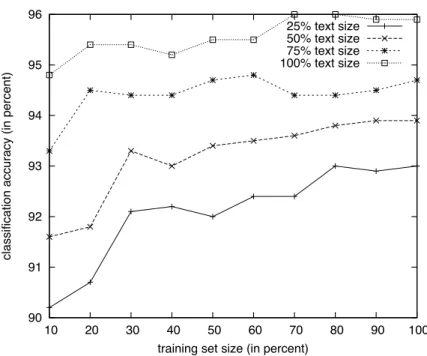
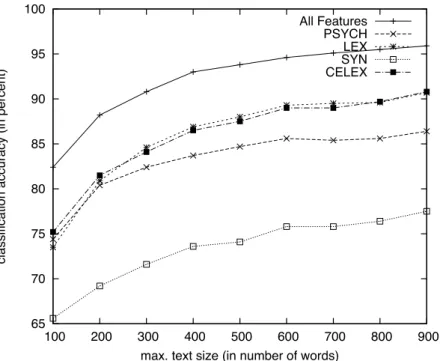
3.1 Classification accuracy for different text sizes and training set sizes 73 3.2 Classification accuracy for different absolute text sizes (in words) 74 4.1 Interaction between Proficiency and Text complexity for Recall . . 99 5.1 Training size vs. classification accuracy . . . 111 5.2 Reading levels of Wikipedia and Simple Wikipedia sentences . . . 113 5.3 Accurately identifiedS <=N . . . 114 5.4 Model accuracy by d-value . . . 115 5.5 Accuracy (S <=N) for different N types . . . 116
5.6 Results forN >= 2.5 . . . 117 5.7 Results forN <2.5 . . . 117 5.8 Training set size vs. accuracy . . . 125 5.9 Performance of different feature groups . . . 126 A.1 3-Way Interaction Visualization for Fixation Count . . . 251 A.2 3-way interaction for First Fixation Duration . . . 254 A.3 Interaction between Proficiency and Text Order for First Pass
Du-ration . . . 256 A.4 Interaction between Proficiency and Text Order for Second Pass
List of Tables
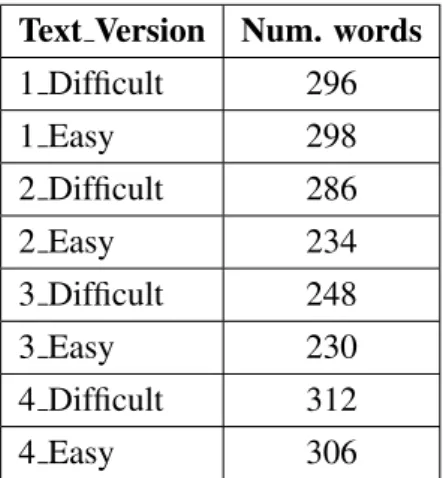
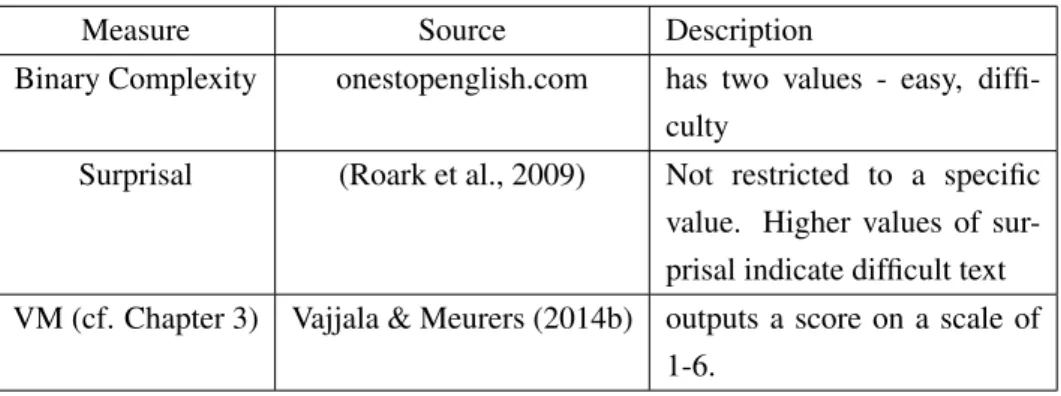
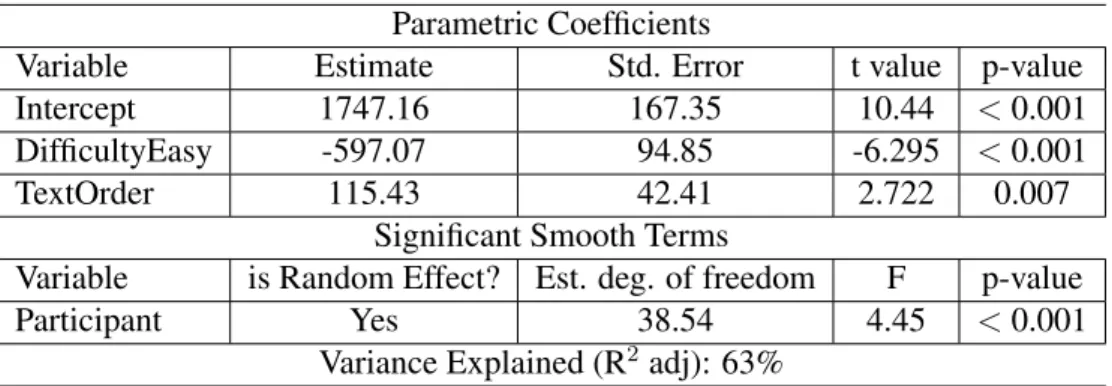
3.1 WeeBitCorpus . . . 47 3.2 BBC Subtitles Corpus . . . 49 3.3 Lexical Richness and POS features . . . 50 3.4 Syntactic Complexity Features . . . 52 3.5 Celex Morphological Features . . . 55 3.6 Celex Syntactic Features . . . 56 3.7 Psycholinguistic Features . . . 58 3.8 Top 10 Features with high weight in the WeeBit trained model . . 60 3.9 Top 10 Features with low weight in the WeeBit corpus trained model 61 3.10 Performance on CommonCore data . . . 63 3.11 Using the same feature set to train multiple models (*!p<0.001) 64 3.12 Model performance, by genre . . . 65 3.13 Ranked list of Top-10 features using IG, for BBC Subtitles Corpus 67 3.14 CfsSubsetEval feature subset . . . 69 3.15 Accuracy with various feature subsets . . . 69 3.16 Accuracies of Top-10 individual features . . . 70 3.17 Ablation test accuracies . . . 71 3.18 Confusion Matrix . . . 71 3.19 Topic specific readability models with TASA corpus . . . 75 4.1 Number of words in the texts used for the experiment . . . 84 4.2 Text Complexity Measures Used in this Study . . . 88 4.3 Text Complexity Scores for the Texts Used . . . 88 4.4 Summary of the GAMM model for Fixation Count . . . 93 4.5 Summary of the GAMM model for Average Fixation Duration . . 94
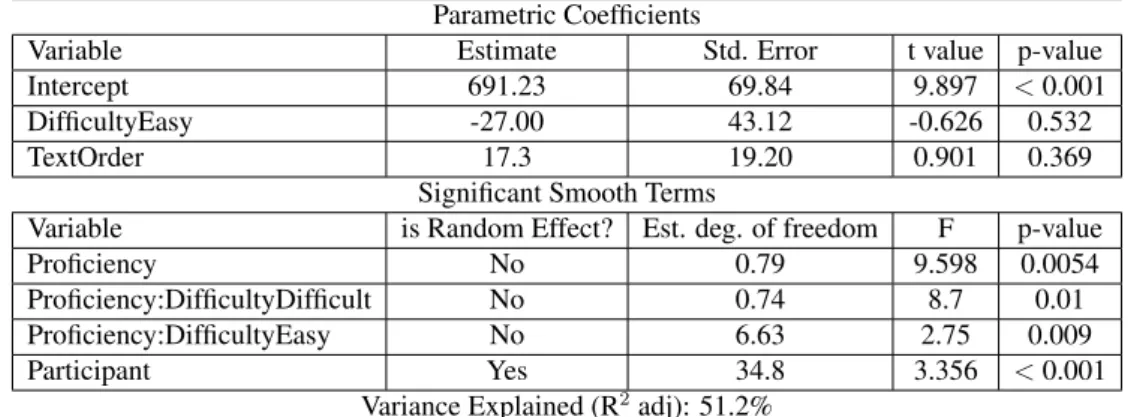
4.6 Summary of the GAMM model for First Pass Duration . . . 95 4.7 Summary of the GAMM model for Second Pass Duration . . . 96 4.8 Summary of the GAMM model for Revisits . . . 97 4.9 Summary of the GAMM model for Recall Scores . . . 98 4.10 Summary of the GAMM model for Comprehension Scores . . . . 100 5.1 Performance of ranking algorithms . . . 123 5.2 Performance with WIKI-OSE2-TRAINand OSE3 corpora . . . . 124 5.3 Accuracy of single feature models for WIKI-TRAIN/WIKI-TEST . 127 5.4 Accuracy of single feature models for OSE2-TRAIN/OSE2-TEST 127 5.5 Simplification at different levels . . . 128 5.6 Single feature ranking models for INTER-ELEsimplification . . . 129 5.7 Rank-correlations for the Common Core Standards dataset . . . . 134 6.1 BLEU comparison on WIKI-TESTdata for models using different
training data . . . 143 6.2 BLEU comparison on OSE-TESTdata for models using different
training data . . . 143 6.3 BLEU comparison on WIKI-TEST data using different language
models for translation . . . 144 6.4 BLEU comparison on OSE-TEST data using different language
models for translation . . . 144 6.5 Example Output - Comparison with other approaches . . . 145 6.6 A few more Example Outputs . . . 146 7.1 BUiD Arab Learner Corpus . . . 157 7.2 The ICNALE Corpus . . . 157 7.3 The TOEFL11 Corpus . . . 158 7.4 Best features for BUID corpus, using CfsSubsetEval method . . . 160 7.5 Best features for BUID corpus, using ReliefFAttributeEval method 161 7.6 Confusion Matrix for BUiD dataset . . . 161 7.7 Confusion Matrix for TOEFL11, unbalanced dataset . . . 162 7.8 Confusion Matrix for TOEFL11, balanced dataset . . . 163 7.9 Top-20 features, for TOEFL11 corpus . . . 163
7.10 Top-10 features, by native language of the learners . . . 164 8.1 The Reading Demands Corpus . . . 171 8.2 Grade Wise Classification . . . 172 8.3 Grade Wise Classification, Gymnasium texts . . . 173 8.4 Grade Wise Classification, Hauptschule texts . . . 173 8.5 Classifying Hauptschule Texts with Gymnasium Texts model . . . 174 8.6 Classifying Gymnasium Texts with Hauptschule Texts model . . . 174 8.7 Binary Classification between grades . . . 175 8.8 School Wise Classification . . . 176 8.9 Gym vs HS classification, by grade level . . . 177 8.10 Publisher differences for Gym versus HS classification . . . 178 8.11 Grade Wise differences with single features - by school and by
publisher . . . 179 8.12 School wise differences at each grade, for Publisher A . . . 181 8.13 School wise differences at each grade, for Publisher B . . . 182 8.14 School wise differences at each grade, for Publisher C . . . 183 A.1 Best Performing Model for Fixation Count . . . 250 A.2 Best Performing Model for First Fixation Duration . . . 253 A.3 Best Performing Model for First Pass Duration . . . 255 A.4 Best Performing Model for Second Pass Duration . . . 257 A.5 Best Performing Model for Revisits . . . 259 A.6 Best Performing Model for Recall . . . 260
Chapter 1
Introduction
Reading is one of the common modes of language learning and knowledge acqui-sition. Thus, anything that causes difficulty during reading is then going to affect the process of learning and comprehension. The causes of reading difficulty in a text and its effects on learners are of specific interest for educational researchers. Hence, the linguistic properties of texts that contribute to reading difficulty, like vocabulary, syntax and cohesion have been widely studied and debated for several decades now in educational psychology. The primary purpose of this research has been to decide what students should read (e.g., Lively & Pressey, 1923; Vogel & Washburne, 1928; Islam et al., 2012; Fitzgerald et al., 2015).
An approach to automatically assess the reading difficulty of a text could be useful for teachers selecting topic specific reading material for their students. In the days of availability of a wide range of information on the web, such an ap-proach could also be beneficial for students wanting to learn about a certain topic as well, since it can suggest them relevant texts on the web that are suitable for their grade level. Apart from educational contexts, the analysis of reading diffi-culty can be useful in several scenarios where reading and understanding textual content plays an important role, for e.g., reading legal texts.
Because of this practical relevance, the task of automatic assessment of text complexity has attracted the attention of researchers working in several disciplines connected to language, such as education, cognitive science, psychology, linguis-tics and second language acquisition, to name a few. Formulae for calculating the
readability of texts, typically on the scale of school grade levels, have been pro-posed since the early 20th century, for various kinds of target readers. However, despite this long standing interest, most of the proposed readability formulae use surface indicators of text complexity like word length, sentence length and amount of difficult words in a text (see DuBay (2006) for a survey). To some extent, this was also because of the computational and text processing limitations of those times.
1.1 Automatic Readability Assessment
Recent developments in Computational Linguistics and Computer Science al-lowed the exploration of readability using more diverse linguistic indicators of text complexity and robust computational models. In the past 15 years, wide range of textual features were explored for automatic readability assessment, modeling the lexical, syntactic and semantic properties of the text. However, the traditional readability formulae remained popular and the real life applicability of the com-putational readability approaches was not explored much. This started to change in the recent past, with the introduction of educational standards like the Common Core1standards in the United States.
The Common Core State Standards (CCSSO, 2010a) Initiative is a set of guidelines for academic standards in the United States of America, which out-lines what students in the primary and secondary school should know at the end of each grade in Mathematics and English/Language Arts. They were developed by the Council of Chief State School Officers (CCSSO) and the National Gov-ernors Association Center for Best Practices (NGA Center) in collaboration with teachers, school chiefs and other educational experts. In the “Reading” compo-nent of the language arts section, the standards call for a “staircase of increasing text complexity” for the students i.e., the students should be able to read more and more complex texts with increasing grade level.
A sample of 168 exemplar texts were also provided in the Appendix A of the Common Core Standards document, annotated with their appropriate grade level.
The standards were quickly adapted and endorsed by commercial systems that provide frameworks for assessing reading levels of texts (e.g., Lexile 2, DRP3, Reading Maturity Metric4).
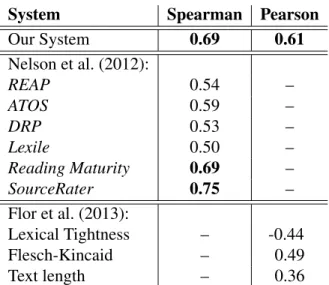
Nelson et al. (2012) compared some of the existing academic and commercial reading level prediction systems and showed that the approaches that consider diverse aspects of language complexity perform significantly better than the rela-tively shallow measures used by many systems, using multiple standard test sets annotated with a reading level. The Common Core Standards test set described in the previous paragraph too was one of them. Fitzgerald et al. (2015) studied texts written for primary school children in terms of their text complexity and reached the conclusion that several linguistic dimensions (word structure, word meaning, sentence and discourse level characteristics) and the interplay among them con-tribute to text complexity. In a different context of L2 writing assessment, Bult´e & Housen (2014) also reached the conclusion that a wide range of complexity mea-sures need to be calculated to get a comprehensive picture of writing complexity. These recent results emphasize the need to model a broader range of textual fea-tures for readability assessment.
The Elementary School Journal, a 115 year old educational research journal had a special issue onUnderstanding Text Complexity in December 2014, which prompted an in-depth discussion on approaches to automatically analyze text com-plexity and the methodological issues involved. The discussions in this issue stressed on the importance of modeling readability considering a broader range of linguistic properties, reader comprehension and the learning task involved (e.g., answering questions vs reading instructions).
These recent developments clearly indicate that the readability assessment sys-tems can now play an important role in educational policy making and in choosing appropriate reading material for students.
Our approach: Against this backdrop, in this thesis, we proposed a supervised machine learning based approach to readability assessment, which models a broad
2https://www.lexile.com/using-lexile/lexile-measures-and-the-ccssi/ 3http://drp.questarai.com/home/about-the-drp/
drp-and-the-common-core/
range of textual features that are based on research in Second Language Acqui-sition and Psycholinguistics along with several other linguistic characteristics of language, using state of the art methods in natural language processing research. This approach still considers only the nature of the text. However, we also con-ducted an eye-tracking study with a recall and comprehension task for the readers, that partially takes the reader and task into account.
1.2 Validity of Readability Assessment Approaches
While it is clear that robust automatic readability assessment approaches hold a promising future in educational applications, this discussion around the usefulness of readability models also raises questions about the empirical basis, validity and applicability of readability models for a specific application context. Since the initial days of readability research, these issues have been studied and debated extensively. As readability formulae were being used for all sorts of application scenarios irrespective of their original purpose, researchers like Bruce & Rubin (1988) cautioned about the pitfalls of this practice. They recommended that they should be used on the same population as the formula was validated against. More recently, Begeny & Greene (2013) criticized the use of readability formulae in school, arguing that they are valid only at particular grade levels, by comparing them with the oral reading fluency of children from elementary school.
Automatic readability assessment methods can be validated by either data driven or user based approaches. Another approach could be to validate the mod-els by comparing them with theoretical results from research on human language processing.
Data driven validation: From a textual perspective, the validity of an au-tomatic approach can be verified by testing its robustness by performing cross-corpus evaluations with corpora consisting of graded texts, intended for the same target audience.
User based validation: From the target user perspective, one has to perform an empirical evaluation and compare their performance outcomes with texts of varying difficulty.
Text Complexity and Human Processing Another approach to validate the readability assessment approaches is to explore the correlates of linguistic text complexity models with some of the research on the processing of text in the hu-man mind. Researchers in areas like neuroscience, psycholinguistics and cogni-tive psychology have theoretically and experimentally studied the process of text comprehension in the human mind. Neuroscience research in the past few decades explored ways to measure brain activity, by detecting changes in the blood-flow in various regions of the brain that are affected by word-level, syntactic and semantic level characteristics of text. For example, Hruby & Goswami (2011) summarized some of the research on neural correlates of reading comprehension and difficul-ties.
In psycholinguistics, the notion of text complexity has been studied in the context of text comprehension, to understand what types of linguistic constructions cause comprehension problems for humans (cf. Chapter 10, Aitchison, 2011, for a sum-mary). Text processing difficulty was also studied by computationally modeling surprisal, working memory constraints and parsing costs for a text (e.g., Boston et al., 2008; Roark et al., 2009; Boston et al., 2011). Eye-tracking is commonly used in Cognitive Psychology research to understand online processing of text by the subjects through their eye-movement patterns (Rayner, 1998). Some of the eye-tracking measures like Fixation Count and Average Fixation Duration are known to correlate with text processing difficulty for the readers (Rayner et al., 2006).
Validating our approach: In this thesis, we employed both data-driven and user-based studies to evaluate the validity of our automatic readability assessment approach. In terms of the data-driven evaluation, validated our readability model by using it to predict the reading level of other externally validated texts like Com-mon Core exemplars. The validity of the features was studied by using the features to construct multiple readability prediction models, using datasets that cover di-verse topics, and genres (written vs. spoken). To understand the effect of text complexity on readers, we conducted an eye-tracking study where the subjects read texts in two versions, prepared by external experts. Through this study, we studied both the cognitive correlates of text complexity as well as the impact of
text complexity on the performance outcomes of the subjects.
1.3 Text Simplification
While difficult to read texts pose problems to the target readers, providing them comprehensible texts can be seen as a solution to address this issue. Text simpli-fication can be seen as one way of achieving the goal of providing comprehen-sible texts for users, on a given topic. The effect of text simplification on target readers was explored in psychology research before. For example, in psychology, text comprehension theories were proposed to understand the comprehension pro-cesses in humans and educational research attempted to use some of these models in instructional practice, to rewrite texts for better comprehension. Empirical in-vestigations about the effect of the rewritten texts on the cognitive processing and performance outcomes were conducted using reading time experiments, compre-hension questions and free recall.
Kintsch & van Dijk (1978) proposed a theoretical model of text comprehen-sion, which was used by Britton & G¨ulg¨oz (1991) to rewrite texts. This model was shown to improve free recall for users. Britton et al. (1989) compared the original and revised versions of several texts prepared by five experts and concluded that the experts did not always reproduce rewritten versions reliably and had imperfect declarative knowledge about their revisions. They called for the experts to learn to be more explicit about rewrites and hoped for the development of technology that can do this automatically. Automatic text simplification and tools that provide explicit feedback to the writers about the complexity in the text produced can be seen as solutions to this issue.
Automatic Text Simplification approaches have been proposed in the recent past, both with the use of linguistic simplification rules as well as using statisti-cal learning based approaches. There are two primary ways to evaluate automatic text simplification. From a reader perspective, one needs to conduct a user study to assess the impact of text-simplification on readers. From a data-driven perspec-tive, readability assessment models can be used for the linguistic evaluation of simplification. They can also be used for selecting what to simplify, apart from evaluating the degree of simplification performed by the system.
Our approach: In this thesis, we explored automatic text simplification as a monolingual, statistical machine translation problem, as english to simple en-glish translation. We primarily focused on the role of focused training data and use of various language models in improving the generation of simplified text. We also investigated the utility of readability models to compare the normal and simplified sentences in terms of their reading levels. We validated our approach by comparing the BLEU scores between machine-translated text and the original text. Though we studied the evaluation of manual text simplification in terms of readability, we did not perform any evaluation of automatically simplified text in terms of the readability yet.
1.4 Other Applications of Text Complexity Analysis
Apart from readability assessment and text simplification, the estimation of text complexity can also be useful for other educational applications. In this thesis, we used the linguistic features developed for readability assessment to two other problems specific to educational research:
• assessing the second language proficiency of adult English learners by mod-eling the linguistic complexity of the texts they produced
• analyzing the reading demands in German school textbooks in terms of their text complexity
1.5 Research Questions
In sum, we address the following questions in this thesis:
1. Can we build an automatic readability model that generalizes well to new texts and genres?
2. How does text complexity affect the reader’s cognitive processing and per-formance outcomes?
3. Can we accurately quantify the readability of texts at a sentence level, for evaluating the degree of simplification performed?
4. Can we simplify texts automatically to a given reading level?
5. Can we apply the analysis of text complexity in other educational contexts?
1.6 Terminology
In the existing body of literature on this topic, the terms text complexity and text difficulty are sometimes considered different constructs. While text complexity refers to the linguistic properties of text that are believed to affect comprehen-sion, text difficulty refers to comprehension considering the user’s reading ability (Mesmer et al., 2012). While in this thesis, we focus on the text complexity as-pect, we use the terms interchangeably like Sheehan et al. (2014). We use the term automatic readability assessment as the process of analyzing this construct. The difficulty that a text poses to a reader also depends on the population of learn-ers (e.g., first vlearn-ersus second language learnlearn-ers, children vlearn-ersus adults), their socio cultural background and other aspects like the interaction between the reader and the text. This thesis is primarily concerned with the textual features that make it difficult to read.
1.7 Approach and Key Contributions
We applied supervised machine learning approaches with existing graded cor-pora as our basis for developing automatic readability and simplification models. In terms of the features, we used a combination of features from Second Lan-guage Acquisition (SLA), word-level properties from pre-existing psycholinguis-tic databases and other linguispsycholinguis-tic features that can be automapsycholinguis-tically extracted using publicly accessible NLP software. We evaluated the performance of the models we built by multiple cross-corpus, data driven evaluations. Apart from these, we also performed an eye-tracking study to understand the effect of text complexity on readers. The specific contributions of this thesis are:
• We compiled a corpus of web texts consisting of five grade levels, which can be used to train readability models.
• We developed a state of the art readability model that reports second best results on the common core standards test set (Spearman’s rho: 0.69). In this process, we created feature set that takes into account several linguis-tic properties and generalizes to spoken language too, with a classification accuracy of 96%.
• We performed an empirical analysis about the effect of text complexity and language proficiency on readers’ cognitive processes and reading perfor-mance through an eye-tracking study. We show experimentally that both the variables impact the online and offline processing of the readers and in some cases, there is an interaction between them.
• We proposed a state of the art approach to rank sentences based on their difficulty level and compare the degree of simplification between them. Our approach orders the sentences correctly with>80% accuracy.
• We created a corpus of parallel simplifications of sentences across three levels of simplification, compiled from texts created by human experts. • We explored a machine translation based text simplification approach that
is trained with data containing only lexical simplifications and paraphrases that results in a better performance compared to an approach trained on a large, noisy corpus, achieving better BLEU scores in the process.
• We report on two experiments studying the application of readability ori-ented features to educational applications:
1. Modeling the proficiency of L2 English writing using linguistic com-plexity features for real life English learner texts.
2. Analysis of geography text books in German schools in terms of their linguistic complexity.
1.8 Outline of the Thesis
The rest of this thesis is organized as follows:
Chapter 2 first describes prior work on automated readability assessment and its applications. Later, the applications of readability assessment methods in auto-matic and manual text simplification are discussed. Finally, after a brief survey of research on automatic text simplification, this chapter concludes connecting these three parts and connecting the current thesis to existing research.
Chapter 3 describes our approach to readability assessment in terms of the corpora, features, modeling and evaluation. Several experiments performed to establish the validity of the proposed models across genres, topics and corpora are described in this chapter. This chapter is based on the results reported in Vajjala & Meurers (2012, 2014b,c).
Chapter 4 describes an eye-tracking experiment that studies the effect of text complexity and simplification on the cognitive processing and performance out-comes of the readers.
Chapter 5 connects readability assessment to text simplification. Here, we study readability assessment at the level of sentences to compare simplified and unsimplified versions of sentences. This chapter is partially based on the results from Vajjala & Meurers (2014a) and Vajjala & Meurers (under review).
Chapter 6 explores a Statistical Machine Translation (SMT) based approach to text simplification that handles specific operations, explores the role of various language models and studies the generalizability of the SMT approach by cross-corpus evaluation.
Chapters 7 and 8 describe two applications of readability analysis in Educa-tional contexts. Chapter 7 uses the features described in Chapter 3 to analyze L2 learner writing samples and perform proficiency classification. Chapter 8 utilizes an existing German feature set for analyzing text complexity from Hancke (2013) to analyze the reading demands in German school textbooks, and to predict the grade level of a text book based on the linguistic features.
Finally, Chapter 9 summarizes the contributions of this thesis and discusses potential extensions to this work.
Part I
Readability Assessment and Text
Simplification
Chapter 2
Literature Review
Abstract
In this chapter, we survey the contemporary and past research on readability as-sessment and text simplification. We also briefly discuss the key contributions of this thesis to both the areas.
2.1 Introduction
Automatic readability assessment (ARA) approaches for several application sce-narios existed for almost a century now. Within educational research, the primary application of readability assessment was to assign a reading level to texts read by learners. Although early studies on readability focused on a variety of linguistic and non-linguistic textual properties, subsequent studies typically relied on easy to estimate surface measures like average length of words and sentences in a text to create formulae for readability, as they were found to correlate with other, more reliable measures. This was also motivated by the fact that there were no existing computational tools for automatic estimation of all textual properties. With the evolution of Natural Language Processing (NLP) tools for processing texts, more sophisticated approaches for readability assessment, involving statistical and Ma-chine Learning methods started to emerge.
pro-posed, researchers questioned the validity of these readability approaches. The evolution of the Common Core Standards initiative (CCSSO, 2010b) in the United States created a gold standard test set for readability assessment. This was created based on the exemplar texts per grade level from the Common Core Standards document. Comparing the performance of different approaches on this test set could address the external validity of the approaches to some extent.
Once we decide that a text is difficult to read for a target reader, one way to address the issue is to simplify difficult texts to the level of the reader. Educa-tional researchers studied the effect of simplifying texts on the comprehension of the learners and their results showed that simplified text could result in better comprehension in some scenarios. Automatic Text Simplification (ATS) could be useful in such a scenario. Interest in ATS started two decades ago to improve natural language parser efficiency and expanded to various application scenarios ranging from language learning to understanding protein-protein interactions in the Biomedical domain. In an educational context, the aim of automatic text sim-plification would be to provide easy to comprehend texts for language learners. Readability assessment can be very useful in such a scenario in various stages like choosing targets for simplification and to evaluate the degree of simplification. However, this relationship between readability and simplification has remained largely unexplored in the literature so far, beyond using traditional readability for-mulae. In this thesis, apart from developing and testing new approaches for auto-matic readability assessment and text simplification, we also connect the missing link between them, for a language learning scenario, by using readability assess-ment to evaluate text simplification.
The rest of this chapter provides an overview of the research in both ARA and ATS and puts this thesis in context. Section 2.2 first summarizes existing research on readability assessment and its applications and describes how the current thesis adds to this area. Section 2.3 summarizes the research in text simplification so far and briefly describes the contributions of this thesis to this area.
2.2 Automatic Readability Assessment (ARA)
2.2.1 Early Work and Traditional Readability Formulae
The need for assessing the difficulty of a text in an objective manner dates back to almost a century. Most of the early work on this topic focused on the lexical aspects of a text (i.e., difficult words) and was directed at school children and their reading tasks. Thorndike’s approach (Thorndike, 1921; Thorndike & Lorge, 1944) can be considered the first systematic approach to assess the difficulty of texts. Thorndike (1921) compiled a list of 10,000 words in English along with their respective frequencies, providing school teachers a way to measure the difficulty of texts based on the vocabulary used. This list was followed up with another list in Thorndike & Lorge (1944), which consisted of 30,000 words. This list served as a basis for many more readability formulae during the decades that followed. Lively & Pressey (1923), while investigating the problem of selecting appropriate science textbooks for junior high school students, concluded that the median of the index numbers of words taken from Thorndike (1921) was the best indicator of vocabulary difficulty for the texts they chose and the measures they studied.
Vogel & Washburne (1928) studied multiple aspects of readability to assign appropriate grade levels for children’s reading material. Apart from using Lively & Pressey (1923)’s technique for vocabulary difficulty, they also considered sev-eral aspects of the syntactic structure of the document, part-of-speech tag distri-bution in a sample of 1000 words, paragraph construction and physical makeup. They finally proposed theWinnetka Readability formulawith four textual proper-ties after removing all the correlated features. These four properproper-ties are: number of different words, number of prepositions, number of uncommon words in the 1000 word sample for a text and the number of simple sentences in a sample of 75 sentences. The scores from this formula were later mapped to the grade levels at schools. They validated their approach against 700 books (called theWinnetka Book List) that had been labeled aslikedby at least 25 of around 37,000 children. This is the first formula that predicted readability by grade levels. Patty & Painter (1931) continued with the problem of measuring the vocabulary burden of text-books and proposed an approach that combined Thorndike’s list with vocabulary
diversity in the text.
Readability formulae for adult readers: In the early 30s, the focus of readabil-ity research shifted from school children to adults with reading difficulties. Dale & Tyler (1934) published a study on factors causing reading difficulties for adults of limited reading ability. They found that 10 out of the 29 significant factors for children’s comprehension also had significant effects for adults. Of these, they constructed a readability formula considering three most predictive factors - num-ber of different technical words, numnum-ber of different hard non-technical words and number of indeterminate clauses. This formula was empirically validated by correlating its scores with performance in multiple-choice tests. Lorge (1944)’s formula which included three factors - average sentence length, number of prepo-sitional phrases per 100 words and number of hard words not on the list of Dale’s list of 769 easy words. It used McCall-Crabbs Standard Test Lessons in Reading (McCall & Crabbs, 1926) as a basis for reading difficulty, which was also used by others in the following decades.
Gray & Leary (1935) can be considered the most comprehensive study of that time on the topic. They studied readability for adults with limited reading ability and identified 228 factors that affect the readability of a text. They divided these factors into four groups - content, style, format and organization and concentrated primarily on 64 variables of style, which can be measured reliably. The empir-ical basis of their reading difficulty scores was based on the results of reading comprehension tests performed with adult readers. Finally, they created a formula with five variables - average sentence length in words, number of different ”hard” words, number of first, second and third person pronouns, percentage of different words and number of prepositional phrases.
The focus on adults with limited reading ability continued in the post-WWII phase, when the emphasis on clear writing increased. This resulted in the creation of several readability formulae that are still in use today (e.g., Dale-Chall For-mula (Dale & Chall, 1948a; Chall & Dale, 1995), Flesch Reading Ease ForFor-mula (Flesch, 1943, 1948) and Gunning-Fog Index (Gunning, 1968)). The Dale-Chall Formula, which is a two-factor formula based on number of words not in Dale list of 3000 words and average sentence length, was shown to correlate highly
with several texts apart from the original McCall-Crabbs passages like health ed-ucation materials and current affairs articles. It also included a manual (Dale & Chall, 1948b) for the application of the formula correctly.
Flesch (1948) examined readability by considering average word length (in syllables) and average sentence length (in words), average percentage of personal words and average percentage of personal sentences as features. A later version considered only the first two features and measured readability on a scale of 0-100. Variants to the Flesch formula were also proposed (Farr et al., 1951; Kincaid et al., 1975). Two other formulae of this type, which use variants of word-length, sentence-length and lists of difficult words as factors are Coleman-Liau index (Coleman & Liau, 1975) and SMOG (McLaughlin, 1969). Word lists like West’s General Service List (West, 1953) and Coxhead’s Academic Word List (Coxhead, 2000) were also used to create readability formulae. Bormuth (1966) also inves-tigated readability using a large number of linguistic variables and cloze tests and concluded that more sophisticated linguistic variables are needed to improve the readability prediction. Granowsky & Botel (1974) turned the focus back to more fine-grained syntactic measures of readability by claiming that sentence length is an insufficient measure of syntactic complexity.
2.2.2 Validity of Readability Formulae:
Although more than 200 formulae have been proposed in the past century, empir-ical validity of the formulae and the relationship between them have been ques-tioned by multiple researchers (e.g., Bruce & Rubin, 1988; Anderson & Davison, 1988). Klare (1974) compared several readability formulae that either were cre-ated or revised since 1960, in terms of their application scenarios and computabil-ity and concluded that the formulae do not indicate causes of difficulty in a text but only serve as an indicator of difficulty. More recently Pearson & Hiebert (2014) advocated the need for a more qualitative analysis of text complexity, to counter the unchecked quantitative approaches like readability formulae in cases where they can be invalid.
Klare (1952) compared some of the existing readability formulae at that time in terms of correlations between each other. In the discussion about coming up
with new readability formulae that included more features, he mentioned about the need for an inter-disciplinary approach combining knowledge on the topic from fields like linguistics, psychology, typography and semantics. However, most of the formulae from those days were manually estimated and thereby imposed a constraint on the creation of formulae that included more features. Quick, short hand formulae that can be easily estimated continued to be used. Klare (1974); DuBay (2004, 2006) discuss in detail on the early decades of work on readabil-ity assessment. Although computer programs to calculate readabilreadabil-ity formulae started by the late 60s (e.g., Klare (1969)), feature-rich modeling of readability started only after the evolution of natural language processing approaches.
However, this did not diminish the popularity of old style readability formulae. Some of these formula-based approaches such as Lexile1(Stenner, 1996), Degrees of Reading Power2are still being used widely in educational applications. Flesch-Kincaid scores are being used in a range of applications including Microsoft Word. Some of the popular readability formulae are readily computable on the internet3. Thus, the widespread use continued despite all the criticism.
Formulae for other languages: It has to be noted that all the traditional read-ability research described so far are exclusively focused on English. However, such approaches with surface features were also proposed for other languages, like French (e.g., Kandel & Moles, 1958; Uitdenbogerd, 2005), Italian (Franchina & Vacca, 1986; Lucisano & Piemontese, 1988), Swedish (Jakobsen, 1971; An-derson, 1983), Chinese (Tham, 1987), Japanese (Yuka et al., 1988; Ozasa et al., 2007) etc., (Klare, 1974) also provides a brief survey of readability formulae for French, Dutch, Spanish, Hebrew, German, Hindi, Russian and Chinese.
In the past two decades, advances in the field of Natural Language Process-ing have lead to the development of more sophisticated readability assessment approaches using a range of language features and statistical learning models. Al-though most of this work still focused on English as it has more corpora to train the models and more tools to extract the features, readability research in other
1www.lexile.com
2http://drp.questarai.com/home/
languages is also emerging. The following section provides an overview of the methods and measures used in computational modeling of readability assessment.
2.2.3 Computational Modeling of Readability - English
Computational modeling of readability typically follows a supervised machine learning approach with the following steps:
1. Corpus: Select a gold standard corpus annotated with reading levels e.g., graded readers or a corpus of books across grade-levels. We assume here that the gold standard corpus takes linguistic complexity issues into account while preparing grade-appropriate content.
2. Features: Select the linguistic variables that are hypothesized to be indica-tive of text complexity.
3. Modeling: Select a learning algorithm and build a computational model using the corpus, features and the learning algorithm.
4. Evaluation: evaluate the model by a data-driven or user-based approach. In data driven approaches, the performance is usually evaluated in terms of prediction accuracy. User-based evaluations are sometimes performed by comparing recall and comprehension performance of the users on texts of varying difficulty.
Language Models The first computational models of readability were based on statistical language models. Si & Callan (2001) first proposed a model of de-tecting the reading difficulty of web pages using a linear combination of statisti-cal language models and surface linguistic features. Collins-Thompson & Callan (2004, 2005) extended this approach with a larger web-corpus covering multiple US-English school grade levels and using a combination of language models fol-lowed by a feature selection step. They also performed cross-corpus evaluations and ported the approach to French and concluded that language models are better predictors of web document readability than traditional readability measures. This
work laid foundation for the REAP project4, which provides appropriate reading materials while satisfying pre-defined lexical constraints, for language learners. REAP was also extended to work with Portuguese (dos Santos Marujo, 2009; Marujo et al., 2009).
Heilman et al. (2007) extended this approach and combined lexical, language model features with grammatical features and modeled readability using a corpus of English textbooks spanning 12 grade levels of the US education system. Their approach was focused on providing appropriate texts for language learners. Heil-man et al. (2008) explored several statistical models, considering readability on nominal, ordinal and interval scales. They concluded that a Proportional Odds model, which assumes ordinal data, worked best for readability assessment. Lan-guage models were also used in (Quarteroni & Manandhar, 2006) to incorporate readability assessment into a question answering system.
Schwarm & Ostendorf (2005); Petersen (2007); Petersen & Ostendorf (2009) proposed a readability assessment approach for retrieving readable texts for En-glish as Second Language (ESL) learners. This model relied on language models, Out of Vocabulary (OOV) word features and parse tree based syntactic features. They used a corpus of news articles written for children of various age groups by an educational news paper called Weekly Reader. They showed that a support vector machine model that combined all the features performed the best in terms of classification accuracy. The applicability of this approach for web search was also briefly explored in (Petersen & Ostendorf, 2006).
Other Word-difficulty based approaches: More recently, Kidwell et al. (2011) applied a statistical model of word acquisition for readability prediction. Flor et al. (2013) used a measure called lexical tightness, derived from word distributions in a large corpus for assessing text complexity. Shardlow (2013a,b) proposed approaches to assess the difficulty of words. Leroy & Kauchak (2013) studied the effect of word familiarity on reading difficulty. Weir & Anagnostou (2008) used collocation frequency as a measure of readability.
Since language models and word difficulty methods only look at the bag of words and n-grams, they may not always capture aspects of readability encoded in
the syntactic structure of the language. Further, issues like text coherence cannot be addressed with language models alone. Hence, several other approaches to readability explored a wide range of features.
Other Features: Kate et al. (2010) used a range of lexical and syntactic features for developing a readability approach to evaluate machine reading, which included several grammar rules that involve deeper linguistic analysis of sentences. Ma et al. (2012b) compared human and automatic feature extraction for readability assessment. Beinborn et al. (2012) describes the use of readability assessment for self-directed language learning. Medero & Ostendorf (2013) used atypical prosodic structure as a measure of reading difficulty. Green (2014) performed an eye-tracking evaluation of parser complexity metrics and showed that surprisal and entropy reduction metrics are good indicators of text readability for human comprehension. Looking at readability from a different perspective, Salama et al. (2013) showed the effect of improving the typesetting of a text based on lexical and syntactic features.
Along with various lexical, POS and parse tree based features, Feng et al. (2009); Huenerfauth et al. (2009); Feng et al. (2010); Feng (2010) used cogni-tively based indices for readability assessment to provide assistance for adults with intellectual disabilities. This group of features included - lexical chains, entity-density features, coreferential inference and entity grid features. Shallow discourse measures for estimating cohesion and coherence have been explored in the Coh-Metrix project (Crossley et al., 2007, 2008, 2011a; Graesser et al., 2014). Scarton & Alu´ısio (2010) ported the Coh-metrix approach to Brazilian Portuguese.
Genre Specificity: Most of the work on readability assessment did not consider the differences in texts of various genres. Sheehan et al. (2010, 2014) discuss the development of TextEvaluatorTM tool for measuring reading levels of a text and showed the effect of text genre (e.g., normal text versus spoken language) on readability prediction (Futagi et al., 2007; Sheehan et al., 2008). Sheehan et al. (2013) proposed a two-stage approach to readability consisting of a genre classification stage.
Topic Specificity: While most of the approaches proposed so far ignored topical or domain relevance, some of the approaches focused on these aspects. Qumsiyeh & Ng (2011) combined topic modeling and authorship information along with other language features for automatic readability assessment. Yan et al. (2006) proposed an approach that considers domain-specific conceptual readability as a feature. Jameel et al. (2012) proposed a model of domain specific readability based on conceptual difficulty and discourse cohesion. Zhao & Kan (2010) cre-ated a publicly accessible readability annotcre-ated corpus specifically for the math-ematical domain while Kandula & Zeng-Treitler (2008) discusses the need for creating a gold standard for readability measurement of health texts.
Modeling Although almost all the proposed approaches have used either clas-sification or regression approaches to learning, Pitler & Nenkova (2008); Tanaka-Ishii et al. (2010); Ma et al. (2012a) applied ranking and pair-wise comparison approaches to readability assessment. Brooke et al. (2012) proposed an unsuper-vised ranking based approach for constructing a readability lexicon.
2.2.4 Readability and Non-English languages
A majority of research into feature engineering and application of readability models focused on English. However, there is a growing body of literature in non-English languages that takes into account language specific characteristics like morphology. This section provides a short overview of some of the existing research.
Arabic: Forsyth (2014a,b) recently reported on readability classification for Modern Standard Arabic using traditional, POS based and discourse connective features. Shen et al. (2013) proposed a language independent readability assess-ment approach consisting of surface features and bag-of-words approaches and tested the approach for Arabic, Dari, English and Pashtun. In a follow-up study (Salesky & Shen, 2014), they showed that the addition of morphological and in-formation theoretic features significantly improved the performance of their ap-proach.
Bangla: Islam et al. (2012); Islam & Mehler (2013); Islam et al. (2014) explored the use of information theoretic features for English and Bangla readability as-sessment and showed that they perform on par with more linguistically oriented features. Sinha et al. (2012) developed new readability formulae using language specific surface features for Hindi and Bangla while Phani et al. (2014) performed an inter-rater agreement study for readability annotation which showed a moder-ate agreement between annotators.
Basque: Gonzalez-Dios et al. (2014b) used a range of linguistic features used in other languages along with those specific to Basque, to create two class read-ability models. Gonzalez-Dios et al. (2014a) proposed a tool that simplifies par-enthetical structures in biographical articles in Wikipedia and also extended the approach to seven other languages. They showed that this approach improved the readability of Basque sentences.
Chinese: Lau (2006); Lau & King (2006) utilized the nature of the Chinese script to form several sub-character and character level features in addition to the common word and sentence level features for Chinese readability classifi-cation. They also explored bi-lingual website readability in this context. Chen et al. (2013) showed that lexical chains and term frequency features together were useful for the readability classification of Chinese textbooks. Hara et al. (2013) combined linguistic features with gaze information to model comma placement in Chinese text for improving the readability. Sung et al. (2014) discussed the advan-tage of using a multi-level modeling approach for Chinese readability assessment.
Dutch: van Oosten et al. (2010); van Oosten & Hoste (2011); Van Oosten et al. (2011); Clercq et al. (2014) studied Dutch readability assessment and investigated strategies for creating gold standard readability annotated data for both English and Dutch through crowd sourcing.
French: Franc¸ois (2009); Francois & Watrin (2011) used features modeling tense difficulty and multi-word expressions along with the other lexical and syn-tactic features for studying the readability of French as Foreign Language (FFL)
textbooks. While Francois & Fairon (2012) additionally considered semantic fea-tures, Todirascu et al. (2013) modeled coherence and cohesion for French read-ability assessment. Franc¸ois et al. (2014) developed a graded lexicon resource, which could be useful for readability assessment of French. Grabar et al. (2014) proposed an approach to diagnose the difficulty of level of medical terminology in French.
German: Vor der Br¨uck & Hartrumpf (2007); Vor der Br¨uck et al. (2008a,b) used comprehensive lexical, syntactic, morphological, semantic and discourse features for estimating the readability of German administrative texts. They showed that apart from the regular surface features and some of the parse tree features, as-pects such as the quality of the semantic network, number of propositions per sen-tence and connections between network nodes representing objects in a text also played an important role in assessing the readability for German. Nietzio et al. (2012) analyzed the linguistic properties of text for preparing easy-to-read mate-rial in German. Hancke et al. (2012a) compiled a web-based two-class readability corpus for German and using a wide range of lexical, syntactic, morphological and language model features, achieved a classification accuracy of ⇠90%. Lavalley
& Berkling (2014) compared the sentence structure in various age-groups of chil-dren’s writing and normal literature for German, with the aim of understanding children’s reading and writing competence at word and sentence level.
Hindi: Sinha et al. (2012, 2014) discussed some approaches for readability as-sessment of Hindi using both traditional and other lexical and discourse features. They modeled readability using support vector machines, with a small set of 100 documents annotated with reading levels.
Italian: Dell’Orletta et al. (2011) worked with a corpus of Italian newspaper text at two different reading levels, with the eventual goal of performing text-simplification. They used a mixture of traditional, morpho-syntactic, lexical and syntactic features for building a two-class readability model for Italian. Among others, their feature set included verbal mood based features, which relied on the rich verbal morphology of Italian. This was later continued in Dell’Orletta
et al. (2012, 2013) where, using multiple two-class corpora spanning different genres, they showed the genre dependent nature of readability models. Tonelli et al. (2012) proposed a Coh-metrix inspired readability system for Italian that also provided a graphical representation of readability.
Japanese: Sato et al. (2008) followed a language modeling based approach for Japanese readability assessment using a corpus of textbooks sorted by their grade levels. Their method showed a strong correlation with readability in a cross cor-pus evaluation with web documents and also with shorter texts. Nishikawa et al. (2013) modeled readability prediction through a range of lexical, syntactic and discourse features. They used a training corpus annotated with reading time for Japanese texts. On the other hand, Sato (2014) studied the relationship between readability and word distribution in Japanese.
Polish: Broda et al. (2014) proposed a readability approach for Polish, primar-ily based on a corpus of web-documents and language models.
Portuguese: Readability assessment approaches for European and Brazilian Por-tuguese were proposed using various lexical, syntactic, discourse and language modeling features derived from English research (dos Santos Marujo, 2009; Aluisio et al., 2010; Scarton & Alu´ısio, 2010).
Swedish: Larsson (2006) used lexical and syntactic features to classify Swedish texts into three reading levels, with the aim of using it in a search engine to provide readable texts for students. More approaches have been proposed for Swedish in the recent past primarily relying on similar sets of features (Falkenjack et al., 2013; Heimann M¨uhlenbock, 2013; Falkenjack & Jonsson, 2014). Sj¨oholm (2012) dis-cusses document and sentence level readability, considering readabilit