A Three-Layered Cyclic Model of E-Learning
Development and Evaluation
PAUL LAM AND CARMEL MCNAUGHT
The Chinese University of Hong Kong, The People’s Republic of China [email protected]
Evaluation is often depicted as being in a cyclic relationship, together with the planning, development, and implementation aspects of e-learning in higher education. This article sup-ports this view and elaborates the multiple roles evaluation can have. We present a three-layered cyclic model developed during an e-learning support project: e3Learning (e3L). For-mative evaluation can refine e-learning planning and devel-opment before implementation; however, the emphasis of this article is on the contributions of summative evaluation. Expe-riences during the e3L project reveal two key roles of evalu-ation from summative data: (a) Evaluevalu-ation assists teachers in improving their e-learning strategies in further rounds of planning and development; and (b) evaluation can also pro-vide epro-vidence through meta-analyses across projects, which can feed into overall e-learning planning, development and evaluation strategies.
THE ROLE OF EVALUATION IN E-LEARNING PROJECTS
E-Learning projects can greatly benefit from evaluation. Reeves and Hed-berg (2003) suggested that the integration of evaluation into all technology-enhanced interactive learning systems is essential. Kennedy (1998) com-mented that formative and summative evaluation addresses a broad range of issues from interface design to student learning outcomes and is thus “funda-mental in courseware development” (p. 375). There is a cyclic relationship (Phillips, 1997) between evaluation and the other planning and implementa-tion stages of an e-learning project: planning and implementaimplementa-tion lead to evaluation, but evaluation also loops back into the planning and
implementa-tion stages by providing feedback and data for reflecimplementa-tion. In this article we wish to elaborate these cyclic relationships by looking closely at the benefits resulting from a range of e-learning evaluation strategies. We will do this using evidence collected from evaluation of 70 e-learning projects under the auspices of the e3Learning project which operated in three Hong Kong uni-versities during the period 2003-2005. The data from these 70 projects led to a three-layered cyclic model of e-learning development and evaluation.
E-Learning evaluation takes place in different stages of the development and implementation of e-learning projects, usually with different purposes. Evaluation can be roughly distinguished into two main types of evaluation, formative and summative. Formative evaluation often co-occurs with opment so that the e-learning product can be improved as it is being devel-oped (Khan, 2005). Summative evaluation, on the other hand, is usually con-ducted as the final assessment of the material or strategy. The distinction, however, should not be taken as a clear-cut dichotomy. Mandinach (2005) explained that supposedly summative evaluations can be formative, espe-cially if the goal of evaluation is to provide constructive feedback and is linked into a model of evaluation based on continuous cycles of improve-ments and redevelopment.
There are diverse evaluation strategies involving both qualitative and quantitative methods. Very often multiple strategies are used in a single case to “triangulate results” and “enhance creditability” (Oliver, 2000, p. 1437). Evaluation strategies for formative e-learning evaluation can include strate-gies such as checklists to confirm functions and accuracy, carrying out usability trials of product prototypes, or conducting pilot tests with a small-er numbsmall-er of subjects before using the online component in full scale. Sum-mative evaluation strategies can range across open-ended comments from participants, structured closed surveys, focus-group meetings, investigation of the engagement in online activities through the web activity logs, and/or analyses of students’ learning outcomes through monitoring, comparing, and contrasting students’ various forms of performance.
With such a diversity of evaluation purposes and strategies, benefits from evaluation are naturally also varied. For example, formative evaluation, of course, can assist the further improvement of learning materials before their actual use. A classic design for formative evaluation is that of Tschirner, Muller, Pfeiffer, and Thomsen (2006) who did three pilot tests with small groups of students (<30) focusing on usability issues in online multimedia examinations in preparation for a later implementation on a larger scale. A valuable approach to summative evaluation is exemplified by McPherson (2004) and Levy (2003) who carried out evaluation studies as action research studies or practice-based research. Such studies are capable of pro-viding rich descriptions of what works well in particular contexts.
e-learning projects. One example is the evaluation of e-learning object reposito-ries. Nesbit and Li (2004), for example, proposed a system to evaluate a pool of learning objects in a repository. The learning materials were examined for content quality, learning goal alignment, feedback (perhaps in an adaptive form), motivation, and presentation designs. The evaluation of individual learning objects should benefit future users in selecting the most appropriate learning objects. However, as Jones and McNaught (2005) demonstrated, developing a robust and pragmatic evaluation system for learning objects does not ensure it will be used by other developers. Other broad evaluation designs include meta-analytic studies such as McNaught and Lam’s (2005a) examination of 58 e-learning cases in Hong Kong universities in order to deduce the most popular e-learning strategies at use in Hong Kong. (In this study, sadly from our point of view, fixed learning resources such as glos-saries, notes, and PowerPoints were the most popular).
CONTEXT OF THIS STUDY
The e3Learning (e3L) project (enrich, extend, evaluate learning; e3L), which was designed to assist teachers in web-assisted teaching and learning, conducted a wide range of e-learning evaluations. The project offered a range of design, development and evaluation services. For each subproject or case, a team was formed whereby teachers had access to educational and technical support. Full details of the design of this project are in James, McNaught, Csete, Hodgson, and Vogel (2003) and the project website. The e3L project operated across three universities, the Hong Kong Polytechnic University, the City University of Hong Kong, and The Chinese University of Hong Kong. Over a 30-month period, the e3L project supported the web development of 139 subprojects designed to actively assist teaching and learning in courses. Evaluations of 70 sites in use within authentic course contexts were completed. The project had an evaluation officer (first author) who actively assisted teachers with evaluation of the websites developed under the auspices of the e3L project. The project formally ended early in 2006, and has been replaced by other e-learning service projects in each of the three e3L universities.
The rationale and the benefits of designing a flexible evaluation mecha-nism that can handle a wide variety of e-learning developments are reported in an earlier paper, Lam and McNaught (2004). The evaluation system can account for the individual preferences of each teacher and the specifics of each course design. The evaluation procedure assisted teachers to articulate their objectives in using the technology, and then the evaluation officer worked with teachers to design evaluation strategies and instruments to answer the evaluation questions the teachers had formulated about their websites and their students’ learning. The strategies used by the evaluation
research team to effectively carry out a diverse range of investigations using this flexible mechanism are explained in Lam and McNaught (2005). These strategies include systematic procedures to foster communication between teachers and the evaluation research team; and internal workflow processes within the evaluation team which ensured within-team mutual understand-ing, staff development and team spirit.
The focus of this article is a consideration of how the experience of all these evaluation studies feeds into our understanding of how evaluation can enhance teaching and learning at the level of the individual teacher and courses, and also at a broader level of informing the local and global e-learn-ing communities. In addition, we will outline how our understande-learn-ing of how to carry out e-learning evaluations has been enhanced. The actual data from and evaluation “stories” of many of these evaluation studies can be found in the papers and articles recorded in the references. An overview of the nature of these is given in the discussion of cycle c1 on p. 320 below. The intention in this article is to look more globally at the whole e3Learning experience and illustrate with evidence the claims that are frequently made about how “good” evaluation is.
THE CYCLICAL NATURE OF E-LEARNING PROJECTS
The experiences of the e3L project have provided the data in this article to enable the analysis of the various contributions of e-learning evaluation. Phillips (1997), in his description of the incremental prototyping interactive multimedia development model, pictured the development process as hav-ing a cyclic relationship with evaluation (formative) servhav-ing to perfect the multimedia products: “production proceeds through a cycle consisting of design, develop, evaluate, until the project is finished and implemented or installed” (p. 38). Phillips’s graphical representation of the cyclic process is adapted and significantly extended in Figure 1 to cover also two major con-tributions of summative evaluation during the implementation stage.
Figure 1 illustrates the multiple contributions that evaluation can make: a. First of all, formative evaluation assists the process of refining
materials and activities during development before implementation. This article, however, concentrates on the contributions of summative evaluation in the implementation phase.
b. The contributions evaluation can make towards the planning, devel-opment, and even the implementation stages of the original subpro-ject or case (the middle circle in Figure 1). Summative evaluation provides evidence of the strengths and weaknesses of the e-learning strategies adopted in the specific case. This can assist individual teachers to improve their original e-learning designs.
c. The contributions towards overall approaches to development and evaluation. This can affect future subprojects (the outer circle in Figure 1). Summative evaluation can lead to:
c1 new ideas on more effective e-learning strategies, which are then available for all teachers; and
c2 refinement of the evaluation strategies used in future studies. Accumulation of evaluation experiences and reflection of these experiences can contribute to the advancement of evaluation methodologies, and the tools and strategies used.
As the e3L project came to closure, we were able to provide evidence about the nature of the loops in the cycles of Figure 1.
CYCLE B: ASSISTANCE FOR THE PLANNING, DEVELOPMENT, AND IMPLEMENTATION OF THE ORIGINAL CASE
The overall design of the e3L evaluation process can be considered as a reflection–improvement model in which the findings of the evaluation con-tribute to further improvements in each of the web-assisted courses under Figure 1.E-Learning development cycles with three layers of circles
(a, b and c explained in text) Protocols for planning and development Plan and develop Evaluate (formative) Evaluate (summative) Implement Evaluation experience and pool of evidence c. b. a.
investigation. For example, one of the e3L subprojects involved a set of innovative (for Hong Kong) online peer-review activities. The experience was carefully documented (Mohan & Lam, 2005), and these reflections of the approach’s strengths and weaknesses have been used by Mohan and also by other individual teachers in Hong Kong.
Improvements made by individual teachers to their courses can be seen in an investigation of the 13 “repeat” teachers who revisited the project for further services after the first round of implementation and evaluation of their e-learning strategies. Project records show that all of these teachers had already made modifications to their e-learning strategies based on the eval-uation data they had received by the second time they came to our project. For example, one teacher used the forum for free discussion of subject-relat-ed news. Evaluation, however, revealsubject-relat-ed that postings by the students were infrequent and the students perceived the forum activity as not very helpful. In the following year, the teacher gave the forum a more organized structure with fixed discussion topics for students to express their opinions in groups. Each e3L case had a formal evaluation plan with the evaluation questions being formally noted. The template for the evaluation plan can be seen at http://e3learning.edc.polyu.edu.hk/Eval/ evaluationPlanTemplate.doc; actu-al examples of evactu-aluation plans can be seen in the four evactu-aluation cases on the project website. At the beginning of each subproject, the evaluation team had discussions with the teacher(s) concerned in each of the cases to decide on the evaluation questions. These evaluation questions were clearly record-ed in each case’s evaluation plan, which also documentrecord-ed the evaluation strategies used to best answer the questions.
McNaught and Lam (2005b) studied the evaluation questions asked in all 70 cases of the project. The 13 “repeat” teachers were involved in 26 cases. It is interesting to examine how the evaluation questions of these 13 teach-ers changed. Eleven of the 13 teachteach-ers had different evaluation questions the second time round. Major changes in the teachers’ evaluation interests in their subsequent attempts of e-learning strategies are noted in Table 1, which shows the evaluation questions added or dropped by this group of 13 teach-ers. Comparing the second round of e-learning evaluation with the first round indicates how the teachers’ concerns have changed. In general, in the second evaluation, teachers were less interested in learning about students’ opinions on the e-learning materials and their ideas to further improve them; this may be because the teachers felt they had enough understanding of the materials and had already dealt with improvements. Teachers’ attention had shifted to identifying learning outcomes. These changes between evaluation of the first and second rounds of a teacher’s course thus indirectly support evaluation contributing to better planning, development and implementation when teachers are given feedback so they can learn from their previous experiences.
Benefits of evaluation to individual teachers can also be seen in email messages such as:
I wanted to acknowledge what a first-rate job you have done (and please convey to others should they have assisted), on compiling a rather daunting data set (mixed quantitative and qualitative aspects). Your masterful compilation of the feedback will enable us to design Phase II even better, as well as enhance the quality of this innovative professional education project in physical therapy.
Thanks for your report which I have already read with interest! I have gone through all of it…I really appreciate your efforts to enhance the course…I’m cc’ing this to <another teacher of the course>, in case she sees it while she’s on leave or else early Monday before our meeting, as she was also quite involved in teaching the course.
All comments are very valid and will definitely help us to improve not only the way we will run our video-linked sessions next year but also our teaching.
So, we can see that the flexible evaluation services we provided for teach-ers had significant impact on the teachteach-ers’ e-learning strategies. Evaluation thus can provide helpful answers to teachers’ queries through the use tailor-made evaluation plans, strategies and instruments. There is a feedback
Table 1
Changes of Evaluation Questions in Cases Where Teachers Asked for Repeated Services
Common evaluation questions to add Common evaluation questions to drop
in the second round in the second round
learning outcome: remember or understand usability of the e-learning environment (4)
concepts (6)
general feelings towards e-learning (4) ideas for improvement (3)
learning outcome: apply knowledge and quality of content of the e-learning environment (3)
analyze situations (2)
learning outcome: evaluate and create pattern of student use during implementation (2)
knowledge (2)
general benefits to learning (2) technical problems met during implementation (2)
enhancement on motivation to learn (1)
Note:the numbers in brackets indicate the instances the specific evaluation question was added or dropped from the subsequent evaluation plans
mechanism operating whereby the results of these customized evaluations feed into teachers’ actual e-learning strategies because teachers can develop a clear rationale for the decisions they make about which e-learning strate-gies are most appropriate for their context and their students. As they become more confident about their e-learning strategies, issues about tech-nology may become less important, enabling teachers to pay more attention to pedagogical issues.
CYCLE C: REFINEMENT OF E-LEARNING APPROACHES c1 More Effective E-Learning Strategies
As the b arrow on Figure 1 shows, evaluation benefited teachers even the first time they came for e-learning support because the project staff had con-tinually acquired knowledge from the planning, development, and evalua-tion of previous e-learning subprojects. As the e3L project progressed, we accumulated more and more experience on e-learning through the evaluation studies we conducted. This experience was disseminated in four main ways: 1. Suggestions about e-learning strategies were generated through meta-analyses across numerous e-learning cases. Many of these studies have been published. For example, Lam, Csete, and Hodg-son (2005) summarized ways to improve e-learning strategies by enhancing three forms of interaction: learner–content, learn-er–instructor, and learner–learner. Lam, Cheng, and McNaught (2005) reviewed 13 educational online forums to identify relation-ships between the levels of teacher involvement, the designs of the discussion activities and the quality of discussion. McNaught and Lam (2005a) discussed the perceived usefulness of 17 common e-learning strategies and deduced some factors that influence these perceptions. Lam and McNaught (2006b) examined three sets of online strategies for facilitating peer and group assessment utilizing eResources, eDisplay, and eCommunication. Lam and McNaught (2006a) examined the role of media elements in online courses. The difficulties of developing complex online learning materials was examined and common challenges noted, such as miscommunica-tion, and limitations in resources and expertise (McNaught, Lam, Cheng, Kennedy, & Mohan, in press). All of this accumulated expe-rience is in the public domain.
2. One of the outcomes of the e3L project was an ePlanning matrix which was developed during the project to streamline the planning stage of new e-learning endeavours. This matrix lists the nature and purpose of e-learning strategies (Table 2) and is designed to be a
checklist for planning. The purposes (columns) represent the com-mon reasons why teachers use the Web to assist teaching; this list is based on the experience of the meetings the evaluation team had with teachers in setting up evaluation plans. This matrix has the advantage of being a summary of a plethora of benefits web-assist-ed teaching might be able to bring, enabling teachers to focus on the specific purposes they might have in mind, and then assisting them in the selection of the appropriate e-learning strategies to match the purposes. More details about strategy planning can be found in Lam, Csete, and Wong (2005).
3. Six workshops, showcasing the project’s experiences on e-learning support and suggestions for e-learning strategies, have taken place locally in our three universities in Hong Kong. In addition, there have been presentations externally in international conferences (see reference list) and at universities across Australasia.
4. The e3Learning experience was invaluable in a subsequent study of e-learning at The Chinese University of Hong Kong (McNaught, Lam, Keing, & Cheng, 2006) that has led to continued funding for e-learning support services. Without the evidence base generated by carefully evaluated studies, it is difficult to persuade university administrations that investment in e-learning has real benefits. c2 Refined Evaluation Strategies
The next major contribution of evaluation is its feedback to the evalua-tion mechanism itself, resulting in refined and improved evaluaevalua-tion strate-gies. The evaluation strategies that were used to provide answers for differ-ent evaluation questions in the 70 evaluated e3L subprojects were examined. The evaluation plans recorded this level of detail. The evaluation strategies selected for the most frequently selected 12 evaluation questions are listed in Table 3. It should be noted that course-end surveys were conducted in 60 of the e3L subprojects.
A few general trends can be observed and explained as follows. First of all, questions concerning learning outcomes were less often asked in surveys because questions on these aspects recorded students’ perceptions about learning only; further, they are sometimes difficult to answer in a question-naire and the answers may not be reliable. The researchers were able to employ other means, such as the analysis of forum postings, assignments, examination performance, or through asking students’ more detailed com-ments in focus-group meetings. Similarly, the question about e-learning usage patterns that students adopt is better recorded by the more objective log data than through students self-reporting in surveys. Lastly, questions
Table 2
ePlanning Matrix Showing the Nature and Purpose of Possible E-Learning Strategies
Content
Tend to enable simple interaction only
Course background Notes & PowerPoints
Teachers’ information Past papers
Announcements Archives of student work
Others…
Content
Enriched interaction possible
Multimedia-rich Cases & issues
explanations of Simulations
concepts Extended readings
Online quizzes Cases Concept mapping of
& stories in the field subject topics
Others… Linkage to other web
resources
Readings on learning
skills Interaction with tutors
Online discussion Feedback on
using forum/ email/ assignments
icq/ chatroom/ video Online community
conference, etc.
Others…
Interaction with peers
Online discussion Web-based group
using forum/ email/ projects
icq/ chatroom/ video Online community
conference, etc. Others… Nature of e-learning strategy C la ss m a n a g e m e n t Le a rn in g re m em be r/ un de rs ta nd Le a rn in g ap pl y/ an al yz e Le a rn in g M o ti va ti o n a n d a ff e ct A p p ro a ch e s to le a rn in g E n g a g e m e n t G e n e ri c le a rn in g sk ill s C o m m u n ic a ti o n O th e rs Purpose of e-learning strategy
about usability and improvement ideas are not regularly handled by surveys as the researchers found students unwilling to write lengthy feedback. Focus-group meetings became the major alternative method to collect stu-dents’ ideas on these aspects. Throughout the project, the e3L project staff became more experienced in designing appropriate evaluation strategies.
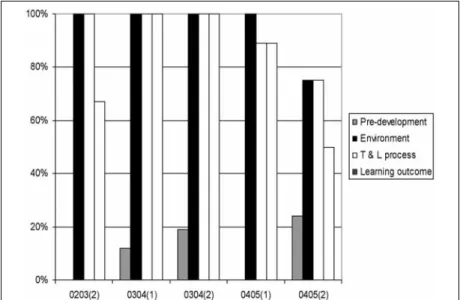
Apart from the trend of using a variety of evaluation strategies, there was also a refinement of the most commonly used strategy: the survey. First of all, the flexible nature of our evaluation process produced a range of question-naires to cater for the diverse evaluation needs of the individual cases. The questionnaire items were kept to facilitate future evaluation processes. The latest version of this question pool can be viewed at the evaluation resources section of the e3L project site at http://e3learning.edc.polyu.edu.hk/Qdb.htm We analyzed the questionnaire items used in each of the evaluation cases to show how our survey strategy underwent continuous refinement as evalu-ation experiences accumulated and the lessons learnt provided feedback back into the system. For example, as the project proceeded, more questionnaire items focused on predevelopment issues such as learners’ needs and expecta-tions of the web component. As a result the evaluation took on a more com-prehensive function which assisted the planning stage. The shift of attention to include the predevelopment aspects can be seen in Figure 2 in which the questionnaire items are classified into those that seek comments or data on the following four areas: (a) predevelopment (aspects that concern students’ needs and habits before the web development), (b) environment (concerning
Table 3
Matching Evaluation Questions With Appropriate Evaluation Strategies
Evaluation No. of Cases Cases The other
questions cases where where strategies used
recorded in with question question
evaluation plan evaluation asked tackled
question using by other
surveys strategies
No. % No. %
learning outcome: 5 0 0.0 5 100.0 content analysis of postings,
evaluate and create assignments and exams,
knowledge focus-group meetings
learning of subject- 6 1 16.7 5 83.3 assignments, lab sessions,
specific skills focus-group meetings
ability to reflect on 5 1 20.0 4 80.0 focus-group meetings
own learning
enjoyment of the 8 2 25.0 6 75.0 focus-group meetings
online activities
learning outcome: 13 4 30.8 9 69.2 content analysis of postings,
apply knowledge and assignments and exams,
analyse situations focus-group meetings
learning outcome: 20 8 40.0 12 60.0 content analysis of postings,
remember or assignments and exams,
understand concepts focus-group meetings
general feelings 25 13 52.0 12 48.0 focus-group meetings
towards e-learning
usability of the 20 12 60.0 8 40.0 user tryout sessions,
e-learning focus-group meetings
environment
general benefits 43 26 60.5 17 39.5 content analysis of postings,
to learning assignments and exams,
focus-group meetings
ideas for 40 26 65.0 14 35.0 user tryout sessions,
improvement focus-group meetings
quality of content 40 26 65.0 14 35.0 user tryout sessions,
of the e-learning focus-group meetings
environment
pattern of student 47 35 74.5 12 25.5 site logs
use during implementation
the usability and quality of the web development), (c) teaching and learning process (concerning opinions and feelings towards participating in the web activities), and (d) learning outcome (concerning benefits to learning).
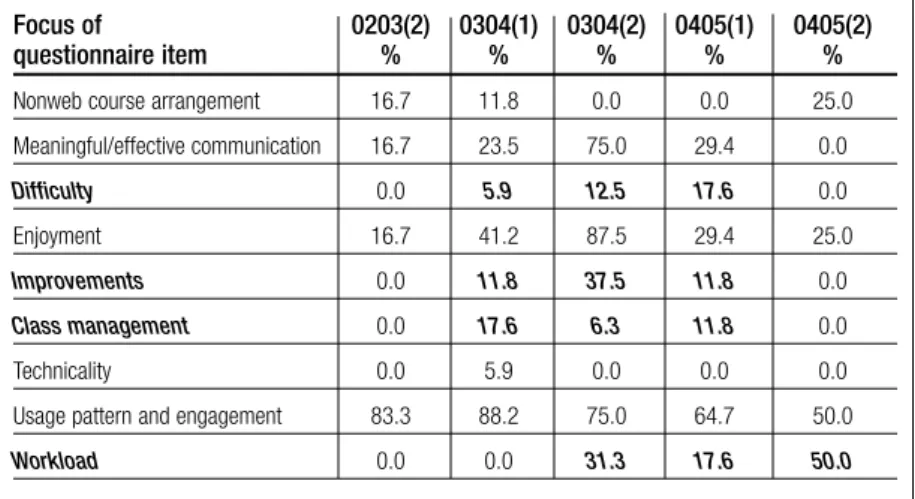
There was also a trend for the questionnaire items to become more refined and specific during the later part of the project. They were thus able to tap into feedback on more detailed subareas within each of these four main themes. For example, as Table 4 shows, questionnaire items on “diffi-culty,” “improvements,” “class management,” and “workload” gradually appeared in the later surveys of the project, allowing the evaluation strategy to obtain more detailed evidence about the teaching and learning process.
Table 5 shows a similar trend in the “learning outcome” type of question-naire items: the evaluation strategy improved progressively as new questions were used to ask about more specific areas in learning outcomes. That is, not only were we interested in the general benefits to learning which were repre-sented in surveys by questions like “Did you find the materials helpful to learn-ing?,” but we became more conscious about how to differentiate potential learning benefits: “confidence,” “generic learning skills,” “building of a sense of community,” and change to the “approaches taken to learning,” and so forth. In summary, the lessons learned through reflections on the evaluation strategies themselves can lead to enhanced processes for evaluation. We have refined our understanding of how to use a wider range of evaluation instruments and developed skills in the implementation of these strategies. For example, in the use of surveys, questions become more refined through the constant revision and reuse of previous items.
Table 4
Percentage of Questionnaire Items Concerning Various Aspects of the Teaching and Learning Process
Focus of 0203(2) 0304(1) 0304(2) 0405(1) 0405(2)
questionnaire item % % % % %
Nonweb course arrangement 16.7 11.8 0.0 0.0 25.0
Meaningful/effective communication 16.7 23.5 75.0 29.4 0.0 Difficulty 0.0 5.9 12.5 17.6 0.0 Enjoyment 16.7 41.2 87.5 29.4 25.0 Improvements 0.0 11.8 37.5 11.8 0.0 Class management 0.0 17.6 6.3 11.8 0.0 Technicality 0.0 5.9 0.0 0.0 0.0
Usage pattern and engagement 83.3 88.2 75.0 64.7 50.0
CONCLUSION
In the e-learning development cycles, evaluation contributes to improve-ment of existing materials, and the better planning, developimprove-ment, imple-mentation, and evaluation strategies of overall e-learning practice. The arti-cle has presented the details of these contributions using data from 70 sub-projects in the e3L project. Formative evaluation is able to refine e-learning planning and development before implementation. In the e3L project, there were two main areas of benefit from summative evaluation:
• first of all, it benefits planning, development, and implementation by providing feedback to teachers to improve their e-learning strategies. Our experience has shown that teachers’ use of e-learning strategies became more mature as evaluation supplied the data for reflecting on their previous practices. Teachers became more skillful in planning their evaluation strategies. Their evaluation questions also shifted from the earlier ones that were about look and feel of the materials, to the ones that focused on core issues such as the benefits to teaching and learning. • second, evaluation experiences can accumulate and be transferred into refinement of e-learning planning tactics for future requests for devel-opment and evaluation support. For example, teachers who are new to e-learning can gain e-learning ideas through papers and workshops. The
Table 5
Questionnaire Items About Different Learning Outcomess
Aspect of 0203(2) 0304(1) 0304(2) 0405(1) 0405(2)
learning outcome % % % % %
Confidence 0.0 17.6 12.5 23.5 0.0
Generic learning skills 16.7 23.5 81.3 11.8 0.0
Motivation 16.7 23.5 6.3 23.5 50.0
Preparation 0.0 5.9 18.8 5.9 25.0
Reflective learning 0.0 0.0 37.5 11.8 0.0
Relationship/sense of community 0.0 0.0 25.0 11.8 0.0
Revision of taught topic 0.0 0.0 0.0 17.6 25.0
Scope of learning 0.0 5.9 0.0 0.0 0.0
Self-study on content 16.7 11.8 37.5 5.9 0.0
Subject-specific skills 0.0 11.8 12.5 17.6 0.0
Approaches to learning/ 0.0 17.6 6.3 23.5 0.0
ePlanning matrix is one tool which we developed based on empirical data. This matrix assisted us to better understand the various web func-tions and the educational intenfunc-tions behind the various ways the Web can be used. The matrix serves as a useful tool to assist teachers in posi-tioning their e-learning strategies during the planning stage. The matrix, in the present or in a simplified format, has been used in many occa-sions of our subsequent e-learning projects with teachers. Also, apart from advances in describing e-learning strategies, our evaluation expe-riences provide the grounds for continuous refinement of the evaluation mechanism as well. For example, accurate questions have been devised to ask for the more specific aspects of the e-learning context under investigation, and evaluation instruments (such as the question pool) allow reuse of good items.
The findings illustrate the three-layer cyclic representation depicted in Figure 1. Furthermore, they clearly confirm the indispensable role evalua-tion has in e-learning development and implementaevalua-tion. We have provided an evidence base for the often-made claims that evaluation can inform teach-ing and learnteach-ing for individual teachers and also for the whole e-learnteach-ing community.
References
e3Learning. Retrieved February 26, 2008, from http://e3learning.edc.polyu.edu.hk/ James, J., McNaught, C., Csete, J., Hodgson, P., & Vogel, D. (2003). From MegaWeb to e3Learning: A model of support for university academics to effectively use the Web for teach-ing and learnteach-ing. In D. Lassner & C. McNaught (Eds.),Proceedings of ED-MEDIA 2003: 15th Annual World Conference on Educational Multimedia, Hypermedia & Telecommunications
(pp. 3303-3310). Norfolk, VA: Association for the Advancement of Computing in Education. Jones, J., & McNaught, C. (2005). Using learning object evaluation: Challenges and lessons
learned in the Hong Kong context. In G. Richards & P. Kommers (Eds.),Proceedings of ED-MEDIA 2005: 17th Annual World Conference on Educational Multimedia, Hypermedia & Telecommunications(pp. 3580-3585). Norfolk, VA: Association for the Advancement of Com-puting in Education.
Kennedy, D. M. (1998). Software development teams in higher education: An educator’s view. In R. Corderoy (Ed.),FlexibilITy: The next wave? Proceedings of the 15th Annual Australian Soci-ety for Computers in Learning in Tertiary Education ‘98 Conference(pp. 373-385). Retrieved February 26, 2008, from http://www.ascilite.org.au/conferences/wollongong98/asc98-pdf/kennedyd.pdf
Khan, J. (2005). A comprehensive e-learning model.Journal of e-Learning and Knowledge Society, 1(1). 33-43.
Lam, P., & McNaught, C. (2004). Evaluating educational websites: A system for multiple websites at multiple universities. In L. Cantoni & C. McLoughlin (Eds.),ED-MEDIA 2004: Proceedings of the 16th Annual World Conference on Educational Multimedia, Hypermedia & Telecom-munications(pp. 1066-1073). Norfolk, VA: Association for the Advancement of Computing in Education.
Lam, P., & McNaught, C. (2005). Management of an eLearning evaluation project: e3Learning. In G. Richards & P. Kommers (Eds),ED-MEDIA 2005: Proceedings of the 17th Annual World Conference on Educational Multimedia, Hypermedia & Telecommunications (pp. 2261-2268). Norfolk, VA: Association for the Advancement of Computing in Education.
Lam, P., & McNaught, C. (2006a). Design and evaluation of online courses containing media-enhanced learning materials.Educational Media International, 43(3), 199-217.
Lam, P., & McNaught, C. (2006b). Evaluating designs for web assisted peer and group assess-ment. In T. Roberts (Ed.),Self, peer, and group assessment in e-learning(pp. 210-244). Her-shey, PA: Information Science Publishing.
Lam, P., & McNaught, C. (2006c). A three-layered cyclic model of elearning development and evaluation. In E. Pearson & P. Bohman (Eds.),ED-MEDIA 2006: Proceedings of the 18th Annu-al World Conference on EducationAnnu-al Multimedia, Hypermedia & Telecommunications (pp. 1897-1904). Chesapeake VA: Association for the Advancement of Computing in Education. Lam, P., Cheng, K. F., & McNaught, C. (2005). Asynchronous online discussion: Empirical
evidence on quantity and quality. In G. Richards & P. Kommers (Eds.),ED-MEDIA 2005: Pro-ceedings of the 17th annual World Conference on Educational Multimedia, Hypermedia & Telecommunications(pp. 3209-3215). Norfolk VA: Association for the Advancement of Com-puting in Education.
Lam, P., Csete, J., & Hodgson, P. (2005). Enrichment of interaction in online assessments. In S. Frankland (Ed.),Enhancing teaching and learning through assessment: Embedded strategies
(pp. 70–79), Assessment Series, Volume 2. Hong Kong: Assessment Resource Centre, The Hong Kong Polytechnic University.
Lam, P., Csete, J., & Wong, Y. H. (2005). Online learning strategies that work: Real examples (with an emphasis on strategy planning).Disted 2005, Proceedings of the 21st Annual Conference on Distance Teaching and Learning. Retrieved February 26, 2008, from http://www.uwex.edu/ disted/conference/Resource_library/proceedings/05_1797W.pdf
Levy, P. (2003). A methodological framework for practice-based research in networked learning.
Instructional Science, 31, 787-109.
Mandinach, E. (2005). The development of effective evaluation methods for e-learning: A concept paper and action plan.Teachers College Record, 107(8), 1814-1835. Retrieved February 26, 2008, from http://www.csupomona.edu/~dolce/pdf/mandinach.pdf
McNaught, C., & Lam, P. (2005a). Building an evaluation culture and evidence base for e-learning in three Hong Kong universities.British Journal of Educational Technology, 36(4), 599-614. McNaught, C., & Lam, P. (2005b). What do teachers want to know about their student’s eLearning?
A study of 70 evaluation plans. In H. Goss (Ed.),Balance, fidelity, mobility. maintaining the momentum? Proceedings of the 22nd Annual Australasian Society for Computers in Learning in Tertiary Education 2005 Conference(pp. 433–443). Retrieved February 26, 2008, from http://www.ascilite.org.au/conferences/brisbane05/blogs/proceedings/50_McNaught.pdf McNaught, C., Lam, P., Cheng, K-F., Kennedy, D. M., & Mohan, J. B. (in press). Challenges in
employing complex eLearning strategies in campus-based universities.International Journal of Technology Enhanced Learning.
McNaught, C., Lam, P., Keing, C., & Cheng, K. F. (2006). Improving elearning support and infrastructure: An evidence-based approach. In J. O’Donoghue (Ed.),Technology supported learning and teaching: A staff perspective(pp. 70-89). Hershey, PA: Information Science Publishing.
McPherson, M. (2004).Developing innovation in online learning: An action research framework. London: RoutledgeFalmer.
Mohan, J., & Lam, P. (2005). Learning for understanding: A web-based model for inquisitive peer-review learning activities. In G. Richards & P. Kommers (Eds.),ED-MEDIA 2005: Pro-ceedings of the 17th Annual World Conference on Educational Multimedia, Hypermedia & Telecommunications(pp. 2083-2090). Norfolk, VA: Association for the Advancement of Com-puting in Education.
Nesbit, J. C., & Li, J. (2004, July). Web-based tools for learning object evaluation. Paper presented at the International Conference on Education and Information Systems: Technolo-gies and Applications, Orlando, FL. Retrieved February 26, 2008, from http://www.sfu.ca/~jzli/publications/Nesbit_Li_2004.pdf
Oliver, M. (2000). An introduction to the evaluation of learning technology.Educational Technology & Society, 3(4), 20-30. Retrieved February 26, 2008, from http://www.ifets.info/journals/3_4/ intro.html
Phillips, R. (1997).The developer’s handbook to interactive multimedia: A practical guide for educational applications. London: Kogan Page.
Reeves, T. C., & Hedberg, J. G. (2003).Interactive learning systems evaluation. Englewood Cliffs, NJ: Educational Technology Publications.
Tschirner, N., Muller, M., Pfeiffer, O., & Thomsen, C. (2006). Design and realization of multimedia-examinations for large numbers of participants in university education.International Journal of Emerging Technologies in Learning, 1(2). Retrieved February 26, 2008, from http://eprints.physik.tu-berlin.de/89/01/iJet.pdf
Acknowledgements
Funding support from the University Grants Committee in Hong Kong and the Hong Kong Polytechnic University is gratefully acknowledged, as is the collaborative support of many colleagues in the three universities asso-ciated with the e3L Project. This article is an enhanced republication of a paper presented at ED-MEDIA 2006 (Lam & McNaught, 2006c).