Traffic Scheduling in Software-defined
Backhaul Network
Hao Li
Department of Electronic and Electrical Engineering
University of Sheffield
This thesis is submitted for the approval of the
Doctor of Philosophy
I would like to dedicate this thesis and everything I do to my parents. I would not be who I am today without their love and support.
Acknowledgements
Firstly, I would like to express my sincere gratitude to my supervisor Prof. Jie Zhang for the continuous support of my PhD study and related researches, for his patience, encouragement and guidance. He always encouraged me to go deeper in interesting research topics. Besides my supervisor, I would like to thank Dr. Xiaoli Chu for her great support in my entire study. My sincere thanks also goes to Dr. Jiliang Zhang, who set a good example for me to be a researcher. His passion and earnest attitude affected me deeply. He also contributed in some collaborated works in this thesis. Without his valuable suggestions and comments, I can barely complete my researches.
A very special gratitude goes out to my girlfriend Ms. Huey Teng Koh, who have provided me emotional support in my daily life. She has always been there for me even in my difficult and trying times.
I thank my colleagues, Mr. Qi Hong, Ms. Hui Zheng, Mr. Baoling Zhang, Mr. Weijie Qi, Mr. Kan Lin, Ms. Fan Wu, Mr. Haonan Hu, Mr. Yuan Gao, and Mr. Bozhong Chen, for the stimulating discussions, for the sleepless nights we were working together before deadlines, and for all the fun we have had in the last four years. A special mention goes to Mr. Lewis Chung, Ms. Lin Chen, and Ms. Tiantian Ding, who have shared many happy memories in my leisure time.
In addition, please allow me to express my sincere appreciation to the examiners of this thesis, Prof. Zhili Sun and Dr. Petros Karadimas, for the most valuable suggestions and corrections to improve the quality of the thesis.
I would also want to send my special thanks to my faculty for all the supports throughout my studies.
Last but not the least, I would like to thank my family: my parents, my aunt and uncle, for supporting me spiritually throughout my life.
Abstract
In the past few years, severe challenges have arisen for network operators, as explosive growth and service differentiation in data demands require an increasing number of network capacity as well as dynamic traffic management. To adapt to the network densification, wireless backhaul solution is attracting more and more attentions due to its flexible deploy-ment. Meanwhile, the software-defined network (SDN) proposes an promising architecture that can achieve dynamic control and management for various functionalities. In this case, by applying the SDN architecture to wireless backhaul networks, the traffic scheduling functionality may satisfy the ever-increasing and differentiated traffic demands.
To tackle the traffic demand challenges, traffic scheduling for software-defined backhaul networks (SDBN) is investigated from three aspects in this thesis. In the first aspect, vari-ous virtual networks based on service types are embedded to the same wireless backhaul infrastructure. An algorithm, named VNE-SDBN, is proposed to solve the virtual network embedding (VNE) problem to improve the performance of the revenue of infrastructure providers and virtual network request acceptance ratio by exploiting the unique characteristics of SDBNs. In the second aspect, incoming traffic is scheduled online by joint routing and resource allocation approach in backhaul networks operated in low-frequency microwave (LFM) and those operated in millimetre wave (mmW). A digraph-based greedy algorithm (DBGA) is proposed considering the relationship between the degrees of vertices in the constructed interference digraph and system throughput with low complexity. In the third aspect, quality-of-service is provided in terms of delay and throughput with two proposed algorithms for backhaul networks with insufficient spectral resources. At last, as a trial research on E-band, a conceptual adaptive modulation system with channel estimation based on rain rate for E-band SDBN is proposed to exploit the rain attenuation feature of E-band. The results of the research works are mainly achieved through heuristic algorithms. Genetic algorithm, which is a meta-heuristic algorithm, is employed to obtain near-optimal solutions to the proposed NP-hard problems. Low complexity greedy algorithms are devel-oped based on the specific problem analysis. Finally, the evaluation of proposed systems and algorithms are performed through numerical simulations. Simulations for backhaul networks with respect to VNE, routing and resource allocation are developed.
Published
1. H. Li, J. Zhang, Q. Hong, H. Zheng, and J. Zhang, “Exploiting adaptive modula-tion in E-band software-defined backhaul network,” in2018 IEEE 8th IEEE Annual Computing and Communication Workshop and Conference(CCWC), pp. 1009-1013, 2018.
2. H. Li, J. Zhang, Q. Hong, H. Zheng, and J. Zhang, “Digraph-based joint routing and resource allocation in software-defined backhaul networks,” in2017 IEEE 22nd International Workshop on Computer Aided Modeling and Design of Communication Links and Networks (CAMAD), pp. 1-5, 2017.
3. H. Li, J. Zhang, Q. Hong, H. Zheng, and J. Zhang, “QoS-aware channel-width adapta-tion in wireless mesh networks,” in2016 IEEE International Conference on Communi-cations (ICC), pp. 1-6, 2016.
Submitted
4. H. Li, J. Zhang, and J. Zhang, “Virtual network embedding in software-defined back-haul networks,” submitted toIEEE Transactions on Network and Service Management, 2017.
Table of contents
List of Publications viii
List of figures xiii
List of tables xv
List of Abbreviations xvi
1 Introduction 1
1.1 Background and Motivation . . . 1
1.1.1 Mobile Networks . . . 1
1.1.2 Wireless Backhaul Networks . . . 3
1.1.3 Software-defined Networks . . . 5
1.1.4 Motivation . . . 6
1.2 Objectives of the Thesis . . . 7
1.3 Contributions of the Thesis . . . 8
1.4 Structure of the Thesis . . . 8
2 State of the Art and Research Challenges 11 2.1 Reviews of Virtual Network Embedding . . . 11
2.1.1 Fundamental Concepts . . . 11
2.1.2 Related Works and Discussions . . . 13
2.2 Reviews of Routing . . . 15
2.2.1 Typical Routing Metrics . . . 16
2.2.2 Routing in Wireless Backhaul Networks . . . 17
2.2.3 Related Works . . . 18
2.3 Reviews of Resource Allocation . . . 20
2.3.1 Basic Concepts . . . 20
2.3.3 Related Works . . . 22
2.4 Reviews of QoS Provisioning . . . 24
2.4.1 Main Challenges . . . 24 2.4.2 Basic Approaches . . . 25 2.4.3 Related Works . . . 26 2.5 Reviews of E-band . . . 27 2.5.1 Characteristics of E-band . . . 28 2.5.2 Related Works . . . 31 2.6 Summary . . . 33
3 Virtual Network Embedding in Software-defined Backhaul Networks 35 3.1 Introduction . . . 35
3.2 System Model and Basic Problem Statement . . . 37
3.2.1 Software-defined Backhaul Network . . . 37
3.2.2 Substrate Network Model . . . 39
3.2.3 The Virtual Network Request Model . . . 40
3.2.4 The Virtual Network Embedding Problem . . . 42
3.3 Virtual Network Embedding in Software-Defined Backhaul Networks . . . 42
3.3.1 Virtual Node Mapping . . . 42
3.3.2 Virtual Link Mapping . . . 47
3.4 The Algorithm of VNE for SDBN . . . 48
3.4.1 Node Mapping Stage . . . 48
3.4.2 Link Mapping Stage . . . 53
3.4.3 The Proposed Algorithm . . . 54
3.4.4 Time Complexity Analysis . . . 54
3.5 Performance Evaluation . . . 55
3.5.1 Caching Gain Metric Verification . . . 56
3.5.2 VNE-SDBN Performance Analysis . . . 57
3.6 Conclusions . . . 60
4 Joint Routing and Resource Allocation in Software-Defined Backhaul Networks 61 4.1 Introduction . . . 61
4.2 System Model . . . 63
4.2.1 Software-defined Backhaul Network . . . 63
4.2.2 Service-oriented Virtual Sub-network . . . 64
4.2.3 Resource Pool . . . 64
Table of contents xi
4.2.5 Link Transmission Rate . . . 66
4.2.6 System Throughput . . . 68
4.3 Joint Routing and Resource Allocation Problem . . . 68
4.3.1 Problem Formulation . . . 68
4.3.2 Genetic Algorithm (GA) Solution . . . 70
4.4 Digraph-based Joint Routing and Resource Allocation . . . 72
4.4.1 Interference Digraph Construction . . . 72
4.4.2 Problem Analysis . . . 73 4.4.3 Proposed Algorithm . . . 75 4.5 Performance Evaluation . . . 76 4.5.1 Simulation Setup . . . 76 4.5.2 Performance Analysis . . . 78 4.6 Conclusions . . . 82
5 Quality of Service Provisioning in Software-Defined Backhaul Networks 83 5.1 Introduction . . . 83
5.2 System Model . . . 84
5.2.1 Software-defined Backhaul Network . . . 85
5.2.2 Quality of Service . . . 85
5.3 Delay-aware Routing . . . 88
5.3.1 Problem Analysis . . . 88
5.3.2 Proposed Algorithm . . . 88
5.4 QoS-aware Bandwidth Allocation . . . 92
5.4.1 Problem Formulation . . . 92
5.4.2 Solutions of the Optimisation Problem . . . 94
5.5 Performance Evaluation . . . 97
5.5.1 Delay-aware Routing . . . 97
5.5.2 QoS-aware Bandwidth Allocation . . . 99
5.6 Conclusions . . . 103
6 Exploiting Adaptive Modulation in E-band Software-defined Backhaul Network105 6.1 Introduction . . . 105
6.2 Adaptive Modulation System for E-band Software-defined Backhual Networks107 6.2.1 Thresholds Development . . . 107
6.2.2 Update Frequency of Rain Rate Data . . . 109
6.3 Proposed Algorithm for the Proposed Adaptive Modulation System . . . . 111
6.4.1 E-band Backhaul Link Setup . . . 113
6.4.2 Adaptive Modulation System Setup . . . 113
6.4.3 Error Simulation . . . 113
6.5 Performance Evaluation . . . 114
6.6 Conclusions . . . 117
7 Conclusions and Future Work 118 7.1 Conclusions . . . 118
7.2 Future Work . . . 120
List of figures
1.1 Increasing base station density . . . 2
1.2 Backhaul network architecture . . . 3
1.3 Software-defined network three-layer model . . . 5
2.1 Virtual network embedding diagram . . . 12
2.2 Routing in backhaul networks . . . 18
2.3 OFDMA in backhaul networks . . . 22
2.4 Specific attenuation due to atmospheric gases [73] . . . 29
2.5 Rain attenuation versus rain rate [74] . . . 30
3.1 Software-defined backhaul network architecture . . . 38
3.2 An example of virtual network with embedded substrate network . . . 39
3.3 A scenario for virtual serving node mapping . . . 43
3.4 A scenario for virtual serving node mapping . . . 44
3.5 Schematic diagram for virtual gateway node mapping . . . 45
3.6 An example for caching gain calculation . . . 46
3.7 Clustering demonstration . . . 50
3.8 Network-level caching gain verification . . . 56
3.9 Comparison of real-time revenues . . . 58
3.10 Comparison of accumulative revenues . . . 58
3.11 Comparison of VNR acceptance ratio . . . 59
4.1 Software-defined backhaul network with resource allocation and routing module . . . 63
4.2 Protocol interference model illustration in LFM-based backhaul network . . 65
4.3 Protocol interference model illustration in mmW-based backhaul network . 66 4.4 Adaptive modulation illustration in mmW-based backhaul network . . . 67
4.5 Genetic algorithm flowchart . . . 70
4.7 Network topology . . . 78
4.8 System throughput performance in LFM-based backhaul network . . . 79
4.9 System throughput performance in mmW-based backhaul network . . . 79
4.10 Average system throughput performance in LFM-based backhaul networks 81 4.11 Average system throughput performance in mmW-based backhaul networks 81 5.1 QoS module of software-defined backhaul network . . . 86
5.2 Delay-aware routing flow chart . . . 90
5.3 Random network topology . . . 98
5.4 Statistical result of successful routings . . . 98
5.5 Performance comparison between GR-QABA and Genetic Algorithm . . . 100
5.6 Performance when traffic demand is {0.5, 1, 1.5, 2}Mb/s . . . 101
5.7 Performance when traffic demand is {1, 2, 3, 4}Mb/s . . . 102
5.8 Performance when traffic demand is {2, 4, 6, 8}Mb/s . . . 102
5.9 Performance when traffic demand is {3, 6, 9, 12}Mb/s . . . 103
6.1 System model . . . 107
6.2 Rain-rate data update time decision . . . 109
6.3 BER performance with error level = 0.5, 1, 1.5 and 2.5 respectively (5 solid lines from left to right represent ideal performances of 4-QAM, 16-QAM, 64-QAM, 256-QAM and 1024QAM; 5 dashed lines represent performance with errors correspondingly.) . . . 114
6.4 Rain rate thresholds (upper bound) in different error levels . . . 115
6.5 Link capacity versus rain rate with different error levels . . . 116
List of tables
3.1 Symbols for the virtual network embedding problem . . . 41
3.2 Symbols and definitions for caching gain calculation . . . 47
6.1 Parameters for link simulation . . . 113
BS Base Station
CSI Channel State Information
GA Genetic Algorithm
HetNet Heterogeneous Network
InP Infrastructure Provider
IoT Internet of Things
ISP Internet Service Provider
LFM Low Frequency Microwave
LOS Line-of-Sight
LT E−A Long Term Evolution Advanced
MIMO Multi-Input Multi-Output
mmW Millimetre Wave
NLOS None-Line-of-Sight
OFDM Orthogonal Frequency Division Multiplexing
OFDMA Orthogonal Frequency Division Multiple Access
P2MP Point-to-MultiPoint
List of Abbreviations xvii
QoS Quality of Service
RB Resource Block
SDBN Software-defined backhaul network
SDN Software-Defined Network
SINR Signal to Noise Ratio
SN Substrate Network
SP Service Provider
T DMA Time Division Multiple Access
U E User Equipment
V LiM Virtual Link Mapping
V N Virtual Network
V NE Virtual Network Embedding
V NoM Virtual Node Mapping
V NR Virtual Network Request
Chapter 1
Introduction
Overview
In this chapter, the background of the thesis will be introduced. From mobile networks to backhaul networks, the explosive traffic data-increment issue presents severe challenges to network operators. Service providers also demand tailored requirements from the wireless networks. Software-defined network (SDN) proposes a promising architecture to tackle these challenges. Thus, the motivation of the thesis is to investigate the traffic scheduling in wireless backhaul networks taking advantage of the SDN features. Then, the principle objectives will be proposed. Finally, the structure of the thesis will be presented together with an overview of the contributions this thesis has made.
1.1
Background and Motivation
In this section, the trends in mobile network development will be presented. Challenges and problems will be analysed generally. The necessity of wireless backhaul network and software-defined network will be explained, together with basic concepts of both aspects. The motivation for this work will also be explained.
1.1.1
Mobile Networks
Mobile phones have become an essential tool in daily life all over the world. With the development of modern phones, the features of mobile networks are not only providing voice calls but also data services like web browsing, video streaming and mobile games among other facilities. Moreover, the data services are accounting for a growing proportion of mobile phone usage. As a consequence, the last decade has witnessed an exponential increase of data demands [1]. The huge amount of data traffic has created a severe challenge
Fig. 1.1 Increasing base station density
for network operators as they aim to satisfy all services with limited spectral resources. In particular, with the development of the Internet of Things (IoT) [2], the data that goes through mobile networks is expected to continue to grow rapidly. Based on the network functions, the mobile network can be divided into two categories: the access network and the backhaul network. The access network is responsible for serving user equipments (UEs) with the base stations. The backhaul network is deployed to connect the base stations to the core network. To solve the conflicts between data demand and limited spectral resources, small cell techniques are accepted as one of the promising solutions in the access networks [3]. To relieve the pressure of macro base stations (BSs) , small cell base stations are deployed to increase the total capacity and offer better quality-of-service (QoS) . This multi-tier mobile network structure is known as heterogeneous network (HetNet) , which has been widely used around the world as an important concept in Long Term Evolution Advanced (LTE-A) . From the capacity point of view, when increasing the number of small cells that are deployed, the network capacity can be raised nearly linearly if interference is well-managed. Thus, small cell densification is leading a trend in the future generation of network planning as shown in Figure 1.1.
However, the dense deployment of small cells has created new problems. In conventional mobile networks, the base stations backhaul the traffic data to the core network through wired
1.1 Background and Motivation 3
Fig. 1.2 Backhaul network architecture
links, such as copper and fibre. The cost of deploying wired links was acceptable in early years as the number of base stations was limited. The planning of backhaul network is not an issue. However, with increasing numbers of small cell base stations being deployed, the cost and difficulty of installing wired links also rises. More importantly, with the development of small cell techniques, the requirements of small-cell base station deployment on simplicity and flexibility have been improved. Self-backhauled small-cell base stations are taking over greater proportions of the deployments, and wireless backhaul solutions are attracting increasingly more attentions from researchers and mobile network operators.
1.1.2
Wireless Backhaul Networks
The wireless backhaul network is comprised of radio links that connect the base stations to the core network. Figure 1.2 shows an example of the wireless backhaul architecture. Some principle components play important roles in the backhaul networks. The definitions of the components and related concepts are specified as follows.
Gateway
The gateway is a central aggregation point that collects the traffic from different base stations and delivers it to the core network. The gateway is installed with wired backhaul links that directly connect to the core network. In general, the capacity of the wired link is considered to be sufficient for most cases. The gateway can also improve the scalability of the network and provide control and user plane functionalities [4].
Backhaul Coverage
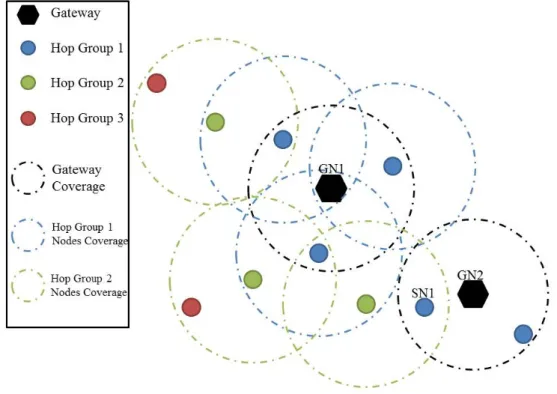
The backhaul coverage is referred to the coverage of the gateway or the relay. The coverage of the gateway is the area where the base stations can directly communicate with the gateway. The coverage of the relay is the area where the base stations have direct links connecting to the relay. Compared with the access network coverage, we can regard the gateways or relays as the base stations in the access network. The base stations in the backhaul network can be seen as the UEs in the access network.
Backhaul Topology
Multi-hop backhaul is required if a base station is not in the backhaul coverage of any gateway. The traffic data can be relayed by other base stations to reach the gateway. There may exist various relay choices for one specific base station, as it may be located in the backhaul coverage of several relays. Thus, the topology of a wireless backhaul network can be similar to wireless mesh networks due to the web-like connectivity.
Carrier Frequency
Wireless backhaul solutions can be mainly classified into two categories by carrier frequency: low frequency microwave (LFM) and millimetre wave (mmW) . Although LFM techniques have matured after years of development, the capacity that it can offer cannot guarantee to satisfy the increasing traffic demand completely. Meanwhile, mmW has the potential to deliver high capacity with large undeveloped bandwidth. However, compared to LFM, mmW has much larger atmospheric attenuation, which limits the transmission range of the link. Among different frequency bands of mmW, E-band, which is commonly referred to 71−76GHzand 81−86GHz(International Telecommunication Union stipulation), has a relatively low atmospheric attenuation, which makes a promising choice for future wireless backhaul networks.
1.1 Background and Motivation 5
Fig. 1.3 Software-defined network three-layer model
Backhaul Planning
When planning a wireless backhaul network, requirements such as capacity, latency, cover-age and availability should be strictly examined [4]. As backhaul networks are providing connections between the access networks and the core network, the backhaul performance should not limit the QoS of the access networks. Furthermore, with the trend being that backhaul units are often co-located with small cells, coverage and connectivity should be carefully designed.
1.1.3
Software-defined Networks
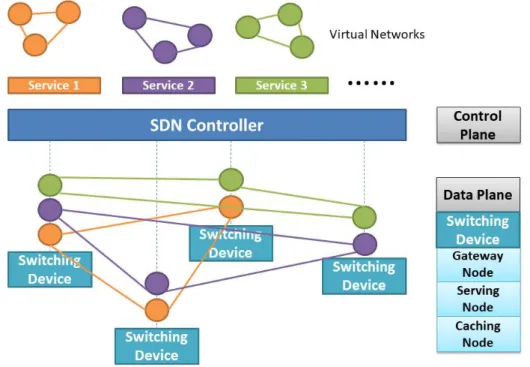
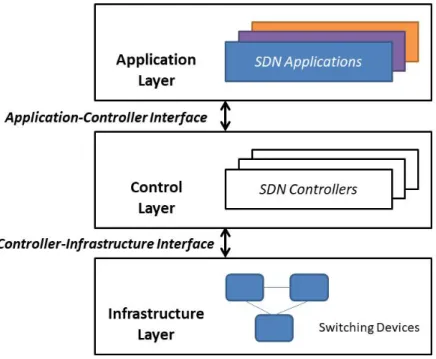
Emerging trends like network densification and service differentiation are commanding new challenges to future network architecture. Owing to its simplified and dynamic management, high flexibility and improved performance, SDN has drawn considerable attention in recent years [5–7]. The typical three-layer model of SDN is shown in Figure 1.3. By separating the control plane and the data plane, SDN can offer logical centralisation of network management over distributed switching devices and introduce programmability, which opens up new approaches to control functions in the application layer.
Control Plane
The control plane is responsible for the network management with the aid of SDN controllers. The SDN controller serves as a logically centralised intelligence in the SDN structure. Thus, the SDN controller has a global view of the entire network. Thanks to programmability [8], the SDN controller also has the ability to control the various functions in the application layer individually and dynamically. The SDN applications are programs that directly make requests and report their behaviors to SDN controller. Different functionalities can be provided with separate programmed applications, such as network protocols, network monitoring, and network reconfiguration.
Data Plane
The data plane is generally responsible for forwarding the traffic flow between switching devices based on the rules that are provided by the control plane. The switching devices are also responsible for collecting the network state information and reporting to the control plane.
Research Gaps
Many aspects of the mobile networks have been studied combining the SDN architecture. Function virtualisation has been comprehensively stated in survey [9]. Cellular networks based on SDN structure have been studied in [10]. Researches on software-defined optical networks have also been thoroughly summarized in [11]. Wireless sensor networks combining SDN have been investigated in the study conducted by [12]. From the operators’ point of view, advanced SDN has been researched in [13]. However, research works in SDN-based wireless backhaul network are rarely seen.
1.1.4
Motivation
The main function of backhaul network is to direct the traffic flow from the access network to the core network. Traffic scheduling is essential in wireless backhaul networks. In wireless backhaul networks, traffic scheduling is basically consisted of a routing strategy, resource allocation and QoS provisioning, which aims at optimising the performance of the network [14]. Nowadays, the traffic requirements from different services are becoming multifarious. For example, mobile games are strict with network latency. Video streaming is demanding large bandwidth. It is therefore a severe challenge for the backhaul network to load the tremendous amount of traffic data while satisfying various traffic demands.
1.2 Objectives of the Thesis 7
To deal with the large amount of data and tailored requirements of various services, the software-defined network architecture stands out as a promising solution due to its control and data plane separation, and programmability. By applying software-defined network architecture to wireless backhaul network, different services can be separately managed. Furthermore, the SDN controller has a global view over all the traffics flowing in the backhaul network, which means that all services in the network share all the information and can cooperate to improve the network performance while meeting their own requirements.
Thus, this thesis is mainly concerned with the traffic scheduling in software-defined backhaul networks (SDBN) . In order to satisfy various requirements from different services, network virtualization is an effective technique, which can form different virtual networks based on various service requirements. The problem of virtual network embedding (VNE) should be investigated in the SDBN. Then, to satisfy the traffic demands and improve the throughput of the network, the routing and resource allocation problem is studied in both LFM-based and mmW-based wireless backhaul networks. To guarantee the QoS of the diverse services, service delay and bandwidth allocation should be carefully handled in the backhaul network. At last, as a promising frequency band for future backhaul network, E-band has the potential to build large-capacity and high-quality backhaul links. The features of E-band can be taken advantage of to enhance the network capacity.
1.2
Objectives of the Thesis
As a result, the principal objectives of the thesis can be summarised as follows:
• To overview the current VNE, routing, resource allocation and QoS provisioning approaches in the mobile networks, discuss their applicability in SDBNs, and introduce the motivation for new approaches that are more suited for SDBNs.
•To build models for SDBNs in terms of VNE, routing, resource allocation and QoS provisioning aspects. This objective should take advantage of the SDN features to reduce the difficulty of corresponding problems.
• To propose novel algorithms that can improve the network performances for traf-fic engineering in SDBN.
•To implement the models and algorithms in a simulation tool to verify the enhanced performances in SDBN with respect to other approaches.
1.3
Contributions of the Thesis
Chapter 3: Virtual Network Embedding in Software-defined Backhaul Networks
1) The VNE problem is modelled in the SDBN. Based on backhaul network features, the virtual node mapping problem is divided into serving nodes, gateway nodes and caching nodes mapping. 2) Caching technique is considered in VNE problems. Caching gain metric for backhaul network is proposed. 3) For virtual link mapping problem, two metrics, interference properties and available resources, are proposed to evaluate the substrate link. 4) The VNE-SDBN algorithm is proposed to solve the developed problem for SDBN.
Chapter 4: Joint Routing and Resource Allocation in Software-defined Backhaul Net-works
1) Routing and resource allocation functions module is proposed for SDBN. LFM and mmW scenarios are both considered. 2) System throughput is given in two forms of equations. 3) Two cost function based on digraph are proposed to evaluate the routing process. 4) The DBGA algorithm is proposed to improve the system throughput of SDBN.
Chapter 5: Quality of Service Provisioning in Software-defined Backhaul Networks
1) QoS module for SDBN is proposed. 2) The queueing sequential order adjustment is introduced to improve the routing successful rate. 3) Delay-aware routing algorithm and QoS-aware bandwidth allocation greedy algorithm are proposed to provide QoS support.
Chapter 6: Exploiting Adaptive Modulation in E-band Software-defined Backhaul Networks
1) Adaptive modulation is introduced to enhance the capacity of networks operated in E-band, countering its rain attenuation problem. 2) Taking advantage of IoT, rain rate data based channel estimation is proposed. 3) Rain rate data update algorithm is proposed based on the Markov chain of rain rate. 4) System performance is evaluated under various error levels.
1.4
Structure of the Thesis
1.4 Structure of the Thesis 9
Chapter 2: State of the Art and Research Challenges
This chapter introduces the background knowledge and related works of VNE, routing, resource allocation, QoS provisioning and E-band characteristics. Corresponding analysis and comments are presented about the applicability in SDBNs.
Chapter 3: Virtual Network Embedding in Software-defined Backhaul Networks
The VNE problem in OFDMA-based SDBN, where caching technique is employed, is investigated. Virtual node mapping and virtual link mapping are separately modelled based on the features of SDBN. In the proposed VNE-SDBN algorithm, serving nodes and gateway nodes of the backhaul network are mapped based on location information of virtual network request (VNR) , while the caching nodes are located to maximise the caching gain of the backhaul network. For the virtual link mapping problem, interference property and available resources of links are taken into consideration. Numerical results have shown the improvements in the revenue and the VNR acceptance ratio with the proposed algorithm.
Chapter 4: Joint Routing and Resource Allocation in Software-defined Backhaul Net-works
The joint routing and resource allocation in an OFDMA-based SDBN is investigated. Based on the proposed SDBN system model, the joint routing and resource allocation problem is formulated as a ‘system throughput optimisation problem’. To solve the problem in a decomposition manner, an interference digraph was constructed. A low complexity greedy algorithm is proposed based on the indegree and outdegree of vertices in the digraph. Simu-lation results are presented comparing with benchmark genetic algorithm.
Chapter 5: Quality of Service Provisioning in Software-defined Backhaul Networks
The QoS provisioning problem in OFDMA-based SDBN is investigated. As two main QoS aspects in backhaul networks, delay and bandwidth are emphatically analysed. Delay-aware routing algorithm is proposed to guarantee various end-to-end delay requirements. A greedy algorithm for the QoS-aware bandwidth allocation problem is proposed to improve the QoS in resource-limited scenarios. Numerical results also validate the performance of the proposed algorithms.
Chapter 6: Exploiting Adaptive Modulation in E-band Software-defined Backhaul Networks
Adaptive modulation is introduced into E-band SDBN. With accurate channel model, a system model that where the rain rate data is utilised as channel estimation in the adaptive modulation scheme has been proposed. The system performance is evaluated under various error levels caused by channel model and rain rate data inaccuracy.
Chapter 7: Conclusions and Future Work
Chapter 2
State of the Art and Research Challenges
Overview
In this chapter, the topics related to traffic scheduling in software-defined backhaul networks are reviewed. Specifically, state of the art in virtual network embedding, routing, resource allocation and QoS provisioning are presented. Related works are discussed and further re-search possibilities and directions are given. The characteristics of E-band are also discussed due to its potential to establish high-capacity backhaul links.
2.1
Reviews of Virtual Network Embedding
In this section, the basic concepts and problems of virtual network embedding will be introduced. Then, the related works in this research field will be presented with comments and discussions. At last, the research gap for virtual network embedding problem in software-defined backhaul network will be pointed out.
2.1.1
Fundamental Concepts
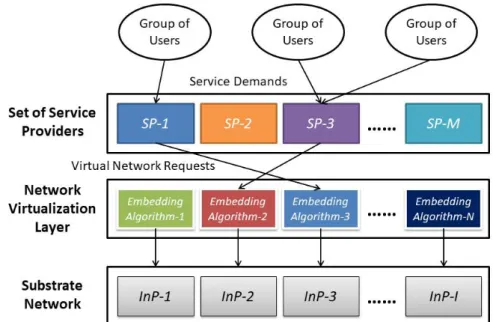
Based on the Infrastructure as a Service [15] business model, the role of the current Internet Service Provider (ISP) will be decoupled into the infrastructure provider (InP) and the service provider (SP) . InPs are responsible for deploying and maintaining the physical hardware of the network. SPs rent part of the infrastructure according to its own demands. Thus, the components and resources of the network infrastructure need to be abstracted for SPs to utilise.
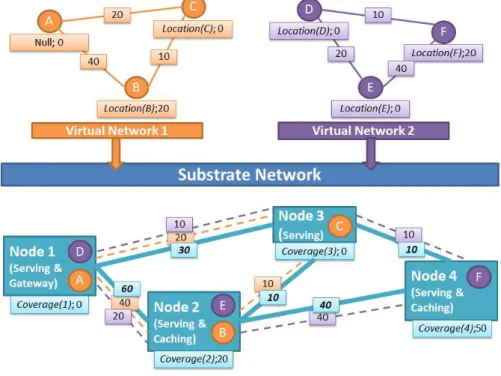
Network virtualization [16–18] has been proposed as enabling technologies for the next generation of network services. In network virtualisation, two fundamental entities are the virtual network (VN) and the substrate network (SN) . All the nodes and links in the
Fig. 2.1 Virtual network embedding diagram
network infrastructure form the SN, which is the set of physical hardware, while the VN is a combination of certain nodes and links. In VNs, virtual topologies are produced by connecting virtual nodes with virtual links according to the varying VNRs from different SPs. By embedding various VNs into the SN, different services with widely varying characteristics can co-exist in the same physical infrastructure. Fig. 2.1 shows a diagram of virtual network embedding to the substrate network.
However, the VNE problem, which is to embed various virtual networks onto the substrate network, remains a severe resource allocation challenge in network virtualisation [19]. Based on the objectives of embedding, the VNE problem can be divided into two sub-problems: virtual node mapping (VNoM) problem and virtual link mapping (VLiM) problem. In VNoM procedure, the virtual nodes are located to the substrate nodes. In VLiM procedure, the virtual links are mapped onto paths that connect the corresponding mapped substrate nodes. In both procedures, the resources of the candidate substrate nodes and links should be able to satisfy the requests of the virtual resources, where in most cases the substrate resources are partitioned to host several virtual resources of the same type.
Generally, in virtual network embedding problem, the virtual network request is modelled by node and link demands, while the substrate network consists of node and link resources. Then the embedding procedure is to satisfy the demands with resources. Once all demands
2.1 Reviews of Virtual Network Embedding 13
have been met, the virtual network embedding procedure ends with a successful solution. The VNE problem is related to the multi-way separator problem [20]. Thus, it isNP -hard to solve. If the VNoM solution has been given, the VLiM problem is reduced to the unsplittable flow problem [21, 22], which is alsoNP-hard. Thus, exact solutions for VNE only exist in problems with simple scenarios. Most of works in this research field are based on heuristic or meta-heuristic approaches [23].
VNE aims to find optimal solutions for VNoM and VLiM in consideration of single or multiple objectives. Some common objectives is listed as follows: 1) Maximise the profit of InPs; 2) Provide survivability; 3) Enhance QoS.
2.1.2
Related Works and Discussions
As an enabling technology for future Internet, the VNE area has attracted attention from many academic researchers.
A survey-based study [23] has comprehensively presented the research efforts before 2013 in the VNE area. The classification of current VNE algorithms was provided and research opportunities were discussed. The literature pointed out that solving VNE problem in wireless networks remains a challenge, as the interference caused by the broadcast nature of wireless communication needs careful consideration.
Exact solutions for VNE before 2016 was summarised in another survey-based study [24]. The formulation, implementation and performance of VNR exact solution were presented in detail. The authors pointed out that the exact solution is the foundation of heuristic and meta-heuristic solutions. However, the limit of the exact solution is conspicuous, in that it is not suitable for on-line dynamic VNE in complex scenarios.
Authors in [25] proposed that the topological attributes of neighbourhood nodes impact the performance of VNE. Based on the node degree and clustering coefficient informa-tion, VNE-DCC was proposed to enhance the resource utilisation of the substrate network. Through simulations, the proposed algorithm was verified to improve the Revenue/Cost and acceptance ratio, and the metric of node importance was also validated as a useful tool to solve VNE problems. The limitation of the work is that the authors did not consider the wireless network scenario.
Besides node capacity and link bandwidth, the location constraint was taken into consid-eration in [26]. Based on Integer Linear Programming, an exact VNE algorithm ILP-LC was proposed, which aimed at improving the acceptance ratio of VNRs. The performance of the algorithm outperformed typical heuristic algorithms by at least 15%. However, the work was based on wired VNE and the computational complexity of the algorithm was large.
re-source splitting and sharing, which means that the rere-source blocks of each substrate node/link are split and shared by multiple virtual nodes/links, was introduced. The formulation of an optimisation problem was presented and an LP-based optimal solution RBS-LP was proposed, with which higher node/link utilization was achieved. However, the work was also based on wired networks.
Authors in [28] studied the VNE problem in mobile wireless networks. Countering the mobility and migration problem of mobile user equipment, an approximation VNE algorithm BIRD-VNE was proposed. The algorithm aimed at narrowing the solution search space, avoiding backtracking while maintaining the acceptance ratio of the VNE solutions. This work takes the node mobility and link instability into consideration, which are common in mobile networks. The work made great progress towards the application of VNE to mobile networks.
The researchers in [29] also considered the VNE to support the actual user mobility in mobile networks. The impact of mobility on the performance and efficiency of the networks that applied VNE was revealed by numerical investigations. The proposed mobility aware algorithm utilised the mobility information and would take the next mobility anchor point where the user was moving towards into consideration. The work contributed to VNE re-search in the mobility aspect of the mobile network. However, this work emphasised routing and ignored the resource allocation aspect.
Survivability was mainly investigated in VNE problem in Cloud’s backbone network [30]. The authors proposed a new reactive VNE algorithm Advanced-CG-VNE based on game theory. The algorithm took advantage of reliable physical resources and would then re-embed the failed virtual resources. Both unsplittable and splittable virtual link mapping were considered. The numerical results showed the improvement of the proposed algorithm in terms of rejection rate of VNs and rate of VNs impacted by physical failures. Wired backbone was considered in this work, which is not applicable in our research objectives.
To maximise the profitability of advertisement targeting, a novel design framework for location-recommendation-aware VNE in optical-wireless hybrid networks was proposed by [31]. The interdependency among user groups was utilised to decide into which data centre the embedded virtual network should be pushed. As a result, the advisor could push the corresponding products to the user groups in the single DC. Greater energy efficiency and more profit were achieved by the proposed algorithm. The location recommendation concept can be used for reference.
Node and link mapping were solved in one-shot based on optimisation theory and path generation in [32]. The VNE solution first obtained an initial solution based on node and link coordination. Then the solution was improved in the final solution by performing pricing
2.2 Reviews of Routing 15
for the dual variables. The acceptance ratio and VNE revenue results were obtained with extensive simulations and the proposed approach performed better over other algorithms. To solve the VNE problem in the one-shot manner is innovative.
An approach to generate simulation scenarios for VNE algorithm evaluation was pro-posed in [33]. The authors also introduced concepts to control the randomness in evaluation scenarios and discussed solvable scenarios with two generation elements. This work helps researchers to evaluate the quality of VNE algorithms accurately with less time, which may be applied to the simulations in the current study.
Location-constrained virtual network embedding was investigated in [34]. The NP -completeness of the problem was proved by utilising graph bisection. Two heuristic al-gorithms were proposed based on compatibility graph to one-shot node and link mapping. Reduced time complexity, lower blocking probabilities and higher time-average revenue were provided. The location constraint can be employed in backhaul network scenario where user equipment is served by base stations located in a fixed location.
The VNE problem was studied in the integrated wireless and wired domain 5G net-work infrastructure [35]. A novel heuristic VNE algorithm was proposed based on the layered-substrate-resource auxiliary graph and six-quadrant service-type-judgement method. Compared with benchmark, the proposed algorithm performed better in average blocking rate, average latency and substrate resource efficiency. The layered network structure may be applicable for various VNs of different service types in the backhaul network.
Authors in [36] proposed a general distributed auction mechanism for VNE problem. The proposed consensus-based auctions include three procedures: discovery, virtual network mapping and allocation. The convergence and performance proved to be bounded with CAD. The auction mechanism can be applied to the competition for resources among different services. However, the work is based on distributed manner.
To conclude, many efforts have been made to solve the VNE problem in wired networks. However, the investigation into wireless networks is rarely seen. In particular, as far as we know, no work has been conducted on wireless backhaul networks considering dynamic resource allocation and interference between links. Besides, with the proposal of caching technique benefiting the backhaul network, new challenges has occurred in VNE.
2.2
Reviews of Routing
As a basic sub-problem of traffic scheduling, routing has been studied for many years in different network architectures [37]. Routing is the procedure of determining a path for traffic in networks. If more than one path exists, the best path is selected with the aid of
routing metrics. In this section, some typical routing metrics will be introduced and related works will be presented and discussed.
2.2.1
Typical Routing Metrics
Some typical routing metrics are presented in details in the following.
Hop count
Owing to its simplicity, hop count is the most widely used metric. It is based on the assumption that every link counts as one equal unit, ignoring any characteristics of the link. The least-hop routing algorithm is a straightforward implementation of this metric, which selects the path with least hop count from source to destination. If several paths all have the minimal number of hops, an arbitrary path is chosen. Widest Shortest Path [38] was proposed to deal with situation, where the path with largest bandwidth would be chosen.
Geographical Information
In ad hoc networks, usually the geographical position of nodes is assumed as known to neighbours. Such information can be used to design routing algorithms with particular applications.
Another metric known as geographical distance is also widely used, which is often combined with other metrics, as distance information is easy to acquire and has an impact on signal strength and delay. The least-distance routing algorithm is based on this metric.
Bandwidth
Bandwidth is an important metric in throughput-demanding applications [39]. The minimal available bandwidth of links in the path can indicate the route capacity that is the upper bound of the traffic throughput. Thus, selecting paths with larger bandwidths can guarantee the traffic throughput to be maximised. Sometimes, the bandwidth metric can be employed to avoid traffic congestion in the network because the available bandwidth can tell if the link is overloaded.
Traffic Load
Another metric that can help relieve the traffic congestion situation in the network is the load in links. The larger the load of one link is the more chance of traffic congestion occurring. Thus, the path with least loads on links should be selected. Load balancing can also be
2.2 Reviews of Routing 17
performed based on this metric. Moreover, sometimes higher network capacity may be achieved because the load of certain links is diverted and more traffic can be loaded through those links.
Besides the load of links, queue length is a metric that can also indicate the traffic load from the nodes perspective [40]. Each node is equipped a processor and buffer to deal with traffic packets. More traffic can be assigned to nodes with shorter queues.
Delay
The delay metric is a measurement of the transmission time for one data packet from the source node to the destination node. It is a vital metric in latency-crucial applications. This metric can also be applied to provide QoS for various services that have requirements on network delay.
Delay variation is a metric to indicate the jitter situation of paths. Applications with strict real-time restrictions (e.g. video streaming) may utilise this metric to smooth transmissions.
Survivability
In multi-path routing, survivability is an evaluation of fault tolerance of the multi-path solution if link failure occurs. This metric is usually employed to design routing algorithms to provide guaranteed transmissions.
Other Metrics
Some other metrics are also proposed in network scenarios with special interest. Transmission energy is an accepted metric in energy-efficiency networks and battery capacity is considered in wireless sensor networks [41]. Reliability is emphasised in vehicular ad hoc networks [42]. Link quality is presented to contribute to QoS management. Security is especially crucial in military networks.
2.2.2
Routing in Wireless Backhaul Networks
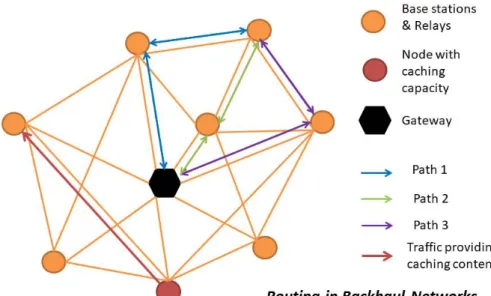
In backhaul networks, the traffic mainly goes between base stations and gateways . Within networks where caching techniques are enabled, some traffic flows may go from nodes with caching capacity to other base stations to provide caching contents, e.g. the red route shown in Fig. 2.2. With wireless connectivity, the base stations and relays can build up a mesh topology. Multiple paths may exist from one particular base station to the gateway. For example, as shown in Fig. 2.2, three possible paths between the node at the top and the
Fig. 2.2 Routing in backhaul networks
gateway are marked. Thus, routing problem needs investigation in this network topology. The backhaul network takes the responsibility to connect the access network to the core network. As the performance of the backhaul links limits the access network functionality, many metrics related to service requirements have to be considered in the routing procedure in the backhaul network. For example, bandwidth should be considered to guarantee the service throughput. The delay metric should be employed to meet the latency requirements of specific services. Moreover, the routing in the backhaul network should attach primary importance to improve the capacity of the backhaul network to satisfy the huge amount of traffics. Although interference management is more related to resource allocation, the routing should also consider the interference states between links, which may potentially impact the network capacity.
2.2.3
Related Works
A few research studies have been conducted focusing on the routing problem in the backhaul networks.
Focusing on routing and scheduling in time division multiple access (TDMA) based wireless mesh backhaul networks, the authors in [43] proposed a linear programming
opti-2.2 Reviews of Routing 19
mization to provide QoS guarantees to real-time services with unrestricted topologies. A model for performance evaluation was also developed. The numerical results showed that the proposed mechanism outperforms the least-hop routing and conventional TDMA scheduling. Bandwidth metric is also considered in this work.
In paper [44], an adaptive cross-layer routing scheme was proposed to select the most reliable path in IEEE 802.16 WiMAX based backhaul networks. Evolutionary game theory was employed to model the routing procedure. The speed of convergence of the proposed scheme was also investigated. In this work, the packet error ratio was chosen as the main metric in routing.
Routing and scheduling were investigated in [45] in wireless backhaul networks with smart antennas. Interference aware tree construction problem was defined by the authors. A routing algorithm was proposed to solve it in polynomial time with the aid of adaptive antennas that could suppress the interference with the degrees of freedom. Scheduling was also presented with both optimal algorithm and effective heuristic algorithm. Efficiencies of the algorithms were justified by simulation results. Interference metric is considered in this work.
Wireless self-backhaul was assumed in [46], where the access network and the backhaul network share the same spectral resources. To maximise the throughput of routes, mutual interference among wireless links was taken into account in the centralised joint routing and resource allocation algorithm in an ultra-dense indoor network scenario. Multi-hop self-backhaul was shown to be a viable solution with limitations on system throughput through simulations. A joint design approach was adopted in this work considering interference management.
The authors in [47] focused on employing mmW backhaul solution based on LTE archi-tecture. A method of dual connectivity establishment for heterogeneous wireless backhaul network was proposed, which enabled LFM and mmW backhaul in the same infrastructure. Additionally, a self-organised mmW multi-hop backhaul establishment procedure was pre-sented to take advantage of the bidirectional beam alignment. Dynamic routing was enabled by the flexible backhaul reconfiguration. The dual connectivity is innovative to embed mmW and dynamic routing into current broadband systems.
Time-varying routing, of which the concept is that routing changes in certain time interval to adapt to dynamic traffic loads, was investigated in mobile backhaul topologies in [48]. The benefit of time-varying routing was proven through comparison with static routing. A new metric, capacity variation, was proposed to minimise capacity waste. The approach to adapt to dynamic traffic loads can be used for reference in future design.
schedul-ing in mmW multi-hop backhaul network was studied in paper [49]. Considerschedul-ing various channel conditions and QoS requirements, the problem was formulated as a generalised vehi-cle routing problem, which is comprised of channel-aware path selection and queue-aware link scheduling. Solutions were given to achieve higher spectral efficiency and utilization. Interference and Delay metric are considered in this work.
Considering distributed caching in mobile networks, the authors proposed a novel in-RAN caches orchestration strategy was proposed in the work of [50]. Minimising content transmission delay was set as the objective in the joint wireless and backhaul routing algo-rithm. Numerical results showed that the strategy and algorithm can significantly reduce the delay and backhaul load. Delay metric is employed in this work.
An optimisation model to minimise the total power consumption in 5G HetNets with mmW backhaul was presented by [51]. User association, multi-hop backhaul routing and small cell sleeping strategy were jointly considered in the mixed integer linear problem. Simulations were performed to gain insights of the system model. Energy-based metric is utilised in this work.
To conclude, few works have been performed to improve the backhaul capacity while satisfying various traffic demands. Further research should be conducted in this direction. In addition, the interference management is important in routing procedure for wireless backhaul networks.
2.3
Reviews of Resource Allocation
Resource allocation is a fundamental problem for wireless communications. The resource in wireless domain mainly refers to spectral resource. Due to spectrum scarcity, how to optimally allocate the available spectral resources to various communication links remains a challenge.
2.3.1
Basic Concepts
The resource allocation problem mainly considers the following aspects: 1) Spectral resource model; 2) Model of resource request for traffics; 3) Mechanism of assigning and updating the resources.
The spectral resource model can vary, with diverse technologies applied. For example, with TDMA technique, the spectral resources are sliced based on time slots, while, in orthog-onal frequency division multiple access (OFDMA) systems, the spectral resources can be divided into resource blocks according to time slot and frequency sub-carriers.
2.3 Reviews of Resource Allocation 21
The resource request model of traffics can be mainly categorised into two classes: based models and throughput-based models. The resource requests in resource-based models are straightforward, consisting of a certain amount of resource units (e.g. time slots in TDMA and resource blocks in OFDMA). As the resource units can be directly put into the allocation procedure, this kind of models has advantages in allocation imple-mentation. However, the disadvantage of such requests is also obvious, in that it is hard for service providers to guarantee the data rate by requesting resource units due to various channel conditions. In the throughput-based models, the requests are given in the measure of minimum data rates. This kind of models make the allocation procedure more strict and complex because the request has to be transformed to resource units based on current channel condition and dynamic control has to be performed due to time-varying data rate per resource unit.
To accomplish the requests, a mechanism to assign the resources to various transmission links in the network should be designed based on various metrics. Several metrics are mainly considered in wireless communications: energy efficiency, throughput maximisation, fairness, robustness and QoS. The resource allocation mechanisms can vary in order to fit for the requirements in various network scenarios.
2.3.2
Resource Allocation in OFDMA-based Backhaul Networks
With the advantages of scalability, robustness to multipath, downlink multiplexing, uplink multiple access and multi-input multi-output (MIMO) benefits [52], OFDMA has been accepted as the multiple access technology for LTE, and also as an outstanding candidate for future networks. Thus, OFDMA-based backhaul network is mainly considered in this thesis. The principle of orthogonal frequency division multiplexing (OFDM) is to divide the data stream into several sub-streams that can be transmitted over different orthogonal sub-carriers. The rate and power on each sub-carrier can be individually adjusted so that OFDM can resist frequency selective fading. Moreover, any combination of sub-carriers can be accepted to transmit the data, which makes OFDM flexible for resource allocation. OFDMA extends OFDM to multiple transmission scenarios. For example, in the access networks, multiple UEs can build transmission links with the base station through OFDMA. Different UEs are assigned with different orthogonal sub-carriers to avoid interference.
By adopting OFDMA, the spectral resources can be divided into resource blocks (RBs) in time-frequency plane . RB is the smallest unit of resources that can be assigned by the network. Typically, RB is 180kHzwide in frequency and 1 slot long (0.5ms) in time. The resource request model can be resource-based or throughput-based. As the topology of backhaul network is stable, the channel conditions are relatively steady compared with the
Fig. 2.3 OFDMA in backhaul networks
access networks. Thus, both models are simpler to implement.
In multi-hop backhaul networks, the nodes may build multiple transmission links with other nodes. Thus, links are the research objects that need to be assigned with resource blocks. Throughput maximisation and QoS are the main metrics to be considered in backhaul networks. With the assumption that omnidirectional antennas are equipped to the nodes, there are two basic rules that can apply to all resource allocation mechanisms from the interference management point of view. Different outward links from the same node cannot occupy the same resource blocks. Different inward links to the same node cannot be assigned with the same resource blocks.
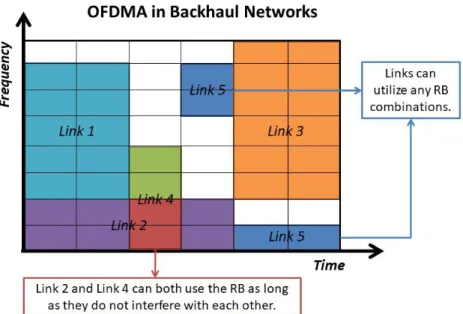
As shown in Fig. 2.3, any combination of RBs can be utilized by any link. For example, Link 5 are assigned with 4 RBs that are not adjacent. Also, the OFDMA enables the reuse of the same RB. For example, as long as Link 2 and 4 do not interfere with each other, they can utilize the same RBs.
2.3.3
Related Works
Many researches in the resource allocation area in backhaul networks have been conducted. In [53], the authors proposed a cognition based resource allocation strategy for multi-hop
2.3 Reviews of Resource Allocation 23
backhaul networks with directional antennas. A weighting factor based reinforcement learn-ing scheme was investigated to apply to interference weighted channel selection policy. As a result, the spectrum efficiency and QoS were improved. In this novel work, cognition and reinforcement learning are introduced to resource management in backhaul networks.
Resource allocation in multi-channel multi-radio wireless mesh backhaul network was investigated in [54], where physical-layer interference was concerned. A two-stage radio allocation scheme based on a game-theoretic approach was proposed to increase operative links in the network. In the proposed game, a utility function was designed to minimise co-channel interference among players. The game-theoretic approach is proven to be effective in resource management.
A mmW-based unified access and backhaul network was investigated in [55]. As the same mmW bands were shared between the radio access and backhaul networks, resource allocation problem was studied to adjust the allocated resource ratio between them. Three dynamic algorithms were developed in order to maximise the network capacity and the fairness among base stations. Network capacity is analysed from both access and backhaul perspectives in this work.
Self-backhauling and caching were introduced into resource allocation problem in ultra-dense networks in the work of [56]. To solve the resource allocation problem in the proposed network architecture, a tri-stage fairness algorithm was developed considering fairness, effi-ciency, overhead and complexity. A traffic model taking caching impact into account was also presented. Numerical results indicated that flexible resource allocation between access and backhaul link enhances performance gain. Caching technique is employed in the system model in this work.
A joint optimisation of resource allocation in wireless backhaul links and user-centric clustering in the access links was performed in [57]. To solve the problem iteratively, proper approximation and transformation were employed. The proposed scheme aimed to assign users to BSs considering the backhaul link constraint. Simulation results verified the perfor-mance of the proposed algorithm in various network settings. In this work, the novelty is that the serving BSs are dynamically assigned to users combining the backhaul network states.
E-band was employed in wireless mesh network for 5G backbone in the research con-ducted in [58]. Simultaneous transmission and reception with divergent beams was described for the system. A graph approach was proposed to distribute the time-frequency resources in the backbone links. The efficiency of the heuristic distribution algorithm was verified through simulations. Antenna technique is introduced to aid the resource management in E-band mesh networks.
wireless-optical network architecture. The scenario where two base stations belonging to different operators compete for resources in the shared optical backhaul network was in-vestigated. An evolutionary game theory based approach was designed to assign backhaul resources dynamically to base stations considering QoS and backhaul limitation. The results indicated that the system design was stable even with various time delays. The game theory that base stations competing for backhaul resources can be referenced in further backhaul resource allocation studies.
HetNets with macro-cell base station providing wireless backhaul for small cell access points were investigated in paper [60]. Massive MIMO was assumed in the macro-cell base station and the same spectrum resources were shared in the backhaul and access networks. Deterministic formulations for ergodic uplink and downlink sum rates were developed de-pending on statistical channel information. Based on the expressions, a resource allocation method was proposed to improve the system performance in terms of sum rates. The sum rates expressions are presented in the proposed system architecture, which can be further transformed to apply to other network settings.
To conclude, resource allocation problem in wireless backhaul networks still need fur-ther investigation in the scenario where backhaul network operates in exclusive frequency bands. Interference management and performance enhancement should be achieved to satisfy various service requirements.
2.4
Reviews of QoS Provisioning
The definition of quality of service may vary based on different applications. Generally speaking, QoS provisioning can be defined as satisfying the stated and implied needs of the users of the service [61], which can be achieved through cross-layer approaches. In the following, basic challenges and approaches of QoS provisioning in wireless backhaul networks will be presented and related works will be introduced with discussions.
2.4.1
Main Challenges
Implementing QoS mechanisms to wireless backhaul networks not only faces traditional challenges like interference management but also confronts unique challenges due to the speciality of the network characteristics. In this section, some of these challenges are highlighted and discussed:
2.4 Reviews of QoS Provisioning 25
Limited Resources
Until now, the mmW-based backhaul network has not been commercially available. By sharing the same spectrum with the access networks, the wireless backhaul network suffers from limited spectral resources. Even if mmW bands are utilised in the future networks, the data demand is also experiencing explosive growth. There is no guarantee that the spectral resources can completely satisfy the future traffic demand.
Dynamic Traffic
Not only the randomness of different users accessing the network from various locations but also the random time durations of various services contribute to the dynamic behaviour of the traffics in the backhaul network. Furthermore as pointed out by [62], user plane traffic from the access networks can be summarised as busy time traffic and quiet time traffic. During busy times (e.g. noon and evenings), many UEs are distributed across the whole network generating large amount of traffics. During quiet time (e.g. midnight), only a few UEs are accessing the network, which means that few traffics are required in this scenario. However, users may demand higher QoS with services like video streaming and mobile gaming. Thus, the backhaul network has to satisfy the dynamic traffics while providing diversified QoS requirements.
Heterogeneous Traffic
The diversification of applications in mobile phones is pushing the service differentiation. Various services have different requirements on network performances. Especially in 5G networks, all kinds of functions need to be supported in the same architecture. For example, mission-critical communications have a steep demand on reliability and resilience. Autopilot systems cannot tolerate delays in vehicular communications. To satisfy the heterogeneous traffics, the backhaul networks have to support differentiated QoS.
2.4.2
Basic Approaches
QoS provisioning is a complex cross-layer function, which requires several QoS management components to collaborate. The QoS management components include routing, spectral resource allocation, transmission power control among others. QoS metrics, such as through-put, delay, packet loss rate, packet error rate and reliability should be optimised according to service requirements.
global offline QoS networking and greedy online QoS networking [63].
Global offline QoS networking jointly considers all QoS management components to find a global optimal QoS solution for all current traffic flows in the network. This approach typically employs optimisation tools, such as integer or mixed integer programs, within which computational complexity may be very high.
Greedy online QoS networking aims to find a local optimal QoS solution for incoming traffic flows while maintaining the QoS of current traffic flows in the network. In this approach, the estimated QoS metric values of different components are required prior to decision making. This approach is more suitable for dynamic networks.
In wireless backhaul networks, the transmission links are stable due to the stationary topology of the backhaul nodes. Thus, transmission parameters in the nodes are config-ured with appropriate values, which mean that the physical layer of QoS is not a concern. Therefore, delay and throughput are two main metrics to consider in wireless backhaul QoS provisioning.
2.4.3
Related Works
Few works have been conducted that focus on QoS provisioning for backhaul networks, although different QoS metrics have been considered in the related works.
The work performed by [64] addressed both throughput and delay requirements in multi-hop wireless backhaul networks. Several admission control schemes were developed to guarantee the requirements of admitted connections. In the proposed algorithm, a tree-based topology was constructed and then the subset of connections that satisfy the QoS metric was selected. The topology construction and the subset selection are novel approaches to deal with admission control in backhaul networks.
The QoS problem was investigated through routing and scheduling in TDMA-based wireless mesh backhaul networks in study [43]. By integrating the routing and scheduling procedure, the authors proposed an algorithm to provide throughput and delay guarantees for real-time services. Linear programming was employed to assign non-collision bandwidth for the selected path. Minimal-hop routing was outperformed by the proposed scheme. Throughput, delay and interference management are jointly considered in this work.
By studying the scheduling of traffic flows and channel assignment, the authors in [65] proposed a recursive fair stochastic matrix decomposition algorithm and a constrained graph colouring algorithm to support QoS on a per-flow basis in wireless mesh backhaul networks. Beamforming was also employed to guarantee the transmission rate and minimise the signal to noise ratio (SINR) . Near-minimal delay and jitter were achieved while satisfying the throughput requirements with the proposed algorithm. However, the network model in this
2.5 Reviews of E-band 27
work is simplistic.
A wireless backhaul business case was studied in [66]. To achieve low cost and low power, a novel carrier-grade heterogeneous multi-radio backhaul architecture was developed. Various functions were described including topology, capacity, pipe management, terminal control and QoS-aware LANE emulation functions. Measurements were conducted to verity the proposed system. Fairness and predictability are considered as the QoS metric in this work.
To confront the unfairness problem in chain-based wireless backhaul networks, a two-level QoS scheduler was proposed by adopting the Ripple protocol. A queueing model was developed to analyse the mean delay, throughput in the network. Multiple-class traffics were supported by the proposed QoS scheduler. Mean delay, end-to-end throughput and aggregated throughput are guaranteed to provide QoS for various traffic classes.
Combining SDN and existing LTE architecture, three OpenFlow-based mechanisms were proposed to provide the required QoS in research conducted in [68]. Traffic routing, admission control and traffic coexistence mechanism were separately designed to improve the QoS in the infrastructure by controlling the bandwidth usage. Numerical results validated the performance improvement in terms of throughput, delay, jitter and packet loss. This work introduced the SDN protocol into QoS provisioning for future researches.
To reduce the end-to-end delay of high priority packets in mobile backhaul networks, packet priority scheduling was investigated in [69]. The proposed algorithm utilised dynamic packet reordering and scheduling to support QoS. The concept of priority and queue reorder-ing can be referenced in further researches.
To conclude, throughput and delay are two main QoS metrics to consider in wireless backhaul networks. However, works that focus on satisfying diverse QoS requirements for various services are rarely seen. Especially when the network has insufficient spectral resources to satisfy all traffic demands, the QoS provisioning remains a challenge. Further researches are required to improve the QoS management in wireless backhaul networks.
2.5
Reviews of E-band
As a potential candidate for future backhaul networks, E-band frequency has unique charac-teristics that can be utilised for system designs. In this section, the features of E-band are reviewed and related works are also presented.
2.5.1
Characteristics of E-band
Compared to lower frequency bands, E-band signals can only transmit in shorter range and cannot penetrate physical obstructions very well. These characteristics should not be treated as disadvantages. On the contrary, benefits can be obtained with proper network designs. The characteristics of E-band are discussed in the following sub-sections.
Propagation Features of E-band
With the assumption that the transmission link is line-of-sight (LOS) and the antennas are omnidirectional, the path gain of the link with free space propagation can be formulated as:
G=GTGR
λ2
(4πD)2
(2.1)
WhereGT andGR are the gains of transmitter and receiver antennas respectively,λ is the
signal wavelength and D is the link distance [70]. It can be concluded from Eq. (2.1) that with givenGT,GR andD, the path gain is decided byλ. As the signal wavelength in
E-band is much smaller than that of low frequency microwave bands, E-band transmission is experiencing less gain. Thus, omnidirectional antennas are not fit for E-band transmissions. Directional antenna, which is made up of a number of antennas to form a “pencil beam”, is one approach to counter the addressed problem. In E-band, it is much easier to apply directional antennas because the space between antennas to form an equivalent directional beam is scaled down with the wavelength size.
Free space propagation only exists with LOS guaranteed and no obstacles around. How-ever, the application scenario of E-band links is mainly located in urban area, where buildings and trees may block or reflect the signals. Penetration, absorption, diffraction, reflection and diffusion are phenomena that would happen in such cases. The wavelength of E-band signal is the main factor that influences all these phenomena. The penetration ability of E-band signal is extremely poor [71]. Due to the millimetre level wavelength, E-band signal is difficult to diffract when encountering obstacles. Speaking of multipath, besides the absorption part by the materials the reflection part is much smaller compared to low frequency microwave because greater diffusion would arise for E-band signal with small wavelength due to the r
![Fig. 2.5 Rain attenuation versus rain rate [74]](https://thumb-us.123doks.com/thumbv2/123dok_us/62918.2507347/48.892.178.685.157.573/fig-rain-attenuation-versus-rain-rate.webp)