Proceedings of the International Workshop on
User Profile Data on the
Social Semantic Web
(UWeb)
co-located with 8th Extended Semantic Web Conference
May 30, 2011, Heraklion, Crete, Greece
Editors:
Fabian Abel
1, Qi Gao
1, Eelco Herder
2,
Geert-Jan Houben
1, Daniel Olmedilla
3, Alexandre
Passant
41 Web Information Systems, Delft University of Technology Mekelweg 4, 2628 Delft, the Netherlands
{f.abel,q.gao,g.j.p.m.houben}@tudelft.nl
2 L3S Research Center, Leibniz University Hannover, Germany
3 Telefonica R&D, Spain
4 Digital Enterprise Research Institute, National University of Ireland, Ireland
Table of Contents
Preface . . . i F. Abel, Q. Gao, E. Herder, G.-J. Houben, D. Olmedilla, A.
Passant
Ambiguity in Tagging and the Community Effect in Searching
Relevant Resources in Folksonomies . . . ii S. Beldjoudi, H. Seridi, C. Faron-Zucker
Sensing Presence (PreSense) Ontology User Modelling in the
Semantic Sensor Web. . . iii A.E. Cano, A.-S. Dadzie, V.S. Uren, F. Ciravegna
Semantic Social Profile – a Semantic Boost for the Social
Information in MediaWiki . . . iv Y. Katkov, D. Pokoptsev
Forecasting Audience Increase on YouTube . . . v M. Rowe
TUMS: Twitter-based User Modeling Service. . . vi K. Tao, F. Abel, Q. Gao, G.-J. Houben
UWeb Workshop Proceedings i
Preface
Social Web sites, such as Facebook, YouTube, Delicious, Flickr and Wikipedia, and numerous other Web applications, such as Google and Amazon, rely on implicitly or explicitly collected data about their users and their activities to provide personalized content and services. As these applications become more and more connected, a major challenge is to allow various applications to ex-change, reuse, and integrate user data from different sources. The amount of user data available on the Web is tremendously growing and reasoning on such heterogeneous user data distributed across the Web, i.e. exploiting user data on the Web, is a non-trivial problem that poses several challenges to the Semantic Web community.
While the linking of user data provides advantages for recommendation and personalization, it also raises questions related to provenance, trust and privacy: how does one know that the data gathered from several sources can be trusted, and how can one avoid that sensitive personal data is disclosed to certain ser-vices or used to infer and expose sensitive information? Trust and privacy, and associated policies, may therefore impact reasoning on user data.
The UWeb workshop5discusses research on user data in the Social Semantic Web from both angles:
– techniques and applications for linking, reusing and reasoning about user data, as well as
– trust and privacy techniques and their impact on society.
UWeb joins the SPOT6 and LUPAS7workshops from ESWC 2010 and pro-vides a forum for academic and industrial researchers and practitioners in the fields of the Social and Semantic Web, trust, privacy, user modeling, and per-sonalization to discuss theoretical and practical knowledge, open research issues, applications, and experiences.
We thank the members of the Program Committee of UWeb 2011 for their support and reviews. Furthermore, we are grateful to all authors who submitted articles to UWeb and contributed with their works to the UWeb workshop.
Fabian Abel Qi Gao
Eelco Herder Geert-Jan Houben Daniel Olmedilla Alexandre Passant UWeb Organizing Committee, May 2011
5 http://wis.ewi.tudelft.nl/uweb2011/ 6 http://spot.semanticweb.org/
ii UWeb Workshop Proceedings
Ambiguity in Tagging and the Community Effect in
Researching Relevant Resources in Folksonomies
Ambiguity in Tagging and the Community Effect in
Researching Relevant Resources in Folksonomies
Samia Beldjoudi1, Hassina Seridi1, Catherine Faron-Zucker2, 1 Laboratory of Electronic Document Management LabGED, Badji Mokhtar University,
Annaba, Algeria 2
I3S, University of Nice Sophia Antipolis - CNRS, France 1
{seridi,Beldjoudi}@labged.net 2
Abstract. In this paper we present an original approach to improve the search
of web resources tagged with folksonomies. We argue that the semantics in folksonomies can be extracted from the force of the community effect and the social interactions between the members of a community. Our approach called SSF for Semantic Social Folksonomy tackle the problem of ambiguity between tags by considering user profiles and social interactions in folksonomies to reduce tags ambiguity.
Keywords: Folksonomies, Web 2.0, Semantic Web, Social Interactions, Tag
Ambiguity.
1 Introduction
Before the revolution of Web 2.0, the creation of keywords or metadata associated to web resources was realized by the professionals of a domain in order to clearly specify its data. Therefore the cost in time and effort was too exaggerated. With the advent of the so called Social Web, users are allowed to create their own keywords which are known as tags and to tag web resources. The term folksonomy has appeared on the web to designate a new technology based on the triple (the User, the Tag and the Resource), where the user is an actor in the system, the tag designates the keyword proposed by the user and the resource indicates the object that will be annotated by the user with the tag. According to Wikipedia a folksonomy is a system of classification derived from the practice and method of collaboratively creating and managing tags to annotate and categorize content. For instance, delicious1 is one of the most famous such websites, based on folksonomies, which allow users to publish, tag and share resources. It represents an effective way to collaboratively manage bookmarks: it enables each user to add sites to his personal collection of links, to categorize those sites with tags, and to share them with other users. Folksonomies are used to tag any kind of multimedia web resources: Flickr2 is a photo management and
1 http://del.icio.us
sharing web application; youtube3 and dailymotion4 are dedicated to the sharing of videos; myspace5 and Odeo6 to the sharing of music files.
These social practices continue every day to gain popularity. However, the use of folksonomies for finding information on the web poses some problems, among which the problem of tags ambiguity: a tag can designate several concepts, i.e. can have several meanings. For example when a user employs the tag "orange" to annotate a resource, the system will not understand whether he is talking about the "color" orange or the "fruit" orange. A related problem comes from the variations in writing the same concept. For instance, "cat" and "chat" both means the same concept (animal) in English and in French, but when a user searches resources annotated with the tag "cat", the system will not offer him those tagged with the word "chat" because it cannot understand that the tag "cat" is equivalent to the tag "chat". In addition, the tags that are freely chosen in these systems are likely to contain spelling errors and therefore make the retrieval of resources more doubtful than the metadata recovering from a lexicon examined by the professionals of information.
In this paper we present an original approach to improve the search of web resources tagged with folksonomies. We argue that the semantics in folksonomies can be extracted from the force of the community effect and the social interactions between the members of a community. Our approach called SSF for Semantic Social Folksonomy tackle the problem of tags ambiguity by considering user profiles and social interactions in folksonomies. More precisely, we intend to propose each user resources relevant to his profile in the folksonomy even when he uses ambiguous tags. The key of our approach is the similarities between the community’s members. Our paper is organized as follows: Section 2 presents an overview of the major contributions in this field. The design of our approach is presented in Section 3. In Section 4 the experimental phase is in order to measure the performance of our approach and also the obtained results are discussed. We conclude in Section 5.
2 Related Works
Despite the relative newness of folksonomies, there already are a lot of works in this domain; each one trying to resolve a specific problem. Most of these contributions are balanced between searching semantic relationships among folksonomy’s terms, and helping users choosing appropriate terms when annotating their resources for increasing the weights associated to each tag. In this paper, we focus our state on the art on both the works relative to the reduction of the ambiguity of terms in folksonomies and those on the extraction of semantic links between terms in a folksonomy.
Mika [8] proposed to extend the traditional bipartite model of ontologies to a tripartite one: that of folksonomies, where instances are keywords used by the actors of the system in order to annotate web resources. In this article, Mika focuses on
3 http://www.youtube.com
4 http://www.dailymotion.com 5 http://www.myspace.com 6 http://odeo.com
social network analysis in order to extract lightweight ontologies and, the exploitation of the strength of these ontologies in order to explicit semantics between the terms used by the users (actors).
In another work, Gruber [4] argued that there is no contrast between ontologies and folksonomies, and therefore recommended to build an "ontology of folksonomy". According to Gruber, the problem of the lack of semantic links between terms in folksonomies can be easily resolved by representing folksonomies by ontologies.
Specia and Motta [11] in their turn have preferred the use of ontologies to extract the semantics of tags. Their approach consists in building tags clusters, and then trying to identify the possible relationships between tags in each cluster. The authors have chosen to use ontologies available on the semantic web in order to express the correlations which can exist between tags. A more detailed attempt to mechanize this method is described in [1].
In the same trends; Buffa et al. [2] presented a semantic web application baptized SweetWiki reconciling two trends of the web: a semantically augmented web and a web of social applications where every user is an active provider as well as a consumer of information. The goal here is to exploit ontologies and semantic web models to improve the notion of social tagging. According to the authors, tagging remains easy and becomes both motivating and unambiguous.
The niceTag project of Limpens et al. [5] is focused on this same principle: the use of ontologies to extract semantic links existing between tags in a system. In addition, this project has introduced the idea of exploiting interactions between users and the system to validate or invalidate automatic treatments carried out based on tags. The authors have proposed methods to build lightweight ontologies that can be used to suggest terms semantically close during the search of documents guided by tags.
Pan et al. [9] aimed at reducing the problem of ambiguity in tagging. They proposed to extend the search of tags in afolksonomy by using ontologies. They defended this principle of extension of the search in order to avoid bothering the users with the rigidity of ontologies. More precisely, they concatenated ambiguous terms with other ones in order to increase the precision of the results of a keyword-based search.
Scott and Hubermann [10] analyzed the structure of collaborative tagging systems as well as their dynamic aspects. Specifically, they discovered regularities in user activity, tag frequencies, kinds of tags used, bursts of popularity in bookmarking and a remarkable stability in the relative proportions of tags within a given URL. They also discussed why it is difficult to retrieve contents (which in our case play the role of resources) in a folksonomy. In particular they highlighted some problems like synonymy and polysemy.
Markines at al. [6] discussed how to extend and adapt traditional notions of similarity to folksonomies, and which measures are best suited for applications such as navigation support, semantic search, and ontology learning. The authors builded an evaluation framework to compare various general folksonomy-based similarity measures derived from established information-theoretic, statistical, and practical measures.
We also investigated the works relative to the recommendation of relevant resources. De Meo et al. [3] proposed to recommend a set of resources to enrich user profiles, a user profile being represented by the list of tags involved in his query. They
expand queries to recommend resources to users performing a keyword-based search; in order to enhance their profiles. A user query is enriched with tags discovered through the exploration of the two graphs TRG (Tag Resource Graph) and TUG (Tag User Graph). According to the authors, this enrichment improves both the strategy of recommender systems and that of collaborative filtering and content-based filtering systems.
To sum up, most of the works relative to folksonomies aim to bring together ontologies and folksonomies as a solution to the tags’ ambiguity problem and that of the lack of semantic links between tags. The approaches summerized in this section showed that the social nature of resources sharing is not in contradiction with the possibilities offered by ontology-based systems. But the rigidity which characterizes ontologies and the need of an expert who must control and organize links between terms as in [4] seems a little cumbersome and too much expensive. Even the structures extracted automatically as in [8] still suffer from the ambiguity of concepts. Regarding the work of [11], the use of semantic web ontologies for extracting relationships between terms is not sufficient, because the semantic web does not include enough specific domain ontologies and this will push the problem further. Also the expertise of users which was introduced in [5] is characterized by the complexity of its exploitation when we try as much as possible to avoid a cognitive overload, to limit the necessary effort for the formalization of this expertise.
Based on these observations, we propose an original approach which avoids the explicit use of ontologies.
3 The Semantic Social Folksonomy Approach
Our approach is to introduce both semantics and social aspects in forlksonomies in order to enable the user to retrieve relevant web resources tagged by the members of his community and close to his preferences. For this purpose, we propose to measure the similarity between the members of a community and to compare their preferences. Our goal is to provide a flexible method to reduce the problem of tags ambiguity and the lack of semantic relationships between terms in folksonomies, based on the similarities between users.
The innovative aspect of our approach is that it enables to surmount the lack of semantic relationships between tags and to suggest the user web resources close to his preferences when he performs a tag-based search. We assign to each suggested resource a degree of recommendation 'strongly recommended', 'recommended' or 'weakly recommended ' depending on the degree of similarity among users.
Let us note that our approach comes with a new point of view on folksonomies. The 'display’s instability' of folksonomies is a corrolary to the fact that the results of a search procedure vary depending on the interests of each user. Moreover we answer the problem of ambiguity in tagging by retrieving resources depending on their similarity with user profiles.
Example 1. o better explain our approach, let us consider the following example (Table 1) where three users are each represented by a list of tags:
Table 1: A set of users with their tags
Users Tags
U1 computer, java, folksonomies, programming.
U2 apple, fruit, strawberry, kitchen.
U3 computer, apple, software.
Let us suppose that user U1 wants to retrieve resources relative to the word (i.e. the tag) 'apple'. In the current folksonomies, the output result will contain all the resources tagged with the 'apple' i.e. those relative to food and computer, despite the fact that it is clear for a human reading U1’s tags, that his preferences are relative to computer and not to food. This can be summarized in the following table (Table 2):
Table 2: The key points of our approach: problem, assumption solution
Problem Lack of semantic links between tags leading to a problem of ambiguity: a tag can refer to several concepts, i.e., a tag can have several meanings.
Hypothesis Two resources tagged with the same term (tag) are similar, if they are used by users who share similar interests or similar tags7
Solution Measure the similarity between users, to specify those who have similar preferences.
To make the system flexible, we propose to make it interact with the user to accept or reject the retrieved resources.
To avoid the "cold start" problem which generally results from a lack of data required by the system in order to make good quality recommendation, we propose to measure the similarity between resources when there are no similar users.
• Example 2. Let us now consider the following situation described in Table 3:
Table 3: A second set of users with their tags
Users Tags
U1 computer, java, folksonomies, programming.
U2 apple, fruit, strawberry, kitchen.
U3 computer, apple, software.
U4 apple.
7 Of course the degree of similarity between two resources will differ according to the number of the common tags between them.
If user U1 searches resources tagged with 'apple'; our system will first propose him the resource corresponding to tag 'apple' which is used by the user U3 with a 'very strong' level of recommendation because the two users U1 and U3 have similar preferences.
On the contrary the resources corresponding to the tag 'apple' which is used by user U2 will be given to U1 with a percentage 'low' level of recommendation because U1 and U3 do not share the same interests.
Now how should the system answer U4 for whom it does not have much information about his interests? For such cases, we propose to measure the similarity between the resources corresponding to the tag 'apple' which is used by U4 and the resources already proposed to U1 with a high percentage i.e. those of U3,. If the resources are similar, the system will propose them to U1 with a 'very strong' level of recommendation, otherwise with a 'low' level of recommendation.
3.1 Formal description of the approach SSF
In this section we explain how the folksonomy is represented and how the community members, resources, and tags are exposed, how the relationships between these three elements are symbolized and how the system can recommend the best resources to each user according to his profile in the folksonomy.
Formally, a folksonomy is a tuple F = <U, T, R, A> where U, T, R represent respectively the set of users, tags and resources. A represents the relationship between the three preceding elements (i.e. A ⊆ U x T x R). In this approach a folksonomy is considered as a tripartite model where the instances are a web resources associated by user to a list of tags. So we can extract a tripartite hypergraph with three types of vertices which are tags, users and resources. However working with this kind of graphs is in general not easy to understand. Thus, we have preferred to extract three bipartite graphs with three social networks 'tag_user', 'tag_ressource' and 'user_ressource' from the folksonomy as in [7]. These three graphs are represented as follow:
-TU = <vertices, edges> noting that:
• Vertices = T U where T = {t1, t2, ..., tn} is the set of tags and U = {u1, u2, ..., um} is the set of users.
• Edges = {t, u} represents the set of links between the different vertices. -TR = <vertices, edges> noting that:
• Vertices = T R where T = {t1, t2, ..., tn} is the set of tags and R = {r1, r2, ..., rk} is the set of resources.
• Edges = {t, r} represents the set of links between the different vertices. -UR = <vertices, edges> noting that:
• Vertices = U R where U = {u1, u2, ..., um} is the set of users and R = {r1, r2, ..., rk} is the set of resources.
• Edges = {u, r} represents the set of links between the different vertices. For better representation, the three graphs formalization is represented by a matrix form as follows:
-TU= [Xij] where Xij = 1 if there is an edge between the tag i and the user j
0 otherwise
-TR= [Yij] where Yij = 1 if there is an edge between the tag i and the resource j
0 otherwise
-UR= [Zij] where Zij = 1 if there is an edge between the user i and the resource j
0 otherwise
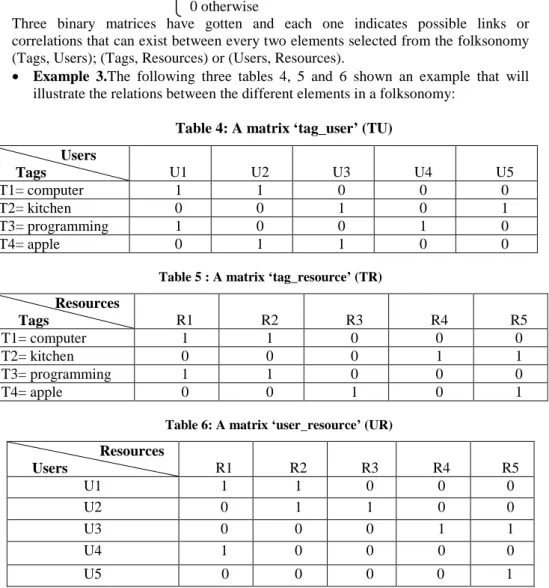
Three binary matrices have gotten and each one indicates possible links or correlations that can exist between every two elements selected from the folksonomy (Tags, Users); (Tags, Resources) or (Users, Resources).
• Example 3.The following three tables 4, 5 and 6 shown an example that will illustrate the relations between the different elements in a folksonomy:
Table 4: A matrix ‘tag_user’ (TU) Users Tags U1 U2 U3 U4 U5 T1= computer 1 1 0 0 0 T2= kitchen 0 0 1 0 1 T3= programming 1 0 0 1 0 T4= apple 0 1 1 0 0
Table 5 : A matrix ‘tag_resource’ (TR)
Resources Tags R1 R2 R3 R4 R5 T1= computer 1 1 0 0 0 T2= kitchen 0 0 0 1 1 T3= programming 1 1 0 0 0 T4= apple 0 0 1 0 1
Table 6: A matrix ‘user_resource’ (UR)
Resources Users R1 R2 R3 R4 R5 U1 1 1 0 0 0 U2 0 1 1 0 0 U3 0 0 0 1 1 U4 1 0 0 0 0 U5 0 0 0 0 1
Noting that; the profile of each user has been represented by the list of his tags or his resources in the folksonomy.
• Example 4. From the Example 3 (Table 4), the following profiles are found:
Table 7: A table shows the users’ profiles in the form of tags
Users Profiles Tags
Profile U1 computer, programming.
Profile U2 computer, apple.
Profile U3 cooking, apple.
Profile U4 programming.
Profile U5 kitchen.
3.2 The similarities between users
For the similarity between users computing, we suggest to use a measure that allows representing each user by a vector vi designates a series of binary numbers defining the set of his tags or his resources. Thus, calculating the similarity between two users, for example u1 and u2, is using the cosines of the angle between their associated vectors v1 and v2 as shown in the formula (1):
, .
(1)
The vectors corresponding to each user are computing by using two matrixes: UR x RU and UT x TU must be calculated. Where:
-RU is the transposed matrix of UR. -UT is the transposed matrix of TU.
3.3 The similarities between resources
When users are not similar, we suggest measuring the similarity degree between resources in order to avoid “cold start” problem. And for that we suggest calculating the matrix resource = RT x TR. Where: RT is the transposed matrix of TR.
3.4 The search procedure
In the Figure 1 which is presented below, an activity diagram that will illustrate the search’s procedure followed by our approach is introduced:
As it’s shown in this Activity Diagram, the Levenshtein distance8 is being used when the tag is not found in the folksonomy in order to measure the edit distance between
8 By following the example of [10] and [5]
tags in the system, this allows our system to detect spelling variations and so it can offer to user presumably equivalent tags.
Example 5. In Table 8, there are some examples for the Levenshtein distance:
Table 8: Levenshtein Distance for some couples of tags
Tag1 Tag2 Distance of Levenshtein
Oracle Orakle 0.83
User Users 0.80
Stic2010 Stic-2010 0.88
Cat Chat 0.75
For each resource recommended by the system a factor is proposed to indicate the percentage of its recommendation, i.e. the resource is 'highly recommended', 'recommended' or 'weakly recommended'. To achieve this classification, we have proposed to calculate the ratio between the number of resources used by the user himself (i.e. the one who does the research) and the number of shared resources between him and the others users. It must first select a threshold S ∈ [0, 1] to schedule the results. Where for each recommended resource, the following steps are performed:
1. Calculate _
_ (2)
>= S then the resource is highly recommended
2. If _
_ < S then the resource is recommended
= 0 then calculate the similarity between resource
• Example 6. In table 9 the symmetric matrix User = UR x RU is represented:
Table 9: A symmetric matrix User =UR x RU
User User U1 U2 U3 U4 U5 U1 2 1 0 0 0 U2 1 2 0 1 0 U3 0 0 2 0 1 U4 0 1 0 1 0 U5 0 0 1 0 1
In this matrix; for each user we have a vector as shown in Table 10:
Table 10: The correspondence between each user and his vector
User Vector U1 2,1,0,0,0 U2 1,2,0,1,0 U3 $ 0,0,2,0,1 U4 % 0,1,0,1,0 U5 & 0,0,1,0,1
For a threshold S = 0.5 for example. Supposing that after the similarity between users computing, the system provides the resource R3 used by the user U2 and which is annotated by the tag 'apple' to user U1. Noting in Table 8 that the resource number used by user U1 is equal to 2, and the number of shared resources between the user U1 and the user U2 is equal to 1, so:
'(
'(
1 2 0.5
Having _
_ S , and the resource is highly recommended.
4 Experiment
This section describes the used Dataset in the experiment and its treatment’s method in order to fully understanding the given results. But first it should be noted that the experiment aim is to satisfy users when a research by keywords is done within folksonomies by offering them pertinent resources even in the presence of ambiguous tags. For this, we followed the steps described below:
4.1 Data Set
The dataset used in the test phase is described in this section followed by some analysis and discussion of the obtained results. The database of the website del.icio.us has been employed in this experiment representing the most used dataset for overall conducted experiments in folksonomies. Noting that we have selected a random set of data (i.e. a random sets of users, tags and resources) to well demonstrate the validity of our proposal. To fully shown the validity of SSF, two classes of users are randomly chosen: the first one contains the users who employed ambiguous tags and the second contains those who don’t use these words but who can get them in the future. The users’ number is equal to 21. For the set of tags used in this experiment we selected 97 different ones, among them there are some tags which are ambiguous. The used resources number is equal to 92; every resource can have multiple tags, and even multiple users. And in total we have 207 tag assignments. The table 11 summarizes the information about the data sample used in this experiment:
Table 11: The correspondent value for every element in the data sample
Nb tags Nb users Nb resources Nb tag assignments Delicious dataset 97 21 92 207 4.2 Data treatment
The aim of this contribution is to generate a flexible technique, in other words, a technique which can be adapted to any situation. For this reason, we tried to automate it by using tools that can considerably reducing the site’s administrator effort. Thus, after collecting all used data in the test phase, a tool of social network analysis called
"Pajek9" is used for extracting three networks 'Users_Tags', 'Users_Resources' and 'Tags_Resources'. The “Parek” usage greatly facilitating the three graphs generation and their corresponding matrixes, which makes this step automatically generated. The figures presented below (Figure 2, 3 and 4) shown the three generated networks from the data sample. Results of this step are used to calculate the similarities between users and between resources in order to detect the pertinent resources for each researcher (i.e. each user).
Fig 2: The network Users_Tags of our data sample with Pajek
Fig 3: The network Users_Resources of our data sample with Pajek
Fig 4: The network Tags_Resources de our data sample with Pajek
4.3 Results
Seeing that an information retrieval system allows giving to user documents that satisfy his need in information, and that a recommender system delivers documents to people basing on their profiles in long term. Sure enough the system that have been realized combines these two fields, because it allows at the same time proposing
resources that will help a user to satisfy his need for information, basing on its long-term profile. For this, a set of metrics are used in evaluating the proposal:
Precision: measures the system's ability to reject all not relevant resources to a query. It is given by the ratio of all relevant selected resources and the set of all selected resources.
Recall: measures the system’s ability to retrieve all relevant resources inherent to a query. It’s given by the relevant retrieved resources ratio and all relevant resources in the database.
Rates of precision and recall are given by formulations (3) and (4): Precision = ./
0 (3) Recall = ./
. (4)
Where R: is the number of relevant resources in the entire collection, M: is the number of resources selected by the system and R+: is the number of relevant resources selected by the system.
It should be noted that elements of each set (i.e. those of R), M and R+ are selected from our data sample as follow:
-The R number for each user is calculated according to its profile in the folksonomy. For example we took the case of user who is identified by this list of tags {java, computers, mac}, in the evaluation we supposed that preferences of this latter are similar to computing sciences field and not to the food when he did a search by the keyword apple. All resources that are close to the first domain are considered relevant to this user. Now in order to avoid the case when this user changes his opinion and likes to search resources related to second field (i.e. food) we give him in our proposal this resources at the end of list in order to avoid this kind of problems. In other words the approach SSF takes the probable changes in tastes of each user.
- The M number is calculated from resources number proposed by SSF approach. - The number of R+ is calculated by computing the number of R resources which are highly proposed to the user.
The metric F1: is a combination of the two previous metrics and is defined by the formula (5):
F1= . 1 ..233
1 / .233 (5)
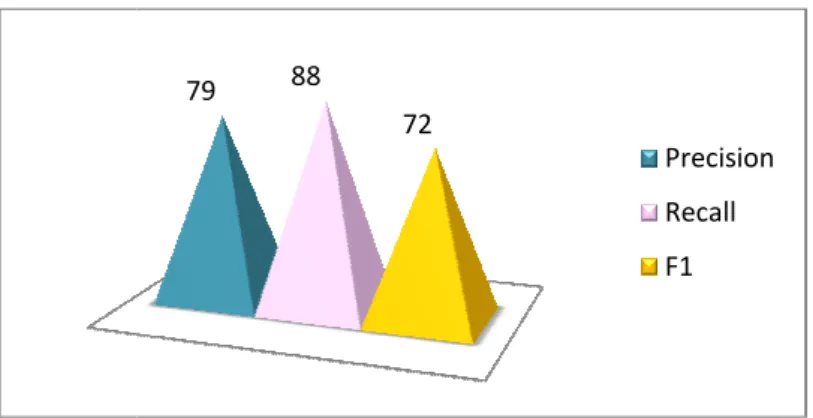
In order to evaluate this approach; the three metrics listed above are calculated for each user, and then the average of each metric in the system is calculated. The results are shown in Figure 5.
Fig 5: The average of the three metric: precision, recall and F1
4.5 Discussion
In SSF approach, we propose
development of the sharing systems which try
users to capture in the course of their daily tasks the social dimension of their use of some terms. It appears from this study highlights that can be summarized as follows: The consensus among users who have similar interests for using the same tags or the same resources plays an important role in eliminating the ambiguity
the increase in the weights of these terms or these resources has an influence on the emergence of semantic even when there are tags that can have several meanings. In fact, in the view of the
said that the use of analytical tools of social networks and also the collaborative filtering methods, even in the absence of ontologies, can help considerably to automate the nature of appl
folksonomies. Indeed the
technique SSF is succeeded in distinguishing between ambiguous tags. Comparing SSF approach with other
ambiguity; for example the
very optimistic especially when we know that
the result of the search’s procedure will be changed according to interests and the profile of each user in contrary to other approach. Also concerning the works that aimed to recommending a set of resources for each user like in the appr
[3]. We find that the technique that has been designed doesn’t take into account the semantic between terms, in particular it can’t distinguish between the ambiguous tags and therefore it can provide to a user resources that can rejected by h
are not close to his preferences.
The average of the three metric: precision, recall and F1
In SSF approach, we propose finding ways to equip in a "dynamic" manner the development of the sharing systems which trying to extract semantic in order to allow the course of their daily tasks the social dimension of their use of some terms. It appears from this study highlights that can be summarized as follows: The consensus among users who have similar interests for using the same tags or the
ays an important role in eliminating the ambiguity problem the increase in the weights of these terms or these resources has an influence on the emergence of semantic even when there are tags that can have several meanings. In e obtained promising results in the experimental phase, it can be said that the use of analytical tools of social networks and also the collaborative filtering methods, even in the absence of ontologies, can help considerably to automate the nature of applications seeking to extract the semantic in the folksonomies. Indeed the obtained results the used data sample show that the technique SSF is succeeded in distinguishing between ambiguous tags.
approach with others trying to discuss the problem of tags’ ambiguity; for example the Pan’s and al work [8], we can conclude that our results are very optimistic especially when we know that the proposed approach is flexible i.e. the result of the search’s procedure will be changed according to interests and the profile of each user in contrary to other approach. Also concerning the works that aimed to recommending a set of resources for each user like in the approach
e find that the technique that has been designed doesn’t take into account the semantic between terms, in particular it can’t distinguish between the ambiguous tags and therefore it can provide to a user resources that can rejected by him because they are not close to his preferences.
79 88
72
Precision Recall F1
finding ways to equip in a "dynamic" manner the to extract semantic in order to allow the course of their daily tasks the social dimension of their use of some terms. It appears from this study highlights that can be summarized as follows: The consensus among users who have similar interests for using the same tags or the problem. Also the increase in the weights of these terms or these resources has an influence on the emergence of semantic even when there are tags that can have several meanings. In experimental phase, it can be said that the use of analytical tools of social networks and also the collaborative filtering methods, even in the absence of ontologies, can help considerably to ications seeking to extract the semantic in the results the used data sample show that the
lem of tags’ we can conclude that our results are is flexible i.e. the result of the search’s procedure will be changed according to interests and the profile of each user in contrary to other approach. Also concerning the works that oach cited in e find that the technique that has been designed doesn’t take into account the semantic between terms, in particular it can’t distinguish between the ambiguous tags im because they
5 Conclusion and Future Works
Our work presented in this paper contributes to answer the problem of tags ambiguity when searching for tagged resources. Our approach is based on taking into account social interactions between the members of a community to implicitly extract the semantics of the tags in a folksonomy. We therefore call it a Semantic Social Folksonomy. Our first experiments have shown the efficiency of our approach. However it is too early to conclude – the test phase should first cover the whole del.icio.us database. A short term issue will then be the validation of our approach on other large databases.
In the continuation of our work, we intend to enrich our approach of a Semantic Social Folksonomy by improving semantic network analysis (SNA) metrics.
References
1. Angeletou, S., Sabou, M., Specia, L., Motta, E.: Bridging the Gap Between Folksonomies and the Semantic Web: An Experience Report, Proc. Of ESWC workshop on Bridging the Gap between Semantic Web and Web (2007)
2. Buffa, M., Gandon, F., Ereteo, G., Sander, P. and Fabon, C.: SweetWiki: A semantic Wiki. J. Web Sem., 6(1), 84–97 (2008)
3. De Meo, P., Quattrone, G., Ursino, D.: A query expansion and user profile enrichment approach to improve the performance of recommender systems operating on a folksonomy. User Model. User-Adapt. Interact. 20(1): 41-86 (2010)
4. Gruber, T.: Tag Ontology- a way to agree on the semantics of tagging data, http://tomgruber.org/ (2005)
5. Limpens, F., Gandon, F., Buffa, M. : Sémantique des folksonomies: structuration collaborative et assistée, IC (2009)
6. Markines, B., Cattuto, C,. Menczer, F., Benz, D., Hotho, A., Stumme, G.: Evaluating similarity measures for emergent semantics of social tagging. WWW 2009: 641-650. (2009) 7. Mika, P.: Ontologies are us: A unified model of social networks and semantics, In ISWC, volume 3729 of LNCS, p. 522–536: Springer (2005)
8. Pan, J., Taylor, S., Thomas, E.: Reducing Ambiguity in Tagging Systems with Folksonomy Search Expansion, In Proc. of the 17th International World Wide Web Conference (2009) 9. Specia, L. Motta, E.: Integrating Folksonomies with the Semantic Web, 4th European Semantic Web Conference (2007)
10. Scott A. Golder, Bernardo A. Huberman: Usage patterns of collaborative tagging systems. J.Information Science 32(2): 198-208 (2006)
11. Specia, L. Motta, E.: Integrating Folksonomies with the Semantic Web, 4th European Semantic Web Conference (2007)
UWeb Workshop Proceedings iii
Sensing Presence (PreSense) Ontology – User Modelling
in the Semantic Sensor Web
Sensing Presence (PreSense) Ontology –
User Modelling in the Semantic Sensor Web
A.E. Cano, A.-S. Dadzie, V.S. Uren, F. Ciravegna Department of Computer Science, The University of Sheffield,
Sheffield, United Kingdom
{firstinitial.surname}@dcs.shef.ac.uk
Abstract. Increasingly, people’s digital identities are attached to, and expressed through, their mobile devices. At the same time digital sensors pervade smart environments in which people are immersed. This paper explores different per-spectives in which users’ modelling features can be expressed through the infor-mation obtained by their attached personal sensors. We introduce thePreSense
Ontology, which is designed to assign meaning to sensors’ observations in terms of user modelling features. We believe that theSensing Presence (PreSense)
Ontology is a first step toward the integration of user modelling and “smart envi-ronments”. In order to motivate our work we present a scenario and demonstrate how the ontology could be applied in order to enable context-sensitive services. Keywords:linked data streams, semantic sensor web, user modelling, smart ob-jects
1 Introduction
Digital sensors have pervaded the modern world, and increasingly make up the major-ity of connected devices, in, e.g., intelligent buildings, traffic lights and in particular in mobile devices. These advances have resulted in “smart” environments, marking an evolution in the generation of information, and the interaction between humans, smart and ordinary devices and sensors. Human-computer interaction now extends to every-day objects attached to the end user or located in their changing environment [8]. Users produce data streams through their mobile devices, wearable and implantable micro-sensors (e.g., GPS tracklogs, heart rate monitors). These devices now frequently act as the gateway to cyberspace, which is increasingly becoming an extension of the lives of humans in the real, physical world. Therefore, these can provide information regarding a user’s physical context (e.g. location, physiological state), in addition to their digi-tal environment (e.g. adding new friends to an online social network, tweeting on an evolving event). This leads to a bond between the user and their mobile devices and sensors, in which the latter act as an extension of the user’s identity, providing real-time information that can reveal important user and environmental characteristics.
This provides motivation to explore new techniques for combining current user modelling methods, that depict the digital identity of a given person, with sensor in-formation distributed across the online and physical worlds.
2 A.E. Cano, A.-S. Dadzie, V.S. Uren, F. Ciravegna
The contributions of this paper are as follows: we explore different perspectives in which the attachment of sensor data to user models can impact the derivation of tai-lored services that feed into users’ interaction with smart objects and environments, by
providing real-time contextualisation. We propose theSensing Presence(PreSense)
ontology as an approach to modelling the attachment of sensor data streams to a user profile, allowing rich, semantic, real-time change in a user’s representation. This en-ables also the integration of observable user features to the linked data cloud [3].
The paper is structured as follows: in section 2 we present the motivation for our work by discussing different perspectives on the use of sensor data for user modelling; in section 2.3 we introduce a scenario that highlights challenges and benefits that the attachment of sensor data to user profiling presents; section 3 discusses existing on-tologies that consider sensor data in user modelling; in section 4 we introduce a set of requirements for modelling the attachment of sensor data streams to a user profile;
in section 5 we introduce the Sensing Presence Ontology (PreSense). Section 6
de-scribes the application of the ontology in relation to our scenario; finally, section 7 discusses the potential of this work, plans for evaluation, and concludes the paper.
2 Motivation
The relevance of users to the Sensor Web has been explored from the perspective of users acting as collective sources of information. Goodchild [9] highlights the relevance of the Social Web in Volunteered Geographic Information, where users have created
a mesh of global information. Projects like SensorBase1 and SensorPedia2 provide a
platform for sharing online sensor information within user communities. However, lit-tle attention has been paid to the importance of users’ sensors as gateways for personal feature information. This section motivates our work by introducing different perspec-tives from which users engage with the physical and online worlds through sensor data. 2.1 Mobility in the Digital Society
In the past few years, users’ online activities, including web browsing, online shop-ping, and social web media use [15,20], have served as information sources for user
modelling. Further, the emergence of compelling social web platforms (e.g. Facebook3,
Twitter4) have encouraged users to proactively participate, shaping their online
per-sonae and influencing their perception about how they are viewed by others (a.o., [23]). Social studies on the adaptation of users to online technologies highlight that users appropriate telecommunications technologies in ways that fit their social groups, life stages, sociability and activities [10]. Since mobility has become a central aspect of the digital society, the introduction of location-aware services in social web platforms for mobile devices has received considerable attention from researchers in recent years. Research in this area includes scenarios for emergency response, tracking, navigation,
1http://sensorbase.org 2http://www.sensorpedia.com 3http://www.facebook.com 4http://twitter.com
PreSense– User Modelling in the Semantic Sensor Web 3 billing and social networking [16,21,27]. Part of the success of these applications is the user’s increased dependency on mobile devices; which have become, for some, an indispensable tool. While the use of sensors for registering users’ features (e.g. location) has proved to be fundamental in these applications, transient, sensor-based information has, to date, not been considered as an inherent component in user modelling.
2.2 Sensors and Users’ Context
Sensors refer not only to physical sensor devices but also to values computed as a result of the composition of indirect or abstract measurements derived from multiple, dis-tributed, often heterogeneous data streams [5,19,24]. Such sensors are usually referred
to asvirtual sensors; they allow the abstraction of data collection away from a fixed
set of physical objects. A virtual sensor may define a number of valid sources of in-formation, allowing it to poll for and retrieve information from different sources and at varying levels of granularity.
Following this definition, we consider aweb-based sensoras an extension of the
concept of virtual sensors, in which the measuring computation involves data streams generated from web resources. A web-based actuator may be regarded as a reactive
computation that produces a response to a specified event. E.g. NASA Hurricane5 on
Twitter is a data stream of instantly updated information generated from the contin-uous monitoring of different devices sensing meteorological conditions for predicting hurricanes and tropical cyclones all over the world.
In the same way, personal data streams may be regarded as gateways reporting relevant information for user modelling. The information embedded in these streams involves different users’ context. User context is built on static, stable and dynamic contexts. A user’s static and stable contexts represent information about or related to a user that does not, or rarely, changes in time, e.g. the relation between a user and their hometown or work place. A user’s dynamic context, in contrast, reflects highly changing information, which is often influenced by the environment in which a user is immersed; this includes, e.g., changes in position, anxiety levels while in a traffic jam.
Advances in intelligent, context-aware systems promote a vision of increasingly autonomous and ubiquitous applications that act on proactive knowledge to provide tai-lored services to individuals. These smart systems must not only support users in static, pre-defined environments, but also adapt to users’ changing context and evolving goals. However, the integration of user context and the user’s immersed environmental con-text, taking into account tempo-spatial restrictions, still requires research. We present next a scenario highlighting the role of sensor data streams in a user profile.
2.3 Scenario
Imagine Alice, aDoctorworking at a public hospital, and Bob, aPatientsuffering from
Type II diabetes and obesity. Bob’s treatment combines regular insulin injections with a diet plan. His nutritionist works with Alice to monitor how well he follows the plan, his physical activity and the impact both have on his overall health. Periodic reviews will
4 A.E. Cano, A.-S. Dadzie, V.S. Uren, F. Ciravegna
take this information into account in updating his treatment. Alice must also monitor Bob’s blood glucose levels, to determine the suitability of both his diet and medication. This scenario requires Bob to wear multiple sensors that communicate with Alice over a network. More precisely, it requires the attachment of sensor information to Bob’s personal attributes. Given the emergence of sensor-enabled mobile devices, we can imagine that Bob owns a device that connects to the Internet and monitors his location and health [4,7]. In this context, Alice accesses, in real-time, the data generated by Bob’s sensors. Should Bob’s blood sugar reach a dangerous level, Alice must be able to dispatch emergency assistance to Bob in the most efficient way. Information on his diet is not critical, so is only uploaded periodically.
Let us consider a weekday when Bob is returning to his office after inspecting a construction site with a client. His sensors have recorded higher than usual physical activity and that he missed his usual mid-morning snack. His smartphone warns him of the danger of his blood glucose levels dropping too low. Since it is close to lunchtime his nutrition monitor (NutrApp) polls for suitable eateries between his current location
and his office (see Fig. 1A). It also checks Bob’s online social network for
recommen-dations by friends he often eats out with. The NutrApp polls for the ingredients of meals and portion sizes from virtual sensors, and determines suitability by matching with the requirements of his diet plan. Time to cook is also important – his calendar has posted
a reminder about an early afternoon meeting he must prepare for (Fig. 1B). By merging
online information with GPS the NutrApp will try to locate members of Bob’s social network in the neighbourhood, whose calendars or status information show they are available – if any are found Bob will receive a suggestion to invite them to join him.
Fig. 1.Schematic for thePreSensescenario, illustrating the exchange of data streams between sensors, and the interaction between human actors and other entities as a result. To illustrate an emergency in which situational context is communicated to external actors via sensors, let us consider what happens if Bob ignores the alerts he receives to
PreSense– User Modelling in the Semantic Sensor Web 5 stop for lunch, because he forgot to carry his medication. He decides to return directly to his office, 45 minutes away via the subway. However, due to a signal failure Bob’s train
is held stationary just outside a station 1 hour later (Fig. 1C). The stressful situation,
combined with more exercise than normal and the time since his last meal, result in a large drop in his blood sugar. Without the sensors recording Bob’s blood sugar he may not recognise symptoms of hypoglycaemia till they become severe. In our scenario his smartphone warns him to consume food or drink with high sugar content urgently. His sensors attempt to warn Alice when his blood sugar reaches a critical threshold; however with the train stuck in a tunnel Bob’s sensors are unable to connect to Alice’s. Bob’s sensors also attempt to locate nearby resources that can help to alleviate his
symptoms. AGeneral Practitioner (GP) in the next carriage receives the emergency
alert. Virtual sensors apply a context-sensitive filter to Bob’s medical information (some of which is held on his personal devices). Another virtual sensor calculates Bob’s loca-tion using GPS and a schematic of the train and transmits this to the GP’s mobile device over a (local) wireless network. The GP locates Bob, and armed with the information needed to attend to the semi-conscious patient, successfully handles the emergency.
When the train exits the tunnel the delayed emergency alert is relayed to Alice
(Fig. 1D), with a timestamp that indicates that it has now expired. An update with more
current, valid information on Bob’s status is also relayed to Alice over the Internet. To be effective, this scenario implies the need to connect different information streaming sources in time- and location-constrained situations, via (context-sensitive) virtual sensors. Particularly, it illustrates the demands of attaching streaming informa-tion to real world entities such as people – the GP must be able to identify the patient via sensor stream ownership. Wireless networks also play a role in information exchange; in the emergency situation this is how the virtual and physical sensors communicate.
3 Related Work
Ontologies for user modelling follow two paradigms: standardisation- and mediation-based modelling [26]. The first is mediation-based on a top-down approach in which ontologies for user modelling are designed to be domain-independent (top-level ontologies), or still high-level but domain-specific (upper ontologies) in order to be reusable by multiple systems. The second is a bottom-up approach which proposes an integrated user model for a specific goal within a specific context [1].
The Friend of a Friend (FOAF) ontology6is a top level ontology that models generic
information about a user, including their name, social graph, interests and location.
However, current FOAF profiling is based on the static representation of, in some
cases, highly changing data, such as the temporal location of a user, or their current
position in the world (`a la foursquare7). Since many of these highly changing user
properties can be observed through sensors, different ontologies for considering sensor data in user modelling have emerged. The Service-Oriented Context-Aware Middle-ware (SOCAM) ontology [11] is an upper ontology which introduces concepts like
Activity,Location,ComputationalEntityandTimeunder the umbrella
6FOAF ontology:http://xmlns.com/foaf/spec 7http://www.foursquare.com
6 A.E. Cano, A.-S. Dadzie, V.S. Uren, F. Ciravegna
concept ofContextEntity. Although it models sensors using theDeviceconcept,
it does not provide a link between a sensor and its owner, nor a relation between the sensor’s observations and user properties.
The General User Model Ontology (GUMO) is a top-level ontology introduced in 2005 [14]. GUMO is based on the User Mark-up Language (UserML) [13] and consid-ers dimensions including pconsid-ersonality, demographics, emotional and physiological state. The use of sensors in GUMO is considered particularly for users’ physiological state; Heckman et al. [14] suggest the use of wearable bio-sensors to register users’ body conditions such as pupil dilation and blood pressure. Although they consider the use of
UbisWorld8for integrating users in ubiquitous environments, there is no clear definition
of the way in which a sensor’s relationship with a user’s properties could be addressed.
The Ontonym ontologies9[25] are a collection of seven upper ontologies for
per-vasive computing. including theSensor, DeviceandPersonontologies. They are
de-signed to allow the definition of ownership between aSensorand aPersonthrough
theDeviceclass’sownsandownedByproperties. However, Ontonym requires the definition of a new ontology to map each sensor observation to user properties. For ex-ample, to add a relationship between a user’s mobile device GPS’s location observations
and the user’s location, theLocationontology is defined to declare the
Locatable-EntityandLocatableFeatureclasses (and associated properties). Ontonym is, to the best of our knowledge the only user modelling ontology available online.
Work done in sensor data integration into ontology-based user modelling following a bottom-up approach includes the Mobile Ontology-based Reasoning and Feedback System (MORF) [2], which defines a set of domain-specific ontologies which include
classes such asPatient,DoctorandHeartRateSensorData. Their model
al-lows monitoring and transmitting a patient’s data through a mobile device. However, restrictions due to domain-specific design prevent MORF and other such bottom-up ontologies from being extensible to generic user modelling.
Relevant components of standard ontologies are discussed in the requirements iden-tified in section 4 and revisited in 5.4 where we assess the extent to which these are met.
4 Requirements
The scenario presented in section 2.3 highlights not only the relevance of the identi-fication of sensors and their observations as meaningful web resources, but also the importance of addressing the generated data streams as users’ feature properties. In this section, we identify requirements for associating sensor data to user modelling. Identification and Addressability: To uniquely identify and dereference sensor
re-sources. In our scenario, Alice should be able to identify Bob’s sensors, as well as the potential relations among these sensors. For example, by exposing Bob’s physical activity and sugar levels, through the definition of his pedometer, as well as his glucose sensor as web resources, health care services could react in a con-tingency situation, in which external entities such as nearby emergency medical services could respond according to Bob’s physical location (see section 6.2).
8UbisWorld can be tested at:http://www.ubisworld.org 9Ontonym ontologies:http://ontonym.org
PreSense– User Modelling in the Semantic Sensor Web 7 Sensor Ownership and Provenance: To establish the sources of information, includ-ing entities and processes involved in the generation of measurements from ob-served stimuli. Provenance in sensor data is crucial for assessing trust judgements
on information. AnEntity, in particular aPerson, should be able to address
a sensor as its own – Bob, for instance, should be able to associate sensors with himself. Given a sensor data stream, it should be possible to access the sensor pub-lishing the given stream and identify the sensor’s owner. In the scenario, Alice and the GP should be able to identify the streams they are consuming as Bob’s.
Association of Sensor Data and Profile Information: To map explicitly, a user’s prop-erty characterised by a stimulus with the sensor that observes this stimulus. In the scenario, Alice must be able to associate Bob’s (continuously changing) location
with, e.g., Bob’scurrent locationproperty, observed by his GPS.
Privacy in Data Streams: To consider how identity information should be exposed and to whom: (1) The consumer of a data stream should be guaranteed that no other service has impersonated the sender; (2) The owner of a data stream should be able to establish authentication methods so only authorised consumers have access to it. E.g., besides Bob, Alice should be authorised to access Bob’s health information, as well as the closest emergency doctor who treats Bob at the scene (the latter will have access to a filtered view).
Sensor Data Expiration: To enable a data stream to declare an estimation of the pe-riod of time in which its data should be considered valuable. In our scenario, Alice must be able to tell if the received information is still valid, e.g., Alice must know the latest (valid) position of Bob and the time beyond which it is no longer valid. Interaction with Smart Entities: To allow the representation of collective stimuli in
which different entities, including the user, are involved. With collective stimuli we refer to the aggregation of common detectable changes in observable properties. E.g., Bob’s location-based proximity social graph is a property derived from the collective stimulus of being located in the vicinity of Bob, within a radius of 5km. Integrate Physical and Virtual Presence Stimuli: To identify and incorporate virtual
and physical stimuli as part of a user’s presence. This integration would bridge the user’s physical and online personae. In the scenario, the NutrApp would make use of Bob’s online social network to obtain the references of those entities to be monitored for physical presence proximity.
5 The Sensing Presence Ontology
In this section we introduce concepts related to users’ presence and present the
Sens-ing Presence (PreSense) Ontology10. It defines key concepts and properties required
to describe users’ features in terms of virtual sensor observables.PreSensemodels
users as entities whose presence is the aggregation of online and physical properties. It represents sensors’ observations for deriving presence properties and particular features of interest, following the Stimulus-Sensor-Observation (SSO) ontology design pattern
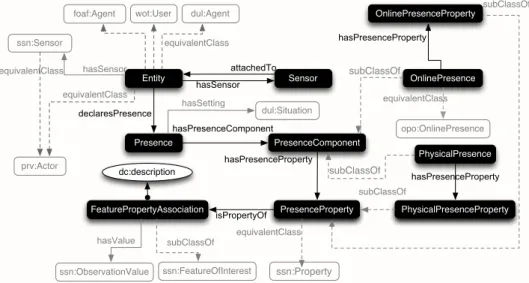
[18]. Fig. 2 illustrates the structure of thePreSenseontology, focusing on the
rela-tionships between its core components.
8 A.E. Cano, A.-S. Dadzie, V.S. Uren, F. Ciravegna Entity FeaturePropertyAssociation PresenceProperty OnlinePresence Presence PresenceComponent PhysicalPresence declaresPresence hasPresenceComponent subClassOf isPropertyOf subClassOf hasPresenceProperty Sensor hasSensor attachedTo PhysicalPresenceProperty OnlinePresenceProperty hasPresenceProperty subClassOf dc:description hasPresenceProperty subClassOf ssn:ObservationValue ssn:FeatureOfInterest hasValue subClassOf ssn:Property equivalentClass ssn:Sensor prv:Actor equivalentClass equivalentClass hasSensor opo:OnlinePresence equivalentClass
foaf:Agent wot:User dul:Agent equivalentClass
dul:Situation
hasSetting
Fig. 2. Sensing Presence Ontology (PreSense) Overview 5.1 User Modelling Based on Personal Sensors
Based on the definition of virtual sensors (in section 2.2) and the SSO design pattern
[18], we introduce the concept of “personal sensors” to refer to both physical sensor
devices and compositions of computations or procedures that measure a user’s proper-ties. The information embedded in the data produced by personal sensors includes the
users’onlineandphysical presence contexts. Byonline presence context, we refer to the
information provided by the aggregation of personal data streams (e.g. microblog posts, emails, text messages) generated by a user within a window of time. We consider the physical presence contextas the abstraction of physical features, measured by sensor devices, regarding a user’s state of existence or being present in a place or a thing (e.g. the user’s location, body temperature). Both online and physical presence interweave dynamically with a user’s surrounding environmental context, which can include other entities like people, places and things (e.g. members of the user’s social graph who are close by, or local points of interest – POIs).
5.2 Imported Ontologies
Specifications on how to exchange sensor data and their observations have been defined by the Open Geospatial Consortium (OGC). In particular the OGC’s Sensor Web
En-ablement11 (SWE) suite is a broad standardisation initiative which comprises models
such as the Sensor Model Language12 (SensorML) and the Observation &
Measure-ment13 (O&M) standards, and services such as the Sensor Observation Service (SOS)
11http://www.opengeospatial.org/projects/groups/sensorweb 12http://www.opengeospatial.org/standards/sensorml
PreSense– User Modelling in the Semantic Sensor Web 9 [18]. However, sensor data sharing and discovery expose different challenges involv-ing semantic heterogeneity and integration. The Semantic Sensor Web (SSW) [24] ap-proaches these challenges by providing an ontological platform that defines a machine-readable specification of the conceptualisations that underlie this sensor data.
There are over twelve sensor ontologies [5] for declaring a specification of sens-ing devices; some include sensors’ domain definitions and their relation to observations and measurements. The need for a domain independent and end-to-end model for sens-ing applications led to the creation of the W3C’s Semantic Sensor Network Incubator
Group14 (SSN-XG), who developed the Sensor and Sensor Network (SSN) ontology15
[6,22]. Taking into account available standards such as the OGC’s SWE, theSSN
on-tology merges sensor-, observation- and system-focused views. The onon-tology describes sensors following the SSO ontology design pattern [18] and considers spatial
prove-nance properties through theSSN’sDeploymentmodule.
Following ongoing research and standardisation efforts, we use theSSNontology to
represent sensors inPreSense. Further, we use the Provenance Vocabulary16 (PRV)
[12] to extend provenance-related metadata regarding both sensors and their owners
throughprv:Actor. For modelling anEntityasserting the ownership of a sensor,
we usefoaf:Agent. According to theFOAFspecification, afoaf:Agentcan refer
to a person, a group, software or a physical artifact. The Web of Trust17(WOT) ontology
is used to ensure that the ownership of a sensor cannot be falsified by a third party, thus
providing a solid base for valid sensor attachment. PreSensemodels a user to be
equivalent to awot:User. This equivalence allows a user to assert a digital signature
to a web resource, which ensures that: (1) The provenance of the resource cannot be falsified easily; (2) The resource cannot be modified without revoking the provenance of the information.
From the Online Presence Ontology18(OPO), we reuseopo:OnlinePresence
to model users’ online presence properties. Finally, from the Dolce Ultralight
On-tology (DUL) 19 we reuse dul:Agent to align existing properties of SSN with a
preSense:Entity(abbreviated prefixps:used hereafter), anddul:Situation,
in defining the contextual setting of an entity’sps:Presence.
5.3 Core Components
Table 1 summarises the requirements fulfilled by each of the core components of the
PreSenseontology, which we discuss next:
Entity An entity is modelled to be equivalent tofoaf:Agent,wot:User, dul:-Agentandprv:Actor. The function of theEntityclass is twofold: (1) to describe the identity of an individual (not only persons but entities in general) to whom the sensor data should be attached; and (2) to avoid provenance falsification
14SSN Incubator Group:http://www.w3.org/2005/Incubator/ssn/wiki 15SSN Ontology:http://purl.oclc.org/NET/ssnx/ssn
16Provenance Vocabulary:http://purl.org/net/provenance 17WOT Ontology:http://xmlns.com/wot/0.1
18Online Presence Ontology:http://online-presence.net/opo/spec 19Dolce Ultralight Ontology :http://www.loa-cnr.it/ontologies/DUL.owl
10 A.E. Cano, A.-S. Dadzie, V.S. Uren, F. Ciravegna
Table 1.Match of corePreSenseontology components to requirements
Ident. & Address-ability of Sensors Sensor’s Ownership & Prove-nance Sensor & User Profile Assoc.
Privacy ExpirationData with SmartInteraction Objects Integration of Phys. & Virt. Pres. Stimuli Entity • • − ◦ − − − Sensor − − • − • • − Presence − − − − − • • PhysicalPresence − − − − − • • OnlinePresence − − − − − − • FeaturePropAssoc. − − • − − − −
Legend:•Yes.◦Limited.−No.
through the use of digital signatures inwot:User. The Entityclass
consid-ers the propertyhasSensorfor attaching a sensor to an entity (its inverse
prop-erty isattachedTo).Entityisskos:closeMatchwithssn:Platform,
which is considered to be anEntityto which aSystemof sensors is attached.
However,SSNconsiders aPlatformto be adul:PhysicalObjectwhich is
disjoint withdul:SocialObject.
Sensor A sensor is defined by thessn:Sensorclass and refers to a physical
ob-ject that detects, observes and measures a stimulus. Theps:attachedTo
prop-erty is used to assert that aps:Entityowns this sensor (its inverse property
isps:hasSensor). In order to extend provenance metadata of a sensor and its
observations, we model thessn:Sensorto be equivalent to aprv:Actor.
Presence APresencerefers to the state or fact of existing or being manifest in a
place or a thing. We consider that aPresenceis an aggregation of anEntity’s
online and physical manifestations, that occur within a situation or setting.
Follow-ingDUL, a situation is defined as a “relational context” created by an observer on
the basis of a description frame.
Physical Presence This is the abstraction of the aggregation of physical properties fea-turing a quality of an entity. These properties are derived by sensors observing
physical stimuli. Theps:PhysicalPresenceclass manifests an entity to be in
a state of existing or being present in a place or a thing. These physical presence properties can be broken down into different modules regarding different dimen-sions in which users’ properties can be linked to sensor data.
Online Presence This is equivalent toopo:OnlinePresence; it refers to the
ab-straction of the aggregation of online properties featuring a quality of anEntity,
e.g., a user. These properties are derived by virtual sensors observing stimuli
in-volving thisEntity, e.g., the detection of a user’s change of status on a social
network site through theps:OnlineStatusStream.
Feature Property Association Following theSSOontology design pattern we intro-duce this class to bridge a sensor’s observed stimulus and the feature that this
stimu-lus characterises in the user model. It is a subclass ofssn:FeatureOfInterest;