EKE, H.N., PETROVSKI, A. and AHRIZ, H. 2019. The use of machine learning algorithms for detecting advanced
persistent threats. Presented at the 12th International on security of information and networks conference 2019
(SINCONF 2019), 12-15 September 2019, Sochi, Russia. New York: ACM [online], (accepted). Available from:
https://doi.org/10.1145/3357613.3357618
The use of machine learning algorithms for
detecting advanced persistent threats.
EKE, H.N., PETROVSKI, A., AHRIZ, H.
2019
This document was downloaded from
https://openair.rgu.ac.uk
© Owner/Author | ACM 2019. This is the author's version of the work. It is posted here for your personal use.
Not for redistribution. The definitive Version of Record was published in Proceedings of the 12
thInternational
on security of information and networks conference 2019 (SINCONF 2019),
2 3 4 5 6 7 8 9 10 11 12 13 14 15 16 17 18 19 20 21 22 23 24 25 26 27 28 29 30 31 32 33 34 35 36 37 38 39 40 41 42 43 44 45 46 47 48 49 50 51 52 53 54 55 56 57 58 60 61 62 63 64 65 66 67 68 69 70 71 72 73 74 75 76 77 78 79 80 81 82 83 84 85 86 87 88 89 90 91 92 93 94 95 96 97 98 99 100 101 102 103 104 105 106 107 108 109 110 111 112 113 114 115 116
The Use of Machine Learning Algorithms for Detecting
Advanced Persistent Threats
Hope Nkiruka Eke
∗School of Computing Science and Digital Media, Robert Gordon
University Aberdeen, Scotland, UK
Andrei Petrovski
[email protected] School of Computing Science and
Digital Media, Robert Gordon University
Aberdeen, Scotland, UK
Hatem Ahriz
[email protected] School of Computing Science and
Digital Media, Robert Gordon University
Aberdeen, Scotland, UK
ABSTRACT
Advanced Persistent Threats (APTs) have been a major challenge in securing both Information Technology (IT) and Operational Tech-nology (OT) systems. Due to their capability to navigates around defenses and to evade detection for a prolonged period of time, targeted APT attacks present an increasing concern for both cyber security and business continuity personnel. This paper explores the application of Artificial Immune System (AIS) and Recurrent Neural Networks (RNNs) variants for APT detection. It has been shown that the variants of the suggested algorithms provide not only detection capability, but can also classify malicious data traffic with respect to the type of APT attacks.
CCS CONCEPTS
•Computing methodologies →Artificial intelligence; Ma-chine learning;Neural networks.
KEYWORDS
Advanced Persistent Threats(APTs), Artificial Immune System (AIS), Human Immune System (HIS), Long Short-Term Memory (LSTM), Recurrent Neural Network (RNN)
ACM Reference Format:
Hope Nkiruka Eke, Andrei Petrovski, and Hatem Ahriz. 2019. The Use of Machine Learning Algorithms for Detecting Advanced Persistent Threats. InThe 12th International Conference on Security of Information and Networks (SIN 2019), September 12–15, 2019, Sochi, Russian Federation.ACM, New York, NY, USA, 8 pages. https://doi.org/10.1145/3357613.3357618
1
INTRODUCTION
Threats to information and network security remain one of the biggest challenges facing organisations and industries at differ-ent levels of operation. There have been a number of successful breaches of critical infrastructure. Stuxnet is one example of a sophisticated APT attack purposefully launched to target critical nuclear infrastructure in Iran as highlighted in [9]. This type of at-tack has drawn special attention to the possibilities of APT atat-tacks
Permission to make digital or hard copies of all or part of this work for personal or
on the Industrial Control System (ICS) such as Supervisory Control and Data Acquisition (SCADA) network. It has also led to a number of research interests in developing methods to detect intrusions within network and isolated devices.
The application of Artificial Intelligence (AI) inspired by AIS [5, 19], Deep Learning (DL) [25, 31] and Machine Learning (ML) algorithm[13] in APT intrusion detection has attracted more re-search attention. Security practitioners believe that these approaches may be a solution to APT and other cybersecurity issues.
In spite of recent popularity of the above mentioned techniques and extensive academic research, there is a need to exploit this knowledge of the system in detection of operational behaviour since sensors are been controlled in real-time similar to how the human body immune system detects and removes or destroys threats from numerous pathogens such as viruses, bacteria and parasites [26, 33]. Various techniques and models have been developed and applied in securing Information system infrastructures such as ICS devices and different network devices and platforms against APT and cyber threats.
Sim et al [30] have applied the combination of immune metaphor with genetic programming in their work "Network for Lifelong Learning (NELLI) system". NELLI is a first step towards creating L2O systems that continue to adapt over time [15]. NELLI has been applied to bin-packing and job-shop scheduling domains. In any given domain, NELLI independently generates a group of optimisa-tion algorithms that has the capability of solving a diverse range of problem instances. NELLI has demonstrated that, in order to im-prove its performance when exposed to more instances that exhibit different characteristics from those previously seen, it generates an ensemble of optimisation new algorithms that are capable of solving a diverse range of problem instances in any given domain. Also, since it retains memory, it quickly returns new algorithm that exhibits good performance when re-exposed to any instances it has seen in the past [30]. However, the NELLI model has not been tested for APT detection in the cybersecurity domain.
Hence, adaptation of artificial immune system combined with integration of optimised continues machine-learning approaches to predict attack instances offers a great potential to pre-generate algorithms in anticipation of future demand, thereby increasing the efficiency of the system. As suggested in [15], for a shift towards the direction of optimisation community rather than focusing effort on developing more complex algorithms that is trained on large static datasets, a move towards developing systems that independently and continually generate specialised algorithms on demand may bear considerable fruit.
https://doi.org/10.1145/3357613.3357618
117 118 119 120 121 122 123 124 125 126 127 128 129 130 131 132 133 134 135 136 137 138 139 140 141 142 143 144 145 146 147 148 149 150 151 152 153 154 155 156 157 158 159 160 161 162 163 164 165 166 167 168 169 170 171 172 173 174
SIN 2019, September 12–15, 2019, Sochi, Russian Federation Eke et al.
175 176 177 178 179 180 181 182 183 184 185 186 187 188 189 190 191 192 193 194 195 196 197 198 199 200 201 202 203 204 205 206 207 208 209 210 211 212 213 214 215 216 217 218 219 220 221 222 223 224 225 226 227 228 229 230 231 232 233 234 235 236 237 238 239 240 241 242 243 244 245 246 247 248 249 250 251 252 253 254
This paper present the results of investigation of the application of deep learning optimised ensemble stacked RNNs and its variants as inspired by Life-Long Learning Optimiser (L2O) approach to enhance performance [15] in Intrusion Detection Systems (IDSs) and compared this with previously published results of AIS model -Negative Selection (NS) with Antigen Feedback (AF) [22].
The contribution of this paper can be summarised as follows: •We propose a novel approachusing deep neural networks
for APT multi-step detection which takes stacked LSTM-RNNs networks to automatically learn features from the raw data to capture the malicious patterns.
•We carried out series of experiments to;evaluate the ability of this model to (i) accurately detect and classify an attack as abnormal and (ii) detect different type of attacks family accurately.
•The achieved resultssuggest that the proposed approach is a good candidate for developing attack detection systems. The remainder of this paper is organised as follows. A brief background of the AIS and RNNs variants application in security domain is discussed in section 2. Experiments, evaluation metrics and analysis results are discussed in Section 3. Section 4 and 5 presents the conclusion of this paper and future work respectively.
2
BACKGROUND
This section contains a brief background of the AIS and RNN ap-plication in security domain through the examination of major components and basic definition.
2.1
Artificial Immune System (AIS)
An AIS is a system that is capable of self adaption, self-learning, self regulatory, distributed with self and non-self detection properties, capable of identifying and eliminating any intruding foreign body of antigenicity while maintaining the stability of the environment within the body [19, 28]. This is relatively similar to Intrusion Detection System (IDS) functionality in protecting the network systems.
Human body has an in built mechanism for protecting itself against harm from harmful bacteria and viruses, known as pathogens. This is achieved through the help of Human Immune System (HIS) without a previous knowledge of the pathogens structure [2]. Since HIS has the ability to detect and defend against previously and unseen harmful invaders, this approach can as well be adopted to protect computer system and critical infrastructure.
Application of AIS has gained popularity in many areas such as but not limited to processing of text [3], anomaly detection [12] and network security [17]. However, the most prominent AIS al-gorithms are centered around these four alal-gorithms- (1) Artificial Immune network (AIN), (2) Clonal selection (CLONALG), (3) Neg-ative Selection (NSA), and (4) Danger Theory and Dendritic Cell Algorithms (DCA), while other approaches are based on the combi-nation of these four approaches [5, 10].
Four Major AIS Algorithms:
•Artificial Immune Network (AIN): was proposed by [18] which suggested that the immune system has the ability to
attained immunology memory by the existence of a mutually reinforcing network of B cells as there is an interaction be-tween its components to increase its tolerance and memory. Immune system cells work as a group in a networked sys-tem to eliminate any foreign body, this forms the basis for cooperative agents based IDS [5, 10].
• The Clonal Selection algorithm (CLONALG): was put forward by Frank in 1959 [7] This approach suggest that a clonal expansion of the original lymphocyte occurs when the original lymphocyte is activated by binding to the antigen; however, any low-affinity detectors (clone of the activated lymphocyte) are eliminated and replaced with the cloned detectors during the development of the lymphocyte. • Negative Selection Algorithm (NSA): is based on
neg-ative representation of information using either string or real-valued vector representation [10]. There is a continuous improvement on the existing methods and new models being proposed, Bejoy et al. in [5] suggested that NSA is a major candidate for designing IDS algorithms.
• Danger Theory (DT) and Dendritic Cell Algorithms (DCA): was proposed by Matzinger in [23] which states that the im-mune system responds to danger signals from injured cells rather than self-nonself discrimination as danger signals should not be sent by healthy cells. Greensmith et al. in [14] proposed the Dendritic Cell Algorithm (DCA) which suggest that dendritic cells when stimulated, it differentiate and undergo maturation and migrate to secondary lymphoid tissues where they can only work if there is a danger signal by a cell when attacked by an antigen to stimulate an induce immune response
2.2
AIS Model Application in Intrusion
Detection Systems (IDSs)
To implement AIS, this involves four different stages these includes (a) encoding, (b) similarity measure, (3) selection and (4) mutation as highlighted by [1], "Once an encoding has been fixed and a suit-able similarity measure is chosen, the algorithm will then perform selection and mutation, both based on the similarity measure, until stopping criteria are met".
Gadi et al. in [12], applied AIS model in credit card fraud detec-tion and compare their result to other classical classifiers such as Neural Nets (NN) and Bayesian Nets (BN), Naive Bayes (NB) and Decision Trees (DT).The result of this experiment indicates that AIS performed better when parameters optimised by Genetic Algorithm (GA) visualization procedure. Figure 1 is a representation of GA for parameters optimisation.
The following GA multi-resolution optimization steps algorithm are used in [12] are:
• They identified those parameters that have not changed, and freezes the values for the respective parameter.
• Parameters were screened and the 20 best parameter sets for each split and identify reasonable range.
• For all non-robust parameters, they choose an integer steps so the searching space does not explode
• Next, they evaluated the costs for all possible combinations according to the defined search space and find the parameter 2019-09-17 10:42. Page 2 of 1–8.
255 256 257 258 259 260 261 262 263 264 265 266 267 268 269 270 271 272 273 274 275 276 277 278 279 280 281 282 283 284 285 286 287 288 289 290 291 292 293 294 295 296 297 298 299 300 301 302 303 304 305 306 307 308 309 310 311 312 313 314 315 316 317 318 319 320 321 322 323 324 325 326 327 328 329 330 331 332 333 334 335 336 337 338 339 340 341 342 343 344 345 346 347 348 349 350 351 352 353 354 355 356 357 358 359 360 361 362 363 364 365 366 367 368 369 370 371 372 373 374 375 376 377 378 379 380 381 382 383 384 385 386 387 388 389 390 391 392
Figure 1: Genetic Algorithm for parameters optimization [12]
setPthat brings the minimum average cost among all the different used splits
•Finally, zoomed the screen to the neighborhood ofP, re-fine stepss, and repeat the process from then on, until no refinement is possible.
Investigation of system-level fault diagnosis using AIS model was carried by [35], in their work they have introduced AIS-based fault identification approach for multiprocessor and multi computer systems. This model emulated the ability of the immune system in recognising pathogenic agent (antigen) there by distinguishing body own cells and molecules (self) from foreign antigens (non-self ) which was similar to the fault diagnosis problem, that aims at identifying processors (cells) in a system (body) to be a faulty (non-self) or fault-free ((non-self). Their experimental results indicated that the immune diagnosis model can successfully identify the faulty processors and diagnose a faulty situation in short period of time. An efficient proactive AIS based anomaly detection and preven-tion system (EPAADPS) was introduced by Saurabh et al. in [28]. EPAADPS was developed by combination of AIS ideas with agents to proactive defense system against unseen anomalies. Theses were achieved using three modules: Repertoire Training Module (RTM), Vulnerability Assessment Module (VAM) and Response module (RM). The authors utilised the NSA self-tuning of detectors and detector power in view to make a detector evolve and promote a better and correct self and non-self coverage. RTM generates and selects efficient detectors that forms detector set (DS) based on a self-tuning. VAM creates detector agents (DA) and assigns it Detector Set (DS) to evaluate Test Set instances. In a situation where VAM discovered any abnormality within the system, RM take action against the detected attacks.
A distributed multi-agent IDS using AIS approach that applied all four AIS algorithms were proposed by [29]. In this approach, elimination of low profile agents was done using NAS, the CLON-ALG was used to proliferate agents with best fitness value while agents communicate with each other was possible through AIN. This approach used mobile and static agents with detector agents as the main actors in MAIS-IDS. This approach also used NSL-KDD [11] dataset to evaluate the system based on three factors- accu-racy, false alarm (FA) and detection rate (DR). According to the
authors, this approach can be applied on both network and host based settings.
2.3
Recurrent Neural Network
Recurrent neural network (RNN) is an effective class of artificial neural network (ANN) that is used when dealing with very complex supervised and unsupervised tasks [20].
Recently, deep learning techniques have been applied in cyber security [24]. Since it can detect the cyber attacks by learning the complex underlying structure, hidden sequential relationships and hierarchical feature representations from a huge set of security data. The authors of [20] Proposed and evaluated RNN model against classical support vector machine classifier (SVM) for cybersecurity in Android malware classification, incident detection, and fraud detection.
RNN emerged as a powerful approach for deep learning archi-tecture generally applicable for time-series data modelling. Despite the RNN and its variant networks remarkable performance in long standing AI sequence data modelling tasks such as time-series anal-ysis, speech recognition and machine translation [21], applying the same in cyber security task is in early stage of development [34].
Figure 2: Schema of Unfolded Basic Recurrent Neural Net-work [4]
RNN were developed in the 1980s and it is similar to a feed-forward network (FFN) with an additional internal feedback loop (short-term memory to store and retrieve past information over time scales and thereby execute the temporal task) which is a cir-cular connections between higher- and lower-layer neurons and optional self-feedback connections. These feedback connections en-able RNNs to propagate data from earlier events to current process-ing steps which is in contrasts to FFN. The formulated mathematical representations of the RNN computational flow are represented in Equations 1 and 2.
st =fw(st−1,xt) (1)
Equation 1 represent the basic recursive formula of RNN where
fwis the recursive function. The network has an input layerx, hidden layers(also known as hidden state) and output layero. The current observed input to the network at time steptis denoted as xt, the hidden state at time steptis denoted asstandst−1represent the previous hidden state.
st=f(U xt+W st−1) (2) st is calculated based on the previous hidden statest−1and the input at the current stepxtas shown in Equation 2.stis the short-term "memory" of the network which captures information about 2019-09-17 10:42. Page 3 of 1–8.
393 394 395 396 397 398 399 400 401 402 403 404 405 406 407 408 409 410 411 412 413 414 415 416 417 418 419 420 421 422 423 424 425 426 427 428 429 430 431 432 433 434 435 436 437 438 439 440 441 442 443 444 445 446 447 448 449 450
SIN 2019, September 12–15, 2019, Sochi, Russian Federation Eke et al.
451 452 453 454 455 456 457 458 459 460 461 462 463 464 465 466 467 468 469 470 471 472 473 474 475 476 477 478 479 480 481 482 483 484 485 486 487 488 489 490 491 492 493 494 495 496 497 498 499 500 501 502 503 504 505 506 507 508 509 510 511 512 513 514 515 516 517 518 519 520 521 522 523 524 525 526 527 528 529 530
what happened in all the previous time steps, this can further be fed to other stacked recurrent layer or final layer where the layer has nonlinear activation function such as softmax functionsf as represented in Equation 3.
ot =s f(Vst) (3)
ot is the output at time steptand the vector of probabilities of initial hidden state is set toV.
f denote the nonlinearity mapping function from the input fea-tures to the output labels such as tanh or ReLU, where the weight matrices of the previous state weight at time step t and input state weight at time step t are represented asUxt andW st−1respectively. s−1 is required to calculate the first hidden state and is usually initialised to zeroes.
Understanding the dynamics of RNN entirely is difficult due to its cyclic connection. To overcome this an RNN structure input sequence of length is transformed to a FFN structure by unfolding over time-steps as represented in Figure 2. FFN consist of hidden layers. This new structure can be analysed and also is adaptable to the backward propagation (BP) of errors, at this point the predefined error function are computed by comparing the output values with correct values and then distributed back throughout the network layers. This process is often used to train deep neural networks (DNN). An unfolded RNN at any given timetis defined as a function hT Equation 4.
hT =ST(x2x1) (4) WhereST represents the unfolded graph of time-stepst. The sum of all input-output pairs in a sequence over all the time-steps is referred to as the lossLfunction represented in Equation 5. L=d(tr,pr)= T Õ i=1 d(tr,pr) (5) The schema of unfolding of RNN in time of the computation is shown in Fig. 4. In RNN cyclic connections, each layer represents per time information similar to DNN but the unfolded RNN shares weight parametersWacross time-steps as represented in Figure 2. This indicates the fact that network performs the same task with various inputs over time-steps. In addition to learning the temporal patterns with cyclic connections, unfolding allows the RNN model to learn the association of static features between the input and output sequences. In order to apply the feedback concept, the BP is used to compute the gradients for weight parameters across time-stept.
To find the recurrent weights, the computation of gradient at t=2 will involve back propagating 1 step and add them to find and update the recurrent weight . This technique is known as back prop-agation through time (BPTT) employed by RNN to reduce network cumulative error. However, modeling large scale data sequence with RNN and BPTT is not efficient due to vanishing and exploding gradient problem as stated in [6] which usually occurs when we BP the error back in many time-steps in the deep unrolled RNNs network models.
Since RNN shares the parameters across all time step reducing the amount of parameter to be trained, this is utilised to calculate the gradient at each timetas in Equation 6 and 7.
st =tanh(Wxsxt+Wssst−1+bs) (6) ot=sof tmax(wsost+b0) (7) wherestis the hidden layer,tanhis the hidden layer nonlinear activation function, the softmax functionsf is used at the last layer as,bs andboare the bias terms for the hidden state and prediction at time stept. Where the prediction at time steptis denoted aszt
while the weight shared between the hidden s and output o across all the time sequence areWos andWssrespectively.
2.4
Long Short-Term Memory (LSTM)
LSTM is a second order RNNs that is augmented by recurrent gates known as Forget Gates (FG) [16]. LSTM has the capability to remember information for long periods of time. It contains a memory block which is a complex processing unit that is composed of one or more memory cell and a pair of multiplicative gates known as input and output gate with in-built recurrent connection value 1 as constant error carousel (CEC). This value will be active across the time-step and triggered when a memory block has not received any value from outside signals [27]. In order to combat the issue of vanishing gradient that prevents RNN from learning long term dependencies through gating mechanism, the computation of recurrent hidden stateSt can be seen as mean elementwise multiplication as shown in Equation 8
i=σ(xtUi+St−1Wi) f =σ(xtUf +St−1Wf) o=σ(xtUo+(St−1or)Wo) д=tanh(xtUд+st−1orWд) ct =ct−1+дoi st =tanh(ct)oo (8)
LSTM comprises of one cell statecand three gates; the input i, forgetf and output gatesoused to illustrate interaction within LSTM architecture as represented within Equation 8. These gates are composed out of a sigmoid functionσthat generate output vec-tors between 0 and 1 through elementwise multiplication operation oused in Equation 8 with another vector to decide how much of the newly computed state for the current input you want to let through by input gatei, the forget gatef defines how much of the previous state you want to let through. The output gate defines how much of the internal state to expose to next layer in timetstep.
The candidate valueдis calculated based on the current input and the previous hidden state, the input gateiwill decide which part of this information to store in cell state memoryctas the new hidden stateд. The internal memory of the unit is denoted asct, this is the combination of the previous memoryct−1multiplied by the forget gatef , and the newly computed hidden stateд, multiplied by the input gate.
Finally, the hidden state output statest can be computed by multiplying the internal memoryctwith output gateo.
531 532 533 534 535 536 537 538 539 540 541 542 543 544 545 546 547 548 549 550 551 552 553 554 555 556 557 558 559 560 561 562 563 564 565 566 567 568 569 570 571 572 573 574 575 576 577 578 579 580 581 582 583 584 585 586 587 588 589 590 591 592 593 594 595 596 597 598 599 600 601 602 603 604 605 606 607 608 609 610 611 612 613 614 615 616 617 618 619 620 621 622 623 624 625 626 627 628 629 630 631 632 633 634 635 636 637 638 639 640 641 642 643 644 645 646 647 648 649 650 651 652 653 654 655 656 657 658 659 660 661 662 663 664 665 666 667 668
2.5
Gated Recurrent Unit (GRU)
GRUs are gating mechanism in recurrent neural networks. Its per-formance on polyphonic music modeling and speech signal model-ing are similar to that of LSTM with fewer parameters due to there lack of output gate. A GRU has two gates, a reset gater, and an update gatezshown in Equation 9
z=σ(xtUz+St−1Wz) r=σ(xtUr +St−1Wr) h=tanh(xtUh+(St−1or)Wh) st=(1−z)oh+zost−1)
(9)
The computation of GRU gating mechanism to learn long-term dependencies in neural network is similar to that of LSTM with few variation as listed below.
•GRU has two gate; the reset gate that determines how to com-bine new input with the previous memory, and the update gate decides how much of the previous memory to keep •GRU does not have output gateo.
•GRUs does not have internal memoryc1that differs from the exposed hidden state.
3
EXPERIMENT
The purpose of this study is to examine the performance of two different approaches, the AIS-NSA and LSTM-RNN in APTs de-tection. In this study, we have carried out two different tasks that involves LSTM-RNN model application using corrected 10% KDD-Cup99 dataset containing 494021 records. The first task focused on deriving hyper-parameter values for best performance model. In the second phase, we applied the achieved hyper-parameter values in measuring the model performance. We also compared the result of LSTM-RNN model to previously published AIS-NSA[22, 27] and [32] application.
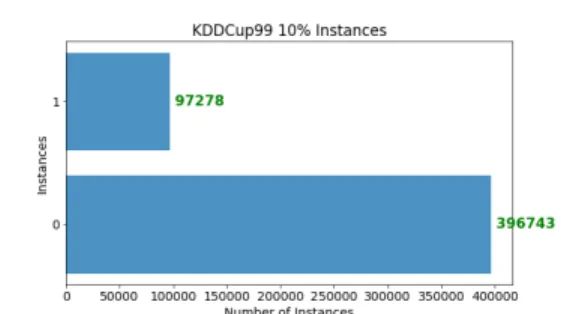
All the standard data mining processes such as data cleaning and pre-processing, normalisation, visualisation and classification were implemented in Python. The batch size of 64 and epochs are run up to 50 and 300 with a learning rate set in the range of 0.01-0.5 on a GPU-enabled TensorFlow network architecture. Also, various traditional ML classification algorithms were used to perform the classification experiments on 10% KDDCup99 dataset in order to analyse the network protocol relationship with the attack used by intruders in generating anomalous network traffic. The ML classification result was compared to LSTM-RNN result in order to further evaluate the performance of LSTM-RNN model. The KDDCup99 dataset used consists of 22 attacks classes and 1 normal class. These attacks were grouped into 4 main attack classes - Denial of Service (DOS), Remote to User (R2L), User to Root (U2R) and Probe. Figure 3 and 4 shows the number of records in each of the classes. All features were used as input vector with 75% as training set and 25% as testing set for the binary and multi classification respectively . The training dataset were normalised from 0 to 1. This was trained using sigmoid activation function through time with ADAM optimiser, sigmoid function was used on all the three gates and categorical/binary cross entropy as loss function for multi and binary classification respectively.
3.1
Experimental Data
Figure 3: Visualisation of data classes in KDDCup99 dataset, with classes defined as (0) for normal and (1) for attacks (DOS, Probe, R2L and U2R as shown in Figure 4)
Figure 4: Four Main Attack Group and Normal Classes
3.2
Evaluation Metrics
The true positive rate (TPR) and false positive rate (FPR) were used to evaluate the effectiveness of LSTM-RNN model.
• True Positive (TP) - abnormal instances correctly predicted as abnormal.
• True Negative (TN) - normal instances correctly predicted as normal
• False Positive (FP) - normal instances incorrectly predicted as abnormal
• False Negative (FN) - abnormal instances incorrectly pre-dicted as normal
3.3
Results and Discussions
To validate the approach of using the LSTM-RNNs model for de-tecting attacks statistical matrices such as accuracy (Acc), precision (Prec), true positive rate (TPR), false positive rate (FPR), recall (Rec) and f-score are calculated (i) to evaluate the ability of the LSTM-RNNs model to accurately detect and classify an attack as abnormal and also (ii) to check the ability of this model to detect different type of attacks accurately.
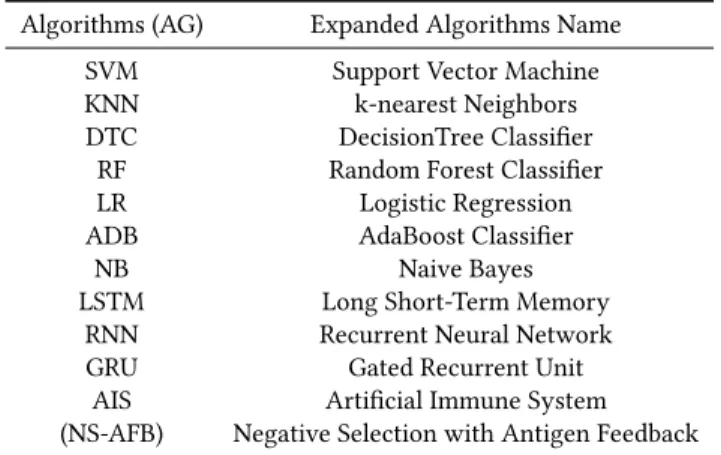
Table 1 contains an expanded name of all the algorithms as used on this paper. Table 2 contains the comparative summary result of the ML algorithms, the LSTM-RNNs network and result of previously published AIS (NS-AFB to be more precise), while Table 4 shows the summary of the performance of each of the algorithms 2019-09-17 10:42. Page 5 of 1–8.
669 670 671 672 673 674 675 676 677 678 679 680 681 682 683 684 685 686 687 688 689 690 691 692 693 694 695 696 697 698 699 700 701 702 703 704 705 706 707 708 709 710 711 712 713 714 715 716 717 718 719 720 721 722 723 724 725 726
SIN 2019, September 12–15, 2019, Sochi, Russian Federation Eke et al.
727 728 729 730 731 732 733 734 735 736 737 738 739 740 741 742 743 744 745 746 747 748 749 750 751 752 753 754 755 756 757 758 759 760 761 762 763 764 765 766 767 768 769 770 771 772 773 774 775 776 777 778 779 780 781 782 783 784 785 786 787 788 789 790 791 792 793 794 795 796 797 798 799 800 801 802 803 804 805 806
in detecting all the four attack groups including 1 normal class. This is also shown in Figure 12, where AG represent algorithms, DT represent detection and classification rate - other abbreviations have been mentioned previously.
Table 1: List of Expanded Algorithms Names as Used Algorithms (AG) Expanded Algorithms Name
SVM Support Vector Machine
KNN k-nearest Neighbors
DTC DecisionTree Classifier RF Random Forest Classifier
LR Logistic Regression
ADB AdaBoost Classifier
NB Naive Bayes
LSTM Long Short-Term Memory RNN Recurrent Neural Network
GRU Gated Recurrent Unit
AIS Artificial Immune System (NS-AFB) Negative Selection with Antigen Feedback
Table 2: Average Binary Summary Results On 10% of KDD-Cup99 Dataset
AG DT Acc TPR FPR Prec Rec F-score SVM 0.994 0.981 0.998 0 1 0.999 1 KNN 0.999 0.999 0.998 0 1 0.999 1 DTC 0.999 0.999 0.998 0 1 0.999 1 RF 0.999 0.999 0.998 0 1 0.999 1 LR 0.997 0.998 0.993 0.001 0.999 0.998 0.998 ADB 0.998 0.999 0.997 0.001 0.999 0.999 0.999 NB 0.945 0.945 0.784 0 1 0.932 0.965 LSTM 0.999 0.999 0.999 0 1 1 1 RNN 0.999 0.999 0.998 0.001 0.999 1 0.999 GRU 0.999 0.999 0.998 0 1 1 1 AIS[22] (NS-AFB) Attacks 0.952 - 0.998 0.479 - - -Normal 0.992 - 0.998 0.790 - -
-•Confusion Matrix: The model was trained on the full de-velopment training set and scores are computed on the full evaluation set. The confusion matrix of the LSTM-RNNs shows the predicted and the actual true binary classifica-tions of normal/attack and detection of all the four attacks group for each of the RNNs as represented on Figure 5-7 and 8-10 respectively. Visual observation of the Figure 4 shows a clear picture of the number of instances of the R2L, U2R and Probes with lower connection records while normal and DOS appear to have more connection records. Those group with more records are learnt properly without confusing their identity while those with fewer connection records during training did not show good true positive rate and
Table 3: Performance Matrix Table for Binary Classification
Criteria LSTM RNN GRU Total No of Samples 494021 True Positive (TP) 32187 32177 32178 False Positive (FP) 34 44 43 True Negative (TN) 130765 130734 130766 False Negative (FN) 41 72 40 True Positive Rate (TPR) 99.90% 99.80% 99.80%
False Positive Rate (FPR) 0 0 0 Score
Accuracy 99.90% 99.90% 99.90%
F-Score 1 99.90% 1
Recall 1 1 1
Precision 1 99.90% 1
Table 4: Average Multi-Class Summary Results On 10% KD-DCup99 Dataset
AG DT Acc TPR FPR Prec Rec F-score SVM 0.991 0.999 1 0 0.999 0.999 0.999 KNN 0.999 0.999 1 0 0.999 0.999 0.999 DTC 0.999 0.999 1 0 0.999 0.999 0.999 RF 0.999 0.999 1 0 0.999 0.999 0.999 LR 0.997 0.998 1 0.001 0.998 0.998 0.998 ADB 0.923 0.924 0.998 0.205 NB 0.931 0.931 1 0.033 0.984 0.931 0.954 LSTM 0.999 0.999 1 0 0.999 0.999 0.999 RNN 0.999 0.999 1 0 0.999 0.999 0.999 GRU 0.999 0.999 1 0 0.999 0.999 0.999
precision as it was had to identify them. This indicates data imbalance problem. The dataset contains many examples for "neptune" that belongs to DOS attack class, "satan" attacks that belongs to Probe and "normal" but fewer examples of the others.
The LSTM-RNNs model was used as classifier and detector. As a binary classifier to separate normal from attacks in-stances, the LSTM-RNNs were able to achieve a significant result of 99.99% average accuracy. A closer observation of the individual performance of each of the RNNs indicates that LSTM model outperformed the RNN with insignificant result, indicating an outstanding overall performance of this model as indicated with good DOS attack detection and acceptable detection of Probe.
4
CONCLUSION
In this paper, we applied IDS based on LSTM-RNNs and evaluated the effectiveness of RNN model and its variants, we also compared our result to previously published work on AIS-NSA [22, 27] and [32] application. We went further to implement attacks classifica-tion with seven different classifiers as contained in Table 1, 2 and 4. The result from this classification were also compared to LSTM-RNN results. We noticed that most of the algorithms applied in this
807 808 809 810 811 812 813 814 815 816 817 818 819 820 821 822 823 824 825 826 827 828 829 830 831 832 833 834 835 836 837 838 839 840 841 842 843 844 845 846 847 848 849 850 851 852 853 854 855 856 857 858 859 860 861 862 863 864 865 866 867 868 869 870 871 872 873 874 875 876 877 878 879 880 881 882 883 884 885 886 887 888 889 890 891 892 893 894 895 896 897 898 899 900 901 902 903 904 905 906 907 908 909 910 911 912 913 914 915 916 917 918 919 920 921 922 923 924 925 926 927 928 929 930 931 932 933 934 935 936 937 938 939 940 941 942 943 944
Figure 5: Binary Confusion Matrix for LSTM
Figure 6: Binary Confusion Matrix for RNN
Figure 7: Binary Confusion Matrix for GRU
Figure 8: Multi-Class Confusion Matrix for LSTM
Figure 9: Multi-Class Confusion Matrix for RNN
Figure 10: Multi-Class Confusion Matrix for GRU
Figure 11: Normal and Attack Binary Detection Accuracy
Figure 12: Performance Accuracy of Each Model on all Five Classes
945 946 947 948 949 950 951 952 953 954 955 956 957 958 959 960 961 962 963 964 965 966 967 968 969 970 971 972 973 974 975 976 977 978 979 980 981 982 983 984 985 986 987 988 989 990 991 992 993 994 995 996 997 998 999 1000 1001 1002
SIN 2019, September 12–15, 2019, Sochi, Russian Federation Eke et al.
1003 1004 1005 1006 1007 1008 1009 1010 1011 1012 1013 1014 1015 1016 1017 1018 1019 1020 1021 1022 1023 1024 1025 1026 1027 1028 1029 1030 1031 1032 1033 1034 1035 1036 1037 1038 1039 1040 1041 1042 1043 1044 1045 1046 1047 1048 1049 1050 1051 1052 1053 1054 1055 1056 1057 1058 1059 1060 1061 1062 1063 1064 1065 1066 1067 1068 1069 1070 1071 1072 1073 1074 1075 1076 1077 1078 1079 1080 1081 1082
study, achieved a competitive accuracy rate with insignificant FAR while few such as ADB and NS-AFB achieved a noticeable FAR, although NS-AFB achieved a good percentage detection accuracy of 95.20% on attacks, 99.20% on normal with TPR of 99.809% on both attack and normal classes. During the training, we also noticed that LSTM-RNN appear to be suitable for classifying high-frequency attacks and also the low frequency attacks with lower confidence prediction of 62.50%, 56.20% and 37.50% for LSTM, GRU and RNN respectively on multi attack detection, while achieving a very sig-nificant average accuracy of 99.99% for LSTM, GRU and RNN on differentiating attacks from normal instances. The percentage accu-racy of LSTM-RNNs model achieved on this study as represented on the Figure 11 and 12 shows that the LSTM model performed slightly better than GRU and RNN model especially in differentiat-ing attack from normal instances. Overall, the result suggest that the LSTM-RNNs model is a good candidate for developing attack detection systems.
5
FUTURE WORK
This work on the application of stacked LSTM-RNN model on IDS using a KDDCup99 dataset is an ongoing study. Further work will explore modelling combination of an optimised LSTM-RNN model and CNN on a time-series dataset - UNSW-NB15 datasets (University of New South Wales 2015 Datasets) over a multi-stage APT detection architecture. As APT is a multi-step attacks, detecting a single stage of an APT technique itself does not imply detecting an APT attack as mentioned by [13]. Patterns embedded in large generated datasets through industrial processes may be dynamic, hence the need for a system that can accurately detect APT in a systematic way at different time step and has the ability to learn, store and update existing patterns with the collection of new data, and also be scalable to process data in large volumes [8]. Hence, the combination of this two model to determine the efficiency of this approach since RNN has the capability to learn temporal dynamic behaviour over a time sequence data. The authors are currently engaged in work in this domain.
REFERENCES
[1] Uwe Aickelin, Dipankar Dasgupta, and Feng Gu. 2013. Artificial immune systems (intros 2).arXiv preprint arXiv:1308.5138(2013).
[2] Uwe Aickelin, Julie Greensmith, and Jamie Twycross. 2004. Immune system ap-proaches to intrusion detection–a review. InInternational Conference on Artificial Immune Systems. Springer, 316–329.
[3] Luca Albergante. 2008. Wireless discussion forums: Automatic management via artificial immune systems. InPerformance Evaluation of Computer and Telecom-munication Systems, 2008. SPECTS 2008. International Symposium on. IEEE, 74–81. [4] Abdelrahman Ayad, Mohsen Khalaf, and Ehab El-Saadany. 2018. Detection of
false data injection attacks in automatic generation control systems considering system nonlinearities. In2018 IEEE Electrical Power and Energy Conference (EPEC). IEEE, 1–6.
[5] BJ Bejoy and S Janakiraman. 2017. Artificial immune system based intrusion detection systemsâĂŤa comprehensive review.Int J Comput Eng Technol8, 1 (2017), 85–95.
[6] Yoshua Bengio, Patrice Simard, and Paolo Frasconi. 1994. Learning long-term dependencies with gradient descent is difficult. IEEE transactions on neural networks5, 2 (1994), 157–166.
[7] Sir Frank Macfarlane Burnet et al. 1959. The clonal selection theory of acquired immunity. (1959).
[8] Meng-Hui Chen, Pei-Chann Chang, and Jheng-Long Wu. 2016. A population-based incremental learning approach with artificial immune system for network intrusion detection.Engineering Applications of Artificial Intelligence51 (2016), 171–181.
[9] Thomas Chen and Saeed Abu-Nimeh. 2011. Lessons from stuxnet.Computer44, 4 (2011), 91–93.
[10] Dipankar Dasgupta, Senhua Yu, and Fernando Nino. 2011. Recent advances in artificial immune systems: models and applications.Applied Soft Computing11, 2 (2011), 1574–1587.
[11] L Dhanabal and SP Shantharajah. 2015. A study on NSL-KDD dataset for intrusion detection system based on classification algorithms. International Journal of Advanced Research in Computer and Communication Engineering4, 6 (2015), 446–452.
[12] Manoel Fernando Alonso Gadi, Xidi Wang, and Alair Pereira do Lago. 2008. Credit card fraud detection with artificial immune system. InInternational Conference on Artificial Immune Systems. Springer, 119–131.
[13] Ibrahim Ghafir, Mohammad Hammoudeh, Vaclav Prenosil, Liangxiu Han, Robert Hegarty, Khaled Rabie, and Francisco J Aparicio-Navarro. 2018. Detection of advanced persistent threat using machine-learning correlation analysis.Future Generation Computer Systems89 (2018), 349–359.
[14] Julie Greensmith, Uwe Aickelin, and Steve Cayzer. 2005. Introducing dendritic cells as a novel immune-inspired algorithm for anomaly detection. InInternational Conference on Artificial Immune Systems. Springer, 153–167.
[15] Emma Hart. 2017. Towards Lifelong Learning in Optimisation Algorithms. (2017). [16] Sepp Hochreiter and Jürgen Schmidhuber. 1997. Long short-term memory.Neural
computation9, 8 (1997), 1735–1780.
[17] Hailing Huang, Weiqiang Guo, and Yu Zhang. 2008. Detection of copy-move forgery in digital images using SIFT algorithm. InComputational Intelligence and Industrial Application, 2008. PACIIA’08. Pacific-Asia Workshop on, Vol. 2. IEEE, 272–276.
[18] Niels K Jerne. 1974. Towards a network theory of the immune system.Ann. Immunol.125 (1974), 373–389.
[19] Bin Jia, Zhaowen Lin, and Yan Ma. 2014. Advanced Persistent Threat Detection Method Research Based on Relevant Algorithms to Artificial Immune System. InInternational Conference on Trustworthy Computing and Services. Springer, 221–228.
[20] Soman KP et al. 2019. RNNSecureNet: Recurrent neural networks for Cyber security use-cases.arXiv preprint arXiv:1901.04281(2019).
[21] Y LeCun, Y Bengio, and G Hinton. 2015. Deep learning. nature 521 (7553): 436.
Google Scholar(2015).
[22] Wanli Ma, Dat Tran, and Dharmendra Sharma. 2008. Negative selection with antigen feedback in intrusion detection. InInternational Conference on Artificial Immune Systems. Springer, 200–209.
[23] Polly Matzinger. 2002. The danger model: a renewed sense of self.Science296, 5566 (2002), 301–305.
[24] Christopher D McDermott, John P Isaacs, and Andrei V Petrovski. 2019. Evaluat-ing Awareness and Perception of Botnet Activity within Consumer Internet-of-Things (IoT) Networks. InInformatics, Vol. 6. Multidisciplinary Digital Publishing Institute, 8.
[25] Christopher D McDermott, Farzan Majdani, and Andrei V Petrovski. 2018. Bot-net detection in the interBot-net of things using deep learning approaches. In2018 International Joint Conference on Neural Networks (IJCNN). IEEE, 1–8. [26] Lalit K Mestha, Olugbenga M Anubi, and Masoud Abbaszadeh. 2017. Cyber-attack
detection and accommodation algorithm for energy delivery systems. In2017 IEEE Conference on Control Technology and Applications (CCTA). IEEE, 1326–1331. [27] Marek Ostaszewski, Franciszek Seredynski, and Pascal Bouvry. 2006. Immune anomaly detection enhanced with evolutionary paradigms. InProceedings of the 8th annual conference on Genetic and evolutionary computation. ACM, 119–126. [28] Praneet Saurabh and Bhupendra Verma. 2016. An efficient proactive artificial immune system based anomaly detection and prevention system.Expert Systems with Applications60 (2016), 311–320.
[29] Neda Afzali Seresht and Reza Azmi. 2014. MAIS-IDS: A distributed intrusion detection system using multi-agent AIS approach.Engineering Applications of Artificial Intelligence35 (2014), 286–298.
[30] Kevin Sim, Emma Hart, and Ben Paechter. 2015. A lifelong learning hyper-heuristic method for bin packing.Evolutionary computation23, 1 (2015), 37–67. [31] Ralf C Staudemeyer. 2015. Applying long short-term memory recurrent neural networks to intrusion detection.South African Computer Journal56, 1 (2015), 136–154.
[32] Thomas Stibor, Jonathan Timmis, and Claudia Eckert. 2005. A comparative study of real-valued negative selection to statistical anomaly detection techniques. In
International Conference on Artificial Immune Systems. Springer, 262–275. [33] S Venkatesan, Ramachandran Baskaran, C Chellappan, Anurika Vaish, and P
Dhavachelvan. 2013. Artificial immune system based mobile agent platform protection.Computer Standards & Interfaces35, 4 (2013), 365–373.
[34] R Vinayakumar, KP Soman, and Prabaharan Poornachandran. 2017. Evaluation of Recurrent Neural Network and its Variants for Intrusion Detection System (IDS).International Journal of Information System Modeling and Design (IJISMD)
8, 3 (2017), 43–63.
[35] Hui Yang, Mourad Elhadef, Amiya Nayak, and Xiaofan Yang. 2008. Network fault diagnosis: an artificial immune system approach. InParallel and Distributed Systems, 2008. ICPADS’08. 14th IEEE International Conference on. IEEE, 463–469.
![Figure 2: Schema of Unfolded Basic Recurrent Neural Net- Net-work [4]](https://thumb-us.123doks.com/thumbv2/123dok_us/9845848.2477607/4.918.511.799.501.624/figure-schema-unfolded-basic-recurrent-neural-net-net.webp)