A Conceptual Framework for Construction of Teacher-made
Computer Educational Software Package for Communicating
Chemical Concepts to Secondary School Students
Eugene U. OkorieDepartment of Science Education, University of Nigeria, Nsukka E-mail: [email protected]
Francis Akubuilo
Department of Arts Education, University of Nigeria, Nsukka E-mail: [email protected]
Abstract
The 21st century society requires special skills and knowledge from individuals to be relevant to the society and participate actively in the economy of nations. To acquire these special skills and knowledge, Information and Communication Technology (ICT) comes to the fore to drive the education system. In Nigeria, the National Policy on Education recognises the importance and place of ICT in ‘advancing knowledge and skills in the modern world’, but serious effort to provide ‘necessary infrastructure and training for the integration of ICT in the school system’ as stated in the policy is yet to be seen. Most public and private primary and secondary schools lack the basic infrastructure, and teachers are yet to be ICT literate. Relevant educational software packages, especially for education in chemistry are scarce. There is need, as part of the chemistry teacher education programme, to include courses in ICT that will enable the chemistry teachers to construct teacher-made educational software packages for teaching specific chemistry concepts. This is necessary in order to fill the gap created by lack of relevant software packages in the school system for teaching and learning of such concepts. This paper proposes a framework for the construction ofteacher-made educational software packages for teaching specific chemical concepts.
1. Introduction
A number of secondary school chemistry curricula emerged by the end of the 20th century and the beginning of the 21st century across the globe. In the West African sub-region, especially in Nigeria, the 21st century secondary school chemistry curriculum points to a new direction in pedagogy in which use of information and communication technology (ICT) is assisting students in learning chemical concepts (Okorie, 2010). ICT in the context of this paper includes, but not limited to, use of computer-based classroom projection tools, the internet, various computer educational software packages, satellite, television, etc that could be integrated into the traditional teaching method to facilitate the teaching-learning process. Mbah (2010) opined that inadequacy of traditional instructional methods and materials gave rise to introduction of ICT in education. This opinion as it were may be the case, given the fact that the traditional methods of teaching chemistry in schools had come under scrutiny and attack, especially because of the unabated decline in secondary school students’ performance in public examination in the subject. Oriaifor (1993) attributed secondary school chemistry students’ low achievement to a function of several factors including proficiency of teachers, teaching method which in Nigeria is ‘still largely based on abstract exposition and learning done by rote memorisation’. Lasisi (1998) observed that chemistry teaching in secondary schools has become too rigid, didactic and expository, and that this traditional method of teaching chemistry limits effective communication of chemical concepts to students.
As a solution to the problem of teaching method in chemistry, Oriaifor (1993) suggested that teachers should adopt the ‘eclectic methods which combine essential components of the traditional or lecture method with those of the progressive’. It is in this spirit of progressiveness that Mckee (1997) suggested that progressive teachers would seize any available opportunity to integrate appropriate multimedia into the learning environment. One of such progressive approaches to pedagogy is the Computer-Assisted Instruction and Learning (CAIL), recommended in most 21st century secondary school chemistry curricula, including that of Nigerian Educational Research and Development Council (NERDC), see NERDC (2009). The use of ICT in pedagogy in the 21st century education has to do with the fact that the 21st century world is a complex and knowledge society driven by science and technology. It is a world that places emphasis on scientific literacy. Scientific literacy is the possession of scientific knowledge, skills, attitudes and habits of mind required to live and participate actively in the science and technology driven world. Each individual needs a good measure of scientific literacy to be relevant in the present day society.
In Nigeria, Section 5, Article 30(f) of the National Policy on Education (FGN, 2004) explains that integration of ICT in school system is ‘in recognition of the role of ICT in advancing knowledge and skills in the
modern world’. As Weeb (2008) asserted, with use of ICT, students receive a deeper understanding of complex science concepts. Besides, 21st century learning calls for learner-centred approaches to education (Voogt, 2003, 2008), where a variety of learning activities are provided, while the students are offered opportunity to learn at their own pace. It is in this regard that Otuka (2012) asserted that ‘ICT occupies a very strategic place in education’. Voogt, Knezek, cox, knezek and ten Brimmelhuis (2013) noted that in the 21st century, new learning processes have emerged and that learners have augmented capabilities by using available basic technology infrastructure and tools. They stressed the need for teachers to be conscious ‘that in today’s teaching, technology has an indispensable role, because it can add to the pedagogy as well as to the content of many subjects’. Indeed, literature is replete with reasons for adoption of ICT, as a very indispensable tool to aid teaching-learning process. The bottom line is that ICT and computer in particular have come to stay as an inevitable factor in the educational enterprise. It is therefore understandable why institutions of learning, teachers and curriculum planners now place emphasis on computer-assisted instruction and computer assisted learning.
The computer is seen as an important, intelligent and versatile electronic machine, and very often, it is not realised that these attributes of the computer depend on the computer software, without which it becomes impossible for the computer machine to carry out any operation (Mbam, 2005). The software is a set of programs necessary to carry out operations for a specific job. These programs consist of step-by-step instructions telling the computer how to carry out operations for a specific job (Gupta, 2008). The computer software’s ability to interface and interact very well with the computer hardware accounts for these attributes associated with the computer. Therefore, meaningful computer operations can only take place when computer software is available in the computer machine.
2. The Problem
The acceptance of computer as a vital instrument for teaching and learning in the 21st century implies that relevant educational software packages to teach specific lessons need to be developed for computer-assisted instruction and learning, especially in chemistry where difficult and abstract concepts abound. Mbam (2005) and Ekoko (2006) point to the scarcity of relevant educational software packages and need to develop them for Nigerian education system. Such software packages might also be relevant to other education systems in the West African sub-region, especially those whose students take the same Secondary Education Certificate Examinations conducted by West African Examinations Council (WAEC). An investigation conducted by this researcher shows that the few educational software packages available in the Nigerian market are not tailored to the curriculum needs of the students; they are therefore not particularly relevant to the education system. It is worrisome to note that most of the available commercially produced educational software packages are pirated copies of the original. Teachers and curriculum planners need to address and find solution to this issue. Care must be taken to ensure that only relevant educational programs are made available to the students. Teachers should be encouraged to develop educational software packages, in order to fill the gap created by scarcity of relevant educational packages needed to achieve the objectives of the Nigerian secondary school chemistry curriculum.
3. The Purpose
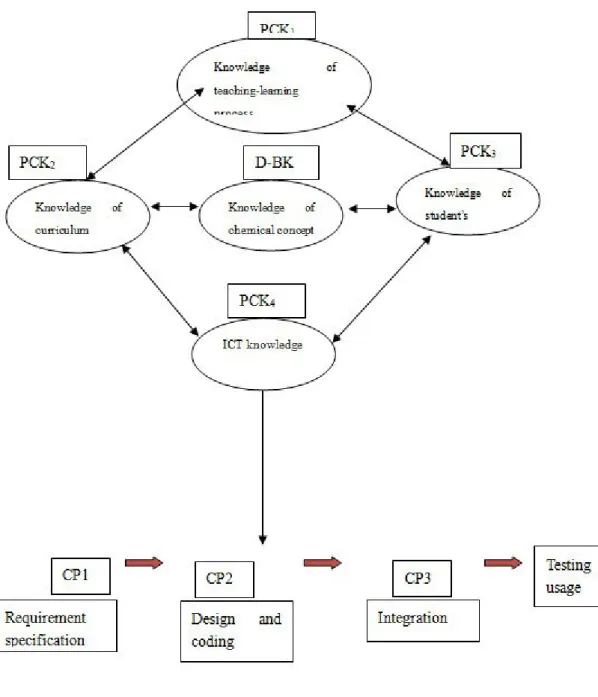
The purpose of this paper is to propose a conceptual framework for developing teacher-made computer educational software packages, for teaching specific chemical concepts in the senior secondary school chemistry curriculum. Known as framework for teacher-made computer educational software package (FTCESP-model) (see Fig.1), it is based on the conviction that 21st century teachers should be computer literate and proficient in use of ICT to aid teaching-learning process. In other words, 21st century chemistry teachers should possess sufficient ICT knowledge and skills such that in addition to ability to use ICT to aid teaching-learning process, they should be able to develop multimedia platforms for communication and interaction between the learning material and students.
Teachers have pedagogical content knowledge (PCK), and discipline-based knowledge (D-BK). As a result of these unique expertise, teachers should be able to communicate concepts to students in a teaching-learning process. Teachers are usually conversant with the curriculum content and very familiar with their students. Familiarity with the students places the teacher in a position to know the student’s attributes and psychological dispositions in classroom situations. This knowledge lies within the domain of pedagogical content knowledge. With this knowledge as a guide, teachers are able to prepare lesson notes, provide relevant teaching aids such as suitable illustrations, diagrams, photographs and teacher-made tests for assessment and evaluation of students’ understanding of the lessons delivered to them. This has always been the case before the advent of ICT. With the adoption in 21st century of ICT as a tool in facilitating the teaching-learning process, the need to align the pedagogical orientation of teachers towards 21st century learning arose. 21st century learning may be defined as the process and acquisition of scientific and technological knowledge and skills needed for
maximum contribution to, and effective participation in the economy of 21st century society.
4. Development of educational software package for specific chemical concepts
An educational software package is one that teaches particular knowledge and skills, of a specific content area and at specified intellectual level and age/grade range. Using the computer, the educational software package aids teaching-learning process. It comes usually with content goals and knowledge built in, and is tailored to suit the difficulty level and topic needs of the learner.
The conceptual framework being proposed here (see Fig 1) is a guide to enable teachers construct their own educational software packages tailored to satisfy the needs of their students in the learning process of a specific chemical concept.
5. The various components of the FTCESP-model are explained as follows.
5.1 Knowledge of Teaching - Learning Process (PCK1)
PCK1 is the first part of FTCESP-model. In this part, it is assumed that teachers know that teaching is causing someone (a learner or student) to acquire knowledge, skills and or modify the learners behaviour. Learning in the context of this conceptual framework is the process of constructing meaning from information and experience made available to the learner by the teacher. Teaching and learning are correlated, and in a teaching-learning process there exists interpersonal influence, which could lead to the modification of the behaviour, for instance attitude of both the teacher and the learner towards each other. The teacher for example, could be influenced by the students’ reactions to a particular teaching method, to re-examine and change the teaching method in order to bring about a positive attitude on the part of the students. Such a positive attitude could help the students in learning the chemical concept without much stress.
5.2 Knowledge of Student’s Characteristics
The teacher is assumed to have a good knowledge of the student’s disposition to learning in a classroom situation; and that the student controls the process of learning in a teaching-learning process, depending on the learner’s interest, motivation, perception, previous knowledge, social interaction and situation context and attitude
5.3 Knowledge of Curriculum Content
The teacher is assumed to have a good knowledge of the curriculum. The curriculum prescribes and articulates the desirable experience intended to be imparted to the students; the sequence and methods of achieving such experiences, usually spelt out as goals and objectives to be reached in a schooling process.
5.4 Knowledge of Chemical Concept
It is assumed that the chemistry teacher has good background knowledge of the chemical concept to be taught. The fact that chemistry student teachers take the same chemistry courses as other students in the Department of Chemistry gives credence to this assumption. In fact, in Nigeria Chemistry teacher training is done by the Department of Chemistry in conjunction with the Faculty of Education.
5.5 ICT Knowledge
With ICT knowledge, teachers can now perform some basic computer operations such as preparation of power point slides, animation of objects, and use of computer-based classroom projection tools and integration of educational software packages into the traditional lecture method of teaching. The ICT knowledge lies within the domain of pedagogical content knowledge, while the knowledge of the concept to be communicated to the students lies within the domain of Discipline-based Knowledge (D-BK).
The interaction of the various components of the FTCESP-model defines the needs of users; and kind of software developmental tools for constructing the software package. These needs are identified; and specified in a blueprint for constructing the software. Satisfaction of users’ needs is the sole aim of constructing the educational software package.
5.6 The Construction Process (CP)
The construction of the software package should take the following three steps: (i) requirement specification (CP1),
(ii) design and coding; (CP2), (iii) integration(CP3),
6.0 Requirement specification (CP1):
At this stage, all that will be needed to design, create and animate electronic slides that run on computers should be identified and recorded. The electronic slides are dynamic slides that automatically change after a set time. 6.1 Design and Coding (CP2)
6.2. Integration (CP3):
This entails adding animation effects to slides in the following order and steps.
a) Transition effect, using this option, the way one slide leaves the screen and another one appearing could be controlled.
b) Custom animation, this enables users to control the appearance of various slide elements, which could be some text image, illustration, photographs, etc.
c) Adding voice to the slide presentation, saving and burning the presentation in a compact disk (CD). This is the software package.
There are several software development tools, which chemistry teachers can use to achieve the above steps, depending on their level of ICT literacy.
7.0 Conclusion
The role of chemistry teachers in 21st century education appears to have been redefined, or rather expanded by use of ICT and lack of relevant educational software packages. The implication is that the present teacher education programme needs to be restructured, to include more ICT courses aimed at equipping the teachers to be able to fashion out and use their own software packages. Prospective and practicing chemistry teachers in the education system should be trained and retrained respectively, to be creative in the use of ICT tools, especially computer; they should be able to successfully integrate ICT knowledge and skills with pedagogical skills to produce their own educational software packages. Equipping teachers to be able to design and construct educational software package for specific concepts in chemistry is a veritable way of ensuring sustainable supply and use of relevant educational software packages for the subject. The FTCESP-model proposed in this paper is significant for this purpose. Teacher-made educational software packages might after all be more effective in educating pupils than those commercially produced. This provides a case for research.
References
Ekoko, R. O. (2006). Computer Usage for Health Instruction in Nigerian Schools: An Overview. Ebonyi State University Journal of Education. September. Vol. 4, No.2. PP.111 – 116.
Gupta, V. (2008). Secret Guide to Computers. New Delhi: Dreamtech Press.
Lasisi, A. A. (1998). Testing the Relative Efficacy of Laboratory Teaching Technique in Enhancing Effective Communication in Chemistry. 39th Annual Conference Proceedings of the Science Teachers Association of Nigeria.PP.167-171.
Mbah, B.A (2010). Benefits and Problems of Integration of Information and Communication Technology (ICT) in Universal Basic Education (UBE) in Nigeria. Curriculum & Media Technology Research: Journal of CUDIMAC, Vol. 2, No. 1, 240-247
Mbam, B.C.E. (2005). Analysis of Computer Software Concepts, Applications, Development and Program Structure. Journal of Information, Communication and Computing Technologies (Maiden Edition) October,
2005, PP. 13-20.
Mckee, B.G. (1997). Multimedia-Effectiveness in the Learning Environment. A Review of Literature. Division of Educational Technology, “Department of curriculum and Instruction. University of Northern Iowa. (Available on-line at) Http://Staff.Niacc.Ed/Bmckee/Edtech/Multimedia.Html. Lastaccessed on 21 February 2011.
NERDC (2009). Senior Secondary School Curriculum (Chemistry). Abuja: NERDC press.
Okorie, E.U. (2010). Secondary Schools Chemistry Curriculum Reforms in the 21st Century: Implication for Nigerian Educational System. Curriculum and Media Technology Research: Journal of CUDIMAC, Vol. 2(1) 108-119.
Oriaifor, S. O. (1993). Developing Curriculum in Chemistry. In Ivowi, U. M. O. (Ed). Curriculum Development in Nigeria. Ibadan: Sam Bookman Educational and Communication Services. pp.131-148.
Otuka, J. O. E. (2012). Enhancing the Status of ICT Knowledge and Skills of Teachers at the Basic and Post Basic Education Levels in Nigeria. A Memorial Lecture at the 53rd Annual Conference of the Science Teachers Association of Nigeria (STAN). August, 6-1.1
Voogt J. (2003). Consequences of ICT for aims, contents, processes and environments of learning. In J. van den Akker, W. Kuiper & U. Hameyer (eds ). Curriculum Landscapes and Trends. Dordrecht: Kluwer. pp. 217–236. Voogt J. (2008). IT and curriculum processes: dilemmas and challenges. In J. Voogt & G. Knezek (eds ).
International Handbook of Information Technology in Primary and Secondary Education. New York, NY: Springer. pp. 117–132.
Voogt, J., Knezek, G., Cox, M., Knezek, D. and ten Brummelhuis, A. (2013). Under which conditions does ICT have a positive effect on teaching and learning? A Call to Action. Journal of Computer Assisted Learning, 29: 4– 14. doi: 10.1111/j.1365-2729.2011.00453.x
Information Technology in Primary and Secondary Education New York, NY: Springer. pp. 133–148. Table 1. Explanation of the FTCESP-model