Machine Learning based Human
Observer Analysis of Video Sequences
by
Seema Faqeer Abdul Rahim Al-Raisi
A Doctoral Thesis
Submitted in partial fulfilment
of the requirements for the award of
Doctor of Philosophy
of
Loughborough University
2017
Abstract
The research contributes to the field of video analysis by proposing novel approaches to automatically generating human observer performance patterns that can be effectively used in advancing the modern video analytic and forensic algorithms. Eye tracker and eye movement analysis technology are employed in medical research, psychology, cognitive science and advertising. The data collected on human eye movement from the eye tracker can be analyzed using the machine and statistical learning approaches. Therefore, the study attempts to understand the visual attention pattern of people when observing a captured CCTV footage. It intends to prove whether the eye gaze of the observer which determines their behaviour is dependent on the given instructions or the knowledge they learn from the surveillance task. The research attempts to understand whether the attention of the observer on human objects is differently identified and tracked considering the different areas of the body of the tracked object. It attempts to know whether pattern analysis and machine learning can effectively replace the current conceptual and statistical approaches to the analysis of eye-tracking data captured within a CCTV surveillance task.
A pilot study was employed that took around 30 minutes for each participant. It involved observing 13 different pre-recorded CCTV clips of public space. The participants are provided with a clear written description of the targets they should find in each video. The study included a total of 24 participants with varying levels of experience in analyzing CCTV video. A Tobii eye tracking system was employed to record the eye movements of the participants. The data captured by the eye tracking sensor is analyzed using statistical data analysis approaches like SPSS and machine learning algorithms using WEKA.
The research concluded the existence of differences in behavioural patterns which could be used to classify participants of study is appropriate machine learning algorithms are employed. The research conducted on video analytics was perceived to be limited to few
projects where the human object being observed was viewed as one object, and hence the detailed analysis of human observer attention pattern based on human body part articulation has not been investigated. All previous attempts in human observer visual attention pattern analysis on CCTV video analytics and forensics either used conceptual or statistical approaches. These methods were limited with regards to making predictions and the detection of hidden patterns. A novel approach to articulating human objects to be identified and tracked in a visual surveillance task led to constrained results, which demanded the use of advanced machine learning algorithms for classification of participants
The research conducted within the context of this thesis resulted in several practical data collection and analysis challenges during formal CCTV operator based surveillance tasks. These made it difficult to obtain the appropriate cooperation from the expert operators of CCTV for data collection. Therefore, if expert operators were employed in the study rather than novice operator, a more discriminative and accurate classification would have been achieved. Machine learning approaches like ensemble learning and tree based algorithms can be applied in cases where a more detailed analysis of the human behaviour is needed. Traditional machine learning approaches are challenged by recent advances in the field of convolutional neural networks and deep learning. Therefore, future research can replace the traditional machine learning approaches employed in this study, with convolutional neural networks. The current research was limited to 13 different videos with different descriptions given to the participants for identifying and tracking different individuals. The research can be expanded to include any complicated demands with regards to changes in the analysis process.
Dedication
I dedicate this thesis to the two most important men in my life my father and my best friend Khalid (my beloved husband) for their endless support and unconditional love. My father always believed in me even in times when I was full of doubt in myself. My beloved husband sacrificed his own future in order to make my dream come true. He was always there cheering me up and stood by me through the good and bad times.
Acknowledgements
First, I would like to thank Allah Almighty for giving me such an opportunity & ability to undertake this PhD project and complete it with satisfaction. This achievement wouldn’t have been possible without his blessings.
I would also like to thank my supervisor Professor Eran, there aren’t enough genuine words in which I can describe an appreciation to my supervisor. One simply could not wish for a better or friendlier supervisor. He has set an example of excellence as an instructor and a mentor. I have been extremely lucky to have a supervisor who cared so much about my work, health and family.
To my dear supervisor, I am grateful to you for giving me the right directions during studies, your understanding, extraordinary patience, lavish assistance and support. I must say that without your advice and trust, I’d never come so far. Thank you very much professor Eran for everything you did to help and support me.
My family deserves a special mention for their endless supports, love and prayers day and night to make me achieve success and honor during my PhD. A special thanks to my father for his moral support and constant encouragement. Many thanks to my mother and sister Samiya for their love, supports and encouragements. I will forever be thankful to them.
My deepest appreciation and love goes to my husband Khalid, who has been with me from beginning of this PhD journey until its end. Thank you for your endless love, your encouragement, your entire confidence in me and for being my true best friend. Thank you for everything you have ever done for me.
My warmly acknowledge to all the colleagues of Computer Science Department at Loughborough University, specially to all Omani colleagues and friends.
Finally, I would like to thank his majesty Sultan Qaboos government the Ministry of Manpower (my sponsor) and Cultural Attaché (Embassy of Oman) for providing the financial assistance and support throughout the research period.
Table of Contents
Abstract ... ii
Dedication ... iv
Acknowledgements ... v
List of Figures ...xii
Chapter 1. Introduction ... 1
Aim & Objectives ... 4
Research Contributions ... 5
Thesis overview ... 8
Chapter 2. Literature Review ... 9
Introduction ... 9
Eye tracker research ... 9
2.2.1 Medical Applications ... 10
2.2.2 Applications in Education ... 11
2.2.3 Applications in Aviation ... 12
2.2.4 Applications in Usability Studies ... 12
2.2.5 Applications in Marketing ... 13
Eye Movement Tracking in CCTV ... 13
Machine Learning and Surveillance ... 16
Chapter 3. Research Background ... 21
The Human Visual System ... 21
3.1.1 Human Eye: perception ... 21
3.1.2 Visual Perception and Attention ... 22
3.1.3 Computer vision versus human vision ... 22
3.1.4 Eye Movements & Visual Attention ... 23
Measurement of eye movements ... 24
3.2.1 Eye tracker ... 24
3.2.2 Tobii studio ... 26
Visual stimuli: static versus dynamic stimuli. ... 27
3.3.1 Text-based stimuli ... 27
3.3.2 Image-based stimuli ... 27
3.3.3 Dynamic stimuli ... 28
Area of Interest ... 29
Data mining tools ... 30
3.5.1 SPSS ... 30
3.5.2 Statistical Method (ANOVA)... 30
3.5.2.1Interpreting the key results of One-Way ANOVA ... 31
3.5.3 Machine learning ... 33
3.5.3.1Predictive models ... 35
3.5.4 Machine learning software ... 38
Statistical Analysis Versus Machine Learning ... 39
Think Aloud Method(TAM) ... 39
Person or human re-identification ... 40
Chapter 4. Experimental Design & Data Gathering ... 42
Research questions ... 42
Methodology for data collection and analysis ... 45
4.2.1 Experimental design ... 46
4.2.2 Data Collection Phase ... 60
4.2.2.1 The procedure ... 60
4.2.3 Data Analysis... 65
Summary ... 68
Chapter 5. Statistical Analysis of Visual Attentional Patterns in Video Footage . 69 Data preparation ... 70
Experimental Results and Discussions ... 71
5.2.1 Research Question 1 ... 74
5.2.1.1Summary Research Question 1 ... 77
5.2.2 Research Question 2 ... 78
5.2.2.1Summary Research Question 2 ... 84
5.2.3 Research Question 3 ... 85
5.2.3.1Summary Research Question 3 ... 88
5.2.4 Research Question 4 ... 89
5.2.4.1Summary Research Question 4 ... 96
5.2.5 Research Question 5 ... 97
5.2.5.1Summary Research Question 5 ... 98
5.2.6 Research Question 6 ... 99
5.2.6.1Summary Research Question 6 ... 100
Summary and conclusion ... 103
Human Observer Behaviour Analysis of CCTV Video Surveillance using Linear Regression ... 105
5.4.1 Data capture ... 106
5.4.2 Data pre-processing or preparation ... 107
5.4.3 Removal of Missing Values ... 107
5.4.4 Attribute or Feature Selection ... 108
Dataset Representation ... 109
Modelling Fixation Duration ... 112
Interpretation and Analysis of Regression Models ... 115
Summary and Conclusion ... 122
Chapter 6. Use of Machine Learning Algorithms to Classify Different Groups of Participants based on Eye Gaze Patterns ... 123
Introduction ... 123
Experimental Procedure ... 125
Experimental Results ... 126
6.3.1 Results for the classification of experts from novice participants: .... 126
6.3.2 Results for the classification of Female from Male participants: ... 128
Analysis of Results ... 130
Summary & Conclusions ... 132
Chapter 7. Conclusion and future work... 133
Future Work ... 136 References ... 138 Appendix 1 ... 148 Appendix 2 ... 180 Appendix 3 ... 187 Appendix 4 ... 194
List of Tables
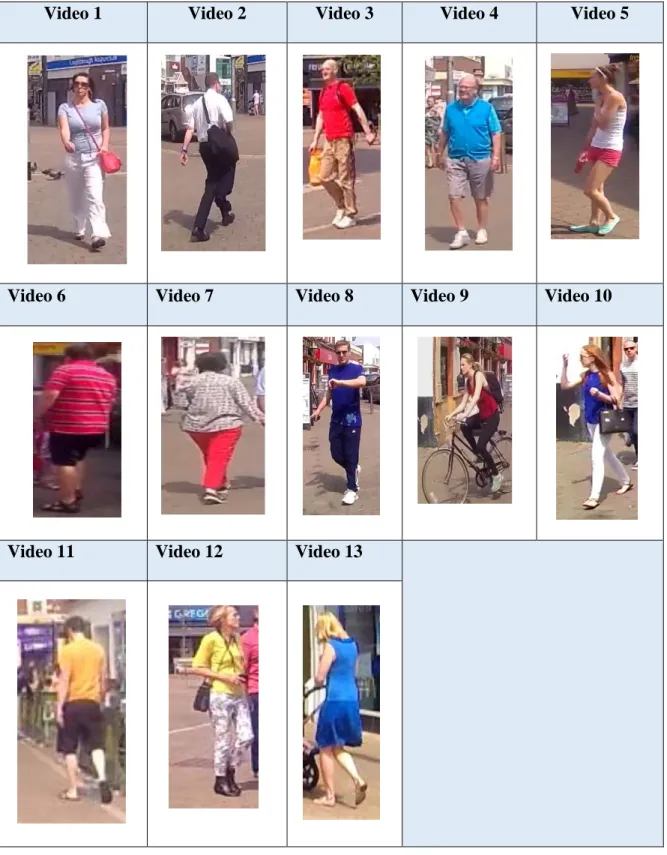
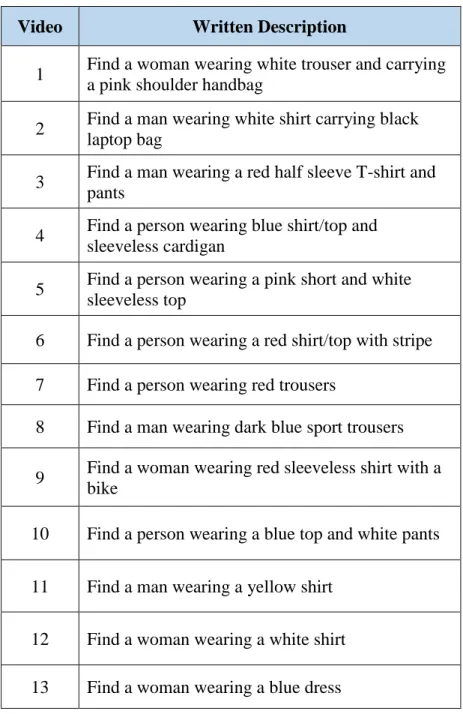
Table 4.1: The written descriptions of the objects to be identified and tracked
in the videos ... 52
Table 4.2: The written descriptions of the objects to be identified and tracked based on level of description from simple to complex ... 55
Table 4.3: DAOI for each video ... 57
Table 4.4: Eye-gaze metrics used in the conducted experiments ... 63
Table 4.5: The two test videos considered for detailed data analysis ... 67
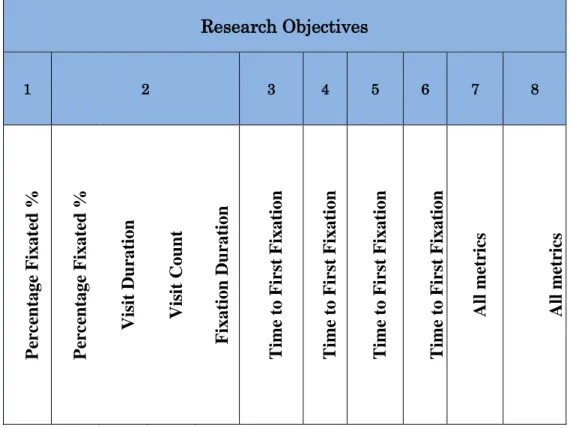
Table 5.1: Mapping between research questionsand data metrics ... 72
Table 5.2: Analysis of Order of Fixation for (a) Video 1 and (b) Video 10 ... 92
Table 5.3 Attributes and attribute ‘type’ for each DAOI ... 106
Table 5.4 WEKA Feature Selection Methods ... 108
Table 5.5 Selected Attribute when all data are considered ... 109
Table 5.6: Sample data selection for video-10 ... 110
Table 5.7: Sample data selection for video-1 ... 111
Table 5.8 The regression models for video-1 ... 114
Table 5.9 The regression models for video-10 ... 114
Table 5.10: Models for video-1 ... 118
Table 5.11: Models for video-10 ... 120
Table 6.1: Groupings of participants ... 124
Table 6.2: Results of classification of Experts vs Novice participants ... 126
List of Figures
Figure 3.1: Tobii Eye tracker Source ... 24
Figure 3.2: Illustration of how eye tracking works ... 25
Figure 3.3: The DAOIs in research conducted ... 29
Figure 3.4 : Reporting one way ANOVA in APA style ... 33
Figure 3.5 : Types of ML ... 34
Figure 3.6 : The general process of machine learning ... 34
Figure 3.7: Linear correlation ... 36
Figure 3.8: Weka Machine learning software ... 38
Figure 3.9: Weka Machine learning software ... 40
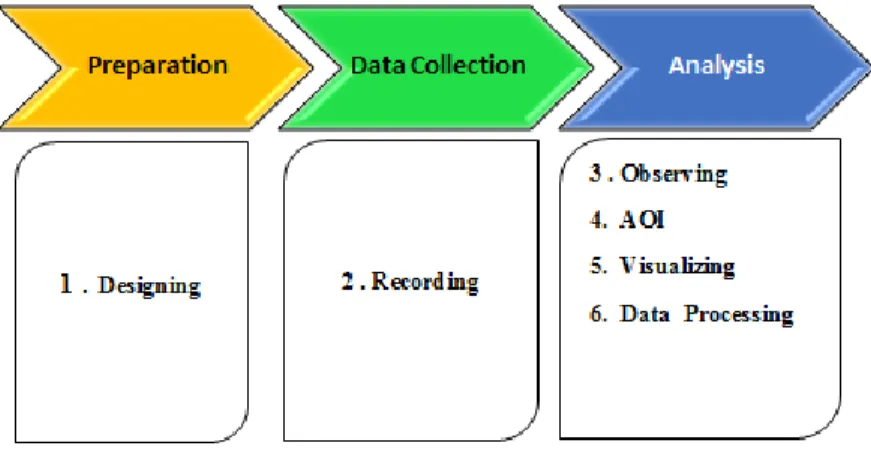
Figure 4.1 : Stages followed in a Research Project ... 45
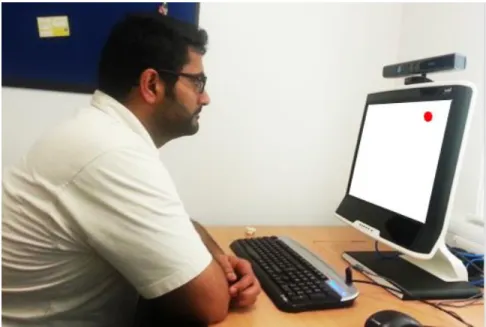
Figure 4.2: Pilot Study Venue (Usability Lab, Haslegrave Building) ... 47
Figure 4.3: Field-of-view of each captured video ... 49
Figure 4.4: Objects that are requested to be identified and tracked by the participants ... 50
Figure 4.5: Objects that are requested to be identified and tracked by the participants ... 56
Figure 4.6: The calibration procedure for a participant ... 59
Figure 4.7: Overview of study setup with regards to data collection and information display ... 64
Figure 5.1: Field-of-view of each captured video ... 73 Figure 5.2: Percentage of respondents that have fixated at least once within
the defined DAOIs in (a) video 1 [ Find a women wearing white trousers and carrying a pink shoulder handbag ] and (b) video 10
Figure 5.3: Average fixation duration for each DAOI in (a) video 1and (b) video 10 ... 80 Figure 5.4: Average visit count for each DAOI in (a) video 1 and (b) video 10 ... 82 Figure 5.5: The average visit duration for each DAOI in (a) video 1 and (b)
video10 ... 83 Figure 5.6: Average fixation time to first fixation for each DAOI in (a) video 1
and (b) video 10 ... 87 Figure 5.7: Novice and Expert Average time to first fixation for each DAOI
in (a) video 1 and (b)video 10 ... 95 Figure 5.8: Female and Male Average time to first fixation for each DAOI in
(a)video 1 and (b) video 10 ... 96 Figure 5.9: Analysis of Average Time to First Fixation for (a) video 1 and (b)
video 10 ... 98 Figure 5.10: Scan paths of all participants (a) before, (b) during and (c) after
the target object appears on screen for video-1 Analysis of Average Time to First ... 102 Figure 5.11: A linear relationship ... 113 Figure 5.12: Correlation coefficient obtained for each DAOI of video-1 and
video-10... 117 Figure 6.1: Results of classification of Experts vs Novice participants (a)
Without bagging (b) with bagging ... 127 Figure 6.2: Results of classification of Female vs Male participants (a)
List of Abbreviations
ANOVA
Analysis Of Variance
AOI
Area Of Interest
Bagging
Bootstrap Aggregation
CC
Correlation Coefficient
CCTV
Closed Circuit Television
DAOI
Dynamic Areas Of Interest
df
degrees of freedom
FC
Fixation Count
FD
Fixation Duration
GPU
Graphics Processing Unit
HVS
Human Visual System
LR
Linear Regression
ML
Machine Learning
MLP
Multi Layer Perceptron
P value
Probability value
PF
Percentage Fixated
RepTree
Reduced-error pruning
RF
Random Forest
SPSS
Statistical Package for the Social Sciences
TAM
Think Aloud Method
TTFF
Time To First Fixation
TTFMC
Time To First Mouse Click
VC
Visit Count
VD
Visit Duration
Chapter 1.
Introduction
While the novel fundamental principles and latest trends are continuously improving technology, one fact that remains is that the general public security is improving, specifically after the introduction of Closed-Circuit Television commonly known as CCTV cameras. The fundamental purpose of the cameras is to provide on-time and recorded visual analytic and forensic services. The cameras have been widely used in almost every organization as they serve the security of individuals, groups or public with visuals at areas that especially authorities have minimal presence in person. The security authorities and departments of such organisations use such videos to manually or automatically review the recorded videos. The advantages brought by the cameras is the key aspect of CCTV systems praised in most popular literature; however, the capability of added computational intelligence potentially possible behind the cameras have been of great interest to computer scientists as the cameras bring to light the possible application of two artificial intelligence branches - machine learning and pattern recognition algorithms within the area of computer vision.
Most videos recorded using CCTV are usually of low visual quality as the cameras are aimed at recording specific areas that are at a long distance or in a dark environment. Further the cost, hardware and software related constraints of cameras themselves may lead to cheaper technology being utilised in the design and manufacture of the CCTV cameras that brings to light the potential use of machine learning and pattern recognition in the post manufacture quality improvement of captured video footage. Nevertheless, these two-computer science related areas have been importantly used, supported by latest development of eye tracking technology, to provide useful information capture from within the contents of recorded CCTV video footage. In particular machine learning and pattern recognition has been used as an aid to the users and/or operators of CCTV
systems due to the ability they provide to especially understand the data provided, identifying and uncovering hidden patterns in the footage.
An Eye Tracker is a versatile device often applied in many fields of applications to study human behaviour. It has been hailed as, “a great opportunity for fascinating researchers to look into the mind” of the participants by analysing their eye movements. Thus far, this device is considered to be the only powerful and fast-growing method for studying and understanding human behaviour research. It has been used in the different fields of application of camera technologies including video surveillance in order to identify, analyse and deliver valuable insights into the gaze patterns of the video observers [24] [25] [26].
Eye trackers and eye movement analysis technology has been used in psychology[6], medical research[18] [19] [20] [21], advertising[9][10] and cognitive science. Today, using CCTV cameras, human eye gaze (i.e. eye movement pattern) is relatively recorded with ease and with high reliability. Since eye movement is primarily a combination of voluntary and involuntary cognitive processes, eye data analysts need to be careful in interpreting the participant’s appearance as well as movements, as this is what is used to infer the participant’s behaviour and intentions. The eye movement data collected from the eye tracker can be analysed using statistical and machine learning methods.
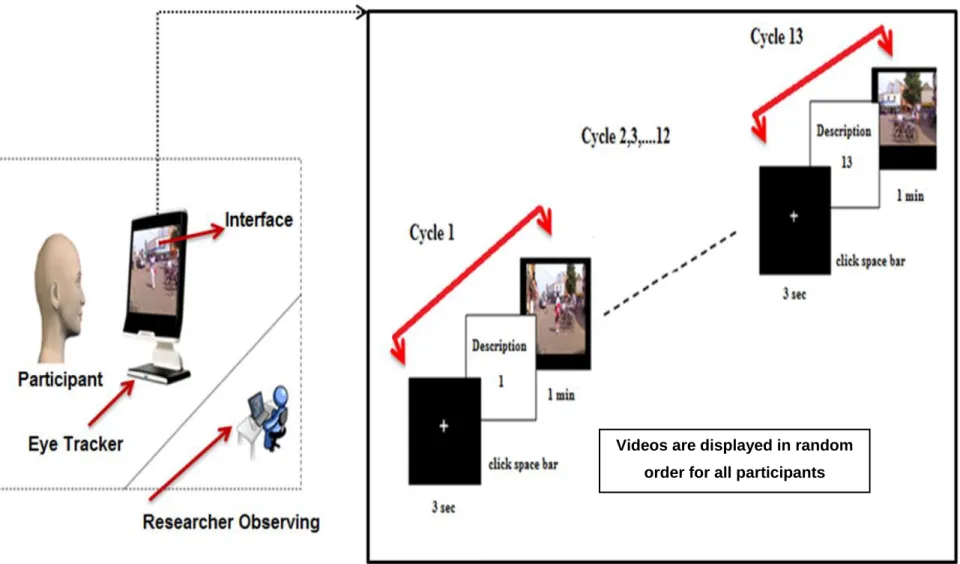
In this thesis, we provide the results of a rigorous study that was carried out to investigate how humans observe and analyse a CCTV surveillance video, when instructed to look for a person with a given description. The pilot study, which lasted for approximately 30 minutes per participant, consisted of observing 13 different pre-recorded CCTV clips of a public space with a clear given written description of the targets to look for, in each video. The study was conducted with the help of 24 participants having varied levels of experience analysing CCTV video. During the experiments, the participants' eye movements were recorded by a professional Tobii eye tracking system. Based on the data captured by the eye tracking sensor and by making use of statistical data analysis approaches using SPSS and machine learning algorithms using WEKA, the observed behaviour of participants is analysed, given a specific task.
To the authors' knowledge, all existing studies of CCTV observer performance analysis use statistical and/or conceptual data analysis approaches using tools such as ANOVA that does not allow observer behaviour pattern analysis [24] [25] [26] as ANOVA is not designed for time based predictive analysis but rather to provide statistical metrics that subsequently needs manual analysis. Further such studies conducted are limited in their analysis as the investigations are carried out with regards to observing eye tracking data captured in visually identifying particular human objects based on their entire body areas that significantly constrains the potential to carry out detailed behaviour analysis. The purpose, however, of using machine learning techniques is to better analyse, identify, learn, understand, make predictions and uncover hidden patterns in the eye tracking data. Given the above reasons the research proposed and presented in this paper could immensely benefit the video analytic community in the future by providing the means to use the automatically generated human performance patterns in making modern video analytic and forensic algorithms, smarter and more time-efficient, especially by making to mimic the behaviour of a human.
Motivated by the above reasoning the proposed research will focus on answering the following research questions:
1) In carrying out a visual surveillance task using captured CCTV footage, is the behaviour of a human observer measured by his/her eye gaze tracking, dependent on the instructions given or knowledge they process about the surveillance task. 2) Is the human observer’s visual attention on human objects being identified and
tracked, different with regards to the different areas of the tracked object’s body and if so how and why.
3) Can pattern analysis and machine learning be effectively used to replace existing statistical and conceptual analysis approaches, in analysing eye-tracking data captured within a CCTV surveillance task.
In the research conducted within the research context of this thesis the above research questions are investigated in detail and answered.
Aim & Objectives
The overall aim of this research study is defined as follows:
“Investigate and understand how a human observes and analyses a CCTV surveillance
video specifically when they are asked to look for a target with a given description”
The above aim is achieved via making an effort to meet the following thesis objectives: 1. Conduct a comprehensive review of literature to investigate existing work on
human observer eye tracking behaviour analysis applied especially to analysing CCTV footage.
2. To investigate in detail, via statistical and conceptual approaches, the eye movement behaviour of a human observer when carrying out an instructed video surveillance task.
In order to achieve this objective five general sub-objectives will be met:
a) Investigate if the participants ‘fixate their gaze’ on all parts of the target human body in the same way or not.
b) To investigate which specific parts of the target body captured the most attention, and why.
c) To investigate what target body attracts attention first when participants have been instructed very specifically about the appearance of a person being searched.
d) To investigate the order in which the participants paid attention to given body regions, given an instruction and in the presence of potential distractions.
3. To investigate using both statistical and data mining approaches, if the written description for search of a specific person has any influence on the order in which participants look at target body parts and pay attention to them.
4. To investigate using advanced machine learning algorithms if the data captured via eye tracking can be used for general behaviour analysis and classification of different groups of people such as experts vs. novice observers, male vs female observers, etc.
The research conducted within the context of this thesis has met all above objectives and have led to the following original contributions.
Research Contributions
The research conducted within the context of this thesis has met all above objectives and have led to the following original contributions.
1. Conceptual Contribution
Previous research with respect to the human observer analysis of CCTV video have not been sufficiently detailed and rigorous enough to analyses observer attention on different parts of the tracked object’s body, given different instructions[24] [25] [26]. This lack of detailed investigation leads one to a number of open research questions. Chapter-4 of this thesis defines a novel method to break-down a human body into four areas of significant visual importance and carry out eye tracking data capture and analysis, based on Dynamic Areas Of Interest (DAOIs) using rigorous statistical and conceptual approaches.
2. Technical Contribution
a) Analysing eye tracking data using statistical and conceptual approaches using SPSS and linear regression using a machine learning suite WEKA to provide valuable insight to the participant visual attention features associated with the surveillance task assigned (when carrying out an instructed video surveillance).Chapter-5 of this thesis proposes the use of linear regression which is a statistical approach by using matching suit called WEKA for the detailed analysis of eye tracking data captured when human observers are carrying out pre-instructed visual surveillance tasks on videos. The novel approaches of data analysis supported by linear regression in WEKA proposed in this chapter not only benefits the research community within CCTV video analytics/forensics, but beyond, specifically those who carry out medical, material inspection and environmental monitoring. This contribution has resulted in the following conference paper.
S. F. Al Raisi and E. Edirisinghe, “A Machine Learning Based Approach to Human Observer Behaviour Analysis in CCTV Video Analytics & Forensics,” Proceedings of the 1st International Conference on Internet of Things and Machine Learning. ACM, 2017. [1] (Appendix 4)
b) To the best of our knowledge previous work on classification of human observer groups based on data captured via eye tracking devices has been limited to direct use of derived statistical data and the drawing of graphs for the visualization of differences for the ease of human interpretation. These approaches are not only tedious but will also not be able to identify the presence of fine detailed discriminative features between data captured from different groups. In Chapter-6 we propose the use of machine learning algorithms for the classification of experts vs. novice participants and male vs female participants, of the experiments carried out within the context of this thesis. The research outcomes prove the capability of machine learning algorithms to carry out such discriminate tasks with a very high degree of accuracy.
3. Overall Contribution
In Chapter-7 we provide an insight into how the outcomes of the research conducted within the context of this thesis was effectively used within another research project to improve the performance of a purely computer vision based human object re-identification algorithm, enabling the algorithms to be re-designed using agent based technology in a manner similar to how a human will carry out the task of visual forensics, showing improvements to the accuracy of the tasks carried out. This work proves the usefulness of the novel research work carried out in this thesis and its potential contributions to CCTV analytics and forensic research.
The research conducted within the remit of this thesis has resulted in the following Secondary contributions:
1. A comprehensive review of literature to investigate existing work on human observer eye tracking behaviour analysis applied especially to analysing CCTV footage (Chapter-2).
2. Data collection (dataset): It was noted that a dataset of similar nature in which the analysis of the eye tracking information based on separate parts of the human body has not been conducted prior to this research and hence no public database is available to support the original research presented in this thesis. Hence it was essential to carry out the tasks relevant to capturing this novel dataset. The dataset collected during this research is going publicly available and this will be itself contribution to the future research committee (Chapter-4).
Thesis overview
For clarity of presentation the thesis is organised into seven chapters as follows:
Chapter 2:
Provides a review of literature on the use of Eye Tracking equipment and data thus gathered on studying the visual attention associated features and patterns.Chapter 3:
Introduces the reader to the research background and covers details of the human visual system, visual attention, eye tracking equipment used in the experiments and the theoretical background of various statistical and machine learning algorithms used in this thesis for data analysis.Chapter 4
: Provides details of the experimental design, the processes adopted in carrying out the subjective experiments, data capture and data preparation for the analysis to be conducted in the contributory chapters that follow.Chapter 5
: Proposes the use of statistical and conceptual approaches to data analysis, providing a valuable insight to the participant visual attention features associated with the surveillance task assigned. It’s also proposes the novel use of linear regression which is a statistical approach by using matching suit called WEKA for the participant visual attention behaviour analysis when conducting the tasks assigned. useChapter 6
: Proposes the use of machine learning algorithms to classify and distinguish
between various groups of participants, e.g. expert vs novice and female vs male.Finally,
Chapter 7
concludes with an insight to future work, including details of a separate project conducted to prove the concepts that are the outcomes of the research presented in this thesis.Chapter 2.
Literature Review
The aim of this chapter is to provide a thorough and extensive review of the research areas related to the work that are relevant to the research that is being undertaken as a result of this project. To this effect the chapter presents previous research on eye tracking experiments supporting a number of applications with the main aim of reviewing how in these attempts the data obtained from eye tracking was analysed.
Introduction
The eye tracking experiments and related developments have been gaining popularity and has been used to great effect within the field of human computer interaction [2]. By integrating eye tracking into HCI based studies it has helped researchers to explore and understand the human Physico -visual system in more detail. Eye tracking equipment have become valuable tools in helping the researchers to understand human behaviour [3] and investigate the relationship between the design of a system, where people are looking and which point of interest within the scene being viewed has captured their attention when completing a task [4]. It is this relationship that can identify whether a system is deemed usable by developing a deeper understanding of the evaluation and the execution of a task.
Eye tracker research
Eye tracking has been a main tool used in human observer behaviour studies [5]. There are many disciplines that had benefited from eye tracking systems both in their research and applications, such as human psychology [6], marketing [7] [8] [9] [10], aviation
[11], education [12] [13] [14] [15] [16], usability [17], medicine [18] [19] [20] [21], marketing [9][10], pilot training assistance [22], entertainment [23], surveillance [24], [25], [26] [27] and so on. In the research presented in this thesis we focus on using eye
this specific discipline in more detail is section 2.3. In the following sub-sections, we present the use of eye tracking systems in other disciplines stated above.
2.2.1
Medical Applications
Detecting Readers with Dyslexia Using Machine Learning with Eye Tracking Measures. [19]
Rello & Ballesteros in 2015 Applied machine learning and eye tracking methods to automatically classify readers with dyslexia and without dyslexia. The data collected from the output was used in the classification tasks.
Visual search behaviour during laparoscopic cadaveric procedures. [20]
Dong et al. 2014 presented results of an investigation carried out to discover if there is any difference between surgeons’ eye movements during an actual operation and while viewing the same in a pre-recorded operation.
Predicting diagnostic error in radiology via eye tracking and image analytics: Preliminary investigation in mammography. [21]
The main aim of the research study was using an eye tracker and machine learning to predict any diagnostic error in mammography by using expert observers’ (radiologists') gaze behaviour and image content. The second aim was study group based and aimed to create personalized predictive models for radiologists depending on their previous skill and knowledge. The data analysis of this research was carried out using ML.
2.2.2
Applications in Education
Eye Tracking and Studying Examples: How Novice and Advanced Learners Study SQL Examples. [13]
Shareghi Najar, Amir Mitrovic & Kourosh 2015 presented research findings of a project where the main aim was to investigate and analyse how advanced and novice students study SQL examples. The data analysis of this research was carried out using ML.
Teachers’ gaze and awareness of students’ behaviour: using an eye
tracker.[14]
In this work authors conducted research to investigate the gaze behaviour of teachers while they watched pre-recorded video of a student’s behaviour in the classroom. The participants’ gaze was recorded using a Tobii T60 and T120.
Tracking learners’ visual attention during a multimedia presentation in a
real classroom. [15]
Yang et al. 2013 investigated students' visual attention while viewing a multimedia presentation (Power Point) in a real classroom. In order to achieve the aim of the research an eye tracking sensor technology was applied to record and analyse eye movement allocation over a multimedia (PPT) presentation.
Learner Behaviour Analysis on an Online Learning Platform.[16]
The first aim of this study was to investigate the learners' behaviour on an e-learning platform in order to produce user profiles that reorganized and regrouped learners depending on their behaviour on the e-learning platform. Secondly, the research resulted in the creation of a system to better understand the requirements of the online learning user in order to improve the learning situation. It was shown that the proposed system can be integrated with the learner agent of an intelligent tutoring system (ITS).
2.2.3
Applications in Aviation
Pilot's Attention Allocation During Approach and Landing -Eye- and Head-Tracking Research in an A330 Full Flight Simulator. [11]
Anders 2001 investigated the use of eye tracking technology within an advanced flight simulator. The professional pilot's head and eye movements were monitored and recorded under real flight conditions in an Airbus A330 full flight simulator (FFS). This recording was used to investigate human computer interaction (HCI) behaviour significantly to study information selection and management and mode awareness in a modern glass cockpit.
2.2.4
Applications in Usability Studies
Effects of User Age on Smartphone and Tablet Use, Measured with an Eye tracker via fixation Duration, and Saccades Proportion. [17]
The aim of this research study was to provide an insight into the effects of user age on interactions with smartphones and tablets applications. An eye tracker (Eyelink-1000 desktop device amounted with IR illuminator) was used to track and record users’ eye movements which were analysed to understand the effects of age and screen-size on browsing effectiveness. The study proved that the elderly users faced difficulties when using or interacting with smart phones and tablet devices as compared to other age groups. All other age groups were affected by screen sizes; the small screen size has smaller cascades proportion indicating uneasy interface browsing compared to large screen size. The results have been statistically evaluated using two-way ANOVA.
2.2.5
Applications in Marketing
Game, Set, Match! Brand eye-tracking on TV sport programmes.[10]
Roy et al. 2008 conducted research to discover the distribution of attention between football games, and banner advertisements by using a sample of people involved in a football broadcast event.
Seeking attention: an eye tracking study of in-store merchandise displays. [9] Huddleston et al. 2015 The aim of this research was to understand online shoppers’ search behaviours. The eye tracking related work where machine learning has been used for observer behaviour analysis presented above has focused specifically on application areas that are not directly related to the subject area of research presented within this thesis. The review also shows that the main approach that is used to analyse the data that gets captured is using statistical methods. In the few attempts machine learning has been used, the study has been limited to the classification of expert and novice users based on their behaviour that is analysed by the eye tracker/s.
The research of direct relevance to the key area of application this thesis is to focus, is detailed below.
Eye Movement Tracking in CCTV
Statistical analysis of visual attentional patterns for video surveillance. [24] In 2013, Roffo et al. showed that understanding the way people visually analyse video sequences, beyond the content they observe in a video, is vital for the understanding and the prediction of people’s activities. The analysis presented in this study was based on eye tracking data on CCTV video sequences. Because of the extensively investigated higher capabilities of expert operators in predicting violence in surveillance footage, the main goal of the research proposed was to understand how expert CCTV operators analyse such videos, and if there is a difference between expert operators and novice participants. It is noted that all the analysis was carried out using statistical approaches.
Suspiciousness perception in dynamic scenes: a comparison of CCTV operators and novices. [25]
In 2013 Iain Gilchrist et al. Proposed that CCTV operators sometimes may be able to predict trouble, and trouble hotspots, very rapidly and they can take less than two-second delay before making any decision. The study suggests that a waiting strategy permits them to take an action and identify supplementary visual information, and may be a thoughtful approach or method to help the operators make a correct decision and reduce the number of false alarms. In this study, the CCTV operators were requested to view 80 clips of recorded footage (such as a night-time view of a car park, a shopping street underpass, a nightclub entrance and a cash point) for one minute each. They were instructed to observe the clips for behaviour believed to be suspicious enough in order to alert the relevant authorities and used a joystick device to specify the perceived level of suspicious behaviour. The eye tracking sensor data were used to calculate the relationship between these ratings and the CCTV operators’ patterns of gaze.
The research results were compared against a group of untrained observers (novices). A statistical data analysis tool was used to analyse the operator's performance. The study established that trained operators spend more time than untrained observers when determining whether a scene is suspicious. The collected data also suggested that trained operators moved their eyes to the significant part of the scene earlier, and they followed very similar viewing patterns. They would normally look at specific areas of focus rather than moving quickly between random locations as was the case with untrained operators and were also much more consistent in spotting suspicious events in ambiguous footage. In addition, the study revealed that CCTV operators decide to undertake additional visual processing to reduce their doubt and help them to make an accurate decision while viewing the footage. While in safety and security situations, where quick and accurate judgements are critical to public safety, this is clearly of significant importance. The data analysis of this research was carried out using statistical approaches.
Automatic Human Behaviour Recognition and Explanation for CCTV Video Surveillance. [26]
Robertson’s et al. research found that explanation of global scene activity, mostly where interesting events had happened, can aid human observer analysis of high volumes of captured data. This was mainly achieved by using an extensible, rule-based method that was generated based on past studies of observer behaviour analysis using statistical methods. This research paper was concerned with creating high-level text reports and explanations of people’s activity in video from single, static cameras, with the motivation being to allow surveillance analysts to provide situational awareness regardless of the presence of huge data. The paper focused on urban surveillance where the pictured person was shown in low/medium resolution. The final output required was text descriptions that explained the interactions that took place and described what was happening (observed human activity). The research also states that the whole system denotes a general technique for video understanding, which involves a guided training phase via an experienced analyst. It is however noted that all the data analysis conducted within the scope of the research presented in this paper were carried out using statistical approaches.
The ( Change ) Blindingly Obvious : Investigating Fixation Behavior and Memory Recall during CCTV Observation. [27]
Dr. Gemma Graham has integrated eye tracking technology into many research projects. In one of her studies she investigated how people observe the CCTV footage[27], mostly when they are given instructions to focus on given features in the video and seeing different severity of crimes. In this research four experiments were carried out in order to investigate the following research questions: “(a) does instruction and/or event type impact where observers view during CCTV footage observation?; (b) how do task instructions and central and marginal information influence fixation behaviour during CCTV observation?; (c) what is the effect of change detection on memory recall during CCTV observation?; and (d) do verbalization, attentional set and/or repeated viewing improve change detection rates and memory recall for CCTV footage?”.
The study was conducted with a different number of participants for each experiment. During the experiments, the participants' eye movements were recorded by a professional eye tracking system. The observer performance was analysed by using a statistical data analysis tool called ANOVA. This research found that the instructions did not significantly affected gaze behaviour for dynamic scenes and any changes in detectors evoked more accurate detail from the CCTV footage as related to the non-detectors, but only in the case where the seriousness of the crime had increased. However, when the observer was repeatedly shown the CCTV footage the rates of change detection improved greatly, but verbalisation made no difference in terms of change detection and the accuracy of memory recall. The last finding obtained from this research can provide help to inform training courses aimed at instructing users on how to optimally attend to surveillance video.
Machine Learning and Surveillance
An American pioneer named Arthur Samuel defined machine learning as “a field of study that gives computers the ability to learn without being explicitly programmed”[28]. The researchers conducted many studies on machine learning in order to make more intelligent machines that can replace as many human tasks as possible. Machine learning is employed in many fields such as education [13] [29], surveillance systems, medicine [30] [31] [32] [33], advertising [34], entertainment (Netflix), autonomous vehicles (self-driving) [35], face recognition [36] and many more.
The following section describes numerous applications of machine learning in the field of surveillance.
Automated Detection of Firearms and Knives in a CCTV Image. [37]
In this paper, the researchers proved that it is possible to build a warning system in order to provide advance alert for any dangerous situation, which may help in reducing the number of victims in a very short time. This research paper concentrated on two tasks of automated detection and recognition of any dangerous activities appearing on CCTV systems. The paper proposed an algorithm to notify the CCTV operator when a firearm or knife is visible in the image thus being able to alert the operator to take quick action.
Identifying moving bodies from CCTV videos using machine learning techniques. [38]
This paper proposed face detection from surveillance cameras using SURF feature extraction and for comparing image descriptors. Normally the task of recognition involves comparing each face detected from the video with all the other faces saved in the database. When new faces come into the camera view the database of images will be updated. However, the face labelling can be done by a human or not be done at all. According to the researcher, if the proposed system is used, it does not require a database of images to start with. The system automatically creates its own collection of images, and then searches for the future occurrences of those images.
A Machine Learning System For Human-in-the-loop Video Surveillance.[39]
This paper introduced a novel real-time surveillance monitoring and offline retrieval surveillance system that studies the properties of items that are interesting to a CCTV operator. This proposed system combines methods from different areas such as human-computer interaction, human-computer vision, and machine learning. In this system, the items that are of interest to the CCTV operator are automatically studied via tracking the operator’s eye gaze positions while they monitor the surveillance video in order to find interesting activities and synthesize interesting actions first.
The researchers plan to extend the proposed system to enable it to work with multiple video and CCTV operators where individual operators view the surveillance video with different interests in mind.
Predictive Policing: Using Machine Learning to Detect Patterns of Crime.[40]
In this paper, the authors proposed a machine learning pattern detection method named as “Series Finder” that can support the police in determining and gaining a better understanding of patterns of crime. This method produces a pattern of crime, starting from a seed of two or more crimes. Basically, the method was trained to discover patterns in housebreaking (i.e. theft within houses) by learning from historical data collected from the Cambridge Police Department’s crime analysis unit.
Summary & Conclusion
The research work reviewed above reveals that a significant number of application domains benefit from observing human behaviour and intent via the use of eye tracking devices. Each of these studies requires an approach to analyse the eye tracking related data that is captured and the main method adopted has been the use of statistical approaches and functionality within statistical software packages such as ANOVA. All previous research mentioned in this chapter with respect to the human observer analysis of CCTV video have not been sufficiently detailed and rigorous enough to analyses observer attention on different parts of the tracked object’s body, given different instructions [24] [25] [26] [37] [38] [40]. Further these studies adopted statistical and/or conceptual data analysis approaches that are limited in their analysis capability in particular in their ability to learn from past observed behaviour and predict towards future outcomes, based on behaviour. Further the investigations carried out with regards to observing eye tracking data captured via visually identifying human objects based on their entire body areas significantly constrains the potential to carry out detailed behaviour analysis. The research presented in this thesis argues that any analysis that will produce realistic behavioural analysis should analyse a human object being viewed in the manner that human’s would naturally do and this needs attention on articulated body parts, separately. For example, humans, when looking at another human would normally either look at the face, the clothes being worn or anything being carried, e.g. colourful handbag etc..This lack of detailed investigation in previous literature leads one to many open research questions that still needs investigation.
Further to the above observation the literature review conducted above clearly demonstrates that most of the work in classification of different human observer groups based on data captured via eye tracking devices has been limited to the direct use of derived statistical and/or conceptual data analysis approaches, data and the drawing of graphs for the visualization of differences for the ease of human interpretation [24] [25] [26] [37] [38] [40]. These approaches are not only tedious but will also not be able to identify the presence of fine detailed discriminative features between data captured from
The capabilities of machine learning when used in data analytics not only could complement statistical data analytics, but could also enable effective behaviour analysis, pattern recognition and behaviour prediction, all of which are vital aspects in detailed human observer analysis. Although a very few attempts have been made in using machine learning for human observer analysis in particular with regards to CCTV operator analysis, machine learning will be able to deliver significant additional pattern recognition, prediction and behaviour analysis tasks, the key focus of the research conducted in this thesis.
In the proposed research the data mining tool WEKA is used for CCTV observer performance analysis, using a linear regression model and other machine learning algorithms, to analyse, identify, learn, understand, make predictions and uncover hidden patterns in the eye tracking data / behaviour. Use of WEKA prevents this research having to focus on the implementation of standard machine learning algorithms, saving time and effort
The research conducted within the context of this thesis and presented in chapters 4, 5,6 and 7 contributes towards closing this research gap as briefly highlighted in Chapter 1.
Chapter 3.
Research Background
The purpose of this chapter is to provide a thorough and extensive information about the conceptual and theoretical background of the subject areas this thesis covers. To this extent the chapter initially presents the Human Visual System (HVS), operational aspects functionality of eye tracking systems, and details about visual stimuli. The chapter also presents information about different data mining tools and methods that have been considered to analyse the data collected via the eye tracking systems in this thesis, the difference between statistical approaches to investigating collected data and the proposed machine learning algorithms based approach and concept behind the thinking aloud method often used to complement the data capture during an eye tracking experiment. The information provided in this chapter is most essential to understand the main body of the thesis, if the readers are interested in more detail regarding this information can refer to the original publications and references where appropriate.
The Human Visual System
3.1.1
Human Eye: perception
The human eye is one of the most vital, important, valuable and very complex human organs. It has a very complicated structure. It uses light and allows humans to see objects and the colourful world around them [41]. When a light beam is reflected off an object it enters the eye through the pupil and passes through the lens. The lens reverses the viewed object’s picture upside down and focuses it onto the retina. The retina has two types of light-sensitive cells called rods and cones, which transmit impulses to the brain via the optic nerve. Finally, the optic nerve transfers the readings of the light sensitive cells from the eye to the brain. When the brain obtains this reading, it directly tries to process it by
turning the image back to the right way up and detects the object which has been seen by the eyes [42].
3.1.2
Visual Perception and Attention
One of the ways we experience the world surrounding us is via our vision (eyes). Visual perception can be simply defined as the way humans get to know and understand the world surrounding them through what they see by using two organs, the eyes and brain[43]. Therefore, what is seen through our eyes is interpreted by the brain. The brain is the most significant organ in the human body and enables one to work out what the eyes see [44]. It is also known as sight, vision or eyesight. It is caused when visible light reaches the eye and we have the ability to interpret the information and our surroundings [45]. In psychology, visual perception is the process or ability by which sensory information from our eyes is transformed to produce an experience of shape, size and brightness of objects and we perceive the distance telling us how close or how far away an object is [46]. Moreover, it involves the brain's ability to interpret the surrounding environment by processing information; that is, it processes and integrates incoming functional activity as an outcome. Whenever we look at the world surrounding us, we do not process every single piece of information available. We basically perform a perceptual selection process called attention. In this process, we select and filter out unnecessary or less significant information so that we can deal with the most important elements.
3.1.3
Computer vision versus human vision
Computer vision is a field that includes methods for acquiring, processing, analysing, and understanding images and, in general, high dimensional data from the real world in order to produce numerical or symbolic information, e.g., in the forms of decisions[47]. However, for many complex problems raised in the field of computer vision, human learners are much better than machines in learning and recognizing. The humans visions have highly accurate internal recognition and learning mechanisms that are not yet fully understood by researchers. They often have experienced more extensive training data
during their lifetime with the visual world [48] that a computer vision based system will never be exposed to, during training. The most challenging goal of computer vision at present is to solve visual challenges for which human observers have gained effortless expertise, such as face recognition, object recognition, image segmentation, medical image analysis and more [48]. However, there is still some obvious gaps between human performance and performance of a computer vision application. With the advances made in research and technology development, the researchers are trying their best to improve current methods to not only mimic the human visual system, but also reach its performance levels. However, the changes to date are below the level of human performance.
3.1.4
Eye Movements & Visual Attention
The eye plays an important role in helping humans and other species to easily detect and recognise objects. The human eyes are always scanning and moving until they stop and focus on a point of interest. However, during visual perception the eye has two major functions, fixation and tracking[49][50]. Fixation is to position the target object into the fovea. This function allows our eyes to maximize the focus we can give to the object even when the object is moving. Tracking an object is important because most real world objects move, and without the ability to track, we will have a very difficult time perceiving things around us[50].
The human eye makes different kinds of eye movements, and each type of movement provides a different function in visual perception. There are over ten different types of eye movements, of which the most important ones for us and for the eye tracking perspective are saccades, fixations and smooth pursuit.
A fixation is the sustaining of the eye focus on a single area [51]. When the eye moves very quickly between any two given consecutive fixation points on the viewed scene, these movements are called saccade. The quick eye movements allow the eyes to concentrate on various parts of the visual world to gather as much information as possible and draw a general picture in our brain [50]. However, the main movement of interest for our research is smooth pursuit. Smooth pursuit movements are used to track moving
objects, and as stated previously this is an important function because most objects in the real world move. In our daily life this eye movement is most vital, as without the ability to track moving objects surrounding us we would not be able to walk safely on the streets because we wouldn't be able to perceive cars and bikes etc. [50]
Measurement of eye movements
In 1897 the first eye tracker was developed[52]. Since many different methods and sensors have been developed for measuring eye movements. The equipment (sensor) we used for measuring eye movements in this thesis is a Tobii eye tracker, which consists of a computer screen with a built-in camera that captures the participants’ eye movements.
3.2.1
Eye tracker
In the simplest terms, eye tracking refers to recording eye movements whilst a participant examines a visual stimulus [53]. It basically tracks the eye movements and that tells us where, how and when people look. This gives meaningful insights about behaviour and performance that may be important for any research. Eye tracking technology is increasingly applied to research in several areas, such as design, testing and diagnostics, and entertainment etc. Eye tracking data is collected using either a remote or head-mounted eye tracker connected to a computer.
An eye tracker consists of two main parts: sensor (camera & projectors) and algorithms. The projector sends out near infrared light beams toward person’s eyes. The eyes receive this light and reflects the light. The reflected light is then captured by the eye tracker’s cameras. Finally, the image processing algorithms find specific details in the user’s eyes and reflection patterns, and understand the image stream generated by the sensors. They basically calculate the user’s eyes and gaze point on a device screen. Based on details gathered, a mathematical algorithm calculate’s the eye’s positions or in other words eye tracker knows where the human subjects looking. The figure 3.2 illustrates how an eye tracking works.
For this study, we collected experimental data using the Tobii T60 eye tracker [54]. This non-invasive device is connected to a computer; it captures and records the position of the user's gaze on the screen using infrared cameras. This particular eye tracker was chosen for a number of reasons:
1. A user friendly and easy to use device.
2. Simple, quick and fully automatic calibration producer: The system displays a number of points to follow in order to help the eye tracker to learn or know the characteristics of participant’s eyes. This procedure helps the sensor to work as expected, for eye tracking to work accurately. The calibration is done in less than a minute and it can save and reuse calibrations for future use.
3. Allow the participants to freely move their head.
4. Integrated and comprehensive eye tracking, analysis and visualization software provided with the eye tracker.
3.2.2
Tobii studio
Tobii eye trackers offer a unique platform and an opportunity to work with Tobii Studio; it is considered one of the most advanced tools for visualization and analysis [56]. The eye tracking data is easily processed for useful comparison, interpretation and presentation. This software provides a complete platform for easy designing, presenting testing procedures, recording, observing, visualizing and analysis of eye gaze data by using statistics. Tobii Studio features a new ‘Area of Interest’ (AOI) tool that allows users to easily create areas of interest on stimulus, both on static (images) and on dynamic areas of interest (video and animations). This allows the eye tracking researcher or analyst to calculate quantitative eye movement measures easily by automatically analysing the AOI [56]. In addition, setting up, participant eye calibration and carrying out an experiment with Tobii Studio software is easy as compared to other competing eye trackers that are available commercially. These amazing built-in features make the software user friendly and allow users to work with the system without extensive training or the need for the participation of experts.
Visual stimuli: static versus dynamic stimuli.
A static stimulus is a visual scene that does not change in time, such as images, text and advertisements (containing images and text or both).
3.3.1
Text-based stimuli
When we look at a visual scene or read a text, a series of eye movements occur known as the scan path. The scan path is the sequence of eye fixations and saccades made when someone looks at a visual scene or reads a text [57]. In 2011 Holland et al. [58] proposed a method for biometric identification based on the scan path using a text as a stimulus. In this paper, the authors have reported the eye trajectories of the observers during a short reading task and analysed quantitative properties of the scan path produced while reading; for example, the number of fixations and the average duration of each. During repeated viewings of the same text-based stimulus most of the participants tend to repeat certain scan paths. The results indicate that variations in the scan between observers and the similarity of paths in the same person might make the text-based stimulus hold promise to excite the behaviour of the eyes for an eye movement biometric technique.
3.3.2
Image-based stimuli
Komogortsev et al. [59] studied the use of static images as a stimulus for eye movements. In this study, the authors used a complex pattern image called Rorschach inkblots and concluded that the inkblots could be used for eye movement biometrics. The inkblots were used in psychological tests where the subjects' perception of the inkblots is recorded and analysed.
3.3.3
Dynamic stimuli
Dynamic stimulus is a visual scene that changes in time, such as videos, animated pictures, dynamic visualizations and real-world scenarios.
• Jumping point stimuli
The first work, which attempted to study eye movements as a personality trait for biometric identification, was conducted by Kasprowski and Ober[60]. The researchers designed a stimulus consisting of a 3x3 matrix of yellow dots and used this stimulus to excite the movements of the eyes for biometric identification. Each yellow dot flashed one after the other for 550ms to create an animation of a jumping point. The jumping point stimulus has been extensively used by many researchers for eye movement biometrics. Komogortsev et al. [61] studied a similar approach to evaluate the feasibility of using eye movements for biometric identification. The purpose of the study was to identify the movements that could be used for biometric identification by using a simple dynamic stimulus such as a jumping point.
• Movie stimuli
Kinnunen et al. [62] used a movie as a stimulus for exciting the eye movements for biometric identification. The reason for using a dynamic stimulus in their research was that watching a movie is not associated with a specific task or instructions to perform, and movies as a stimulus method can be used for stealth identification.
In the study, all the participants were requested to watch 31 movies in 25 minutes presented on an eye tracker screen one after another.
The eye movement signal was segmented into short-term signals to determine how much time was necessary for collecting usable eye movement data for biometric identification. The authors worked out that five minutes of movie watching was sufficient to collect eye movement data for biometric identification.
Area of Interest
The AOI (Area Of Interest ) and DAOI (Dynamic Area Of Interest) is a powerful concept that allows the eye tracking researcher or analyst to easily define areas of interest on the stimulus such as videos and images[63]. This concept is integrated in Tobii Studio and helps us easily and simply create a boundary around a target body. For this study, we used a DAOI because the target is not static; the target is dynamic as it is moving or walking across a scene in CCTV footage. The DAOI calculation tool in Tobii is considered a powerful way to quantify gaze data; rather than knowing where the test participants were looking, we can get information on which object (DAOI) they were looking at by automatically calculating and analysing DAOI. The DAOIs utilised in the research conducted within the scope of this research is illustrated below.
Data mining tools
In this section, we present the different data mining tools and methods that were used to analyse the data collected in the research of this thesis.
3.5.1
SPSS
In Chapter-5 we show the use of Statistical Package for the Social Sciences (SPSS) version 23[64] in the analysis of the data collected via the eye tracker sensor used in the proposed experiments. SPSS Statistics is one of the most popular advanced software packages used for statistical analysis. This software is commonly used in the social sciences and many other disciplines for managing data and calculating a wide variety of statistics. The reason for using SPSS in our research is that SPSS includes many features and functions that help us to make the most out of the statistical data we obtained from Tobii studio software. It helped in finding trends in the data to produce a clear and correct outcome and offered the means to draw effective graphs and provided many other benefits.
3.5.2
Statistical Method (ANOVA)
Using data generated from Tobii Studio, a one-way analysis of variance (ANOVA) data analysis method was used in the proposed work to establish if there are differences in the areas of interest for different eye tracking measurement metrics. The ANOVA is appropriate for various reasons. Firstly, each measurement metric focuses on a single variable. Secondly, One-way ANOVA is an inferential statistic that allows generalization of the findings from a sample to the entire population. Lastly, ANOVA allows for comparison of more than two groups. In this case, there are three or more groups that represent each area of interest. In addition to One-way ANOVA, graphs were used to provide visual representation for comparison of the groups.
3.5.2.1
Interpreting the key results of One-Way ANOVA
After carrying out statistical analyses of data, it is very important to report findings (what we did and what we found) in a simple and easy to understand language.
The following are the relevant parts of the SPSS output that is required in order to report our findings: the p-value F-value and the df value [65] .
a. p-value
P is a short form of probability. It is used in order to determine whether our condition means were statistically significant or not significant (different from one another). The p-value ranges from 0 to 1, If the p-value is >.05 this indicates that there is no significant difference b
![Figure 3.7: Linear correlation[72]](https://thumb-us.123doks.com/thumbv2/123dok_us/341148.2537452/50.918.154.758.121.462/figure-linear-correlation.webp)