Research Journal
Volume 10, No. 31, Sept. 2016, pages 31–39
DOI: 10.12913/22998624/64016 Research Article
DEVELOPMENT AND IMPLEMENTATION OF HASH FUNCTION FOR
GENERATING HASHED MESSAGE
Erfaneh Noroozi1, Amir Ghaeedi2
1 Young Researchers and Elite Club, Dariun Branch, Islamic Azad University, Dariun, Islamic Republic of Iran,
e-mail: [email protected]
2 Islamic Azad University of Dariun Branch, Dariun, Islamic Republic of Iran
ABSTRACT
Steganography is a method of sending confidential information in a way that the existence of the channel in this communication remains secret. A collaborative ap
-proach between steganography and digital signature provides a high secure hidden data. Unfortunately, there are wide varieties of attacks that affect the quality of image steganography. Two issues that required to be addressed are large size of the ciphered data in digital signature and high bandwidth. The aim of the research is to propose a new method for producing a dynamic hashed message algorithm in digital signa
-ture and then embedded into image for enhancing robustness of image steganography with reduced bandwidth. A digital signature with smaller hash size than other hash algorithms was developed for authentication purposes. A hash function is used in the digital signature generation. The encoder function encoded the hashed message to generate the digital signature and then embedded into an image as a stego-image. In enhancing the robustness of the digital signature, we compressed or encoded it or performed both operations before embedding the data into the image. This encryption algorithm is also computationally efficient whereby for messages with the sizes less than 1600 bytes, the hashed file reduced the original file up to 8.51%.
Keywords: digital signature, steganography, bandwidth, authentication, hash message.
INTRODUCTION
Since people have been succeeded in making connections among themselves, the issue of con -fidential (private) connection came to the atten -tion, too. At first; the application of confidential connection was mostly in martial issues. With the development of civilization, the use of ciphering in issues like politics became essential. Public key encryption technique is the desired encryption technique that each input bytes into exactly one byte as output. The secret key can be any string such as a word, a number, or just a string of random letters. Then the secret key is used to change the content of the information in the method. One of category of hiding information is steganography that is a way of inserting information in host image and its end is protecting copyright law,
validation and legitimization of image [Shin and Ruland, 2013]. In all the cases, manipulation of image for inserting information should be in a licensed limit, so that there would be no damage to the image. Nowadays, various applications of steganography like monitoring the way of product distribution, ownership validation, copy control and concealed communication are introduced [Saadi et al., 2009].
Digital signature scheme and steganography are the popular techniques available to hide data securely. In fact, in a communication channel, steganography is a method of sending confiden -tial information in a way that the existence of the channel in this communication remains se -cret [Thomas and Singh, 2013]. The three most important parameters for image steganography are: i) payload, ii) imperceptibility, iii) robust
ness [Makbol and Khoo, 2013], and impercep -tibility should be observed in applying the tech -niques which attempt to enhance the payloads or robustness. A collaborative approach between steganography and cryptography is suggested by Islam et al. [2010]. Using Public Key Infra -structure (PKI) method, the approach provides a high secure hidden data, although the size of the cipher-text is a genuine problem for the steganography. In order to preserve integrity, PKI encryption has been proposed by Wang et al. [2009]. By using a hash function of digital signature instead of PKI, we can obtained faster processing and less size for authentication of the message. In steganography, the original message remains without any change and it is just con -cealed by using an embedding technique into a cover medium. By doing the reverse function, we can retrieve the original data.
In computer networks, bandwidth or data transfer rate is the amount of information that can be transmitted from sender to the receiver side in the specific given time [Chen et al., 2001]. In dig -ital signature scheme after generating dig-ital sig -nature, original file with the digital signature have to send to the receiver side, separately. Conse -quently, a high bandwidth [Jansirani et al., 2011] is required. Thus, for solving this issue, the data was transformed into encoded format and then these data were embedded in an image file, finally the image file with the much lower bandwidth is transmitted. By this scheme not only the authen -ticity and the integrity of images can be verified, but also the illegal modifications can be located.
The ability to create dynamic digital signature is highly related with the integrity and robustness of the image steganography. As a significant veri -fication method, digital signature algorithm in -troduces a technique to endorse the contents of
the message. This message has not been altered throughout the communication process [Filler et al., 2009]. Thus, it increases the receiver confi -dence that the message was unchanged. Two drawbacks when using digital signature schemes are extra bandwidth and large file size during transmission. Implementing an encryption al -gorithm in the spatial domain steganographic method can contribute to increasing the degree of security. Unfortunately, there is wide variety of attacks that effect on quality of image steganog -raphy, although there are methods for data hiding but they are still very weak in resisting these at -tacks. The aim of the research is to propose a new method for producing a dynamic hashed message algorithm in digital signature and then embedded into image for enhancing robustness of image steganography with reduced bandwidth.
Research objectives is to analyze the robust -ness of dynamic digital signature for authentica -tion purpose by image steganography.
POPULAR TECHNIQUES AVAILABLE TO
HIDE DATA
Steganography, cryptography and watermar-king are the popular techniques available to hide data securely. Steganography except for its different purpose is similar to watermarking. Hiding the existence of a message with high data capacity is the aim of steganography while the concentration of digital watermarking is mostly on the robustness of embedded message rather than capacity or concealment. The purpose and application of the first is augmenting capacity while the second’s focus is on robustness. The first uses a communication channel to transfer
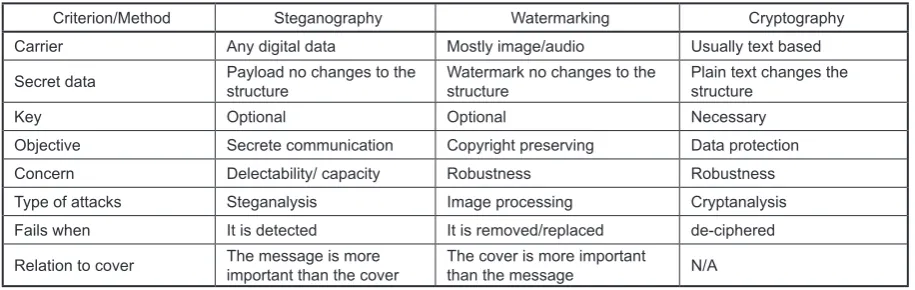
Table 1. Comparison of techniques available to hide data securely
Criterion/Method Steganography Watermarking Cryptography Carrier Any digital data Mostly image/audio Usually text based Secret data Payload no changes to the structure Watermark no changes to the structure Plain text changes the structure
Key Optional Optional Necessary
information in an undetectable way, while the second focuses on copyright protection and looking after the legal application of a particular software or media [Mazumder and Hemachandran, 2012]. The human eye cannot detect the difference between before and after the process of embedding. Since the different between the original image and watermarked image can be easily detected, we can distin -guish visible watermark easily. Watermarking for binary and halftone images is suggested by [Lee et al., 2009; Kim et al., 2006]. Their approach is using data hiding by self-toggling (DHST) scheme that is known as authentica -tion watermarking by self-toggling (AWST) especially proper for dispersed dot halftone images than for binary images. The compari -son shows that steganography can be applied in any kind of media such as image, audio and video, while cryptography is only used for text-based data.
Steganography algorithm
The most widely used algorithms for embed -ding data into images are the JSteg and F5 spatial domain algorithms.
Spatial domain technique
The commonly-used technique to embed message bits in DCT coefficients is the least sig -nificant bit (LSB) embedding technique [Goyal and Chutani, 2012; Ahmed et al., 2010]. The LSB insertion method alternatives the least significant bits in each pixel with the secret data; this tech -nique is effective, easy and has high embedding capacity [Aarumugam and Rajan, 2011].
JSteg algorithm
The JSteg algorithm (Fridrich and Kodovsky, 2011) was one of the first JPEG steganography al -gorithms. Developed by Derek Upham, JSteg em -beds message bits in the LSB of the JPEG coeffi -cients. In this method, the index of the JPEG coef -ficients is not randomized to embed the message bits. JSteg embeds no message with the values 0 and 1 in DCT coefficients. This is to avoid chang -ing too many zeros to ones because the number of zeros is extremely high [Fridrich et al., 2003]. If we compare it to the number of ones, the number of zeros that will be altered to ones is more than the number of ones being changed to zeros. As
in the JSteg algorithm, the data are concealed in the Blowfish algorithm by substituting the LSB of the DCT coefficients but there is a difference which is that here all the coefficients (even those with values of 0 and 1) are used [Westfeld, 2009]. Visual changes detectable by the human eye are the result of concealing more data. Generally, the messages are embedded in lossy compressed JPEG images by the JSteg steganographic algo -rithm [El-Ghoneimy, 2008].
F5 algorithm
One of the most popular steganographic al -gorithms is F5 [Westfeld et al., 2010], which is undetectable using the chi-square technique [Filler et al., 2009]. To encode message bits, F5 uses matrix encoding. The changes are distributed evenly throughout the stego-image with the help of permutated straddling [Filler et al., 2010]. By changing only one of the places, matrix encoding can embed k bits. Any DC coefficients and coeffi -cients with a zero value are not changed by the F5 algorithm. Since zero value coefficients are not considered in decrypting, the same message bit should be embedded in the subsequent coefficient until its value becomes non-zero (Andrew, 2009), but the histogram of JPEG coefficients will be modified by this technique in a way that can be predicted [Goljan et al., 2009].
METHODOLOGY
Operational framework
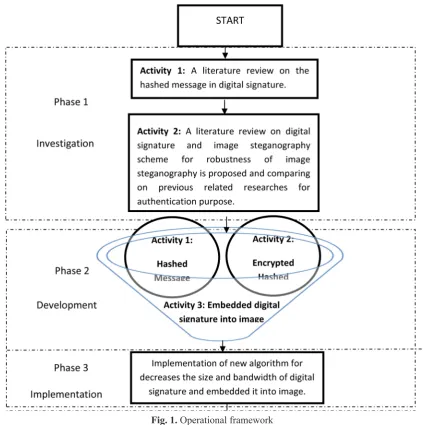
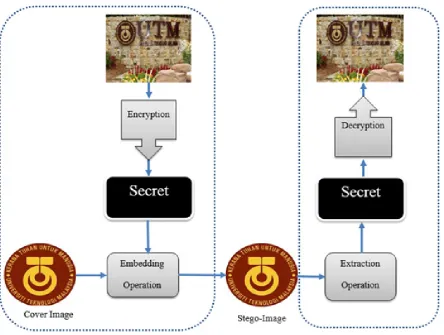
The overall aim of the research is to propose a new method for producing a dynamic hash mes -sage algorithm in a digital signature and then embedding it into an image in order to enhance the robustness of image steganography. This is accomplished by implementing the operational framework as shown in Figure 1. Phase 1 and each of the subsequent phases are explained in detail in the following sections.
data. The third phase involves implementation of the proposed algorithm.
DEVELOPMENT AND IMPLEMENTATION
A new digital signature that is developed by using RGB color image steganography for au -thentication purposes is proposed. After produc -ing the digital signature with a small hash size, both as text and image, we can embed it into the cover image and produce the stego-image. This research is designed to fulfill the requirements of reduced bandwidth and increased robustness and imperceptibility of the embedded data.
Development of the algorithm
In the proposed algorithm, we use the first bytes of the original file by the fetching function
and set the data in variable characters. A hashing algorithm is explained as the following phases: the fetch phase, compare phase and written phase. Then, the hashing function is fetched followed by the encoder function. The encoder function opens the hashing file and 16-byte private key. Once we don’t reach the end of the hashed file, the first byte of the private key and the first byte of the hashing file will be XOR and the results are placed in the first byte of the key. The algorithm adopted is as follows:
int main (void){
int x, y; int mn; strnset (sign, passlen*2); FILE ∗ myfile;
Char filename [80]; text mode (C80); clrscr ( ); Printf („Signature Generator Version 1.00\n”);
Printf („Enter File Name: „);
Scanf („%s”, filename); My file = fopen (filename,”rb”); If (myfile==NULL) {
Printf („\nCan not Open File %s! \n”, filename);
Exit (0) ;} else { Hashing (my file);
Printf („\hashing was Completed ...\n”); encoder (); Printf („Result Was: %s\n”, sign); fclose (my file); Getch (); getch (); return 0 ;};
To convert an array of characters to the hexa -decimal function and change it to hexa-decimal format, two variables (Lo and Hi) are required to implement the operation from the beginning until the end of the encoded file. The algorithm for the conversion is shown as follows:
Int converttohex (char ∗ data, char ∗ result)
{int j=0; int i=0; int hi, lo;
For (; i<passlen; i++)
{Hi=data[i] & 240; Lo=data[i] & 15; Hi=hi>>4;
If (hi>9) {Hi=hi+’A’’0’;}; If (lo>9) {Lo=lo+’A’-’9’-1 ;}; Hi+=’0’;
Lo+=’0’;
Result [j++] =hi; Result [j++] =lo; }; return 0 ;};
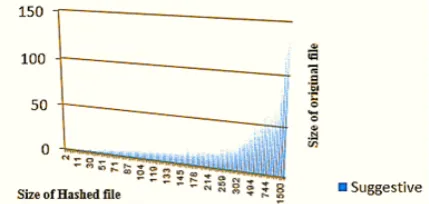
Figure 2 shows the size of the original file versus the size of the hashed files. As illustrated, the average hashed file size was 8.51% less than the size of the original file. The algorithm gener -ates a dynamic hash file. It means that the size of the hashed file depends directly on the size of the original file with an average reduction of 8.51% of the size of original file.
Implementation of the algorithm
In the implementation, the digital signature is created with a dynamic hash message and then embedded into an image as a stego-image. At the beginning of the software implementation (Ex -celent Modulator, Ver 1.0), a new private key is created by choosing the “new key” option from the file menu. The file, encode and decode menus will be active. The probability of producing the same keys does not exist. In the next step, we
choose the “save key” option and save the private key. In the next step, the new private key with its password should be introduced to the software. As a result, we choose the “load key” option from the file menu and load the private key and the password belonging to the private key on the pro -posed software. The “select image option” is for choosing the RGB cover image on the system. By choosing that, the properties of the image appear such as width, height and capacity. Another op -tion is the “import file to buffer op-tion”. At first, the input file in this software is entered in the nor -mal buffer; then the compress buffer is created from the embedded data which reduces the size of the embedded data. To use the public-key encryp -tion method, we need a different public key and private key. If we choose a new key in the soft -ware, we select the public key from (256!) states. In the sender section, from the encoder menu, we choose “select BMP image” that is applied for choosing the cover image. To make the stego-im -age, we have two kinds of buffer for handling the cover image. When we want to embed a large size file into the cover image, we should compress it and then put it into the cover image. The first state can be placed in the normal buffer into cover im -age by choosing the ‘import file to normal buf -fer’. In this case, we put the embedded data into the cover image and produce stego-image. This is by choosing ‘normal to bitmap’ and we send it to the receiver.
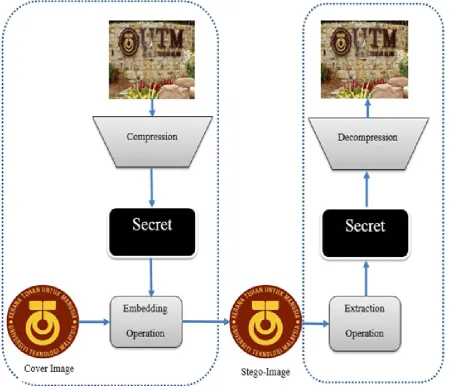
In the second state, the embedded file size is large and we want to compress it and embed -ded it into the image. In this case, we choose the “create compress from normal” menu. After compressing, the embedded file size and capacity decreases to 100 000 bytes and we can then eas -ily embed it into the cover image by choosing the “put compress to bitmap” option, without caus -ing any change in the quality of the cover image (Figure 3).
In the third state, the proposed software is able to encode the embedded data in order to el -evate the security. Next, we put the encoded data into the colour RGB cover image. To operate this system, we need to choose the “import file to nor -mal buffer” option, and then put the embedded file into the buffer. In the next step, we choose “encode to normal buffer” and encode the em -bedded data. Lastly, to produce the stego-image, we choose the “put normal to bitmap” option and send it to the receiver without making any chang -es in the image appearance. The user needs to be
aware if another file is embedded as data in the cover image (Figure 4).
In the fourth state, we want to compress data with a large file size and encode it. In order to elevate security, the compressed encoded data is placed into the cover image and sent to the re -ceiver. Next, after choosing the cover image, we select the “import file to normal buffer” option and, by doing this, we have transferred the em -bedded data to the normal buffer.
There are various states on the sender side, and the user is privileged to choose the states. The condition of the embedded file will determine the state that will be available on the receiver side. In the first state on the receiver side, the embed -ded file is in normal state without compression or encoding. In this case, at first we choose the “get normal from bitmap” option. It means that it puts the embedded image into the normal buffer. In the next step, by choosing “export file from normal
buffer”, we separate the embedded data from the cover image. In the second state, when the size of the embedded data is large, we choose the “get compress from bitmap” option. In this case, we fill the buffer with the compressed data and after that we choose “create uncompressed from com -press” which extracts the embedded data out of the compressed state. Finally, to separate the cov -er image from the embedded image, we use “ex -port file from normal buffer”. In the third state, the sender has embedded the data in the encoded form in the RGB cover image; therefore, at the re -ceiver side, “get normal from bitmap” is first ap -plied and then the “decode normal buffer” option is selected to decode the normal buffer. The “ex -port file from normal buffer” option is selected in order to export the embedded data from the cover image in the stego-image. In the fourth state, the sender has increased the security by using both compression and encoding and has embedded the
encoded compressed data into the cover image. In this case, the user who receives the stego-image should use the “get compress from bitmap” op -tion and fill the software buffer from the com -pressed data. In the next step, we should export it from the compressed state. We use the “create uncompressed from compress” option. In this process, we extract the embedded data out of the compressed state and now we should also export it from the encoded state. Therefore, the “decode compress buffer” option is used for decoding the uncompressed data (which is impossible without having the private key), and then the “export file from normal buffer” option is used to extract the embedded data from the cover image.
Evaluation of the hash algorithms
Some hash algorithms were compared with the proposed algorithm in terms of logical op -erators and the complexity of the hardware in -volved. The results of the comparison are pre -sented in Table 2.
As seen in the table, it is found that more than four (4) logical operations (the rotating shift)
are required than the proposed algorithm. The hardware complexity requirement for the pro -posed algorithm was also lower compared to the requirement for the other algorithms. Hardware complexity covers devices such as logic devices, programmable and gate arrays and application-specific integrated circuits.
The proposed algorithm had reduced signifi -cantly the sizes of the files only 8 bytes for vari -ous original file sizes compared to the other algo -rithms (Table 3).
CONCLUSION
One of the most important issues in digi -tal media is the security of messages being sent throughout the network. The security provided through steganography means that unwanted us -ers are prevented from accessing the secret data and reading the contents. There is a possibility that unwanted users can access the data and the contents, therefore techniques such as compres -sion and encoding techniques should be used in the process of embedding and extracting data.
Computer steganography methods should be es -sentially performed in such a way that the stego-image is not detectable from the original stego-image. These methods of steganography can be used for different purposes. For example, in addition to se -cure communications, steganography can be ap -plied to develop data banks. In this application, the task of steganography is to add accompanying information to an image in order to integrate the information and simplify saving. In these applica -tions of steganography, the existence of the infor -mation in the image is generally clear. The system is supposed to be closed and there is no concern about an attack from outside to discover the infor -mation. In these cases, the non-resistant methods are considered suitable. One of the properties of the proposed software is that we can embed any kind of data, such as an image, text or audio file, into the cover image without making any change in the appearance or quality of the cover image. In addition, after producing the digital signature or encoded hash message, we can compress or encode it in order to have highly secure data. An -other capability of the proposed software is that the embedded data can be encoded several times and, in this case, the security increases and no hacker can access the original data. Of course, on the receiver side, the same number of decoding operations must be performed.
REFERENCES
1. Shin J., Ruland C. 2013. A survey of image hashing technique for data authentication in WMSNs. In: Wireless and Mobile Computing, Networking and
Communications (WiMob), 2013 IEEE 9th Inter
-national Conference on. IEEE, 253-258.
2. Saadi K.A., Bouridane A., Guessoum A. 2009. Combined fragile watermark and digital signature for H. 264/AVC Video Authentication. In EUSIP
-CO, Vol. 9, 1-4.
3. Thomas P., Singh A.K. 2013. A novel steganograph
-ic approach for enhancing the security of images. 4. Makbol N.M., Khoo B.E. 2013. Robust blind im
-age watermarking scheme based on redundant dis
-crete wavelet transform and singular value decom
-position. AEU-International Journal of Electronics and Communications, 67(2), 102-112.
5. Islam R., Naji A.W., Zaidan A.A., Zaidan B.B. 2010. New system for secure cover file of hidden data in the image page within executable file using statistical steganography techniques. arXiv pre
-print arXiv: 1002.2416.
6. Wang Q., Wang C., Li J., Ren K., Lou W. 2009. Enabling public verifiability and data dynamics for storage security in cloud computing. Computer Se
-curity–ESORICS 2009, 355-370.
7. Chen T., Wang J., Zhou Y. 2001. Combined digital signature and digital watermark scheme for image authentication. In: Info-tech and Info-net, 2001. Proceedings. ICII 2001-Beijing. 2001 International Conferences on, IEEE, Vol. 5, 78-82.
8. Jansirani A., Rajesh R., Balasubramanian R., Es
-waran P. 2011. Hi-tech authentication for palette images using digital signature and data hiding. The International Arab Journal of Information Technol
-ogy, 8(2), 117-123.
9. Filler T., Ker A.D., Fridrich J. 2009. The square root law of steganographic capacity for Markov
covers. In: IS&T/SPIE Electronic Imaging (pp. 725408-725408). International Society for Optics and Photonics.
Table 2. Comparison of logical operations and hardware complexity
Algorithm Logical operations Hardware complexity MD5 algorithm [Sinha and Singh, 2003] AND, OR, NOT, rotating shifts medium SHA1 algorithm [Sternet al., 2002] AND, OR, NOT, rotating shifts, XOR large-scale SHA2 algorithm [Alkhathamiet al., 2013] AND, OR, NOT, rotating shifts, XOR large
Proposed algorithm OR and XOR low
Table 3. Comparison of size of file in bytes
Size of original files
(Byte) MD5 algorithm(Byte) SHA1 algorithm (Byte) SHA2 algorithm(Byte) Proposed algorithm(Byte)
14 32 40 64 8
18 32 40 64 8
72 32 40 64 8
1 32 40 64 8
10. Mazumder J.A., Hemachandran K. 2012. Review of different techniques used in recent steganogra
-phy researches. International Journal of Engineer
-ing, 1(8).
11. Lee J.W., Kim S.L., Kim C.H., Koch R.H., Lee C. U., Kim H.I., Park J.H. 2009. The sdB+ M eclips
-ing system HW Virginis and its circumbinary plan
-ets. The Astronomical Journal, 137(2), 3181. 12. Goyal H., Chutani S. 2012. LSB Embedding in
spatial domain – a review of improved techniques. International Journal of Computers & Technology, 3(1), 153-157.
13. Aarumugam G., Rajan B. 2011. Independent do
-main of symmetric encryption using least sig
-nificantBit: Computer vision, steganography and cryptography techniques (Doctoral dissertation, Dalarna University).
14. Fridrich J., Kodovsky J., Holub V., Goljan M. 2011. Steganalysis of content-adaptive steganography in spatial domain. In: Information Hiding. Springer Berlin/Heidelberg, 102-117.
15. Fridrich J., Goljan M., Hogea D. 2003. Steganaly
-sis of JPEG images: Breaking the F5 algorithm. In: Information Hiding. Springer Berlin/Heidelberg, 310-323.
16. Westfeld A. 2009. Fast determination of sensitiv
-ity in the presence of countermeasures in BOWS-2. In: Information Hiding. Springer Berlin/Heidel
-berg, 89-101.
17. El-Ghoneimy M.M. 2008. Comparison between two watermarking algorithms using DCT coef
-ficient and LSB replacement. Journal of Theo
-retical and Applied Information Technology, 4(2), 132-139.
18. Westfeld P., Maas H. G., Pust O., Kitzhofer J., Brücker C. 2010. 3-D least squares matching for volumetric velocimetry data processing. In: Pro
-ceedings of the 15th International Symposium on Appliocationsof Laser Techniques to Fluid Mechnaics (pp. 5-8).
19. Filler T., Judas J., Fridrich J. 2010. Minimizing embedding impact in steganography using trellis-coded quantization. Proceedings of Media Foren
-sics and Security III, SPIE, 7451, 715405-1. 20. Andrew J.P. 2009. European Patent No. EP 0971544.
Munich, Germany: European Patent Office. 21. Goljan M., Fridrich J., Filler T. 2009. Large scale
test of sensor fingerprint camera identification. Proc. SPIE, Electronic Imaging, Security and Fo