ISSN: 2231-3354 Received on: 06-12-2011 Accepted on: 11-12-2011
Gamalat Y. Osman, Ahmed M. Mohamed
Zoology Department Faculty of Science, Menoufia University, Egypt
Ahmed Abdel Kader, Asmaa A. Mohamed
Environmental Research and Medical Malacology Department, Theodor Bilharz Research Institute, Egypt.
For Correspondence
Gamalat Y. Osman,
Zoology Department Faculty of Science, Menoufia University, Egypt.
Biological studies on Biomphalaria alexandrina
snails treated with Furcraea selloa marginata
plant
(family:
Agavaceae)
and
Bacillus
thuringiensis kurstaki (Dipel-2x)
Gamalat Y. Osman, Ahmed M. Mohamed, Ahmed Abdel Kader and
Asmaa A. Mohamed
ABSTRACT
Effect of the dry leaves powder water suspension of the plant Furcraeaselloa
marginata, belonging to family Agavaceae and Bacillusthuringiensis kurstaki (Dipel-2x) was
evaluated against non-infected and Schistosoma mansoni-infected Biomphalaria alexandrina
snails as well as their efficacy against the free larval stages of S. mansoni. The obtained results indicated that the LC50 and LC90 values after 24 hrs exposure were 53.66 & 84.35 ppm
for F.selloa marginata and 392.3 & 483.64 ppm for B.thuringiensis kurstaki against adult B.
alexandrina snails, respectively. The plant F.selloa marginata and B.thuringiensis kurstaki
have a larvicidal activity against S. mansoni larvae (miracidia and cercariae), the plant F.
selloa marginata was more toxic against larvae than B.thuringiensis kurstaki, the miracidia
were more sensitive towards the toxic action of the tested agents than cercariae and the mortality percent of miracidia andcercariaeis directly proportional to the time and the tested concentrations. The results revealed that the tested sub-lethal concentrations (LCo, LC10 and LC25) reduced the survival, growth rates and egg laying capacity of both non-infected and S.
mansoni-infected snails during 12 weeks of exposure in comparison with their control group.
The hatchability percent of B. alexandrina eggs of one, three and six days old exposed to LCo, LC10, LC25, LC50 & LC90 concentrations of F. selloa marginata and B. thuringinesis
kurstaki, significantly decreased by increasing their age and the tested concentrations.
Exposing B. alexandrina snails to sub-lethal concentrationsof the tested agents for 24 hours either pre-, during or post exposure of snails to S. mansoni miracidia caused a marked reduction in the infection rate and decreased the mean total number of shedding cercariae/snail. Also, elongated their prepatent period (cercarial incubation period) and shortened the duration of cercarial shedding in comparison with their control group. Under semi-field conditions the more time of exposure to the concentration (LC90= 84.35 ppm) of the plant F. selloa marginata the more mortality among snails. The mortality rates of the snails were 0%, 2%, 18% and 30% at 3, 6, 12 and 24 hrs post exposure, respectively.
Keywords: Biomphalaria snails- Biocontrol agents- Furcraea selloa marginata- Bacillus
thuringiensis kurstaki (Dipel-2x).
INTRODUCTION
part in the combat against schistosomiasis and the biological control of snail populations offers an expensive and environmentally acceptable alternative to chemical molluscicides (Jobin et al., 1977).
In fact, molluscicides of plant origin seem to be less expensive, readily available, rapidly biodegradable, have low toxicity to non - target organisms and probably easily applicable with simple techniques appropriate to developing countries (Adewunmi et al., 1990a & b and Ibrahim et al., 2004).
During the last two decades several important investigations on plant molluscicides were carried out (Mott, 1987 and Mohamed and Abdel Gawad, 2005). Among the promising plants for snail control are Millettia thonningii (Evans et al., 1986),
Anagallis arvensis (Shoeb et al., 1989), Cestrum parqui and Hedra canariensis (El- Emam et al., 1990), Dialium guineese (Odukoya
et al., 1996), Calendula micrantha officinalis (Mostafa and Tantawy, 2000), Solanum dobium (Tantawy et al., 2000), Solanum nigrum and Panicum repens (Ibrahim et al., 2004). Also the plants belonging to Agavaceae were found to have good molluscicidal properties by several investigators as shown by Shoeb et al., 1983 (Agave angustifolia & Agave celsii), 1992a (Agave lophantha), 1992b (Agave attenuata) and El-Sayed et al., 1995 (Agave filifera).
Biological agents have been exploited for snail's control (Osman and Mohamed, 1991). For example, bacteria were suggested as biocontrol agent against schistosomiasis vector snails. The bacterial pathogen, Bacillus thuringiensis, is one of the most common biological control agents in use today. It was known for along time as insecticide (Ignoff et al., 1981and Hassanain et al.,
1997). It has been also used as anthelmintic (Hassanain et al.,
1998; Abdel-Rahman et al., 1998). El-Emam et al. (1996 b) reported that Bacillus thuringiensis israelensis has a highly suppressive effect on the population growth of B. alexandrina
snails, thus affecting the availability of these snails in S. mansoni
transmission. Gamal et al. (2000) reported that prolonged exposure of snails to B. thuringiensis (R153/78) (Bt1) and B. thuringiensis kurstaki 32000 IU/mg (Bt2) at concentrations of 0.8-1 gL-1 resulted to complete loss of the hatchability of B. alexandrina snails.
This study aimed to evaluate the effect of the plant
Furcraea selloa marginata, belonging to family Agavaceae and
Bacillusthuringiensis kurstaki (Dipel-2x) against non-infected and
S. mansoni-infected Biomphalaria alexandrina snails as well as it's efficacy against the free larval stages of S. mansoni.
MATERIALS AND METHODS
Experimental animals used in the present study were
Biomphalaria alexandrina snails; Schistosoma mansoni miracidia and cercariae and male white albino mice (CD1) brought from Schistosome Biological Supply Center (SBSC) Theodor Bilharz Research Institute, Giza, Egypt. The experimental snails were maintained under experimental laboratory conditions (25± 2ºC) according to the method described by (WHO, 1965).
The plant used in this study Furcraea selloa marginata
(Family: Agavaceae). It was collected from EL-Orman Garden, Giza during full growing season. The collected plant leaves were
transferred to the laboratory, shade dried, then in an oven at 50°C and finely powdered using an electrical grinder. The dry powder of each experimental plant was stored in a clean dark glass bottle till use. Therefore, they were evaluated against B. alexandrina snails as aqueous suspensions on basis of weight / volume using dechlorinated tap water (WHO, 1965).
Commercial Bacillus thuringiensis kurstaki (Dipel-2x), 32,000 I.U. / mg was kindly provided from Central Agricultural Pesticides Laboratory, Ministry of Agriculture, Dokki, Giza, Egypt. Dilutions of the experimental powder were prepared on the basis of weight / volume using dechlorinated tap water according to Osman and Mohamed (1991).A series of concentrations that would allow the computation of LC50 and LC90 values were
prepared according to WHO (1965), while the sub-lethal concentration (LCo) was calculated as it equals 1/10 LC50 (WHO,
1965).
Experimental Infection
Mice infection
CD1 mice were individually exposed to 80-100 freshly emerged S. mansoni cercariae by paddling method, in dechlorinated tap water for 1-2 hrs at 22-25 ºC.
Snail infection
Infected mice 6-8 weeks post infections were dissected, the infected livers and intestines were homogenized and eggs were extracted washed in saline. S. mansoni miracidia hatched under illumination from the isolated eggs (Chernin, 1970). B. alexandrina snails were individually infected each with 4-5 miracidia in glass test tubes filled with 1 ml dechlorinated tap water for 2 hours (Anderson et al., 1982).
Cercaricidal and miracidicidal effect
Twenty five ml of dechlorinated tap water containing 100 freshly hatched miracidia or cercariae were mixed with 25 ml double concentrations of LCo, LC10, LC25, LC50 & LC90 values of
the tested materials. Fifty ml of dechlorinated water containing 100 freshly hatched miracidia were used as a control (Ritchie et al., 1974). During treatment period, microscopical observations on the movement and mortality of the miracidia and cercariae were recorded at time intervals of 1/4, 1/2, 3/4, 1, 2, 3, 4, 5 & 6 hrs.
Prolonged exposure of snails to sub-lethal concentrations (LCo,
LC10 and LC25) of the tested materials
concentration in two-liter capacity plastic containers. For 12 weeks the concentrations were changed with freshly prepared ones every week. Fresh lettuce leaves were provided as the daily food. Observations were recorded weekly for mortality, number of egg masses laid and the shell diameter (growth rate).
Effect on hatchability
For studying the effect of the tested materials on the hatchability of B. alexandrina eggs, three replicates of egg masses, each of about 60 eggs of one, three and six days old were used. Egg masses were obtained from healthy B. alexandrina snails, which were laid on foam pieces, maintained in the laboratory. Egg masses were continuously exposed to 100 ml of LCo, LC10, LC25,
LC50 & LC90 concentrations of the tested materials in Petri dishes
until hatching. Another group of about 60 eggs was maintained in dechlorinated tap water as a control (Frik and Dejmenez, 1963 and Oteifa et al., 1975). Egg masses were examined daily during the experimental period under a steromicroscope and the number of normal viable eggs and hatched embryos were recorded (Oliver et al., 1962). At the end of the experiment, the percentage of hatchability was calculated.
Effect on infectivity
B. alexandrina snails were exposed to sub-lethal concentrations (LCo, LC10 & LC25) of the tested materials for 24
hours either pre-, during or post exposure of snails to S. mansoni
miracidia (Badawy, 2007).Snail exposure to miracidia was carried out in mass, i.e. for each experimental concentration three replicates, each of 10 snails/ L in glass container, were exposed to miracidia freshly hatched from ova at a dose of 10 miracidia/snail, either with or without the experimental concentrations. Another group untreated with the tested concentrations, but exposed to miracidia was maintained as a control. After 25 days of miracidial exposure, surviving snails were individualy examined for cercarial shedding in multi-dishes under artificial light for 1 hr and 2 ml dechlorinated water /snail to stimulate cercarial shedding (Meuleman, 1972), the mean number of cercariae, the incubation period (prepatent period ), duration of cercarial shedding (patent period) and the infection were calculated for each snail.
Effect of F. selloa marginata on B. alexandrina Snails under Semi-Field Conditions
This experiment was carried out in the Snails Research Station of TBRI , El-Qanater El-Khayria, Qalubia Governorate, Egypt according to the protocol of (Mostafa et al., 2005). Statistical analysis: Student t-test was carried out to determine the significance between control and experimental groups.
RESULTS
Molluscicidal activity of the plant Furcraea selloa marginata and Bacillus thuringiensis kurstaki (Dipel-2x) against adult B. alexandrina snails is presented in Table (1). The data revealed that the LC50 and LC90 values were 53.66 & 84.35 ppm
for F. selloa marginata and 392.3 & 483.64 ppm for B.
thuringiensis kurstaki, respectively after 24hrs. The results also showed that tested materials displayed a larvicidal activity against
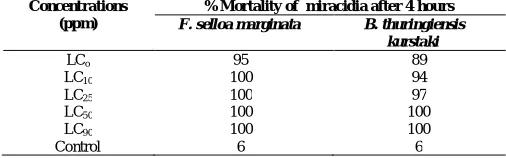
S. mansoni miracidia and cercariae as shown in Tables (2 and 3). The miracidia are more sensitive towards the toxic action of the tested agents than cercariae during 6 hours of exposure and the mortality percent of miracidia and cercariae is directly proportional to the time and the tested concentrations.
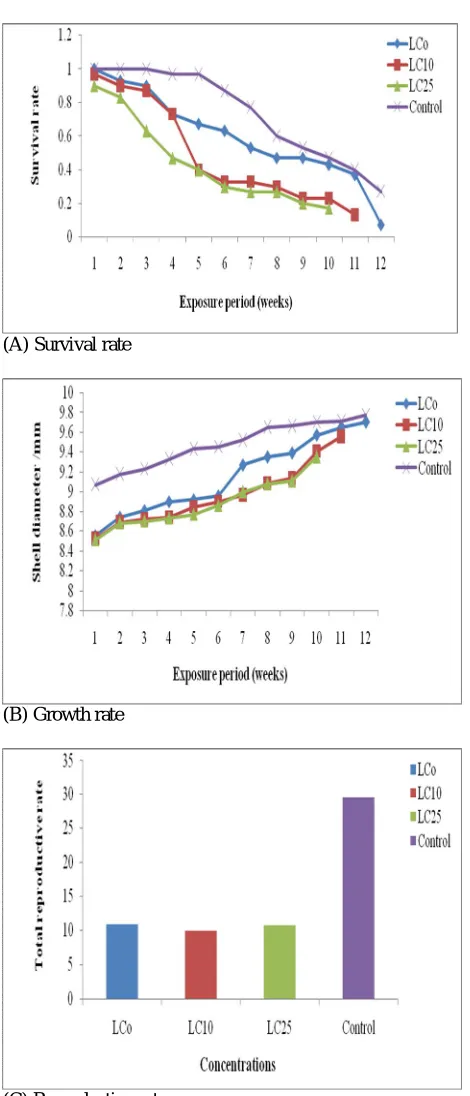
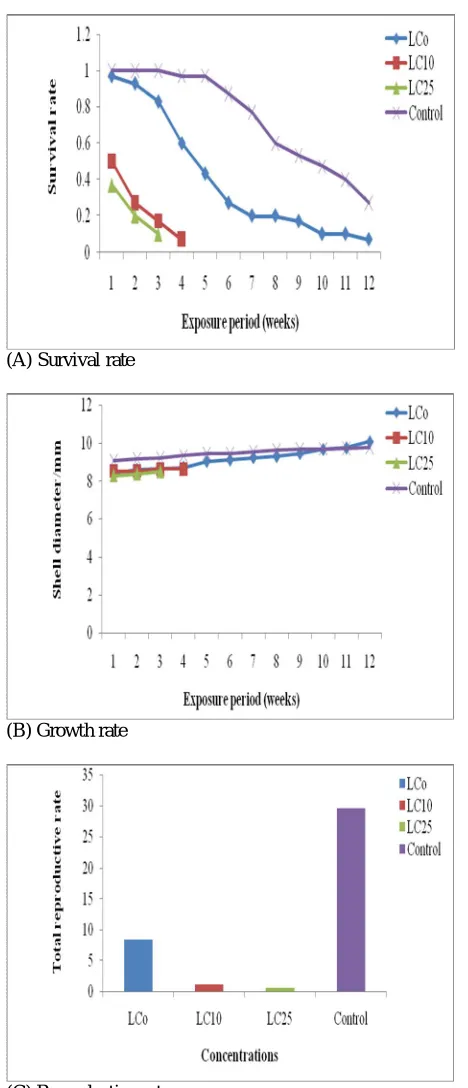
Figures (1, 2, 3 and 4) illustrate the effect of prolonged exposure of snails to sub-lethal concentrations (LCo, LC10 and
LC25) of Furcraea selloa marginata and Bacillus thuringiensis
kurstaki. The obtained results showed a significant decrease on survival rate, growth rate and egg laying capacity in both non-infected and S. mansoni-infected snails during 12 weeks of exposure compared to untreated control group.
Regarding to the hatchability of B. alexandrina eggs, the obtained results indicated that the eggs of different ages can hatch in all tested concentrations (LCo, LC10, LC25,LC50 and LC90) of
F. selloa marginata and Bacillus thuringiensis but with different rates ,except eggs at three and six days ages exposed to LC90 of
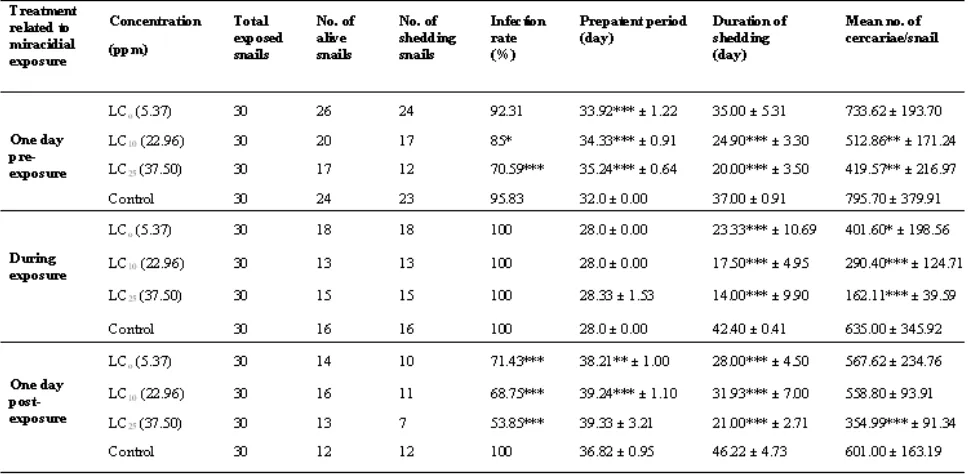
B. thuringiensis kurstaki didn't hatch in the examined solution (Tables 4 A & B). The results illustrated in (Table 5 A & B) revealed that the treatment of infected B. alexandrina snails with sub-lethal concentrations (LCo, LC10 & LC25) of F. selloa
marginata and Bacillus thuringiensis for 24 hours either pre-, during or post exposure of snails to S. mansoni miracidia caused a marked reduction in the infection rate and the mean total number of shedding cercariae/snail. Also, elongated their prepatent period (cercarial incubation period) and shortened the duration of cercarial
Table 1: Molluscicidal activity of Furcraea selloa marginata plant (family:
Agavaceae) and Bacillusthuringiensis kurstaki (Dipel-2x) on adult Biomphalaria alexandrina after 24 hours of exposure.
Tested Materials LC50
(ppm) LC90 (ppm) Slope functio n Sublethal concentrations (ppm)
LCo LC10 LC25 Furcraea selloa
marginata
53.66 84.35 1.66 5.37 22.96 37.50
Bacillus thuringinesis kurstaki
392.31 483.64 1.21 39.23 300.98 344.24
Table 2: Miracidicidal effect of the tested materialson S. mansoni miracidia. Concentrations
(ppm)
%Mortality of miracidia after 4 hours
F. selloa marginata B. thuringiensis
kurstaki
LCo 95 89
LC10 100 94
LC25 100 97
LC50 100 100
LC90 100 100
Control 6 6
Table 3: Cercaricidal effect of the tested materialson S. mansoni cercariae. Concentrations
(ppm)
%Mortality of cercariae after 6 hours
F. selloa marginata B. thuringiensis
kurstaki
LCo 93 78
LC10 97 84
LC25 100 88
LC50 100 92
LC90 100 95
shedding in comparison with their control group. From the results in Table (6) it is clear that the more time of exposure the more mortality among snails treated with the plant F. selloa marginata
(LC90= 84.35 ppm) under semi-field conditions.
DISCUSSION
The present study indicated that the plant F. selloa marginata and Bacillus thuringiensis kurstaki (Dipel-2x) have molluscicidal and larvicidal activities against adult snails and S. mansoni larvae, respectively.
The considerable toxic effect of the plant F. selloa marginata might be due to steroidal saponins, the main constituents of Agavaceae (Mahato et al., 1982), that are known to possesss molluscicidal activities, due to their ability to form complexes with cholesterol and decrease its level in the plasma and increase cholinesterase activity or may be decrease the frequency of cardiac contractions (El-Gengaihi et al., 1988). The results obtained by Diaz and Ferrer (1996) proved that the heart rate of
Biomphalaria havanensis snails was highly reduced post their exposure to an aqueous extract of Agave fourcroydes.
B. thuringiensis kurstaki (Dipel-2x) also showed molluscicidal activity against adult B. alexandrina snails, and this might be due to the fact that it has a hazardous effect on the digestive tract or probably due to one or more of the toxins produced by bacteria (Abdel-Rahman and Hassanian, 1999). The author showed that Dipel-2x caused great alterations in the stomach and digestive tubules of Lymnaea natalensis snails. The present data concerning the molluscicidal activity of Dipel-2x are
in agreement with those obtained by Ducklow et al. (1980) who reported that the bacterium Vibrio parahaemolyticus was found to be pathogenic for the schistosome intermediate host B. glabrata. Also, Abdel-Megeed and Abdel-Aziz (1999) revealed that the Dipel-2x concentration which induced 50% mortality (LC50) of
Physa acuta snails after 24hr of exposure was 270 mg/L.
Results of the current study also revealed that the miracidial mortalities are greater than that of cercariae after the same time intervals. This observation is in agreement with the study of Mahmoud (1993) on Kelthane that killed miracidia faster than cercariae. Also, Ibrahim et al. (2007) showed that miracidial mortality were greater than that of cercariae during application of Hinsan and the plant T. terrestris after the same time intervals.
The tested materials showed a significant reduction on the survival rate, growth rate and egg laying capacity of both adult non-infected and S. mansoni-infected B. alexandrina snails. Such reduction of snail's survival and fecundity may arise as a result of the action of the tested agents upon the steroid hormones, the harmful effect on the male and female genital tract, or may arise from metabolic disorders as has been described by Mohamed et al.
(1981) who tested the efficacy of low concentrations of some organometallic compounds that may alter the reproduction of B. alexandrina snails as a result of reduction of the growth of the male and female organs of the genetal tract and endocrine disruption, which reduce or stop their oviposition. These findings are in a harmony with results obtained by Abdel-Hafez et al. (1997); Bakry et al. ( 2001); Tantawy ( 2002 and 2008 ); Tantawy
et al. (2004); El-Sayed (2006) and Bakry et al. (2007) on testing the plants; Azolla pinnata, A. franzosinii, Atriplex halimus,
Commiphora molmol, Synadenium grantii, Cupressus macrocarpa
and Azadirachta indica for mollusciciding activities. Abdel– Rahman and Hassanain (1999) revealed that B. thuringiensis kurstaki (Dipel-2x) has a potent effect on the survivor and egg laying capacity of L.natalensis snails. Also, investigations by El-Emam et al. (1996b) reported that B. thuringiensis israelensis
bacteria have a highly suppressive effect on the population growth of B. alexandrina snails.
Ibrahim (2006) stated that, at 4th week post infection, additional demonds consume the energy of the B. alexandrina
snails, i.e. cercarial emergence, thus leaving low amounts for survival, growth, detoxification and reproduction.
The current study also revealed that the tested materials have aconsiderable effect on the hatchability of B. alexandrina
eggs of different ages. Several authors recorded a similar harmful and remarkable reduction in hatchability of B. alexandrina eggs treated with different molluscicides (El-Bolkiny et al., 2000; Rizk
et al., 2001 and Al-Mathal and Fouad, 2006).
Table 5: Effect of sublethal concentrations of F.selloa marginata (A) and B. thuringiensis on infectivity of S.mansoni miracidia
(2000); Bakry et al. (2001 and 2007); El-Ansary et al. (2001); Massoud et al. (2004) and El-Sayed et al. (2006) on different molluscicides at different periods of B. alexandrina snail's exposure to S. mansoni miracidia. Under semi-field conditions the more time of exposure the more mortality among snails treated with the plant F. selloa marginata. The importance of semi-field and field trials of successful laboratory studies was recommended by several scientists. Lemma et al. (1978) reported that a systemic field trial needed to demonstrate that a candidate molluscicidal operation can kill snails under local field conditions when applied by simple means. Some plant species were applied in field trials and used in snail control programs, as T. tetraptera in Nigeria (Adewunmi, 1991), E. splendens in Brazil (Baptisa et al., 1994 and Mendes et al., 1997 and Schall et al., 2001) and P. dodecandra
(endod) in Zimbabwe (Erko et al., 2002). In Egypt, A. maritima
(damsissa) (El-Sawy et al., 1981 and 1989) and Anagallis arvensis
Emam et al. (1996a).
REERENCES
Abdel-Hafez, A.M.; Zidan, Z.H.; Abdel-Megeed, M.I.; El-Emam, M.A.; Ragab, F.M. and El-Deeb, F.A. Effect of the plant Azolla
pinnata on survival, growth rate, Fecundity and hatchability of egg-masses
of Biomphalaria alexandrina snails. J. Egypt. Soc. Parasitol., 1997; 27 (3):
825-841.
Abdel-Megeed, K.N. and Abd El-Aziz, M.M. Lethal effect of Dipel-2X on Physa acuta snails. Egypt. J. Zool. 1999; 33: 267-275.
Abdel-Rahman, E.H. and Hassanian, M.A. Bio-efficacy of Dipel-2X on fascioliasis transmitting snail, Lymnaea cailliaudi. Beni-Suef. Vet. Med. J. 1999; 9: 137-148.
Abdel-Rahman, E.H.; Kandil, O.M. and Abdel-Megeed, K.N. Comparative studies of lethal effects of B. thuringiensis, Allium sativum
and Nerium oleander on Trichostrogylidae parasites. Egypt. J. zool. 1998;
30: 65-79.
Adewunmi, C.O. Plant molluscicides: Potential of Aridan,
Tetrapleuratetraptera, for schistosomiasis control in Nigeria. Sci. Total.
Environ. 1991;102: 21-33.
Adewunmi, C.O.; Doerfler, G. and Becker, W. The effect of aridanin isolated from T. tetraptera and serotonin on the isolated gastrointestinal tract smooth muscles of Biomphalaria glabrata and uptake of calcium. J. Nat. Prod. (Loydia). 1990a ; 53 (4): 956- 969.
Adewunmi, C.O.; Furu, P.; Marquis, B.B.; Fagbota, M. and Olatunfi, Q.A. Molluscicidal trials and correlation between the presence of
T. tetraptera in an area and the absence of the intermediate hosts of
schistosomiasis and fasciolasis in South est Nigeria. J. Ethanopharmacol. 1990b; 30 (2): 169-184.
Ahmed, A.H. and Ramzy, R.M. Laboratory assessment of the molluscicidal and cercaricidal activities of the Egyptian weed, Solanum
nigrum L. Ann. Trop. Med. Parasitol. 1997; 91 (8): 931-937.
Al-Mathal, E.M. and Fouad, M.A. Effect of C. molmol on adults, egg masses and egg-deposition of B. arabica under laboratory conditions. J. Egypt. Soc. Parasitol. 2006; 36 (1): 305-314.
Anderson, R. M.; Mercer, J. G.; Wilson, R. R. and Carter, N. P. Transmission of Schistosoma mansoni from man to snail experimental studies of miracidial survival and infectivity in relation to larval age, water temperature, host size and age. Parasitol. 1982; 85: 339-360.
Badawy, A.M.S. (2007): Studies on Dracaena draco
(Agavaceae) and Viburum tinus (Caprifoliaceae) as plant molluscicides against the snail vectors of schistosomiasis and the larval stages of this parasite. Ph. D. Thesis, Zoology Department, Girls college for Arts, Science and Education, Ain Shams Univ. Cairo, Egypt.
Bakry, F. A.; Abdel-Hamid, H. and Abu-El-Einin, H.M. Effect of neem plant (Azadirachta indica) on some biological and
histological parameters of healthy B. alexandrina and infected with S.
mansoni. J. Egypt. Ger. Soc. Zool. 2007; 54 (D): 51-68.
Bakry, F.A.; Tantawy, A.A.; Ragab, F.M.A. and Abdel Kader, A. Effect of sublethal concentrations of Agave franzosinii plant (Agavaceae) on the infectivity of S. mansoni to B. alexandrina snails. J. Egypt. Ger. Soc. Zool. 2001; 33 (4): 129-141.
Baptisa, D.F.; Vasconcellos, M.C.; Lopes, F.E.; Silva, I.P. and Schall, V.T. Perspectives of using Euphorbia splendens as a molluscicide in schistosomiasis control programs. Southeast Asian J. Trop. Med. Pub. Hlth. 1994;25 (3): 419-424.
Borch, M.; Kiernan, M.; Rust, K.; Baron, B.; Simmons, B.; Hattala, P.; Davey, A.; Yovanovich, J.; Shayder, D.; Wasilewski, A. And Lafaro, V.E. Schistosomiasis: a case study. Urol. Nurs. 2009; 29 (1): 26-29.
Chernin, E. Behavioral responses of miracidia of S. mansoni and other treamatodes to substances emitted by snails. J. Parasitol. 1970; 56: 287-296.
Diaz, G.R. and Ferrer, L.J.R. Effect of lethal doses of plants of
the Agavaceae family on the cardiac activity and oviposition of
Biomphalaria havanensis (Mollusca: Planorbidae) Rev. Cubana Med.
Trop. 1996; 48 (1): 15-20.
Ducklow, H.W.; Tarraza, H.M.Jr. and Mitchell, R. Experimental pathogenisity of Vibrio parahaemolyticus for the schistosome-bearing snail B. glabrata. Can. J. Microbial. 1980; 26 (4): 503-506.
El-Ansary, A.; Sammour, E.M.; Soliman, M.S. and Gawish, F.A. In vivo attenuation of Schistosoma cercarial development and disturbance of egg laying capacity in B. alexandrina using sublethal concentrations of plant molluscicides. J. Egypt. Soc. Parasitol. 2001; 31(3): 657-669.
El-Bolkiny, Y.E.; Rizk, E.T. and El-Ansary, A.A. Effect of diethydithiocarbamate on some biological and physiological parameters of
B. alexandrina snails. Egypt. J. Aquat. Biol. Fish. 2000; 4 (2): 157-181.
El-Emam, M.A.; El- Amin, S.M and Ahmed, W.S. Molluscicidal properties of the plants Cestrum Parqui (Solanaceae) and H. Canariensis
(Araliaceae). Egypt. J. Bilh. 1990;12 (1-2): 185-195.
El-Emam, M. A.; El-Amin, S.M.; El-Sayed, M. and El-Nahas, H.A. Field trials to control the snail vector of schistosomiasis and fascioliasis by the plant A. arvensis (Primulaceae). Egypt. J. Bilh. 1996a;18: 89-100.
El-Emam, M. A.; El-Hak, S. and Shafik, M. Preliminary study
on B. thuringiensis israelensis bacteria as a biocontrol agent against B.
alexandrina snails. Egypt. J. appl. Sci. 1996b; 11 (9): 184-191.
El-Gengaihi, S.; Mohamed, A.M.; Selim, M.A. and Motawe, H.M. Biological and chemical studies of some saponins having antimolluscal activity. Egypt. J. Bilh. 1988; 10 (1): 127-133.
El-Sawy, M.F.; Bassiony, K. and Magdoub, A.I. Biological control of schistosomiasis. A. maritima (damsissa) for snail control. J. Egypt. Soc. Parasitol. 1981;11: 99-117.
El-Sawy, M.F.; Duncan, J.; Amer, S.; El-Ruweini, H. and Brown, N. The molluscicidal properties of A. maritima L. (Compsitae). 4- Temporal and spatial distribution of B. alexandrina in Egyptian village irrigation system with reference to schistosomiasis transmission control. Trop. Med. Parasitol. 1989; 40 (2): 103-106.
El-Sayed, K.M. Effect of the plant Cupressus macrocarpa on some haematological and biochemical parameters of B. alexandrina snails. J. Egypt. Soc. Parasitol. 2006; 36: 911-924.
El-Sayed, M.M.; El-Nahas, H.A. and Refahy, L.A. A study on the molluscicidal activity of C. micrantha officinalis, A. arvensis and A.
filifera. Egypt. J. Bilh. 1995;12 (1-2): 207-216.
El-Sayed, K.M.; Mahmoud, M. and Sharaf El-Din, A.T. Effect of exposure of B. alexandrina snails to various extracts of Physalis
angulata on their survival and subsequent infection with S. mansoni. J.
Union. Arab Biol. Zool. 2006; 26 (A): 52-64.
Erko, B.; Abeb, F.; Berhe, N.; Medhin, G.; Gebre, T.; Gemetchu, T. and Gunderson, S.G. Control of S. mansoni by soapberry Endod (Phytolacca dodecandra) in Wollo, north eastern Ethiopia: Post-intervention prevalence. East. Afr. Med. J. 2002; 79 (4): 198-201.
thonningii (Leguminosae : Papilionoideae). Trans. R.Soc. Trop. Med. Hyg. 1986; 80: 451-453.
Frick, P. L. and Dejimenz, W.Q. Egg clutches as againest individual egg of Australorbis glabratus as test unit in molluscicidal evaluation Bull. W.H.O. 1963; 29 (3): 286-287.
Gamal, R.F.; Roshdy, M.Z.; Hafez, S.M. and Tadros, M.M. The molluscicidal activity of some local bacterial isolates and commercial B.
thuringiensis. Strains on: Hatchability, mortality and growth rate of B.
alexandrina snails. J. Environ. Sci. 2000;1 (2): 687-718.
Hassanain, M.A.; Abdel-Rahman, E.H. and Abdel-Megeed, K.N. Vermicidal effect of B. thuringiensis on Fasciola gigantica. Egypt. J. Vet. Med. Sci. 1998; 58 (2): 251-267.
Hassanain, M.A.; Garhy, M.F.; Abdel Ghaffar, F.A.; El-Sharaby, A. and Abdel-Megeed, K.N. Biological control studies of soft and hard ticks in Egypt. 1. The effect of B. thuringiensis varieties on soft and hard ticks (Ixodidae). Parasitol. Res. 1997; 83 (3): 209-213.
Ibrahim, M.M. Energy allocation patterns in B. alexandrina
snails in response to cadmium exposure and S. mansoni infection. Experimental parasitology. 2006;122: 31-36.
Ibrahim, A.M.; El-Emam, M.A.; El-Dafrawy, S.M. and Mossalem. H.S. Impact of certain plant species on S. mansoni, B.
alexandrina system. Proc. 3rd Int. Conf. Sci. 2004; 3(1): 390-413.
Ibrahim, W.L.F.; El-Nahas, H.A. and Abdel-Raouf, H.A. Comparative studies on the effectiveness of two synthetic pesticides and plant molluscicides on B. alexandrina and some larvae of S. mansoni. J. Egypt. Ger. Soc. Zool. 2007;53 (D): 119-141.
Ignoff, G.M.; Couch, T.L.; Garcia, C. and Kroha, M.J. Relative activity of B. thuringiensis var. israelensis against larvae of Aedes aegypti,
Culex quinquefasciatus, Trichoplusia heliotbiszea and Heliobis virescents.
J. Econ. Entomol. 1981; 63: 1987-1989.
Jobin, W.R.; Brown, R.A.; Velez, S.P. and Ferguson, F.F. Biological control of Biomphalaria glabrata in major reservoirs of Puerto Rico. Am. J. Trop. Med. Hyg. 1977;25: 1018-1024.
Lemma, A.; Goll, P.; Duncan, J. and Mazengia, B. Control of schistosomiasis with the use of endod in Adwa, Ethiopia: Results of 5 years study. Inter. Conf. Schisto., Egyptian Ministry of Health, Cairo, Egypt. 1978;1: 415-436.
Mahato, S.B.; Ganguly, A.N. and Sahu, N.P. Steriod saponins. Phytochemistry. 1982;21 (5): 959-978.
Mahmoud, M.B. (1993): Effect of certain pesticides on B.
alexandrina and the intramolluscan larval stages of S. mansoni. M. Sc.
Thesis, Fac. of Science, Cairo, Univ.
Massoud, A.; Metwally, D.M.; Khalifa, K.E. and Habib, F.S. Compatibility of B. alexandrina snails to infection with S. mansoni after exposure to sublethal concentrations of Myrrh. J. Egypt. Soc. Parasitol. 2004; 34: 995-1008.
Mendes, N.M.; Vasconcellos, M.C.; Baptista, D.F.; Rocha, R.S. and Schall, V.T. Evaluation of the molluscicidal properties of Euphorbia
splendens var. Hislopii (N.E.B.) latex; experimental test in an endemic
area in the State of Minas Gerais, Brazil. Mem. Inst. Oswaldo Cruz. 1997; 92: 719-724.
Meuleman, E.A. Host-parasite interrelationships between the fresh water pulmonata B. pfeifferi and the trematode S. mansoni Neth. J. Zool. 1972; 22: 355-427.
Mohamed, A. M.; El-Fiki, S.A.; El-Sawy, M.F. and El-Wakil, H. Effect of prolonged exposure of B.alexandrina to low concentrations of some molluscicides. J. Egypt. Soc. Parasitol. 1981; 11 (2): 295-311.
Mohamed, A.Z. and Abdel – Gawad, A.E. (2005): Effect of plant growth regulator (Mepiquat chloride) on circulating hemocytes and total plasma protein of B. alexandrina snails. Egypt. J., 2001 (44): 283-303.
Mostafa, B.B.; El-Khayat, H.M.M.; Ragab, F.M.A and Tantawy, A.A. Semi-field trials to control B. alexandrina by different modes of exposure to certain plant and chemical molluscicides. J. Egypt. Soc. Parasitol. 2005; 35 (3): 925-940.
Mostafa, B.B. and Tantawy, A.A Bioactivity of Anagallis
arvensis and Calendula micrantha plants treated with ammonium nitrate,
superphosphate and potassium sulfate fertilizers on B. alexandrina. J. Egypt. Soc. Parasitol. 2000; 30 (3): 929–942.
Mott, K.E. (1987). Plant molluscicides. Edited by K.E. Mott. Published on be half of the UNDP/ World Bank / WHO.
Odukoya, O.A.; Houghton, P.J.; Adelusi, A.; Omogbui, E.K.I., Sanderson, L. and whitfield P.J. Molluscicidal triterpenoid glycosides of
Dialium guineense. J. Nat. Prod. 1996;59: 632-634.
Osman, G.Y. and Mohamed, A.M. Bio-efficacy of bacterial insecticides, B. thuringiensis Berl. as biological control agent against snail vectors of schistosomiasis in Egypt. Anz. Schadlingsk., Pflanz., Umwett. 1991; 64: 136-139.
Oliver, L.; Haskins W. T. and Gurian, J. Action of very low concentration of Na pentachlorophenate on freshly laid eggs of
Australorbis glabratus. Bull. W.H.O. 1962; 27: 87-94.
Oteifa, B. ; Mousa, A.; Abou El – Hassan, A. A.; Mohamed, A. M. and El – Emam, M. Effect of certain insecticides in the control of the fresh – water snails; B. alexandrina and Bulinus trnucatus. Egypt. J. Bilh. 1975; 2 (2): 221-243.
Ritchie, L.S.; Lopez, V. and Cora, T.M. (1974). Prolonged application of an organtin against B. glabrata and S. mansoni. In: Tomas C. Cheng (Ed.), Molluscicides in Schistosomiasis Control. (PP: 77-88). Academic Press, New York and London.
Rizk, E.T.; El-Mehlawy, M.H. and Mona, M.H. Evaluation of the slow release potency of polymeric niclosamide against B. alexandrina
eggs and S. mansoni larvae. J. Egypt. Ger. Soc. Zool. 2001; 35 (D): 189-204.
Schall, V.T.; Vasconcellos, M.C.; Rocha, R.S.; Souza, C.P. and Mendes, N.M. The control of the schistosome transmitting snail B.
glabrata by the plant molluscicide E. splendens var. Hislopii (Synmilli
Des. Moul): A longitudinal field study in an endemic area in Brazil. Acta Trop. 2001;79 (2): 165-170.
Shoeb, H.A.; El-Sayed, M.M. and El- Nahas, H.A. Field evaluation of A. arvensis as molluscicidal plant in snail control. Alex. J. Vet. Sc. 1989; 5: 311-321.
Shoeb, H.A.; El-Emam, M. A.; El-Amin, S.M.; Refahy, A.; Khalifa, A.M. and Abdel Motagally, M.M. Molluscicidal activity of
Fagonia cretica, S. nigrum and A. lophantha against B. truncatus and L.
cailliaudi. Egypt. J. Appl. Sci. 1992a; 7 (5): 421-429.
Shoeb, H.A.; El-Wakel, L.; Abdel-Ghany, M.A.; Abdel Motagally, M. and Saad, A.M. The molluscicidal properties of Thymelaea
hirsuta and A. attenuata. Egypt. J. Bilh. 1992b; 14 (1): 77-89.
Shoeb, H.A.; Refahy, L. and Khalifa, A.M. The molluscicidal properties of the crude saponins in Agave angustifola "marginata", Agave
celsii and Yacca filamentosa "variegata". Egypt. J. Bilh. 1983; 9 (1):
55-66.
Tantawy, A. Effect of two herbicides on some biological and biochemical parameters of B. alexandrina. J. Egypt. Soc. Parasitol. 2002; 32 (3): 837-847.
Tantawy, A.A. Comparitive study on the effect of myrrh
(Commiphora molmol) and mirazid on Biomphalaria alexandrina snails
and on the free larval stages of Schistosoma mansoni. J. Biol. Environ. Sci. 2008; 3 (1): 47-55.
Tantawy, A.A.; Mostafa, B.B. and Sharaf El-Din, A.T. Molluscicidal activity of Synadenium grantii (Euphorbiaceae) against B.
alexandrina and B. truncatus the intermediate host snails of
schistosomiasis in Egypt and their infectivity with the parasite. Egypt. J. Biomed. Sci. 2004; 14: 183-196.
Tantawy, A.A.; Sharaf El-Din, A.T. and Bakry, F.A. Laboratory evaluation of the mollusciciding activity of Solanun dubium (Solanaceae) against B. alexandrina snails. J. 1st Inter. Cong. Biol. Sci. (ICBS). 2000; 1 (2): 307-318.
(A) Survival rate (A) Survival rate
(B) Growth rate (B) Growth rate
(C) Reproductive rate (C) Reproductive rate
Fig 1: Effect of sub-lethal concentrations of F. selloa marginata on survival rate (A), growth rate (B) and reproductive rate (C) of adult non-infected B. alexandrina
snails.
(A) Survival rate
(A) Survival rate
(B) Growth rate (B) Growth rate
(C) Reproductive rate (C) Reproductive rate.
Fig 3: Effect of sub-lethal concentrations of B.
thuringiensis kurstaki on survival rate (A), growth rate (B) and reproductive rate (C) of adult non-infected B. alexandrina snails.
Fig 4: Effect of sub-lethal concentrations of B.
thuringiensis kurstaki on survival rate (A), growth rate (B) and reproductive rate (C) of adult S. mansoni infected