TECHNICAL NOTES
CRISPR interference-guided multiplex
repression of endogenous competing
pathway genes for redirecting metabolic flux
in
Escherichia coli
Seong Keun Kim
1†, Wonjae Seong
1,2†, Gui Hwan Han
1, Dae‑Hee Lee
1,2*and Seung‑Goo Lee
1,2*Abstract
Background: Multiplex control of metabolic pathway genes is essential for maximizing product titers and conversion yields of fuels, chemicals, and pharmaceuticals in metabolic engineering. To achieve this goal, artificial transcriptional regulators, such as clustered regularly interspaced short palindromic repeats (CRISPR) interference (CRISPRi), have been developed to specifically repress genes of interest.
Results: In this study, we deployed a tunable CRISPRi system for multiplex repression of competing pathway genes and, thus, directed carbon flux toward production of molecules of interest in Escherichia coli. The tunable CRISPRi system with an array of sgRNAs successfully repressed four endogenous genes (pta, frdA, ldhA, and adhE) individually and in double, triple, or quadruple combination that are involved in the formation of byproducts (acetate, succinate, lactate, and ethanol) and the consumption of NADH in E. coli. Single‑target CRISPRi effectively reduced the amount of each byproduct and, interestingly, pta repression also decreased ethanol production (41%), whereas ldhA repres‑ sion increased ethanol production (197%). CRISPRi‑mediated multiplex repression of competing pathway genes also resulted in simultaneous reductions of acetate, succinate, lactate, and ethanol production in E. coli. Among 15 condi‑ tions repressing byproduct‑formation genes, we chose the quadruple‑target CRISPRi condition to produce n‑butanol in E. coli as a case study. When heterologous n‑butanol‑pathway enzymes were introduced into E. coli simultaneously repressing the expression of the pta, frdA, ldhA, and adhE genes via CRISPRi, n‑butanol yield and productivity increased up to 5.4‑ and 3.2‑fold, respectively.
Conclusions: We demonstrated the tunable CRISPRi system to be a robust platform for multiplex modulation of endogenous gene expression that can be used to enhance biosynthetic pathway productivity, with n‑butanol as the test case. CRISPRi applications potentially enable the development of microbial “smart cell” factories capable of producing other industrially valuable products.
Keywords: CRISPR interference, Escherichia coli, n‑Butanol, Multiple gene knockdown, Endogenous gene
© The Author(s) 2017. This article is distributed under the terms of the Creative Commons Attribution 4.0 International License (http://creativecommons.org/licenses/by/4.0/), which permits unrestricted use, distribution, and reproduction in any medium, provided you give appropriate credit to the original author(s) and the source, provide a link to the Creative Commons license, and indicate if changes were made. The Creative Commons Public Domain Dedication waiver (http://creativecommons.org/ publicdomain/zero/1.0/) applies to the data made available in this article, unless otherwise stated.
Background
Modulation of gene expression is essential for balanc-ing metabolic flux in metabolic pathway engineerbalanc-ing,
because balanced expression of heterologous pathway genes usually results in high productivity, product titer, and conversion yield [1–3]. The primary goal of balanc-ing a metabolic pathway is to produce additional target products by reducing potential flux imbalances in the host cells. This is mainly achieved by eliminating the pro-duction of excessive intermediates or byproducts, which results in the efficient conversion of substrates, interme-diates, and cofactors to desired products [4]. To prevent
Open Access
*Correspondence: [email protected]; [email protected]
†Seong Keun Kim and Wonjae Seong contributed equally to this work 1 Synthetic Biology and Bioengineering Research Center, Korea Research Institute of Bioscience and Biotechnology (KRIBB), Daejeon 34141, Republic of Korea
byproduct formation, host cells are typically engineered by knocking out genes involved in endogenous pathways associated with byproduct formation and that share the important intermediates and compete with heterologous production pathways [5]. However, consecutive deletion of multiple genes in competing pathways using the phage λ Red recombinase method widely used in Escherichia coli requires iterative recombination, which is irrevers-ible, time consuming and laborious [6]. Furthermore, the phage λ Red recombinase method leaves unwanted scar-DNA sequences in host cells.
Multiplex automated genomic engineering (MAGE) and its derivatives have been developed and optimized to accelerate genome engineering by simultaneous modi-fication of multiple genomic locations, including mis-matches, insertions, and deletions [7]. However, MAGE exhibits limited applicability to diverse microbial hosts, because it requires a certain strain deficient in the DNA-mismatch-repair system, and the frequency of desired variants harboring multiple mutations is much lower than that of single-mutation variants [7, 8]. Recently, clustered regularly interspaced short palindromic repeats (CRISPR)-mediated genome engineering in conjunc-tion with the λ Red recombinase method or MAGE was developed to rapidly manipulate multiple genes [9, 10] or integrate large DNA fragments into the E. coli chro-mosome [11, 12]. Besides simultaneous deletion of com-peting-pathway genes, repression of multiple genes can be considered an alternative approach for balancing the metabolic pathway. Repression of endogenous genes has been used for efficient production of desired metabolites in E. coli [13–16]. One benefit of gene repression is its ability to modulate endogenous gene expression without the modification of chromosomal DNA sequences. Fur-thermore, using the gene repression method, essential endogenous genes in host cells can be regulated [17], and the expression of target genes can be efficiently tuned to balance cell growth and the production of metabolites of interest [18, 19]. A general strategy for modulating gene expression at the translational stage using synthetic small-regulatory RNA (sRNA) was developed and suc-cessfully applied to metabolic engineering by combina-torial knockdown of endogenous and exogenous genes in E. coli [20]. Using the synthetic sRNA-based strategy, cadaverine titers in engineered E. coli increased by 55% under conditions of murE repression [13]. However, simultaneous expression of four synthetic sRNAs for repression of multiple genes imposes metabolic bur-den onto E. coli cells, because the efficiency of synthetic sRNA-based repression relies upon their binding affinity with target mRNA [13].
Recently, CRISPR interference (CRISPRi) was devel-oped for DNA-sequence-specific gene regulation and
used to repress multiple genes simultaneously in bac-teria, yeast, plants, and animals [13, 21, 22]. CRISPRi enables the control of gene expression at the transcrip-tional level by blocking transcription initiation or elon-gation depending on single-guide RNA (sgRNA) binding sites [21]. CRISPRi implementation is simple and easy, because it requires only co-expression of a nuclease defi-cient Cas9 (dCas9) protein and an sgRNA that recognizes target gene sequences. As proof-of-concept applications to the metabolic engineering of E. coli, CRISPRi-medi-ated gene repression increased biosynthesis-pathway flux associated with the biodegradable material polyhy-droxyalkanoate [14] and a plant flavonoid, naringenin [23]. Recently, we developed a regulatable CRISPRi sys-tem for fine-tuning biosynthetic pathways and, thus, directing carbon flux toward target-product synthesis. By exploiting engineered E. coli harboring a biosyn-thetic mevalonate (MVA) pathway and plant-derived terpenoid synthases, our bacterial CRISPRi system suc-cessfully modulated the expression of all MVA-pathway genes, resulting in enhanced production of isoprene, (−)-α-bisabolol, and lycopene [16]. However, most of these previous studies were focused on repression of het-erologous pathway gene [16, 24] or single endogenous gene [25, 26] for enhanced production of molecules of interest. There remain only a handful of CRISPRi appli-cations capable of simultaneous repression of multiple endogenous genes to promote enhanced production of target molecules [14, 23].
Here, we extended the feasibility of CRISPRi as a prom-ising tool for multiplex repression of competing path-ways. As a model system, multiplex CRISPRi was used to enrich acetyl-CoA pools in E. coli by reducing the formation of byproducts (acetate, succinate, lactate, and ethanol), thereby directing carbon flux toward improved production of n-butanol. Using a tunable CRISPRi sys-tem, we explored the effect of individual or combinato-rial repression of multiple endogenous genes involved in the formation of acetate, lactate, succinate, and ethanol in central metabolic pathways on n-butanol production in E. coli. Furthermore, we compared the performance of several E. coli strains in terms of n-butanol production under conditions of simultaneous repression of multiple endogenous genes through the use of CRISPRi. Finally, we implemented static or dynamic knockdown of mul-tiple endogenous genes simultaneously through use of CRISPRi, leading to increased production of n-butanol. This study represents a valuable example of CRISPRi-mediated repression of multiple endogenous genes for rapid evaluation of multiplex metabolic engineering interventions and can be used to develop E. coli as a well-organized cell factory for producing numerous acetyl-CoA-derived products.
Results and discussion
CRISPRi‑mediated repression of multiple endogenous genes
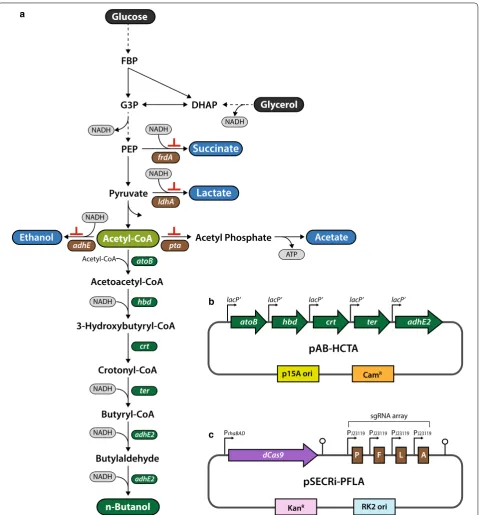
To explore the feasibility of CRISPRi-mediated blockage of multiple competing pathways for redirecting carbon flux toward improved production of molecules of inter-est, we adopted the CRISPRi to control n-butanol-bio-synthesis pathway flux as a model system. To this end, E. coli cells were transformed with a pAB-HCTA plasmid encoding a reconstituted n-butanol-production path-way that included five enzymes (AtoB, Hbd, Crt, Ter, and AdhE2) catalyzing six reactions from endogenous acetyl-CoA by incorporating their respective genes: atoB from E. coli, hbd, crt, and adhE2 from Clostridium ace-tobutylicum, and ter from Treponema denticola (Fig. 1a, b) [35]. This synthetic pathway requires two molecules of acetyl-CoA and four molecules of NADH for produc-tion of one molecule of n-butanol (Fig. 1a). Glucose and glycerol have been mainly used for n-butanol produc-tion in engineered E. coli, wherein they are converted to acetyl-CoA through glycolysis. However, glucose and glycerol are mainly redirected into succinate, lactate, acetate, and ethanol production during glycolysis, which reduces the availability of cellular acetyl-CoA and NADH required for n-butanol production (Fig. 1a). Therefore, endogenous acetyl-CoA enrichment is expected to favor improved production of n-butanol in E. coli. In this con-text, we employed the regulatable CRISPRi system with
an array of sgRNAs to channel carbon flows toward acetyl-CoA by simultaneously repressing the expression of four endogenous genes (pta, frdA, ldhA, and adhE) involved in production of acetate, succinate, lactate, and ethanol, respectively (Fig. 1c). Additionally, multiplex repression of four competing-pathway genes might con-serve NADH required for n-butanol production in engi-neered E. coli because except for Pta enzyme, other three enzymes utilize NADH for their catalytic reactions. The CRISPRi system used here contained an l-rhamnose-inducible dCas9 expression cassette and an sgRNA array transcribed by a constitutive J23119 promoter in a sin-gle plasmid (pSECRi-PFLA) (Fig. 1c). We designed this plasmid based on the low-copy number pSEVA series to minimize metabolic burden; moreover, this plasmid can be easily swapped with other antibiotics and replication origins from the standard European vector architecture (SEVA) 2.0 database for use in applications with other bacterial hosts [36]. However, it is important to note that the functionality of the l-rhamnose and J23119 promot-ers must be determined on a case-by-case basis in other bacteria. To tightly control dCas9 expression, we used an l-rhamnose-inducible promoter with RhaS and RhaR regulators; however, 1.8 kb of the RhaS and RhaR regula-tors in CRISPRi plasmids can be removed to reduce plas-mid size without altering regulatory functionality in E. coli [37]. Isopropyl β-d-1-thiogalactopyranoside (IPTG)-inducible promoters have been widely used for the expression of heterologous genes in metabolic engineer-ing efforts. Therefore, we chose the l-rhamnose-induci-ble and J23119 promoters to allow for orthogonal control of the transcription of the S. pyogenes dCas9 gene and sgRNA, respectively, in the CRISPRi system used here. Moreover, the l-rhamnose-inducible promoter is capa-ble of homogenous and rheostatic transcriptional control of genes and shows undetectable background expres-sion in the absence of l-rhamnose [37, 38]. Because the n-butanol-production plasmid was derived from pACBB-eGFP (p15A origin, chloramphenicol resistance), and each gene of the n-butanol pathway is transcribed from a constitutive lac promoter (lacP′), it is genetically compat-ible with the pSECRi-PFLA plasmid (RK2 origin, kana-mycin resistance), allowing n-butanol production in the absence of IPTG, which is an expensive inducer.
Design and assay of sgRNAs targeting endogenous genes
Glucose
PEP
DHAP FBP
G3P Glycerol
NADH NADH
NADH
NADH
NADH Acetyl-CoA
NADH
NADH
NADH
Acetyl-CoA Acetyl Phosphate Acetate
Acetoacetyl-CoA
3-Hydroxybutyryl-CoA
Crotonyl-CoA
Butyryl-CoA
Butylaldehyde
n-Butanol
Lactate
Pyruvate
ATP
atoB frdA
adhE pta
hbd
crt
ter
adhE2
adhE2
NADH
ldhA
Succinate
Ethanol
a
atoB hbd crt ter adhE2
lacP’ lacP’ lacP’ lacP’ lacP’
pAB-HCTA
p15A ori CamR
b
sgRNA array
PrhaBAD
pSECRi-PFLA
PJ23119 PJ23119 PJ23119 PJ23119
RK2 ori KanR
dCas9 P F L A
c
Fig. 1 CRISPRi system design and construction for reducing byproduct formation in engineered E. coli producing n‑butanol. a Schematic repre‑
sentation of the n‑butanol‑production pathway. The reconstituted n‑butanol‑production pathway consists of five enzymes involved in the six‑step
synthesis of n‑butanol from acetyl‑CoA. Glucose and glycerol mainly used for n‑butanol production in E. coli are redirected into succinate, lactate,
acetate, and ethanol production during glycolysis. b A plasmid encoding the five genes of the reconstructed n‑butanol pathway. The expression of
n‑butanol‑pathway genes was controlled by a constitutive lac promoter (lacP′). c The CRISPRi plasmid harboring an sgRNA array consisting of four
sgRNAs targeting pta, frdA, ldhA, and adhE genes in E. coli. The CRISPRi system consisted of a dCas9 protein and sgRNAs governed by an l‑rham‑
nose‑inducible promoter (PrhaBAD) and a J23119 constitutive promoter (PJ23119), respectively. P, F, L, and A are sgRNAs targeting endogenous pta, frdA,
ldhA, and adhE gene, respectively. AdhE, aldehyde/alcohol dehydrogenase; AtoB, acetyl‑CoA acetyltransferase; CamR, chloramphenicol‑resistance
gene; Crt, crotonase; DHAP, dihydroxyacetone phosphate; FBP, fructose 1,6‑bisphosphate; FrdA, fumarate reductase; G3P, glyceraldehyde 3‑phos‑
phate; Hbd, 3‑hydroxybutyryl‑CoA dehydrogenase; KanR, kanamycin resistance gene; LdhA, lactate dehydrogenase; PEP, phosphoenolpyruvate; Pta,
acetyltransferase, fumarate reductase, lactate dehydroge-nase, and alcohol/aldehyde dehydrogedehydroge-nase, respectively (Fig. 1a). We then designed each sgRNA for repression of pta, frdA, ldhA, or adhE based on the following criteria: (1) we identified a conserved DNA sequence between E. coli K and B strains for application of the CRISPRi system to the diverse laboratory E. coli strains; (2) the sgRNA targets a non-template DNA strand in the 5′-proximal DNA sequence of each coding DNA sequence (CDS) to guarantee repression efficiency [15]; and (3) the 10-bp seed-DNA sequence harboring an NGG-protospacer-adjacent motif (PAM) domain cannot match perfectly with the E. coli host genome to avoid off-target effects of the dCas9/sgRNA complex. All designed sgRNA sequences are listed in Additional file 1: Table S3.
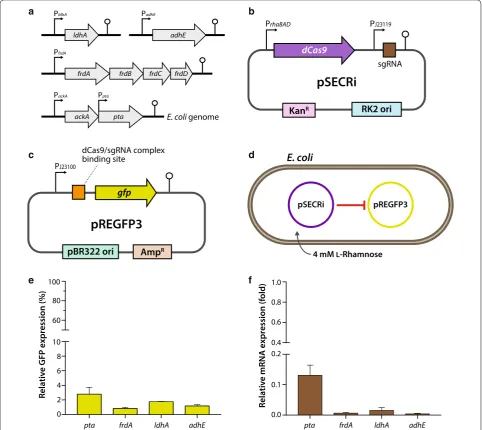
In E. coli, the ldhA and adhE genes are monocistronic, whereas frdA and pta are resident in operons (Fig. 2a). Because the frdA gene is the first gene in the frdABCD operon, CRISPRi targeting frdA might repress the tran-scription of downstream frdB, frdC, and frdD genes com-prising the fumarate reductase complex [23]. This is a potential benefit of CRISPRi-mediated transcriptional repression over translational-silencing strategies, such as sRNA. Given that genes encoding related enzymes in metabolic pathways are often grouped into operons simi-lar to frdABCD and are frequently transcribed as polycis-tronic mRNA due to the lack of intervening terminators, targeting the first gene of an operon or a single promoter could repress many or all of the important enzymes in a metabolic pathway. Conversely, one disadvantage of this approach is that genes downstream of the target will be repressed if there is no intervening promoter, which could be problematic when downstream genes are essential, though unrelated to the pathway of inter-est, or required for any other reason [17]. Although pta is downstream of the ackA gene in the ackA-pta operon, the pta gene has its own promoter in addition to that of the ackA promoter [24]. Therefore, we targeted the pta promoter to block acetyl-CoA conversion to acetyl phos-phate. After we chose the four repression-target genes and designed sgRNA sequences for pta, frdA, ldhA, and adhE, we performed a gene-reporter assay to assess the repression efficiency of the designed sgRNAs for CRIS-PRi. To this end, we used the pSECRi plasmid containing an l-rhamnose-inducible dCas9 expression cassette and sgRNA transcribed by a constitutive J23119 promoter (Fig. 2b) and a pREGFP3-reporter plasmid containing a binding site for an individual sgRNA with an NGG PAM sequence (Fig. 2c). This directed CRISPRi activity to the strand running opposite to the direction of transcription at a site between the gfp gene and its strong constitu-tive J23100 promoter. The repression activity associated with CRISPRi induced with 4 mM l-rhamnose was, thus,
quantified by the reduction in green fluorescent protein (GFP) fluorescence (Fig. 2d). The reporter assay revealed that all CRISPRi systems based on the pSECRi plasmid with four sgRNAs (ptaA, frdA, ldhA, and adhE) success-fully repressed gfp expression; the final GFP-expression levels ranged from 0.8 to 2.8% those of control values (Fig. 2e). Real-time PCR was performed to corroborate this result, verifying that the CRISPRi system functioned at the mRNA level to repress endogenous gene expres-sion in E. coli harboring the pSECRi plasmid alone (Fig. 2f). Therefore, these results demonstrated that the l-rhamnose-inducible CRISPRi system was successfully used in the context of metabolic engineering for repres-sion of endogenous competing-pathway genes in E. coli.
Effect of CRISPRi‑mediated single or combinatorial gene repression on byproduct formation
After examination of individual repression efficiency by the designed sgRNAs using the fluorescence-reporter plasmid and real-time PCR, we created sgRNA arrays by assembling four individual sgRNAs (pta, frdA, ldhA, and adhE) into six double sgRNA arrays (pta/frdA, pta/ldhA, pta/adhE, frdA/ldhA, frdA/adhE, and ldhA/adhE), four triple sgRNA arrays (pta/frdA/ldhA, pta/frdA/adhE, pta/ldhA/adhE, and frdA/ldhA/adhE), and one quad-ruple sgRNA array (pta/frdA/ldhA/adhE) to conduct multiplex repression of endogenous genes in E. coli. To exchange the four individual sgRNAs, only a single clon-ing step usclon-ing simple PCR and ligation was required. This allowed easy assembly of the sgRNA array for multiplex repression by two consecutive cloning steps involving individual sgRNA cassettes using a BioBrick assembly method using AgeI/XmaI isocaudomers (Fig. 3). To this end, we placed sgRNAs in tandem, with AgeI and XmaI restriction enzyme sites inserted at both ends of the sgRNA cassette (Fig. 3). AgeI and XmaI have compatible cohesive ends, and the ligation of both DNA fragments digested with AgeI and XmaI generates a new restric-tion site not cleavable by either of the two restricrestric-tion enzymes. We transformed a pSECRi plasmid encod-ing sencod-ingle, double, triple, or quadruple sgRNA(s) into E. coli DH5α cells and cultivated them in terrific broth TB-glucose medium supplemented with 4 mM l-rham-nose, which is required for inducing dCas9 expression in the pSECRi plasmid, under micro-aerobic conditions. After a 36 h cultivation, we measured the concentrations of acetate, succinate, lactate, and ethanol in the culture medium.
strain harboring a pSEVA221 plasmid. Therefore, we designed three additional sgRNAs targeting the pta gene [P2 targeting the ribosome-binding site (RBS), P3 and P4 targeting the CDS at different locations] and used these
to repress the pta gene in E. coli DH5α cells. The acetate concentrations produced from single CRISPRi using four different sgRNAs did not result in significantly differ-ent results (Additional file 1: Figure S1), indicating that
a
KanR RK2 ori
pSECRi
PrhaBAD PJ23119
dCas9
b
pREGFP3 pSECRi
E. coli
4 mM L-Rhamnose
d
pta frdA ldhA adhE
Relati
ve
GFP expression (%)
100
80
4 2 0 60
10 8 6 e
pREGFP3
pBR322 ori AmpR PJ23100
dCas9/sgRNA complex binding site
gfp
c
f
pta frdA ldhA adhE
Relati
ve
mRNA expression (f
old)
1.0
0.8
0.1
0.0 0.6
0.4 0.2
sgRNA PldhA
ldhA
PadhE
adhE
PfrdA
frdC frdD
frdB frdA
PackA Ppta
ackA pta E. coli genome
Fig. 2 Schematic description of CRISPRi‑mediated repression of endogenous genes involved in byproduct formation. a Genomic structure of four
endogenous genes in E. coli. The ldhA and adhE genes are monocistronic, whereas frdA and pta reside in frdABCD and ackA‑pta operon, respectively,
in E. coli. In the ackA‑pta operon, pta is controlled by a separate promoter in addition to the ackA promoter. b The CRISPRi plasmid harboring an
sgRNA targeting the pta, frdA, ldhA, or adhE gene in E. coli. c A synthetic fluorescence‑based gene‑reporter plasmid containing a GFP‑encoding
gene. Binding sites for each dCas9‑sgRNA complex were inserted between the constitutive J23100 promoter (PJ23100) and the gfp gene in the
pREGFP3 plasmid. The expression of the gfp gene was controlled by the constitutive J23100 promoter (PJ23100). d, e In vivo fluorescence assay
reporting CRISPRi‑mediated GFP repression. Two plasmids (pSECRi and pREGFP3) were introduced into E. coli, and expression of the dCas9 protein
was induced by 4 mM l‑rhamnose. f mRNA levels of CRISPRi target genes in E. coli. The pSECRi plasmid was transformed into E. coli cells, and
real‑time PCR was performed to determine the mRNA levels of each gene (pta, frdA, ldhA, or adhE). The expression ratios of GFP were calculated
as expression(%)= RFUxv/ODxv
RFUnull/ODnull × 100, where RFU and OD are relative fluorescence units and optical density values at 600 nm, respectively. The
subscript xv designates the tested cells harboring the pSECRi plasmid in the presence of l‑rhamnose, whereas null indicates a control with the same
TrrnB TrrnB
TrrnB
pSECRi-P
RK2 KanR
PrhaBAD
dcas9 sgRNA P
pSECRi-F
RK2 KanR
PrhaBAD
dcas9 sgRNA F
pSECRi-PF
RK2 KanR
PrhaBAD
dcas9 sgRNA P sgRNA F
pSECRi-L
RK2 KanR
PrhaBAD
dcas9 sgRNA L
pSECRi-A
RK2 KanR
PrhaBAD
dcas9 sgRNA A
pSECRi-LA
RK2 KanR
PrhaBAD
dcas9 sgRNA L sgRNA A
pSECRi-PFLA
RK2 KanR
PrhaBAD
dcas9 sgRNA P sgRNA F sgRNA L sgRNA A
NcoI +XmaI
(~3.0 kb) Nco(~7.8 kb)I+ AgeI P1
XmaI
NcoI AgeI XmaI
P2 AgeI
NcoI
P1
NcoI AgeI XmaI
P2
NcoI +XmaI
(~3.0 kb) Nco(~7.8 kb)I+ AgeI
P3 XmaI
NcoI AgeI XmaI
P4
AgeI
NcoI
P3
NcoI AgeI XmaI P4
P1
NcoI AgeI
P2 P3
XmaI P4
NcoI +XmaI
(~3.2 kb) Nco(~7.9 kb)I+ AgeI
TrrnB TrrnB TrrnB TrrnB
Fig. 3 Construction of sgRNA arrays using a restriction digest‑based modular assembly. Plasmids pSECRi‑P, ‑F, ‑L, and ‑A encode individual sgRNAs
that are flanked by AgeI and XmaI on the 5′ and 3′ end, respectively. These flanking restriction sites in all pSECRi plasmids allow us to connect any
two sgRNAs by ligating a plasmid backbone digested with NcoI and AgeI to an insert fragment obtained by digestion with NcoI and XmaI. The
resulting plasmid (pSECRi‑PF, or ‑LA) harbors a two‑sgRNA array that again is flanked by AgeI and XmaI on the 5′ and 3′ end, respectively. We should
mention that AgeI and XmaI have compatible cohesive ends and ligation of both DNA fragments digested with AgeI and XmaI generates a new
restriction site that is not cleavable by both restriction enzymes. A two‑sgRNA array can be joined to the array by ligating a plasmid backbone
digested with NcoI and AgeI to an insert digested with NcoI and XmaI, resulting in a pSECRi‑PFLA. All sgRNAs are under the control of J23119 pro‑
moter (P1–P4)
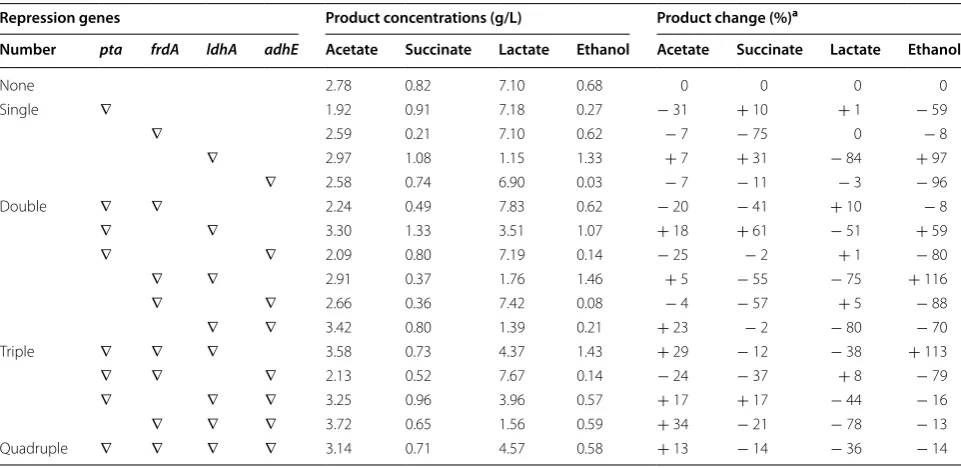
Table 1 Comparison of the effect of multiplex CRISPRi on byproduct production in E. coli
a The percentage reduction of target byproduct was calculated as iProduct[g/L] Product[g/L] × 100
−100 where iProduct [g/L] and Product [g/L] are concentration of each
target byproduct produced in the presence and absence of CRISPRi control, respectively
Repression genes Product concentrations (g/L) Product change (%)a
Number pta frdA ldhA adhE Acetate Succinate Lactate Ethanol Acetate Succinate Lactate Ethanol
None 2.78 0.82 7.10 0.68 0 0 0 0
Single ∇ 1.92 0.91 7.18 0.27 − 31 + 10 + 1 − 59
∇ 2.59 0.21 7.10 0.62 − 7 − 75 0 − 8
∇ 2.97 1.08 1.15 1.33 + 7 + 31 − 84 + 97
∇ 2.58 0.74 6.90 0.03 − 7 − 11 − 3 − 96
Double ∇ ∇ 2.24 0.49 7.83 0.62 − 20 − 41 + 10 − 8
∇ ∇ 3.30 1.33 3.51 1.07 + 18 + 61 − 51 + 59
∇ ∇ 2.09 0.80 7.19 0.14 − 25 − 2 + 1 − 80
∇ ∇ 2.91 0.37 1.76 1.46 + 5 − 55 − 75 + 116
∇ ∇ 2.66 0.36 7.42 0.08 − 4 − 57 + 5 − 88
∇ ∇ 3.42 0.80 1.39 0.21 + 23 − 2 − 80 − 70
Triple ∇ ∇ ∇ 3.58 0.73 4.37 1.43 + 29 − 12 − 38 + 113
∇ ∇ ∇ 2.13 0.52 7.67 0.14 − 24 − 37 + 8 − 79
∇ ∇ ∇ 3.25 0.96 3.96 0.57 + 17 + 17 − 44 − 16
∇ ∇ ∇ 3.72 0.65 1.56 0.59 + 34 − 21 − 78 − 13
the repression activity might not be further improved due to the pta gene being transcribed from both ackA and pta promoters. Otherwise, during the 36 h cultiva-tion, acetate might also be generated from alternative acetate-production pathways (poxB, pyruvate dehydro-genase) involving glucose in E. coli [39, 40]. Interestingly, along with acetate reduction, ethanol production also decreased to 41%, with this reduction reproducible using all four sgRNAs targeting the pta gene (Additional file 1: Figure S1). This suggested that ethanol reduction was caused not by off-target effects of CRISPRi, but by reduced expression of phosphate acetyltransferase encoded by the pta gene, which was consistent with a previous study reporting that a E. coli BW25113Δpta mutant produced less ethanol [41, 42]. CRISPRi-medi-ated ldhA repression produced less lactate (16% relative to the control), whereas production of succinate and eth-anol was elevated to 131 and 197%, respectively (Table 1), indicating that ldhA repression increased the availability of pyruvate and, subsequently, acetyl-CoA. In our cul-ture conditions, lactate was the most highly produced byproduct (7.1 g/L) with other byproducts (acetate, suc-cinate, and ethanol) generated at 2.78, 0.82, and 0.68 g/L, respectively, in the control strain harboring a pSEVA221 plasmid (Table 1). Because lactate was largely reduced to 1.15 g/L from 7.1 g/L through CRISPRi-mediated ldhA repression, this might have affected the formation of other byproducts, such as ethanol, which could poten-tially solve the NADH-regeneration problem. Further-more, repression of frdA and adhE decreased succinate and ethanol production by 25 and 4%, respectively, with-out altering formation of other byproducts.
Using the double CRISPRi systems enabled repression of two target genes simultaneously (pta/frdA, pta/ldhA, pta/adhE, frdA/ldhA, frdA/adhE, ldhA/adhE). Similar to single CRISPRi, double CRISPRi also reduced byproduct production in all tested cases (Table 1). Double CRISPRi repressing pta/ldhA or frdA/ldhA genes decreased lac-tate production and increased ethanol production simul-taneously, whereas the enhanced ethanol production was suppressed by double CRISPRi targeting ldhA/adhE genes (Table 1). The repression efficiencies of triple and quadruple CRISPRi were similar to that of double CRIS-PRi (Table 1). Notably, we observed that increasing the number of sgRNAs to repress endogenous genes involved in succinate, lactate, and ethanol biosynthesis and NADH consumption might cause an NAD+/NADH imbal-ance in host cells, because the FrdA, LdhA, and AdhE enzymes require NADH for catalysis in the central gly-colytic pathway (Fig. 1a). Therefore, our findings showed that byproduct formation was severely influenced by other metabolic fluxes, especially during the process of multiple-gene repression. Overall, these results indicated
that the multiplex CRISPRi system successfully repressed endogenous genes in E. coli and reduced byproduct for-mation. Additionally, we observed that ethanol produc-tion was dependent upon the expression of the ldhA gene, the product of which catalyzes the conversion of pyruvate to lactate in E. coli.
Effects of CRISPRi‑mediated single or combinatorial gene repression on n‑butanol production
S2), which suggested that the ratio of dCas9 and sgRNA content may be a critical factor, i.e., trace amount of dCas9 is sufficient to repress a few copies of endogenous genes. In general, factors that determine CRISPRi effi-ciency are length, sequence complementarity, and bind-ing location of sgRNA [22]. Because the dynamic control strategy required no l-rhamnose during seed cultivation, this approach would be more suitable for the develop-ment of economic bioprocesses for n-butanol production via CRISPRi.
CRISPRi‑mediated screening of the best n‑butanol producing E. coli
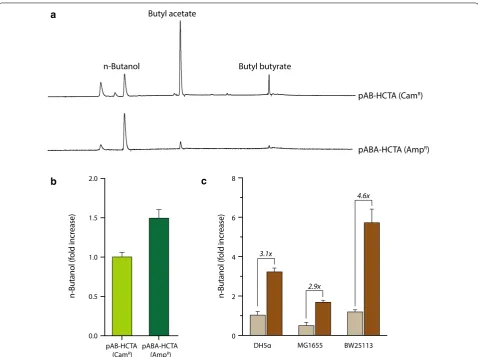
During analysis of n-butanol and byproduct produc-tion, butyl acetate and butyl butyrate were unexpectedly detected in E. coli cells harboring pAB-HCTA (Fig. 5a). A recent study showed that the chloramphenicol-resistance gene (cat) encoding chloramphenicol acetyltransferase (CAT) attaches an acetyl or butyryl group derived from acetyl-CoA or butyryl-CoA, respectively, to one of the hydroxyl groups on the aromatic alcohols [1], butanol
0 1 2 3
n-Butanol (fold increase)
Single
CRISPRi-mediated repression
Double Triple Quadruple
pta frdA ldhA adhE
Repr
essed gene
a
b
n-Butanaol (f
old increase)
Static control Dynamic control
0 8
0 16 Seed culture
Flask culture
L-Rhamnose [mM] 0
0 0.25 0.25
1 1
4 4
8 8
16 16
0 0.25
0 1
0 4 0.0
0.5 1.0 1.5 2.0 2.5
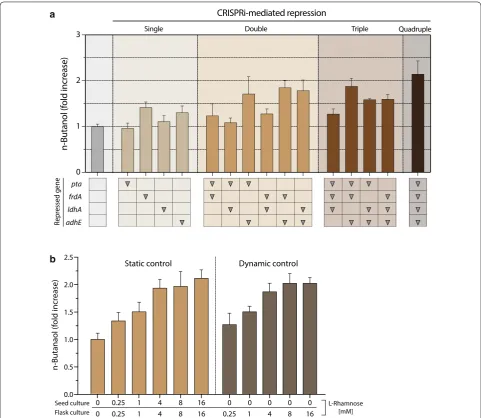
Fig. 4 Comparison of the effect of CRISPRi‑mediated multiplex gene repression on n‑butanol production in E. coli. DH5α cells harboring pAB‑
HCTA and each pSECRi plasmid were grown in TB medium supplemented with 20 g/L glycerol and a 4 mM l‑rhamnose or b various concen‑
trations of l‑rhamnose at 37 °C for 48 h. n‑Butanol levels were determined by GC. The fold increase of n‑butanol production was calculated as
n-butanol(fold)= BtOHBtOHnullxv × 100, where BtOH is n‑butanol concentration. The subscript xv designates the tested cells harboring the pAB‑HCTA
and pSECRi plasmid in the presence of l‑rhamnose, whereas null indicates a control with the same two plasmids in the absence of l‑rhamnose. Data
and methyl butanol [43]. Coincidentally, because the pAB-HCTA plasmid encoding heterologous n-butanol-pathway genes contained the cat gene, we hypothesized that butyl acetate and butyl butyrate were produced from n-butanol acetylation by the CAT enzyme. To test this, we replaced the cat gene with an ampicillin-resistance gene (β-lactamase encoded by the bla gene) in the pAB-HCTA plasmid. As expected, E. coli cells harboring an n-butanol-producing plasmid with ampicillin resistance produced almost no butyl butyrate, butyl acetate forma-tion also significantly reduced (Fig. 5a). Additionally,
n-butanol production increased 1.5-fold as compared with that observed in cells harboring the pAB-HCTA plasmid with the cat gene (Fig. 5b), indicating that CAT was involved in the production of butyl acetate and butyl butyrate. Therefore, we used the pAB-HCTA plas-mid with ampicillin resistance (pABA-HCTA) for fur-ther experiments on n-butanol production. To screen for the best n-butanol producer among various E. coli strains, we used three different E. coli strains: DH5α, MG1655, and BW25113. We transformed two plasmids, pSECRi-PFLA carrying a quadruple sgRNA array and
pAB-HCTA (CamR)
pABA-HCTA (AmpR)
Butyl acetate
Butyl butyrate n-Butanol
a
b
0.0 0.5 1.0 1.5 2.0
n-Butanol (fold increase)
pAB-HCTA (CamR)
pABA-HCTA (AmpR)
c
0 2 4 6 8
n-Butanol (fold increase
)
DH5α
3.1x
MG1655 BW25113
2.9x
4.6x
Fig. 5 Reductions in n‑butanol‑derived byproducts and screening of various E. coli strains for n‑butanol production. Escherichia coli DH5α cells
containing pAB‑HCTA(CamR) or pABA‑HCTA(AmpR) were grown in TB medium supplemented with 20 g/L glycerol at 37 °C for 48 h. a, b Meta‑
bolic products, including n‑butanol and its derivatives, were determined by GC. The fold increase of n‑butanol production was calculated as
n-butanol(fold)= BtOHamp
BtOHcam ×100, where BtOH is n‑butanol concentration. The subscript amp designates the tested cells harboring the pABA‑HCTA,
whereas cam indicates a control with the pAB‑HCTA plasmid. c To screen the best n‑butanol producer among various E. coli strains, three different
E. coli strains (DH5α, MG1655, and BW25113) were examined. Two plasmids, pSECRi‑PFLA carrying a quadruple sgRNA array and pABA‑HCTA encod‑
ing heterologous n‑butanol‑pathway genes, were introduced into each E. coli strain, which was grown in TB medium supplemented with 20 g/L
glycerol and 4 mM l‑rhamnose at 37 °C for 48 h. n‑Butanol levels were determined by GC. The fold increase of n‑butanol production was calculated
as n-butanol(fold)= BtOHxv
BtOHdh × 100, where BtOH is n‑butanol concentration. The subscript xv designates the tested cells harboring the pABA‑
HCTA and pSECRi‑PFLA, whereas dh indicates E. coli DH5α cells with the pABA‑HCTA and pSEVA221. Data represent the averages of three biological
pABA-HCTA encoding heterologous n-butanol-pathway genes, into each E. coli strain. Each E. coli strain harbor-ing the pABA-HCTA plasmid and a pSEVA221 plasmid (no repression) was also used as a control. In the absence of CRISPRi regulation, the BW25113 strain produced ~ 30% more n-butanol than the DH5α strain and 125% more n-butanol than the MG1655 strain (Fig. 5c). In the presence of CRISPRi regulation, n-butanol production increased in all tested E. coli strains relative to the con-trol: 3.1-fold in the DH5α strain, 2.9-fold in the MG1655 strain, and 4.6-fold in the BW25113 strain. These results showed that the BW25113 strain exhibiting quadruple gene silencing produced 5.9-fold and 10.3-fold more n-butanol relative to the DH5α and MG1655 strain, respectively, in the absence of CRISPRi regulation. There-fore, we easily selected the BW25113 strain as the best n-butanol producer through use of CRISPRi-mediated multiple-gene repression. Indeed, the BW25113 strain has been mainly used as a host for n-butanol produc-tion in numerous studies [44, 45] since it was used in the pioneer work on n-butanol production [34]. In addition, a maximum titer of 30 g/L of n-butanol in E. coli was also achieved using BW25113 deletion mutants through anaerobic cultivation [33].
Effects of multiplex CRISPRi on production of n‑butanol
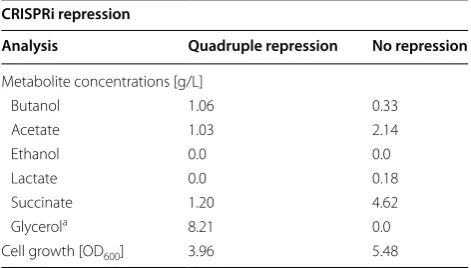
Glycerol may be an ideal feedstock to produce n-butanol because of its availability, low prices, and a high degree of reduction [46]. Therefore, to examine the effect of quad-ruple CRISPRi condition (pta, frdA, ldhA, and adhE) on production of n-butanol and byproducts from glyc-erol, instead of glucose, in E. coli, BW25113 cells con-taining the pSECRi-PFLA and pABA-HCTA plasmids were grown in TB medium supplemented with 20 g/L glycerol and 4 mM l-rhamnose for dCas9 expression under micro-aerobic batch fermentation, and concen-trations of n-butanol and byproducts were monitored for 99 h. BW25113 strain containing a pSEVA221 plas-mid instead of pSECRi-PFLA was also used as a con-trol strain (Additional file 1: Figure S3 and Table 2). In the control strain, 20 g/L glycerol was completely con-sumed after 60 h, whereas there remained 8.21 g/L glyc-erol in the strain under CRISPRi regulation after 60 h. Additionally, production of ethanol and lactate was negligible in both strains, and acetate was continuously produced up to 2.14 g/L in the control strain, whereas strains under CRISPRi regulation yielded twofold less acetate (1.03 g/L). Succinate was the most highly pro-duced byproduct in both strains, with the control strain producing 4.62 g/L succinate, and the strain under CRIS-PRi regulation produced 1.20 g/L succinate (Table 2). The n-butanol yield and productivity via CRISPRi regulation increased up to 5.4- and 3.2-fold, respectively. Overall,
the strain under CRISPRi regulation successfully reduced succinate and acetate formation and increased n-butanol production from glycerol. The implementation of CRIS-PRi-mediated repression of multiple endogenous genes was simple and efficient for enhanced production of mol-ecules of interest, and is applicable to nearly any other endogenous genes including essential genes for host cell growth.
Conclusions
Identification of potential target genes and balancing their expression are crucial for the efficient production of molecules of interests [47, 48]. However, it is limited to manipulate multiple target genes through the conven-tional approaches of gene deletion. This study described a simple method for multiple endogenous gene repres-sion using a designed CRISPRi system. By simple inverse PCR, we created CRISPRi plasmids targeting four endogenous genes, resulting in the successful repres-sion of GFP expresrepres-sion to 2.8% following transformation of multi-copy reporter plasmids and reductions in the product formation via endogenous target genes. Using BioBrick assembly, sgRNA arrays targeting two, three, or four genes were created within two successive clon-ing steps. Their subsequent utilization reduced byprod-uct formation simultaneously, although the effects of repression of one byproduct influenced the formation of other byproducts. When the four byproduct pathways were blocked by CRISPRi in the DH5α strain, n-butanol production was enhanced by up to 2.1-fold, with this enhancement dependent upon dCas9 expression. Fur-thermore, we found that the CAT enzyme responsible for conferring chloramphenicol resistance was involved in the formation of butyl acetate and butyl ester, and that by exchanging the cat gene for a bla gene and performing optimal-strain selection, n-butanol yield was enhanced
Table 2 Effect of CRISPRi-mediated multiplex repression on n-butanol production
Cells were grown micro-aerobically in TB-glycerol media at 37 °C for 60 h
a Glycerol remained
CRISPRi repression
Analysis Quadruple repression No repression
Metabolite concentrations [g/L]
Butanol 1.06 0.33
Acetate 1.03 2.14
Ethanol 0.0 0.0
Lactate 0.0 0.18
Succinate 1.20 4.62
Glycerola 8.21 0.0
by up to 5.9-fold as compared with that observed in the DH5α strain containing the production plasmid without CRISPRi regulation. When glycerol, instead of glucose, was used as the carbon source for n-butanol production under CRISPRi regulation, it also exhibited reduced for-mation of byproducts, especially succinate and acetate, resulting in higher n-butanol yields and productivity than those observed in unregulated strains. The CRISPRi system holds great promise as a genetic reprogramming platform that is suitable for microbial metabolic engi-neering. In particular, the ability of CRISPRi to effort-lessly regulate multiple endogenous genes simultaneously will play a very important role for synthetic biology and metabolic engineering.
Methods
Bacterial strains, media, and reagents
Escherichia coli DH5α was used as a host strain for cloning and n-butanol production. Strains MG1655 and BW25113 were also used as n-butanol production hosts. Escherichia coli cells were grown in Luria–Ber-tani (LB) medium (5 g/L yeast extract, 10 g/L tryptone, and 5 g/L NaCl). For byproduct analysis, TB-glucose medium consisting of TB medium (12 g/L enzymatic casein digest, 24 g/L yeast extract, 9.4 g/L K2HPO4, and
2.2 g/L KH2PO4) containing 2% (w/v) glucose was used,
and TB-glycerol medium, which is TB medium contain-ing 2% (w/v) glycerol, was used for n-butanol production. Ampicillin (100 μg/mL), kanamycin (25 μg/mL), or chlo-ramphenicol (34 μg/mL) was added to media for plasmid selection and maintenance. High-fidelity KOD-Plus-Neo polymerase (Toyobo, Osaka, Japan) was used for PCR. All restriction enzymes, T4 DNA ligase, T4 polynucleo-tide kinase, and Gibson assembly master mix were pur-chased from New England Biolabs (Ipswich, MA, USA), and experiments were conducted according to manufac-turer instructions.
Plasmid construction
Primers, plasmids, and sgRNAs used in this study are summarized in Additional file 1: Tables S1, S2, and S3, respectively. For CRISPRi plasmid construction, we used an inverse PCR method for changing the sgRNA sequences [49]. Briefly, we amplified entire regions of the pSECRi plasmid using CRI(pta)-F and CRI(pta)-R primer pairs, followed by ligation of the amplified frag-ments using T4 DNA ligase and T4 polynucleotide kinase, resulting in the P plasmid. The pSECRi-F, pSECRi-L, pSECRi-A plasmids were constructed using similar methods. For multiplex repression, the pSECRi-P plasmid was digested with NcoI/XmaI, and the fragment containing sgRNA(P) was gel purified (Promega, Madi-son, WI, USA). The other fragment containing sgRNA(F)
was gel purified by NcoI/AgeI digestion from the pSE-CRi-F plasmid, followed by ligation of the two purified fragments, resulting in the pSECRi-PF plasmid. Other multiplex CRISPRi plasmids were constructed using a similar method. For pBBR1CRi-PFLA plasmid construc-tion, the RK2 origin of pSECRi-PFLA was removed by AscI/FseI restriction digest, and the remaining fragment was ligated along with the pBBR1 origin of replication fragment prepared using a pSEVA131 plasmid digested with AscI/FseI.
For reporter-plasmid construction, we amplified entire regions of the pREGFP3 plasmid using the pMW(pta)-F and pMW(pta)-R primer pairs, followed by ligation of the amplified fragments using T4 DNA ligase and T4 poly-nucleotide kinase (New England Biolabs), resulting in plasmid pREGFP3-P. The pREGFP3-F, pREGFP3-L, and pREGFP3-A plasmids were constructed using similar methods.
To change the antibiotic resistance gene in the n-butanol-production plasmid, we amplified the entire target region, except for that harboring the cat gene, from the pACBB-eGFP plasmid using the AV-F and AV-R primer pairs, and amplified the bla gene from the pSEVA131 plasmid using the AI-F and AI-R primer pairs. We assembled the two amplified fragments using the Gibson assembly method [50], resulting in the pACBBA-eGFP plasmid. To incorporate n-butanol-pathway enzymes, we amplified the backbone region of the pACBBA-eGFP plasmid using the ACBBA-F and ACBBA-R primers, and n-butanol-pathway genes were obtained by SpeI/XbaI restriction digest from the pAB-HCTA plasmid. The two fragments were then assembled with using the Gibson assembly method [50], resulting in the pABA-HCTA plasmid.
Gene‑reporter assay for CRISPRi activity
Escherichia coli cells harboring a reporter plasmid and CRISPRi plasmid were grown in LB medium contain-ing the appropriate antibiotics at 37 °C with shakcontain-ing at 200 rpm for 8 h. For dCas9 protein induction, 4 mM l-rhamnose was also added to the culture medium. The culture broth was washed once with phosphate-buffered saline (PBS) and resuspended with PBS. Fluorescence and optical density at 600 nm measurements were con-ducted with the Victor X multi-label plate reader (Perki-nElmer, Waltham, MA, USA) using black-walled 96-well polystyrene plates.
Determination of endogenous mRNA‑expression levels
to the culture medium. Total RNA from cultured cells was isolated using the RNeasy protect bacteria mini kit according to manufacturer instructions (Qiagen, Valen-cia, CA, USA), and cDNA was synthesized from iso-lated RNA using the ReverTra Ace qPCR RT master mix with gDNA remover (Toyobo, Osaka, Japan). Real-time PCR for mRNA quantification was performed using the CFX Connect real-time PCR detection system (Bio-Rad, Hercules, CA, USA) with iQ SYBR Green supermix (Bio-Rad). The primers used for real-time PCR analy-sis are listed in Additional file 1: Table S1. Relative gene expression was quantified using 16S ribosomal RNA (rRNA) as an internal control according to the 2−∆∆Ct
method [51].
Quantification of n‑butanol and other metabolites
For n-butanol quantification, the 50-µL headspace of the sealed bottle in which E. coli was cultured was used for direct injection for gas chromatography (GC) analysis using a flame ionization detector (FID) attached to an HP-5 column (30 m × 0.320 mm × 0.25 µm) at a flow rate of 1 mL/min. The starting temperature of the oven was set to 40 °C for 3 min, followed by increases at 10 °C/ min to 100 °C, maintenance at 100 °C for 3 min, increases at 30 °C/min to 200 °C, and maintenance at 200 °C for 1 min.
For ester-derivative identification, the 50-µL head-space of the sealed bottle in which E. coli was cul-tured was analyzed by GC using an HP-5MS column (30 m × 0.250 mm × 0.25 µm) and a single quadrupole mass spectrometer (Agilent Technologies, Santa Clara, CA, USA). Samples were analyzed at a starting tempera-ture of 40 °C for 3 min, followed by increases at 10 °C/ min to 100 °C, maintenance at 100 °C for 3 min, increases at 30 °C/min to 200 °C, and maintenance at 200 °C for 1 min. The ion-source temperature was set to 250 °C, and mass spectra were collected at m/z 41 and m/z 56, with a 1 min solvent delay. The peaks were analyzed using Agi-lent ChemStation software (AgiAgi-lent Technologies).
For n-butanol and byproduct quantification in medium, 1 mL of cultured cell was centrifuged for 10 min at 12,000 rpm. The supernatant was filtered through a 0.45-µm filter (Millipore, Billerica, MA, USA), and the filtrate was analyzed by GC for n-butanol quantifica-tion or by high-performance liquid chromatography (HPLC) for byproduct analysis. For n-butanol quantifica-tion, the filtrate was injected into a gas chromatograph equipped with a FID and a DB-WAX capillary column (30 m × 0.320 mm × 0.5 µm; Agilent Technologies). The oven temperature was initially heated to 60 °C and held for 4 min, followed by increases to 120 °C at a gradient of 15 °C/min, to 230 °C at a gradient of 50 °C/min, and
maintenance at 230 °C for 2 min. The injector and detec-tor were maintained at 250 and 300 °C, respectively.
For glycerol and byproduct analyses, the filtrate was injected into an HPLC column equipped with a reflec-tive index detector (Agilent Technologies). Analyses were conducted using an Aminex HPX-87H column (300 × 7.8 mm; Bio-Rad) with the mobile phase (4 mM H2SO4) injected at 0.5 mL/min and at a temperature of
50 °C. Pure n-butanol, acetate, succinate, lactate, and eth-anol were purchased from Sigma-Aldrich (St. Louis, MO, USA) and used as external standards for quantification.
n‑Butanol fermentation in a bioreactor
n-Butanol fermentation was performed in a 1-L stirred-tank fermenter (CNS, Seoul, South Korea) using a work-ing volume of 0.4 L in TB medium containwork-ing 2% (w/v) glycerol and 4 mM l-rhamnose with appropriate antibi-otics. The fermenter was inoculated with 1% (v/v) of cul-tured cells, which were grown in LB medium containing 4 mM l-rhamnose with appropriate antibiotics at 37 °C and shaking at 200 rpm overnight. After inoculation, stirrer speed was maintained 250 rpm, and 1 volume of air per volume of liquid per minute (vvm) was air-bubbled through the fermenter. After 6 h, 1 vvm air gas was turned off, and all gas tubes were sealed with pinch clamps to initiate micro-aerobic conditions. The pH was controlled at 7.0 at all times by automated addition of 2 N NaOH solution.
Abbreviations
CRISPRi: clustered regularly interspaced short palindromic repeat interference; NADH: reduced β‑nicotinamide adenine dinucleotide isopentenyl diphos‑ phate; NAD+: β‑nicotinamide adenine dinucleotide isopentenyl diphosphate;
MAGE: multiplex automated genomic engineering; sRNA: synthetic small‑ regulatory RNA; sgRNA: single‑guide RNA; dCas9: nuclease‑deficient Cas9; MVA: mevalonate; IPTG: isopropyl β‑d‑1‑thiogalactopyranoside; CDS: coding
DNA sequence; PAM: protospacer adjacent motif; GFP: green fluorescent pro‑ tein; PCR: polymerase chain reaction; CAT: chloramphenicol acetyltransferase; TB: terrific broth; LB: Luria–Bertani; PBS: phosphate‑buffered saline; qPCR: quantitative PCR; mRNA: messenger RNA; rRNA: ribosomal RNA; vvm: volume of air per volume of medium per minute; GC: gas chromatography; FID: flame ionization detector; HPLC: high‑performance liquid chromatography.
Authors’ contributions
SKK and WS performed most of the plasmid construction and bacterial fer‑ mentations. GHH conducted the optimization experiments, their linked analy‑ ses, and fermentation. SKK and DL planned experiments and analyzed and interpreted the data. DL and SL supervised the study, designed experiments, and analyzed and interpreted the results. SKK and DL wrote the manuscript. All authors read and approved the final manuscript.
Author details
1 Synthetic Biology and Bioengineering Research Center, Korea Research Institute of Bioscience and Biotechnology (KRIBB), Daejeon 34141, Republic Additional file
of Korea. 2 Department of Biosystems and Bioengineering, KRIBB School of Biotechnology, University of Science and Technology (UST), Daejeon 34113, Republic of Korea.
Acknowledgements
The authors would like to thank Dr. Victor D. Lorenzo for the kind donation of the pSEVA plasmids and members of the Synthetic Biology Laboratory in the Synthetic Biology and Bioengineering Center at KRIBB for their valuable com‑ ments and helpful discussions.
Competing interests
The authors declare that they have no competing interests.
Availability of data and materials
The datasets supporting the conclusions of this article are included within the article.
Consent for publication Not applicable.
Ethics approval and consent to participate Not applicable.
Funding
This work was supported by the KRIBB Research Initiative Program and a grant from C1 Gas Refinery Program (Grant Number: NRF‑2015M3D3A1A01064875) from the National Research Foundation (NRF) funded by the Ministry of Science and ICT of the Republic of Korea. This work was also supported by a grant from the Next‑Generation BioGreen 21 Program (SSAC, Grant Number: PJ011118) funded by the Rural Development Administration of the Republic of Korea.
Publisher’s Note
Springer Nature remains neutral with regard to jurisdictional claims in pub‑ lished maps and institutional affiliations.
Received: 10 July 2017 Accepted: 30 October 2017
References
1. Alonso‑Gutierrez J, Chan R, Batth TS, Adams PD, Keasling JD, Petzold CJ, Lee TS. Metabolic engineering of Escherichia coli for limonene and perillyl alcohol production. Metab Eng. 2013;19:33–41.
2. Du J, Yuan Y, Si T, Lian J, Zhao H. Customized optimization of metabolic pathways by combinatorial transcriptional engineering. Nucleic Acids Res. 2012;40:e142.
3. Zelcbuch L, Antonovsky N, Bar‑Even A, Levin‑Karp A, Barenholz U, Dayagi M, Liebermeister W, Flamholz A, Noor E, Amram S, et al. Spanning high‑ dimensional expression space using ribosome‑binding site combinato‑ rics. Nucleic Acids Res. 2013;41:e98.
4. Jones JA, Toparlak OD, Koffas MA. Metabolic pathway balancing and its role in the production of biofuels and chemicals. Curr Opin Biotechnol. 2015;33:52–9.
5. Lee SY, Kim HU. Systems strategies for developing industrial microbial strains. Nat Biotechnol. 2015;33:1061–72.
6. Datsenko KA, Wanner BL. One‑step inactivation of chromosomal genes in Escherichia coli K‑12 using PCR products. Proc Natl Acad Sci USA. 2000;97:6640–5.
7. Wang HH, Isaacs FJ, Carr PA, Sun ZZ, Xu G, Forest CR, Church GM. Programming cells by multiplex genome engineering and accelerated evolution. Nature. 2009;460:894–8.
8. Gallagher RR, Li Z, Lewis AO, Isaacs FJ. Rapid editing and evolution of bacterial genomes using libraries of synthetic DNA. Nat Protoc. 2014;9:2301–16.
9. Li Y, Lin Z, Huang C, Zhang Y, Wang Z, Tang YJ, Chen T, Zhao X. Metabolic engineering of Escherichia coli using CRISPR‑Cas9 meditated genome editing. Metab Eng. 2015;31:13–21.
10. Ronda C, Pedersen LE, Sommer MO, Nielsen AT. CRMAGE: CRISPR opti‑ mized MAGE recombineering. Sci Rep. 2016;6:19452.
11. Bassalo MC, Garst AD, Halweg‑Edwards AL, Grau WC, Domaille DW, Muta‑ lik VK, Arkin AP, Gill RT. Rapid and efficient one‑step metabolic pathway integration in E. coli. ACS Synth Biol. 2016;5:561–8.
12. Chung ME, Yeh IH, Sung LY, Wu MY, Chao YP, Ng IS, Hu YC. Enhanced inte‑ gration of large DNA into E. coli chromosome by CRISPR/Cas9. Biotechnol Bioeng. 2017;114:172–83.
13. Gilbert LA, Larson MH, Morsut L, Liu Z, Brar GA, Torres SE, Stern‑Ginossar N, Brandman O, Whitehead EH, Doudna JA, et al. CRISPR‑mediated modular RNA‑guided regulation of transcription in eukaryotes. Cell. 2013;154:442–51.
14. Lv L, Ren YL, Chen JC, Wu Q, Chen GQ. Application of CRISPRi for prokary‑ otic metabolic engineering involving multiple genes, a case study: controllable P(3HB‑co‑4HB) biosynthesis. Metab Eng. 2015;29:160–8. 15. Yang Y, Lin Y, Li L, Linhardt RJ, Yan Y. Regulating malonyl‑CoA metabolism
via synthetic antisense RNAs for enhanced biosynthesis of natural prod‑ ucts. Metab Eng. 2015;29:217–26.
16. Kim SK, Han GH, Seong W, Kim H, Kim S‑W, Lee D‑H, Lee S‑G. CRISPR interference‑guided balancing of a biosynthetic mevalonate pathway increases terpenoid production. Metab Eng. 2016;38:228–40. 17. Cress BF, Toparlak ÖD, Guleria S, Lebovich M, Stieglitz JT, Englaender JA,
Jones JA, Linhardt RJ, Koffas MAG. CRISPathBrick: modular combinato‑ rial assembly of type II‑A CRISPR arrays for dCas9‑mediated multiplex transcriptional repression in E. coli. ACS Synth Biol. 2015;4:987–1000. 18. Wu J, Yu O, Du G, Zhou J, Chen J. Fine‑tuning of the fatty acid pathway by
synthetic antisense rna for enhanced (2S)‑naringenin production from
l‑tyrosine in Escherichia coli. Appl Environ Microbiol. 2014;80:7283–92.
19. Solomon KV, Sanders TM, Prather KL. A dynamic metabolite valve for the control of central carbon metabolism. Metab Eng. 2012;14:661–71. 20. Sharma V, Yamamura A, Yokobayashi Y. Engineering artificial small RNAs for
conditional gene silencing in Escherichia coli. ACS Synth Biol. 2012;1:6–13. 21. Bikard D, Jiang W, Samai P, Hochschild A, Zhang F, Marraffini LA. Program‑ mable repression and activation of bacterial gene expression using an engineered CRISPR‑Cas system. Nucleic Acids Res. 2013;41:7429–37. 22. Qi LS, Larson MH, Gilbert LA, Doudna JA, Weissman JS, Arkin AP, Lim WA.
Repurposing CRISPR as an RNA‑guided platform for sequence‑specific control of gene expression. Cell. 2013;152:1173–83.
23. Wu J, Du G, Chen J, Zhou J. Enhancing flavonoid production by sys‑ tematically tuning the central metabolic pathways based on a CRISPR interference system in Escherichia coli. Sci Rep. 2015;5:13477. 24. Li D, Lv L, Chen J‑C, Chen G‑Q. Controlling microbial PHB synthesis via
CRISPRi. Appl Microbiol Biotechnol. 2017;. https://doi.org/10.1007/ s00253‑00017‑08374‑00256.
25. Cress BF, Leitz QD, Kim DC, Amore TD, Suzuki JY, Linhardt RJ, Koffas MAG. CRISPRi‑mediated metabolic engineering of E. coli for O‑methylated anthocyanin production. Microb Cell Fact. 2017;16:10.
26. Elhadi D, Lv L, Jiang X‑R, Wu H, Chen G‑Q. CRISPRi engineering E. coli for morphology diversification. Metab Eng. 2016;38:358–69.
27. Wen M, Bond‑Watts BB, Chang MCY. Production of advanced biofuels in engineered E. coli. Curr Opin Chem Biol. 2013;17:472–9.
28. Liu M, Ding Y, Chen H, Zhao Z, Liu H, Xian M, Zhao G. Improving the production of acetyl‑CoA‑derived chemicals in Escherichia coli BL21(DE3) through iclR and arcA deletion. BMC Microbiol. 2017;17:10.
29. Saini M, Li S‑Y, Wang ZW, Chiang C‑J, Chao Y‑P. Systematic engineering of the central metabolism in Escherichia coli for effective production of
n‑butanol. Biotechnol Biofuel. 2016;9:69.
30. Centeno‑Leija S, Huerta‑Beristain G, Giles‑Gómez M, Bolivar F, Gosset G, Martinez A. Improving poly‑3‑hydroxybutyrate production in Escherichia coli by combining the increase in the NADPH pool and acetyl‑CoA avail‑ ability. Antonie Leeuwenhoek. 2014;105:687–96.
31. Kim J‑H, Wang C, Jang H‑J, Cha M‑S, Park J‑E, Jo S‑Y, Choi E‑S, Kim S‑W. Iso‑ prene production by Escherichia coli through the exogenous mevalonate pathway with reduced formation of fermentation byproducts. Microb Cell Fact. 2016;15:214.
32. Chang MCY, Eachus RA, Trieu W, Ro D‑K, Keasling JD. Engineering Escheri-chia coli for production of functionalized terpenoids using plant P450s. Nat Chem Biol. 2007;3:274–7.
• We accept pre-submission inquiries
• Our selector tool helps you to find the most relevant journal
• We provide round the clock customer support
• Convenient online submission
• Thorough peer review
• Inclusion in PubMed and all major indexing services
• Maximum visibility for your research
Submit your manuscript at www.biomedcentral.com/submit
Submit your next manuscript to BioMed Central
and we will help you at every step:
34. Atsumi S, Cann AF, Connor MR, Shen CR, Smith KM, Brynildsen MP, Chou KJ, Hanai T, Liao JC. Metabolic engineering of Escherichia coli for 1‑butanol production. Metab Eng. 2008;10:305–11.
35. Han GH, Seong W, Fu Y, Yoon PK, Kim SK, Yeom S‑J, Lee D‑H, Lee S‑G. Leucine zipper‑mediated targeting of multi‑enzyme cascade reactions to inclusion bodies in Escherichia coli for enhanced production of 1‑butanol. Metab Eng. 2017;40:41–9.
36. Martínez‑García E, Aparicio T, Goñi‑Moreno A, Fraile S, de Lorenzo V. SEVA 2.0: an update of the Standard European Vector Architecture for de‑/re‑construction of bacterial functionalities. Nucleic Acids Res. 2015;43:D1183–9.
37. Wegerer A, Sun T, Altenbuchner J. Optimization of an E. colil‑rhamnose‑
inducible expression vector: test of various genetic module combina‑ tions. BMC Biotechnol. 2008;8:2.
38. Giacalone MJ, Gentile AM, Lovitt BT, Berkley NL, Gunderson CW, Surber MW. Toxic protein expression in Escherichia coli using a rhamnose‑ based tightly regulated and tunable promoter system. Biotechniques. 2006;40:355–64.
39. Dittrich CR, Bennett GN, San KY. Characterization of the acetate‑produc‑ ing pathways in Escherichia coli. Biotechnol Prog. 2005;21:1062–7. 40. Phue JN, Lee SJ, Kaufman JB, Negrete A, Shiloach J. Acetate accumula‑
tion through alternative metabolic pathways in ackA−pta−poxB− triple
mutant in E. coli B (BL21). Biotechnol Lett. 2010;32:1897–903. 41. Zhu J, Shimizu K. Effect of a single‑gene knockout on the metabolic
regulation in Escherichia coli for D‑lactate production under microaerobic condition. Metab Eng. 2005;7:104–15.
42. Castano‑Cerezo S, Pastor JM, Renilla S, Bernal V, Iborra JL, Canovas M. An insight into the role of phosphotransacetylase (pta) and the acetate/ acetyl‑CoA node in Escherichia coli. Microb Cell Fact. 2009;8:54.
43. Rodriguez GM, Tashiro Y, Atsumi S. Expanding ester biosynthesis in
Escherichia coli. Nat Chem Biol. 2014;10:259–65.
44. Chen C‑T, Liao JC. Frontiers in microbial 1‑butanol and isobutanol pro‑ duction. FEMS Microbiol Lett. 2016;363:fnw020.
45. Dong H, Zhao C, Zhang T, Lin Z, Li Y, Zhang Y. Engineering Escherichia coli
cell factories for n‑butanol production. In: Ye Q, Bao J, Zhong J‑J, editors. Bioreactor engineering research and industrial applications I: cell facto‑ ries. Berlin: Springer; 2016. p. 141–63.
46. Murarka A, Dharmadi Y, Yazdani SS, Gonzalez R. Fermentative utilization of glycerol by Escherichia coli and its implications for the production of fuels and chemicals. Appl Environ Microbiol. 2008;74:1124–35.
47. Na D, Yoo SM, Chung H, Park H, Park JH, Lee SY. Metabolic engineering of Escherichia coli using synthetic small regulatory RNAs. Nat Biotechnol. 2013;31:170–4.
48. Xu P, Gu Q, Wang W, Wong L, Bower AGW, Collins CH, Koffas MAG. Modu‑ lar optimization of multi‑gene pathways for fatty acids production in E. coli. Nat Commun. 2013;4:1409.
49. Yoo SM, Na D, Lee SY. Design and use of synthetic regulatory small RNAs to control gene expression in Escherichia coli. Nat Protoc. 2013;8:1694–707.
50. Gibson DG, Young L, Chuang R‑Y, Venter JC, Hutchison CA, Smith HO. Enzymatic assembly of DNA molecules up to several hundred kilobases. Nat Methods. 2009;6:343–5.