R E S E A R C H
Open Access
Technology-aided assessments of
sensorimotor function: current use, barriers
and future directions in the view of different
stakeholders
Camila Shirota
1†, Sivakumar Balasubramanian
2†and Alejandro Melendez-Calderon
1,3,4*†Abstract
Background:There is growing interest in the use of technology in neurorehabilitation, from robotic to sensor-based devices. These technologies are believed to be excellent tools for quantitative assessment of sensorimotor ability, addressing the shortcomings of traditional clinical assessments. However, clinical adoption of technology-based assessments is very limited. To understand this apparent contradiction, we sought to gather the points-of-view of different stakeholders in the development and use of technology-aided sensorimotor assessments. Methods:A questionnaire regarding motivators, barriers, and the future of technology-aided assessments was prepared and disseminated online. To promote discussion, we present an initial analysis of the dataset; raw responses are provided to the community as Supplementary Material. Average responses within stakeholder groups were compared across groups. Additional questions about respondent’s demographics and professional practice were used to obtain a view of the current landscape of sensorimotor assessments and interactions between different stakeholders. Results:One hundred forty respondents from 23 countries completed the survey. Respondents were a mix of Clinicians (27%), Research Engineers (34%), Basic Scientists (15%), Medical Industry professionals (16%), Patients (2%) and Others (6%). Most respondents were experienced in rehabilitation within their professions (67% with > 5 years of experience), and had exposure to technology-aided assessments (97% of respondents). In general, stakeholders agreed on reasons for performing assessments, level of details required, current bottlenecks, and future directions. However, there were disagreements between and within stakeholders in aspects such as frequency of assessments, and important factors hindering adoption of technology-aided assessments, e.g., Clinicians’top factor was cost, while Research Engineers indicated device-dependent factors and lack of standardization. Overall, lack of time, cost, lack of
standardization and poor understanding/lack of interpretability were the major factors hindering the adoption of technology-aided assessments in clinical practice. Reimbursement and standardization of technology-aided assessments were rated as the top two activities to pursue in the coming years to promote the field of technology-aided sensorimotor assessments.
(Continued on next page)
© The Author(s). 2019Open AccessThis article is distributed under the terms of the Creative Commons Attribution 4.0 International License (http://creativecommons.org/licenses/by/4.0/), which permits unrestricted use, distribution, and reproduction in any medium, provided you give appropriate credit to the original author(s) and the source, provide a link to the Creative Commons license, and indicate if changes were made. The Creative Commons Public Domain Dedication waiver (http://creativecommons.org/publicdomain/zero/1.0/) applies to the data made available in this article, unless otherwise stated.
* Correspondence:[email protected] †Camila Shirota, Sivakumar Balasubramanian and Alejandro
Melendez-Calderon contributed equally to this work.
1
Department of Health Sciences and Technology, ETH Zurich, Zürich, Switzerland
3cereneo Advanced Rehabilitation Institute (CARINg), cereneo - Zentrum für
Interdisziplinäre Forschung, Vitznau, Switzerland
(Continued from previous page)
Conclusions:There is an urgent need for standardization in technology-aided assessments. These efforts should be accompanied by quality cross-disciplinary activities, education and alignment of scientific language, to more effectively promote the clinical use of assessment technologies.
Trial registration:NA; see Declarations section.
Keywords:Sensorimotor assessments, Neurorehabilitation technologies, Outcome measures, Rehabilitation, Physical therapy
Background
Neurorehabilitation technologies are increasingly viewed as tools for quantifying and understanding sensorimotor prob-lems, with potential beyond their use as therapeutic tools. It is commonly stated that technology can overcome some of the limitations of traditional clinical assessments by pro-viding more objective, sensitive, reliable and time-efficient measurements [1–5]. However, despite the rich literature on technology-driven assessment of sensorimotor func-tions, the assessment tools currently used in clinics are gen-erally limited to standard clinical scales and a trained clinician’s observation of a patient’s ability. It is unclear why neurorehabilitation technologies are not ubiquitous in rou-tine clinical assessment of sensorimotor functions.
The status quo raises several questions about the ad-vancement of sensorimotor assessments: what are the main uses and features of technological assessments? What hinders their further use, especially in the clinic? What do clinicians consider important to use these tools to aid in clinical decision-making? Answers to these questions can help technology developers create tools with meaningful translation to clinical practice.
In this context, there is need for a critical and open discussion among different stakeholders—with different points of view—about the current status and the future of the field. To this end, we conducted a workshop at RehabWeek 2017 in London (UK). This workshop had two components: (a) a survey prior to the workshop to gather the perceptions of different stakeholders, includ-ing patients, about the field; and (b) a multi-stakeholder panel discussion at RehabWeek with clinicians, engi-neers, researchers and technology providers. The aim of the workshop was to foster discussion about the role of technology in assessments by bringing together people from different backgrounds. These activities aimed at (i) taking a critical look at current approaches to sensori-motor assessments in neurorehabilitation; and (ii) trying to reach an integrated view of potential avenues for re-search that can lead to clinically meaningful and trans-latable results. Here, we report an initial analysis of the survey responses to initiate a deeper discussion regard-ing this topic; we further provide the raw responses (Additional file 1 - Responses) for future detailed analyses.
Methods
Online questionnaire
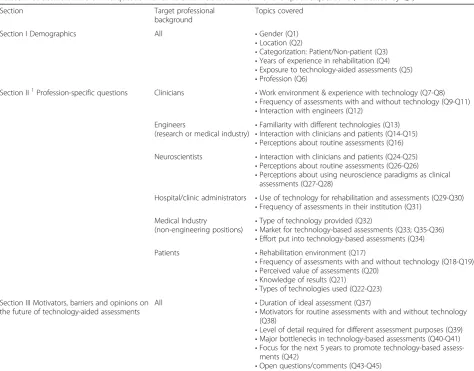
The survey was conducted as an online questionnaire designed to gather the views of different stakeholders in sensorimotor assessments for neurorehabilitation. The items of the questionnaire probed the perceived current state of assessments, along with the appropriate future directions for the field. The questionnaire had both common and stakeholder-/profession-specific questions (Table 1) and was divided into three sections. Section I had questions on the respondent demographics and pro-fession. The latter was used to direct respondents to profession-specific questions in Section II. Section III consisted of common questions focused on the current views, barriers, and future of technology-aided assess-ments in neurorehabilitation. The questions were based on Duncan and Murray [6], who categorized the barriers for performing routine clinical assessments into: (i) Knowledge, Education, and Perceived Value; (ii) Sup-port/Priority; (iii) Practical Considerations; and (iv) Pa-tient Considerations.
The online questionnaire was elaborated in Google Forms and was pilot tested (to verify content and clarity) with therapists and human movement scientists from cere-neo Center for Neurology and Rehabilitation (Switzerland), the University Hospital Zurich (Switzerland), and rehabili-tation engineers from ETH Zurich (Switzerland). The final version of the questionnaire was available online from 12 June to 08 August 2017. The link to the questionnaire was advertised in: rehabrobotics listserv, RehabWeek newslet-ter, RehabWeek Facebook and Twitter pages, cereneo AG Facebook and Twitter pages, personal LinkedIn accounts of the authors, as well as through the personal network of the authors, workshop co-organizers and speakers through email. The complete online questionnaire is provided (Additional file2- Questionnaire).
Analysis
The responses for each question were summarized ac-cording to the type of question:
QT3. Questions with multiple items, with only one selectable option per item (e.g., Q8),
QT4. Questions with multiple items that need to be ranked (e.g., Q9), and
QT5. Open-ended questions with written responses. (e.g., Q44)
QT1- and QT2-type questions were summarized by counting the number of times each option was se-lected by the respondents. Responses for QT3-type questions were summarized by generating a 2D array of counts, where the rows corresponded to the differ-ent items in the question, and the columns corre-sponded to the different options to be selected. A similar analysis was first carried out for QT4-type questions, which created a 2D array summarizing the ranking of the different items in the question; row-wise weighted averages of the ranks were calcu-lated for each item, where the weights were the cor-responding rank values. QT5-type questions were
summarized manually by grouping similar comments together. Reported percentages were rounded to the closest integer.
To understand the viewpoints from different stake-holders, respondents were prompted to select a single profession they most identified with. Based on their re-sponse, they were categorized into different groups (Table 2). Based on this categorization, the overall re-sults for each question were the average rere-sults across the stakeholder groups.
Results
Respondent background and experience
A total of 140 responses were obtained (52% male, 47% female, 1% preferred not to say; Q1). Responses were from 23 different countries, mainly in Europe and North America (Q2; Fig. 1). Thirty-seven percent of respon-dents declared that they would be attending RehabWeek (Q43).
Table 1Structure of the online questionnaire. Refer to Additional file1for the specific questions (indicated by Qx)
Section Target professional
background
Topics covered
Section I Demographics All •Gender (Q1)
•Location (Q2)
•Categorization: Patient/Non-patient (Q3)
•Years of experience in rehabilitation (Q4)
•Exposure to technology-aided assessments (Q5)
•Profession (Q6)
Section II1Profession-specific questions Clinicians •Work environment & experience with technology (Q7-Q8)
•Frequency of assessments with and without technology (Q9-Q11)
•Interaction with engineers (Q12) Engineers
(research or medical industry) •
Familiarity with different technologies (Q13)
•Interaction with clinicians and patients (Q14-Q15)
•Perceptions about routine assessments (Q16) Neuroscientists •Interaction with clinicians and patients (Q24-Q25)
•Perceptions about routine assessments (Q26-Q26)
•Perceptions about using neuroscience paradigms as clinical assessments (Q27-Q28)
Hospital/clinic administrators •Use of technology for rehabilitation and assessments (Q29-Q30)
•Frequency of assessments in their institution (Q31) Medical Industry
(non-engineering positions) •
Type of technology provided (Q32)
•Market for technology-based assessments (Q33; Q35-Q36)
•Effort put into technology-based assessments (Q34)
Patients •Rehabilitation environment (Q17)
•Frequency of assessments with and without technology (Q18-Q19)
•Perceived value of assessments (Q20)
•Knowledge of results (Q21)
•Types of technologies used (Q22-Q23) Section III Motivators, barriers and opinions on
the future of technology-aided assessments
All •Duration of ideal assessment (Q37)
•Motivators for routine assessments with and without technology (Q38)
•Level of detail required for different assessment purposes (Q39)
•Major bottlenecks in technology-based assessments (Q40-Q41)
•Focus for the next 5 years to promote technology-based assess-ments (Q42)
•Open questions/comments (Q43-Q45)
1
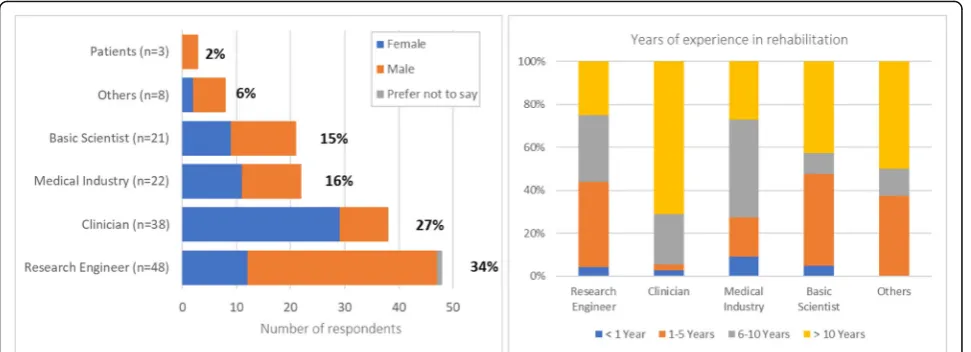
Most respondents were Research Engineers (34%), followed by Clinicians (27%), Medical Industry profes-sionals (including Managers, Sales representatives, Engi-neers; 16%), Basic Scientists (including Neuroscientists, Human Movement and Clinical Scientists; 15%), Other professionals (6%), and Patients (2%) (Q6; Fig. 2, left). We did not have responses from Hospital/Clinic Admin-istrators, Policy Makers or Insurance Representatives; thus, questions related to these stakeholders were not included in this manuscript.
Forty-two percent of respondents (not including Pa-tients) had more than 10 years of experience in their respective fields (Q4; Fig. 2, right); Clinicians had the most experience, while respondents from other pro-fessional backgrounds were more evenly split between
junior (up to 5 years of experience) and senior (more than 5 years of experience). Clinicians worked (Q17) mostly in Inpatient units (34% in small and 21% in large clinics/hospitals), followed by Outpatient units (18% in small and 11% in large clinic/hospital), Home care (5%), Skilled nursing facilities (3%) and Others (8%). From the three patients, one was treated in an acute-care unit, one in a small inpatient unit, and one in a large outpatient unit (Q17).
Interdisciplinary interactions
In general, most respondents had some interdisciplin-ary interactions with other professional groups. About 66% of Clinicians had previously interacted with tech-nology developers on at least one case, with 24% Table 2Categorization of professions in stakeholder groups for analysis
Stakeholder category Selected profession (Q6)
Clinician - Medical doctor
- Therapist (clinic-focused) - Therapist (research-focused)
Research Engineer - Engineer (academic or non-profit institution research)
Basic Scientist - Neuroscientist
- Other (free text) with the keyword (Mov* Scien*ORClin* Scien*) AND NOTIndus*(e.g., movement scientist, clinical scientist)
Medical Industry - Engineer (medical industry) - Manager (medical industry)
- Sales representative of medical technologies - Other (medical industry)
- Other (free text) with the keywordIndus*(e.g., therapist in industry)
Hospital Administrator - Hospital / clinic administrator
Policy Maker - Policy maker (e.g., work for a government organization) - Insurance representative
Patient Receiving therapy due to a neuromuscular disorder (Q3).
Other None of the above
(overall) having done so on more than 5 separate oc-casions (Q12; Table 3). Among the Research Engi-neers, 90% had interacted with patients and therapists, with 52% (overall) having interacted with more than 10 patients (Q14) and 21% (overall) with more than 10 therapists (Q15). Among the Medical Industry (Engineers), all had directly interacted with patients, with 50% (overall) having interacted with more than 10 patients (Q14) and 10 therapists (Q15). Among Basic Scientists (Neuroscientists), 94% had directly interacted with patients and 82% with thera-pists; 76% (overall) reported interactions with more than 10 patients (Q24) and 41% (overall) reported in-teractions with more than 10 therapists (Q25).
Use of technology at work
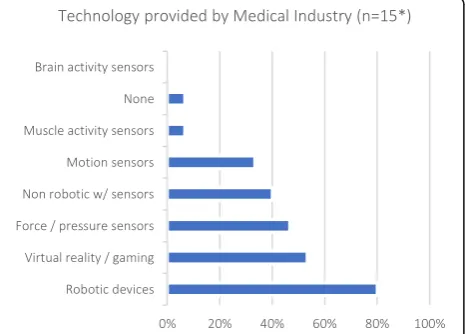
To gauge respondents’proficiency with technology, rather than focus on potential age-related barriers, we asked about their exposure to different types of technological de-vices at work. Eighty percent of Medical Industry (non-E-ngineer) respondents were providers of robotic devices (Q32; Fig.3).
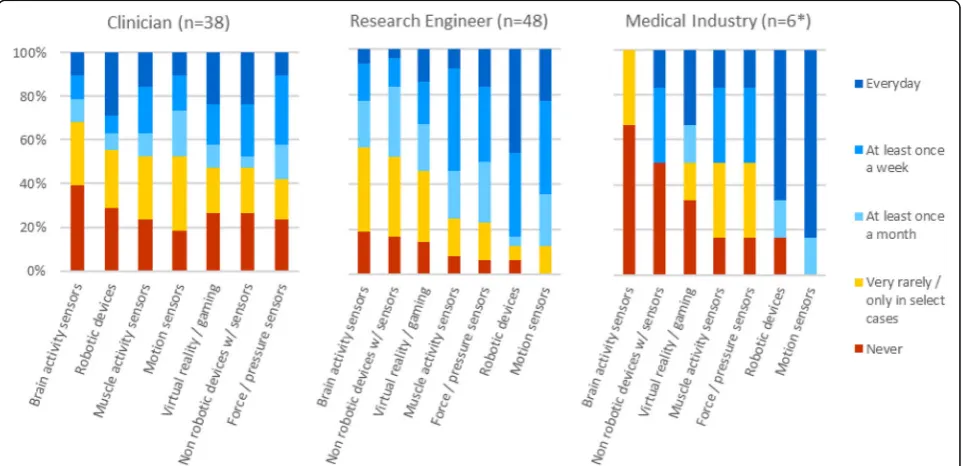
About 75% of Clinicians worked in environments where technology (not exclusively assessment-related) is used routinely, with 50% (overall) working with technology on a regular basis (Q8; Fig. 4). Of the listed technology types, most clinicians had been ex-posed to motion sensors, and least with brain activity-related technologies. In contrast, the majority Fig. 2Respondent demographics per stakeholder group (left) [Q1: What is your gender?; Q6: What is your profession? (according to Table2)] and years of experience in rehabilitation (right) [Q4: How many years of professional experience do you have in the field of rehabilitation? (Including: clinical work, research, technology development, sales, policy making, etc.)]
of Engineers (research and industry) used technology on a regular basis (Q13; Fig. 4), especially robots and motion sensors.
Exposure to technology-aided assessments
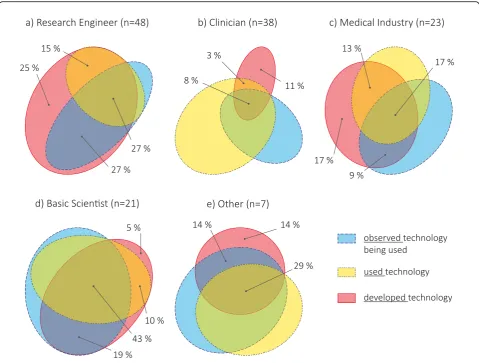
Almost all respondents had exposure to technology-aided assessments, through observation, use or develop-ment, with only 5% of Clinicians and 5% of Medical Industry reporting no experience (Q5; Fig.5). All stake-holder groups had individuals who had developed tech-nology: 94% of Research Engineers, 21% of Clinicians, 59% of Medical Industry professionals, 59% of Basic Sci-entists, and 50% of Others. Surprisingly, a large percent-age of people who had developed had not observed technology being used: 43% of Research Engineers, 54% of Medical Industry professionals, 63% of Clinicians, 29% of Basic Scientists, and 25% of Others; this included people with senior level experience in almost all groups. Basic Scientists presented the most overlap between ex-posure types, suggesting collaboration and interaction between developer and user groups.
Current state of assessments
Frequency of standard assessments in the clinic
Research Engineers, Basic Scientists and Medical Industry professionals underestimated how often Clinicians per-form assessments. Approximately 75% of Clinicians re-ported using standardized clinical assessments on a regular basis (at least once a month; Q10), while technology-based assessments were used less often (Q11). In contrast, half or more of Research Engineers (Q16), Medical Industry professionals (Q16) and Basic Scientists
(Q26) believed that, for each patient, sensorimotor assess-ments are performed only at entry and discharge (Table4), although many believe that assessments are performed on a regular basis (at least once a month; 34%, 50%, and 30%, respectively). Patient responses (Q18-Q19) generally followed Clinician responses.
All patients reported that they are made aware of the results from their assessments (Q21). Two out of three Patients reported that they see value in having their abilities assessed by a professional (Q20), while one said ‘maybe’. None of the patients in this study use technological tools to assess their own progress (Q22-Q23).
Preferred sensorimotor assessment tools
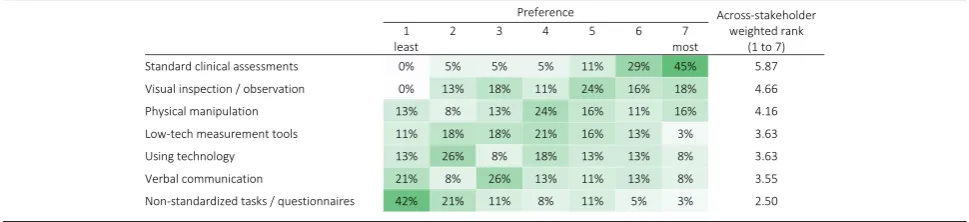
In their practice, Clinicians reported a strong preference for the use of standard clinical assessments (scales or questionnaires) and showed least preference for non-standardized tasks or questionnaires (Q9; Table 5). Low-tech and technology-based measurements obtained similar weighted rank (3.63 out of 7), but their response distributions were different, with many respondents show-ing a strong dislike for technology-based measurements (47% had preference below or equal to 3 out of 7, where 1 is the least and 7 is the most preferred method). It is un-clear how constrained responses to this question were to internal standards or requirements of the institutions where Clinicians work.
Reasons for doing assessments
Stakeholders generally agreed that the main motivator for carrying out assessments was for “individual” rea-sons (n = 140; across-stakeholder weighted rank of 2.6 on a scale from 1 to 3), i.e., for treatment planning and evaluation for each specific patient (Q38; Table6). Medical Industry professionals and Patients also scored institutional reasons, i.e., healthcare delivery planning and evaluation, highly (average of 2.1 and 2.3, respectively).
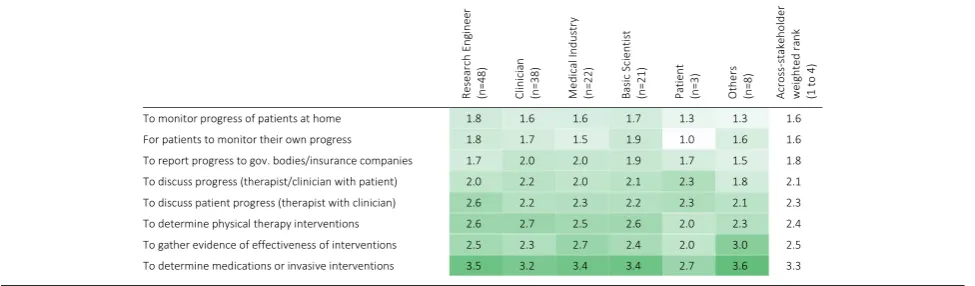
There was general agreement among the stake-holders about the reasons for performing assessments, and the level of detail required for different purposes. The level of detail required for assessments varied based on the objective of the assessment (Q39; Table 7). Assessments performed to determine inva-sive interventions were perceived to require the most detail (across-stakeholder weighted rank of 3.3 on a scale from 1 to 4), while monitoring progress at home required the least (across-stakeholder weighted rank of 1.6). Therapy planning and evaluation of different therapeutic techniques required more detail than for reporting progress to government bodies/insurance companies. Discussions among clinicians were Fig. 3Types of technology provided by Medical Industry [Q32: What
reported to require more detail than when discussing progress with patients. Interestingly, the three Patients that participated in the survey were not interested in details to monitor their own progress; they also con-sidered that discussing patient progress required more detail than evaluating/determining interventions, which disagrees generally with all other stakeholders. Further, Clinicians and Basic Scientists tended to think more detail is needed to determine therapy in-terventions than when gathering evidence for effect-iveness of interventions, while Medical Industry professionals and Others tended to think the opposite; En-gineers considered a similar level of detail is needed for both objectives.
Current effort in industry for technology-based assessments
Medical Industry (non-Engineer) professionals reported that sensorimotor assessments are a selling point for de-vices (n= 15; average of 3.5 on a scale from 1 to 5; Q35), with most interest shown by researchers, followed by therapists, medical doctors, insurance companies, pa-tients, hospital administrators and regulatory bodies (Q33; Table 8). Three out of fifteen respondents from Medical Industry reported that they only sell assessment devices; the rest reported investing the same amount of resources in sensorimotor assessment features as in therapeutic features of their devices (n = 12; average of 2.1 on a scale from 0 to 5, where 0 Zero resources, 2 -Same, 4 - Double, and 5 - More than Double; Q34).
Future of technology-aided assessments
All professionals from Medical Industry (excluding Engi-neers) believe there will be an increase in market demand for assessment tools in the upcoming years (Q36). This is a positive sign that should motivate improvements and systematization of current tools and techniques in technology-aided sensorimotor assessments.
Duration of an ideal assessment protocol
Across all stakeholders, 6–15 min per patient per week was considered as the most reasonable amount of time for a sensorimotor assessment including setup time (Q37; Table9), with the majority of respondents suggest-ing a time between 1 min and 30 min and none favorsuggest-ing assessments longer than 60 min. Medical Industry pro-fessionals tended to strongly prefer shorter assessment durations (1–5 min); Medical Industry professionals, Re-search Engineers and Patients had strong preferences for specific time intervals, with half or more of each group selecting one time interval.
Bottlenecks in current assessments
Across all stakeholders, practical considerations were ranked as the most hindering factor to the use of standard and technology-aided sensorimotor assess-ments in the clinic, followed by knowledge/education/ perceived value, support/priority and finally patient considerations (Q40; Table 10). This ranking generally agreed with the responses from all stakeholder Fig. 4Use of technology at work by different stakeholders. [Clinicians: Q8: How often are these technologies used in your work (not restricted to assessments)?; Engineers (research and medical industry): Q13: How often are these technologies used in your work environment?]. *Only Medical
groups, except Patients and Others. Of note, know-ledge/education/perceived value was scored highly by Clinicians and Basic Scientists; support/priority by Patients; and patient considerations by Other professionals.
Specifically for technology-aided sensorimotor assess-ments, lack of time to perform assessments and the cost of technologies were considered the most important fac-tors currently hindering their use (Q41; Table 11). The lack of reimbursement for assessment time and lack of educational programs on how to use technology were the least important factors. Interestingly, Medical Indus-try professionals and Research Engineers differed from the other stakeholder groups, respectively emphasizing lack of reimbursement, and lack of standardization and understanding how to interpret and use assessment re-sults as most important.
Plan for the next 5 years
To advance the field in the near future, standardization of technology-aided assessments, bet-ter understanding of the link between different levels of assessment (i.e., activity, high-level function, low-level function, and structural/biological), and re-imbursement/economic feasibility were considered the most important activities to focus on in the coming years (Q42; Table 12). Cross-disciplinary education/communication and definition of terms and taxonomies were considered less important.
In the context of further developing sensorimotor as-sessments, Neuroscientists believe that paradigms from movement neuroscience can provide more insights than standard clinical assessments (score of 4.2 on a scale of 1 to 5; Q27). Explaining their response further (Q28), they believed that:
1. Tools and methods of neuroscience would provide more precise and objective information about a
patient’s movement quality and quantity, which are
not available through standard clinical assessments; 2. The use of computational models to better
understand recovery (at different levels) would be a useful feature in neurorehabilitation.
In general, they recognized that not all approaches from Neuroscience might be practically feasible for routine clinical use.
Open comments
The final questions of the survey asked for specific com-ments for the panel discussion at the ICORR workshop (Q44), and any open comments related to sensorimotor assessments (Q45). A summary of the responses is pro-vided in Table13.
Discussion
This work aimed at identifying the barriers and facilita-tors for technology-driven assessments for sensorimotor function, as perceived by different stakeholder groups.
The survey was carried out via an online questionnaire to obtain a broad overview of different viewpoints from across the globe. Our results reflect the opinion of 140 respondents from 23 countries from the Engineer, Clinician, Neuroscientist, Patient and Medical Industry stakeholder groups. There were disparate views on the current bottlenecks to technology-aided sensorimotor assessments, due to differences in stakeholders’ profes-sional backgrounds, their goals, and the primary focus of their work. Nevertheless, we found that stakeholders generally agreed on the value of technology-aided sen-sorimotor assessments and how to move towards clinical practice.
Current barriers
An obvious barrier to the adoption of technology-aided assessments could be the lack of demand for such tools, i.e., if assessments are not routinely performed. Previous studies [6,8,9] reported low implementation rates of as-sessments in routine clinical practice, which is consistent with the beliefs of Research Engineers, Basic Scientists and Medical Industry professionals in our questionnaire (section 3.2.1). However, all clinicians reported that they Table 4Frequency of sensorimotor assessments as predicted by Research Engineers, Medical Industry and Basic Scientists (yellow), as practiced by Clinicians (green), and as experienced by Patients (blue; results in percent respondents per group). Darker shades indicate higher percentages. [Q16, Q26: How often do you think therapists perform standard clinical assessments on a given patient during routine clinical practice? | Q10: How often do you (or your personnel) perform standard clinical assessments on a given patient during routine clinical practice? | Q11: How often do you (or your personnel) use any kind of technology to perform assessments on a given patient during routine clinical practice? | Q18: How often do you do clinical assessments during your therapy sessions | Q19: How often do your therapists use technological tools to assess you during therapy sessions?]
use standard clinical assessments, with approximately 75% using them on a regular basis (50% at least once a week and 24% at least once a month; Table4). It is possible that the inconsistency between previous studies and our results on clinicians’reported use of assessments reflects a biased view from our respondents, who may be more inclined to use assessments. But it is also possible that assessments are currently performed more regularly than in the past (based on literature references from 5 to 9 years before our survey). Furthermore, Medical Industry professionals reported that there is a strong interest among their clients in tools for sensorimotor assessments, foreseeing an in-crease in demand in the coming years. Medical Industry professionals also reported that they invest resources in the development of such tools, and that assessment cap-abilities are a selling point for their devices. Thus, the lack of need is likely not the reason for the poor adoption of these tools in clinical practice.
It is possible that the available technology does not meet the user needs for sensorimotor assessments due to differ-ences in understanding of the role of assessments in clin-ical practice among the different stakeholder groups (especially between developers and users). However, we found general agreement across stakeholders. There was
agreement among stakeholders that individual reasons were the most important reason for performing assess-ments (Table6). Stakeholders also agreed, in general, about the level of detail required from assessments for different purposes (Table7): communication with government bod-ies, insurance companies and patients were perceived to require the lowest amount of detail, followed by evaluation or selection of therapies, and finally determining medica-tions or invasive intervenmedica-tions. These results indicate that there is an alignment across stakeholder groups about the general reasons for doing sensorimotor assessments, and the level of detail required for different goals.
Another barrier for adoption of technology-aided as-sessments could be the lack of access and exposure to available tools. We did not find this to be the case among the respondents in this study; the majority of stakeholders had used or at least observed technology-aided assess-ments being used (Fig.5). In particular, around 50% of Cli-nicians worked with technological tools on a regular basis (at least once a month), and 60–80% of Clinicians used technological tools to measure a wide range of variables relevant to neurorehabilitation (Fig. 4). Although these percentages are not sufficient to suggest widespread adop-tion of technologies, they are encouraging as they indicate Table 6Motivators to perform and document assessments (1–Least Important, 3–Most Important). Darker shades indicate higher percentages. [Q38: What are the main motivators to perform and document results from routine assessments (standard clinical or technology-aided)?]
that the main user group of assessment technologies has at least been exposed to such tools. Thus, in a population with access and exposure to neurorehabilitation technol-ogy, there were other barriers that were preventing rou-tine use of technology-aided assessments.
The survey identified that practical considerations (e.g., assessment duration, cost, etc.) were some of the main factors hindering clinical use of standard assessments (Table10). This is in line with Jette, et al. [8], where thera-pists identified: (a) duration for patients to complete assess-ments, (b) duration for clinicians to analyze data, and (c) difficulty for patients in completing assessments independ-ently, as the three main barriers for routine assessments. We also found this for technology-aided assessments, where, across stakeholders, lack of time to perform assess-ments and high cost of technologies were the top two hin-dering factors (Table 11). Interestingly, Medical Industry professionals chose the lack of reimbursement for time spent in assessments as the second most hindering factor. This highlights the importance of financial aspects that dir-ectly impact delivery of care, adding to the cost associated with technology-aided assessments.
Unlike other stakeholders, Research Engineers scored the lack of understanding on how to interpret and use assessment results, and the lack of standardization/ device-dependence of assessment results as the most
important factors hindering technology-aided assess-ments. These highlight the differences in the roles of stakeholder groups: Research Engineers, who are primar-ily tool developers (Fig.5a), are aware of the limitations of these devices and the applicability of the different methods used in quantitative assessments. However, this aspect seems to be lost to other (user) stakeholders, which can easily lead to inappropriate use of the devel-oped tools, e.g., application of measures in conditions where they are not valid, comparison of metrics with same name but that are not calculated in a comparable manner, etc. Thus, deeper interdisciplinary interactions need to be fostered to decrease the potential of overlook-ing stakeholder-specific factors.
In general, Clinicians showed a strong preference for standard tools for carrying out assessments in their work (Table5). Despite this, Clinicians scored the lack of stan-dards and interpretability of results below the financial burden of technology-aided assessments, indicating that the cost of existing technology was a more pressing prob-lem than the lack of standards. Across stakeholders, the poor understanding of using technology-aided assess-ments for clinical decision-making, and the lack of stan-dards were rated the third and fourth important factors hindering clinical acceptance. The lack of standards is a known problem with technology-aided assessments, as Table 8Interest in assessment tools by different groups as reported by Medical Industry (n = 15*). Darker shades indicate higher percentages. [Q33: What is the current interest in assessment tools?]
*Only Medical Industry (non-Engineers), i.e., respondents that selected entries different than“Engineer (medical industry)”as their profession (Q6), were asked this question
**To avoid confusion, the term“Researchers”is used here in a general sense
Table 9Preferred amount of time for sensorimotor assessments per patient per week (in percent respondents per group). Darker shades indicate higher percentages. [Q37: What is a reasonable amount of time for a sensorimotor assessment that has to be performed at least once a week (per patient) - from beginning of setup to end of undoing setup?]
there is no general consensus on what features of sensori-motor behavior to measure and how, especially in the context of neurorehabilitation. Differences in technologies (e.g., robots vs. sensor-based systems) affect the nature of human-machine interaction between the different devices. This further exacerbates the problem of standardization and could partly explain the current lack of standards given the wide landscape of available technological tools. The tendency is that technology will continue to improve at a fast pace, and this is one reason why it is critical to se-lect a solid base to best explore technological develop-ments rather than re-evaluate every new device.
The issues of standardization, the associated time and cost to perform assessments, and reimbursement for clin-ical use of technology-aided assessment are intermingled. The circular nature (“chicken-and-egg” problem) of these issues was also raised in the open comments (Table 13): reimbursement requires standardization, standardization requires clinical use, and clinical use requires reimburse-ment/standardization. These issues are unlikely to be re-solved immediately, and require high-quality evidence in favor of technology-aided assessments to demonstrate the value added by these procedures to clinical practice. In
their current state, technology-aided assessments are likely not adding much value to clinical practice, and have poor benefit-to-cost (money and time) ratio. In contrast, tech-nologies such as MRI are routinely used given the value they add to clinical practice, and there is little discussion around whether or not to use these procedures, even though they are many times more expensive than most technologies related to sensorimotor assessments. Thus, clearly showing the added value of technology-aided as-sessments to clinical practice, in terms of improved and efficient assessment, and better clinical decision-making and outcomes, is critical to support their future adoption.
Suggestions for the future of technology-aided assessments
There was general agreement between the different stake-holders about the activities to be pursued for the next 5 years (Table12), with standardization of technology-aided assessments ranked highest. This was followed by activ-ities to: (a) understand the link between the different levels of assessment, which is important for therapy planning and clinical decision making; and (b) make routine Table 10Importance of factors currently hindering the use of (standard and technology-aided) sensorimotor assessments in the clinical practice according to stakeholder groups (weighted rank per group). Darker shades indicate higher rank. [Q40: How much do issues in each of the following categories hinder the routine use of assessments (standard clinical or technology-aided) in the clinical practice?]
assessment reimbursable and economically viable. The least ranked activities were cross-disciplinary education, and the development of taxonomies for the field.
The suggestion to focus on standardization of technology-aided assessments is a logical one, but a diffi-cult issue to address. Even without technology, developing standards in sensorimotor assessments requires a number of inter-related choices: the tasks performed and the as-sessment protocol, tools used for measurements, and the methods used for analysis and interpretation of the results. Technology in this context specifically refers to the tools used for assessment, and it directly influences the tasks that can be performed, the physical variables that can be measured, and the interpretation of results.
In the last decades, robotics has emerged as a viable and safe tool to complement traditional therapy (see [10–12]) and it is a popular technology used by different stake-holders (Fig. 4). These robotic developments, primarily designed for delivering therapy, have also been pro-grammed to measure a great variety of parameters related to sensorimotor function (e.g., [3, 13,14]) and they have been suggested as standard tools for sensorimotor assess-ments. Although an appealing idea, using therapeutic ro-bots for assessment is limited because each outcome measure is influenced by robot-specific factors such as the topology of the robot’s kinematic chain, control modal-ities, etc., which confound the results obtained from these tools. Nevertheless, robotic devices have the potential to become standards in assessments, but they must be specif-ically designed for the purpose of assessment, e.g., robotic dynamometers or ergometers.
Another way forward is by using technology that has the potential for quick and widespread use with minimal interference to human movements, to promote focused and quicker convergence to a common set of measures/ standards. One such example is inertial measurement technology, whose popularity is increasing and is likely to be ubiquitous in the near future. Inertial measurement technology has been used to quantify many existing
assessments [15] and movement behaviour in natural (non-laboratory) conditions [16–18]. Thus, this technol-ogy could help establish standards in technoltechnol-ogy-based sensorimotor assessments. However, this technology also has its limitations. For instance, there is currently no standard algorithm for extracting movement kinematics from these devices; several different algorithms for ac-tivity counts or steps [19], energy expenditure [20, 21], smoothness [22, 23], etc., exist but were validated in different populations (e.g., walking detection algorithms that work very well in the unimpaired population may not work well with impaired users [24]). This is not ideal for establishing a standard, but it is likely that coming years will see increased work with this particu-lar technology, which hopefully will result in accurate, robust and sensitive methods for quantifying move-ments. To accelerate and facilitate this, it is relevant to encourage the community to openly share their algo-rithms and data. Standardization is unlikely to happen if every research group develops their own version of different measures; as highlighted by Ince et al. [25], non-availability of the original software code is a ser-ious impediment to reproducibility–even if algorithms are perfectly described in the literature.
Moreover, there currently exist no standards for accur-ate and robust data collection with these devices in both laboratory/clinic and real-life settings. In the laboratory/ clinic setting, there is a need to standardize tasks, so com-parisons can be made between studies. In the real-life set-ting, there is still a big challenge in interpreting data from these devices operating in unstructured environments and without contextual information. Nevertheless, interesting and potentially useful methods have started surfacing in recent years, e.g., [17,26], and hopefully these will be ex-tended further in the coming years.
on a common set of tools to be used for sensorimotor as-sessments, another important issue that needs to be ad-dressed for developing standards is the development of suitable language and taxonomies for the field [27]. This is essential to ensure there is a common understanding of important constructs in the field among the different stakeholders. Such language is also crucial for formalizing procedures, e.g., [28], and the development of appropriate measures for quantifying different sensorimotor constructs relevant for research and clinical purposes. There have been recent international efforts towards standardizing outcome measures for sensorimotor assessments with and without technology, e.g., [29,30]. An encouraging thought is that the difficulties currently faced in standardization of technology-aided assessments are not very unlike problems encountered in other fields before standards were estab-lished (e.g., [31–33]), or at least openly discussed (e.g.,
[34]). It would be essential to continue our technical and clinical work in the different fronts, while being aware of how our activities fit in the bigger picture of a standard for technology-aided assessments.
Cross-stakeholder communications would also be es-sential in this process, and a common language will also make it easy to implement cross-disciplinary education among the different stakeholders. We found surprising that, while different respondents reported having had many interdisciplinary interactions (Table3), many tech-nology developers had not used nor seen techtech-nology for assessments being used (Fig. 5). This could be reflected as a lack of proper understanding of user needs when developing technology, which could lead to devices not being used, and highlight the importance of fostering quality cross-disciplinary education and interactions among stakeholders.
Table 13Summary of open questions (Q44) and comments (Q45)
Research Engineers Questions
•Will insurance companies be willing to reimburse for technology-aided assessment with the current level of standardization and output metrics?
•How to combine diverse technologies and the lack of clarity on what exactly to measure? What is the way forward for both these issues?
Comments
•It seems that standardization, clinical use, and reimbursement mechanisms are a bit of a chicken and egg problem: standardization requires use, use requires reimbursement, and reimbursement requires standardization.
Clinicians Questions
•How to interpret and standardize technical outcome parameters?
•Why don’t technology developers collect more information from clinical therapists and patients? Comments
•There is a need for better access to affordable technology for clinical use.
•An objective sensory measurement tool would be clinically useful.
•Assessment must be reliable, meaningful, simple to administer and learn.
•Technology failures cannot occur. We cannot use the time of clinicians and patients by using technically unreliable tools. Basic Scientists Questions
•What is really important to assess for clinicians, therapists, and patients? Are they aligned?
•How do researchers developing outcome measures based on neuroscientific principles convince clinicians to trust and use these new tools?
Comments
•“…effects of TBI injuries and stroke are more clearly reflected in movement rather than in imaging, as is improvement due to rehab. It is time to use movement science to do a composite assessment of brain-body and to start building tools which can sense accurately and with reliability.”
•“There is significant under-estimation of current pressures on clinicians in the public sector. Certain assessments are mandated by Govt. agencies, even though they have limited usefulness clinically. Departments of Health also need to be included in education about technology.”
•There is a need for standardization and widespread implementation. Medical Industry Comments
There are standard requirements of any measurement tool, e.g., validity, reliability, sensitivity to change, inter and intra-rater reliability, training. It is important that these are evaluated in a standardized way.
Others Questions
What is the best way to share current research outcomes for clinical therapists to be up-to-date on the latest findings? Such sharing of knowledge can advocate the gradual implementation of technology in clinical activities at different organizational levels.
Patients Comments
Limitations of the present work
The results of this survey should be taken in light of some of its shortcomings:
1. An online survey was adopted at the cost of rigor in the data collection process to obtain a broad overview of the different viewpoints from across the globe. This could have resulted in a biased view of the field.
2. The number of responses per stakeholder group was low with large differences in the numbers among the different stakeholders, e.g., there were more than 40 Engineers, but only 3 Patients. 3. The majority of respondents were from developed
countries, likely with more access to technologies. Also, given how the survey was advertised, the respondents are likely to be from technology-oriented institutions or institutions already inclined to promote the use of technology. Thus, the views presented are likely a biased view of stakeholders with an interest in the use of technology-driven assessments.
4. To define‘standard clinical assessments’and
‘technology-aided assessments’we relied on picture
examples with no written definition. This was subjective and their meanings could have been interpreted differently by different people, affecting some of the responses.
5. Another limitation towards reaching a more representative population was language. The survey was only available in English and we heard from many therapists that their colleagues could not respond to the questionnaire due to insufficient mastery of English. This decreased participation, and could have also led to misinterpretation of questions and/or answers among the respondents. 6. Finally, we did not get any response from policy
makers or insurance companies, which are important to understand how the use of
technology-aided assessments is promoted in
every-day practice [35].
Conclusions
The current study presented results from an online survey to understand the perceptions of the different stake-holders about thestatus quoof technology-based sensori-motor assessments, in particular: (a) the barriers to their adoption in clinical practice; and (b) the potential avenues for future work to promote use of technology-aided as-sessments in research and clinical practice. There was general agreement between the stakeholders on the differ-ent issues, with some differences between the stakeholders based on their educational and professional backgrounds. Lack of time, high cost and difficulties in interpretability
of results from technology-aided sensorimotor assess-ments were identified as the three major bottlenecks. Standardization of technology-aided assessment was iden-tified as the most important activity to pursue to promote the field. We strongly believe that with continued tech-nical and clitech-nical efforts, and communication between the different stakeholder groups, a suitable standard can be established in the due course of time.
Additional files
Additional file 1:Responses. (XLSX 49 kb)
Additional file 2:Questionnaire. (PDF 2623 kb)
Acknowledgements
The authors would like to thank the respondents; Jacopo Zenzeri and Francisca Marini for co-organizing the RehabWeek workshop; Nick Ward, Jaap Buurke, Paul Gudonis, Allen Heinemann, Joel Perry, Juergen Konczak, Olivier Lambercy, Michael Holmes and Stephen Scott for their expert opinion and input as speakers/panelists of the RehabWeek 2017 workshop; Stephen Page for his comments on the workshop proposal; and Anne Schwarz, Olivier Lambercy, Roger Gassert and therapists from cereneo AG for their feedback on formulating the questionnaire.
Funding
CS’s research is supported by the ETH Zurich Foundation in collaboration with Hocoma AG.
AMC’s research is supported by the cereneo–Zentrum für Interdisziplinäre Forschung (cefir) Gemeinnützige Stiftung.
Availability of data and materials
Questionnaire and responses are included in the supplementary information files.
Authors’contributions
All authors contributed equally to this work. All authors read and approved the final manuscript.
Authors’information
Camila Shirota is a Senior Research Associate at the Rehabilitation Engineering Lab of ETH Zurich, Switzerland. She received her Ph.D. in Biomedical Engineering from Northwestern University for her work at the Rehabilitation Institute of Chicago, in tripping recovery of unilateral transfemoral amputees. She is interested in locomotor control, balance, and rehabilitation.
Sivakumar Balasubramanian is an Associate Professor in Bioengineering at the Christian Medical College, Vellore India. He received his Ph.D. in Bioengineering from Arizona State University, USA. Following this he worked as a research associate in the Human Robotics Group at the Imperial College London, and subsequently worked as a researcher at Tecnalia Research & Innovation (Spain). He is interested in the development and clinical validation of neurorehabilitation technology, and quantitative sensorimotor assessment of neurological conditions.
Alejandro Melendez-Calderon is a Senior Research Scientist in Neuromechanics at the cereneo Advanced Rehabilitation Institute (Switzerland), Guest Researcher at ETH Zurich, and Adjunct Assistant Professor at Northwestern University (USA). He was previously a postdoctoral research fellow at the Rehabilitation Institute of Chicago, and Project Manager and (co-) leader of the Core Technologies Assessments & Reporting at Hocoma AG. He received his doctoral degree from Imperial College London for research in robotics, rehabilitation and human motor control. He is interested in understanding principled mechanisms of human behavior, in particular related to movement control/learning and physical interaction.
Ethics approval and consent to participate
1) this is not‘personal data’but scholarly research: US–http://www.hhs.gov/ ohrp/regulations-and-policy/regulations/common-rule/index.html;EU Directive 95/46/EC.
2) the information was not about the people responding but about their knowledge.
3) respondents were clearly informed about the reason for seeking their opinion and implicitly gave consent to participate by clicking on the link directing them to the survey.
Consent for publication
Not applicable.
Competing interests
The authors declare that they have no competing interests.
Publisher’s Note
Springer Nature remains neutral with regard to jurisdictional claims in published maps and institutional affiliations.
Author details
1Department of Health Sciences and Technology, ETH Zurich, Zürich,
Switzerland.2Department of Bioengineering, Christian Medical College, Bagayam, Vellore, Tamil Nadu 632002, India.3cereneo Advanced
Rehabilitation Institute (CARINg), cereneo - Zentrum für Interdisziplinäre Forschung, Vitznau, Switzerland.4Department of Physical Medicine and
Rehabilitation, Northwestern University, Chicago, USA.
Received: 8 October 2018 Accepted: 27 March 2019
References
1. Maetzler W, Domingos J, Srulijes K, Ferreira JJ, Bloem BR. Quantitative wearable sensors for objective assessment of Parkinson's disease. Mov Disord. 2013;28:1628–37.
2. Oung Q, Muthusamy H, Lee H, Basah S, Yaacob S, Sarillee M, Lee C. Technologies for Assessment of motor disorders in Parkinson’s disease: a review. Sensors. 2015;15:21710.
3. S. Balasubramanian, R. Colombo, I. Sterpi, V. Sanguineti, and E. Burdet, "Robotic assessment of upper limb motor function after stroke," Am J Phys Med Rehabil,Nov 2012 vol. 91, pp. S255–S269,.
4. Sasaki JE, Sandroff B, Bamman M, Motl RW. Motion sensors in multiple sclerosis: narrative review and update of applications. Expert Rev Med Devices. 2017;14:891–900.
5. Colombo R. Chapter 8 - performance measures in robot assisted assessment
of sensorimotor functions. In: Colombo R, Sanguineti V, editors. Rehabilitation Robotics: Academic Press; 2018. p. 101–15. ISBN
9780128119952.https://doi.org/10.1016/B978-0-12-811995-2.00011-4(http:// www.sciencedirect.com/science/article/pii/B9780128119952000114). 6. Duncan E, Murray J. The barriers and facilitators to routine outcome
measurement by allied health professionals in practice: a systematic review. BMC Health Serv Res. 2012;12:96.
7. Micallef L, Rodgers P. eulerAPE: drawing area-proportional 3-Venn diagrams using ellipses. PLoS One. 2014;9:e101717.
8. Jette DU, Halbert J, Iverson C, Miceli E, Shah P. Use of standardized outcome measures in physical therapist practice: perceptions and applications. Phys Ther. 2009;89:125–35.
9. Van Peppen RPS, Maissan FJF, Van Genderen FR, Van Dolder R, Van
Meeteren NLU. Outcome measures in physiotherapy management of patients with stroke: a survey into self-reported use, and barriers to and facilitators for use. Physiother Res Int. 2008;13:255–70.
10. Mehrholz J, Thomas S, Werner C, Kugler J, Pohl M, Elsner B.
Electromechanical-assisted training for walking after stroke: a major update of the evidence. Stroke. 2017;48(8):e188–e189.
11. Veerbeek JM, Langbroek-Amersfoort AC, van Wegen EE, Meskers CG,
Kwakkel G. Effects of robot-assisted therapy for the upper limb after stroke. Neurorehabil Neural Repair. 2017;31:107–21.
12. Mehrholz J, Pohl M, Platz T, Kugler J, Elsner B. Electromechanical and robot-assisted arm training for improving activities of daily living, arm function, and arm muscle strength after stroke. Cochrane Database of Systematic Reviews. 2015;11.
13. Nordin N, Xie SQ, Wunsche B. Assessment of movement quality in robot-assisted upper limb rehabilitation after stroke: a review. J Neuroeng Rehabil. 2014;11:137.
14. Maggioni S, Melendez-Calderon A, van Asseldonk E, Klamroth-Marganska V, Lünenburger L, Riener R, van der Kooij H. Robot-aided assessment of lower extremity functions: a review. Journal of neuroengineering and
rehabilitation. 2016;13(1):72.
15. Patel S, Hughes R, Hester T, Stein J, Akay M, Dy JG, Bonato P. A novel approach to monitor rehabilitation outcomes in stroke survivors using wearable technology. Proc IEEE. 2010;98:450–61.
16. Bailey RR, Lang CE. Upper extremity activity in adults: referent values using accelerometry. J Rehabil Res Dev. 2014;50:1213–22.
17. Leuenberger K, Gonzenbach R, Wachter S, Luft A, Gassert R. A method to qualitatively assess arm use in stroke survivors in the home environment. Med Biol Eng Comput. 2017;55:141–50.
18. Bailey RR, Klaesner JW, Lang CE. An Accelerometry-based methodology for assessment of real-world bilateral upper extremity activity. PLoS One. 2014; 9:e103135.
19. Evenson KR, Goto MM, Furberg RD. Systematic review of the validity and reliability of consumer-wearable activity trackers. Int J Behav Nutr Phys Act. 2015;12:159.
20. Murakami H, Kawakami R, Nakae S, et al. accuracy of wearable devices
for estimating total energy expenditure: comparison with metabolic chamber and doubly labeled water method. JAMA Intern Med. 2016; 176:702–3.
21. Chowdhury EA, Western MJ, Nightingale TE, Peacock OJ, Thompson D.
Assessment of laboratory and daily energy expenditure estimates from consumer multi-sensor physical activity monitors. PLoS One. 2017;12: e0171720.
22. Balasubramanian S, Melendez-Calderon A, Roby-Brami A, Burdet E. On
the analysis of movement smoothness. J Neuroeng Rehabil. 2015;12:112.
23. Hogan N, Sternad D. Sensitivity of smoothness measures to movement
duration, amplitude, and arrests. J Mot Behav. 2009;41:529–34. 24. Schaffer SD, Holzapfel SD, Fulk G, Bosch PR. Step count accuracy and
reliability of two activity tracking devices in people after stroke. Physiother Theory Pract. 2017;33:788–96.
25. Ince DC, Hatton L, Graham-Cumming J. The case for open computer
programs. Nature. 2012;482:485.
26. Bailey RR, Klaesner JW, Lang CE. Quantifying real-world upper-limb activity in nondisabled adults and adults with chronic stroke. Neurorehabil Neural Repair. 2015;29:969–78.
27. Shirota C, Jansa J, Diaz J, Balasubramanian S, Mazzoleni S, Borghese NA, Melendez-Calderon A. On the assessment of coordination between upper extremities: towards a common language between rehabilitation engineers, clinicians and neuroscientists. Journal of neuroengineering and
rehabilitation. 2016;13(1):80.
28. Hogan N, Sternad D. On rhythmic and discrete movements: reflections,
definitions and implications for motor control. Exp Brain Res. 2007;181: 13–30.
29. T. Keller, V. Klamroth-Marganska, and R. Riener, Eds., Technically-advanced assessments in sensory motor rehabilitation. (an article collection in journal of NeuroEngineering and rehabilitation). J Neuroeng Rehabil, 2015. Available:https://www.biomedcentral.com/collections/TAASMR 30. Stroke Recovery and Rehabilitation Roundtable (SRRR) (A series of papers
relating to this roundtable). Int J Stroke, 2017. Available:http://journals. sagepub.com/page/wso/srrr
31. Merletti R, Di Torino P. Standards for reporting EMG data. J Electromyogr Kinesiol. 1999;9:3–4.
32. Wu G, Siegler S, Allard P, Kirtley C, Leardini A, Rosenbaum D, Whittle M, D’Lima DD, Cristofolini L, Witte H, Schmid O, Stokes I. ISB recommendation on definitions of joint coordinate system of various joints for the reporting of human joint motion—part I: ankle, hip, and spine. J Biomech. 2002; 35:543–8.
33. Wu G, van der Helm FCT, Veeger HEJ, Makhsous M, Van Roy P, Anglin C,
Nagels J, Karduna AR, McQuade K, Wang X, Werner FW, Buchholz B. ISB recommendation on definitions of joint coordinate systems of various joints for the reporting of human joint motion—Part II: shoulder, elbow, wrist and hand. J Biomech. 2005;38:981–92.