1
DEVELOPING A CONFLICT MANAGEMENT MODEL
FOR THE NIGERIAN EXECUTIVE.
Prof. Hilda E. Osisioma, Ph.D Department of Business Administration Nnamdi Azikiwe University, Awka, Nigeria
Prof. Ben Chuka Osisioma, Ph.D Department of Accountancy,
Nnamdi Azikiwe University, Awka Nigeria
Emma E.O. Chukwuemeka, Ph.D Department of Public Administration, Nnamdi Azikiwe University, Awka Nigeria.
Abstract
This study is located in Nigerian formal organizations across a broad range of manufacturing and service organizations, with the aim of capturing the responses of executives working in a diversity of firms and enterprises. A questionnaire of the Likert type was administered on 424 respondents. Four research questions and four hypotheses were formulated for the study. Data for the research questions were analyzed using the mean and standard deviation of responses, while the t-test of difference between means and students’ t-distribution were used to analyze the hypotheses. The study in the end, recommended the adoption of the Creative-Contingency Model of Conflict Management as an enduring answer to conflict situations in firms.
Keywords: Conflict, Conflict Management, Assertiveness, Cooperativeness.
INTRODUCTION:
2
Conflict is inevitable in organizations because organizations function by means of adjustments and compromises among competitive elements in their structure and membership. In the organizational context, conflict can be normal and healthy, as absolute lack of tension is ultimately dull and stagnant, and unlikely to foster creativity and growth (Ozkalp et al, 2009, p. 419). Conflict arises when there is a change in situations where change is seen as a threat to be challenged or resisted. Where the change process is frustrated, this may produce an aggressive reaction – fight rather than flight. Conflict is not to be deplored; it is an inevitable consequence of progress and change, and it can be used constructively (Armstrong, 2005). The productivity of conflict arises from the fact that conflict can lead to change, change can lead to adaptation, and adaptation can lead to survival and even prosperity (Darling & Walker, 2001, p. 231; Walton, 1976, pp. 5-7). The fact that conflict is a normal part of organizational life is recognized by most management authors and that is why organizations must plan for it so that when it does arise, they will be prepared for it.
Different management theorists and writers have attempted to define conflict from different perspectives. It has been variously defined as “a breakdown in standard mechanisms of decision making” thus tying the concept to decision making (March & Simon, 1958, cited by Nair, 2007, p. 360). Other writers defined conflict from the perspective of incompatibilities in goals. The focus would later change to disagreements on ends or goals; incompatibilities in means or views; perceived differences in interests, views or goals; opposing interests involving scarce resources and goal divergence; and a cognitive bargaining process (Walton & Dutton, 1969; Jehn, 1997; Kolb & Putnam, 1992; and Nair, 2007).
The definitions of conflict have taken a process-oriented, descriptive/situational or conditional view of conflict. Process view focused on breakdown of decision making and oppositional patterns. Descriptive views of conflict tend to focus on what happens at the time of conflict in terms of perceptions and behaviour. The conditional approach is a contingent view underlying when conflict is likely to occur (Nair, 2007, p. 361).
Nigeria is a “society with low synergy, with many in-groups and inter-group conflicts” (Ozkalp et al, 2009, p. 420). These in-groups may be ethnic, religious or geo-political, which tend to keep and maintain relationships within their closed networks, regarding all others as strangers. There is “high collectivism, power distance, uncertainty avoidance, and conservatism”. The organizations are typically hierarchical, with low delegation, centralized decision making and strong personality of managers (Ozkalp et al, 2009, p. 420). Nigeria has more than 250 ethnic groups, each with its own language and customs. To the North of the country, the Hausa are the largest single group; to the West, the Yoruba and to the East, the Igbo. Islam is the dominant religion in the North, while Christianity is prevalent in the South, with a sprinkling of traditional African religions. This paper is an attempt to explore the conflict management styles of Nigerian executives, with a view to modelling an ideal and suitable conflict handling technique.
CONCEPTUAL AND THEORETICAL FRAMEWORK
Conflict is no longer seen as dysfunctional, but as a healthy process needing to be managed (Ozkalp et al, 2009; Pondy, 1976; and Thomas, 1976). Different classifications have been put forward about types of conflict. There are the three conceptual models:
▪ Bargaining model among interest groups which are in competition for scarce resources; ▪ Bureaucratic Model prevalent in superior-subordinate relationships or along any vertical
3
▪ Systems Model among parties in a lateral or functional relationship, with particular emphasis on problems of coordination within a system (Pondy, 1967, Ozkalp et al, 2009; Nair, 2007).
Further more, Ayoko & Pekerti (2008) carried out an analysis of the relationship between conflict types, conflict features, communication openness and workplace trust. They identify three components of conflict types: task, relationship and process. Task conflict results from group members’ consciousness that there are disagreements about the actual tasks being performed, even though the ultimate goal and objective about the task may be shared.
Relationship conflict arises from disagreements that are based on personal and social issues which are not related to the work (Jehn & Chatman, 2000). Process conflict refers to conflict about rules and procedures for task accomplishment and work allocation between members of the group with a view to maximizing overall productivity (Jehn, 1997; Kabanoff, 1991). Conflict features refer to the duration and intensity of the conflict.
Ayoko et al (2008) distinguished between productive and destructive reactions to conflict.
Productive reactions refer to conflictual circumstances where there are productive outcomes such as learning from disagreements and settling discords and divergences. Destructive conflicts
refer to circumstances that lead to poor outcomes such as failing to learn from the conflict, finding it difficult to settle conflict, and difficulty moving on after a conflict episode. Where an organization adopts positive attitudes to conflict and more active management and recognition of conflict attributes, stronger relationships are built, team effectiveness is enhanced, and levels of employee citizenship behaviours are strengthened (Ayoko et al, 2008, p. 125). Thus, to engage conflicts cooperatively leads to a full exchange of views that lead to an improved understanding of the key perspectives and issues, and an improved understanding of the position of other individuals. Conversely, employees who approach conflict competitively have a propensity to close their minds, avoid conflict, and reject opposing ideas. This trend has a disruptive effect on organizational relationships and results in low productivity (Tjosvold, 1998, cited by Ayoko et al, 2008).
The way an organization settles conflict has a direct impact on the workplace climate, and in particular on the conflict aspect of this climate (Poitras & Tareau, 2007). Researchers have identified three patterns for resolving disputes within organizations: interest-based resolution, resolution based on regulation and power-based resolution.
• Interest-based Resolution focuses on reconciling the interests of both parties from a win/win perspective. It is founded on the logic of accommodation and concern for both parties. Negotiation and mediation are typical examples of conflict resolution based on reconciling interests.
• Regulation- or Rights-based Approach aims to determine who is right based on pre-established rules. This approach has a win/lose orientation built on respect for rules established by organization or society, which are deemed to be fair and just. Hearings and arbitration are typical examples of rights-based conflict management procedures.
4
Nair (2007) discusses the approach and avoidance modes of conflict management. The approach mode includes such strategies as confrontation, compromise, arbitration and negotiation, while
avoidance styles include resignation, withdrawal, buying time or appeasement. Kolb and Putnam (1992, p. 315; cited by Nair, 2007) summarize the basic forms of conflict management as:
• Self-help which includes force and vengeance;
• Avoidance which involves withdrawing from the relationship; • Lumping, that is, tolerating the situation without public comment; • Negotiation – trying to find a common ground among parties in conflict; • Third party mediation, arbitration and/or adjudication.
Brett (1984) offers a three-part model to conflict management: structural and procedural channelling, the use of negotiation skills, and the use of third parties. Structural channelling implies the application of organizational redesign using mechanisms such as liaisons, task forces, teams, matrix designs, and so on. Negotiations could involve bargaining behaviours, concessions and tactics. And tactics have been described as attempts to influence the opponent’s perceptions via argumentation with the intention of changing the other party’s perception of power (Nair, 2007, pp.363, 364).
This paper among other considerations, attempts to define the prevalent conflict handling style in the Nigerian corporate environment. The study takes a look at the basic components of conflict types in Nigerian organizations. It seeks to determine whether Nigerian executives resolve conflicts in a manner that makes those conflicts destructive or constructive. Even more fundamentally, it seeks to ascertain the view of conflict that is prevalent in Nigerian organizations - the traditional, the behavioural or the inter-actionist. Finally, the paper proffers a conflict management model that will suit the Nigerian organizational environment.
LITERATURE REVIEW
The Thomas-Kilman dual-concern model does not offer a win-win solution to conflicts, but argues that there are a number of different ways to deal with conflict, and each of these modes of conflict handling can be useful under different sets of circumstances. The model identifies five different conflict-handling styles based on two dimensions: Assertiveness and Cooperativeness. The five-step model comprises:
▪ Competing – involves a high concern for self and low concern for others; ▪ Collaborating – high concern for the self, and high concern for others; ▪ Compromising – moderate concern for the self and for others;
▪ Accommodating – low concern for self and high concern for others; ▪ Avoiding – low concern both for self and for others (Ma, 2007, p. 103).
These styles reflect the individual’s behavioural intentions in the face of conflict situations. They also represent different motives in conflict management, either with a distributive intent or an
integrative intent. The distributive dimension represents either extreme taking from others (competing) or extreme giving to others (accommodating). It is a zero-sum game; one party’s
5
A plethora of studies have been carried out in different climes and settings to verify the conflict handling strategies of managers in different types of organizations. Ma (2007) used three simulated business negotiations, to explore the nature of conflict management styles in China, and to examine the effects of different styles on the negotiation process and outcomes. The conflict management styles were measured with the Thomas-Kilmann Conflict Mode Instrument, and the negotiation process and outcomes were assessed by a variety of methods. Results showed that compromising and avoiding are the most preferred methods of conflict management in China, while accommodating and competing lead to more satisfaction during business negotiation.
Ozkalp et al (2009) studied the conflict management styles of 130 Turkish managers, with the avowed aim of determining their conflict styles in different sectors, namely durable consumer goods, aviation, automotive and banking. The study found that first, integrating, and second,
compromising, were the most preferred conflict management styles of Turkish managers. The other important finding is that preferring obliging styles of conflict management changes according to the status of the managers. Obliging is mostly used when the conflict partner has an upper level status.
In another study, Darling and Walker (2001) applied the behavioural style paradigm as a tool to manage conflict effectively, using an actual case as a point of study. Using the two dimensions of interactive behaviour - assertiveness and responsiveness - the researchers defined four behavioural styles in conflict handling: the Relater, the Analyzer, the Director and the Socializer.
Relaters combine higher-than-average responsiveness with a comparatively low level of assertiveness, while Analyzers combine a low level of emotional responsiveness and a low level of assertiveness. The Directors on the other hand, blend a low level of emotional responsiveness with a relatively high degree of assertiveness, while the Socialisers integrate high levels of both emotional responsiveness and assertiveness. The study concludes that effective management teams are made up of all four types of individuals, and the most productive management team in a firm will usually have a balance of individuals who reflect each behavioural style.
Chuang et al (2004) examine how organizational culture affects the ways diverse groups function, with emphasis on group processes and intra-group conflict. Five major individual demographic attributes were defined as influencing organizational functioning: Age, Gender, Race/Ethnicity, Organizational tenure, and Functional background. The researchers argue that intensity and content of organizational culture, not only have direct impact on intra-group conflict, but also moderate the relationship between group diversity and intra-group conflict, depending on the degree of value congruence and the value content shared among group members.
6
the major causes of conflict in the organization. The close inter-dependency between units in the Library was also identified as a source of friction among staff. The study provided evidence for the effectiveness of managing conflict through prevention, by means of improved communication, and argued for a pro-active approach to handling conflict.
In yet another study, Darling and Fogliasso (1999), sought how to deal with conflict in the workplace, and effectively manage that conflict across cultural boundaries. Using a multi-national bank with a diverse workforce as a case study, the researchers first established the basic premise that conflict is a fact of life. From this base, they defined the causes of conflict - the different expectations, experiences, frames of reference and goals. They put forth a three-phase model for conflict management, incorporating nine different steps. This is represented as Fig 1.
Fig.1
Key Steps in Conflict Management
Preliminary Steps Resolution Steps Maintenance Steps
1. Power Based Development; 2. Relational Acceptance; 3. Meaningful Communications.
1. Assumption Analysis; 2. Objective Identification; 3. Alternative Selection.
1. Action Feedback; 2. Feedback Review; 3. Continuing Oversight.
Source: Darling, J. R. & Fogliasso, C. E. (1999), "Conflict Management Across Cultural Boundaries", European Business Review, Vol. 99, No. 6.
The first phase of the model, the Preliminary Stage, concerns the manager's preparation for conflict management - development of a psychic power base for inter-personal relationship to the conflict, the development of that level of trust and acceptance that will support successful management, and the cultivation of meaningful communication, with careful listening and sending positive, constructive messages. In the second phase called the Resolution Stage,
successful conflict management includes testing the assumptions being made by participants in the conflict; proper definition of the objective to be accomplished in the conflict situation; and brainstorming to identify all imaginable alternatives, allowing for creative processes and new and innovative possibilities, and guiding them through selection of the best alternatives. Final phase, the Maintenance Stage, involves achieving an agreement between the parties involved in the conflict on the decision to be executed and how - a realistic, workable and precise plan, and continuing review and oversight of the process.
Skjorshammer (2001) carried out a study in a middle-sized city hospital in Norway, which provides treatment services in the area of general surgery, internal medicine and psychiatry. The study was aimed at the design, development, installation, and operation of a new conflict management system with new procedures for managers and professionals to process disputes. The conflict resolution programme offers a structure composed of four levels, where each level represents a different approach to conflict management:
▪ Open-Door Level – This level lowers the threshold for raising an issue, dispute or conflict in order to work it out early as close as possible to the parties’ own work, role, work group and immediate superior.
▪ Conference Level – At this level, the conflict is adjudged to be intractable, requiring conference between the parties facilitated by a mediator.
7
▪ Litigation Level – This is the end-point of the conflict management process, where representatives of the employer’s association and labour unions become involved in the management process, with the ultimate possibility of going to court for settlement.
Together these levels make up a comprehensive system similar to the flow of a potential escalation of a conflict, from avoidance to the end point of litigation/arbitration. These research works, in their studied diversity, represent the core variables and parameters against which the findings of our empirical investigation are judged.
PURPOSE AND RATIONALE FOR THE STUDY.
Nigeria has had to battle with the containment of conflict at all levels. Ethnic conflicts, social conflicts, organizational conflicts – all have taken their toll on the Nigerian project. There has been an increase in such conflicts since the onset of the present democratic dispensation in the country. The mushrooming conflicts include, the labour unions versus government, Muslims versus Christians, especially in Northern Nigeria, and one ethnic group against another – between the Tivs and Jukuns in Taraba State, Ife and Modakeke in Oshun State, Aguleri and Umuleri in Anambra State, Hausa/Fulani and Beroms in Jos North Area of Plateau State, and between Ijaws, Urhobos and Itsekiris in a three-pronged battle in Delta and River States. All this is not unconnected with the freedom attendant to democratic rule in the Nigerian polity. Freedoms long suppressed under military rule, are now rearing their heads in all sorts of forms and dimensions. Conflict studies, whether at the micro- or macro-level, with the attendant search for mediation and peaceful resolution, have exceptional attraction for Nigerian in these times.
This study therefore, sets out to inquire into the conflict management practices of Nigerian executives and attempts to proffer a model for conflict resolution in Nigerian organizations. The focus here is on conflict handling techniques and how they can be manipulated in different conflict situations which the executive may face.
RESEARCH QUESTIONS AND HYPOTHESES
The following research questions have been formulated for this study:
▪ What is the dominant Conflict Management style among Nigerian executives?
▪ How does the Conflict Management strategy of Nigerian executives vary by individual characteristics?
▪ What is the perception of the Nigerian executive on the inevitability of Conflict?
▪ Which dimension of culture - the Individualistic or Collectivistic, influences the Nigerian executive in Conflict Management?
▪ Which view of conflict is prevalent in Nigerian business organizations?
The following hypotheses were formulated to guide this study:
Research Hypothesis One:
Ho: The Conflict Management Style adopted by executives in the service and other sectors is not significantly different from that adopted by executives in the manufacturing sector.
Research Hypothesis Two:
Ho: There is no significant difference between the male and female responses in the choice of conflict management style.
Research Hypothesis Three:
8
Research Hypothesis Four:
Ho: There is no significant difference between the mean response of Christian executives and other executives on their view of conflict.
METHODOLOGY
This study is located in Nigerian formal organizations across a broad range of manufacturing and service organizations. The spread is aimed at capturing the responses of executives working in a diversity of firms and enterprises across Nigeria. This way, quite a number of diverse ethnic and religious persuasions are represented in the study. The study therefore provides us with a fairly good representation of the Nigerian executive’s attitude to conflict. The sample size was statistically determined by applying the formula for an infinite population (Walpole, 1974:175)
n = Z²α ⁄ 2 ⁄ 4e
²
where n = sample size: Z = standard score corresponding to a given confidence level ( in this case 95%); and e = proportion of sampling error in a given situation (in this case 0.05).
Thus using the formula we derived our sampling size thus:
n =
(1.96) ²
⁄ 4(0.05)
²
= 384.16 approximately 400
This study is based on the administration of 501 questionnaires across Nigerian Manufacturing and Service organizations, out of which 77 were not properly completed. The study is therefore based on 424 structured questionnaires of the Likert type administered on respondents from Nigeria’s main industrial and commercial cities: Lagos, Kano, Jos, Onitsha, Enugu and Ajaokuta. Data for the research questions were analyzed using the mean and the standards deviation of responses from the executives, while the t-test of difference between means and
students’ t-distribution were used to analyze the hypotheses.
PRESENTATION OF DATA
The data obtained from respondents are provided below:
a) Responses according to Gender
Sex Frequency Percentage
Male 279 65.8%
Female 145 34.2%
Total 424 100%
Source: Data obtained from Field Survey
b) Responses according to Religion
Religion Frequency Percentage
Christianity 319 75.2%
Others 105 24.8%
Total 424 100%
Source: Data obtained from Field Survey
9
Nature of Industry Frequency Percentage Valid Percent
Service 224 52.8% 54.5%
Manufacturing 142 33.5% 34.5%
Others 45 10.6% 10.9%
Total 411 96.9% 100%
1
Missing System 13 3.1%
-Total 424 100%
-Source: Data obtained from Field Survey
Answers to Research Questions
The following are the research questions and the attendant results:
Research Question 1: What is the dominant conflict handling style among Nigerian executives?
Table 1.01 shows the mean and standard deviation of conflict handling styles of Nigerian executives.
Table 1.01
Conflict Handling Styles of Nigerian Executives
S/N
Management Styles
5 4 3 2 1 N
ᾶ
SD1 Integrating 229 143 39 11 - 422 4.4 0.763
2 Accommodating 69 190 129 28 3 419 3.7 0.847
3 Compromising 65 157 136 47 14 419 3.5 0.994
4 Dominating 25 114 173 82 26 420 3.07 0.974
5 Avoiding 43 93 153 97 36 419 3.02 2.107
Source: Results obtained from computer analysis of Field Survey data.
Key: N stands for number of responses per subject;
ᾶ
stands for mean; and SD stands for standard deviation.The table shows that the dominant conflict handling style among Nigerian executives, is the
Integrating style, with a mean of 4.4. This is followed by the Accommodating and Compromising styles with means of 3.7 and 3.5 respectively. The Integrating style is a Win/Win technique that describes a frame of mind and heart that constantly seeks mutual benefit in all human interactions. It means that agreements or solutions are mutually beneficial, mutually satisfying, and life is seen as a cooperative, not a competitive arena. It is interesting to note that the least used style in the Nigerian corporate context is the Avoiding style, which ignores or suppresses a conflict in hope that it will go away.
Research Question 2:
10
Table 1.02
Awareness of Inevitability of Conflict and Job Performance
S/N
Awareness/Job Performance 5 4 3 2 1 N
ᾶ
SD1 Aware of Inevitability 56 171 133 42 15 417 3.51 0.969
2 Unaware of Inevitability 28 112 139 111 28 418 3.00 1.035
3 Badly Affects Job Performance 15 31 220 115 35 416 2.70 0.863
4 Does Not Affect Performance 134 122 113 39 6 414 3.82 1.036
Source: Results obtained from computer analysis of Field Survey data.
Nigerian executives are aware of the inevitability of conflict, that is, they accept that when two or more people work together, areas of conflict are bound to arise. This awareness does not have a negative effect on how they do their job. The implication of this is that conflict management will not pose a problem to Nigerian managers. Since the corporate executive already knows that conflict is inevitable, all he needs to do is to put the machinery for conflict management in place. That is the emerging challenge for the Nigerian corporate manager.
Research Question 3:
Which dimension of culture, the individualistic or collectivistic, influences the Nigerian executive in Conflict Management? What face-saving mechanism does he employ - his or others'? The responses are reflected on Table 1.03.
Table 1.03
Dimensions of Culture and Conflict Management
S/N Dimensions of Culture 5 4 3 2 1 N
ᾶ
SD1. Collectivistic View 70 118 158 42 27 415 3.39 1.082
2. Individualistic View 25 24 187 138 39 413 2.66 0.947
3. Saving Others' Face 150 168 73 21 3 415 4.06 0.896
4. Saving Own Face 24 44 154 137 54 413 2.63 1.029
Source: Results obtained from computer analysis of Field Survey data.
The Nigerian executive is of the collectivistic culture. This is further confirmed by the fact that the data show that he is generally more concerned with saving "others' face" than self face. The collectivistic dimension of culture values group goals over individual goals, collective needs over individual need, and is concerned with saving others' face. In other words, the executive operating in this dimension makes efforts to maintain others' self respect and personal image, unlike the individualistic dimension which is more concerned with enhancing his own self image and rubbing the opponent's face in the mud.
Research Question 4:
11
Table 1.04
Views of Conflict of Nigerian Executives
S/N View of Conflict
5 4 3 2 1 N
ᾶ
SD1 Traditional 152 116 97 41 12 418 3.85 1.108
2 Behavioural 102 108 115 49 42 416 3.43 1.257
3 Interactionist 65 133 156 52 11 417 3.45 0.985
Source: Results obtained from computer analysis of Field Survey data.
The traditional view of conflict seems to be prevalent in the Nigerian corporate world. This view sees conflict as being inherently bad and to be avoided. Worldwide, there is a paradigm shift
from this view of conflict, though it is not unusual to still meet cultures that have very little tolerance for conflict.
Testing the Research Hypotheses
Research Hypothesis 1
H0: The conflict management style adopted by executives in the service and other sectors is not significantly different from that adopted by executives in the manufacturing sector;
H1: The conflict management style adopted by executives in the service and other sectors is significantly different from that adopted by executives in the manufacturing sector.
Table 1.05 shows the analysis of variance test for comparing data obtained from executives in the manufacturing, service and other sectors, on conflict handling style.
Table 1.05
Sectoral Comparison of Executives on Conflict Management Style Sources of
Variation
Sum of Sq.
d.f Mean Sq.
F-cal F-crit Decision
Integrating Between Groups Within Groups Total 0.516 237.107 237.623 2 406 408 0.258 0.584
0.442 3.00 Do not reject
Avoiding Between Groups
Within Groups Total 1.019 488.971 489.990 2 404 406 0.509 1.210
0.421 3.00 Do not reject
Accommodating Between Groups Within Groups Total 3.358 290.863 294.221 2 404 406 1.679 0.720
2.332 3.00 Do not reject
Dominating Between Groups Within Groups Total 2.889 386.905 389.794 2 405 407 1.445 0.935
12 Compromising Between Groups
Within Groups Total 0.825 406.924 407.749 2 404 406 0.413 1.007
0.410 3.00 Do not reject
Source: Results obtained from computer analysis of Field Survey data.
Key: Sum of Sq. stands for Sum of Squares; d.f stands for degrees of freedom; Mean sq. stands for mean square; F-cal stands for calculated value of F; F-crit is the critical value of F. Taking each of the styles individually, we see that the critical values in all the cases are greater than the computed values. Again, we do not reject the H0. The conclusion is that there is no
significant difference between Nigerian executives in the service and other sectors, and those in the manufacturing sector, as to what handling style they adopt.
Research Hypothesis 2:
H0: There is no significant difference between the male and female responses in the choice of conflict management style;
H1: There is a significant difference between the male and female responses in the choice of conflict management styles.
Table 1.06 shows the t-test of difference between the mean responses of male and female Nigerian executives, on their style of conflict management.
Table 1.06
Male and Female Responses on Conflict Management Style
Style Sex
ᾶ
SD N d.f std.e t-cal t-critIntegrating Male
Female 4.40 4.39 0.781 0.729 277 145
420 0.078 0.092 1.96
Avoiding Male
Female 2.96 3.13 1.122 1.040 277 142
417 0.113 -1.567 1.96
Accommodating Male
Female 3.75 3.61 0.885 0.761 277 142
417 0.087 1.543 1.96
Dominating Male
Female 3.12 2.99 1.004 0.911 277 143
418 0.100 1.292 1.96
Compromising Male
Female 3.53 3.45 0.980 1.022 277 142
417 0.103 0.815 1.96
Source: Results from computer analysis of Field Survey data.
Key:
ᾶ
is the mean; SD is standard deviation; N is number of responses per item; d.f is degrees of freedom; std.e is standard error; t-cal is calculated value of t; and t-crit is critical value of t.The critical t-value in each of the styles is higher than the calculated t-value. Thus we accept our H0. We therefore conclude that the study shows that there is no significant difference between the mean responses of male and female executives on conflict handling style.
Research Hypothesis 3
H0: Executives in the service and other sectors of the economy hold the same opinion on the inevitability of conflict as those in the manufacturing sector;
H1: Executives in the service and other sectors of the economy hold significantly different opinions on the inevitability of conflicts, from those in the manufacturing sector.
13 Table 1.07
Sectoral Analysis of Responses of Executives on Inevitability of Conflict
Inevitability of Conflict Source of Variation Sum of Square d.f Mean Square F-cal F-crit Decisi on Aware of Inevitability Between Groups Within Groups Total 1.244 379.754 380.998 2 401 403 0.622 0.947
0.657 3.00 Do not reject
Unaware of Inevitability Between Groups Within Groups Total 3.904 435.093 438.998 2 403 405 1.952 1.080
1.808 3.00 Do not reject
Source: Results obtained from computer analysis of Field Survey data.
Key: Same as in Table 1.05
From the F-distribution, the critical value of F with 2, and 401 and 403 degrees of freedom at 0.05 level of significance, is 3.00. Since the computed values of 0.657 and 1.808 respectively are less than the critical value, we have no reason to reject the null hypothesis. Thus we conclude that Nigerian executives in all sectors of the economy - manufacturing, service and others - are aware of the inevitability of conflict.
Research Hypothesis 4:
H0: There is no significant difference between the mean response of Christian executives and other executives on their view of conflict
H1: There is a significant difference between the mean response of Christian executives and other executives on their view of conflict.
Table 1.08 shows the mean response of Christian executives, and other executives on their view of conflict - whether traditional, behavioural or interactionist.
Table 1.08
Responses of Christian and Other Executives on their View of Conflict
View of Conflict Religio
n
ᾶ
SD N d.f std.e t-cal t-crit
Traditional Christian
Others 3.90 3.69 1.113 1.080 314 104 41 6
0.125 1.671 1.96
Behavioural Christian
Others 3.45 3.38 1.268 1.227 314 102 41 4
0.143 0.443 1.96
Interactionist Christian Others 3.49 3.33 1.017 0.871 315 102 41 5
0.112 1.417 1.96
Source: Results from computer analysis of Field Survey data.
Key: Same as in Table 1.06
For all the views of conflict, the critical value of 1.96 is greater than the calculated t-values of 1.671, 0.443 and 1.417 respectively. There is thus no scientific basis for rejecting the null hypothesis. We therefore conclude that there is no significant difference in the opinions of Christian and other executives, on their view of conflict.
TOWARDS A MODEL OF CONFLICT MANAGEMENT
14
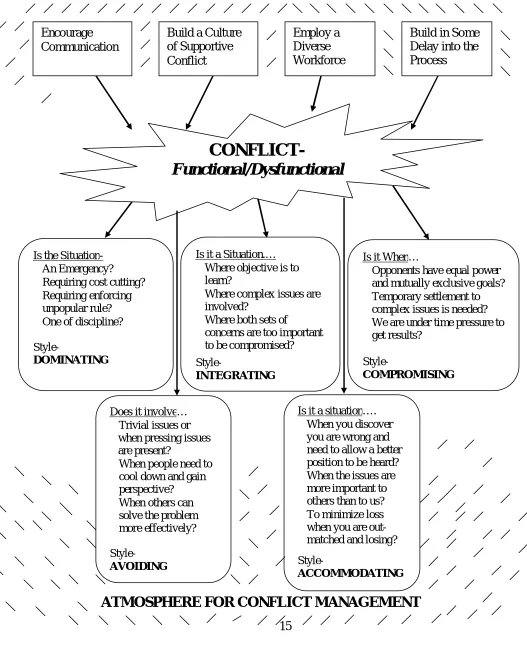
inevitability of organizational conflict, and though the traditional view of conflict is prevalent, the interactionist view is a very close second. Finally, the collectivistic dimension of culture prevails in conflict management among Nigerian executives. This study attempts to aggregate and harness these diverse strands in an effort to put forward a model for conflict management that will suit the Nigerian corporate environment. The model styled, Creative-Contingency Model for Conflict Management is shown as Fig 2.
The Creative-Contingency Model is based on two fundamental principles:
▪ Creative Principle - The view has been canvassed that using conflicts to promote creative syntheses results in high productivity; suppressing conflicts to create a superficial sense of unity, results in low productivity. Thus, organizational members need the structure and the set of social skills in managing conflicts, so that controversies and conflicts can be carefully patterned into the fabric of group life (Adomi & Anie, 2006; Johnson & Johnson, 1994).
▪ Contingency Principle - The second fundamental principle, upon which the model is based, is that every conflict management strategy has its place. Depending on the goals and relationships of the conflicting parties, different strategies may need to be applied. To be effective in resolving conflicts, the corporate executive has to vary his actions and strategies, according to what will work best in the situation. Thus, the choice between integrative, avoiding, accommodating, dominating and compromising, as conflict management strategies, will depend on factors that are prevalent in the organization and between the conflicting parties.
The Creative-Contingency model advocates the creation of an atmosphere in the entire organization for conflict management:
i) Encourage Communication: This involves creating a loose environment where people are not afraid to speak their mind or be irreverent;
ii) Build a Culture of Supportive Conflict: This allows every one to be so free as not to be afraid of having his idea dismissed;
iii) Employ a Diverse Workforce: The more diverse the group, the more diverse the opinions and viewpoints that get expressed, and the more the likelihood of friction;
15 Fig 2
ATMOSPHERE FOR CONFLICT MANAGEMENT
Encourage Communication
Build a Culture of Supportive Conflict
Employ a Diverse Workforce
Build in Some Delay into the Process
CONFLICT-
Functional/Dysfunctional
Is the Situation- An Emergency? Requiring cost cutting? Requiring enforcing
unpopular rule? One of discipline?
Style-
DOMINATING
Is it a Situation.… Where objective is to
learn?
Where complex issues are involved?
Where both sets of
concerns are too important to be compromised? Style-
INTEGRATING
Is it When…
Opponents have equal power and mutually exclusive goals? Temporary settlement to
complex issues is needed? We are under time pressure to
get results?
Style-
COMPROMISING
Does it involve… Trivial issues or
when pressing issues are present?
When people need to cool down and gain perspective? When others can
solve the problem more effectively?
Style-
AVOIDING
Is it a situation…. When you discover
you are wrong and need to allow a better position to be heard? When the issues are
more important to others than to us? To minimize loss
when you are out-matched and losing?
Style-
ACCOMMODATING
ATMOSPHERE FOR CONFLICT MANAGEMENT
16
Johnson & Johnson (1994) outlined some guidelines for constructive conflicts. While they are no cookbook rules, they are principles that can help organizational members argue more constructively and transform disagreements among themselves into a positive experience. The points to note are:
a) Emphasize your common ground of making the best possible decision. The context within which conflict takes place should be cooperative not competitive.
b) Look out for opportunities to engage in healthy and constructive controversy. Highlight contrasting viewpoints, point out disagreements, and promote challenging tasks.
c) Prepare the best case possible for each position.
d) Each party is to advocate its position forcefully but with an open mind. Ensure that each position gets a fair and complete hearing.
e) Value, respect and take seriously everyone's contributions.
f) Understand and challenge opposing ideas and positions. Ask questions, and seek for supporting facts, information and theories in order to understand the opposing positions more thoroughly.
g) Separate the validity of one’s thinking from his competence and worth as a person.
h) Ensure several cycles of differentiation and integration. Differentiation involves bringing out differences in positions, and integration involves combining several positions into one new, creative position.
i) Put one’s self in the other member's shoes. Conflicts and controversies must be seen as the opportunity to improve the quality of our own reasoning by seeing from a variety of perspectives.
j) Follow the canons of rational argument. Generate ideas, collect and organize relevant information, use deductive and inductive logical procedures, and make tentative conclusions. Avoid premature evaluations.
k) Synthesize the best ideas from all the viewpoints and perspectives. The end result is a synthesis that is better than any single position advocated. Think creatively until it is discovered.
The above guidelines build upon, and reinforce the first part of the Creative-Contingency model.
The second part of the model deals with the actual management process. The conflict stimulated by the application of the above suggestions, will be either functional or dysfunctional, depending on the way the conflict is managed. The contingency principle demands that if too little conflict such as apathy or lack of creativity appears, then functional conflict can be stimulated by any or all of the methods listed in the model. When the conflict does become dysfunctional, the appropriate conflict handling style needs to be applied depending on the situation. For example, Burke (1969) found that problem-solving confrontations were strongly associated with constructive resolution of conflicts, whereas forcing (or dominating) the other person to accept one's position was strongly associated with ineffective conflict management. Yet in certain circumstances like an emergency, when there is no time for niceties, the dominating style may be most effective.
17
management. The management process which stretches from "Open door" to Litigation is more of a procedural model, than a management tool.
The Creative-Contingency model is primed to serve the cause of management in the corporate setting. However, with minor adjustments, the basic premises of the model can be applied to virtually any type of conflict situation. It is the considered opinion of the researcher that this could be a remarkable contribution to the task of conflict management, not just in Nigeria, but globally.
CONCLUSION
It is a principle of structure that stress and strain between component parts is necessary to achieve strength and form. Right corporate decisions often grow out of the clash and conflict of divergent opinions and out of the serious consideration of alternatives. Conflicts therefore, hold out the possibility of alternative futures for Nigerian corporate bodies. Organizational conflicts should be viewed as an aid to creativity, innovation and growth. Put in another way, conflict can be made a primary source of organizational learning, development, innovation and ultimately, competitive advantage. Every forward-looking organization should stimulate and nurture a creative clash of new ideas and thoughts as an instrument of growth.
Further more, corporate managers must be flexible in the adoption of styles of conflict management. The circumstances of each organization and the relationship subsisting between the parties must be allowed to determine the choice of management style. A mindset that accommodates conflicting viewpoints is necessary for effective resolution of conflicts.
18 REFERENCES
Adomi E. E. & Anie S. O. (2006), “Conflict Management in Nigerian University Libraries”, Library Management, Vol. 27, No. 8, pp. 520-533.
Ayoko O. B. & Pekerti A. A. (2008), “The Mediating and Moderating Effects of Conflict and Communication Openness on Workplace Trust”, International Journal of Conflict Management, Vol. 19, No. 4, pp. 297-318.
Ayoko O. B., Callan V. J. & Hartel C. E. J. (2008), “The Influence of Team Emotional Intelligence Climate on Conflict and Team Members’ Reactions to Conflict”, Small Group Research, Vol. 39, No. 2, pp. 121-149.
Braverman H. (1974), Labour and Monopoly Capital, New York, Monthly Review Press.
Brett J. M. (1984), “Managing organizational conflict”, Professional Psychology: Research and Practice, Vol. 15 No. 5, pp. 664-78.
Burke, R. (1970), "Methods of Resolving Superior- Subordinate Conflict: The Constructive Use of Subordinate Differences and Disagreements", Organizational Behaviour and Human Performance. Vol. 5 pp 393-411.
Covey, S. R. (1989), The 7 Habits of Highly Effective People, New York, Simon and Schuster.
Darling J. R. and Fogliasso C. E. (1999),"Conflict Management Across Cultural Boundaries: A Case Analysis From a Multi-National Bank", European Business Review, Vol. 99, pp. 383-392.
Darling J. R. & Walker W. E. (2001), “Effective Conflict Management: Use of the Behavioural Style Model”, Leadership and Organization Development Journal, pp. 230-242.
Edwards P. (ed) (1995), Industrial Relations: Theory and Practice in Britain, Oxford, Blackwell.
Edwards R. (1979), Contested Terrain, London, Heinemann.
Harris L. C., Ogbonna E. & Goode M. M. H. (2006), “Intra-Functional Conflict: An Investigation of Antecedent Factors in Marketing Functions”, European Journal of Marketing, Vol. 42, No. ¾, pp. 453-476.
Jehn K. A. (1997), “A Qualitative Analysis of Conflict Types and Dimensions in Organizational Groups”, Administrative Science Quarterly, Vol. 42, pp. 530-57.
Johnson D.W. and Johnson F.P.(1994) Joining Together: Group Theory and Group Skills,(5th ed), Boston, Allyn & Bacon.
Kolb D. M. & Putnam L. L. (1992), “The Multiple Faces of Organizational Conflict”, Journal of Organizational Behavior, Vol. 13 No. 3, pp. 311-24.
Lansbury R., Bamber G. & Wales N. (2002), International and Cooperative Employment Relations, Sidney, Allen & Unwin.
19
March J.G. and Simon H.A. (1958), Organizations, London, Wiley.
Marchington M. & Wilkinson A. (2002), People Management and Development, (2nd ed), London, CIPD House.
Mckenna S & Richardson J. (1995), "Business Values, Management and Conflict Handling: Issues in Contemporary Singapore", Journal of Management Development, Vol. 14, No. 4, pp.56-70.
Nair N. (2007), “Towards Understanding the Role of Emotions in Conflict: A Review and Future Directions”, International Journal of Conflict Management, Vol. 19, No. 4, pp. 359-381.
Ozkalp E., Sungur Z. & Ozdemir A. A. (2009), “Conflict Management Styles of Turkish Managers”, Journal of European Industrial Training, Vol. 33, No. 5, pp. 419-438.
Poitras J. & Tareau A. (2007), “Dispute Resolution Patterns and Organizational Dispute States”, International Journal of Conflict Management, Vol. 19, No.1, pp.72-87.
Pondy L. R. (1967), “Organizational Conflict Concepts and Models”, Administrative Science Quarterly, Vol. 12, No. 2, pp. 296-320.
Putnam L. L. & Poole M. S. (1987), “Conflict and Negotiation” in Porter L. W. (ed), Handbook of Organizational Communication: An Inter-Disciplinary Perspective, Newbury Park, Sage, pp. 549-599.
Rahim M. A. (1983), “A Measure of Styles of Handling Interpersonal Conflict”, The Academy of Management Journal, Vol. 26, No. 2, pp. 386-376.
Skjorshammer, M. (2001), "Conflict Management in a Hospital: Designing Processing Structures and Intervention Methods", Journal of Management Psychology, Vol. 15, No.2, pp. 606-625.
Tekleab A. G., Quigley N. R. & Tesluk P. E. (2009), “A Longitudinal Study of Team Conflict, Conflict Management, Cohesion, and Team Effectiveness”, Group Organization Management, Vol. 34, No. 2, pp. 170-205.
Thomas K. (1976), “Conflict and Conflict Management”, in Dunnette M. D. (ed), Handbook of Industrial and Organizational Psychology, Chicago, Rand McNally, pp. 889-935.
Tjosvold, D. (1998), “The Cooperative and Competitive Goal Approach to Conflict: Accomplishments and Challenges”, Applied Psychology: An International, Vol. 47, pp. 285-313.