Vascular plants dataset of the herbarium (COFC)
of the University of Cordoba, Spain
Gloria Martínez-Sagarra1, Juan Antonio Devesa1
1 Department of Botany, Ecology and Plant Physiology, University of Cordoba, Rabanales Campus, 14071, Cordoba, Spain
Corresponding author:Gloria Martínez-Sagarra ([email protected])
Academic editor:Dennis Stevenson | Received 18 June 2019 | Accepted 1 October 2019 | Published 15 October 2019
Citation: Martínez-Sagarra G, Devesa JA (2019) Vascular plants dataset of the herbarium (COFC) of the University of Cordoba, Spain. PhytoKeys 133: 77–94. https://doi.org/10.3897/phytokeys.133.37481
Abstract
This paper describes the herbarium (COFC) dataset of vascular plants of the University of Cordoba (SW Spain). This dataset is made up of two collections, the General collection (61,377 specimens) and the Historical collection (1,614 specimens). This study has focused mainly on the General collection, which contains the largest number of vascular plant specimens, predominantly angiosperms, mainly provin-cial and regional (Andalusia, Spain), but also with a good representation of other areas of the Iberian Peninsula and neighboring countries. The place of collection is specified in 99.7% of the labels, about 35% being georeferenced, and it is estimated that, currently, about 86% of the material housed in the herbarium has been databased using Elysia v1.0. software. With more than 178 families, 1,178 genera, and 3,750 species, this collection not only has educational importance, but is a valuable research tool that has been useful for the development of important works such as "Flora Vascular de Andalucía Oc-cidental" and the "Flora iberica". The dataset described in this paper is registered with GBIF (accessible at https://doi.org/10.15468/fdzzal).
Keywords
Western Andalusia, Cordoba, COFC, herbarium collection, "Flora iberica", Spain, taxonomy, University of Cordoba, vascular plants
http://phytokeys.pensoft.net
Copyright G. Martínez-Sagarra, J. A. Devesa. This is an open access article distributed under the terms of the Creative Commons Attribution License (CC BY 4.0), which permits unrestricted use, distribution, and reproduction in any medium, provided the original author and source are credited.
Context of the COFC herbarium
The herbarium (COFC) of the University of Cordoba (Spain) is located in the Ra-banales Campus, on the outskirts of the city of Cordoba. It was created in 1977 and is associated with the Department of Botany, Ecology and Plant Physiology (Botany Section, Faculty of Sciences). The herbarium, of which Prof. J.A. Devesa is currently the curator, is registered in the Index Herbariorum with the acronym COFC (Thiers 2019, http://sweetgum.nybg.org/science/ih/). It includes three botanical collections: one of fungi (Fungi-COFC, 4,827 specimens) and two of vascular plants, the His-torical collection (1,614 specimens) and the General collection (61,377 specimens), the latter being the most significant. To these will be added in the future the recently created collections of bryophytes and algae, in the initial phase and barely significant. So far, 98.7% of the specimens have been databased and they can be accessed through the GBIF network (http://data.gbif.org). Some interesting data from the Historical collection are provided, but the dataset described in this paper covers exclusively the General collection.
Historical collection
General collection
The General collection has a total of 61,377 specimens that have been recorded with different herbarium number, and there are more than 12,000 duplicate specimens of the gatherings. This collection is the fourth largest among the Andalusian collections in terms of the number of specimens (based on the information obtained from the National Biodiversity Information Node 2015), after SEV, COA and MGC (Table 1). It contains material collected for the most part over the last 40 years from explorations and studies carried out by researchers from the Department of Botany, Ecology and Plant Physiology, undergraduate and post-graduate studies related to teaching and, in minor measure, exchanges with or donations by other herbaria. The collection com-prises a wide representation of vascular plants – especially angiosperms− from the prov-ince of Cordoba and, to a lesser extent, from other Spanish regions, as well as a mod-est representation from bordering countries and other parts of the world. It mainly includes wild plants, with a minimum representation of ornamental plants (around 950 specimens). In recent years the collection has been enhanced, mainly by a large number of collections made in the Iberian Peninsula for taxonomic revision of various genera, especially Centaurea L. (Asteraceae) and Festuca L. (Poaceae), within the "Flora iberica" project. This is one of the Spanish herbaria with greater representation of these genera. The herbarium, therefore, includes an important sample of the vascular plant biodiversity of the Iberian Peninsula, especially that of Western Andalusia (SW Spain), so it is not only essential for the knowledge and study of local flora, but also has been
Table 1. The main Andalusian herbaria (Source: https://www.gbif.org, accessed 2019). (*) Information from the National Biodiversity Information Node (2015), available at https://www.gbif.es/wp-content/ uploads/2018/02/GBIF.ES_Inf_Col_2014.pdf. Acronyms of the herbaria according to Thiers (2019).
Acronyms Collection Institution Estimated number
of specimens (year of estimate)*
Number of records published in GBIF (accessed 2019)
SEV Herbarium of the University
of Seville University of Seville 350,000 (2007) 226,498
COA COA Herbarium Botanical Garden of Cordoba 80,000 (2008) 39,835
MGC MGC-Cormof Herbarium Department of Plant Biology, Faculty of
Sciences 74,683 (2012) 78,930
COFC COFC Herbarium of the
University of Cordoba: General collection
Department of Botany, Ecology and Plant
Physiology, Faculty of Sciences 72,000
1 (2019) 60,566
GDA Collection of vascular plants
of the herbarium of the University of Granada
University of Granada 1,442 (2011) 55,2192
HUAL Herbarium of the University
of Almeria
University of Almeria. Department of Plant Biology and Ecology
24,304 (2012) 14,971
JAEN Herbarium of vascular plants University of Jaen. Faculty of Experimental
Sciences 34,000 (2012) No data
UPOS Herbarium of the University
Pablo de Olavide University of Pablo de Olavide 10,000 (2008) No data
very useful for "Flora de Andalucía Occidental" (Valdés et al. 1987) and, currently, the "Flora iberica" (Castroviejo 1986−2019, http://www.floraiberica.org/).
This collection regularly increases, by about 1,250 specimens per year, and the dataset is periodically uploaded to the GBIF portals. The data referring to this collec-tion can be found at https://doi.org/10.15468/fdzzal (entries through 2018−12−31), except for the data related to the genus Festuca, which have not been uploaded yet since they are still under study.
Taxonomic coverage
The collection of vascular plants has 61,377 specimens belonging to 178 families, 1,178 genera, and 3,750 species. Of the specimens in the collection, 97.8% are identi-fied at the species level and the remaining 2.2% (about 1,350 specimens) only at the level of the genus, awaiting their review by a specialist.
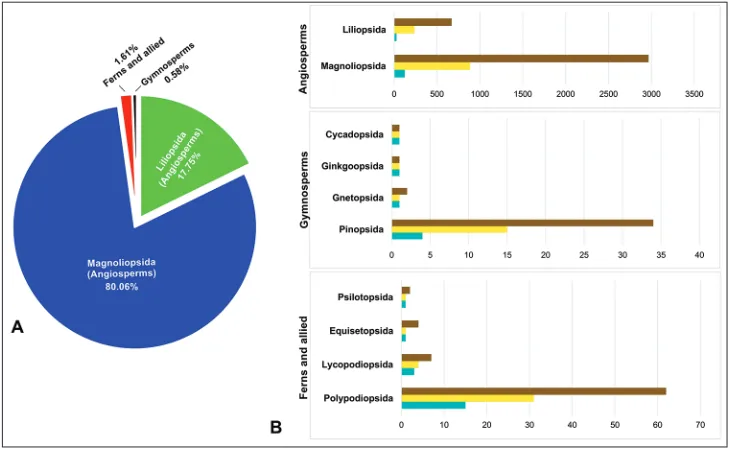
The majority of the specimens in the collection are angiosperms (Angiospermae) be-longing to the classes Magnoliopsida (49,140 specimens; 80.06%) and Liliopsida (10,893 specimens; 17.75%). These are followed, in terms of representation, by ferns and related groups, with 991 specimens (1.61%) and the following distribution: class Polypodiop-sida (740 specimens), EquisetopPolypodiop-sida (139 specimens), LycopodiopPolypodiop-sida (107 specimens), and Psilotopsida (5 specimens). Finally, for gymnosperms (Gymnospermae) there are 353 specimens (0.58%), with the following distribution: Cycadopsida (2 specimens), Gink-goopsida (1 specimen), Gnetopsida (51 specimens), and Pinopsida (299 specimens). In
Figure 2. Families with greater representation in the General collection. In blue, families of Magnoliop-sida; in green, families of Liliopsida.
Figure 3. Genera with greatest number of specimens in the General collection (A). In blue, genera of Magnoliopsida (M); in green, genera of Liliopsida (L). Number of specimens collected for each genus plus associated duplicates (B).
terms of diversity, Magnoliopsida (124 families, 886 genera, and 2,966 species), Pinopsi-da (4 families, 15 genera, and 34 species), and PolypodiopsiPinopsi-da (15 families, 31 genera, and 62 species) are the most diverse classes within each large group of vascular plants (Fig. 1).
Among the best represented genera are Centaurea (1,538 specimens), Trifolium (1,406 specimens), Festuca (811 specimens), Euphorbia (768 specimens), Plantago (750 speci-mens), Ranunculus (739 specimens), Medicago (724 specimens), Silene (722 specimens), Quercus (675 specimens), and Bromus (610 specimens) (Fig. 3). The two genera with the highest specific diversity are Centaurea (102 spp.) and Festuca (59 spp.), followed by Trifo-lium (41 spp.), Silene (40 spp.), Euphorbia (37 spp.), Ononis (37 spp.), Genista (35 spp.), Ranunculus (34 spp.), Astragalus (28 spp.), and Teucrium (27 spp.).
Taxonomic ranks
Kingdom: Plantae Phylum: Tracheophyta
Class: Cycadopsida, Equisetopsida, Ginkgoopsida, Gnetopsida, Liliopsida, Lycopodi-opsida, MagnoliLycopodi-opsida, PinLycopodi-opsida, PolypodiLycopodi-opsida, Psilotopsida.
Salicaceae, Salviniaceae, Santalaceae, Sapindaceae, Saxifragaceae, Scrophulariaceae, Selaginellaceae, Simaroubaceae, Smilacaceae, Solanaceae, Tamaricaceae, Taxaceae, Tetradiclidaceae, Thelypteridaceae, Thymelaeaceae, Tropaeolaceae, Typhaceae, Ul-maceae, Urticaceae, Verbenaceae, Violaceae, Vitaceae, Zygophyllaceae.
Geographic coverage
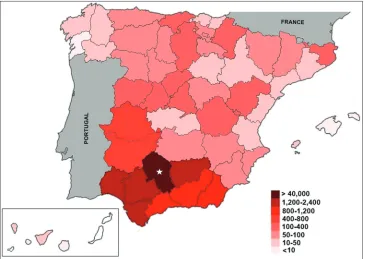
Most of the specimens in the collection are from Spanish territory (60,847 specimens; 99.14%), with the peninsular area being the best represented (Fig. 4). Less than 1% of the specimens come from bordering countries, such as Portugal (316 specimens), Moroc-co (185 specimens), and France (11 specimens). The specimens Moroc-collected elsewhere −in Andorra (5 specimens), Norway (4 specimens), Switzerland (2 specimens), Great Britain (2 specimens), Ireland (1 specimen), Israel (1 specimen), Italy (1 specimen), and the USA (1 specimen) −, have a symbolic presence, representing only 0.03% of the collection.
Within Spain, Andalusia (Southern Spain) is the region with the highest number of specimens; specifically, within Andalusia, the province of Cordoba has the greatest representation (46,505 specimens), followed by Seville (2,244 specimens), Jaen (1,714 specimens), Huelva (1,640 specimens), and Cadiz (1,396 specimens) (Fig. 4).
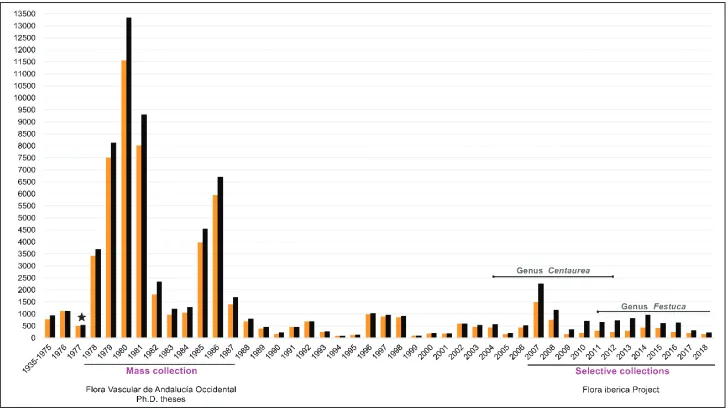
In the province of Cordoba, an important collection effort was made immediately after creation of the herbarium (Fig. 5). This has included all the territories of the Sierra Morena natural areas (northern half of the province), and the Campiña and Sierra Subbetica in the southern half. These include the territories of the Cardeña−Montoro and Sierra de Horna-chuelos Natural Parks, in the Sierra Morena, and the Natural Park of the Sierra Subbetica and the Natural Reserves of the Humid Areas, in the South of Cordoba province.
Temporal coverage
The collection includes specimens collected from 1935 to the present (Fig. 5). The oldest specimens correspond mainly to particular donations and exchanges, main-ly involving renowned Spanish botanists such as José Cuatrecasas (1903−1996), Salvador Rivas Goday (1905−1981), Francisco Bellot (1911−1983), Bartolomé Casaseca (1920−1998), and José Vicente Cordeiro Malato-Beliz (1920−1993). The largest number of specimens (about 44,300 specimens, with 6,300 duplicates) was collected at the end of the 1970s and in the mid-1980s, coinciding with the years of creation of the University of Cordoba and COFC (Fig. 5). In this period, the source of the material was mainly PhD theses on flora and chorology, involving lec-turers and contracted staff of the Department of Botany, Ecology and Plant Physi-ology, and also the surveys and taxonomic revisions of genera within the framework of the project "Flora Vascular de Andalucía Occidental" (Valdés et al. 1987).
quently, the material incorporated into the herbarium had its origin in more or less periodic collections carried out throughout the province of Cordoba, from which numerous chorological publications of local interest were derived. A new boost to the collection took place during the period 2007−2018 (about 4,900 specimens, with 4,600 duplicates, Fig. 5). In this case mainly due to the collections made in the Iberian Peninsula as part of the "Flora iberica" project (National Plan of R+D+i of the Government of Spain; see the later section Funding of the maintenance and databasing of the herbarium), and this is around 8% of the specimens that the col-lection houses.
On the other hand, as expected, high seasonality can be seen in the collections: more contributions are made in spring and summer than in winter. Thus, the months of greatest collection effort are April, May and June (almost 40,000 specimens); while the minor ones are December, January and November (only about 2,500).
Step description
Plant processing procedures
The usual procedures for the processing and storage in the herbarium of the plant material have been employed. The fresh material is dried by pressing, sometimes with simultaneous drying using an oven or heater. When it is dry, and prior to storage, the rotary freezing technique (at -18 °C) is used for four days in order to conserve the ma-terial and prevent its destruction by fungi and insects, thus avoiding subsequent infes-tations. This procedure is repeated approximately every six months. The specimens are stored in boxes inside compactor cabinets located in an isolation unit with controlled temperature and humidity. The families are arranged alphabetically, as are the genera within each family and the species within each genus.
Labeling
Quality control
The care and control of the collection includes its monitoring through the management and registration of all incoming and outgoing botanical gatherings that are the respon-sibility of the Herbarium Service, with the curator’s supervision. The process includes space planning, sample relocation, sample assembly and repair, freezing to minimize the potential for insect infestation, and general repairs. Periodic checks are made in the storage area of the collections to detect possible effects of insects and harmful fungi.
The quality control is mainly performed at three levels:
1. In the identification phase/taxonomic criteria: For their inclusion in the her-barium, the specimens must be identified at the level of the species and, if ap-propriate, the infraspecific category, although for many genera there is material without identification of the species that is waiting to be reviewed by specialists. The main works used to identify the material are: "Flora Vascular de Andalucía Occidental" (Valdés et al. 1987), "Flora Vascular de Andalucía Oriental" (Blanca et al. 2009), "Flora iberica" (Castroviejo 1986−2019), and "Flora Europaea" (Tu-tin et al. 1964−1980). In cases where a modification of the original identification is made, it is reflected in the database as a revision. Currently, work is being done on the organization and delimitation of families according to The Angiosperm Phylogeny Group III (APG III 2009) and IV (APG IV 2016). Regarding nomen-clature, it is checked with several taxonomic authorities, such as The Plant List (http://www.theplantlist.org/), Tropicos (http://www.tropicos.org), IPNI (The In-ternational Plant Names Index, http://www.ipni.org/), and Euro+Med PlantBase (the information resource for Euro-Mediterranean plant diversity, http://ww2. bgbm.org/EuroPlusMed/), as well as the valid name recognized in "Flora iberica" (http://www.floraiberica.es/).
2. Georeferencing and technical validation: It is estimated that only 33% of the specimens in the collection contain information regarding the coordinates (UTM, MGRS, or geographic) of the place of origin, with greater or lesser precision. At present, the georeferencing of the collection is being done using MGRS coordi-nates (1 km2 of precision) based on the information contained in the original label,
using the tools of Google Earth (http://www.google.com/earth/index.html) and
Iberpix (http://www.ign.es/iberpix2/visor/). These coordinates are automatically transformed into geographic coordinates (latitude and longitude are expressed in decimal degrees in the WGS84 datum) when the herbarium information is trans-ferred to the GBIF portal.
the one used today. It is estimated that around 86% of the material housed in the herbarium has been databased. The first transfer of data from COFC to the GBIF portal included data for the period 2006−2012 (56,081 records), and very recently the corresponding data up to and including 2018 were exported (a total of 60,566 records, excluding Festuca). The Darwin Core biodiversity standards were used (DarwinTest v3.3 tool; Ortega-Maqueda and Pando 2008) before uploading the information to the GBIF portal. The Darwin Core file (http://rs.tdwg.org/dwc/), encoded in UTF-8, is generated regularly and is available for download on the GBIF data portal via the Integrated Publishing Toolkit (IPT) of the University of Cordoba (version 1.8, published 2019; https://ipt.gbif.es/resource?r=herbariocofc #versions), through the GBIF Spanish network. The list of elements in the Darwin Core standard published through the GBIF network as well as their definitions and other information of interest can be found at https://dwc.tdwg.org.
Funding of the maintenance and databasing of the herbarium
COFC herbarium does not yet have its own funding. Since its creation, it has been dependent on the personnel and resources of the Department of Botany, Ecology and Plant Physiology of the University of Cordoba. Only more recently has it re-ceived additional funding, fruit of the efforts made by the two Curators who have been in charge, Profs. E. Ruiz de Clavijo (1977−2010) and J. A. Devesa (2011−pre-sent). It had two grants at the beginning of the databasing of the collection (Com-plementary Funding of the Ministry of Education and Science), and since 2011 it has benefitted from the work of technical personnel hired for the maintenance, data-basing, and georeferencing of the collection, in some cases financed by the Govern-ment of Spain, and in others by the Junta de Andalucía. These grants and contracts are summarized below.
Funding received for the initial digitalization of the collection
Funding body: Ministry of Education and Science Reference: CGL2007-28813-E
Lead researcher: E. Ruiz de Clavijo
Duration: January 2008 to December 2008 Amount: 32,900 euros
Funding body: Ministry of Education and Science Reference: CGL2008-02241-E/BOS
Lead researcher: E. Ruiz de Clavijo
Contracts of the complementary actions framework
Program: Adaptation of the Herbaria of the Faculty of Sciences of the University of Cordoba to the GBIF framework (Subprogram: Complementary Actions)
Funding body: Ministry of Science, Innovation, and Universities Lead researcher: E. Ruiz de Clavijo
Duration: July 2006 to April 2007
Program: Adaptation of the Herbaria of the Faculty of Sciences of the University of Cordoba to the GBIF framework (Subprogram: Complementary Actions)
Funding body: Ministry of Science, Innovation, and Universities Lead researcher: E. Ruiz de Clavijo
Duration: January 2008 to December 2008
Program: Adaptation of the Herbaria of the Faculty of Sciences of the University of Cordoba to the GBIF framework (Subprogram: Complementary Actions)
Funding body: Ministry of Science, Innovation, and Universities Lead researcher: E. Ruiz de Clavijo
Duration: March 2009 to December 2009 (extended until 30−10−2010)
Contracts for technical staff member:
Program: Technical Personnel to Assist Research Funding body: Ministry of Science and Innovation Reference: PTA2010-3438-I
Lead researcher: J. A. Devesa
Duration: February 2011 to January 2014 Program: Technical Personnel to Assist Research
Funding body: Ministry of Education and Vocational Training Reference: PTA2017-13723-I
Lead researcher: J. A. Devesa Duration: 2019−2021
Contracts from the Youth Employment Plan:
Program: National Youth Guarantee System
Funding body: Ministry of Employment and Social Security Lead researcher: PEJ-2014-A-82677
Researcher: J. A. Devesa Duration: 2016−2017
Program: National youth guarantee system and the youth employment opera-tional program
Lead researcher: J. A. Devesa Duration: June 2017 to May 2018
Program: National youth guarantee system and the youth employment opera-tional program
Funding body: Junta de Andalucía Reference: EJI-17-RNM-260 Lead researcher: J. A. Devesa
Duration: January 2018 to July 2019
Program: National youth guarantee system and the youth employment opera-tional program
Funding body: Ministry of Economy, Industry, and Competitivity, and Junta de Andalucía
Reference: EJI-17-RNM-260 Lead researcher: J. A. Devesa
Duration: March 2019 to February 2020
Pending or delayed tasks
The following activities are being prioritized by the technical staff.
a) Mounting, databasing, and inclusion of specimens from old collections: About 10,000 sheets of unmounted and unfiled specimens that accumulated in the pe-riod 1977−1987 are pending allocation of a sheet number or accession number, as well as databasing and inclusion in the General collection. Also, some 4,000 sheets have been allocated an accession number, but their data have not been registered in the database, probably due to a lack of technical personnel during that period and/or the absence of standardized databases. All this material has been identified, and most of it has been mounted. It has been arranged by fam-ily in distinctive blue boxes; currently, it is being databased using Elysia v1.0.
These data were not available and so these specimens were not included in the taxonomic analysis or geographical coverage of this paper.
Interest and use of the collection
The General collection of COFC is fundamental for our knowledge of the Andalusian flora, and had great importance in the writing of the "Flora Vascular de Andalucía Oc-cidental" (Valdés et al. 1987). It contains a vast representation of specimens from the province of Cordoba, whose study has deepened our knowledge of its flora, reflected in numerous publications in the last 20 years (e.g., Ruiz de Clavijo and Devesa 2010, López Tirado and Hidalgo 2014, López Tirado et al. 2013, 2015, Martínez-Sagarra et al. 2016, Muñoz et al. 2017, Reyes et al. 2017, Devesa et al. 2018, in press, among the most recent). It has also been fundamental for the taxonomic studies that have been carried out in the "Flora iberica" project (Castroviejo 1986−2019), especially from 2007 to the present, a period in which four subprojects have been developed, coordinated by Dr. J.A. Devesa from the University of Cordoba (projects CGL2008-02982-C03-03; CGL2011-28613-C03-02; CGL2014-52787-C3-3-P; CGL2017-85204-C3-3-P, of the Govern-ment of Spain). These focused mainly on the preparation of the taxonomic syntheses of the genera Centaurea (Devesa et al. 2014) and Festuca (taxonomic revision in progress), two of the most complex genera of the peninsular flora with an excellent representation in the collection. It is estimated that 16% of all the material preserved in the collection cor-responds to duplicates, and these are especially common for the genera Centaurea (1,904 duplicates, Fig. 3B) and Festuca (1,906 duplicates, Fig. 3B), and for whose taxonomic synthesis abundant material was necessary in order to cover all their diversity, even at the population level (e.g., Invernón and Devesa 2013, Devesa 2016, Martínez-Sagarra and Devesa 2015, 2019, López et al. 2016, 2017). Besides, much of the material conserved in COFC also been used in morphological and biogeographic studies (Aedo et al. 2015, Cano et al. 2017, Devesa et al. in press), molecular and phylogeographic studies (Arnelas et al. 2018, Benítez-Benítez et al. 2018), foliar anatomy studies (Martínez-Sagarra et al. 2017), and genome size analysis (Martínez-Sagarra et al. work in progress).
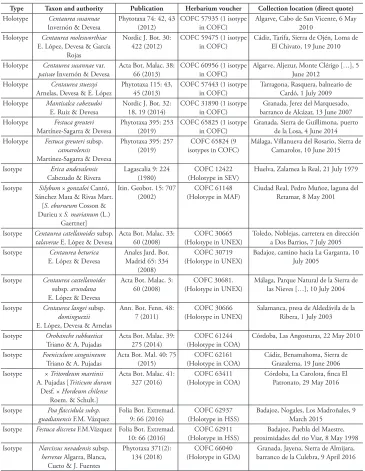
In addition, 34 types (7 holotypes and 27 isotypes) of various described taxa of the Iberian Peninsula are preserved in COFC (Table 2).
Dataset description
Object name: Darwin Core Archive Dpto de Botánica, Ecología y Fisiología Vegetal (COFC). Facultad de Ciencias. Universidad de Córdoba
Character encoding: UTF-8
Format name: Darwin Core Archive format Format version: 1.0
Distribution:https://doi.org/10.15468/fdzzal Publication date of data: 2019-07-19 Language: Spanish
Metadata language: Spanish
Date of metadata creation: 2019-06-18 Hierarchy level: Dataset
Table 2. Type material of vascular plants conserved in COFC. Acronyms of the herbaria according to Thiers (2019). Holotypes and isotypes are listed in order of publication of the taxa.
Type Taxon and authority Publication Herbarium voucher Collection location (direct quote)
Holotype Centaurea susannae
Invernón & Devesa Phytotaxa 74: 42, 43 (2012) COFC 57935 (1 isotype in COFC) Algarve, Cabo de San Vicente, 6 May 2010
Holotype Centaurea molesworthiae
E. López, Devesa & García Rojas
Nordic J. Bot. 30:
422 (2012) COFC 59475 (1 isotype in COFC) Cádiz, Tarifa, Sierra de Ojén, Loma de El Chivato, 19 June 2010
Holotype Centaurea susannae var.
paivae Invernón & Devesa Acta Bot. Malac. 38: 66 (2013) COFC 60956 (1 isotype in COFC) Algarve, Aljezur, Monte Clérigo […], 5 June 2012
Holotype Centaurea stuessyi
Arnelas, Devesa & E. López Phytotaxa 115: 43, 45 (2013) COFC 57443 (1 isotype in COFC) Tarragona, Rasquera, balneario de Cardó, 1 July 2009
Holotype Mantisalca cabezudoi
E. Ruiz & Devesa Nordic J. Bot. 32: 18, 19 (2014) COFC 31890 (1 isotype in COFC) barranco de Alcázar, 13 June 2007Granada, Jerez del Marquesado,
Holotype Festuca greuteri
Martínez-Sagarra & Devesa Phytotaxa 395: 253 (2019) COFC 65825 (1 isotype in COFC) Granada, Sierra de Guillimona, puerto de la Losa, 4 June 2014
Holotype Festuca greuteri subsp.
camarolensis Martínez-Sagarra & Devesa
Phytotaxa 395: 257
(2019) isotypes in COFC)COFC 65824 (9 Málaga, Villanueva del Rosario, Sierra de Camarolos, 10 June 2015
Isotype Erica andevalensis
Cabezudo & Rivera
Lagascalia 9: 224 (1980)
COFC 12422 (Holotype in SEV)
Huelva, Zalamea la Real, 21 July 1979
Isotype Silybum × gonzaloi Cantó,
Sánchez Mata & Rivas Mart. [S. eburneum Cosson & Durieu x S. marianum (L.)
Gaertner]
Itin. Geobot. 15: 707
(2002) (Holotype in MAF)COFC 61148 Ciudad Real, Pedro Muñoz, laguna del Retamar, 8 May 2001
Isotype Centaurea catellanoides subsp.
talaverae E. López & Devesa Acta Bot. Malac. 33: 60 (2008) (Holotype in UNEX)COFC 30665 Toledo, Noblejas, carretera en dirección a Dos Barrios, 7 July 2005
Isotype Centaurea beturica
E. López & Devesa
Anales Jard. Bot. Madrid 65: 334
(2008)
COFC 30719 (Holotype in UNEX)
Badajoz, camino hacia La Garganta, 10 July 2005
Isotype Centaurea castellanoides
subsp. arundana E. López & Devesa
Acta Bot. Malac. 3:
60 (2008) (Holotype in UNEX)COFC 30681. Málaga, Parque Natural de la Sierra de las Nieves […], 10 July 2004
Isotype Centaurea langei subsp.
dominguezii E. López, Devesa & Arnelas
Ann. Bot. Fenn. 48:
7 (2011) (Holotype in UNEX)COFC 30666 Salamanca, presa de Aldedávila de la Ribera, 1 July 2003
Isotype Orobanche subbaetica
Triano & A. Pujadas Acta Bot. Malac. 39: 275 (2014) (Holotype in COA)COFC 61244 Córdoba, Las Angosturas, 22 May 2010
Isotype Foeniculum sanguineum
Triano & A. Pujadas Acta Bot. Mal. 40: 75 (2015) (Holotype in COA)COFC 62161 Cádiz, Benamahoma, Sierra de Grazalema, 19 June 2006
Isotype × Tritordeum martinii
A. Pujadas [Triticum durum Desf. × Hordeum chilense
Roem. & Schult.]
Acta Bot. Malac. 41:
327 (2016) (Holotype in COA)COFC 63411 Córdoba, La Carolota, finca El Patronato, 29 May 2016
Isotype Poa flaccidula subsp.
guadianensis F.M. Vázquez Folia Bot. Extremad. 9: 66 (2016) (Holotype in HSS)COFC 62937 Badajoz, Nogales, Los Madroñales, 9 March 2015
Isotype Festuca discreta F.M.Vázquez Folia Bot. Extremad.
10: 66 (2016) (Holotype in HSS)COFC 62911 proximidades del rio Viar, 8 May 1998Badajoz, Puebla del Maestre,
Isotype Narcissus nevadensis subsp.
herrerae Algarra, Blanca, Cueto & J. Fuentes
Phytotaxa 371(2):
Acknowledgements
We gratefully acknowledge the technical staff members of COFC, especially P. Abad for her help with data cleaning. We also thank K. Cezón (GBIF Spain) for her help in checking and uploading this resource. This study was supported by the "Flora iberica" project (CGL2008-02982-C03-03; CGL2011-28613-C03-02; CGL2014-52787-C3-3-P; CGL2017-85204-C3-3-P) of the Spanish Government, co-financed by The European Regional Development Fund (ERDF).
References
Aedo C, Medina L, Barberá P, Fernández‐Albert M (2015) Extinctions of vascular plants in Spain. Nordic Journal of Botany 33(1): 83–100. https://doi.org/10.1111/njb.00575 APG III (2009) An update of the Angiosperm Phylogeny Group classification for the orders
and families of flowering plants: APG III. Botanical Journal of the Linnean Society 161(2): 105–121. https://doi.org/10.1111/j.1095-8339.2009.00996.x
APG IV (2016) An update of the Angiosperm Phylogeny Group classification for the orders and families of flowering plants: APG IV. Botanical Journal of the Linnean Society 181(1): 1–20. https://doi.org/10.1111/boj.12385
Arnelas I, Pérez-Collazos E, Devesa JA, López E, Catalán P (2018) Phylogeny of highly hy-bridogenous Iberian Centaurea L. (Asteraceae) taxa and its taxonomic implications. Plant Biosystems 152(5): 1182–1190. https://doi.org/10.1080/11263504.2018.1435569 Benítez‐Benítez C, Escudero M, Rodríguez‐Sánchez F, Martín‐Bravo S, Jiménez‐Mejías
P (2018) Pliocene–Pleistocene ecological niche evolution shapes the phylogeography of a Mediterranean plant group. Molecular Ecology 27(7): 1696–1713. https://doi. org/10.1111/mec.14567
Blanca G, Cabezudo B, Cueto M, Fernández López C, Morales Torres C (2009) Flora Vascular de Andalucía Oriental, 4 vols. Consejería de Medio Ambiente, Junta de An-dalucía, Sevilla.
Cano E, Musarella CM, Cano-Ortiz A, Piñar JC, Spampinato G, Pinto CJ (2017) Morphomet-ric analysis and bioclimatic distribution of Glebionis coronaria s.l. (Asteraceae) in the Medi-terranean area. PhytoKeys 81: 103–126. https://doi.org/10.3897/phytokeys.81.11995 Castroviejo S (1986−2019) Flora iberica. Plantas vasculares de la Península Ibérica e Islas
Baleares, vols. I−XVIII, XX, XXI. CSIC. Madrid.
Devesa JA (2016) Las especies del género Centaurea en la Península Ibérica y Baleares. Univer-sidad de Córdoba, UCOPress, 439 pp.
Devesa Alcaraz JA, Martínez Sagarra G (2019) Herbario COFC de la Universidad de Córdoba: colección general de plantas vasculares. Dept. of Botany, Ecology and Plant physiology, University of Cordoba. https://doi.org/10.15468/fdzzal [accessed via GBIF]
Devesa JA, Martínez-Sagarra G, Reyes E, López Tirado J (2018) Novedades florísticas y corológicas para la provincia de Córdoba (España). Acta Botanica Malacitana 43: 175– 179. https://doi.org/10.24310/abm.v43i0.5114
Devesa JA, Martínez-Sagarra G, Ortúñez E (in press) Sobre el status taxonómico de Festuca cor-dubensis Devesa. Acta Botanica Malacitana 44. https://doi.org/10.24310/abm.v44i0.6774 González Soriano A (1923) Flora cordobesa. Boletín de la Real Academia de Córdoba de
Cien-cias, Bellas Letras y Nobles Artes 3: 93−95, 4: 93−99, 5: 49−59, 6: 77−83.
Infante F, Ruiz de Clavijo E, López Párraga E (2002) Herbario Histórico del Fraile cordobés José de Jesús Muñoz Capilla. Documento en conmemoración de los 50 años del comienzo de la Licenciatura de Biología en España. Córdoba.
Invernón VR, Devesa JA (2013) Revisión taxonómica de Centaurea sect. Seridia (Juss.) DC. (Asteraceae) en la Península Ibérica e Islas Baleares. Acta Botanica Malacitana 38: 49–102. Jordano D, Ocaña M (1955) Catálogo del herbario de los botánicos cordobeses Rafael de León
y Gálvez, Fr. José de Jesús Muñoz Capilla, Rafael Entrenas y Antonio Cabrera. Boletín de la Real Academia de Córdoba de Ciencias. Bellas Letras y Nobles Artes 73: 35–290. Jordano D, Ocaña M (1957) Catálogo del herbario de los botánicos cordobeses Rafael de León
y Gálvez, Fr. José de Jesús Muñoz Capilla, Rafael Entrenas y Antonio Cabrera. Anales del Instituto Botánico A. J. Cavanilles 14: 597–715.
Laza Palacios M (1944) Estudios sobre la flora andaluza. Anales de la Real Academia Nacional de Farmacia (Madrid) 10: 157−199, 367−411, 497−556.
López E, Martínez-Sagarra G, Devesa JA (2016) Estudio taxonómico del complejo Festuca alpina (Poaceae, Pooideae) en la Península Ibérica. Acta Botanica Malacitana 41: 19–31. https://doi.org/10.24310/abm.v41i0.2465
López E, Martínez-Sagarra G, Devesa JA (2017) Taxonomic treatment of the Festuca margi-nata group (Pooideae, Poaceae) on the Iberian Peninsula (SW Europe). Phytotaxa 319(3): 201–224. https://doi.org/10.11646/phytotaxa.319.3.1
López Tirado J, Hidalgo PJ (2014) A new locality for the endangered species Ceratocapnos heterocarpa Durieu (Papaveraceae) to Spain and its syntaxonomical characterization. Acta Botanica Malacitana 39: 248–253.
López Tirado J, Muñoz JM, Hidalgo PJ (2013) Aportaciones a la flora vascular de la provincia de Córdoba (Andalucía, España). Lagascalia 33: 314–325.
López Tirado J, Núñez A, Obregón R, Moreno M, Hidalgo PJ (2015) Primera cita del end-emismo ibérico Allium schmitzii Cout. (Liliaceae) en Andalucía (España). Acta Botanica Malacitana 40: 247–248. https://doi.org/10.24310/Actabotanicaabm.v40i0.2524
Martínez-Sagarra G, Devesa JA (2015) Festuca indigesta subsp. indigesta en la Sierra de Gá-dor (Almería, SE de España). Acta Botanica Malacitana 40: 253–254. https://doi. org/10.24310/Actabotanicaabm.v40i0.2526
Martínez-Sagarra G, Devesa JA (2019) Two new taxa of Festuca (Poaceae) from the south-eastern Iberian Peninsula. Phytotaxa 395(4): 251–264. https://doi.org/10.11646/phyto-taxa.395.4.1
Martínez-Sagarra G, Abad P, Devesa JA (2017) Study of the leaf anatomy in cross-section in the Iberian species of Festuca L. (Poaceae) and its systematic significance. PhytoKeys 83: 43–74. https://doi.org/10.3897/phytokeys.83.13746
Muñoz J, Díaz ML, Devesa JA (2017) Rhamnus velutina Boiss. subsp. velutina y Cyperus glaber
L., novedosos para la flora de la provincia de Córdoba (España). Acta Botanica Malacitana 42: 347c348. https://doi.org/10.24310/abm.v42i2.4148
National Biodiversity Information Node (2015) Report of biological collections and databases of biodiversity in Spain (GBIF Coordination Unit in Spain). https://www.gbif.es/wp-con-tent/uploads/2018/02/GBIF.ES_Inf_Col_2014.pdf [accessed: 6 March 2019]
Ortega-Maqueda I, Pando F (2008) Darwin Test v3.3: Una aplicación para la validación y el chequeo de los datos en formato Darwincorev2 or Darwincore 1.4, Unidad de Coordi-nación de GBIF.ES, CSIC. Ministerio de Educación y Ciencia, España. http://www.gbif. es/Darwin_test/Darwin_test.php [accessed: 5 June 2019]
Pando F, Lujano M, Cezón K (2019) Elysia v2.0: Una aplicación para la gestión completa de colecciones biológicas. GBIF.ES. Real Jardín Botánico (CSIC). Ministerio de Ciencia, In-novación y Universidades. [accessed: 19 July 2019]
Pando F, Lujano M, Cezón K (1994−2010) Herbar v3.7.1: Una aplicación de bases de datos para gestión de herbarios. GBIF.ES. Real Jardín Botánico (CSIC). Ministerio de Cien-cia, Innovación y Universidades. https://www.gbif.es/software/herbar-zoorbar/ [accessed: 5 June 2019]
Pando F, Lujano M, Cezón K (1996−2016) Elysia v1.0: Una aplicación para la gestión comple-ta de colecciones biológicas. GBIF.ES. Real Jardín Botánico (CSIC). Ministerio de Ciencia, Innovación y Universidades. https://www.gbif.es/software/elysia/ [accessed: 5 June 2019] Reyes E, Martínez-Sagarra G, Devesa JA (2017) Novedades florísticas y corológicas para la flora
de la provincia de Córdoba (España). Acta Botanica Malacitana 42: 311–319. https://doi. org/10.24310/abm.v42i2.4149
Ruiz de Clavijo E, Devesa JA (2010) Mantisalca duriaei (Spach) Briq. & Cavill. en Andalucía Occidental. Lagascalia 30: 508–509.
Thiers B (2019) Index Herbariorum: A global directory of public herbaria and associated staff. New York Botanical Garden’s Virtual Herbarium. http://sweetgum.nybg.org/science/ih/ [accessed: 6 May 2019]
Tutin TG, Heywood VH, Burges NA, Moore DM, Valentine DH, Walters SM, Webb DA (1964−1980) Flora Europaea (Vols 1−5). Cambridge University Press, Cambridge. Valdés B, Talavera S, Galiano EF (1987) Flora vascular de Andalucía occidental (3 eds). Ketres,