2012, with description of a new species from Portugal
(Lepidoptera, Gelechiidae)
Martin F. V. Corley
1,3, Jorge Rosete
2, Sónia Ferreira
31 Corresponding author: Pucketty Farm Cottage, Faringdon, Oxfordshire SN7 8JP, UK; [email protected]
2 Urbanização Lourisol, Rua Manuel Cerqueira Nobrega, Lote 16, 2. frente, P-3105-165 Louriçal, Pombal, Portugal;
3 CIBIO-InBIO, Centro de Investigação em Biodiversidade e Recursos Genéticos, Universidade do Porto, Campus
Agrário de Vairão, P-4485-61 Vairão, Portugal; [email protected]
http://zoobank.org/BA17A1A4-F2C4-42C1-B2BD-AD1F73F36D13
Received 24 January 2020; accepted 20 February 2020; published: 28 May 2020 Subject Editor: David C. Lees.
Abstract. Following the discovery of a new species on the western coast of Portugal which is closely related to Apatetris mediterranella Nel & Varenne, 2012, the generic placement of both species is considered in re -lation to other genera within the Apatetris complex resulting in the description of a new genus, Mondeguina.
Introduction
Apatetris mediterranella Nel & Varenne, 2012 was described from the coasts of France, Corsica and Italy. The species was observed to have distinctive characters, particularly the long antennae and unusually slender hindwings. These characters had baffled the authors for some time as they considered at one stage that the species might belong to Gracillariidae or even to Neomariania
Mariani, 1943 in the Stathmopodidae. Eventually it was recognised as belonging to Gelechiidae. In spite of the unusual characters for this family, the species was placed in the genus Apatetris
Staudinger, 1880. The authors considered the possibility of placing it in a new genus, but were advised not to do so because Apatetris and related genera remain unrevised on a global scale.
In 2017, J.R. found a small moth species near the Portuguese coast which he identified as possi
-ble A. mediterranella. Subsequently M.C. examined specimens and considered that this could rep
-resent an undescribed species. Meanwhile a DNA barcode was obtained within Portugal-based In
-BIO Barcoding Initiative from a previously unidentified specimen collected in 2015 by J.R. which showed a 5.5% pairwise divergence from A. mediterranella, indicating that this was likely a related but different species. Detailed examination of male and female genitalia confirmed this hypothesis.
In this paper we describe a new genus, Mondeguina to accommodate Apatetris mediterranella
Materials and methods
Material examinedMondeguina mediterranella (Nel & Varenne, 2012): Italy, Friuli Venezia Giulia, Prov. Gorizia, Staranzano, loc. Cona (Canale Quarantia) 13.viii.2000. leg. L. Morin, male gen. prep. 05/1230 P. Huemer (TLMF); France, Bouches-du-Rhône, Arles, 5.viii.2007, leg. Th. Varenne (TVRC) female gen. prep. M. Dale 02653.
Apatetris agenjoi Gozmány, 1954: Portugal, Algarve, Salir, Lagoa da Nave, 22.iv.1992, leg. M. Corley, Corley gen. prep. 302; Portugal, Beira Baixa, Rosmaninhal, 14.v.2018, leg. M. Corley, Corley male gen. prep. 5957, INV06257.
Material of M. atlanticella sp. nov. is listed under description of the new species. Genitalia were dissected using standard techniques (Robinson 1976).
DNA extraction and sequencing
Three specimens were selected for DNA barcoding (INV00726, INV05884 and INV06257). Ge
-nomic DNA was extracted from leg tissue using QIAamp DNA Micro Kit (Citomed, Lisboa, Portu
-gal) following manufacturer’s protocol, except for the lysis period which was extended to enhance extraction success. The cytochrome c oxidase I (COI) barcoding fragment was amplified using primers LepF and LepR (Hebert et al. 2004). PCR reactions had 10 μL of final volume, containing 5 μL of Multiplex PCR Master Mix (QIAGEN, Hilden, Germany), 0.4μM of each primer, and 1–2μL of DNA. PCR amplification was carried out on a T100 Thermal Cycler (BioRad, Hercules, CA, USA) using the following conditions: initial denaturisation at 95 °C for 15 min; 5 cycles at 95 °C for 30 s, 47 °C for 45 s, 72 °C for 45 s; then 40 cycles at 95 °C for 30 s, 51 °C for 45 s, 72 °C for 45 s; and a final elongation step at 60 °C for 10 min. Chromatograms were checked using Geneious v.10.2.3 (http://www.geneious.com/) and aligned using MUSCLE (with 10 as the max
-imum number of iterations (Edgar 2004), and alignments trimmed and corrected manually when necessary). The sequence obtained was blasted against GenBank and BOLD databases.
Phylogenetic analyses
Sequences available in BOLD for species of the genera Apatetris, Dactylotula Cockerell, 1888,
Epiphthora Meyrick, 1888 and Catatinagma Rebel, 1903 were selected to provide a phyloge
-netic context to the genus and species described in this work (Table 1). Three species of Epidola
Staudinger, 1859 (Table 1) were used as an outgroup. The best-fitting model of sequence evolution was determined using jModeltest v.2.1.10 (Darriba et al. 2012) under the Akaike Information Cri
-terion (AIC). Haplotype alignments were analysed using Maximum Likelihood (ML) method. ML trees were built in PhyML (Guindon et al. 2010) with 1,000 bootstrap replicates and searching for the best-scoring ML tree. The average divergence (uncorrected p-distance) between species was calculated in MEGA v.7.0.26 (Kumar et al. 2016) for the COI sequence data.
Abbreviations
INV Reference number for invertebrate sample in InBIO Barcoding Initiative, Portugal JRRC Research collection of Jorge Rosete, Portugal
TLMF Tiroler Landesmuseum Ferdinandeum, Innsbruck, Austria TVRC Research collection of Thierry Varenne, France
Results
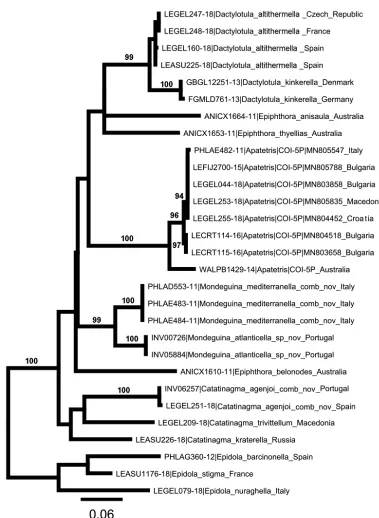
Molecular dataAll samples amplified the COI barcoding fragment. The final COI dataset consisted of 29 sequenc
-es (658 bp long) (Fig. 1). The most appropriate model for the COI dataset was GTR+G+I. Tree topologies from ML approach exhibit high bootstrap values (≥0.95%) to all species (Fig. 1).
Within the dataset the maximum pairwise divergence within genus was obtained between Epi-dola nuraghella Hartig, 1939 and Epidola stigma Staudinger, 1859 (p-distance = 9%) and the minimum pairwise divergence between species (4%) was observed between Dactylotula kinker-ella (Snellen, 1876) from Germany and Denmark and D. kinkerella from southern countries that belong in fact to D. altithermella (Walsingham, 1903) (Table 2, see discussion). The specimens of the Mondeguina species exhibited 5% pairwise sequence divergence and 10% or more from other genera, namely Apatetris and Catatinagma.
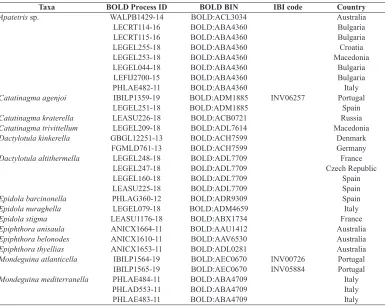
Table 1. List of specimens included in the molecular analysis.
Taxa BOLD Process ID BOLD BIN IBI code Country
Apatetris sp. WALPB1429-14 BOLD:ACL3034 Australia
LECRT114-16 BOLD:ABA4360 Bulgaria
LECRT115-16 BOLD:ABA4360 Bulgaria
LEGEL255-18 BOLD:ABA4360 Croatia
LEGEL253-18 BOLD:ABA4360 Macedonia
LEGEL044-18 BOLD:ABA4360 Bulgaria
LEFIJ2700-15 BOLD:ABA4360 Bulgaria
PHLAE482-11 BOLD:ABA4360 Italy
Catatinagma agenjoi IBILP1359-19 BOLD:ADM1885 INV06257 Portugal
LEGEL251-18 BOLD:ADM1885 Spain
Catatinagma kraterella LEASU226-18 BOLD:ACB0721 Russia
Catatinagma trivittellum LEGEL209-18 BOLD:ADL7614 Macedonia
Dactylotula kinkerella GBGL12251-13 BOLD:ACH7599 Denmark
FGMLD761-13 BOLD:ACH7599 Germany
Dactylotula altithermella LEGEL248-18 BOLD:ADL7709 France
LEGEL247-18 BOLD:ADL7709 Czech Republic
LEGEL160-18 BOLD:ADL7709 Spain
LEASU225-18 BOLD:ADL7709 Spain
Epidola barcinonella PHLAG360-12 BOLD:ADR9309 Spain
Epidola nuraghella LEGEL079-18 BOLD:ADM4659 Italy
Epidola stigma LEASU1176-18 BOLD:ABX1734 France
Epiphthora anisaula ANICX1664-11 BOLD:AAU1412 Australia
Epiphthora belonodes ANICX1610-11 BOLD:AAV6530 Australia
Epiphthora thyellias ANICX1653-11 BOLD:ADL0281 Australia
Mondeguina atlanticella IBILP1564-19 BOLD:AEC0670 INV00726 Portugal
IBILP1565-19 BOLD:AEC0670 INV05884 Portugal
Mondeguina mediterranella PHLAE484-11 BOLD:ABA4709 Italy
PHLAD553-11 BOLD:ABA4709 Italy
Table 2. Mean (below diagonal) and standard deviation (above diagonal) pairwise sequence diver gence (uncorrected p-distances) at the 658 bp DNA barcoding
fragment of cytochrome c oxidase I (COI) among pairs of species of species.
Apatetris agenjoi Apatetris sp. (Australia) Apatetris sp. (Eur
ope)
Catatinagma kraterella Catatinagma trivittellum Dactylotula altithermella Dactylotula kinkerella
Epidola
barcinonella
Epidola nuraghella Epidola stigma Epiphthora anisaula Epiphthora belonodes Epiphthora thyellias Mondeguina atlanticella Mondeguina mediterranella
Apatetris agenjoi
0.01 0.01 0.01 0.01 0.01 0.01 0.01 0.01 0.01 0.01 0.01 0.01 0.01 0.01 Apatetris sp. (Australia) 0.1 1 0.01 0.01 0.01 0.01 0.01 0.01 0.01 0.01 0.01 0.01 0.01 0.01 0.01 Apatetris sp. (Eur ope) 0.1 1 0.04 0.01 0.01 0.01 0.01 0.01 0.01 0.01 0.01 0.01 0.01 0.01 0.01
Catatinagma kraterella
0.09 0.13 0.13 0.01 0.01 0.01 0.01 0.01 0.01 0.01 0.01 0.01 0.01 0.01
Catatinagma trivittellum
0.09 0.12 0.12 0.10 0.01 0.01 0.01 0.01 0.01 0.01 0.01 0.01 0.01 0.01
Dactylotula altithermella
0.10 0.1 1 0.1 1 0.1 1 0.10 0.01 0.01 0.01 0.01 0.01 0.01 0.01 0.01 0.01
Dactylotula kinkerella
0.1 1 0.12 0.1 1 0.12 0.12 0.04 0.01 0.01 0.01 0.01 0.01 0.01 0.01 0.01
Epidola barcinonella
0.16 0.16 0.16 0.14 0.15 0.16 0.16 0.01 0.01 0.01 0.01 0.01 0.01 0.01
Epidola nuraghella
0.13 0.15 0.14 0.13 0.13 0.14 0.15 0.13 0.01 0.01 0.01 0.01 0.01 0.01
Epidola stigma
0.15 0.15 0.14 0.13 0.15 0.15 0.15 0.09 0.1 1 0.01 0.01 0.01 0.01 0.01
Epiphthora anisaula
0.13 0.12 0.13 0.13 0.13 0.10 0.12 0.16 0.15 0.16 0.01 0.01 0.01 0.01
Epiphthora belonodes
0.12 0.12 0.12 0.1 1 0.12 0.1 1 0.12 0.16 0.12 0.14 0.12 0.01 0.01 0.01
Epiphthora thyellias
0.1 1 0.10 0.10 0.12 0.12 0.10 0.1 1 0.16 0.15 0.16 0.1 1 0.1 1 0.01 0.01
Mondeguina atlanticella
0.12 0.12 0.12 0.10 0.12 0.10 0.1 1 0.16 0.14 0.14 0.12 0.1 1 0.12 0.01
Mondeguina mediterranella
Mondeguina Corley & Rosete, gen. nov.
http://zoobank.org/C8584176-8E49-4D5D-92D3-6C8B38DD2BDD Figs 2–8
Type species.Mondeguina atlanticella Corley & Rosete, sp. nov.
Description. Wingspan 9–12 mm. Head with face flat and vertex smooth with appressed scales.
Haustellum rudimentary. Labial palp segment 2 porrect, slightly thickened with scales which ex
-tend beyond base of segment 3, segment 3 upturned, about half as long as and thinner than segment 2, obtuse at apex. Antenna about nine-tenths length of forewing, scape elliptic, bearing pecten of about 12 hair-like scales, flagellum filiform. Forewing elongate, five times as long as wide, costa slightly curved in middle, apex acute but appearing rounded due to long scales around apex, dark-tipped scales give whole wing a speckled appearance, indistinct markings formed by groups of scales with longer dark tips; fringe of larger scales with blacker tips, not organised into a fringe line, dorsal fringe of hair-like scales. Hindwing slender, half as wide as forewing, widest at one-quarter, tapering most strongly between half and three-fifths, apical two-fifths very slender, narrowly acute at apex; fringes whitish, as long as wing width on costal side near base, longer towards apex and up to four times wing width on dorsal side. Venation (figured by Nel and Varenne 2012) of forewing with cell long, R4 and R5 stalked, R5 to apex, M1 and M2 stalked, M3 absent; hindwing with reduced venation, Rs free and unbranched to apex, M1 absent, M2 reduced to a fold, M3, Cu1 and Cu2 curved, A1+2 very short. Legs with unequal pair of spurs on mid-tibia, and two unequal pairs on hind tibia.
Male genitalia. (Figs 4–6). Uncus inserted on posterior side of tegumen, consisting of a pair of stout lobes; gnathos absent; tegumen wider than long; valva just longer than its width at base with broad sacculus reaching beyond middle, apex slightly expanded on ventral side forming a group of short sclerotised pegs; saccus short, wide and rounded, widest in middle; aedeagus tapering from base or a little above to two-thirds, apical third narrower sometimes ending in a slight hook.
Female genitalia. (Figs 7, 8). Papillae anales almost spherical but somewhat flattened on their adjacent faces, with a transverse fold on the dorsal side; posterior apophysis less than length of pa
-pilla analis; segment VIII about twice as wide as long, dorsal side rectangular, ventral side largely excavated, anterior apophysis short, half as long as posterior apophysis or less; ostium on anterior margin of segment VIII; ductus bursae unsclerotised, corpus bursae elliptic, without signum.
Diagnosis.Mondeguina gen. nov. is characterised by antenna nearly as long as forewing, scape
with pecten; forewing venation (figured by Nel and Varenne 2012) M1 and M2 stalked, M3 absent; hindwing slender, only half as wide as forewing, not bilobed, with dorsal fringes up to four times as long as wing width, venation reduced, with M1 absent and M2 weakly marked as a fold. Male gen
-italia with contiguous pair of large uncus lobes, gnathos absent, tegumen wider than long. Female genitalia without signum. These characters combined clearly separate the new genus from Apatetris
Staudinger, 1880 in the wide sense, in which the antennae, although with pecten, are about two-thirds length of forewing; forewing with M1, M2 and M3 separate; hindwing more than half as wide as forewing, bilobed with a pointed apex separated by an emargination from a shorter more round
Figures 4, 5. Male genitalia. 4. Mondeguina atlanticella, Portugal, Ilha da Morraceira (P. Huemer 19/1230). 5.M. mediterranella, Italy, Canale Quarantia (P. Huemer 05/1230).
Etymology.Mondeguina is named after the Mondego River, the longest river that runs its entire
course within Portugal. The type locality for the new species described from Portugal (below) is the Ilha da Morraceira which lies in the estuary of the River Mondego.
The new genus Mondeguina has two species:
Mondeguina atlanticella Corley & Rosete, sp. nov.
Mondeguina mediterranella (Nel & Varenne, 2012), comb. nov.
Basionym: Apatetris mediterranella Nel & Varenne, 2012. Nota lepidopterologica 35: 28. Type locality: France, Mas Fondame, Salses-le-Château, Pyrénées-Orientales.
Mondeguina atlanticella Corley & Rosete, sp. nov. http://zoobank.org/65EA7EB7-A7BE-4CCD-BBB4-F06849343CCD Figs 2–4, 6, 7
type, but collected on 6.vii.2018, M. Dale, gen. prep. MD02492, deposited in JRRC; 2 males, same locality as holotype, but collected on 10.vii.2018, deposited in JRRC; 1 male, same data as holotype, gen. prep. M. Corley 5525, deposited in JRRC; 1 female, Lagoa de São José, Mata do Urso, Carriço, Pombal, Leiria, 40°00’19.52”N, 8°52’03.19”W, UTM/MGRS: 29TNE11302835, Alt. 47m, 28.vii.2017, J. Rosete leg., M. Dale gen. prep. MD02456, DNA barcode INV05884, deposited in MCRC; 1 female, Ludo, Faro, Algarve, 16.ix.1994, M. Corley, Corley gen. prep. 675, in MCRC.
Description. Wingspan 9–12 mm (Figs 2, 3). Head white, scales towards lateral margins tipped
fuscous. Labial palp white with scales tipped fuscous on outer and ventral sides and lower part of inner side, segment 3 white. Antennal scape white with scales tipped fuscous, flagellum white, more or less ringed light fuscous in proximal part but markings increasingly obscure distally. Tho
-rax white, scales tipped dark fuscous towards sides and on tegula. Forewing white, scales dark-tipped giving whole wing a dotted appearance, very indistinct markings formed by groups of scales with longer dark tips, particularly in mid-line of wing with a spot at two-fifths and a short streak around four-fifths, a small spot near dorsum at three-fifths; fringe of larger scales with blacker tips, not organised into a fringe line, dorsal fringe of hair-like scales; underside dull pale yellow more or less overlaid grey, particularly towards costa and apex. Hindwing whitish; fringes whitish, as long as wing width on costal side near base, longer towards apex and up to four times wing width on dorsal side. Legs white, scales tipped fuscous. Abdomen whitish yellow.
Variation. Ground colour may be white or whitish, the dark tips of the scales on head, scape, thorax, forewing and legs vary from fuscous to nearly black with blackest scales forming diffuse markings together with those at end of wing, the diffuse markings can be very obscure and may not be symmetrical on the two wings.
Male genitalia. (Figs 4, 6). Uncus a pair of stout lobes, twice as long as wide, tapering in distal half to truncate apex; tegumen approximately rectangular, wider than long, nearly as long as uncus lobes, anterior and posterior margins without significant bulges; valva as long as its width at base with broad sacculus reaching beyond middle and evenly curved distally, posterior portion of valva parallel-sided, apex rounded on costal side, slightly expanded on ventral side forming a group of about seven short sclerotised pegs; saccus deepest in middle where it is about one-third as long as uncus lobes; aedeagus tapering from base or a little above, to two-thirds, apical third narrower, sometimes ending in a slight hook.
Female genitalia. (Fig. 7). Posterior apophysis two-fifths length of papilla analis; segment VIII with ventral side largely excavated, anterior margin bulging craniad around the ostium, anterior ap
-ophysis short, half as long as posterior ap-ophysis; ostium about one-quarter width of segment VIII. Apparent variation. Male genitalia of Mondeguina are small, three-dimensional and difficult to open in conventional presentation, whether the genitalia are unrolled or not. Some structures remain difficult to see clearly or to interpret. For this reason, we have not described transtilla lobes. We also found apparent variation in shape of valva, depth of tegumen and saccus depending both on the presentation of the various parts in the preparation and on the person performing the dissec
-tion. This is exemplified by comparison of Figure 4 with Figure 6, which are preparations of male
M. atlanticella performed by different persons.
Diagnosis.M. atlanticella and M. mediterranella are very similar externally, although average
Figure 6. Male genitalia.Mondeguina atlanticella, Portugal, Ilha da Morraceira (M. Dale 02492).
has tegumen about twice as wide as long, without obvious bulge on anterior margin, and saccus deeper, two-fifths length of uncus lobe, while M. mediterranella has tegumen four times as wide as long, with length measured through the median bulge, and less deep saccus, about one-quarter length of uncus lobe. In the female of M. atlanticella, posterior apophysis is two-fifths length of papilla analis and ostium is about one-quarter width of segment VIII, while in M. mediterranella posterior apophysis is two-thirds length of papilla analis and ostium is two-fifths of the width of segment VIII.
Biology. Moths have been collected at light in late June and July and once in September. Al
-though some came directly to the light, the majority were collected at rest on grasses a few metres away from the light. Larvae have not been found, but they may be leaf-miners on Elymus athericus
(Link) Kerguélen.
Figures 7, 8. Female genitalia. 7.Mondeguina atlanticella, Portugal, Ilha da Morraceira (M. Dale 02484). 8.M. mediterranella, France, Arles (M. Dale 02653).
The other site on the western coast of Portugal, Lagoa de São José is a small lake behind sand dunes which is gradually silting up. It is surrounded by a forest of Pinus pinaster Aiton. The sandy soil around the lake has a variety of shrubs: Erica L. spp., Cistus L. spp., Halimium (Dunal) Spach spp., and Corema album (L.) D. Don with scattered larger shrubs such as Morella faya (Aiton) Wilbur, Rhamnus alaternus L., Arbutus unedo L. and Salix repens L. Herbaceous plants include
Juncus spp., Ammophila arenaria (L.) Link, Elymus L. sp., Silene littorea Brot., Iberis procumbens
Lange, Seseli tortuosum L. and Asphodelus L. spp.
The third site, 2 km north of Ludo is 3.5 kilometres inland from the south coast of Portugal. The trapping site was on a track separating a low sandy hill with Pinus pinaster and a rich understo
Figure 11. Distribution of Mondeguina species. Red circles Mondeguina atlanticella. Yellow circles
Mondeguina mediterranella.
Distribution.M. atlanticella is currently known from two sites about 22 kilometres apart, close
to the coast of Beira Litoral in central Portugal and a single site in Algarve, north-west of Faro airport (Fig. 11). It can be expected to be found more extensively along the Portuguese coast.
Etymology. The epithet atlanticella refers to the proximity to the Atlantic Ocean of the known
sites and contrasts with the Mediterranean coast distribution of M. mediterranella (Fig. 11).
Discussion. Recent authors discussing the problems of the Apatetris group (Sakamaki 2000; Jun
-nilainen and Nupponen 2010; Nel and Varenne 2012) have emphasised the lack of a global revision of the group, although Janse (1951) had been able to characterise several of the genera involved, largely based on wing venation, wing shape and the structure of the labial palpi. Classification of ge
-lechiid genera in the second half of the 20th century relied heavily on male genitalia and this has been
a significant impediment to further revision of the Apatetris group because the type species of the genus, Apatetris mirabella Staudinger, 1880 was described from a single female from the province of Amasya in the Black Sea region of Turkey. Staudinger stated it to be male, but Janse (1951) showed it to be female. It has apparently never been collected again.The main features of the genus given by Staudinger were the antennal scape with pecten and the bilobed hindwing, with the costal lobe point
-ed and the dorsal lobe round-ed, these lobes separat-ed by a notch. Janse (1951) after studying material from Europe, Asia, Africa, North and Central America constructed a key to some of the genera of the
Apatetris group and re-diagnosed the genus, adding the additional characters of a rudimentary haus
-tellum and maxillary palps, the labial palpus shorter and less ascending than usual for Gelechiidae. Sakamaki (2000) recognised the high level of diversity within Apatetrissensu lato and the need for a world-wide revision of the genus. His contribution was to describe two new Japanese species in the genus which he considered would help to advance knowledge of the group. One of these spe
signa or none and the labial palpus is unique in being reduced to a single segment. Junnilainen and Nupponen (2010) recognised two different groups within Eurasian Apatetris, referring them to the existing genus names Dactylotula and Catatinagma. These differ in several characters of which the most useful are forewing markings, valva structure and type of signum. Dactylotula has forewing without spots, short, broad valva and plate-shaped signa; Catatinagma has forewing with spots, valva almost separate from sacculus and brush-shaped signa. Figure 1 indicates a more complex situation, even if only European species of Apatetrissensu lato are considered. Four groups are evident: 1. Catatinagma; 2. Mondeguina; 3. An unnamed group including specimens from Italy and the Balkan countries; 4. Dactylotula.
This separation appears valid for Europe and the nearer parts of Asia but relationships are likely to be more complex if further taxa from the rest of the world are considered. In Figure 1 and Table 1 three species of the Australasian genus Epiphthora are included, but one is well separated from the other two. This suggests that the genus is likely to include paraphyletic elements.
The four European groups in Figure 1, derived from available DNA barcodes, require a few additional comments. In the course of preparation of this paper we also examined Portuguese specimens identified as Apatetris agenjoi Gozmány, 1954 (including INV06257). Junnilainen and Nupponen (2010) had omitted this species from consideration “because it is known only from Spain and does not coincide well with any of the genera treated here”. Nevertheless, male genitalia and wing markings of this species place it in Catatinagma, and it also shares the head structure of
Catatinagma, which has a truncated conical projection on the frons. Furthermore, genetic evidence provided by the DNA barcode fragments corroborates that A. agenjoi is more closely related to
Catatinagma trivittellum Rebel, 1903 and C. kraterella Junnilainen & Nupponen, 2010than to any other species of Apatetrissensu lato (Fig. 1, Table 2). Although Gozmány (1954) neither described nor figured the genitalia, Ole Karsholt (pers. comm.) informs us that he has seen the type of A. agenjoi and that it belongs to the species flying in the Iberian Peninsula. With this assurance we are able to make the new combination:
Catatinagma agenjoi (Gozmány, 1954), comb. nov.
Basionym.Apatetris agenjoi Gozmány, 1954. Ann. Hist.-nat. Mus. Nat. Hung. 5: 282.
Type locality. Spain, Murcia, Alberca.
We have not had the opportunity to examine the unnamed ‘Apatetris’ from the Balkan countries, and consider it to be outside the scope of this paper. Available sequences from BOLD indicate two
Dactylotula species (Table 1), yet all have been referred to D. kinkerella. From the photographs on BOLD, it is clear that those from the Czech Republic, France and Spain actually belong to D. altithermella (Walsingham, 1903).
Notes. Against the background outlined above, it may be considered unwise of us to describe a
signum. In our view the two species considered in this paper, A. mediterranella and A. atlanticella
have no place in Apatetris as defined by either Staudinger or Janse, nor in any of the related genera and therefore require a new genus. Genetic evidence provided by the DNA barcode fragments sequenced corroborates their distinctness from other Apatetrissensu lato available in the BOLD database, either European or from other continents (Fig. 1).
Acknowledgements
We are extremely grateful to André Lameirinhas for the photos of set specimens of M. atlanticella, Mike Dale and Peter Huemer for the excellent genitalia preparations figured here, without which this paper would not have been possible, to Thierry Varenne for making an abdomen of female M. mediterranella available and to Bob Heckford for scans of relevant pages of Janse (1951). We also thank Klaus Sattler, Ole Karsholt and David Lees for valuable comments. This project has received funding from the European Union’s Horizon 2020 Research and Innovation Programme under grant agreement No 668981 and by the project PORBIOTA-Portuguese E-Infrastructure for Infor
-mation and Research on Biodiversity (POCI-01-0145-FEDER-022127), supported by Operational Thematic Program for Competitiveness and Internationalization (POCI), under the PORTUGAL 2020 Partnership Agreement, through the European Regional Development Fund (FEDER).
References
Corley MFV, Ferreira S, Mata VA (2019) Ypsolopha rhinolophi sp. nov. (Lepidoptera: Ypsolophidae), a new species from Portugal and France unveiled by bats. Zootaxa 4609 (3): 565–573. https://doi.org/10.11646/ zootaxa.4609.3.10
Darriba D, Taboada GL, Doallo R, Posada D (2012) jModelTest 2: more models, new heuristics and parallel computing. Nature Methods 9(8): 772. https://doi.org/10.1038/nmeth.2109
Edgar RC (2004) MUSCLE: multiple sequence alignment with high accuracy and high throughput. Nucleic Acids Research 32(5): 1792–1797. https://doi.org/10.1093/nar/gkh340
Gozmány LA (1954) Studies on Microlepidoptera. Annales Historico-naturales Musei Nationalis Hungarici 5: 273–285.
Guindon S, Dufayard JF, Lefort V, Anisimova M, Hordijk W, Gascuel O (2010) New algorithms and methods to estimate maximum-likelihood phylogenies: assessing the performance of PhyML 3.0. Systematic Biol -ogy 59: 307–307. https://doi.org/10.1093/sysbio/syq010
Hebert PDN, Penton EH, Burns JM, Janzen DH, Hallwachs W (2004) Ten species in one: DNA barcoding reveals cryptic species in the neotropical skipper butterfly Astraptes fulgerator. Proceedings of the Na -tional Academy of Sciences of the United States of America 101: 14812–14817. https://doi.org/10.1073/ pnas.0406166101
Janse AJT (1949–1954) The Moths of South Africa 5. Transvaal Museum, Pretoria, Gelechiadae iv + 464 pp. я202 pls.]
Junnilainen J, Nupponen K (2010) The gelechiid fauna of the southern Ural Mountains, part I: descriptions of sev -enteen new species (Lepidoptera: Gelechiidae). Zootaxa 2366: 1–34. https://doi.org/10.11646/zootaxa.2366.1.1 Karsholt O, Nielsen PS (2013) Revideret fortegnelse over Danmarks Sommerfugle. Lepidopterologisk Foren
-ing. Copenhagen, 120 pp.
Nel J, Varenne T (2012) Description d’Apatetris (s. l.) mediterranella sp. n. du littoral méditerranéen de France et d’Italie (Gelechiidae, Gelechiinae, Apatetrini). Nota lepidopterologica 35: 27–32.
Robinson GS (1976) The preparation of slides of Lepidoptera genitalia with special reference to the Micro -lepidoptera. Entomologist’s Gazette 27: 127–132.
Sakamaki Y (2000) Japanese species of the genus Apatetris (Lepidoptera, Gelechiidae). Tijdschrift voor En -tomologie 143: 211–220. https://doi.org/10.1163/22119434-99900046