INTRODUCTION
Now a days ceramic tile has become a common flooring material to even middle class people. With the reduction in excise duty and availability of technology, boost given to housing and infrastructure sector, more and more ceramic tiles manufacturing plants have come up in India. Production capacity of ceramic tiles in India is growing at the rate of 10 % per annum. Accordingly the consumption of feldspar is also increasing. As we have very limited quantity of feldspar deposits in India, we need to utilize these deposits in appropriate manner and make these deposits available for future generations and also work towards reducing the cost of the product. In this study its helps ceramic industry to identify
An Experimental Study for Identification of Suitable
Low Cost Alternative Flux Material in Manufacturing
of Red Body Ceramic Glazed Tiles: A Model Study
K. RAJASEKHARA REDDY
and S.S. ASADI
Department of Civil Engineering, K L University, Green Fields, Vaddeswaram - 522 502, Guntur District (India)
*Corresponding author: E-mail: [email protected] (Received: November 10, 2011; Accepted: December 29, 2011)
ABSTRACT
Feldspar is a very important flux material in manufacturing of ceramic tiles in ceramic industry. The Present growth rate of ceramic tile industry demands more and more feldspar. Increase in the demand for feldspar may lead to exhaust of deposits of premium quality very soon in India. In order to make the feldspar deposits available for future generation, keeping this in view an experimentalattempt has been made to identify alternative flux material for manufacturing of red body glazedceramic tiles. In this studyfeldspar is partially replaced with Nepheline syenite in manufacturing of red body ceramic glazed floor tiles to reduce the usage and proper management of resources of Feldspar availability in India, cost cutting of materials in order to make the final product available at less price to consumer. From this study the usage of feldspar in the red body ceramic tile industry can be reduced up to 50% and cost of final product can be reduced up to 10%.The study revealed that Nepheline syenite is having more fluxing nature then feldspar and the performance of the product is comparable with regular product.
Key words: Feldspar, Nepheline syenite, Glazed floor tiles, Ceramic industry.
Objectives
1) To identify alternative resource of flux material to ceramic tile industry.
2) Identification of suitable low cost alternative flux material in manufacturing of red body ceramic glazed floor tiles.
3) To study firing proper ties of Nepheline syenite to identify the suitability for use as flux in the place of feldspar.
4) To identify the locations of resources available in India.
Methodology
Nepheline syenite samples are collected from Elchuru, Prakasham District of Andhra Pradesh.Samples of Nepheline Syenite were crushed and ground to 150 mesh in a iron mortar. A cone is prepared for conducting cone test of collected samples by adding carboxy methyl cellulose as binder, placed it on a refractory plate and fired in a muffle furnace along with the feldspar used in the body at 1185 degrees. Nepheline syenite understudy and feldspar used in regular production were subjected to chemical analysis of major chemical oxides. Then A trial composition of body is prepared in lab scale (Nepheline syenite), glaze is applied in glaze line and fired in production kiln along with regular body (feldspar) which was in production and tested for various process parameters and finished product as per IS 15622. The results are compared and analysed.
Conducting of body trial compositions
in this process 6 kg of each composition is prepared taking raw material in jar mill with 39 % water and 0.3 % sodium silicate as dispersant, ground till required residue level (4% on 150 mesh)
is achieved. Density, viscosity and residue are checked. The slip thus prepared is dried in lab oven, dried, ground to granulated powder of 20 mesh size and maintained 6 % moisture. This powder is stored in polythene covers for 24 hours to achieve homogeneity in moisture. The aged granulated powder is pressed in a hydraulic press having 200 X 100 mm cavity at a specific pressure of 240 kg/ cm2. These tiles were dried in lab oven for three hours and passed on running production glaze line and applied glaze maintaining usual pickup weight of engobe and and glaze. These tiles were fired in regular production kiln at 1165 deg. 45 min. firing cycle. The samples of tiles thus fired were tested for various parameters in accordance with IS 15622.
RESULTS AND DISCUSSION Mineralogy of Nephelene syenite
Nephelene syenite is a holocrystalline plutonic rock that consists largely of Nepheline and alkali feldspar. Other minerals common in minor amounts include sodium-rich pyroxene, biotite, titanite, zircon, iron oxides, apatite, fluorite and zircon.The rocks are mostly pale colored, grey, pink or greenish black, and in general appearance they are not unlike granites, but dark green varieties are also known. Nepheline syenites are silica-undersaturated. Nepheline is a feldspathoid, a solid-solution mineral, that does not coexist with quartz; rather, Nepheline would react with quartz to produce alkali feldspar.They are distinguished from ordinary syenites not only by the presence of Nepheline but also by the occurrence of many other minerals rich in alkalis and in rare earths and other incompatible elements. Alkali feldspar dominates, commonly represented by orthoclase In some rocks the potash
Table 1: Details of body trial compositions
Name of the raw material Regular body Trial 1 Trial 2
composition %) (%) (%)
Ball clay – Dwaraka Tirumala II grade 39 39 39
Shale - Rajampeta 12 12 12
White clay 15 15 15
Black clay/ tank silt 9 9 9
Potash feldspar 25 13 7
Table 2: Average chemical analysis of Nepheline syenite
Name of the Oxides Weight%
SiO2 54.69%
TiO2 0.90%
Al2O3 19.9%
Fe2O3 3.4%
FeO 2.2%
MnO 0.3 %
MgO 0.9%
CaO 2.5%
Na2O 8.3%
K2O 5.5%
H2O 1.3%
P2O5 0.2%
Table 3: Chemical analysis of Nepheline syenite and feldspar Name of the Nepheline syenite Potash feldspar
oxides (Wt.percentage) (Wt.percentage)
SiO2 61.50 69.30
Al2O3 22.00 17.47
TiO2 0.35 0.03
Fe2O3 3.05 0.12
CaO 1.80 0.15
MgO 0.45 0.03
Na2O 5.05 2.93
K2O 4.85 9.52
LOI 0.95 0.35
Total 100.00 99.93
Table 4: Slip parameters
Parameter Regular body Trial 1 Trial 2
composition
Density of the slip (gm/cc) 1.672 1.669 1.671
Viscosity in B4 ford cup(seconds) 24 21 25
Residue on 150 mesh (%) 3.9 4.0 4.2
feldspar, in others the soda feldspar predominates. Fresh clear microcline is very characteristic of some types of Nepheline syenite.
Chemical composition of Nepheline-syenites Nepheline-syenites are rich in alkalis and in alumina (hence the abundance of felspathoids and alkali feldspars) with silica varying from 50 to 56%, while lime and magnesia are never present in great quantity, though somewhat more variable than the other components. A worldwide average chemical analysis of Nepheline syenite is given in the Table 2 (G.W.Tyrrell,1926) Average chemical analysis of Nephline syenite indicates that it is having fluxes to the extent of 13.8 % and in addition to that it is having 5.7 % iron oxides which also acts as flux.
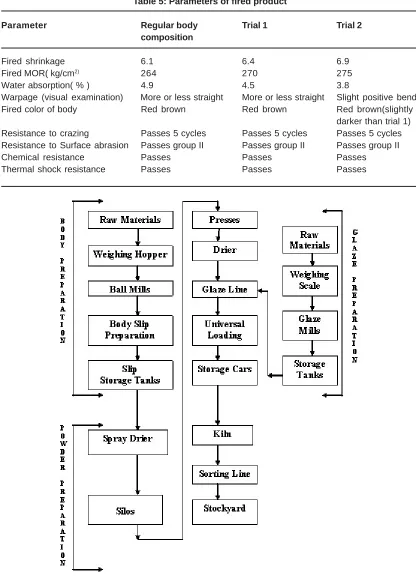
Table 5: Parameters of fired product
Parameter Regular body Trial 1 Trial 2
composition
Fired shrinkage 6.1 6.4 6.9
Fired MOR( kg/cm2) 264 270 275
Water absorption( % ) 4.9 4.5 3.8
Warpage (visual examination) More or less straight More or less straight Slight positive bend
Fired color of body Red brown Red brown Red brown(slightly
darker than trial 1) Resistance to crazing Passes 5 cycles Passes 5 cycles Passes 5 cycles Resistance to Surface abrasion Passes group II Passes group II Passes group II
Chemical resistance Passes Passes Passes
Thermal shock resistance Passes Passes Passes
Fig. 2: Showing samples of Nepheline synite and potash feldspar
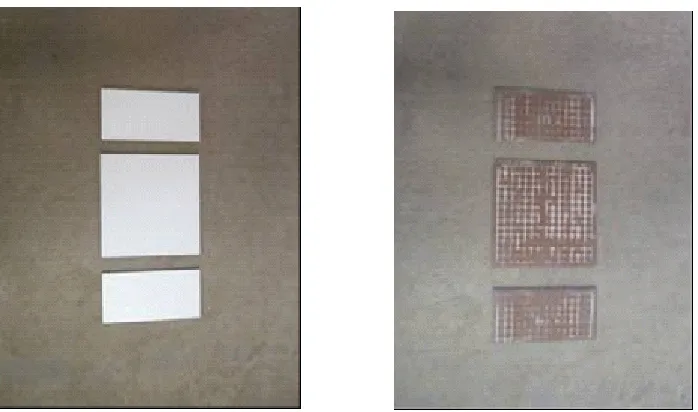
Fig. 3: Samples of fired products. Centre one is sample tile of regular production made with feldspar (25%). lower one is trial one made with Nephelene syenite (13% feldspar +12% Nephelene syenite), Upper one is trial two made with Nephelene syenite(7% feldspar +18% Nephelene syenite)
3.05 % iron oxides which also acts as flux. Potash feldspar is having fluxes to the extent of 12.5 %. Total amount of fluxes in Nepheline syenite is 13.4 % which is 0.9 % higher than potash feldspar indicating high flux nature. No significant variation in residue levels is observed in grinding and also no significant variation in viscosity is observed.
Marginal increase is observed in fired strength, fired shrinkage, decrease in water absorption in trial made with Nepheline syenite. Further slight positive warpage is observed in trial two and body colour of trial two is slightly darker than other two. Samples of trials made with Nepheline syenite also passes in crazing resistance, surface abrasion resistance, thermal shock resistance and chemical resistance and they are comparable with the results of regular body.
More maturity and flowability of fired cone, relatively higher percentage of Na2O, K2O and Fe2O3 indicate that Nepheline syenite under study is having more flux nature than Potash feldspar. Marginal increase observed in fired strength, shrinkage, decrease in water absorption in trial one and two indicates that Nepheline syenite under study confirms that it is having more flux nature than Potash feldspar. Results of trial 1 and trial 2 are almost comparable with results of body in product performance. Potash feldspar can be replaced with Nepheline syenite of understudy to the extent of 50 percent in red body glazed ceramic tiles.
The cost of nephlene syenite is cheaper than potash feldspar by Rs 400/ MT. By replacing Nepheline syenite in feldspar to the extent of 50%,the cost of body raw materials of glazed tile
can be brought down to the extent of 10 % and final product cost can be brought down .However these results are based on lab scale only and these results are to be conformed by making a trial in production scale.
In a tile plant of 40,000 sq.mts capacity per day when feldspar is replaced with 50 % Nepheline syenite, cost of raw materials will come down by Rs 7.50/ sq.mt. Cost reduction only on raw materials comes to Rs.3.0 lakh per day. Assuming that plant operates for 330 days at 90 % capacity utilization, total cost savings in the plant by replacing feldspar with 50 % Nepheline syenite comes to Rs 8.9 crores per anum.
The huge amount of feldspar deposits is using in the ceramic industry due to this the resources are getting depleted, keeping this in view the alternative resources is required for industry. In this connection replacement of feldspar with Nepheline syenite is very much useful for sustainability of the ceramic industry and these nephline synite deposits are occurring in huge quantity in Elchuru, Prakasham District (Leelanandam, 1989); Kunavaram, Khammam District, ( Bose, etal. (1971) of Andhra Pradesh, Kishangarh, Ajmer District, Rajasthan, Mount Girnar, Gujarat, Western India, Sivanmalai, Coimbatore District, Tamil Nadu (B. Bhaskar Rao), Koraput, Orissa of India.
ACKNOWLEDGEMENTS
The authors express sincere thanks to the management of M/s Spartek Ceramics India Limited for permitting to publish the paper.
REFERENCES
1. Leelanandam, C., The Prakasam alkaline province in Andhra Pradesh. Jour. Geol. Soc. India, 53: 41-52 (1989).
2. Bose, Mihir K. ; Chakravarti, S. ; Sarkar, A., Petrological observations on alkali syenites of Kunavaram, A. P., India Geological
Magazine, 108: 273-280 (1971). ISSN 0016-7568
4. Bose, Mihir K., Petrology of the Nepheline syenite of Mount Girnar, India Lithos, 4(4): pp. 357-366 (1971). ISSN 0024-4937 5. Bureau of Indian standards, IS -15622
pressed ceramic tiles Specifications (2006). 6. The principles of petrology , page.117,G.W.Tyrrell,, Asia Publishing House (1926).
7. Czygan W., Goldenberg G. Petrography and geochemistry of the Alkaline complexes of Sivanmalai, Elchuru and Upallapadu, India. Geol.Soc.India Memoir 15: 225-240. 8. Hamilton, D. L. and MacKenzie, W. S., Phase
equilibrium studies in the system NaAlSiO4(Nepheline)-KAlSiO4 (kalsilite)-SiO4(quartz)-H2O. Min. Mag., 34: 214-231 (1965).
9. Krishna Reddy, K. K., Ratnakar, J. and Leelanandam, C., A petrochemical study of the Proterozoic alkaline complexof Uppalapdu, Prakasam alkaline province, Andhra Pradesh. Jour. Geol. Soc. India, 53: 41-52 (1998).
10. Leelanandam, C., The Prakasam alkaline province in Andhra Pradesh. Jour. Geol. Soc. India, 53: 41-52 (1989).
11. Leelanandam, C., Burke, K., Ashwal, L. D. and Webb, S. J., Proterozoic mountain building in Peninsular India: an analysis based primarily on alkaline rock distribution. Geol. Mag., 143: 195-212 (2006).
12. Madhavan V., Mallikhavrjuna R., Subrahmanyam K., Krishna S.G., Leelanandam, C., Bedrock geology of Elchuru Alkaline Pluton, Prakasam Disreict, Andhra Pradesh. Geol.Soc.India Memoir 15: 189-205 (1989).
13. Ratnakar, J., Vijaya Kumar, K. and Rathna, K.. Meso-Proterozoic rifting and Grenville / Pan-African collision in the Prakasam alkaline province, Andhra Pradesh, southern India: Evidence from Nepheline syenite compexes. International Conference on Tectonics of the Indian Subcontinent (TOIS), Intern. Assoc. Gond. Res. Conf. Ser., 5: 194-196 (2008b).
14. Subba Rao T.V., Bhaskar Rao Y.J. Sivaraman T.V., Gopalan K. Rb-Sr age and petrology of the Elchuru alkaline complex: Implication to the alkaline magmatism in the Eastern Ghat mobile belt.// Memeirs Geol. Sci. of India, 15: pp. 207-223 (1989).
15. Ratnakar, J., Precambrian alkaline complexes of southern India. International Seminar on Alkaline Igneous Systems: Dissecting Magmatic to Hydrothermal Mineralizing Processes. Canada, Abstracts, p. 126 (2006).
16. Ratnakar, J. and Leelanandam, C., A petrochemical study of the Purimetla alkaline pluton, Prakasam District, Andhra Pradesh, India. Neues Jahrbuch Mineral.Abh.,156: 99-119 (1986).
17. Upadhyay, D., Raith, M. M., Mezger, K. and Hammerschimdt, K., Mesoproterozoic rift-related alkaline magmatism at Elchuru, Prakasam alkaline province, SE India. Lithos, 86: 447-477 (2006).