Ames Laboratory Publications
Ames Laboratory
2-2005
Comparative Study of Surface Cycloadditions of
Ethylene and 2-Butene on the Si(100)-2 × 1
Surface
Hee Soon Lee
Kyungpook National University
Cheol Ho Choi
Kyungpook National University
Mark S. Gordon
Iowa State University, [email protected]
Follow this and additional works at:
http://lib.dr.iastate.edu/ameslab_pubs
Part of the
Chemistry Commons
The complete bibliographic information for this item can be found at
http://lib.dr.iastate.edu/
ameslab_pubs/331
. For information on how to cite this item, please visit
http://lib.dr.iastate.edu/
howtocite.html
.
Comparative Study of Surface Cycloadditions of Ethylene and 2-Butene
on the Si(100)-2 × 1 Surface
Abstract
Multireference wave functions were used to study the ethylene and 2-butene surface reactions on Si(100) in
their lowest energy singlet states. In addition to the diradical pathway, a π-complex pathway on the ethylene
surface was found. The net barrier for the latter process is 4.5 kcal/mol higher than that for the former, making
the π-complex pathway kinetically less accessible. Therefore, although there is a competition between the two
initial channels, the diradical path is slightly favored, and rotational isomerization is possible. However, since
the initial potential energy surfaces of the two channels are different, depending on experimental conditions,
the branching ratio between the two channels may change. Consequently, the combined effects that would
favor one channel over the other may not derive directly from the initial reaction barrier. This provides an
explanation of the experimental controversy. As a result, the final distributions of surface products may
depend on the experimental kinetic environment, especially when the population change due to the rotational
isomerization is expected to be very small. A significantly different reaction channel is found in the 2-butene
surface reaction on Si(100), in which a methyl hydrogen easily transfers to the surface yielding a new type of
surface product other than the expected [2 + 2] cycloaddition product, with a comparatively small activation
barrier. Consequently, the overall surface reactions of ethylene and 2-butene may be quite different. Therefore,
direct comparisons between ethylene and 2-butene experimental results would be very useful.
Disciplines
Chemistry
Comments
Reprinted (adapted) with permission from
Journal of Physical Chemistry B
109 (2005): 5067, doi:
10.1021/
jp0501345
. Copyright 2005 American Chemical Society.
Comparative Study of Surface Cycloadditions of Ethylene and 2-Butene on the Si(100)-2
×
1 Surface
Hee Soon Lee,†Cheol Ho Choi,*,†and Mark S. Gordon*,‡
Department of Chemistry, College of Natural Sciences, Kyungpook National UniVersity,
Taegu 702-701, South Korea, and Ames Laboratory and Department of Chemistry, Iowa State UniVersity, Ames, Iowa 50011
ReceiVed: January 8, 2005
Multireference wave functions were used to study the ethylene and 2-butene surface reactions on Si(100) in their lowest energy singlet states. In addition to the diradical pathway, aπ-complex pathway on the ethylene surface was found. The net barrier for the latter process is 4.5 kcal/mol higher than that for the former, making theπ-complex pathway kinetically less accessible. Therefore, although there is a competition between the two initial channels, the diradical path is slightly favored, and rotational isomerization is possible. However, since the initial potential energy surfaces of the two channels are different, depending on experimental conditions, the branching ratio between the two channels may change. Consequently, the combined effects that would favor one channel over the other may not derive directly from the initial reaction barrier. This provides an explanation of the experimental controversy. As a result, the final distributions of surface products may depend on the experimental kinetic environment, especially when the population change due to the rotational isomerization is expected to be very small. A significantly different reaction channel is found in the 2-butene surface reaction on Si(100), in which a methyl hydrogen easily transfers to the surface yielding a new type of surface product other than the expected [2+2] cycloaddition product, with a comparatively small activation barrier. Consequently, the overall surface reactions of ethylene and 2-butene may be quite different. Therefore, direct comparisons between ethylene and 2-butene experimental results would be very useful.
Introduction
Surface chemistry on semiconductor surfaces has gained enormous popularity recently, and the interest is still growing.1 This interest may be partially due to the tremendous potential of the new functionalities of synthetically modified sur-faces. Furthermore, the well-ordered silicon surface, especially Si(100)-2×1, provides a unique environment in which a great deal of existing chemical knowledge can be tested.
Surface reactions of unsaturated organic compounds with the Si(100)-2 × 1 reconstructed surface have attracted particular interest. [2s+2s] cycloadditions are formally orbital symmetry forbidden.2Thus, a large reaction barrier is expected along the symmetric reaction pathway. In fact, it is known from carbon solution chemistry that even the low symmetry reaction path has a high reaction barrier, mainly due to unfavorable geometric configurations along the reaction pathway.3 The analogous [2+2] reactions of disilenes have been found to be extremely slow,4suggesting that the same symmetry rule applies in silicon chemistry.
However, the rules governing [2+2] additions on surfaces are apparently different since many instances of formally forbidden reactions have been reported. Early experimental5and theoretical6studies have shown that ethylene, propylene, and acetylene easily chemisorb on Si(100)-2×1 yielding [2+2] products and are able to resist temperatures of up to 600 K.
Theoretically, Liu and Hoffmann6bhave found a low sym-metry pathway of acetylene adsorption that is composed of a π-complex precursor and a biradical intermediate, substantiating the experimental findings. Recent experimental7and theoretical8 studies identified other possible surface products of acetylene, adding a new complexity to the surface reactions of -yne systems.
In any event, it is a consensus that the adsorption reactions of alkynes and alkenes on the Si(100) surface can easily occur via asymmetric pathways. However, there has been some controversy over the stereochemistry of alkene reactions on the Si(100) surface. The two most likely reaction pathways are π-complex and diradical channels (Scheme 1). Theπ-complex channel can be described by a three-atom intermediate, which was proposed for acetylene on Si(100).6bA similar intermediate could be formed for ethylene surface reactions, in which the stereochemistry should be retained as the alkene approaches the Si dimer. Therefore, theπ-complex channel is stereospecific. On the other hand, the diradical channel can be described by a Si-C single-bonded diradical intermediate that results from breaking the CdC double bond. Once the ethyleneπ-bond is * Corresponding authors. E-mail: (C.H.C.) [email protected]; (M.S.G.)
†Kyungpook National University. ‡Iowa State University.
SCHEME 1
5067
J. Phys. Chem. B 2005, 109, 5067-5072
broken, rotation around the CdC bond is possible, resulting in a loss of stereoselectivity if it occurs before the second Si-C bond is formed.
With the help of IR experiments, Liu and Hamers9reported that the adsorption of cis- and trans-1,2-dideuterioethylene on Si(100) is stereospecific and therefore should follow the π-complex channel. In contrast, based on STM (scanning tunneling microscopy) results, Lopinski et al.10suggested that the surface reaction of trans-2-butene on Si(100) is not stereospecific but 98% stereoselective with a small degree of isomerization. This indicates that the reaction follows the diradical pathway. Theoretically, Lu11and co-workers recently used unrestricted density functional theory with the B3LYP functional12and the 6-31G(d) basis set13(UB3LYP/6-31G*) to conclude that ethylene adsorption on the Si(100) surface occurs via the diradical mechanism as well as interdimer reactions. They proposed that the channel is composed of an initial π-complex intermediate and a subsequent diradical intermediate, from which the reaction can undergo either ring closing by making the second Si-C bond or intramolecular rotation with respect to the CdC bond. The ring-closing path was predicted to have a lower barrier height than the intramolecular rotation, suggesting that the intramolecular isomerization rate should be low. Hence, although the overall reaction is not stereospecific, it still would show a high steroselectivity in accord with the STM experiment.10
Although it may seem reasonable to assume that ethylene and its dimethyl substituted derivative (2-butene) may behave similarly on the Si(100) surface, the possibility that 2-butene undergoes alternative reaction pathways due to the presence of the two methyl groups cannot be ruled out. Furthermore, the unrestricted DFT calculations exhibited unusually large spin contamination. Indeed,<S2>∼1.0, meaning that the structures are half singlet and half triplet, so that the intermediates and the transition states are not pure singlet spin states. This large spin contamination means that the energetics and geometries are also likely to correspond to hybrids between the pure singlet and triplet states and therefore may be unphysical. The simplest correct wave function for the pure singlet spin state is a two orbital and two electron MCSCF (multi-configurational self-consistent field) wave function.14
It is therefore of interest to explore alternative reaction pathways with wave functions that represent pure singlet spin states and to explore the effect of methyl substitution on the preferred adsorption mechanism. In this paper, an extensive theoretical study of the potential energy surfaces of ethylene and 2-butene on the Si(100) surface are presented. It is shown that different preferred reaction channels exist for ethylene and 2-butene, leading to new interpretations of experimental find-ings.
Computational Details
The all-electron 6-31G(d)15 basis set was used throughout this work. Minimum energy reaction paths were determined by first optimizing the geometries of the minima and transition states. Then, each stationary point was characterized by comput-ing and diagonalizcomput-ing the Hessian matrix (matrix of energy second derivatives). Minima (first-order saddle points) are characterized by Hessians with zero (one) negative eigenvalues. To follow the minimum energy path (MEP), also called the intrinsic reaction coordinate (IRC), the Gonzalez-Schlegel second-order method16was used with a step size of 0.3 amu1/2 bohr.
Various points on the reaction paths, particularly transition states and intermediates, are often inherently multiconfigura-tional as shown by previous studies.11 Therefore, CASSCF (complete active space SCF) wave functions14 were used to describe these species. For the study of ethylene reaction paths leading to products, a (4,4) active space was used. This active space is constructed from the two electrons in the πandπ* orbitals of ethylene, plus the two electrons andπandπ* orbitals of the surface Si dimer. For the study of 2-butene reactions, a (6,6) active space was used. This active space is constructed from the two electrons in theπandπ* orbitals and the two electrons in theσandσ* terminal methyl C-H bond orbitals of 2-butene, plus the two electrons andπandπ* orbitals of the surface Si dimer.
To recover the dynamic electron correlation, and to ensure that all parts of the reaction path are treated equivalently, multireference second-order perturbation theory was used since the level of accuracy for such methods is at least comparable to that of MP2 when single reference methods are appropriate.17 The particular version of this method used in the present work is referred to as MRMP2 (multireference second-order perturba-tion theory).18 The GAMESS (general atomic and molecular electronic structure system)19program was used for all of the computations.
To study surface size-effects, a hybrid quantum mechanics/ molecular mechanics (QM/MM) method called SIMOMM20 (surface integrated molecular orbital molecular mechanics) was used. This approach embeds a smaller QM cluster in a much larger MM cluster to reduce or eliminate possible edge effects on the (localized) chemistry that occurs on the surface. The SIMOMM cluster for ethylene and 2-butene is composed of C2Si9H16and C4Si9H20quantum regions embedded in C2Si48H40 and C4Si48H44clusters, respectively. MM321parameters were used for the molecular mechanics optimization part of the computations. All of the computations were done without imposing symmetry unless otherwise specified.
Results and Discussion
internal rotation around the weakened ethylene CdC bond or an internal rotation around the Si-C bond. TS2 corresponds to the former process, with a relative barrier of 11.7 kcal/mol, while TS3 corresponds to the latter process, with a barrier of 11.2
kcal/mol. Since the two barrier heights are similar in size, there is a chance of losing stereoselectivity via TS2. Although the higher barrier at TS2 suggests that the reaction occurs without such isomerization, in accord with previous experimental10and theoretical studies,11realistically, the calculated barriers are too close in size to be certain.
Clemen et al.22estimated the activation energies for desorp-tion and chemisorpdesorp-tion from the precursor to be 3.8 and 0.9 kcal/mol, respectively, a difference of 2.9 kcal/mol. According to their model, the precursor state is a temporary state encountered before the chemisorbed final product is formed. If I1 is assumed to be the precursor state, the corresponding desorption and chemisorption barriers would be the TS1-I1 and TS3-I1 energy differences, which are 3.3 and 2.2 kcal/mol, respectively. So the chemisorption barrier reported here is slightly higher than the previously reported value, but the two values are in reasonable agreement. Transition state TS3 connects I1 with another intermediate I2. I2 can now either undergo internal rotation via TS4 (barrier ) 12.0 kcal/mol) around the CdC bond or ring closure via TS5 (barrier)10.0 CHART 1: CASSCF Transition States and Intermediates along the Ethylene Diradical Channela
[image:5.612.75.272.534.671.2]aRelative energies are obtained with SIMOMM:MRMP2/6-31G(d). The values in parentheses are obtained with SIMOMM:CASSCF/6-31G(d).
Figure 1. Solid line represents the CASSCF IRC (intrinsic reaction coordinate) around transition state TS1. The dotted line represents single-point MRMP2 energies at selected points along the CASSCF IRC.
kcal/mol) to form the [2+2] product. The ring-closing channel has a lower barrier, so the net reaction could still be stereo-selective.
Since TS1 has the largest overall barrier height, it can be considered the rate-determining step. The final [2+2] cyclo-addtion product, P, is 33.0 kcal/mol lower in energy than the reactant at the MRMP2 level of theory. The overall theoretical desorption barrier may be calculated as the sum of the stabilization energy of P and the TS1 barrier height, which is 45.3 kcal/mol Although a little bit higher, this value is in reasonable agreement with the experimental value22of 38.0 kcal/ mol.
π-Complex Pathway in the Ethylene Reaction. An alterna-tive to the diradical pathway is theπ-complex pathway (Chart 2). A similar π-complex channel was found in the previous studies on acrylonitrile.23Therefore, this channel is not unex-pected. Initially transition state TS6 connects the reactant with theπ-complex intermediate I3 via an MRMP2 barrier of 17.0 kcal/mol. This is quite similar to the 16.7 kcal/mol overall barrier of acrylonitrile. However, it is 4.5 kcal/mol higher than the diradical pathway so it is kinetically less accessible.
The IRC along the diradical pathway is illustrated in Figure 2. As for theπ-complex mechanism, the CASSCF and MRMP2 maxima do not coincide. Therefore, the MRMP2 barrier height was estimated from the maximum MRMP2 energy along the CASSCF IRC. Intermediate I3 is 15.2 kcal/mol higher in energy than the reactant. Since the two carbon atoms are bound to one surface Si in I3, there is essentially no chance of internal rotation around the CdC bond. Therefore, the stereochemistry of the initial reactant along this path is intact, thereby preserving stereospecificity. Transition state TS7 connects I3 with the final product P, with a net barrier height of 15.3 kcal/mol. Therefore, TS6 is the rate-determining step. Note that the relative energies of TS6 and TS7 are reversed on the MRMP2 PES, as compared with the CASSCF PES.
Although there is a competition between theπ-complex and diradical paths, the latter is slightly favored. Since the initial shapes of the potential surfaces of these two channels are different, the final outcome may also depend on various kinetic factors, such as temperature, initial orientation, etc. Conse-quently, the fact that the combined impacts of factors such as the initial approach angle with respect to the surface and initial
kinetic energy may favor a particular channel over the other is not necessarily a direct consequence of the initial reaction barrier. This provides a possible rationale for the origin of the experimental controversy. Therefore, depending on the experi-mental conditions, the final distributions of surface products and the stereochemistry can vary. Even if the energy differences are small, they may be significant in light of the very small changes in the observed cis-trans product distributions. There-fore, more careful interpretations of experimental data may be warranted.
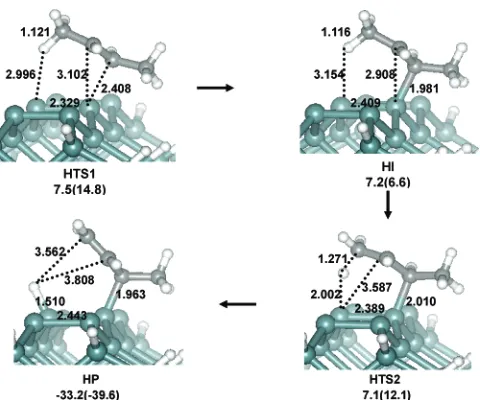
Hydrogen Migration Pathway of 2-Butene. As discussed in the Introduction, 2-butene may behave differently from ethylene on the Si(100) surface. Furthermore, the experiments that disagree with each other studied different molecules. Therefore, it is necessary to explore possible new reaction mechanisms other than the ones leading to the [2 + 2] cycloaddition products that may be due to the differences in the molecules. For this part of the analysis, CASSCF(6,6) as well as corresponding MRMP2 calculations were performed. Geometry optimizations of 2-butene on Si(100) yielded a product, HP (Chart 3), in which one of the 2-butene methyl hydrogens migrates to the surface, making a new Si-H bond with an energy that is 33.2 kcal/mol lower than that of reactants. This reaction is analogous to the well-known -ene reaction in organic chemistry. However, since earlier studies mainly focused on the cycloaddition, the possibility of this -ene reaction has been overlooked. During the reaction, a surface silicon atom acts as a base to abstract a methyl hydrogen. Because of the structure of HP, cis-trans stereochemistry classifications of the surface product become irrelevant. Although direct comparisons are not reasonable in view of the different active spaces used in the ethylene versus 2-butene calculations, on a relative scale, this new product is as stable as is the [2 +2] cycloaddition product in the ethylene surface reaction. After the hydrogen migration, the CdC double bond of the 2-butene moiety moves to the terminal site in HP. This can easily be examined by surface IR experiments. As shown in Figure 3, unlike the CASSCF transition states, MRMP2 values along the CASSCF IRC exhibit a nearly flat potential between HTS1 and HTS2. The left-hand side of the potential energy surface (PES) represents the Si abstraction of an H atom. The Si-H distance decreases from 3.154 to 2.002 Å, while the corresponding C-H distance increases from 1.116 to 1.271 Å. After HTS2, the PES abruptly changes to resemble the final product. There is a weak MRMP2 maximum near HTS1 that can be identified as the CHART 2: Transition States and Intermediates along
the Ethyleneπ-Complex Channela
aRelative energetics are obtained with SIMOMM:MRMP2/6-31G(d).
[image:6.612.53.293.73.254.2]The values in parentheses are obtained with SIMOMM:CASSCF/6-31G(d). Geometric data are from the CASSCF results.
Figure 2. Solid line represents the CASSCF IRC (intrinsic reaction coordinate) around transition states TS6 and TS7. The dotted line represents MRMP2 single-point energies at selected points along the CASSCF IRC.
MRMP2 HTS1 connecting the reactant and the intermediate HI with an MRMP2 barrier of 7.5 kcal/mol. This can be considered to be the overall MRMP2 barrier for this H migration reaction. This estimated MRMP2 barrier is 4.8 and 9.5 kcal/ mol lower than the overall barriers for the radical andπ-complex pathways, respectively, for the ethene adsorption reaction, strongly suggesting that the introduction of a methyl group to ethylene changes the chemical reaction surfaces, and therefore the mechanism, dramatically. It is possible that the dimethyl substitution would reduce the reaction barriers for the [2+2] cycladdition of 2-butene to the degree that they become comparable with the H-migration barrier. However, in our earlier study of acrylonitrile23where the ethene is substituted with a strongly electron-withdrawing cyanide group, the MRMP2 reaction barrier of the corresponding [2+2] cycloaddition was calculated to be 16.7 kcal/mol. This is very close to the 17.0 kcal/mol ethene reaction barrier, indicating that the substitution effect on the [2+2] cycloaddition would be minimal. Therefore, the H-migration pathway could be the dominant channel. However, further studies are needed to resolve this issue.
For the 2-butene system, rotational isomerization along the CdC bond during the reaction is not feasible. However, internal rotation is possible along the newly formed interfacial Si-C single bond as well as along the middle C-C single bond of the butene moiety in HP. Therefore, rotational isomerization
can occur in the exit channel. An STM study10showed that the 2-butene molecules are imaged as paired protrusions inclined by ∼30° with respect to the dimer row direction. This was assigned as the [2+2] cycloaddition product with a trans methyl conformation. However, this protrusion can also be identified as the product HP. The present results suggest that in addition to the widely suggested [2+2] products, the product HP may be an important surface product. It should have sufficient population to be detected experimentally.
Conclusions
Multireference wave functions were used to study the ethylene and 2-butene surface reactions on Si(100) in their lowest energy singlet states. In addition to the diradical pathway, aπ-complex pathway on the ethylene surface was found. However, the overall barrier of the latter process is 4.5 kcal/mol higher than that for the former, making theπ-complex pathway kinetically less accessible. Therefore, although there is a competition between the two channels, the diradical path is slightly favored, and rotational isomerization is possible. However, depending on experimental conditions, the branching ratio between the two channels may change. So the final distributions of surface products may depend on the experimental kinetic environment providing an explanation of the experimental controversy over the possible reaction channels. Even small changes in the environment can be significant, in view of the small changes observed in the cis-trans product distributions.
A significantly different reaction channel is found in the 2-butene surface reaction on Si(100), in which a methyl hydrogen transfers to the surface yielding a new type of surface product other than the expected [2+2] cycloaddition product. The barrier height for this new mechanism is much lower than that for the [2 + 2] channel in ethylene, while the overall thermodynamic energy differences are comparable. This sug-gests that the introduction of a methyl group to ethylene could change the chemical reaction surface significantly. Therefore, in addition to the widely known [2 + 2] products, the new H-transfer product could be an important surface product. If this is true, significant populations of the H-transfer product should be detected experimentally.
It can be concluded that although there are some similarities regarding the [2+2] cycloaddition reactions, the overall surface reactions of ethylene and 2-butene may be rather different. This suggests that the interpretation of the experimental results should not assume that the two species react in the same manner.
Acknowledgment. This work was supported by Korea Research Foundation Grant (KRF-2002-070-C00048) and by a grant from the Air Force Office of Scientific Research.
References and Notes
(1) (a) Choi, C. H.; Gordon, M. S. The Chemistry of Organic Silicon Compounds, Vol. 3; Rappoport, Z., Apeloig, Y., Eds.; John Wiley & Sons: New York, 2001; Ch. 15, pp 821-852. (b) Choi, C. H.; Gordon, M. S. Theoretical Studies of Silicon Surface Reactions with Main Group Absor-bates; Curtiss, L. A., Gordon, M. S., Eds.; Kluwer Academic Publishers: Dordrecht, The Netherlands, 2004; Ch. 4, pp 125-190.
(2) Woodward, R. B.; Hoffmann, R. The ConserVation of Orbital Symmetry; Verlag Chemie: Weinheim, 1970.
(3) Fleming, I. Frontier Orbitals and Organic Chemical Reactions; Wiley: New York, 1976; p 90.
(4) West, R. Angew. Chem., Int. Ed. Engl. 1987, 26, 1201. Domaille, P. J. J. Am. Chem. Soc. 1984, 106, 7677.
CHART 3: CASSCF Transition State and Intermediate along the Hydrogen Transfer Channel of 2-Butenea
aRelative energies obtained with SIMOMM:MRMP2/6-31G(d). The
[image:7.612.55.295.68.268.2]values in parentheses are SIMOMM:CASSCF/6-31G(d).
Figure 3. Solid line represents the CASSCF IRC (intrinsic reaction coordinates) around transition states HTS1 and HTS2. The dotted line represents MRMP2 single-point energies at selected points along the CASSCF IRC.
(5) (a) Nishijima, M.; Yoshinobu, J.; Tsuda, H.; Onchi, M. Surf. Sci. 1987, 192, 383. (b) Yoshinobu, J.; Tsuda, H.; Onchi, M.; Nishijima, M. J. Chem. Phys. 1987, 87, 7332. (c) Taylor, P. A.; Wallace, R. M.; Cheng, C. C.; Weinberg, W. H.; Dresser, M. J.; Choyke, W. J.; Yates, J. T., Jr. J. Am. Chem. Soc. 1992, 114, 6754. (d) Li, L.; Tindall, C.; Takaoka, O.; Hasegawa, Y.; Sakurai, T. Phys. ReV. B 1997, 56, 4648.
(6) (a) Imamura, Y.; Morikawa, Y.; Yamasaki, T.; Nakasuji, H. Surf. Sci. 1995, 341, L1091. (b) Liu, Q.; Hoffmann, R. J. Am. Chem. Soc. 1995, 117, 4082.
(7) (a) Wolkow, R. A. Annu. ReV. Phys. Chem. 1995, 50, 413. (b) Mezhenny, S.; Lyubinetsky, L.; Choyke, W. J.; Wolkow, R. A.; Yates, J. T., Jr. Phys. ReV. Lett.
(8) Sorescu, D. C.; Jordan, K. D. J. Phys. Chem. A 2000, 104, 8259. (9) Liu, H.; Hamers, R. J. J. Am. Chem. Soc. 1997, 119, 7593. (10) Lopinski, G. P.; Moffatt, D. J.; Wayner, D. D. M.; Wolkow, R. A. J. Am. Chem. Soc. 2000, 122, 3548.
(11) (a) Lu, X. J. Am. Chem. Soc. 2003, 125, 6384. (b) Lu, X.; Zhu, M.; Wang, X. J. Phys. Chem. B 2004, 108, 7359. (c) Lu, X.; Zhu, M. Chem. Phys. Lett. 2004, 393, 124.
(12) (a) Becke, A. D. J. Chem. Phys. 1993, 98, 5648. (b) Stephens, P. J.; Devlin, F. J.; Chablowski, C. F.; Frisch, M. J. J. Phys. Chem. 1994, 98, 11623. (c) Hertwig, R. H.; Koch, W. Chem. Phys. Lett. 1997, 268, 345.
(13) Hehre, W. J.; Ditchfield, R.; Pople, J. A. J. Chem. Phys. 1972, 56, 2257.
(14) (a) Sunberg, K. R.; Ruedenberg, K. In Quantum Science; Calais, J. L., Goscinski, O., Linderberg, J., Ohrn, Y., Eds.; Plenum: New York, 1976. (b) Cheung, L. M.; Sunberg, K. R.; Ruedenberg, K. Int. J. Quantum
Chem. 1979, 16, 1103. (c) Ruedenberg, K.; Schmidt, M.; Gilbert, M. M.; Elbert, S. T. Chem. Phys. 1982, 71, 41. (d) Roos, B. O.; Taylor, P.; Siegbahn, P. E. Chem. Phys. 1980, 48, 157. (e) Schmidt, M. W.; Gordon, M. S. Annu. ReV. Phys. Chem. 1998, 49, 233.
(15) Hehre, W. J.; Ditchfield, R.; Pople, J. A. J. Chem. Phys. 1972, 56, 2257.
(16) (a) Gonzalez, C.; Schlegel, H. B. J. Phys. Chem. 1990, 94, 5523. (b) Gonzalez, C.; Schlegel, H. B. J. Chem Phys. 1991, 95, 5853.
(17) (a) Werner, H.-J. Mol. Phys. 1996, 89, 645. (b) Schmidt, M. S.; Gordon, M. S. Ann. ReV. Phys. Chem. 1998, 49, 233. (c) Glaesemann, K. R.; Gordon, M. S.; Nakano, H. PCCP 1999, 1, 967.
(18) (a) Nakano, H. J. Chem. Phys. 1993, 99, 7983. (b) Nakano, H. Chem. Phys. Lett. 1993, 207, 372.
(19) (a) Schmidt, M. W.; Baldridge, K. K.; Boatz, J. A.; Elbert, S. T.; Gordon, M. S.; Jensen, J. H.; Koseki, S.; Matsunaga, N.; Nguyen, K. A.; Su, S.; Windus, T. L.; Dupuis, M.; Montgomery, J. A., Jr. J. Comput. Chem. 1993, 14, 1347. (b) Fletcher, G. D.; Schmidt, M. W.; Gordon, M. S. AdV. Chem. Phys. 1999, 110, 267.
(20) Shoemaker, J. R.; Burgraff, L. W.; Gordon, M. S. J. Phys. Chem. A 1999, 103, 3245.
(21) (a) Allinger, N. L.; Yuh, Y. H.; Lii, J. H. J. Am. Chem. Soc. 1989, 111, 8551. (b) Lii, J. H.; Allinger, N. L. J. Am. Chem. Soc. 1989, 111, 8566. (c) Lii, J. H.; Allinger, N. L. J. Am. Chem. Soc. 1989, 111, 8576. (22) Clemen, L.; Wallace, R. M.; Taylor, P. A.; Dresser, M. J.; Choyke, W. J.; Weinberg, W. H.; Yates, J. T., Jr. Surf. Sci. 1992, 268, 205.