ISSN 2373-7662 (Print) 2373-7670 (Online) Copyright © The Author(s). All Rights Reserved. Published by American Research Institute for Policy Development DOI: 10.15640/ijn.v4n2a1 URL: https://doi.org/DOI: 10.15640/ijn.v4n2a1
Student Impact on Health: Providing Collaborative Care to Underserved Populations
with the Implementation of a Mobile Health Program
Kathleen Rindahl
1, DNP, FNP-C
Abstract
In recent years nursing programs have turned away qualified applicants, citing one reason as a lack of clinical sites. Additionally, traditional nursing curriculum is now challenged to meet the differing needs of health care and shift nursing education from acute care settings to focus on community, and public health. This shift challenges nursing programs to educate students on the needs of communities, particularly rural communities. The challenges of rural health and the need for clinical training sites, led to the implementation of a University based Mobile Health Program. The Mobile Health Program had three goals; provide preventive health screenings to underserved populations in rural areas; provide clinical training sites for nursing students; and provide an opportunity for inter-professional collaboration amongst students at the university. The project began spring of 2015, with just 3 clinical sites, and has increased to 26 clinical sites in Spring 2017. Services offered to individuals included physical examinations, screening for diabetes and heart disease. Thus far, 2,952 patients were served and over 9,405 clinical and service learning hours logged in by the students. Several individuals were referred on for an urgent health concern. It was concluded that if the program is thoroughly explored, developed and well-funded, it could greatly improve the capacity of universities to train more nurses on yearly basis. It could also significantly encourage inter-disciplinary collaborations and ultimately improve rural health.
Keywords: Students Impact on Health, Mobile Health, Inter-Professional Collaboration, Underserved Populations.
Introduction
The United State Census Bureau defines Urban Areas as 50,000 or more people; Urban Clusters as having a minimum of 2,500 but less than 50,000 people: and Rural as all populations, territories or housing not included in any urban area or cluster, (Health Resources and Services Administration, 2017). Although only 17% of the US population is noted to live in a rural area, 65% of all US counties are classified as nonmetropolitan or rural counties (Meit, et al., 2014).
The complexities of rural health have been prevalent throughout history, however, in the 1920’s the structure and curriculum of medical schools in the United States was changed to add rigor and consistency. These changes ultimately led to closure of many medical schools in outlining and rural areas and ultimately began the shortage of physicians practicing in rural America (Beck, 2004). Today the health and well-being of populations living in rural areas is a concern for many reasons. The shortages of physicians in rural areas still remains, as many areas are far below the national recommendation of 631 persons per primary provider (Riordan &Capitman, 2006). This phenomenon is not just limited to the rural areas of the United States, global researchers have identified similar issues in other countries, especially with attempting to recruit and retain health care professionals to practice in rural and remote areas (Hegneyet al., 2006).
1
The World Health Organization report in 2009, identified most health professionals prefer to work in urban areas, where higher rates of pay and career opportunities are often better than rural areas (Dolea, Braichet& Shaw, 2009). Along with the decreased number of providers, there are also very few clinics and hospitals located in rural areas. 2015 statistics acquired from The American Hospital Association (AHA) compared the percentage of urban hospitals at 62% with those of Rural Hospital at 32% (AHA, 2017). With the shortage of health services in rural areas, coupled with transportation difficulties, rural dwellers have limited access to health care. US statistics indicates nearly 6% of rural household do not have access to private vehicles. In addition, 21% of those individuals over the age of 65 years do not drive. The use of public transportation, if available, makes for a very long journey to access health services (American Public Transportation Association, nd). The lack of access to health care directly affects those in rural areas by hindering access to preventive health services including but not limited to diabetes and heart disease checkups, in addition to compromising wellness and healthy lifestyle programs (Meitet al., 2014).
There are also many health disparities that exist in rural populations that differ than inner cities. Those living in rural areas are exposed to environmental hazards due to agricultural pollution of air, water and soil. Typically, populations in rural areas consist of a higher rate of poverty, lower educational levels and multicultural ethnic groups, which limit access to health information and information on preventive health care (Meitet al., 2014).
Cultural demographics of rural communities have continued to change from predominantly White, Non – Hispanic, to multicultural and diverse ethnic communities (Johnson, 2006). Each of these communities brings with them, their own cultural and healthcare beliefs. The increasing ethnic diversity of rural communities presents challenges for health care.
The National Education Association, (NEA), defines cultural competence as a person’s ability to be aware of their own cultural identity and have the capacity to learn other cultural and community norms (NEA, 2017). Development of cultural competence lies within the Essential Curriculum Element of human diversity and social issues and is a vital component of any nursing curriculum (Billings, 2011).
Curriculum for Collaboration
According to research data from the American Association of Colleges of Nursing, (AACN), nursing programs across the United States turned away qualified applicants, citing one reason -- the lack of clinical sites (AACN, 2016). In addition, traditional nursing curriculum is being challenged to change to meet the differing needs of health care. Researchers suggest the need to shift nursing education from acute care settings to community, primary and public health (AACN, 2017).
Current research data points to the need for effective collaboration across health care disciplines and community agencies (California State Office of Rural Health, 2012). Collaboration between agencies while encouraged, is proving to be a little difficult. Many agencies providing health care or supportive care, complain of limited access to funding, which limits services they are able to provide. According to Whitehead (2001), the limitation of specific resources and budgetary constraints are the primary hindrances to collaboration. Many funding sources are directed to specific target populations, which limit sharing of resources (Freshman et al., 2010).
In addition to budget constraints, health care professionals have been trained to operate only within their specific fields, and rarely cross professional boundaries to meet health care needs (Freshman et al., 2010). Professional groups often adopt differing moral and ethical philosophies of care that impedes collaboration. For example, in many rural areas, there still exists a paternalistic, cure-oriented medical model instead of a public health and social advocate type of health care delivery.
Achieving true collaborative practice will require a learning environment that engages students across healthcare disciplines in service learning with each other (Interprofessional Education Collaborative Expert Panel, 2011).
Implementation of a Mobile Health Program
In view of all challenges discussed above, the Mobile Heath Program was implemented. It began as a grant funded program with three specific project goals, (1) to provide preventive health care education and screening services to an underserved population in rural areas; (2) provide an additional clinical training site for graduate and undergraduate nursing students, and (3) to provide an opportunity for inter-professional collaboration with students from different colleges and programs at the California State University.
The foundation of this program is guided by the Essential Curriculum Elements, developed by the American Association of Colleges of Nursing, as well as the Core Competencies for inter-professional Collaborative Practice set for by the Inter-professional Education Collaborative (2011).
Methodology
The Mobile Health Program's first semester in the spring of 2015, provided three clinic sites, while 12 clinic sites were provided in the fall of the same year. In 2016, the spring program witnessed 15 clinic sites, while 24 clinic sites were available in the fall of that year. In the most recent spring 2017 semester, 26 clinical sites were held due to increased funding. Students were given the opportunity to provide care for vulnerable populations including those from diverse age groups, ethnicities, as well as differing social economical statuses. Services offered to individuals included physical examinations, screening for diabetes and heart disease, blood pressure monitoring, cholesterol checks, random glucose checks and Hemoglobin A1C tests.
Due to resource availability, the clinic sites took various shapes. Some sites were powered by mobile units, while others were not. For the major part of the program, the clinics ran between 9 a.m. and 1 p.m. But on other occasions, the clinics ran between 3 and 9 p.m. All students in participation were from the Fresno State University, particularly the College of Health and Human Services, at both undergraduate and graduate levels. The details of patient participation were recorded for all clinics across the 3-year period.
Results and Discussion
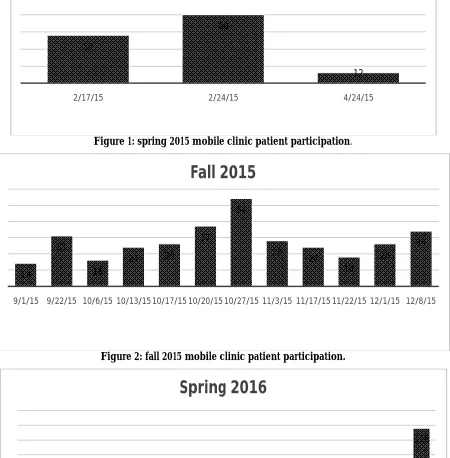
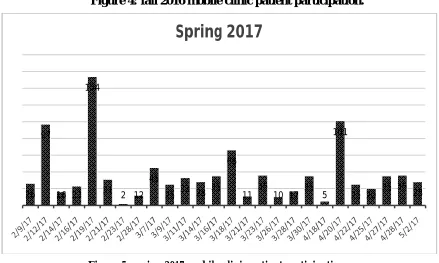
The first program in the spring of 2015, which provided three clinic sites, served a total of 148 patients. In the fall of that same year, 332 patients were served. In 2016, the spring program served 401 patients, while the fall program served 985 patients. In the most recent spring 2017 semester, 26 clinical sites were held, which served a total 962 patients, with a clinic record of serving 154 patients in a 6 hour period of time. For the first three clinics in spring of 2015, only 8 students participated in the mobile health program. Statistics for Student Service Learning hours were not kept at the time, due to limited man power and the pilot nature of the program at that point. Documentation of Student learning hour began in the fall of 2015. Since then, 280 students logged 9,405 clinical and Service Learning hours.
Figure 1: spring 2015 mobile clinic patient participation.
Figure 2: fall 2015 mobile clinic patient participation.
Figure 3: spring 2016 mobile clinic patient participation. 56
80
12
2/17/15 2/24/15 4/24/15
14
31
16
24 26
37
54
28
24
18
26
34
9/1/15 9/22/15 10/6/15 10/13/15 10/17/15 10/20/15 10/27/15 11/3/15 11/17/15 11/22/15 12/1/15 12/8/15
Fall 2015
15 11 18 6 32 20 19 25 23 22 12 11 39 32
116
Figure 4: fall 2016 mobile clinic patient participation.
Figure 5: spring 2017 mobile clinic patient participation.
The Graphs above clearly show a steady increase in number of clinics and patient participation from the inception of the program in the spring up until the spring of 2017. This increase is believed to be due to the increase in awareness levels, as a result increased funding.
10 25
12 82
48
33
9
31 32
16 36
25 4
110
36
15 80
28 40
111 101
20 22 59
Fall 2016
26 97
16 23 154
31 2 12 45
25 33 28 35
66
11 36 10 17 35 5
101
25 20 35 36 28
The media coordinator for the program was extremely diligent in obtaining media attention for the program by sending out the schedule to the community and posting it on social media. However, one point worthy of note is the decrease in amount of patients seen in spring 2017, despite the increase in number of clinics held. This is believed to be due to an issue at Migrant Education Systems, which was one of the clinic sites. There has been a major decrease in the number of patients that attended Migrant Educations sponsored events since January 2017. However, the reason behind this occurrence is unknown.
Many of the underserved communities who have not been able to seek proper health care were able to take advantage of this service and had their health care issues and previously unidentified health concerns addressed. For the 2017 spring program, 49 individuals were referred to the ER, Urgent Care, or their primary doctor, for an urgent health concern such as an abnormally high blood pressure or blood sugar level. In addition to screening services, the program partnered with the local Public Health Department to obtain free flu vaccinations, which provided 477 flu vaccinations to the community during the 2016-2017 flu seasons.
The Mobile Health program provided unique clinical experiences for the students who participated. The program also facilitated the opportunity for inter-professional collaboration, focusing on improving the health statuses of underserved populations. Thus, more American lives, especially those in the rural areas, can be saved.
Conclusion
The Mobile Health Program has allowed the students to better understand the need for community and public health. If this program is thoroughly explored, developed and well-funded, it can be incorporated into the curriculum of universities and this could greatly improve the capacity of such universities to train more nurses on yearly basis. Additionally, having the undergraduate students work alongside the Family Nurse Practitioners (FNP) can eventually inspire many undergraduates to become a Family Nurse Practitioners. This, in turn, can help to meet the need for primary health care providers in underserved areas. Finally, the Mobile Health Program provided a unique opportunity for inter-professional collaboration among the various health care services departments, within the College of Health and Human Services. This is definitely a golden opportunity to bring the best minds together from various fields, with the goal of meeting the needs of underserved populations.
References
American Association of Colleges of Nursing (2016) AACN’s report on 2016-2017 Enrollment and Graduations in Baccalaureate and Graduate Programs in Nursing. Retrieved from http://www.aacn.nche.edu/media-relations/fact-sheets/nursing-shortage
American Association of Colleges of Nursing (2017)Nursing Shortage Fact Sheet. Retrieved from http://www.aacn.nche.edu/media-relations/fact-sheets/nursing-shortage
American Hospital Association, (2017) Fast Facts, American Hospital Statics. Retrieved from http://www.aha.org/research/rc/stat-studies/fast-facts.shtml
American Public Transportation Association, (nd) Rural Communities, Expanding Horizons. Retrieved from http://www.apta.com/resources/reportsandpublications/Documents/Rural-Communities-APTA-White-Paper.pdf
Beck, Andrew H. (2004). "The Flexner report and the standardization of American medical education." (PDF). The
Journal of the American Medical Association. 291 (17): 2139–40.
Billings, D. (2011) Teaching in Nursing Fourth ED. Elsevier;
California State Office of Rural Health (2012) Rural Health Report. Retrieved from
http://www.dhcs.ca.gov/services/rural/Documents/CSRHAPresentationNov132012.pdf
Department of Health Care Services Primary and Rural Health Davidson (2012) Rural Health Report. Retrieved
from http://www.dhcs.ca.gov/services/rural/Documents/CSRHAPresentationNov132012.pdf
Dolea, C., Braichet, J-M., Shaw,D. Health workforce retention in remote and rural areas: call for papers Bulletin of the
World Health Organization 2009;87:486-486. doi: 10.2471/BLT.09.068494 Retrieved from
http://www.who.int/bulletin/volumes/87/7/09-068494/en/
Hegney, D., Eley, R., Plank, A., Buikstra, E. and Parker, V. (2006), Workforce issues in nursing in Queensland: 2001 and 2004. Journal of Clinical Nursing, 15: 1521–1530. doi: 10.1111/j.1365-2702.2006.01558.x
Institute of Medicine Report ,(2012)For the Public's Health retrieved from
http://www.nationalacademies.org/hmd/~/media/Files/Report%20Files/2012/For-the- Publics-Health/phfunding_slides.pdf
Interprofessional Education Collaborative Expert Panel. (2011). Core competencies for interprofessional collaborative practice:
Report of an expert panel. Washington, D.C.: Interprofessional Education Collaborative. Retrieved from
http://www.aacn.nche.edu/education-resources/ipecreport.pdf Johnson,K., (2006) Carsey Institute, Reports on Rural America. Retrieved from
http://scholars.unh.edu/cgi/viewcontent.cgi?article=1004&context=carsey National Educational Association, (2017).Why Cultural Competence? Retrieved from
http://www.nea.org/home/39783.htm/
Meit, M, Knudson, A, GIlbert, T., Tzy_Chyi Yu, A., Tanenbaum, E., Ormson, E., TenBroeck, S. Bayne, A., Popat, S., (2014) Rural -Urban Chart Book retrieved from https://ruralhealth.und.edu/projects/health-reform-policy-research-center/pdf/2014-rural- urban-chartbook-update.pdf
Riordan, D. G., &Capitman, J. A. (2006). Health professional shortage in theSan Joaquin Valley: The impact on federally qualified
health clinics. Fresno, CA: Central Valley Health Policy Institute. Retrieved from:
http://www.fresnostate.edu/chhs/cvhpi/documents/healthy-people-2010-review-1212-2011.pdf
Robert Wood Johnson Foundation (2012) Will Reform Strengthen or Strain the Health Care Safety Net? Retrieved fromhttp://www.rwjf.org/en/library/research/2012/10/will-reform- strengthen-or-strain-the-health-care-safety-net-.html
APPENDIX A
Month Day/Date Location
September Tuesday / 1 Parlier Community Center (MD) 14 NO Mobile Unit 9-22-2015 West Fresno Resource Center Screening 68
October Tuesday / 6 Sanger Community Center (MD) 20
October Tuesday / 13 Reedly Community Center (MD) 22
October 17th SAT Saturday/17 Kerman Commuity Center (MD) 14 October Tuesday / 20 Parlier Senoir Center (MD) 34
NO Mobile Unit 10-27-2015 West Fresno Resource Center Screening 72
November Tuesday / 3 Hope House in Madera (MD) 32
November Tuesday / 17 Hope House in Madera (MD)22
NO Mobile Unit 11-22-2015 West Fresno Resource Center Screening 52
December Tuesday / 1 Firebaugh/St JoesphCathloic Church (MD)15
APPENDIX B
1-30-2017 Spring Schedule Mobile Unit And Screenings/ Spirit of Health Grant $
Month Day-Date-Time Location
February Tuesday - 7th -0900-1300 Barthuli Ranch-16145 E McKinley Ave, Sanger (9pts) Cyndi
February Thursday - 9th - 1100-1500
WFFRC- Mary Ella Brown Commun. Ctr.
1350 E. Annadale Fresno, CA 93706 Kathi
February Sunday - 12th - 1300-1700 Our Lady of Mt Carmel Church (Pottle Ave) Kathi
February Tuesday - 14th - 0900-1300
Madera Hope House- Valentines Day Celebration
117 N. R Street Madera, CA 93637 Cyndi
February Thursday - 16th - 0900-1300
Falcon Court Turning Point
4415 N. Clark St. Fresno, CA 93726 Kathi
February Sunday - 19th- (Confirm) Health on Wheels- Madera Fairgrounds Kathi
February Tuesday - 21st - 0900-1300 GPUSD - San Joaquin Elementary Cyndi
February Thursday - 23rd - 0830-1400 Reedley Migrant Health Kathi
February Tuesday - 28th - 0900-1300
West Fresno Family Resource Center (Asako)
1802 E California Ave Fresno Cyndi
March Tuesday - 7th - 0900-1300
Family Education Center- Orosi-
40802 Road 128 Orosi, CA Cyndi
March Thursday - 9th - 0830-1400 Spirit of Woman Kathi
March Saturday - 11th - 0900-1300 GPUSD- Cantua Creek Kathi
March Tuesday - 14th - 0900-1300
Madera Hope House
117 N. R Street Madera, CA 93637 Cyndi
March Thursday - 16th- 0900-1300 Spirit of Woman Kathi
March Tuesday - 21st - 0900-1300 Dawnings- Dinuba- 682 1st Ave. Dinuba, CA 93618 Cyndi
March Thursday - 23rd - 1000-1400
WFFRC- Mary Ella Brown Commun. Ctr.
1350 E. Annadale Fresno, CA 93706 Kathi
March Sunday - 26th - 0900-1300 GPUSD - Tranquility Highschool Kathi
March Tuesday - 28th - 0900-1300 Reedly Community Ctr Cyndi
March Thursday - 30th - 0830-1400 Spirit of Woman Kathi
April Tuesday - 18th - 0900-1300
Parlier Community Center- 1100 E Parlier Ave. Parlier,
CA 93648 Cyndi
April Thursday - 20th - 0700-1400 Health on Wheels - Fresno Fairgrounds Kathi
April Saturday - 22nd - 0900-1400
West Fresno Resource Ctr -Earth Day- "Spring into
Health" 1802 E California Kathi
April Tuesday - 25th - 0900-1300
Family Education Center- Orosi-
40802 Road 128 Orosi, CA Cyndi
April Thursday - 27th- 0830-1400 Spirit of Woman (No Mobile/No Jim) Kathi
April Friday - 28th - 1000-1300
Reedley Community Ctr Resource Fair
(No mobile/No Jim Kathi
May Tuesday - 2nd - 0900-1300
Madera Hope House
APPENDIX C
10-7-2016 Fall 2016 Schedule for Mobile Unit And Screenings
Month Date Day Time Location Faculty
September 15 Thursday 0900-1300 Spirit Of Woman ( No UNIT) Kathi
September 22 Thusrday 0900-1300 Sprit of Woman ( No UNIT) Kathi
September 27 Tuesday 0900-1300 West Fresno Food Drive Cyndi
September (CNSA) 28 Weds 1000-1300 FSU Health and Wellness ( No UNIT) Kathi
September 29 Thursday 0900-1300 Poverello house Kathi
October 4 Tuesday 1730-2100 Parlier J. H. School, 1200 E. Palrier Ave Kathi
October 6 Thursday 0900-1300 Siprit of Woman Kathi
October 11 Tuesday 1500-1830 Dinuba Heatlh and Wellness Fair Cyndi
October 13 Thursday 0900-1300 Madera/ Hope House Kathi
October 18 Tuesday 0900-1300 Madera/ Hope House Cyndi
October 22 Saturday NURS 141 Community Project /Candace clinical Grp Kathi
October 25 Tuesday 0900-1300 West Fresno Food Drive Cyndi
October 27 Thursday 0900-1200 Spirit of Woman Kathi
October (CNSA) 29 Saturday 0900-1300 Migrant Enrollemnet fair Mendota Kathi
November 1 Tuesday 17:30-2100 OSY Migrant McCabe Elem Mendota Kathi
November 3 Thursday 0900-1300 Spirit of Woman Kathi
November (CNSA) 5 Saturday need to confirm Enrollmenat Fair Migrant West Fresno Kathi
November 8 Tuesday 5:30 -2100 Dinuba Cyndi
November 10 Thursday 0900-1300 Poverello House Kathi
November 15 Tuesday 0900-1300 Cutler Orosi/40802 RD 128, Orosi CA Cyndi
November (CNSA) 17 Thursday 0700-1400 Fresno Flea Market Kathi
November 29 Tuesday 0900-1300 Firebaugh, St. Joesph Church Cyndi
December 1 Thursday 0900-1300 Spirit Of Woman Kathi
December 6 Tuesday Pending Firebaugh Cyndi
December (CNSA) 3 Saturday Need to Confirm Migrant Fair Reedly Kathi
APPENDIX D
1-26-2016 Spring Schedule Mobile Unit And Screenings/ Spirit of Health
Month Day/Date/time Location
January Tuesday /26/ 9-1 Spirit Of Health
February Tuesday /2 / 9-1 St. Joseph Church/1558 12th St,Firebaugh
February Tuesday /9 / 9-1 Mental Health Systems Old Hacienda Fresno
2550 W Clinton Ave, Fresno, CA 93705
February Tuesday / 17 / 9-1 Cantua Creek/ 11996 Nebraska Ave
February Tuesday/ 23/ 9-1 Madera Hope House/117 N.R.Street/Madera
March Tuesday /1 / 9-1
March Tuesday /8 / 9-1 Mental Health Systems Old Hacienda Fresno
2550 W Clinton Ave, Fresno, CA 93705
March Tuesday/15/ 9-1 St. Joseph Church/1558 12th St, Firebaugh
March Tuesday/ 29/ 9-1 Reserve for Pilar
April Tuesday /5 / 9-1 Mental Health Systems Old Hacienda Fresno
2550 W Clinton Ave, Fresno, CA 93705
April Tuesday /12 / 9-1 Reserve for Pilar
April Tuesday /19 / 9-1 Madera Hope House/117 N. R.Street/Madera
Saturday 4-23-2016 Fresno Swap Meet 0700-1400
Sunday 5-1-2016 Madera Swap Meet 0700-1400
Spirit of Health Thursdays 0830-1400 At Spirit of Woman