International Journal of Education and Social Science Research
ISSN 2581-5148
Vol. 1, No. 02; 2018
THE MIDDLE SCHOOL MATH TEACHERS AS A FACILITATOR
Laurie James, Ed.D1 and Alexander Apo2
1University of Hawai‘i – West O'ahu 91-1001 Farrington Highway Kapolei, Hawai‘i
Email Address: [email protected]
2Honolulu, Hawai‘i: Email Address: [email protected]
ABSTRACT
This article investigates how middle school math teachers facilitate meaningful understanding of mathematics in their classroom. The goal was to determine if math teachers modified their teaching styles to accommodate the preferred learning style of their students. The purpose of this study was to examine what instructional methods were used to teach mathematics to students with different learning styles. Based on the responses from an 11-item survey, this study takes a closer look at the teachers’ role in the classroom and their approach to teaching mathematical concepts when taking into consideration how students believed they understood math.
Keywords:Anxiety, Preferred Learning Style, Student Engagement, Mathematics, Learning Environment, Facilitate, Teaching Methods.
INTRODUCTION
Students in today’s educational system experience math differently. In a traditional middle school mathematics class, the teacher stands at the front of the room following a content-focused math curriculum reviewing homework and providing examples of new math problems while students take notes copying the information from the board (Paape, 2017). Traditional lecture-style classes are not always the best way to teach math as not all students are engaged in the learning (Boaler, 2002). Yet, creating meaningful differentiated activities for every math lesson can be difficult. Instead, the teacher’s role should be more of a facilitator guiding students to discover new knowledge arriving at their own conclusions (Posamentier& Smith, 2015).
A quality teacher improves learning using outcomes that matter to the students’ future successes (Coe, Aloisi, Higgins, & Major, 2014). To support students in the math classroom, the teacher must develop a well-rounded program essential for students to connect with mathematical content. This can be accomplished by implementing practices that take into consideration the students’ learning style and how they grasp math concepts. By customizing activities to be developmentally appropriate, students gain fundamental concepts in math through problem solving and exploration. This type of instruction encourages student interaction, which furthers cognitive growth and self- esteem (Posamentier& Smith, 2015).
This would include creating an inclusive learning environment that engages students in discussing tasks through questioning and analyzing mathematical ideas. Building skills and applying knowledge in meaningful ways bridges learning gaps by incorporating multiple instructional techniques allowing students to explain their thinking through their preferred learning style.
Preferred Learning Style
Would middle school students believe they were more successful if given an option to learn math content in a certain way? Students tend to learn better when they receive information in their preferred learning style (Coe, Aloisi, Higgins, & Major, 2014). If students have preferences about how they learn and absorb information, then they often need to have power over events by having a say in what is happening (Van de Walle, Karp, & Bay-Williams, 2016). When students construct their understanding as they articulate their thoughts of mathematical concepts, how they were learning is as important as what they are learning (Van de Walle&Lovin, 2006). Through this process, students increase their need to know why something works in math discovering solutions that make sense.
If mathematical information was presented in a way that encouraged exploration on students’ own terms, then their understanding and experience in math class could be enhanced. Students would be more likely to take risks and communicate mathematically because they believe they were learning through their preferred learning style. Open communication and shared decision-making allows students to process their mathematical thinking by breaking apart the problem to find a solution. Having meaningful conversations allows the students to explain their mathematical reasoning, work through problems, and clarify content (Zwiers& Crawford, 2011). When students share with each other, they expand on new mathematical concepts (Van de Walle, Karp & Bay-Williams, 2016).
Students must have opportunities to advance their knowledge supported by learning that gives attention to their individual needs (Van de Walle, Karp, & Bay-Williams, 2016). The students’ needs and interests should be considered when developing math lessons (Posamentier& Smith, 2015). It is vital for the classroom teacher to increase the students’ level of confidence, offer individualized academic support, and utilize a real-life approach to math (Rossnan, 2006). Since all students have different experiences in math, they process and retain information in a way that makes sense to them through their ideal style of thinking and learning. When students play a more active role, they take ownership of their learning developing a deeper understanding with time (Hiebert& Wearne, 2003). Students become more actively involved in the learning process making connections in math and clarifying their conjecture on how problems should be solved. It is apparent providing multiple contexts for learning presents new opportunities for students to develop mathematical skills that formulate gradually (Van de Walle&Lovin, 2006).
Conceptual Understanding
student values in the math classroom, the teacher can use specific teaching strategies that are engaging and motivating giving students the freedom to see mathematics through their preferred learning style. Allowing students to provide their teacher with feedback regarding the way they want to be taught math can personalize learning.
Guiding and motivating students to learn from their mistakes expands their understanding while developing new strategies to approach mathematical problems. Students are creating a growth mindset when believing they can develop their mathematical ability reinforcing the idea that math is the process of learning not the product (Boaler, 2013). Students who have a growth mindset tend to embrace challenges, work at their own pace, and develop their abilities through persistence (Dweck, 2010). When discussing topics students talk about their thought process making discoveries and supporting a deep long-lasting understanding. These discoveries along with mathematical ideas and relationships help students realize they can be successful in mathematics.
The teacher can have difficulty reaching all students at an early age due to their developmental level, cognitive or intellectual ability, cultural background, and socio-emotional aspects of personality (Corno, 2008). Presenting students with a supportive infrastructure in a learning style that they prefer is necessary to their success in the math classroom. Through Howard Gardner’s theory of Multiple Intelligences, students believe they learn through many styles. Students can have different kinds of intelligence and can learn, remember, perform, and understand differently (Gardner, 2011). Knowing their abilities and multiple intelligences can help the teacher create a more enjoyable math classroom. One way to prepare students is to enhance how the classroom teacher teaches. After modeling math content, the teacher takes the role of a facilitator by encouraging students to share and reflect upon their comprehension of math concepts. That is why it is imperative to present mathematical materials in a variety of ways that support meaningful learning activities (Paape, 2017).
Students at any age can experience anxiety and have a fear of failure in mathematics. Math anxiety builds tension that interferes with the manipulation of numbers and the solving of mathematical problems (Rossnan, 2006). Students can form their beliefsabout their own intelligences based on whether they understand the concepts. Students might find math class more interesting reducing math anxiety if they were being taught math in their preferred learning style. To reduce math anxiety in the classroom, teachers should focus on the importance of classroom design striving to create a space that encourages everyone’s strengths and successes (Rossnan, 2006).
Teacher’s Role
To enrich math instruction, every teacher has an obligation to develop a well-versed math program vital for student success while providing a safe and encouraging environment (Rossnan, 2006). The teacher’s role is to assist and scaffold the learning for the students. It is not necessary for the teacher to be the primary source of mathematical information for students in each math class. Instead, the teacher can transform into more of a facilitator by supporting students in achieving their target or task. The teacher must monitor students’ progress and intervene when necessary.
meeting rigorous learning goals. Students can be successful when articulating their thoughts, monitoring their own progress, and expanding their awareness through perseverance. This can be done by drawing upon knowledge of mathematical content and pedagogy modifying instruction to meet the needs of the students. Scaffolding learning allows students to engage in mathematical inquiry, retain information easier, and have meaningful discussions (Wachira, Pourdavood, &Skitzki, 2013).
An effective teacher establishes consistent math instruction that correlates to clear student learning goals for mathematics. This would be accomplished by modeling mathematics and checking for understanding throughout the lessons allowing students to emulate different approaches. Every teacher can focus on making classrooms inviting as students’ interests connect to the content (Van de Walle, Karp, & Bay-Williams, 2016). The teacher must encourage students to ask questions when they do not understand (NCTM, 2000). It is important for students to get a glimpse of where math can lead them while building their confidence. However, creating relevant learning experiences and providing real-world applications in the math classroom helps students make connections while seeing a purpose for mathematics.
METHODS
This study was conducted to identify what instructional methods teachers used to facilitate meaningful learning opportunities in their math classroom. An 11-item survey was designed to analyze the role of the middle school math teacher and their approaches to teaching mathematical concepts when taking into consideration how students believed they learn. Questions were asked to better understand each teacher’s role of how to facilitate meaningful experiences in the math classroom. These questions focused on teaching methods, modifying teaching style to fit preferred learning style of the students, and student engagement in the math classroom.
Five middle school math teachers responded to the survey. These teachers all work at the same multitrack school. A multitrack system is used to alleviate overcrowding and operates on a special academic calendar. The middle school where the survey was administered had over 1,400 sixth, seventh, and eighth graders with 53% male and 47% female students. Students were relatively high performing as documented by the statewide standardized math exam with the mean scores 5% above the Department of Education School District.
Figure 1. Teaching methods used in the middle school math classroom.
When asked how well students retained information based on their engagement in class, four of the five teachers noted that their students’ performances directly reflected their retention of mathematical content and ability to perform computations. This question was asked to gauge if the teaching methods were adequate in the ability tofoster understanding with the students. Overall, the teachers were aware of their students’ growth as documented through assessments.
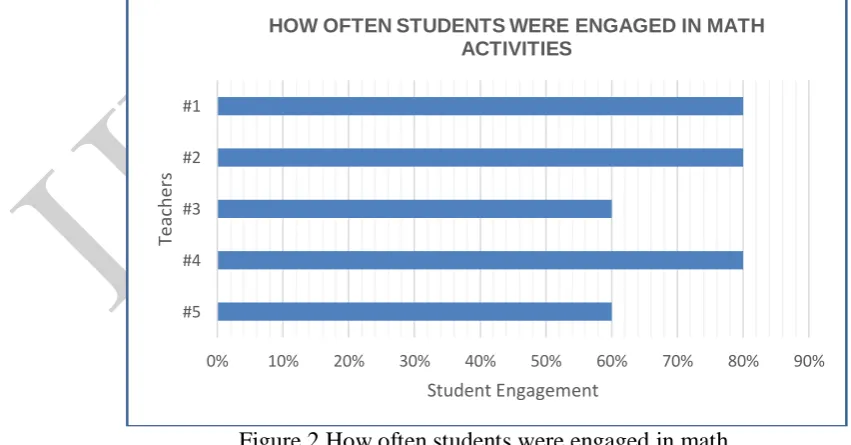
The five teachers identified how often students were engaged in math lessons. Three teachers thought their students were engaged in mathematical activities 80% of the time while the other two teachers believed students were only engaged 60% of the time. It was noted that the teachers made attempts to engage all students in every lesson, but some students were withdrawn during lecture presentations creating a disconnect to the content. Figure 2 shows how often the teachers documented that students were engaged in their math class.
Figure 2.How often students were engaged in math.
One of the survey questions took a closer look to see if the teachers modified their teaching style to fit the preferred learning style of the students who believe they learn in a different way. The teachers
5 5 5 4
4 0
1 1
Lecture Hands-on Activity Group Work Individual Work Video Lessons Flipped Model Other: Art Games
Teachers using the Method
Typ
e
o
f
Ins
tr
ucti
o
n
TEACHING METHODS USED IN THE CLASSROOM
0% 10% 20% 30% 40% 50% 60% 70% 80% 90%
#5 #4 #3 #2 #1
Student Engagement
Tea
cher
s
acknowledged that it would be important to take into consideration how students believed they understood math. Nevertheless, students should take risks and be encouraged to build onto their ideas by analyzing various mathematical approaches when solving problems. This would mean the teacher creates ways to alter the traditional lectures to make math more interactive aligning with the preferred learning style for students who might struggle in an area. Thus, four out of five teachers modified their teaching style to fit the preferred learning style of their students even though they said it would not be practical for each math lesson.
The one teacher who did not modify instruction revealed that it was their first-year teaching and felt a lack of confidence to alter from the adopted math curriculum. Figure 3 represents four of the five teachers who modified math lessons to fit the preferred learning style of the students.
Figure 3.The percentage of teachers modifying instructional methods.
An open-ended question asked the five teachers what they thought was the role of a math teacher. Three responses from the survey stated the role of a math teacher was to: 1) teach mathematics while helping students figure out who they are as learners, 2) help students realize that they can achieve in mathematics, and 3) educate students to solve problems while developing a mathematical mindset. The math teachers believed that modifying their teaching style for their students would enhance in-depth discussions about mathematics.
The two teachers who implemented math stations created different learning environments for students to discuss activities while working in groups, using their artistic skills, and playing content specific interactive games. One teacher incorporated notebooks, videos, mnemonic activities, visuals guides, and student designed projects. Even though not every student nor every class will benefit from the same kinds of interactions and activities, the teacher’s role in the classroom and their approach to teaching mathematical concepts can help facilitate discourse while reinforcing real-life math skills.
DISCUSSION
The main goal of the study was to approach middle school math teachers to determine if their math MODIFIED INSTRUCTION TO PERFERED LEARNING STYLES
Didn't Modify Instruction
lessons were modified to meet the needs of the students’ diverse learning styles. An 11-item survey was administered to middle school math teachers identifying their instructional approaches. Based on the survey results, the teachers stated that it was difficult to reach all students through one instructional method because of a disconnect between the mathematical content and how students grasped the information.
It was noted when students were engaged in math activities that supported their preferred learning style, the students were more willing to take risks and build a shared understanding of mathematical ideas. Even though the teachers made attempts to modify their instruction to fit as many diverse learning styles as possible, some students were not engaged and had trouble retaining information as they were withdrawn during content specific lecture presentations. One comment that was echoed throughout the teachers’ responses to the survey questions was that each student learns differently and catering to those individual needs would become cumbersome during each lesson.
This study was designed with the intention to better understand and identify how to guide students in a math classroom through multiple teaching styles. Because this study was conducted with a limited number of teacher participants, future research should include a larger representation of middle school math teachers including a broader and larger geographic area. Further investigation would need to be conducted to determine if student engagement correlated with students who find math interesting as a subject and if students felt they could master math concepts if taught in their preferred learning style. This information can be used for further research of how the teacher’s role in a math classroom can be used to improve students’ perception of the topic. Overall, this study represented a small step in exploring if math teachers modified their teaching styles to accommodate the preferred learning style of their students.
REFERENCES
Boaler, J. (2013). Ability and mathematics: The mindset revolution that is reshaping education. FORUM, (55)1, 143-149.
Boaler, J. (2002). Learning from teaching: Exploring the relationship between reform curriculum and equity. Journal for Research in Mathematics Education, 33(4).
Coe, R., Aloisi, S., Higgins, S., & Elliot Major, L. (2014). What makes great teaching: Review of the underpinning research.Center for Evaluation & Monitoring.
Corno, L. (2008). On teaching adaptively.Educational Psychologist, 43(3).Dweck, C. S. (2010). Even geniuses work hard. Educational Leadership, 68(1).
Hiebert, J., & Wearne, D. (2003).Developing understanding through problem solving. In
H. L. Schoen & R. I. Charles (Eds.), Teaching mathematics through problem solving (pp. 3–13). Reston, VA: NCTM.
Gardner, H. (2011). Frames of mind: The theory of multiple intelligences. New York, NY: Basic Books.
National Council of Teachers of Mathematics (2000).Principles and standards for school mathematics. Reston, VA: NCTM.
Paape, A. (2017). Not teaching the way we were taught. Shaping the Future.
Posamentier, A. & Smith, B. (2015). Teaching secondary mathematics: Techniques and enrichment units (9th ed.). Upper Saddle River, NJ: Pearson Education.
Van de Walle, J. A., Karp, K. S., & Bay-Williams, J. M. (2016). Elementary and middle school mathematics: Teaching developmentally (9th ed.). Upper Saddle River, NJ: Pearson Education. Van de Walle, J. &Lovin, L. (2006). Teaching student-centered mathematics: Grades 3-
5. Boston, MA: Pearson.
Wachira P., Pourdavood R., &Skitzki, R. (2013).Mathematics teacher’s role in promoting classroom discourse. International Journal for Mathematics and Learning, 1-40.