ABSTRACT
Background: Epilepsy is a disorder that is commonly found in people with intellectual disability (ID). The prevalence of epilepsy increases with the severity of ID. The objective of this study was to determine if there is an association between intelligence quotient (IQ) and epilepsy in children with ID. Materials and Methods: A total of 262 children,
aged 3-18 years, with ID were identified as part of a community-based rehabilitation project. These children were
examined for epilepsy and diagnosed by a psychiatrist and physicians based on results of electroencephalogram
tests. A Spearman’s correlation (ρ) was used to determine if there was an association between IQ scores and the
occurrence of epilepsy. X2 statistics used to examine the relationship of epilepsy with gender, socioeconomic status, population type, severity of ID, family history of mental illness, mental retardation, epilepsy, and coexisting disorder. Results: Spearman’s rho –0.605 demonstrates inverse association of IQ with epilepsy. X2 demonstrates statistically
significant association (P < 0.05) with gender, severity of ID, cerebral palsy, behavior problems, and family history of mental illness, mental retardation, and epilepsy. Conclusions: Lower IQ score in children with ID has association with occurrence of epilepsy. Epilepsy is also found highly associated with male gender and lower age.
Key words: Community-based rehabilitation, epilepsy, intellectual disability, India, intelligence quotient Ram Lakhan
Department of Epidemiology and Biostatistics, School of Health Sciences, College of Public Service, Jackson State University, Jackson, MS, USA
Intelligence quotient is associated with epilepsy in
children with intellectual disability in India
Original Article
Introduction
Epilepsy is defined as recurrent, unpredictable, and
typically unprovoked seizure activity.[1] The prevalence
of epilepsy in the general population is estimated to be 40-70/1000 people;[2] people with intellectual
disability (ID) have a higher rate of epilepsy diagnoses than the general population. ID was known as mental
retardation earlier, and we have used these terms
interchangeably in manuscript. Approximately 14-24%
of the ID population is affected by epilepsy.[3,4] The
prevalence of epilepsy increases with the severity of ID,
which approaches 7% in people with mild to moderate
ID, 67% in people with severe ID,[5] and 50-82% in people
with profound ID.[6,7] Dodson[8] reported that children
with epilepsy have an intelligence quotient (IQ) score
that is 10 points lower than their healthy, age‑matched
peers.
Epilepsy can affect a person’s education, career, general health, mental health, and marriage, among other
things.[9] Epilepsy in children with ID affects a number
of domains and functions.[10,11] For example, epilepsy
affects their health‑related quality of life outcomes[12]
and their ability to function normally.[13] Children with
both epilepsy and intellectual disabilities experience psychiatric disorders in 50-59% of cases.[14,15] Epilepsy
does not only affect the individual but it also negatively affects an individual’s family members. In a review article, Bowley and Kerr[16] reported that having ID along
with epilepsy affects a person’s physical morbidity,
which in turn leads to increased mortality and a greater burden on their family.
The risk of death is five times higher in children with
epilepsy compared with children without epilepsy.[17]
This risk is even higher in children with ID that also have neurological disorders.[17] Because epilepsy is a known neurological disorder,[7] it follows that children who
have low IQ scores and epilepsy have an even higher
death risk. Given these correlations, a strong relationship
Address for correspondence:
Ram Lakhan, Doctoral Candidate in Epidemiology, Department of Epidemiology, School of Health Sciences, College of Public Service, Jackson State University, Jackson, MS, USA. E‑mail: [email protected]
Access this article online
Quick Response Code:
Website:
www.ruralneuropractice.com
DOI:
seems to exist between epilepsy and low IQ,[18] but
very few studies have investigated the nature of this relationship. If the relationship was linear within the ID
population, one would potentially be able to predict how a person’s IQ score relates to their likelihood of having
or developing epilepsy.
Objective
This study investigated the correlation between IQ and epilepsy in children with ID.
Materials and Methods
Demographics and sampling
Ashagram Trust (AGT) is a nongovernment organization. This organization is located in one of the poorest
districts of India,[19] in Barwani. A total of 53% of the
population in this district lives below the poverty line.
The district has both a tribal population (68%) and a
nontribal population (32%). The tribal population is
more disadvantaged in terms of health, education, and
employment compared with the nontribal population.[20]
AGT implemented a community-based rehabilitation
project in 63 villages of the Barwani block with financial
help from Action Aid India. This project began in 1999 and ended in 2010. The project aimed to provide comprehensive services to all people identified to
have disabilities. A total of 63 villages were surveyed door‑to‑door, and a total of 262 children were identified as having intellectual disabilities. All 262 children were
included in this study. Consent to test for epilepsy and receive comprehensive rehabilitation services as part of
the CBR project was obtained from the children’s parents
or grandparents.
Diagnosis of intellectual disability and epilepsy
Mental retardation professionals (including the author) assessed children using standard diagnostic tests.
Initially, two tests – a developmental screening test
(DST)[21] and an Indian adaptation of the Vineland Social
Maturity Scale (VSMS)[21] – were used to determine each child’s IQ score. The average of development quotient
obtained from DST and social quotient from VSMS makes IQ.[22] On place of other standardized test Malins Intelligence Scale for Indian Children, an adaptation of Wechsler Intelligence Scale, DST and VSMS were
preferred because these tests can be administered with less time even in nonclinical settings on nonschool going children. Children were also administered other standardized intelligence tests as needed.
All children diagnosed with ID were referred to
psychiatrists and physicians to assess and treat,
respectively, any medical condition, including epilepsy. While taking case history, professional asked for any symptoms of epilepsy, if there was any
symptom than that case was referred for medical
evaluation for epilepsy. Then, the child underwent
an electroencephalogram (EEG) administered by the psychiatrist or a general physician. EEG was administered for 20-30 min to record brain activities in awaken condition. Abnormal electrical activity (spikes and slowing) considered indication of epilepsy. The EEG results were used to support a positive diagnosis but were not used to rule out epilepsy.[23,24] Clinicians
heavily relied on the clinical history that was obtained from parents or any other eye witness family member.
If available, reports from previous consultations were
reviewed and taken into account before making each diagnosis. A few children also underwent a computed tomography scan for diagnosis purposes.
Statistical analysis
Statistical Software for Social Science (SPSS version 21) was used for statistical analysis. Spearman’s correlation
used to examine association of epilepsy with IQs and age of the study participants. X2 statistics is used for gender, severity of ID, socioeconomic status, cerebral palsy, Down syndrome, behavior problems, coexisting disorders, and family history of mental illness, mental retardation, and epilepsy.
Results
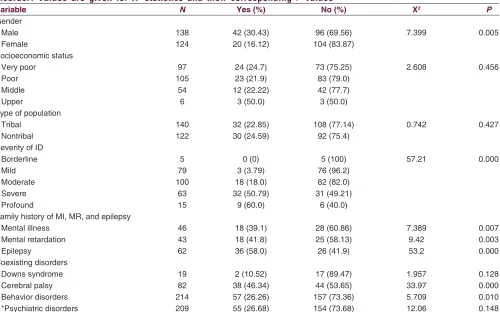
Table 1 categorizes variables characteristics and statistics. We found epilepsy highly associated with male gender than female (X2 –7.399, P = 0.005) and
not equally distributed with severity of ID (X2 –57.21,
P = 0.001). Epilepsy found strongly associated with the children those have family history of mental illness (X2 –7.389, P = 0.007), mental retardation (X2 –9.42,
P = 0.003), and epilepsy (X2 –53.2, P = 0.001). Except psychiatric disorders and Down’s syndrome, epilepsy
is found more among ID children those had cerebral palsy (X2 –33.97, P = 0.001), and behavior disorders
(X2 –5.709, P = 0.01). The occurrence of epilepsy is not different in population groups (X2 –0.742, P = 0.427),
and among socioeconomic groups (X2 –2.608, P = 0.456)
[Table 1].
Table 2 it expresses Spearman’s rho statistics of epilepsy
with the ordinal variables age and intelligence quotient. Epilepsy had inverse correlation with age (P = −0.683),
and intelligence quotient (P = −0.605) among children
Table 1: The association of epilepsy with different variables: Gender, socioeconomic status, population type, severity of intellectual disability, family history of mental illness, mental retardation, epilepsy, and coexisting disorder. Values are given for X2 statistics and their corresponding P values
Variable N Yes (%) No (%) X2 P
Gender
Male 138 42 (30.43) 96 (69.56) 7.399 0.005
Female 124 20 (16.12) 104 (83.87)
Socioeconomic status
Very poor 97 24 (24.7) 73 (75.25) 2.608 0.456
Poor 105 23 (21.9) 83 (79.0)
Middle 54 12 (22.22) 42 (77.7)
Upper 6 3 (50.0) 3 (50.0)
Type of population
Tribal 140 32 (22.85) 108 (77.14) 0.742 0.427
Nontribal 122 30 (24.59) 92 (75.4)
Severity of ID
Borderline 5 0 (0) 5 (100) 57.21 0.000
Mild 79 3 (3.79) 76 (96.2)
Moderate 100 18 (18.0) 82 (82.0)
Severe 63 32 (50.79) 31 (49.21)
Profound 15 9 (60.0) 6 (40.0)
Family history of MI, MR, and epilepsy
Mental illness 46 18 (39.1) 28 (60.86) 7.389 0.007
Mental retardation 43 18 (41.8) 25 (58.13) 9.42 0.003
Epilepsy 62 36 (58.0) 26 (41.9) 53.2 0.000
Coexisting disorders
Downs syndrome 19 2 (10.52) 17 (89.47) 1.957 0.128
Cerebral palsy 82 38 (46.34) 44 (53.65) 33.97 0.000
Behavior disorders 214 57 (26.26) 157 (73.36) 5.709 0.010
*Psychiatric disorders 209 55 (26.68) 154 (73.68) 12.06 0.148
*Psychiatric disorders include attention deficit hyperactivity disorder, anxiety, autism, bipolar affective, depression, delusional disorder, obsessive compulsive, and
schizophrenia. ID: Intellectual disability, mental illness, mental retardation
Table 2: Spearman correlation rho (P) of prevalence of epilepsy with age and intelligence quotient in children with intellectual disability
Variables rho (P) P value
Age −0.683 0.004
IQ −0.605 0.000
IQ: Intelligence quotient
Ͳ
3UHYDOHQFHRIHSLOHSV\
$JHRI,'FKLOGUHQ
3UHYDOHQFHRIHSLOHSV\ZLWKWKHDJHRI,'FKLOGUHQ
Figure 1: Graph showing prevalence of epilepsy with the age of intellectual disability children
Ͳ
3UHYDOHQFHRIHSLOHSV\
,4RI,'FKLOGUHQ
3UHYDOHQFHRIHSLOHSV\ZLWKWKH,4RI,'FKLOGUHQ
Figure 2: Graph showing prevalence of epilepsy with the intelligence quotient of intellectual disability children
and intelligence quotient [Figure 2] of intellectual disability children.
Discussion
2. Dekker PA. Epilepsy: A manual for medical and clinical officers in Africa, WHO, Geneva, Switzerland. [online] 2002. Available from: http://apps. who.int/iris/handle/10665/67453. [Last cited on 2013 May 27]. 3. Dev S. Epidemiology and treatment of epilepsy in patients who are
mentally retarded. CNS Drugs 2000;13:117‑28.
4. Forsgren L, Edvinsson SO, Blomquist HK, Heijbel J, Sidenvall R. Epilepsy in a population of mentally retarded children and adults. Epilepsy Res 1990;6:234‑48.
5. Shepherd C, Hosking G. Epilepsy in school children with intellectual impairments in Sheffield: The size and nature of the problem and the implications in service provision. J Ment Defic Res 1989;33:511‑4. 6. Michelucci R, Forti A, Rubboli G, Plasmarti R, Volpi L, Tassinari CA.
Mental retardation and behavioral disturbances related to epilepsy: A review. Brain Dysfunction 1989;2:3‑9.
7. Suzuki H, Aihara M, Sugai K.Severely retarded children in a defined area of Japan‑prevalence rate, associated disabilities and causes. No To Hattatsu 1991;23:4‑8.
8. Dodson WE. Epilepsy, cerebral palsy, and IQ. In: Pellock JM, Dodson WE, Bourgeois BF, editors. Pediatric epilepsy diagnosis and therapy. New York: Demos Medical Publishing; 2002. p. 613‑27. 9. Jalava M, Sillanpaa M, Camfield C, Camfield P. Social adjustment and
competence 35 years after onset of childhood epilepsy: A prospective controlled study. Epilepsia 1997;38:708‑15.
10. Hoare P, Russell M. The quality of life of children with chronic epilepsy and their families: Preliminary findings with a new assessment measure. Dev Med Child Neurol 1995;37:689‑96.
11. Ronen GM, Rosenbaum P, Law M, Streiner DL. Health‑related quality of life in childhood epilepsy: The results of children’s participation in identifying the components. Dev Med Child Neurol 1999;41:554‑9. 12. Sabaz M, Cairns DR, Lawson JA, Bleasel AF, Bye AM. The health‑related
quality of life of children with refractory epilepsy: A comparison of those with and without intellectual disability. Epilepsia 2001;42:621‑8. 13. O’Brien J. A guide to life‑style planning: Using the activities catalog to
integrate services and natural support system. In: Wilcox B, Bellamy GT, editors. The Activities Catalog: An Alternative Curriculum for Youth and Adults with Severe Disabilities. Baltimore: Paul H. Brookes Publishing; 1987. p. 175‑89.
14. Rutter M. Isle of Wight revisited: Twenty‑five years of child psychiatric epidemiology. J Am Acad Child Adolesc Psychiatry 1989;28:633‑53. 15. Steffenburg S, Gillberg C, Steffenburg U. Psychiatric disorders in children
and adolescents with mental retardation and active epilepsy. Arch Neurol 1996;53:904‑12.
16. Bowley C, Kerr M. Epilepsy and intellectual disability. J Intellect Disabil Res 2000;44:529‑43.
17. Camfield CS, Camfield PR, Veugelers PJ. Death in children with epilepsy: A population‑based study. Lancet 2002;359:1891‑5.
18. Buelow JM, Austin JK, Perkins SM, Shen J, Dunn DW, Fastenau PS. Behavior and mental health problems in children with epilepsy and low IQ. Dev Med Child Neurol 2003;45:683‑92.
19. Report of the Task Force, Identification of Districts for Wage and Self‑Employment Programs, Planning Commission, Bengal Offset Works, New Delhi, India. [online] 2003. Available from: http:// planningcommission.gov.in/reports/publications/tsk_idw.pdf. [Last cited 2013 May 27].
20. Lakhan R. Inclusion of children with intellectual and multiple disabilities: A community based rehabilitation approach, India. J Spec Educ Rehabil 2013;14:79‑97.
21. Bharat RJ. Vineland Social Maturity Scale‑Indian Adaptation: Enlarged Version, Swayamsiddha Prakashanam, Mysore, India; 1992.
22. Lakhan R. The coexistence of psychiatric disorders and intellectual disability in children aged 3‑18 years in the Barwani District, India. ISRN Psychiatry 2013;2013:875873. Available from: http://www.hindawi.com/ isrn/psychiatry/2013/875873/abs/[Last accessed 2013 May 27]. 23. Engel J. The epilepsies. In: Wyngoorden J, Smith L, Bennet C, editors.
Cecil’s Textbook of Medicine. 19th ed. Philadelphia: WB Saunders; 1992.
p. 2202‑13.
24. Noachtar S, R’emi J. The role of EEG in epilepsy: A critical review. Epilepsy Behav 2009;15:22‑33.
25. Singhi PD, Bansal U, Singhi S, Pershad D. Determinants of IQ profile in children with idiopathic generalized epilepsy. Epilepsia A case-control study conducted in North India
demonstrated that children with generalized epilepsy have lower IQ scores than their controls with not epilepsy.[25] A linear decline in IQ is also seen among
people who developed epilepsy.[26] Epilepsy also
found more associated with male gender and that was consistent with our study. Epilepsy is equally distributed between two populations tribal versus nontribal. Children with ID those had family history of mental
illness, mental retardation and epilepsy shown higher
chances of having epilepsy.
It is already known that people with ID have higher rates of epilepsy.[5,7] Further inferring from findings, we can
say that people with ID are on higher risk than non-ID and this risk of epilepsy goes further higher among ID as their IQ score lowers.
Studies have shown correlation of epilepsy with poor cognitive function.[27,28] Thus, professionals should use
extra caution to detect epilepsy as early as person with ID come in their contact so that person can receive early diagnosis and treatment in order to protect from diminishing their cognitive abilities further. ID person
those do not have epilepsy also need regular attention
by professionals in order to check for any symptom of
it, so that immediate care can be offered.
Study limitations
This is a cross-sectional study that demonstrates the
relationship between IQ scores, age, and the occurrence of epilepsy in our study group. However, because of its limited design, the study could not be used to determine a causative relationship. In addition, epilepsy has several categories, which were not differentiated in this study.
Such information would have been greatly useful.
Conclusion
Despite the limitations, this study adds knowledge to the existing scientific literature by describing that a person’s likelihood of suffering from epilepsy increases as IQ scores drop in children with ID. Thus, we can say that
children with low IQ have a higher chance of displaying
epilepsy and, therefore, should be routinely tested for
the condition.
References
How to cite this article: Lakhan R. Intelligence quotient is associated with epilepsy in children with intellectual disability in India. J Neurosci Rural Pract 2013;4:408-12.
Source of Support: Nil. Conflict of Interest: None declared.
1992;33:1106‑14.
26. Strauss E, Loring D, Chelune G, Hunter M, Hermann B, Perrine K, etal.
Predicting cognitive impairment in epilepsy: Findings from the Bozeman epilepsy consortium. J Clin Exp Neuropsychol 1995;17:909‑17. 27. Dikmen S, Matthews CG, Harley JP. The effect of early versus late
onset of major motor epilepsy upon cognitive‑intellectual performance. Epilepsia 1975;16:73‑81.