Megaman: Scalable Manifold Learning in Python
James McQueen [email protected]
Department of Statistics University of Washington Seattle, WA 98195-4322, USA
Marina Meil˘a [email protected]
Department of Statistics University of Washington Seattle, WA 98195-4322, USA
Jacob VanderPlas [email protected]
e-Science Institute University of Washington Seattle, WA 98195-4322, USA
Zhongyue Zhang [email protected]
Department of Computer Science and Engineering University of Washington
Seattle, WA 98195-4322, USA
Editor:Alexandre Gramfort
Abstract
Manifold Learning (ML)is a class of algorithms seeking a low-dimensional non-linear rep-resentation of dimensional data. Thus, ML algorithms are most applicable to high-dimensional data and require large sample sizes to accurately estimate the manifold. De-spite this, most existing manifold learning implementations are not particularly scalable. Here we present a Python package that implements a variety of manifold learning algo-rithms in a modular and scalable fashion, using fast approximate neighbors searches and fast sparse eigendecompositions. The package incorporates theoretical advances in mani-fold learning, such as the unbiased Laplacian estimator introduced by Coifman and Lafon (2006) and the estimation of the embedding distortion by the Riemannian metric method introduced by Perrault-Joncas and Meila (2013). In benchmarks, even on a single-core desktop computer, our code embeds millions of data points in minutes, and takes just 200 minutes to embed the main sample of galaxy spectra from the Sloan Digital Sky Survey— consisting of 0.6 million samples in 3750-dimensions—a task which has not previously been possible.
Keywords: manifold learning, dimension reduction, Riemannian metric, graph embed-ding, scalable methods, python
1. Motivation
2. Downloading and installation
megamanis publicly available at: https://github.com/mmp2/megaman. megaman’s required dependencies arenumpy,scipy, and scikit-learn, but for optimal performance FLANN,
cython, pyamg and the C compiler gcc are also required. For unit tests and integration
megamandepends onnose. The most recentmegamanrelease can be installed along with its dependencies using the cross-platform conda1 package manager:
$ c o n d a i n s t a l l m e g a m a n - - c h a n n e l = conda - f o r g e
Alternatively, megaman can be installed from source by downloading the source repository and running:
$ p y t h o n s e t u p . py i n s t a l l
Withnosetests installed, unit tests can be run with:
$ m a k e t e s t
3. Logical structure and classes overview
embeddings The manifold learning algorithms are implemented in their own classes in-heriting from a base class. Included areSpectralEmbedding, which implements Laplacian Eigenmaps(Belkin and Niyogi, 2002) andDiffusion Maps (Nadler et al., 2006),LTSA(Zhang and Zha, 2004),LocallyLinearEmbedding(Roweis and Saul, 2000), andIsomap(Bernstein et al., 2000). Geometric operations common to many or all embedding algorithms (such as computing distances, Laplacians) are implemented by the Geometry class. AGeometry
object is passed or created inside every embedding class. In particular, RiemannianMetric
produces the estimated Riemannian metric via the method of Perrault-Joncas and Meila (2013). eigendecomposition(module) provides a unified (function) interface to the differ-ent eigendecomposition methods provided inscipy.
For background of manifold learning, as well as megaman’s design philosophy, please see McQueen et al. (2016).
4. Quick start
f r o m m e g a m a n . g e o m e t r y i m p o r t G e o m e t r y
f r o m m e g a m a n . e m b e d d i n g i m p o r t S p e c t r a l E m b e d d i n g f r o m s k l e a r n . d a t a s e t s i m p o r t m a k e _ s w i s s _ r o l l
X = m a k e _ s w i s s _ r o l l ( 1 0 0 0 0 ) # g e n e r a t e i n p u t d a t a
r a d i u s = 1.1 # k e r n e l b a n d w i d t h and for g r a p h c o n s t r u c t i o n # a G e o m e t r y o b j e c t e n c a p s u l a t e s g e n e r i c g e o m e t r i c o p e r a t i o n s g e o m = G e o m e t r y (
a d j a c e n c y _ k w d s = { ’ radius ’ : 3 * r a d i u s } , # n e i g h b o r h o o d r a d i u s a d j a c e n c y _ m e t h o d = ’ cyflann ’ , # f a s t a p p r o x i m a t e n e i g h b o r s
a f f i n i t y _ m e t h o d = ’ g a u s s i a n ’ , # G a u s s i a n k e r n e l a f f i n i t y _ k w d s = { ’ radius ’: r a d i u s } , # k e r n e l b a n d w i d t h l a p l a c i a n _ m e t h o d = ’ g e o m e t r i c ’) # u n b i a s e d L a p l a c i a n SE = S p e c t r a l E m b e d d i n g ( # e m b e d d i n g a l g o r i t h m & p a r a m s
n _ c o m p o n e n t s = 2 , # e m b e d i n t o 2 d i m e n s i o n s e i g e n _ s o l v e r = ’ amg ’ ,
g e o m = g e o m ) # p a s s the g e o m e t r i c i n f o r m a t i o n Y = SE . f i t _ t r a n s f o r m ( X ) # p e r f o r m e m b e d d i n g
The last two instructions are identical to their analogous instructions inscikit-learn. Full documentation is available from themegamanwebsite at: http://mmp2.github.io/megaman/
5. Benchmarks
The one other popular comparable implementation of manifold learning algorithms is the
scikit-learn package. To make the comparison as fair as possible, we choose the
SpectralEmbeddingmethod for the comparison, with radius-based neighborhoods and the Locally-Optimized Block-Preconditioned Conjugate Gradient (lobpcg)eigensolver. Note, too, that with the default settings,scikit-learn would perform slower than in our experiments.
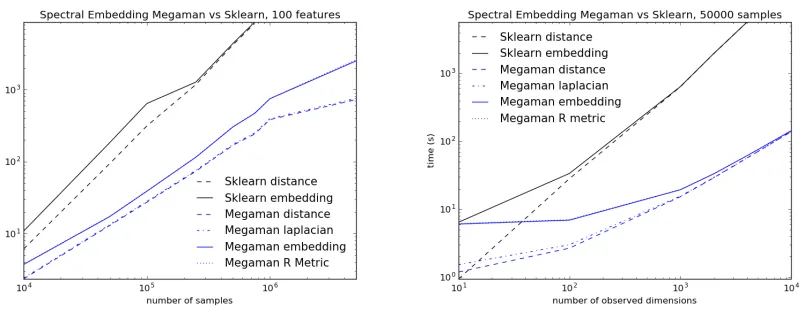
We display total embedding time (including time to compute the graph G, the Lapla-cian matrix and the embedding 2) for megaman versus scikit-learn, as the number of samplesN varies or the data dimensionDvaries (Figure 1). All benchmark computations were performed on a single desktop computer running Linux with 24.68GB RAM and a Quad-Core 3.07GHz Intel Xeon CPU. We use a relatively weak machine to demonstrate that our package can be reasonably used without high performance hardware. The experi-ments show that megamanscales considerably better than scikit-learn, even in the most favorable conditions for the latter; the memory footprint ofmegaman is smaller, even when
scikit-learn uses sparse matrices internally. The advantages grow as the data size grows, whether it is w.r.t Dor toN.
We also report run times on two real world data sets. The first is theword2vecdata set
3 which contains feature vectors in 300 dimensions for about 3 million words and phrases,
extracted from Google News. The vector representation was obtained via a multilayer neu-ral network by Mikolov et al. (2013). The second data set contains galaxy spectra from the Sloan Digital Sky Survey 4 (Abazajian et al., 2009), preprocessed as described in Telford et al. (2016).
Run time [min]
Dataset Size N Dimensions D Distances Embedding R. metric Total
Galaxies 0.7M 3750 190.5 8.9 0.1 199.5
Word2Vec 3M 300 107.9 44.8 0.6 153.3
2. For megaman we also compute the Riemannian metric estimate at each point; this time is negligible compared to the total time to obtain the embedding.
3. Theword2vecdata used were fromGoogleNews-vectors-negative300.bin.gzwhich can be downloaded fromhttps://code.google.com/archive/p/word2vec/.
Figure 1: Run time vs. data set size N for fixed D = 100 (left) and Run time vs. data set dimension D for fixedN = 50,000 (right). The data is from a Swiss Roll (in 3 dimensions) with additional noise dimensions, embedded intos= 2 dimensions by theSpectralEmbedding
algorithm. By D = 10,000 and N = 1,000,000 scikit-learn was unable to compute an embedding due to insufficient memory. Allmegamanrun times (including time between distance and embedding) are faster thanscikit-learn.
6. Conclusion
megamanputs in the hands of scientists and methodologists alike tools that enable them to apply state of the art manifold learning methods to data sets of realistic size. The package is extensible, modular, with an API familiar to scikit-learn users. Future development will be mainly in the direction of further scalability (Nystrom extension, parallelization) and expanding the data analytical tools (distance calculations, estimation of dimension, estimation of neighborhood radius, directed graph embedding).
We hope that by providing this package, non-linear dimension reduction will be benefit those who most need it: the practitioners exploring large scientific data sets.
Acknowledgments
We would like to acknowledge support for this project from the National Science Foundation (NSF grant IIS-9988642), the Multidisciplinary Research Program of the Department of De-fense (MURI N00014-00-1-0637), the Department of DeDe-fense (62-7760 “DOD Unclassified Math”), the Moore/Sloan Data Science Environment grant, and funding from the Wash-ington Research Foundation. This project grew from the Data Science Incubator program
5 at the University of Washington eScience Institute.
References
K. N. Abazajian, J. K. Adelman-McCarthy, M. A. Ag¨ueros, S. S. Allam, C. Allende Prieto, D. An, K. S. J. Anderson, S. F. Anderson, J. Annis, N. A. Bahcall, and et al. The Seventh Data Release of the Sloan Digital Sky Survey. Astrophysical Journal Supplement Series, 182:543-558, June 2009. doi: 10.1088/0067-0049/182/2/543.
M. Belkin and P. Niyogi. Laplacian eigenmaps and spectral techniques for embedding and clustering. In T. G. Dietterich, S. Becker, and Z. Ghahramani, editors, Advances in Neural Information Processing Systems 14, Cambridge, MA, 2002. MIT Press.
Mira Bernstein, Vin de Silva, John C. Langford, and Josh
Tennen-baum. Graph approximations to geodesics on embedded manifolds.
http://web.mit.edu/cocosci/isomap/BdSLT.pdf, December 2000.
Lars Buitinck, Gilles Louppe, Mathieu Blondel, Fabian Pedregosa, Andreas Mueller, Olivier Grisel, Vlad Niculae, Peter Prettenhofer, Alexandre Gramfort, Jaques Grobler, et al. API design for machine learning software: experiences from the scikit-learn project. arXiv preprint arXiv:1309.0238, 2013.
R. R. Coifman and S. Lafon. Diffusion maps. Applied and Computational Harmonic Anal-ysis, 30(1):5–30, 2006.
James McQueen, Marina Meila, Jacob VanderPlas, and Zhongyue Zhang. megaman: Man-ifold learning with millions of points. arXiv e-prints: 1603.02763, March 2016.
Tomas Mikolov, Ilya Sutskever, Kai Chen, Greg Corrado, and Jeffrey Dean. Distributed representations of words and phrases and their compositionality. In Advances in Neural Information Processing Systems 26, 2013.
Boaz Nadler, Stephane Lafon, Ronald Coifman, and Ioannis Kevrekidis. Diffusion maps, spectral clustering and eigenfunctions of Fokker-Planck operators. In Y. Weiss, B. Sch¨olkopf, and J. Platt, editors, Advances in Neural Information Processing Systems 18, pages 955–962, Cambridge, MA, 2006. MIT Press.
D. Perrault-Joncas and M. Meila. Non-linear dimensionality reduction: Riemannian metric estimation and the problem of geometric discovery. arXiv e-prints:1305.7255, May 2013.
Sam Roweis and Lawrence Saul. Nonlinear dimensionality reduction by locally linear em-bedding. Science, 290(5500):2323–2326, December 2000.
O. Grace Telford, Jacob Vanderplas, James McQueen, and Marina Meila. Metric embedding of Sloan galaxy spectra. (in preparation), 2016.