CrossMark
Published by DiscoverSys
ABSTRACT
Background: Cost minimization analysis is a pharmaco-economic study used to compare two or more health interventions that have been shown to have the same effect, similar or equivalent. With limited health insurance budget from the Indonesian National Social Security System implementation in 2015, the quality control and the drug cost are two important things that need to be focused. The application of pharmaco-economic study results in the selection and use of drugs more effectively and efficiently.
Objective: To determine cost minimization analysis of hypnotic drug between a target controlled inhalation anesthesia (TCIA) sevoflurane and a target controlled infusion (TCI) propofol in patients underwent a major oncologic surgery in Sanglah General Hospital.
Methods: Sixty ASA physical status I-II patients underwent major oncologic surgery were divided into two groups. Group A was using
TCIA sevoflurane and group B using TCI propofol. Bispectral index monitor (BIS index) was used to evaluate the depth of anesthesia. The statistical tests used are the Shapiro-Wilk test, Lavene test, Mann-Whitney U test and unpaired t-test (α = 0.05). The data analysis used the Statistical Package for Social Sciences (SPSS) for Windows. Results: In this study, the rate of drug used per unit time in group A was 0.12 ml sevoflurane per minute (± 0.03) and the group B was 7.25 mg propofol per minute (±0.98). Total cost of hypnotic drug in group A was IDR598.43 (IQR 112.47) per minute, in group B was IDR703.27 (IQR 156.73) per minute (p>0.05).
Conclusions: There was no statistically significant difference from the analysis of the drug cost minimization hypnotic drug in a major oncologic surgery using TCIA sevoflurane and TCI propofol.
Keywords: Hypnotic drug, cost minimization analysis, TCIA sevoflurane, TCI propofol
Cite This Article: Wiryana, M., Aribawa, I., Senapathi, T., Widnyana, I., Hartawan, I., Sucandra, M., Parami, P., Heryana Putra, K., Sutawan, I., Arimbawa, I., Semara Jaya, K., Semarawima, G. 2016. Cost minimization analysis of hypnotic drug: Target Controlled Inhalation Anesthesia (TCIA) sevoflurane and Target Controlled Infusion (TCI) propofol. Bali Medical Journal 5(3): 408-412. DOI:10.15562/bmj.v5i3.300
INTRODUCTION
In the healthcare reformation era, it is important to be able to demonstrate some economical values of a new technology. Healthcare reformation also put more pressure for anesthesiologist to determine the cost impact of anesthesia strategies, drugs and technologies.1-7
High cost of anesthesia has always been a prob-lem in the hospital management. As pharmacology and technology advance, there are various anesthe-sia techniques and the development of anestheanesthe-sia depth monitoring tools which could assist anes-thesiologist in determining the drug using and appropriate dosages. The development of comput-erized systems and availability of short acting drugs such as propofol and sufentanyl, made the target controlled infusion (TCI) increasingly used for total intravenous anesthesia.8 Anesthesia inhalation
technique has been making progress as well, with a low fresh gas flow 2 liter per minute (lpm) and
target controlled inhalational anesthesia (TCIA) with end tidal (ET) control which is a conductive anesthesia system available in newer anesthesia machine. It is a kind of anesthetic gas conductor system, in which the machine would automatically adjusts the concentration of anesthetic agents to achieve the desired target level set by the user.9-11
We were determined to do a research on cost minimization analysis of hypnotic drug used for general anesthesia with manually controlled TCIA sevoflurane and TCI propofol in Sanglah General Hospital 2016.
METHODS
This study is an experimental design with non-blind randomized controlled trial. The clinical trials were conducted on 60 patients who met the eligibility criteria who underwent mastectomy surgery and thyroidectomy in Sanglah General Hospital from January to March 2016.
1Professor, 2-10Lecturer,
11Head of Medical Service Division, 12Resident Anesthesiology and
Intensive Care Department, Udayana University, Sanglah General Hospital, Denpasar, Bali, Indonesia
*Correspondence to: I Gusti Ngurah Mahaalit Aribawa, MD, Anesthesiology and Intensive Care Department, Udayana University, Sanglah General Hospital, Denpasar, Bali [email protected]
Volume No.: 5
Issue: 3
First page No.: 408
P-ISSN.2089-1180
E-ISSN.2302-2914
Doi: http://dx.doi.org/10.15562/bmj.v5i3.300
ORIGINAL ARTICLE
Controlled Inhalation Anesthesia (TCIA) sevoflurane
Cost minimization analysis of hypnotic drug: Target
and Target Controlled Infusion (TCI) propofol
Made Wiryana,1 I Gusti Ngurah Mahaalit Aribawa,2* Tjokorda Gde Agung Senapathi,3
I Made Gede Widnyana,4 I Gusti Agung Gede Utara Hartawan,5 Made Agus Kresna
Sucandra,6 Pontisomaya Parami,7 Kadek Agus Heryana Putra,8 IB Krisna Jaya Sutawan,9
The inclusion criteria are: (1) admitted in our hospital from January to March 2016, (2) ASA physical status I-II, (3) 16-64 years old by the time of the admission, (4) the body height is more or equal to 130 cm, (5) the body mass index is 18.5 kg/m2 - 24.5 kg/m2, (6) willing to undergo surgery
with general anesthesia technique TCIA sevo-flurane or total intravenous use of TCI propofol by signing the informed consent, (7) the patient uses one of the following insurance as a mean of payment: National Health Insurance (JKN), Bali Mandara Health Insurance, Health Insurance for the Poor (JAMKESMAS), Indonesian National Social Security System (BPJS).
The exclusion criteria are: (1) the patient refused to participate as a research subject, (2) the bleeding during the surgery >30% Estimated Blood Volume, (3) duration of surgery <1 hour, (4) allergic to propofol, (5) allergic to sevoflurane, (6) patients with hypovolemic shock, (7) has a psychiatric disorder, (8) presents neurological deficits (9) has a heart and blood vessels disease and have experi-enced a cerebrovascular event.
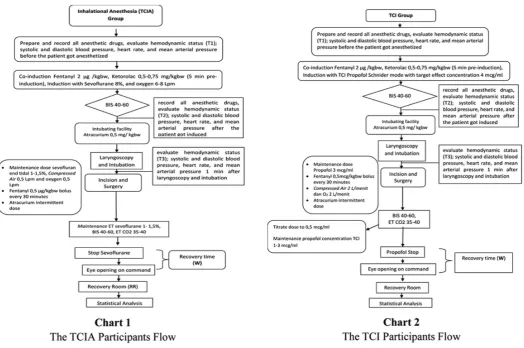
The sample was taken using a consecutive sampling technique. They were divided into two groups by randomized blocks: 30 people in one group received a general anesthesia TCIA sevoflurane, and 30 others in another group received a general anes-thesia TCI propofol. The participants flow details are available in Chart 1 and Chart 2. An analysis of cost comparison was also conducted between TCIA sevo-flurane and TCI propofol. The data analysis used the Statistical Package for Social Sciences for Windows (SPSS Inc., Chicago, version 20.0).
RESULTS
The age in both groups are normally distributed. The age in the TCIA sevoflurane group ranged from 22-63 years, with an average of 47.7 years (SD 9.9). The age in the TCI propofol group ranged from 31-63 years, with an average of 51.6 years (SD 7.8). Based on the gender, the TCIA sevoflurane group consists of 8 men and 22 women (26.7% and 73.3% respectively). The TCI propofol group consists of 5 men and 25 women (16.7% and 78.3% respec-tively). Based on the ASA physical status, the TCIA sevoflurane group consists of 11 ASA I (36.7%) and 19 ASA II (63.3%), while the TCI propofol group consists of 8 ASA I (26.7%) and 22 ASA II (73.3%). Based on the Body Mass Index (BMI), the TCIA sevoflurane group ranged from 19.1 to 24.8 kg/m2, with an average of 22.2 kg/m2 (SD 1.8). The
BMI in the TCI propofol group ranged from 17.9 to 24.5 kg/m2, with an average of 21.7 kg/m2 (SD
1.9). Based on the type of the surgery, the TCIA
Table 1 Comparison of The Duration
of Surgery, The Duration of Anesthesia and The Total Drug Used
Group TCIA
Sevoflurane TCI Propofol
n=30 n=30
Duration of surgery
(minutes, IQR) 202.00 (73) 195.50 (61) Duration of anesthesia
(minutes, IQR) 233.50 (81) 230.00 (71)
Total Drug Used
Sevoflurane
(ml ± SD) 29.06 ± 8.30 Propofol
(mg ± SD) 1723.50 ± 474.93
Ratio of drug used per unit of time
Sevoflurane
(ml/minute ± SD) 0.12 ± 0.03 Propofol
(mg/minute ± SD) 7.25 ± 0.98
Table 2 Comparison of Hypotensive
Incidents Post-induction Between The Two Groups
Side Effects
Group
p TCIA
Sevoflurane n=30 f(%)
TCI Propofol n=30 f(%)
Hypotensive
Incident 6 (20%) 5 (16.7%) 0.739
sevoflurane group consists of 17 people underwent mastectomy (56.7%) and 13 people underwent thyroidectomy (43.3%). While in the TCI propofol group, 18 people underwent a mastectomy (60%) and 12 thyroidectomies (40%).
An adverse event recorded in both groups was post-induction hypotension. The incidence of other side effects such as agitation, nausea, vomiting, bron-chospasm, cough, bradycardia and tachycardia did not occur. In the TCIA group the incidence of hypo-tension occurred was 20.0% (n=6), whereas in the TCI propofol group was 16.75% (n=5). Table 2 shows there is no significant difference between the two groups (p=0.739), based on the Pearson chi-square test.
Figure 1 shows the median recovery time in the TCIA sevoflurane group was 8 minutes, faster than the median recovery time in the TCI propofol. It
also shows a wider distribution of recovery time in the TCIA sevoflurane group than the TCI propofol group. It can be concluded that there was a statisti-cally significant difference in recovery time between the two groups (p<0.05).
The total average use of TCIA sevoflurane per anesthetic duration was as much as 0.12 ml/min (7.2 ml/hour). While the TCI propofol average use per anesthetic duration was 7.25 mg/min (435.0 mg/hour). The sevoflurane unit price in Sanglah General Hospital pharmacy in December 2015 was IDR (Indonesian Rupiah) 1,465,000 per 250 ml bottle, while the propofol price was IDR20,782 per 200 mg ampoule. This means, the sevoflurane price was IDR5,860/ml and the propofol IDR103.91/mg.
Propofol as an intravenous drug could not simply be calculated per ml usage, but it is counted by the number of the opened ampoules. However, the cost minimization analysis between the two groups has no significant difference. The price of the hypnotic drug cost for induction and mainte-nance in TCIA sevoflurane group was IDR152,360 (IQR 70,320), while in the TCI propofol the price was IDR187,038 (IQR 41,564). Based on the Mann-Whitney U test, the cost minimization analysis from the two groups has no significant difference (p=0.146). Table 3 shows the hypnotic drug cost per Table 3 Comparison of The TCIA Sevoflurane and The TCI Propofol
Costs
Group
P TCIA Sevoflurane
n=30 in IDR (IQR)
TCI Propofol n=30 in IDR (IQR)
minute was IDR598.43 (IQR 112.47) in the TCIA sevoflurane group, while the TCI propofol group was IDR703.27 (IQR 156.73). However, the statisti-cal analysis shows no significant difference between the two groups (p=0,138).
In emodynamic parameters, based on the mean arterial pressure which was depicted on TAR1 (baseline mean arterial pressure), the obtained mean difference is 2.7 (1.4-6.8, 95%CI). The mean difference of the post induction mean arterial pres-sure (TAR2) is 2.6 (-3.0-8.2, 95%CI). The mean difference of the post intubation mean arterial pressure is 2.9 (-6.0-5.2, 95%CI). The result indi-cates that in the population, the TAR clinical value did not differ between those two groups at a 95% confidence interval. The heart rate variable consists of N1 as the baseline heart rate, and N2 as the post induction heart rate, and N3 as the post intubation heart rate. The mean difference of the N1 is 2.3 (-3.1-7.7, 95%CI).
The mean difference of the N2 is -1.1 (-6-3.9, 95%CI). The mean difference of the N3is -1.9 (-7.4 -3.6, 95%CI). They indicate that in the population, the heart rate clinical value did not differ between the two treatment groups at 95% confidence interval.
In the other hand, the mean difference of the recovery time is 3.5 (1.9-5.1, 95%CI). This result suggests that in the population, the TCIA sevo-flurane patient recovers faster rather than the TCI propofol patients at 95% confidence interval. In the cost comparison of the hypnotic drug between the two groups, the mean difference is IDR17,399.9 (IDR8,457-IDR43,257, 95%CI). The result indi-cates that TCIA sevoflurane is cheaper than the TCI propofol.
DISCUSSION
The total amount of sevoflurane and propofol per duration of surgery was found different in both groups, due to the different main drug in anesthetic management. A previous research by Iswahyudi, et al. found that in a group treated with sevoflurane, the surgery lasted for 161.33 minutes (± 28.99), and the ratio of sevoflurane per time unit was 0.49 ml/min (± 0.077).12 In this study,
a BIS monitor was used to facilitate the depth of anesthesia continuously, whereas Iswahyudi et al used the index of consciousness (IOC).12-14 An end
tidal was used in our study, with a low flow control inhaled agent and technique in applied anesthesia machine. It would vary the amount of the volatile anesthetic agents given and inspired, depends on the fresh gas flow. Our study shows the ratio of drug needed is 75.51% per unit time. However, literatures stated that a bispectral index monitor
(BIS index) could reduce the dose of anesthetic drug usage by up to 30%.13-14
In this study, the recovery time in the TCIA sevoflurane group was 8 minutes (IQR 3), whereas in the TCI propofol group was 11.5 minutes (IQR 3). Despite the difference in the median recovery time, this distinction might not have a clinical effect in ASA physical status I and II patients. But, in patients with a higher physical status ASA, it would shorten the recovery time, shorten the evaluation of patients, and reduce the morbidity and the cost of care reduction.1-7
The cost minimization analysis between two groups shows no significant difference. The hypnotic drug cost in the TCIA sevoflurane group was IDR152,360 (IQR 70,320) and in the TCI propofol was IDR187,038 (IQR 41,564). The Mann-Whitney U test shows no significant difference between the two anesthetic cost (p=0.146). The cost per minute of the hypnotic drug in the TCIA sevoflurane group was IDR598.43 (IQR 112.47), whereas in the TCI propofol group was IDR703.27 (IQR 156.73). The Mann-Whitney U test also shows no significant difference (p=0.138).
Furthermore, at 95%CI, the clinical values of other variables such as TAR (mean arterial pres-sure) and N (heart rate) show no difference. But, the TCIA sevoflurane group recovers faster than the TCI propofol group at 95%CI. In addition, the cost comparison of the hypnotic drug at 95%CI shows that TCIA sevoflurane is IDR17,399.9 cheaper the TCI propofol. Based on these two findings of the recovery time and the cost difference, we recommend the use of TCIA sevoflurane over TCI propofol.
The cost analysis above did not include the costs of N2O and O2, a muscle relaxant, opioid drugs, a disposable equipment such as a nasal cannula, an orotracheal tube, an infusion set, an intravenous catheter, and gloves. The charges for running the anesthetic and the monitoring tools were not included in the calculation. And, the salaries and the wages for staff, which is the biggest cost of hospital services, were also not included in this study. We did this to know the cost of sevoflurane and propofol used for hypnotic drug in general anesthesia solely and to minimize the bias from other components.
comorbidities.8 In this study, the factors beyond
anesthesia techniques that influence the incidence of hypotension have been eliminated by patient exclu-sion. Therefore, the anesthetic technique is the only factor affecting the incidence of hypotension.
CONCLUSION
There was no significant statistical difference between the cost of the target controlled inhala-tional anesthesia using sevoflurane with a low fresh gas flow 2 liter per minute compared to the target controlled infusion using propofol in physical status ASA I-II patients who underwent a major oncologic surgery in Sanglah General Hospital, Denpasar, Bali, Indonesia. In contrast, based on the clinical values, the TCIA sevoflurane group recov-ers faster than the TCI propofol group at 95% CI. In addition, the cost comparison of the hypnotic drug at 95%CI shows that the TCIA sevoflurane is cheaper than the TCI propofol for a major onco-logic surgery with a long duration.
REFERENCES
1. Stevanovic, P.D., Petrova, G., Scepanovic, R., Perunovic, R., Stojanovic, D., Dobrasinovic, J. A Cost minimization anal-ysis low fresh gas flow balanced anesthesia versus target controlled intravenous infusion anesthesia in laparoscopic cholecystectomy. US National Library of Medicine National Institute of Health 2008; 30(9):1714-25.
2. Sinclair, C.M., Thadsad, M.K., Barker, I. Modern anaes-thetic machines. Continous Education Anaesthesia Critical Care and Pain 2014; 6:75-8.
3. Hinz. J., Rieske, N., Popov, A., Schwien, B., Mohite,P.N., Bartsch, A. Cost analysis of two anaesthetic machines: Primus and Zeus. BMC research Notes 2012; 5:3. 4. Lortat-Jacob, B., Billard, V., Buschke, W., Servin, F. Assesing
the clinical or pharmaco-economical benefit of target controlled desflurane delivery in surgical patients using
Zeus anaesthesia machine. Journal of the Association of Anaesthetists of great Britain and Ireland 2009; 64:1229-35. 5. Lockwood, G. G, White, D.C. Measuring the costs of
inhaled anesthetics. British Journal of Anesthesia 2001; 87(4):559-63
6. Loke, J., Shearer, W.A.J. Cost of anesthesia. Canada Journal of Anesthesia 1993; 40(5):472-74.
7. Potdar, M.P., Kamat, L.L., Save, M.P. Cost efficiency of target controlled inhalational anesthesia. Journal of Anaesthesiology Clinical Pharmacology 2014; 30:222-7. 8. Absalom, A.R., Struys, M. Overview of Target Controlled
Infusions and Total Intravenous Anaesthesia. 2th Ed.
English: Academia Press 2007.
9. Singaravelu, S., Barclay, P. Automated control of end tidal inhalation anaesthetic concentration using the GE Aisys Carestation. British Journal of Anaesthesia 2013; 110(4):561-6.
10. Tay, S., Wienberg, L., Peyton, P., Storys, D., Briedis, J. Financial and environmental costs of manual versus auto-mated control of end tidal gas concentrations. Anaesthesia Intensive Care 2013; 41:95-101.
11. Weich, E. 2002. Low-flow anaesthesia (how to do it). Southern African Journal of Anaesthesia and Analgesia 2002; 13:36-39.
12. Iswahyudi, Sinardja, K., Senapathi, T.G.A. Analisis biaya periode intraoperatif anestesi intravena total propofol target controlled infusion (TCI) dengan anestesi inhalasi sevoflurane pada pasien operasi bedah mayor onkologi di RSUP Sanglah Tahun 2013. Bagian Anestesiologi dan Terapi Intensif. Fakultas Kedokteran Universitas Udayana 2013.
13. Johansen, J.W., Sebel, P.S. Development and clinical application of Electroencephalographic Bispectrum Monitoring. Anesthesiology 2000; 93:1336-44.
14. Absalom, A. R., Sutcliffe N., Kenny, G. N. 2002. Closed-loop control of anesthesia using bispektral index: per-formance assessment in patients undergoing major orthopedic surgery under combined general and regional anesthesia. Anesthesiology 2002 ; 96:67-73.