Abstract—Increasing the number of prepaid subscribers is the main objective of every telecom operator. Accordingly, the telecom operator must have the ability to improve the quality of services as the number of subscribers increases. One of the systems used by customer care is the prepaid subscribers administration system (SAS). The purpose of this paper was to implement subscribers load balancing that related to users’ satisfaction and system performance. The strategy and method that were employed to develop and implement the system as follows: data collection and analysis, preparation (includes dry run process to ensure proper functions), implementation process based on Information Technology Infrastructure Library (ITIL) method and enhanced Telecom Operations Map (eTom) framework, and ultimately the final test and monitoring phase; the latter done to ensure system performance and user satisfaction.
Index Terms—Subscribers Administration System, SAS, load balancing, prepaid system, ITIL, eTOM
I. INTRODUCTION
ompetition among telecom operators in Indonesia, particularly Global System for Mobile Communications (GSM) Operators, is increasing. The number of customers/subscribers is often used as an important variable to determine a telecom operator's extent of market share. Various marketing strategies implemented by telecom operators are created for attracting new customers to use their services while still maintaining the existing customers who have used the services of such operator [1].
In Indonesia, the number of prepaid customers/subscribers differs significantly compared to postpaid customers. This requires operators to be able to improve services to end-users, especially for prepaid subscribers system. Charging System for Intelligent Network services used by the GSM operator has an important role in the handling of loyal customers’ prepaid cards. Subscribers Administration System (SAS) is one of the information technology (IT) node contained in the charging system that serves as the administrative tools that are used by
Bens Pardamean is an Associate Professor of Computer Science, BINUS Graduate Program, Bina Nusantara University, Jakarta, Indonesia (e-mail: [email protected]).
M. Dista Riza Wirman is a graduate student in Management Information System, BINUS Graduate Program, Bina Nusantara University, Jakarta, Indonesia (e-mail: [email protected]).
customer service department in providing maximum service to the end-users. The importance of process management Mobile intelligent Network Service Administration Tool (MINSAT) in setting the correct and accurate information can affect the quality level of customer service to the end-user.
Borthick and Bowen (2008) argue that there is a need for the development of systems and applications simulation to respond to a changing technological development [2]. The simulation also helps to improve a person's ability to perform technical design associated with the results of the audit, to troubleshoot procedures associated with running systems, and to conduct system testing [2]. Hoffman (2008) states the density of data traffic on telecommunications networks can cause system overload due to excessive capacity at each node point; thus, to maintain efficiency it is necessary for a system to have a balanced work load [3].
Application performance improvements in information technology include security, module, audit changes, and new system workflow [4]. It was also stated that the combination of technology and network had been proven over last seven years to move new production in some organizations. Reyes (2001) states that the importance of controlling existing application against the possibility of failure may be related to the control mechanism of the internal audit process. In general, the audit result from the internal process, if applied properly, would produce a system that works well with any suitable model [5].
The paper describes the implementation methodology based on the concept of Information Technology Infrastructure Library (ITIL) - Service Operation (SO) and Continuity Service Improvement (CSI); all within the context of determining implementation strategies in the execution of an internship field project. ITIL has been proven to be the best, widely-used practice in both industry and public. Subscribers Administration System (SAS) is an IT node and an important part of the Charging System. The suitable framework to be applied in general IT related functions is the concept of ITIL [6], but specifically in the telecommunications industry, the eTOM or the corresponding Business Process Framework is the most applicable method to be used [7].
Intelligent Networks (IN) is a concept used in telecommunications networks, which is still being developed around the world to support the mobile telecommunications net-work operators, to provide fast and efficient services to prepaid customers. Each IN within telecommunications systems involves the concept of search/response [8]. For
Subscribers Load Balancing Implementation
on Prepaid System
Bens Pardamean and M. Dista Riza Wirman
Bina Nusantara University, Jakarta
16 INTERNETWORKING INDONESIA JOURNAL PARDAMEAN & WIRMAN
example, the mobile has a central switching logic IN order to post or find a message from the database in a network element called the Service Control Point (SCP). Fig. 1 shows the Intelligent Network Conceptual Model.
Fig. 1. Intelligent Network Conceptual Model [8]
The Intelligent Network Conceptual Models (INCM) forms a framework for design and capabilities for IN design. INCM is represented by several planes: Service, Global Functional, Distributed Functional, and Physical. These planes are the domains of the services and their features, the service's independent components, functional entities & information
flow, as well as physical nodes and protocol interfaces respectively. The design of INAP (Intelligent Network Application Part) and CAMEL (Customized Application for Mobile Network Enhanced) networks and applications are based on the technology framework as defined by the INCM [8].
Many GSM Networks operators still rely on operator specific IN Solutions and/or proprietary extensions of core INAP capabilities for services such as mobile virtual private network, virtual PBX (Private Branch eXchange), personal number service, and call screening. The primary reason for this is that INAP preceded CAMEL, rendering its great functionality.
On the other hand, CAMEL was developed to provide a standard for mobile intelligence across varying vendor equipment for GSM networks. This means that participating mobile network operators who deploy CAMEL-based services may provide advanced services to each other's respective roaming mobile users.
Mobile IN continues to be developed to provide the ability to provide value added services for the prepaid telecom operator that aims to reduce operating costs, improve service to customers, increase the variety of quality services, accelerate the process of creation and development.
Stretch and Adam (2005) state that the standardization of a system is the key to the success of the telecommunications industry, particularly in the area of Intelligent Network [9].
Fig. 2. OMA Technical Plenary Structure [9]
As shown in Fig. 2, standardization may include: 1. International standards
2. Intelligent networks
3. Open Mobile Alliance (OMA)
Fig. 3. eTOM Business Process Framework [7]
The number of prepaid subscribers has increased significantly but many features released by telecom providers have decreased in Subscribers Administration System performance and user satisfaction. The system performance has an impact to end-users who have complained to Customer Care about the quality of service, creating the need for a solution to these problems.
II.METHODOLOGY
The strategy used during the implementation phase had both qualitative and quantitative tests. A qualitative approach utlilized the ITIL method (Service Support - Operational Level) against the problem that had occurred (ITIL-Problem and Incident Management) [11] as well as the implementation using eTOM Business Process Framework-Operations [12]. Therefore, it could achieve the correct model to solve the main problem in the system used by the Customer Care. Fig. 4 describes ITIL version 3.
18 INTERNETWORKING INDONESIA JOURNAL PARDAMEAN & WIRMAN
The qualitative test was utilized by measuring the system performance and quantitative test by conducting the pre-test
questionnaire. Fig. 5 describes the strategy used to conduct the implementation phase.
Background Customer
Complain
System Performance
Legacy System
Literature Study: Jurnal, Text Book, Online Document, Internal Document
Statement of Problem
Data Analysis
Framework: ITIL/eTOM Implementation
Result
Customer Input, System Users
Fig. 5 Strategy of Implementation Phase
The implementation phase could also be quantitatively evaluated to determine the users’ reaction based on several criteria perceptions, such as perceived usefulness, perceived ease of use, behavioral intention of use, up until the actual system use.
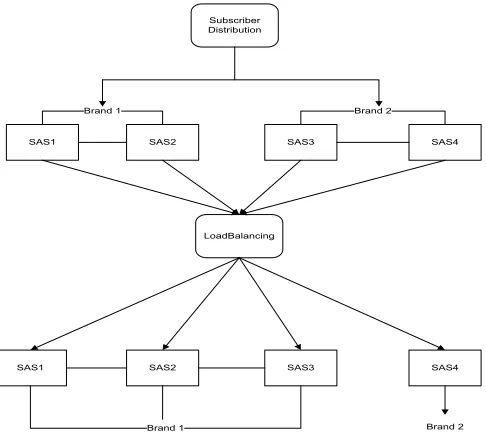
This phase was based on the problem that frequently occurs since the performance decline of Subscribers’ Administration System (SAS). This occurred due to the system's reaching its maximum capacity (32 million subscribers per system). Meanwhile, subscribers provisioning were always there. Thus, to increase its performance, it needed to rebalance the system by solution implementation. Fig. 6 shows the project implementation method.
Based on dimensioning, the system had reached maximum capacity and was even over its optimum capacity in handling subscriber numbers that continue to increase [12]. The following is the data collected prior to implementation: SAS1 = 36.5 million subscribers
SAS2 = 31.2 million subscribers SAS3 = 9.6 million subscribers SAS4 = 12.2 million subscribers
As seen in the data, SAS1 had reached 36.5 million subscribers despite the optimum capacity of 32 million subscribers [13]. In such circumstances, there is an imbalance in the subscriber distribution, in which SAS1 has the largest number of subscribers relative to the other SAS. Ideally, each SAS should have a uniform distribution, with the most ideal
condition distributing approximately 22 million subscribers to every SAS.
Subscriber Distribution
SAS1 SAS2 SAS3 SAS4
LoadBalancing
SAS1 SAS2 SAS3 SAS4 Brand 1 Brand 2
Brand 1 Brand 2
Fig. 6 The Project Implementation Method
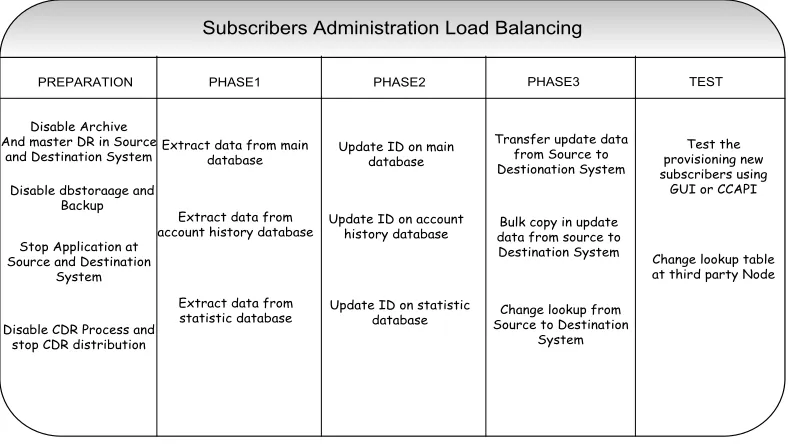
Subscribers Administration Load Balancing
PREPARATION PHASE1 PHASE2 PHASE3 TEST
Disable Archive And master DR in Source
and Destination System
Disable CDR Process and stop CDR distribution
Stop Application at Source and Destination
System Disable dbstoraage and
Backup
Extract data from main database
Extract data from account history database
Extract data from statistic database
Update ID on main database
Update ID on account history database
Update ID on statistic database
Transfer update data from Source to Destionation System
Bulk copy in update data from source to Destination System
Change lookup from Source to Destination
System
Test the provisioning new subscribers using
GUI or CCAPI
Change lookup table at third party Node
Fig. 7 The Load Balancing Methodology
The methodology used for the implementation phase is depicted by Fig. 7, detailing the step-wise procedure of load balancing. Every step started from preparation until test described the detail processes needed to be followed so this could run smoothly.
Preparation
This step includes backup database dump, stop all application process and framework, stop all process coming from 3rd Party Product (3PP) that had transaction with SAS, and changing the lookup number series table on related node.
Phase1
This step has the extraction process, which consists of extracting all data from each database to collect main account data, account history, and statistic data for reporting.
Phase2
Update ID from migration data in each database.
Phase3
Transfer migration data with a new ID updated to destination system using bulk copy method.
Test
Test the provisioning new subscribers using GUI (Graphical User Interface) and CCAPI (Customer Care Application Process Interface).
III. RESULT
The result from the implementation was successful at evenly distributing the customer data across all four Subscribers Administration System (SAS). Three systems are allocated for one brand and the last one for a brand with fewer subscribers than the other brand.
The objective was to overcome the system limitation in dealing with the growing number of prepaid subscribers installed and to optimize the system performance that could ultimately improve the quality of Customer Service operators that use the system as their supporting tools to handle end-user services.
Fig. 8 describes the general output of this implementation.
Sa s 3 SAS 4
b a t c h 1
SAS 2
SAS 1
SAS 3 b a t c h 2
b a t c h 3
Fig. 8 General Output
Considering the subscriber load of SAS1 and SAS2, load-balancing among the four SASes was proposed. This increased the number of generated CDRs (Call Data Records) and better performance of Subscribers Administration System during peak hours. Table 1 describes the output table for subscribers distribution.
TABLE1
UNITS FOR MAGNETIC PROPERTIES OUTPUT TABLE FOR SUBSCRIBERS
DISTRIBUTION
# Original SAS
Destina tion
SAS Partial/All Subscribers Number of of batch Number
1 SAS3 SAS4 All
9,473,083 2
2 SAS2 SAS3 Partial 9,079,563 2
3 SAS1 SAS3 Partial
20 INTERNETWORKING INDONESIA JOURNAL PARDAMEAN & WIRMAN
Table 1 shows the number of subscribers that moved from the original SAS to the destination SAS. SAS3 was the first batch migration with a total of +/- 9.5 million subscribers. This represented all subscribers from SAS3 moving to SAS4, increasing the latter's subscribers to 22 million subscribers from 13 million. It was divided into two batches of implementation, taking into account the downtime allowed during migration. SAS3 remained empty until some subscribers from SAS2 and SAS1 were moved to SAS3.
Fig. 8 shows the number of subscribers that moved from the original SAS to the destination SAS. SAS3 was the first batch migration with a total of +/- 9.5 million subscribers. This represented all subscribers from SAS3 moving to SAS4, increasing the latter's subscribers to 22 million subscribers from 13 million. It was divided into two batches of implementation, taking into account the downtime allowed during migration. SAS3 remained empty until some subscribers from SAS2 and SAS1 were moved to SAS3.
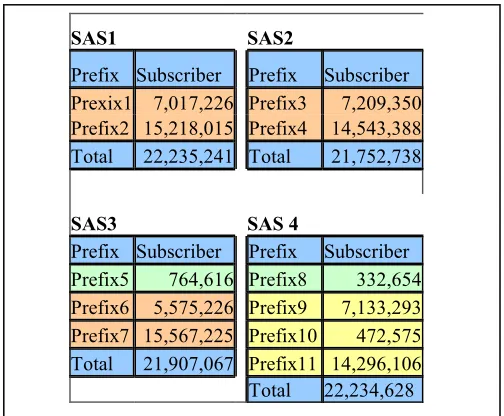
The final subscribers distribution is shown in Fig. 9 with total subscribers stored in each SAS averaging 22 million subscribers, achieving the desired storage balance. Within the last distribution of SAS with some prefixes moved from one SAS to another, the system is now improved. as shown by the tests report, detailing that there is an increase in the total provisioning success and a decrease in failure. No queuing lifecycle process coming to SAS and Customer Care to re-use
the expiry subscribers that need to be activated again and sold to end-users.
Fig. 9 Final Configurations
The comparative results between pre and post implementation are detailed in Table 2.
TABLE 2
QUALITATIVE RESULT PRE AND POST IMPLEMENTATION
Pre-Implementation Paramater Post-Implementation
32,000,000 Capacity Maximum 32,000,000
32,732,409 Total Subscribers Installed in SAS1 22,254,290
30,353,943 Total Subscribers installed in SAS2 22,089,449
9,637,186 Total Subscribers installed in SAS3 22,331,368
12,614,621 Total Subscribers installed in SAS4 22,357,418
10,000 Provisioning Speed (per hour) 50,000
20 Mass. Exp. Subs. Speed (per minute) 110
IV. CONCLUSION
Subscribers Administration System (SAS) is a system used by Customer Service Operation at a telecom service provider to serve the needs of end-users daily. The implementation was based on the declining performance of the system due to growing numbers of prepaid subscribers in telecom service provider as well as the limitation of the system itself.
The implementation of system optimization was done through a rebalancing of the system. The analysis on the numbers of subscribers installed on each system determined the particular brand and number series prefix (5 digits). By utilizing a proper method of ITIL and eTOM as the basis of implementation, the system worked optimally to support the Customer Service Operator in providing satisfactory service to customers as well as to improve the service quality of the telecom provider itself.
REFERENCES
[1] Wan, S. H. C., & Chan, Y., Improving service management in outsourced IT operations, Journal of Facilities Management, Vol. 5, No. 3, 2007, pp. 188-20.
[2] Borthick, A. F., & Bowen, P. L., Auditing system development: Constructing the meaning of "systematic and rational" in the context of legacy code migration for vendor incentives, Journal of Information Systems, Vo. 22, No. 1, 2008, pp. 47-62.
[3] Hoffman, T., A Telco giant gets agile, Computerworld, Vo. 42, No. 18, 2008, pp. 30-31.
[4] Alfaraj, H., & Qin, S., Deriving software acquisition process from maturity models-an experience report, Journal of Software Engineering and Applications,Vol. 3, No. 3, 2010, pp. 280-286. [5] Reyes, A., Second-order auditing practices, Systemic Practice and
Action Research, Vol. 14, No. 2, 2001, pp. 157-180.
[6] Scheepers, H., & Scheepers, R., A process-focused decision framework for analyzing the business value potential of IT investments,
Information Systems Frontiers, Vol. 10, No. 3, 2008, pp. 321-330. [7] Kelly, M. B., Report: The TeleManagement forums enhanced telecom
operations map (eTOM). Journal of Network and Systems Management, Vol. 11, No. 1, 2003, pp. 109-109.
SAS1 SAS2
Prefix Subscriber Prefix Subscriber Prexix1 7,017,226 Prefix3 7,209,350 Prefix2 15,218,015 Prefix4 14,543,388 Total 22,235,241 Total 21,752,738
SAS3 SAS 4
Prefix Subscriber Prefix Subscriber Prefix5 764,616 Prefix8 332,654 Prefix6 5,575,226 Prefix9 7,133,293 Prefix7 15,567,225 Prefix10 472,575 Total 21,907,067 Prefix11 14,296,106
[8] Mobile Intelligent Network Mobile Retrieved from http://www.mobilein.com/Mobile%20Intelligent%20Networking.pdf, 2005.
[9] Stretch, R. M., & Adams, P. M., Standards for intelligent networks, BT Technology Journal, Vol. 23, No. 1, 2005, pp. 154-159.
[10] TM forum: Business process framework (eTOM) version 8.0 aligns IT, business views; service providers and enterprise customers can reduce costs and speed time to market if they close the gap between IT and operations, M2 Presswire, Retrieved from http://search.proquest. com/docview/444359612?accountid=31532, 2008.
[11] Chand, P., Building A standards driven security framework for new generation operations software and systems (NGOSS)--the TeleManagement Forum (TMF) approach. Journal of Network and Systems Management, Vol.13, No. 3, 2005, pp. 345-350.
[12] Bruce, G., Robson, P., & Shaven, R., OSS opportunities in open source software - CRM and OSS standards, BT Technology Journal, Vol. 24, No. 1, 2006, pp. 127-140.
[13] Active Library Explorer, System Description Charging System 3.0 - System Overview. Charging System 3.0 CP4, 2007.
Bens Pardamean is an Associate Professor of Computer Science at BINUS Graduate Program, Bina Nusantara University, Jakarta, Indonesia.
![Fig. 1. Intelligent Network Conceptual Model [8]](https://thumb-us.123doks.com/thumbv2/123dok_us/8755555.1749818/2.612.122.492.387.650/fig-intelligent-network-conceptual-model.webp)
![Fig. 3. eTOM Business Process Framework [7]](https://thumb-us.123doks.com/thumbv2/123dok_us/8755555.1749818/3.612.321.558.494.719/fig-etom-business-process-framework.webp)