Available Online at www.ijpret.com
650
INTERNATIONAL JOURNAL OF PURE AND
APPLIED RESEARCH IN ENGINEERING AND
TECHNOLOGY
A PATH FOR HORIZING YOUR INNOVATIVE WORK
A REVIEW ON TEMPLATE SECURITY SCHEME FOR SECURE BIOMETRIC
AUTHENTICATION
MRS. SWATI A. JADHAV
PG Student, MCERC, Nasik, MH.
Accepted Date: 15/02/2014 ; Published Date: 01/04/2014
\
Abstract: With the fast evolution in sensor technology biometric authentication system becomes more popular in daily lives. However securing these biometric templates is primary need for researcher. The growing use of biometrics has lead to rising concerns about the network security, privacy, trust issues and accuracy. From the earlier research work it has been observed that there are many template protection schemes available to secure biometric template and provide remote authentication. But these systems are not full proof to provide better security. This review paper gives idea about existing biometric template protection schemes based on various approach such as feature transformation and cryptosystem. Biometric template data must be protected to prevent information leakage in case of template compromise. Recently there are many template protection schemes available to provide better security and maintain user’s privacy. In this paper various technique are reviewed related with user’s privacy, template protection, network security and comparison between them.
Keywords: Privacy, Security, Template Protection, ECC, RSA.
Corresponding Author: MRS. SWATI A. JADHAV
Access Online On:
www.ijpret.com
How to Cite This Article:
Available Online at www.ijpret.com
651 INTRODUCTION
Biometric techniques offer a natural and reliable solution for identifying person with their physical and behavioral characteristics like fingerprint, face, iris, palm, etc. Previously, to provide template security the focus of biometrics researcher put on accuracy, speed, cost, and robustness challenges but only recently some attentions have been paid to security and privacy issues of biometric systems. That is the set of extracted biometric features stored in a central database or in a smartcard that makes up the unique features of biometric stored in a template. Biometric data is inherently linked to an individual and can reveal private information about that individual such as their forebears, personality or any confidential data. However, securing biometric template in insecure network is great challenge. Because once it is compromised or stolen it cannot be revoked. The growing use of biometric systems in many real life applications raises some privacy and security concerns [1]. Public acceptance of biometric systems has a critical impact on their success due to their potential misuse of biometric data. Unlike passwords and tokens, compromised biometric templates cannot be revoked and reissued. Therefore it is illegally acquired by an attacker, not only the security of the system is at risk but the privacy and the security of the user may be compromised forever too. So granting template security is one of the most important issues in practical. The need of protecting user sensitive information locally and performing secure user authentication remotely become more increasing in many real time applications.
A. bio-cryptography as solution
Biometric and cryptography could become complementary to each other. It is reasonable and feasible to incorporate biometric into the cryptographic infrastructure to provide network security. Bio-Cryptography is emerging as a powerful solution to provide template security which can combine the advantages of conventional cryptography and biometric security. Cryptography is a conventional method of authenticating users and protecting communication messages in insecure networks. Whereas user can access encrypted content of file only if he having right key. However, cryptography has its own drawbacks like sometimes an attacker may obtain the cryptographic key via an illegal ways and then act as an authentic user [3]. The capabilities of cryptosystems such as of RSA and Diffie-Hellman are inadequate to provide better security due to requirement of large number of bits[15].A lot of work done by researcher
on various encryption algorithm [4] (AES, DES, 3DES, Diffie-Hellman,
Available Online at www.ijpret.com
652 II.LITERATURE SURVEY
This section reviews all existing biometric template protection schemes and compares their advantages and limitation in terms of security, revocability and matching of captured image. Over the years a number of attempts have been made to address the problem of template protection and privacy concerns.
Figure1: Template protection scheme
The first feature transformation approach known as Salting [2] offers security using a transformation function seeded by a user specific key. The strength of the approach lies in the strength of the key. A classifier is designed in the encrypted feature space. Its disadvantage is made compromise between security and performance.
B. SALTING
Kong et al. [7] do a detailed analysis of the current bio-hashing based on biometric approaches. They conclude that the zero equal error rate (EER) reported by many papers is obtained in carefully set experimental conditions and unrealistic under assumptions from a practical view point.
C. NONINVERTIBLE TRANSFORM
In this approach a trait specific noninvertible function on the biometric template to secure it. Robust hashing and cancelable biometric [8] fall in this category to replace a leaked template, while reducing the amount of information revealed through the leak. Privacy is not maintained in this approach.
Boult et. al [9] extended the above approach to stronger encryption, and proposed an encrypted minutia representation and matching scheme of fingerprints. In which a Biotoken consists of the encrypted integer part and the increment information in plain. The approach
Template Protection
Feature Transformation
Biometric Cryptosystem
Salting Noninvertible Transform
Key Binding
Available Online at www.ijpret.com
653 provides provable template security as a strong encryption is used. Its drawback is making compromised between security and accuracy. The third and fourth class, are both variations of Biometric cryptosystems. They try to integrate the advantages of both biometrics and cryptography to enhance the overall security and privacy of an authentication system.
D. KEY BINDING
Juels and Sudan [10] proposed a cryptographic construction called fuzzy vault. The general idea is to hide the cryptographic key in a scrambled list which is composed of genuine fingerprint features and fabricated chaff features. It lacks in diversity and revocability.
C. Soutar et al. [11] proposed a key-binding algorithm using correlation-based fingerprint matching method. In the algorithm, a cryptographic key extracts only limited features and the corresponding user’s fingerprint image are bound at the enrollment stage. Recent research outcome on bio-cryptographic includes bio-hashing, cancelable template, fuzzy extractor and fuzzy vault.
E. KEY GENERAING
Fuzzy extractor is a type of key generating approach designed by researcher Y.Dodis [12] to convert noisy data. It is a combination of a primitive called a Secure Sketch and a Strong Randomness Extractor. The Secure Sketch generates public help data which are related to the input but does not reveal biometric information. To achieve high entropy random extractor maps the string uniformly.
Maneesh Upmanyu et.al.[ 13] proposed blind authentication protocol using biometric features and public key cryptography (RSA). In which server is become secure. While exchanging information between client and server, it does not reveal additional features about biometric than identity.
Available Online at www.ijpret.com
654 etc. Following Table 1 summarizes existing template security mechanism with their effects and researcher opinion.
III. VULNERABILITIES OF BIOMETRIC SYSTEM:
A denial of service occurs when the system doesn’t recognize a legitimate user, while an intrusion refers to the scenario in which the system incorrectly identifies an impostor as an authorized user. Unlike a password-based authentication system, which requires a perfect match between two alphanumeric strings, a biometric-based authentication system relies on the similarity between two biometric samples.
External adversaries can also cause a biometric system to fail through direct attacks on the user interface (sensor), the feature extractor and matcher modules, the interconnections between the modules, and the template database. Examples of attacks targeting the system modules and their interconnections include Trojan horse, man-in-the-middle, and replay attacks. As most of these attacks are also applicable to password-based authentication systems, several countermeasures like cryptography, time stamps, and mutual authentication are available to prevent them or minimize their impact. A false nonmatch occurs when two samples from the same individual have low similarity and the system can’t correctly match them. A false match occurs when two samples from different individuals have high similarity and the system incorrectly declares them as a match.
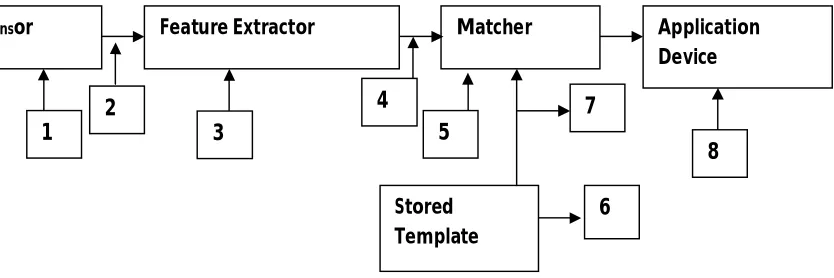
Figure 2: Attack places on a Biometric System
i. Attack1: Attack on sensor device cause a denial of service.
Attack2: Attack on the channel in that attacker intercepts the communication channel
iii. Attack 3: Attacker can replace the feature extractor module with a Trojan horse .
Sensor Feature Extractor Matcher Application
Device
Stored Template
1
2 4
3 5
7
6
Available Online at www.ijpret.com
655 iv. Attack 4: Attacker can steal features of user and replay them to the matcher.
v. Attack 5: Attacker replaces the matcher with a Trojan horse. Then send commands to the Trojan horse to produce high matching scores and send a “Yes” to the application to bypass system.
vi. Attack 6: Attacker compromises the security of the database where all original templates are stored or trying to crack an account.
vii.Attack7:Attacker intercepts communication channel between the database and matcher to either steal and replay data.
viii.Attack8:Attacker intercept communication channel between the matcher and the application to replay previously submitted data or alter data.
ix. Attack9: Not every biometric system is full proof for better security. There should one bug in every software.
IV. Existing System
In existing system biometric is combined with public key cryptography such as RSA. Due to it's large key size RSA require large time for encryption thus increases computation time and key generation time. Also number of features is fixed for biometric key generation. Only black and white images are tested for verification of protocol.
V. Proposed system
Available Online at www.ijpret.com
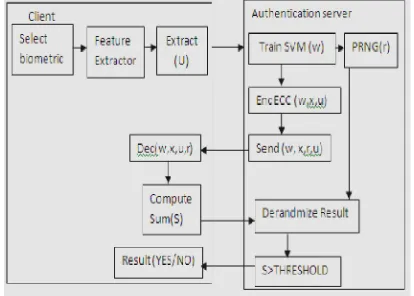
656 Figure 3.1 block diagram for Authentication
Graph1: Comparison between ECC &RSA Encryption
0 0.5 1 1.5 2 2.5
MMU IRISCOLOR IRISCASIA IRIS UB IRIS REAL IMG RSA ENCR
Available Online at www.ijpret.com 657 Sr. No. Researcher name
Year Template Protection
Scheme
Concluding Remarks
1. Koblitz and
Miller et.al
1985 Using Elliptic curve
cryptography how to
generate a pseudo-random sequence
Gives security with short key size and Random no. difficult in discrete logarithm
2. Guang gong 1991 Uses the unconditional
Randomness to measure the EC-sequences
3. C. Souter 2000 Uses digital key for 2D
images
Extract only limited feature of image
4. F. monrose 2001 When user speak it
generate key from voice for securing biometric
User can speak password in its own device. intelligent user can recognize only 104 words
5. Sumanth
Tamma
2002 Using matrix values Multiple dimension of face used
Changed expression unable to detect Face so use eigenfaces
6. Mayank et.al 2005 Robust biometric image
watermarking
By use of wavelet watermark Embedding face image in fingerprint
7. Teddy Ko 2005 Multimodal biometric Able to combine two or more
biometric using local
nonnegative matrix
factorization
8. Muhammad 2006 Feature based, template
based,
appearance based
Knowledge about entire
image
Available Online at www.ijpret.com
658 VI. Expected result
It is expected that Proposed system able to provide small key size for biometric template encryption. So it require less encryption time and key generation time. In RSA choosing large prime number say 200 digits and multiply together it is very large (400 digits) and factoring
et.al cannot be changed
10. Yagitz sutcu 2007 Secure sketch Is solution over digital key
11. Deepthi 2009 Stream cipher based on
elliptic curve point multiplication over GF(2m).
12. P. S. Revenkar
et.al,
Pareek,
I. Ismail et.al
2010 1.Visual cryptography
2.Generate random bit
based on chaotic maps ,
3.Chaos-based stream
cipher
1.secret image encrypted into shares which does not reveal original image.
3.key is modify after encrypt of each pixel of plain image
13. Emanuela
Marasco
2010 Multimodal biometric
scheme
Due to more than one biometric cost is more and not secure than unimodel, vulnerable to spoof attack
14. Maria et.al 2011 Elliptic Curve based Key
Generation for Symmetric Encryption
encryption/decryption of an image in spatial domain
15. Mr. P.
Balakumar et.al
2011 Key Generation Scheme for
Cryptography using
Combined Biometric
Features of Fingerprint and Iris
Provide better security than RSA with small key size
Available Online at www.ijpret.com
659 large prime number is difficult. Also finding prime numbers from product is difficult and intractable. As NIST recommend some key size for ECC and RSA comparison. Due to ECC small key size it applicable in small devices such as RFID, Mobile OS, Smart card where limited memory is require. ECC offers similar level of security that can achieve with small key size. ECC is based on difficulties of solving discrete logarithm over integer and integer factorization. In future ECC is best choice for network security due to its strong mathematical structure.
VII.SUMMARY
After studying detailed literature on template security scheme it has been observed that, although there are many template security mechanism available they lack in meeting requirement such as user’s privacy, revocability, security, and accuracy in biometric verification. From the study of template security mechanism discussed in this paper many researcher put focus on biometric cryptography approach. Key generating approach is mostly suitable for template security and privacy in which due to random number generator additional information about biometric is not revealed. This review highlights the need of further research on combining standard cryptography technique with biometric to provide better security.
REFERENCES
1. A. K. Jain et.al, “Biometric template security”, EURASIP J. Adv. Signal Process. 2008.
2. A. Teoh, D. Ngo, and A. Goh, “Biohashing: Two factor authentication featuring fingerprint
data and tokenised random number,” Pattern Recognit., vol. 37, no. 11, pp. 2245–2255, Nov. 2004.
3. Kai Xi et.al “A fingerprint based bio-cryptographic security protocol designed for client/server
authentication in mobile computing environment”, Security and communication networks, Issue paper,2010.
4. R. L Rivest, A. Shamir, and L. Adleman, “A Method for Obtaining Digital Signatures and
Public-Key Cryptosystems”, MIT Laboratory for Computer Science and Department of Mathematics, ACM 0001-0782178/0200-0120.
5. Arun Kumar et.al., “A Comparative Study of Public Key Cryptosystem based on ECC and RSA”,
Available Online at www.ijpret.com
660
6. Yasser Salem Mohamed Ali, “Implementation of Elliptic Curve Cryptography using biometric
features to enhance security services”, Master of Comp. Science, Thesis, pp.17-38,July 2009.
7. A. L. Jeeva et.al “Comparative analysis of performance efficiency and security measures of
some encryption algorithms”, IJERA, Vol. 2, Issue 3, pp.3033-3037 ,May-Jun 2012.
8. A. Kong, K. Cheung, D. Zhang, M. Kamel, and J. You, “An analysis of biohashing and its
variants”, Pattern Recognition., vol. 39, no. 7, pp.1359–1368, July 2006.
9. M. Savvides and B. V. Kumar, “Cancellable biometric filters for face recognition”, Int. Conf.
Pattern Recognition (ICPR), 2004, vol. 3, pp. 922–925.
10.T. Boult, W. Scheirer, and R. Woodworth, “Revocable fingerprint biotokens: Accuracy and
security analysis”, IEEE Conf.(CVPR), pp. 1–8, June 2007.
11. A. Juels and M. Sudan, “A fuzzy vault scheme”, Designs, Codes and Cryptography, vol. 38, no. 2, pp. 237– 257, 2006.
12. C. Soutar, D. Roberge, A. Stoianov, R. Gilroy, and B. V. K. V. Kumar, “Biometric Encryption” in ICSA Guide to Cryptography, R. K. Nichols, Ed., McGraw Hill, New York, NY, USA, 1999.
13.Y. Dodis, L. Reyzin, and A. Smith, “Fuzzy extractors: How to generate strong keys from
biometrics and other noisy data”, Eurocrypt, pp. 523–540, 2004.
14.Maneesh Upmanyu, “Blind Authentication: A Secure Crypto-Biometric Verification
Protocol”, IEEE Trans, Information Forensics and Security, Vol. 5, No. 2, June 2010.
15. S. Maria et.al, “Nonce Based Elliptic Curve Cryptosystem for Text and Image Applications”, Int. Journal of Network Security, Vol.14, No.4, PP.236-242, July 2012.