Management and Research
Available online at: www.ijstmr.comIJSTMR © 2017 | All Rights Reserved 24
A Efficinet Pruninng Approach to Discover
Interesting Pattern Form Large Data Set
Amit Lalaso Kumbhar1 M. Tech.(CSE) IV Semester . Lord Krishna College of Technology
Indore M.P. India
Vijay Kumar Verma2
Asst Professor C.S.E
Lord Krishna College of Technology Indore M.P. India
Abstract: - Utility item set mining is addition to the frequent pattern mining. The utility is a measure of that how an item is useful in term of profitable. The utility of an item set X, denoted by u(X), which is the sum of the all utilities of item set X in all the transactions containing X. An item set X is called a high utility item set if and only if u(X) greater than or equal to threshold value. Utility threshold is a user defined value. The main objective of high-utility item set is mining meaningful item based on utility threshold. Several algorithms like FUM, TP, MUE, IFUM etc. have been proposed in past year In This paper we proposed a proficient approach reduces search space, number of candidates and reduce calculations.
Keywords: -Utility, Candidates, Transactions, Thresholds, Item set.
1. INTRODUCTION
Mining high utility item sets thus upgrades the standard frequent item set mining. User-defined utility is based on information not available in the transaction dataset. It often reflects user preference and can be represented by an external utility table or utility function. Utility table (or function) defines utilities of all items in a given database. Besides subjective external utility we also need transaction dependent internal utilities (e.g. quantities of items in transactions). Utility function we use to compute utility of an item set takes into account both internal and external utility of all items in an item set
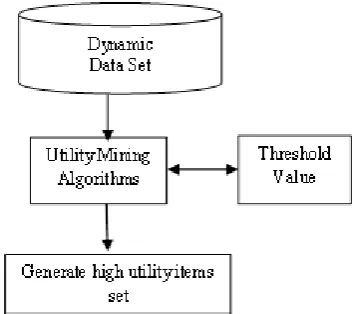
Figure 1. Architecture of utility Item set mining
II. BACKGROUND
External Utility: - The external utility of an item ip is a numerical value yp defined by the user. It is transaction
IJSTMR © 2017 | All Rights Reserved 25 Internal Utility:-The internal utility of an item ip is a numerical value xp which is transaction dependent. In most cases it
is defined as the quantity of an item in transaction. For example, internal utility of item I5 in transaction T5 is 2 in table 1.
The utility of item: - The utility of item ip in transaction T is the quantitative measure computed with utility function
from above definition u(ip, T) = f(xp, yp), ip∈ T . For example: utility of item I5 in transaction T5 is 2 ∗ 5 = 10.
The utility of itemset S in transaction T: - The utility of itemset S in transaction T is defined as
For example utility of itemset {I2, I5} in transaction T2 is
u({I2,I5} , T2) = u({I2} , T2) + u({I5} , T2) = 6 ∗ 10 + 1 ∗ 5 = 65.
The utility of item ip in itemset S: - The utility of item ip in itemset S is defined as
For example, utility of item E in itemset {I2, I5} is u(I5, {I2,I5}) = u(I5, T2) + u(I5, T7) + u(I5, T10) = 20.
The utility of itemset S in database DB: - The utility of itemset S in database DB is defined as
For example, utility of itemset {I1,I5} in database from Table 1 is
Consider a simple example of transactional database
TID & ITEM I1 I2 I3 I4 I5
T1 0 0 18 0 1
T2 0 6 0 1 1
T3 2 0 1 0 1
T4 1 0 0 1 1
T5 0 0 4 0 2
T6 1 1 0 0 0
T7 0 10 0 1 1
T8 3 0 25 3 1
T9 1 1 0 0 0
T10 0 6 2 0 2
Table 1 Transactional data set
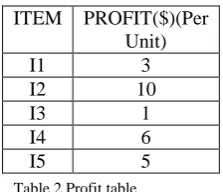
The utility table, the right column displays the profit of each item per unit in dollars
Table 2 Profit table
u({I1,I5}) = u({I1,I5} , T3) + u({I1,I5} , T4) + u({I1,I5E} , T8) = 33.
The utility of transaction T:- The utility of transaction T is defined as
For example: utility of transaction T10 is
u(T10) = u({I2} , T10)+u({I3} , T10)+ u({I3} , T10) = 72.
ITEM PROFIT($)(Per Unit)
I1 3
I2 10
I3 1
I4 6
IJSTMR © 2017 | All Rights Reserved 26 The utility of database DB :- The utility of database DB is defined as
For example, utility of database DB from table 1 and table 2 is u(DB) = u(T1) + . . . +u(T10) = 23 + . . . + 72 = 400.
The utility share of itemset S in database:- The utility share of itemset S in database DB is
For example, utility share of itemset {I1,I4,I5} in database from Table 1 is U({I1,I4,I5}) = 46/400 = 0.115 = 11.5%.
III. LITERATURE REVIEW
In (1994) Agarwal proposed the mining of association rules for finding the relationships between data items in large databases.
In 2003 Chan observes that the candidate set pruning strategy exploring the ant monotone property used in classical algorithm does not hold for utility mining.
In 2004 Yao defines the problem of utility mining formally. The work defines the terms transaction utility and external utility of an itemset. The mathematical model of utility mining was then defined based on the two properties of utility bound and support bound.
In 2006, 2007 Yao defines the utility mining problem as one of the cases of constraint mining. This work shows that the downward closure property used in the standard Classical algorithm and the convertible constraint property are not directly applicable to the utility mining problem.
In 2008 Li proposed two efficient one pass algorithms MHUI-BIT and MHUI-TID for mining high utility item sets from data streams within a transaction sensitive sliding window. Liu et al in proposes a Two-phase algorithm for finding high utility item sets.
In 2009 Shankar presents a novel algorithm Fast Utility Mining (FUM) which finds all high utility item sets within the given utility constraint threshold.
In 2010 Vincent S. Tseng, et. al. Proposed a data structure, named UP-Tree, and then describe a new algorithm, called UP-Growth, The framework of the UP-Growth.
In 2012 Mengchi Liu et al. proposed “Mining High Utility Item sets without Candidate Generation”].
In 2013 Arumugam P et al. proposed “Advance Mining Of High Utility Item sets In Transactional Data”.
In 2014 More Rani N. and Anbhule Reshma V “Mining High Utility Item sets From Transaction Database”[13,14].
IV. PROBLEM STATEMENTS
1. Unnecessary candidate generation: Proposed method use large search space to generate unnecessary candidate at second level and higher levels.
2. Accuracy: - The function used for calculating Utility is also inefficient.
3Arithmetic complexity: - proposed methods used complex calculation and formula. Thus, since calculation takes times, the overall computation time consuming.
V. PROPOSED ALGORITHM
We proposed an efficient method which combined reducing the cost of database scans by transaction merging and pruning search space by using utility and local utility.
5.1 Main Procedure
Input: D a transaction database, minutil: a user-specified threshold value, α is current item set Output: the set of high-utility item sets
1 α = Φ
IJSTMR © 2017 | All Rights Reserved 27 3 Secondary (α) = {i | i ∈ I ^ lu(α; i) ≥ minutil};
4 Let µ be the total order of TWU ascending values on Secondary (α);
5 Scan D to remove each item i ∉ 2 Secondary (α) from the transactions, and delete empty transactions; 6 Sort transactions in D according to µ T;
7 Calculate the sub-tree utility su(α i) of each item i∈ Secondary(α) by scanning D, using a utility-bin array; 8 Primary (α) = {i | i ∪∈ Secondary (α) ^ su(α; i) ≥ minutil};
9 Search (α, D, Primary (α), Secondary (α), minutil);
5.2 Search procedure
Input: α An item set, D: the α projected database, Primary (α): the primary items of α Secondary (α): the secondary items of α, the minutil threshold
Output: the set of high-utility item sets that are extensions of α 1 for each item i ∈2 Primary (α) do
2 β = α ∪ { i };
3 Scan α-D to calculate u(β) and create β -D; // uses transaction merging
4 if u(β) ≥ minutil then output β;
5 Calculate su(β; z) and lu(β; z) for all item z ∈ Secondary(α) by scanning β -D once, using two utility-bin arrays; 6 Primary(β) = {z ∈ Secondary(α) | su(β; z) ≥ minutil};
7 Secondary(β) ={z ∈ Secondary(α)jlu(β; z) ≥ minutil};
8 Search (β, β -D, Primary(β), Secondary(β), minutil);
9 end
VI. EXPERIMENTAL ANALYSIS
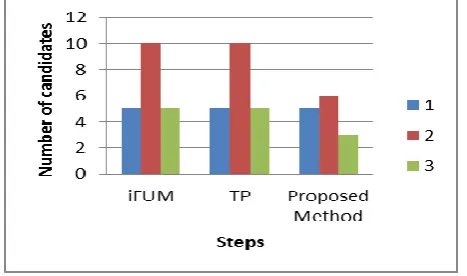
We evaluate the performance of proposed algorithm and compare it with iFUM and TP (Two Phase) algorithms. The experiments were performed on i3 processor (2.5GHz Intel Processor with 4M cache memory), 2GB main memory and 400 GB secondary memory , and running on Windows XP. The algorithms are implemented in using C# Dot Net Framework language version 4.0.1. Both synthetic datasets are used to evaluate the performance of the algorithms.
Figure 2. Comparison graph
CONCLUSION
Mining Expected Utility Two Phase and several other algorithms have mine high utility item set very efficiently. But there is need to enhance this algorithm so that it can be applied to large sized dataset. The complexity factor for frequent pattern mining algorithm includes several factors like Execution time and I/O cost. The proposed method reduce candidates generations at different stages
REFERENCES
1. R. Agrawal and R. Srikant. Fast algorithms for mining association rules. In Proc. of the 20th Int'l Conf. on Very Large Data Bases, pp. 487-499, 1994.
2. C. F. Ahmed, S. K. Tanbeer, B.-S. Jeong and Y.-K. Lee. Efficient Tree Structures for High-utility Pattern Mining in Incremental Databases. In IEEE Transactions on Knowledge and Data Engineering, Vol. 21, Issue 12, pp. 1708-1721, 2009.
3. R. Chan, Q. Yang and Y. Shen. Mining high-utility item sets. In Proc. of Third IEEE Int'l Conf. on Data Mining, pp. 19-26, Nov., 2003. 4. Y. L. Cheung, A. W. Fu, Mining frequent item sets without support threshold: with and without item constraints. IEEE Transactions on
Knowledge and Data Engineering, Vol. 16, No. 6, pp. 1052-1069, 2004.
IJSTMR © 2017 | All Rights Reserved 28 6. A. Erwin, R. P. Gopalan and N. R. Achuthan. Efficient Mining of High-utility Item sets from Large Datasets. In PAKDD 2008, LNAI 5012,
pp. 554-561, 2008.
7. A. W. Fu, R. W. Kwong and J. Tang, Mining N-Most Interesting Item sets, In Proc. of ISMIS’00, 2000.
8. J. Han, J. Pei and Y. Yin. Mining frequent patterns without candidate generation. In Proc. of the ACM-SIGMOD Int'l Conf. on Management of Data, pp. 1-12, 2000.
9. J. Han, J. Wang, Y. Lu and P. Tzvetkov, “Mining Top-k Frequent Closed Patterns without Minimum Support,” In Proc. of ICDM, 2002.
10. Y. Hirate, E. Iwahashi and H. Yamana, TF2P-Growth: An Efficient Algorithm for Mining Frequent patterns without any Thresholds, In Proc. of ICDM 2004.
11. H.-F. Li, H.-Y. Huang, Y.-C. Chen, Y.-J. Liu, S.-Y. Lee. Fast and Memory Efficient Mining of High Utility Item sets in Data Streams. In Proc. of the 8th IEEE Int'l Conf. on Data Mining, pp. 881-886, 2008.
12. Y. Liu, W. Liao, and A. Choudhary. A fast high-utility item sets mining algorithm. In Proc. of the Utility-Based Data Mining Workshop, 2005.
13. Y.-C. Li, J.-S. Yeh and C.-C. Chang. Isolated Items Discarding Strategy for Discovering High-utility Item sets. In Data & Knowledge Engineering, Vol. 64, Issue 1, pp. 198-217, 2008.
14. S. Ngan, T. Lam, R. C. Wong and A. W. Fu, Mining N-most Interesting Item sets without Support Threshold by the COFI-Tree, Int. J. Business Intelligence & Data Mining, Vol. 1, No. 1, pp. 88-106, 2005.
15. J. Pisharath, Y. Liu, B. Ozisikyilmaz, R. Narayanan, W. K. Liao, A. Choudhary and G. Memik, NU-Mine Bench version 2.0 dataset and technical report, http://cucis.ece.northwestern.edu/projects/DMS/MineBench.html.