Available Online at www.ijpret.com 854
INTERNATIONAL JOURNAL OF PURE AND
APPLIED RESEARCH IN ENGINEERING AND
TECHNOLOGY
A PATH FOR HORIZING YOUR INNOVATIVE WORK
FUSED ADD-MULTIPLY OPERATOR FOR MODIFIED BOOTH RECODER
APARNA V. KALE, PROF. M. D. PATIL
Electronics and Telecommunication department SITS, Narhe, Pune-41 Savitribai Phule Pune University, Pune, India.
Accepted Date: 05/03/2015; Published Date: 01/05/2015
\
Abstract: Arithmetic units mainly consists of multiplier which mostly comprises of adders and shifters widely used in Digital signal processing (DSP). Modified Booth algorithm has a recoding table which has been used to minimize the partial products of multiplier. An adder and the multiplier operator of the unit is combine to form a single add-multiply unit. The fusion of the two operators resulting in Fused Add-Multiply (FAM) operator. Different structured recoding techniques are used to implement the Modified Booth encoder incorporating in FAM. The simulation is done using Xilinx ISE Design Suite 14.4 tool.
Keywords: Modified Booth Algorithm, adders, multipliers, add-multiply operation, arithmetic circuits, Xilinx.
Corresponding Author: MS. APARNA V. KALE
Access Online On:
www.ijpret.com
How to Cite This Article:
Available Online at www.ijpret.com 855
INTRODUCTION
Electronic world consists of different applicative circuits for particular applications. These circuits comprises of complex arithmetic units. One such field is DSP(Digital Signal Processing) applications such as FFT (Fast Fourier transform), Filters(FIR-Finite Impulse Response),Signal Convolution and various other communication ,multimedia applications. The multiplier is the base of any arithmetic circuits. The multiplier consists of adders and shifters.
Available Online at www.ijpret.com 856
II. MODIFIED BOOTH RECODER
The modified-Booth algorithm is extensively used for high-speed multiplier circuits. Once, when array multipliers were used, the reduced number of generated partial products significantly improved multiplier performance. The Modified Booth Multiplier was proposed by O. L. Macsorley in 1961. The recoding method is widely used to generate the partial products for implementation of large parallel multipliers, which adopts the parallel encoding scheme. One of the solutions of realizing high speed multipliers is to enhance parallelism which helps to decrease the number of subsequent stages. The original version of Booth algorithm (Radix-2) had two drawbacks:
- The number of add subtract operations and the number of shift operations becomes variable and becomes inconvenient in designing parallel multipliers.
- The algorithm becomes inefficient when there are isolated 1’s.
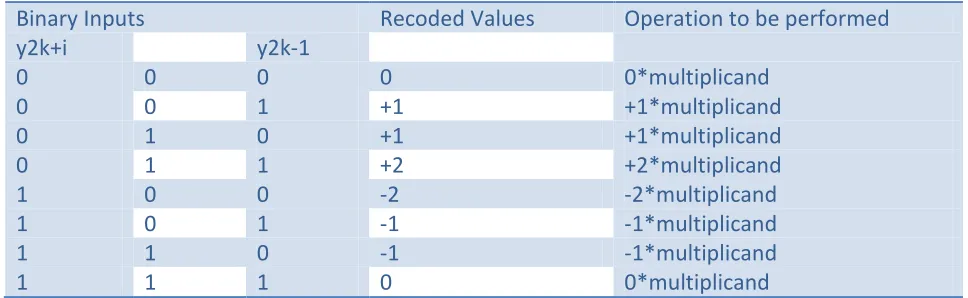
These problems can be overcome by Modified Booth algorithm (MBA). In MBA process three bits at a time are recorded. Recoding the multiplier in higher radix is a powerful way to speed up standard Booth multiplication algorithm. In each cycle a greater number of bits can be inspected and eliminated therefore total number of cycles required to obtain products get reduced. Number of bits inspected in radix r is given by n = 1 + log2r. The Modified Booth algorithm is represented in the form:
= -2y2k+1 + Y2k + Y2k-1
Table I. Modified Booth algorithm recoded table
Binary Inputs Recoded Values Operation to be performed
y2k+i y2k-1
0 0 0 0 0*multiplicand
0 0 1 +1 +1*multiplicand
0 1 0 +1 +1*multiplicand
0 1 1 +2 +2*multiplicand
1 0 0 -2 -2*multiplicand
1 0 1 -1 -1*multiplicand
1 1 0 -1 -1*multiplicand
Available Online at www.ijpret.com 857 The architecture of the commonly used modified Booth multiplier consist of Booth encoder and decoder, Wallace tree and CLA. The inputs of the multiplier are multiplicand X and multiplier Y. The Booth encoder encodes input Y and derives the encoded signals. The Booth decoder generates the partial products using the encoded signals and the other input X. The Wallace tree computes the last two rows by adding the generated partial products. The last two rows are added to generate the final multiplication results using the carry look-ahead adder (CLA) [14].
III. PROPOSED IMPLEMENTATION
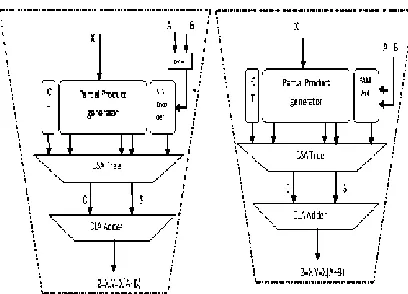
The proposed system fuses the adder unit with multiplier to implement Z= X(A+B) operation which uses the MB encoding technique where A and B are the inputs of the adder whose output Y is driven as an input to the multiplier along with the another input X as shown in a fig.1.The separate adder used in the conventional design adds a convincing delay to the critical path of the design.
Fig. 1: Add-Multiply Operator (a) conventional AM operator (b) Fused Add-Multiply operator design where CT is the correction term, CSA tree is Carry Save Adder tree and CLA is
Carry-Look Ahead Adder.
This critical path usually depends on the bit-width of the inputs due to the carry signals which propagates inside the adder. A use of Carry Look Ahead (CLA) adder is an option but it occupies more area and increases power consumption. To optimize the AM operator design the adder unit is fused with MB encoding unit to form a single unit datapath. This is done by direct recoding of the sum
Available Online at www.ijpret.com 858 Multiply unit has only one adder at the end which results in a significant area reduction. The new techniques has been introduced to implement this fused add-multiply unit. In all techniques separate designs are implemented for an even and odd number of signed and unsigned bits.
(1) Technique I : FAM1
This technique uses two full adders to implement the design for odd and even width of bits stream. For the even number of bits two FAs are used as FA , a conventional full adder and FA* whose output value is given as:
FA*= -2co + s = - q -q + ci . For odd bit-width an additional FA** is used at the end whose output value is
FA**= -2co +s = -p -q +ci .
(2) Technique II: FAM2
In this technique, for even bit-width a conventional full adder along with two half adders with the output value
HA*= - 2c +s = - p- q are used whereas for odd width of bits an additional full adder as FA** has been used at the end.
(3) Technique III: FAM3
Here in this proposed scheme for even bit-width of input numbers a conventional full adder along with three different half adders has been used where the half adders are conventional HA,HA* and HA**.HA** output value is
HA**= 2c - s = - p + q. The odd bit-width input uses a conventional FA,HA and HA* along with and additional FA** at the end of the recoding scheme.
(4) Unsigned input:
Available Online at www.ijpret.com 859
IV. EXPERIMENTAL WORK
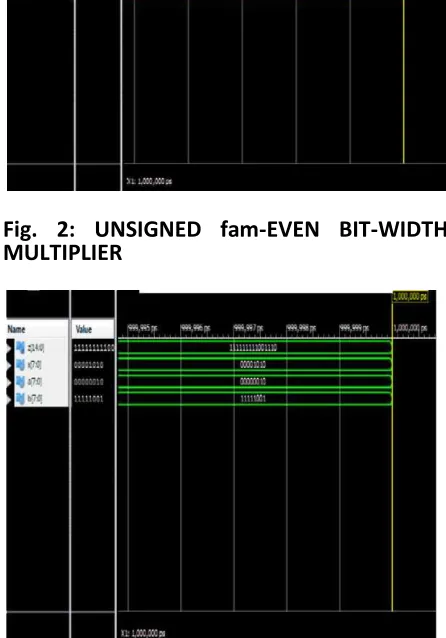
Different recoding techniques has been designed using Xilinx ISE deign suite for all techniques and the output waveform has been shown in the below figures.
Fig. 2: UNSIGNED fam-EVEN BIT-WIDTH MULTIPLIER
OUTPUT WAVEFORM
Available Online at www.ijpret.com 860
Table II. Design Summary of all recoded techniques
Device Utilization Summary
Logic Utilization SMB1 SMB2 SMB3
EVEN ODD EVEN ODD EVEN ODD
Number of Slice Latches 1% 1% 1% 1% 1% 1%
Number of 4 input LUTs 1% 2% 8% 10% 8% 10%
Number of occupied Slices 2% 2% 10% 13% 11% 14%
Number of Slices containing only related
logic
100% 100% 100% 100% 100% 100%
Number of Slices containing unrelated logic
0% 0% 0% 0% 0% 0%
Fig. 4: unsigned FAM-odd bit-width multiplier output waveform
Available Online at www.ijpret.com 861
Total Number of 4 input LUTs 1% 2% 8% 10% 9% 11%
Number of bonded IOBs 42% 47% 59% 66% 59% 66%
Number of BUFGMUXs 16% 20% 4% 4% 16% 20%
Average Fanout of Non-Clock Nets
3.28 3.62 3.35 3.70 3.45 3.70
IV. CONCLUSION
This paper has focuses on the implementation of the Modified Booth Recoder by fusing the Multiply operator. Different techniques has been used to implement the Fused Add-Multiply Operator by using different full adders and half adders whose output values has been given according to the signed and unsigned bit stream of the input numbers depending on the Modified Booth encoded table. The techniques have been designed for the odd and even bit- width of the input numbers.
REFERENCES
1. Kostas Tsoumanis , Sotiris Xydis , Nikos Moschopoulos , Kiamal Pekmestzi , "An Optimized Modified Booth Recorder For Efficient Design Of The Add-Multiply Operator", IEEE Transactions On Circuits And Systemsi: Regular Papers,Vol. 61, No. 4, April 2014.
2. Sukhmeet Kaur, Suman and Manpreet Signh Manna "Implementation of Modified Booth Algorithm (Radix 4) and its Comparison with Booth Algorithm (Radix-2)" Advance in Electronic and Electric Engineering. ISSN 2231-1297, Volume 3, Number 6 (2013), pp. 683-690
3. Sunder S . Kidambi, Fayez El-Guibaly and Andreas Antoniou, "Area efficient multipliers for digital signal processing"- IEEE Transactions on Circuits and Systems-11: Analog And Digital Signal Processing, Vol. 43, No. 2, February 1996.
4. A. Amaricai, M. Vladutiu, and O. Boncalo, "Design issues and implementations for floating-point divide-add fused," IEEE Trans. Circuits Syst. II-Exp. Briefs, vol. 57, no. 4, pp. 295-299, Apr. 2010.
5. J. J. F. Cavanagh,Digital Computer Arithmetic. NewYork:McGraw- Hill, 1984.
Available Online at www.ijpret.com 862 7. Rong Lin "A Reconfigurable Low-Power High- Performance Matrix Multiplier Design" Department of Computer Science,SUNY- Geneseo, Geneseo, NY 14454.
8. Damarla Paradhasaradhi, M. Prashanthi, and N Vivek "Modified Wallace Tree Multiplier using Efficient Square Root Carry Select Adder".
9. C. N. Lyu and D. W. Matula, "Redundant binary Booth recoding," in Proc. 12th Symp. Comput. Arithmetic, 1995, pp. 50-57.
10.A. S. Prabhu V. Elakya "Design of Modified Low Power Booth Multiplier" Department of ECE, Bannari Amman Institute of Technology, Sathyamangalam, Tamil |Nadu, India.
11.Wen-Chang Yeh and Chein-Wei Jen, "High-Speed Booth Encoded Parallel Multiplier Design" IEEE TRANSACTIONS ON COMPUTERS, VOL. 49, NO. 7, JULY 2000.
12.O. L. Macsorley, "High-speed arithmetic in binary computers," Proc. IRE, vol. 49, no. 1, pp. 67-91, Jan. 1961.
13.R. Zimmermann and D. Q. Tran, "Optimized synthesis of sum-of-products," in Proc. Asilomar Conf. Signals, Syst. Comput. , Pacific Grove, Washington, DC, 2003, pp. 867-872.
14.B. Parhami, Computer Arithmetic: Algorithms and Hardware Designs. Oxford: Oxford Univ. Press, 2000.