in the population sciences published by the Max Planck Institute for Demographic Research Konrad-Zuse Str. 1, D-18057 Rostock · GERMANY www.demographic-research.org
DEMOGRAPHIC RESEARCH
VOLUME 27, ARTICLE 4, PAGES 85-120
PUBLISHED 13 JULY 2012
http://www.demographic-research.org/Volumes/Vol27/4/ DOI: 10.4054/DemRes.2012.27.4
Research Article
Regional family norms and child care by
grandparents in Europe
Maaike Jappens
Jan Van Bavel
This publication is part of the proposed Special Collection "Intergenerational family ties in Europe: Multiple linkages between individuals, families and social contexts", edited by Pearl Dykstra.
© 2011 Maaike Jappens & Jan Van Bavel.
This open-access work is published under the terms of the Creative Commons Attribution NonCommercial License 2.0 Germany, which permits use, reproduction & distribution in any medium for non-commercial purposes, provided the original author(s) and source are given credit.
1 Introduction 86
2 Grandparents and child care in Europe 87
2.1 Characteristics of grandparents, parents and children 88
2.2 International variation 90
2.3 Formal child care provision 91
3 Regional family practices and norms 93
4 Hypotheses, data, and methods 95
4.1 Hypotheses 95
4.2 Data and methods 96
4.3 Dependent variable: grandparents as the main source of child care 98
4.4 Explanatory variables on the regional level 99
4.5 Explanatory variable on the country level 105
4.6 Explanatory variables on the individual level 105
5 Results 107
6 Conclusions 111
7 Acknowledgements 113
Regional family norms and child
care by grandparents in Europe
Maaike Jappens1
Jan Van Bavel2
Abstract
BACKGROUND
Child care is widely considered a key issue in confronting demographic change in Europe today, given its centrality in the labour market participation of parents, and of mothers in particular. There are considerable international differences in child care practices throughout Europe, and earlier comparative research has indicated that structural factors do not suffice to explain them.
OBJECTIVE
We investigate whether or not, next to structural differences, cultural factors also play a role in European international variations in child care practices, and more specifically the use of grandparental child care.
METHODS
Using the second wave of the European Social Survey, this paper scores subnational regions of 23 European countries on different dimensions of family norms and practices. We construct regional indicators and use them in a multilevel analysis of the use of grandparents as the main source of childcare by European mothers.
RESULTS
Results show that European mothers’ reliance on grandparental child care is influenced by individual characteristics and the supply of formal child care, but also by the normative climate in the region they live in. Irrespective of the attitudes individually held, we find that mothers in more conservative regions are more inclined to use grandparents as the main source of child care instead of formal alternatives.
CONCLUSIONS
European patterns of child care use are not only subject to structural factors as the supply of formal care provisions for children. Preferences and attitudes prevalent in the regions in which young parents live form an important part of the picture too.
1 Interface Demography, Vrije Universiteit Brussel.
2 Centre for Sociological Research, Family and Population Studies, University of Leuven. Interface
1. Introduction
In 2005, the European Commission published the Green Paper Confronting demographic change: a new solidarity between the generations about the way European and national policy makers could and should respond to population ageing in the 21st century. One of the core recommendations of the Commission was to increase employment rates. In particular, the labour market activity of women was put forward as an essential priority (European Commission 2005). As a matter of fact, the European Council already aimed at raising female employment rates by setting out the Lisbon Strategy in 2000 (High Level Group chaired by Wim Kok 2004).
The European policy objective of increasing the labour market participation of women and especially of young mothers has to deal with the following two circumstances. First, Europe was and is characterized by regional diversity of beliefs, norms, and attitudes, as well as practices in family life and gender roles. In some regions, there exists considerable normative resistance to the idea that a mother with young children could - let alone should - go out to work. According to the logic of this belief, an increase in the employment rate of mothers would imply that more women would postpone or forgo the transition to motherhood, to make room for activity in the labour market. At the same time, the birth rate is already very low in this type of region and the European Commission would prefer to see a slight increase in the birth rates (European Commission 2005). Second, unless one would expect fathers to stay home to care for the children, boosting the labour market participation of mothers implies that provisions for child care are available. In some regions, however, there exists distrust of providing child care for young children in formal facilities such as nurseries (Wheelock and Jones 2002; Van Bavel 2004; Arpino, Pronzato, and Tavares 2010). Typically, these regions have hardly invested in such facilities, and many working parents living there have to rely on informal alternatives – mainly their own parents – to care for their children. Various studies confirm that a considerable share of European grandparents does indeed help their children by providing child care for the grandchildren. The importance of grandparental child care varies greatly across Europe, and this variation is in turn strongly associated with variations in the availability of public child care facilities (Wheelock and Jones 2002; Lewis, Campbell, and Huerta 2008; Smith Koslowski 2009; Hank and Buber 2009; Igel and Szydlik2011; Settles et al. 2010).
formal care facilities. Former research about grandparents and child care shows that, in addition to individual characteristics of grandparents, parents and children, contextual factors such as the availability of formal alternatives also play a role. There exist few studies of the role of cultural differences in grandparental child care, even if there are clear indications that they matter too. We will investigate whether the use of grandparental child care by European mothers is mainly connected to mothers’ own situation and attitudes towards family and gender roles, or is rather the regional family practices and norms that prevail. The chief source of data for this article is the second round of the European Social Survey (ESS2). Using this source of data allows us to contribute to filling another gap in the existing literature: in spite of the sociological, political, and demographic interest of Eastern Europe, there has hardly been any attention to grandparental child care in post-communist countries. Based on ESS2-data, we involve Western, as well as Eastern Europe in our analyses.
2. Grandparents and child care in Europe
Grandparental child care can come in several forms. In exceptional circumstances, custodial grandparents may take the role of surrogate parents. Even if this is the exception, it is happening more and more often (e.g. Dunne and Kettler 2007; Leder, Nicholson Grindstead, and Torres 2007; Erbert and Alemá 2008). Far more commonplace is the arrangement of grandparents providing regular informal child care for their grandchildren when parents are away from home for work or other activities. It is this form of grandparental child care that is the focus of this paper.
Many grandparents provide some kind of care for their grandchildren when the parents are unable to do so, and most do so unpaid. This may reflect the willingness of grandparents to participate in the lives of their grandchildren and to help their children. The help of grandparents can be crucial for working mothers during years when both work and the care of the children are very demanding. For grandparents it can be important to support their daughters and give them chances to improve their labour market position, chances that many grandmothers themselves did not have (Tobío et al. 2010).
Data from the 2004 Survey of Health, Ageing and Retirement in Europe show that 49 percent of Western European grandfathers and 58 percent of grandmothers with grandchildren aged 15 or younger provide some kind of care for a grandchild. Around 30 percent do so almost weekly or more often (Hank and Buber 2009). A European aged 50 years and over spends on average 0,5 hours per day looking after grandchildren, while she or he devotes on average 1,5 hours working in the market and 0,3 hours helping relatives, friends or neighbours (Croda and Gonzalez-Chapela 2005). Grandparents are the second most significant group of non-maternal child care givers, second after the male partners (Fergusson, Maughan, and Golding 2008). In their research about instrumental support in families, Knijn and Liefbroer (2006) found that in the Netherlands, family members help each other most with child minding. More than half of the adult children said that their parents had helped them caring for their children during the last months before the interview. This is higher than the proportion of people who exchanged any other kind of support.
From earlier research we know that the prevalence and intensity of grandparental child care depends on various factors: the availability and willingness of the grandparents, the needs and preferences of parents and their children, but also contextual factors. These sets of factors are discussed in the next sections.
2.1 Characteristics of grandparents, parents and children
Fokkema, Ter Bekke, and Dykstra 2008; Hank and Buber 2009; Igel and Szydlik 2011; Ghysels 2011).
As to parental characteristics, gender again matters: maternal grandparents are more often involved in child care than paternal grandparents (Hank and Buber 2009; Tobío et al. 2010; Danielsbacka 2011; Ghysels 2011). Age is also a factor: younger parents are more likely to use grandparental child care than older ones (Vandell et al. 2003; Fergusson, Maughan, and Golding 2008; Hank and Buber 2009). The probability that grandparents provide child care is generally higher if the grandchild’s mother is employed (Hank and Buber 2009; Ghysels 2011), and if her average working week is longer than usual (Gray 2005). Working nights, weekends and other nonstandard hours is also associated with higher involvement of grandparents in child care, as this may make grandparental child care one of the only available options (Vandell et al. 2003; Guzman 2004). Lone parents seem to be more likely to be supported with child care by grandparents than parents living with a partner (Gray 2005; Fergusson, Maughan, and Golding 2008; Hank and Buber 2009; Ghysels 2011). Reliance on grandparental help may also be a function of the social class of the parents. As formal child care may be too expensive for some parents, grandparents are more likely to help parents with financial problems (Gray 2005; Fergusson, Maughan, and Golding 2008; Smith Koslowski 2009). More highly educated mothers are less likely to receive help with child care from a grandparent. This may be because better educated mothers are more geographically mobile and have experienced greater independence, or because grandparents perceive them as more able to find alternatives (Fergusson, Maughan, and Golding 2008).
The literature shows that some characteristics of children are also related to the probability that they are cared for by grandparents. Grandparents are most likely to provide child care for preschool-aged children, except for toddlers. The older the grandchildren, the less likely grandparental care (Guzman 2004; Hank and Buber 2009; Igel and Szydlik 2011). First-born or only children more often receive grandparental child care than second or subsequent children, as caring for more than one child becomes a more difficult task for grandparents (Fergusson, Maughan and Golding 2008; Igel and Szydlik 2011; Ghysels 2011).
2.2 International variation
The proportion of grandparents providing child care varies greatly between European countries. Using findings from the 2004 Survey of Health, Ageing and Retirement, Hank and Buber (2009) investigated cross-national variations in grandparental child care for ten continental West European countries. Their analysis is restricted to non-residential grandparents aged 50 or older with at least one grandchild under the age of 16. In Spain, Italy and Switzerland, they observed the lowest shares of grandparents caring for grandchildren: about half of the grandmothers and 40 percent of grandfathers. The highest prevalence of care was found in Sweden, France, The Netherlands and Denmark, particularly in the latter two countries, where more than 65 percent of grandmothers and 60 percent of grandfathers provide child care. Focusing on the intensity of provided grandchild care, however, yields a completely different story. In Sweden, Denmark and France, around 20 percent of grandparents providing grandchild care does so ‘almost weekly or more often’. The share of Mediterranean grandparents looking after grandchildren almost weekly or more is twice as high (Hank and Buber 2009).
These inter-country differences were still found after controlling for several of the characteristics of grandparents, parents and children mentioned above. The authors suggest the existence of three groups of countries. In the first group, containing Austria, Germany and Switzerland, grandparents exhibit an average propensity to provide both "any" and "regular" child care. In the second group, grandparents are most likely to provide any child care at all, but they are least likely to look after grandchildren on a regular basis. The Scandinavian countries, the Netherlands, and France are in this group. The third group consists of the Mediterranean countries. Here, grandparents are less likely to provide child care, but those who do provide child care are more likely to do so regularly (Hank and Buber 2009). Post-communist countries in Central and Eastern Europe were not included in this research.
include post-communist Eastern European countries, even though this is possible using ESS2-data.
For Eastern European countries, research on the topic of child care, or on family issues generally, is rather limited (Robila 2004; Szelewa and Polakowski 2008). Under communist government, the state had a powerful impact on and control over the family, and to encourage women to take part in the labour force, public and affordable child care services were provided in most countries. The fall of communism reduced the involvement of the state in family life, and brought a revival of patriarchal attitudes towards families and the male-breadwinner model. Many public child care services were closed down and state expenditures on child care were reduced, however with considerable differences between post-communist countries (Kocourková 2002; Robila 2004; Szelewa and Polakowski 2008). In spite of their sociological, political, and demographic interest, these countries in Central and Eastern Europe have not been included in earlier comparative research on child care by grandparents in Europe.
2.3 Formal child care provision
Research has clearly shown that the availability of formal sources of child care plays an important role in patterns of grandchild care: where there are more formal alternatives, parents rely less on help from grandparents (Attias-Donfut, Ogg, and Wolff 2005a; Gray 2005; Lewis, Campbell, and Huerta 2008; Hank and Buber 2009; Smith Koslowski 2009; Igel and Szydlik 2011; Settles et al. 2010). There exists considerable variation in family policy and child care programs across Europe. Besides the common growth trend, publicly provided child care services are at very different stages of development in European countries (European Monitoring Centre on Change 2006; Plantenga and Remery 2009; Settles et al. 2010; Saraceno 2011).
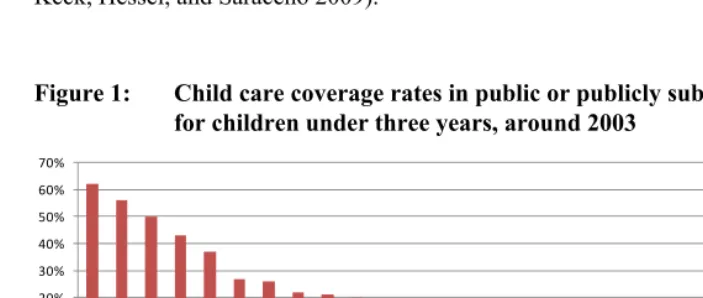
First of all, public investment in child care varies greatly by country. According to OECD estimates, Denmark and Iceland had the highest investment in early child care services including pre-primary education (as percent of GDP) in 2005. France, Sweden and Finland were following. Belgium and Norway were taking an intermediate position, while other countries invested only half or less than Denmark and Iceland (OECD 2008a).
Sweden stand out with coverage rates above 50 percent, France and Norway follow with rates around 40 percent. Coverage rates in Eastern and Southern European countries such as Poland, Hungary, Greece, Bulgaria and the Czech Republic, on the other hand, amount to less than ten percent. Enrolment rates in pre-school education programs are usually much higher, with less variation between countries (OECD 2008b; Keck, Hessel, and Saraceno 2009).
Figure 1: Child care coverage rates in public or publicly subsidized facilities for children under three years, around 2003
0% 10% 20% 30% 40% 50% 60% 70%
Source: Multilinks database on intergenerational policy indicators (Keck, Hessel, and Saraceno 2009)
Where formal child care is abundant, maternal employment is fostered and the role of grandparents in child care can be limited to special circumstances, for example in case of illness or working overtime (Hank and Buber 2009; Settles et al. 2010). Combining data from SHARE and OECD, Igel and Szydlik (2010) found that in Western European countries in which the state provides considerable child care facilities, more grandparents do indeed support their children sporadically with child care. In contrast, when the state provides only weak support, fewer grandparents engage in grandchild care, but those who do look after grandchildren are more likely to do so regularly (Igel and Zdydlik 2010). A lack of formal child care hinders the labour market participation of parents, typically of mothers. In such circumstances, mothers who still want or need to go out to work will have to rely more intensely on informal child care, in most cases provided by grandparents (Hank and Buber 2009; Settles et al. 2010).
grandparents in the labour market (Attias-Donfut, Ogg, and Wolff 2005a; Gray 2005; Lewis, Campbell, and Huerta 2008; Hank and Buber 2009; Smith Koslowksi 2009). Taken together, structural factors still do not seem to suffice to explain the European differences in the use of grandparents as child care providers. Therefore, beliefs about care, gender roles and family obligations and the strength of family networks and solidarity are expected to play an important role too (Lewis, Campbell, and Huerta 2008; Saraceno 2011). This is what we want to verify empirically in this paper.
3. Regional family practices and norms
Although European families face common demographic changes, family life differs considerably from region to region. In social demography, one of the most common typologies to summarize the differences that have been observed in European family life is the north-south division. Reher (1998) identifies ‘persistent contrasts’ between familialistic cultures in the south of Europe and individualistic cultures in the north. In Southern or Mediterranean European countries family ties are argued to be strong, while Northern European countries would be characterized by rather weak family ties. “There are regions where traditionally the family group has had priority over the individual, and others where the individual and individual values have had priority over everything else” (Reher 1998: 203). This contrast is deeply rooted in cultural and historical differences, and Reher sees no indication that it will fade away. Despite the many changes the future will bring, he is convinced that a clear distinction between strong and weak family-systems will survive.
family practices and patterns of solidarity between family members is not just shaped by micro-level factors such as the needs and preferences of family members. Economic and demographic circumstances, social policies and public services, as well as cultural climates all play a role, and these macro-level factors influencing regional variations in family practices are inextricably intertwined (Albertini, Kohli, and Vogel 2007; Heady and Kohli 2010; Kohli and Heady 2010; Dykstra 2012).
Next to patterns of intergenerational family support and living arrangements, norms and attitudes towards the roles of men and women in the family and obligations to support family members vary between different regions of Europe. There are, for example, substantial differences in individual attitudes towards the gender division of work and care, manifested in different degrees of labour market participation of women. Broadly seen, people in Southern and Eastern European countries hold more traditional family values and have a higher sense of duty towards one’s family than in Western and Nordic Europe (Daatland and Herlofson 2003; Georgas et al. 2004; Voicu 2004; Fokkema, Ter Bekke, and Dykstra 2008). While traditional values do change over time, just like actual practices, some patterns persist over prolonged periods of time (Reher 1998; Inglehart and Baker 2000).
conservative and familialistic southern part (Viazzo 2003; Kohli, Künemund, and Lüdicke 2005; Santarelli and Cottone 2009; Micheli 2012).
Instead of developing a typology, we account for the regional heterogeneity by scoring regions on different family practices and norms. To this end, we create a series of four variables on the level of regions within European countries, all measured in the first decade of this century, and we control for the economic situation of a region by adding the gross domestic product per capita. This allows to account for variation within national states, as well as to observe similar patterns in neighboring regions from different countries. We do not only do so for Western Europe, we also include Eastern European regions. We use the regional indicators in a multilevel analysis to investigate whether the family practices and the norms prevailing in a region affect the use of grandparental child care, in addition to individual needs and attitudes and the supply of formal child care.
4. Hypotheses, data, and methods
Many young parents actually piece together a ‘jigsaw’ of child care when they are not able to care for their children themselves, using a mix of formal and informal child care. The latter is mostly provided by the grandparents. In this article, we are interested in the extent to which parents rely on grandparents as the main source of child care for their children, meaning they turn to the child’s grandparents first, or more intensely, than to other, mainly formal alternatives of child care.
4.1 Hypotheses
Based on the results of our literature review, we expect the probability that grandparents provide the main source of child care to be higher if mothers are younger, in paid work and achieved a lower level of education. Also if mothers are divorced or single, we expect the probability that they mainly rely on grandparents for the care of their children to be higher. If grandparents - especially grandfathers - are single and if mothers have more children that need child care, we expect the likelihood that they mainly use grandparental care to be lower.
scarce, on the other hand, we expect mothers will be more inclined to mainly use the help of grandparents.
Next to this important structural factor, our main hypothesis is that the normative context also plays a role in the child care use of European mothers. We predict that mothers living in a region where traditional gender and family norms prevail are more likely to mainly use grandparental child care. We have the same expectation for mothers living in a region where it is common that parents live in the same household as their adult children, and possibly grandchildren. The indicators for these regional level factors are introduced in section 4.4 and will be employed in multilevel regression analysis.
4.2 Data and methods
We use data from the second round of the European Social Survey (ESS2), with fieldwork carried out in 2004 and 2005. In a rotating module, the ESS2 questioned respondents about attitudes towards gender and family roles, the use of child care and intergenerational exchange of support and care (ESS Central Coordinating Team 2010). In addition to the ESS2, we use GDP data from Eurostat and statistics about formal child care provision from the Multilinks database on intergenerational policy indicators (Keck, Hessel, and Saraceno 2009).
We use multilevel logistic regression analysis to investigate whether mothers mainly use grandparental child care for their children. Our random intercepts models contain explanatory variables on three levels: the individual level, the level of the region within a country, and the level of the country mothers live in. Note that, in the following, "grandparents" always refers to the parents or parents-in-law of the respondents, while "children" refers to the children of the respondents. When we talk about "mothers", we mean the respondents included in our analysis themselves.
small population size such as Ireland and Luxembourg, the NUTS 1 level corresponds to the entire country (Różańska-Putek et al. 2009). Our choice to work on the first NUTS level was constrained as the ESS does not contain the information required to construct NUTS 2 or NUTS 3 regions for all countries. Moreover, applying a higher NUTS level would leave some regions without observations for our analysis.
Twenty-six countries participated in the second round of the ESS: Austria, Belgium, Czech Republic, Denmark, Estonia, Finland, France, Germany, Greece, Hungary, Iceland, Ireland, Italy, Luxembourg, Netherlands, Norway, Poland, Portugal, Slovakia, Slovenia, Spain, Sweden, Switzerland, Turkey, UK and Ukraine. Data from Italy are not included in the main ESS2 dataset, because the rotating modules were administered as split ballot there (ESS Central Coordinating Team 2010). This also means that only half of the respondents were asked the questions in the rotating module about family, work and wellbeing, but data for Italy were added to the dataset and included into the following analyses. Data from Turkey, Ukraine and the United Kingdom, however, were dropped from the analysis. Ukraine is not part of Eurostat’s NUTS classification. Turkey has a large number of NUTS regions due to the large population size, but as the total ESS2 sample size is not bigger than in other countries, the number of respondents in some regions is too small. Moreover, reliable and comparable data on child care are hard to find for these two countries. The United Kingdom was dropped from the analyses because data on education level were omitted from the international file due to insufficient questions on the topic (ESS Central Coordinating Team 2010).
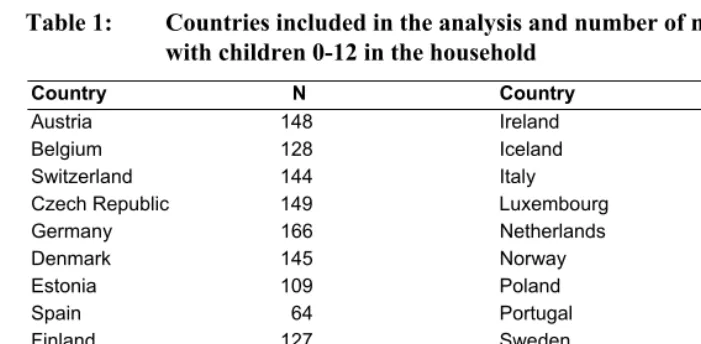
Table 1: Countries included in the analysis and number of mothers aged 20-54 with children 0-12 in the household
Country N Country N
Austria 148 Ireland 189
Belgium 128 Iceland 64
Switzerland 144 Italy 46
Czech Republic 149 Luxembourg 90
Germany 166 Netherlands 142
Denmark 145 Norway 178
Estonia 109 Poland 106
Spain 64 Portugal 170
Finland 127 Sweden 130
France 147 Slovenia 93
Greece 107 Slovakia 77
Hungary 96
2815
4.3 Dependent variable: grandparents as the main source of child care
4.4 Explanatory variables on the regional level
Based on ESS2, we constructed an indicator of conservative norms about family life and three indicators for family practices as explanatory variables on the NUTS 1 level: the percentage of older people co-residing with children, the percentage of older parents providing care or support with housework to adult children outside the household, and the percentage of older parents receiving care or support from children outside the household. We also control for the economic situation of the region by including the gross domestic product.
Family norms
The ESS2 presented five statements about gendered family roles to respondents, who had to indicate whether they agreed strongly, agreed, neither agreed nor disagreed, disagreed, or disagreed strongly. These statements were: 1) “A women should be prepared to cut down on her paid work for the sake of her family”, 2) “Men should take as much responsibility as women for the home and children”, 3) “When jobs are scarce, men should have more right to a job than women”, 4) “When there are children in the home, parents should stay together even if they do not get along”, and 5) “A person’s family ought to be his or her main priority in life”.
These items were used to construct a measure of conservative family norms. Based on an exploratory principal components analysis and further examination of the items, item 2 and item 5 were dropped from the scale. These items correlate only weakly with the other three, so their loadings are low. Moreover, less than 5 percent of respondents disagreed with statement 2, probably because ‘taking responsibility for the home and children’ can be interpreted in different ways, including men taking the breadwinner role. For item 5, less than 4 percent of respondents disagree that a person’s family ought to be his or her main priority in life, irrespective of the attitudes towards the other items. This resulted in a scale of conservative family norms with three items. Table 2 shows the principal component loadings for the three indicators. This principal component analysis was carried out with all respondents in our ESS2 database, irrespective of age or gender.
scores for conservative family culture per region are displayed in Map 1. The higher the component scores, the more conservative the normative climate.
Table 2: Loadings for items in principal component ‘conservative family norms’
Items Component loading
A woman should be prepared to cut down on her paid work for the sake of her family.
0.757
When jobs are scarce, men should have more right to a job than women. 0.807 When there are children in the home, parents should stay together even
if they don’t get along.
0.693
Extraction method: principal component analysis, Cronbach’s α = 0.619
The total number of observations that we used to construct the regional variables is 15170, but differs considerably between regions, ranging from 6 to 1162, with a mean of 205 respondents aged 55 and older per NUTS 1 region. This implies that the reliability of our indices of family culture varies greatly by region, which will undermine our statistical power to find their effects, if any, on the dependent variable. For this reason, due to the noise introduced by small numbers of observations in some regions, our estimates of the effect of regional family culture on grandparental care need to be considered as conservative estimates. If we find effects, we are presumably dealing with underestimations of the real effects (Woodhouse et al. 1996). Still, in order to double check the robustness of the findings we will present below, we have refitted our models with only a subset of the countries. More specifically, in our robustness check, we have excluded the countries with the smallest numbers of respondents in some of their NUTS 1 regions (namely Spain, Italy, Germany and France) and then redone our analysis on this restricted dataset. These results (not included in this paper but available on request from the authors) are very similar to the ones presented below.
Map 1: Average scores for conservative family norms
© EuroGeographics for the administrative boundaries CARTOGRAPHY: Didier Willaert, VUB 0 100 200 300 km
0 50 100 150 mi Lambert conformal conic projection
country border NUTS 1 level Average component scores
0.34 – 0.83
0.06 – 0.33
-0.25 – 0.05
-0.86 – -0.26
no data
Source: ESS, round 2
Coresidence of older parents with their children
The ESS household grid registers the relationship respondents have with their household members, one of them being ‘son/daughter, including step, adopted, foster, child of partner’. The percentage of respondents aged 55 years and older in the region, living with at least one son or daughter in the same household, was aggregated as an indicator on the NUTS 1 level. Map 2 shows the variation of coresidence between older parents and adult children across European regions.
European regions, coresidence between elderly parents and children is more common. Although a lot of variation in this indicator is situated between country-borders, this resume neglects numerous intra-country differences in coresidence of older parents and children.
Map 2: Respondents aged 55 or older living with at least one of their children in the household, % per NUTS 1 region
© EuroGeographics for the administrative boundaries CARTOGRAPHY: Didier Willaert, VUB 0 100 200 300 km
0 50 100 150 mi Lambert conformal conic projection
country border NUTS 1 level Percentage
48 – 64
33 – 47
16 – 32
3 – 15
no data
Source: ESS, round 2
Intergenerational exchange of care and support in housework
aged 18 or older living outside their household were taken into account. Aggregated variables were constructed on the NUTS 1 level, representing the percentage exchanging support with their adult children living separately. Map 3 presents the percentage of respondents aged 55 or older with adult children outside the household providing support for adult children, Map 4 presents the percentage receiving support from children.
Map 3: Respondents aged 55 or older with children aged 18 or older outside the household providing support in everyday housework or care to adult children living apart, % per NUTS 1 region
© EuroGeographics for the administrative borders CARTOGRAPHY: Didier Willaert, VUB
0 100 200 300 km
0 50 100 150 mi country border NUTS 1 level Percentage
48 – 63
35 – 47
26 – 34
13 – 25
no data
Source: ESS, round 2
offspring. Mostly Eastern European regions exhibit high levels of support exchange, although with substantive differences within countries. The lowest percentages of people exchanging everyday support with children living outside the household are, perhaps surprisingly, located in Mediterranean Europe. In these Southern European regions coresidence of elderly parents and children is more common and may function as a main form of intergenerational support.
Map 4: Respondents aged 55 or older with children aged 18 or older outside the household receiving support in everyday housework or care from adult children living apart, % per NUTS 1 region
© EuroGeographics for the administrative boundaries CARTOGRAPHY: Didier Willaert, VUB 0 100 200 300 km
0 50 100 150 mijl Lambert conformal conic projection
country border NUTS 1 level Percentage
38 – 67
26 – 37
16 – 25
5 – 15
no data
Source: ESS, round 2
when it happens that an elderly parent remains alone he/she is less likely to give or receive help than an elderly parent in the Continental or Nordic countries” (Albertini, Kohli, and Vogel 2007: 326). Most Central and Eastern European regions show yet a different pattern of intergenerational family support. Like in Mediterranean regions, a substantive share of people aged 55 or older live in the household with children. But also when parents and children do not live together, many of them exchange support in housework and care.
Gross domestic product per capita
Southern and especially Eastern European regions and countries are usually less wealthy than Northern and Western European countries. Therefore, to anticipate the argument that the hypothesized effect of regional family practices could be spurious, we also control for the economic situation of the regions in our analysis. We include the gross domestic product at market prices for the year 2005, as provided by Eurostat (2010). To assure the comparability between regions, GDP is expressed in Purchasing Power Standard per inhabitant.
4.5 Explanatory variable on the country level
From former research we know that the availability of formal care facilities plays a major role in the use of grandparental child care. Data on formal child care are not available on the regional level, only on the level of European countries. We use formal child care coverage rates from the database on intergenerational policy indicators provided by the EU-FP7 project Multilinks. This database on intergenerational policies includes a set of indicators and describes social policies and legal frameworks in 29 European countries, all around the year 2004 (Keck, Hessel, and Saraceno 2009). We include the child care coverage rate for children under 3 in the analyses, representing the number of places in public or publicly subsidized child care facilities as a share of the number of children aged 0 up to 2 years. Switzerland and Iceland are not represented in the Multilinks-database. Data on child care coverage for Iceland (year 2005) were derived from the OECD family database (2010), data for Switzerland (year 2003) from Immervoll and Barber (2006).
4.6 Explanatory variables on the individual level
separation after a formal marriage. Respondents indicating they are separated but still legally married are regarded the same way as divorced respondents. We distinguish between six categories: 1) in first marriage, 2) never married, cohabiting with a partner, 3) never married, single (this means no partner in the same household) 4) divorced (or separated), cohabiting with a partner (including both remarriage and unmarried cohabitation), 5) divorced, single, and 6) widowed.
Employed mothers have different child care needs than mothers who do not go out to work. We therefore included a variable in the analyses that indicates the employment status of mothers. It refers to whether or not the respondent was in paid work the last seven days before the interview, not necessarily as the main activity. Respondents in paid work were asked how many hours a week they normally work in their main job, regardless of their basic or contracted hours, including paid or unpaid overtime. This information is included in the model that is estimated for mothers in paid work only (see model III in the results section for the rationale for doing this).
The probability that grandparents provide the main source of child care for respondent’s children heavily depends on the number and gender of grandparents still alive. As ESS2 only provides this information for the respondent’s own parents, we included a variable ‘parents alive’ with four categories in the analyses: 1) both parents are still alive, 2) only the mother is still alive, 3) only the father is still alive, and 4) own parents are not alive anymore. Even if respondents in this last category do not have parents to provide child care to their children, they were still included in the analyses because the parents of the partner or ex-partner of the respondent may still be alive. Unfortunately, ESS does not provide this information on the parents of (ex-)partner of the respondent. Also information on the age, labour market participation and health status of grandparents is missing.
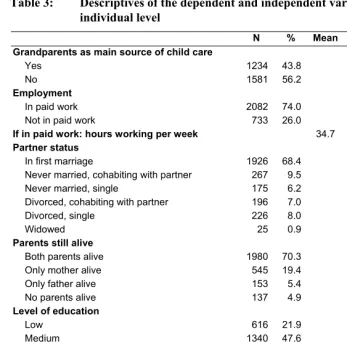
Table 3: Descriptives of the dependent and independent variables on the individual level
N % Mean SD Min Max
Grandparents as main source of child care
Yes 1234 43.8
No 1581 56.2
Employment
In paid work 2082 74.0
Not in paid work 733 26.0
If in paid work: hours working per week 34.7 12.6 0.0 90.0
Partner status
In first marriage 1926 68.4
Never married, cohabiting with partner 267 9.5
Never married, single 175 6.2
Divorced, cohabiting with partner 196 7.0
Divorced, single 226 8.0
Widowed 25 0.9
Parents still alive
Both parents alive 1980 70.3
Only mother alive 545 19.4
Only father alive 153 5.4
No parents alive 137 4.9
Level of education
Low 616 21.9
Medium 1340 47.6
High 859 30.5
Age 35.2 6.1 20.0 54.0
Number of children <13 in household 1.6 0.7 1.0 7.0
Parents (in law) in the same household
Yes 2619 93.0
No 196 7.0
Conservative family norms (component scores) -0.4 0.9 -2.1 2.4
5. Results
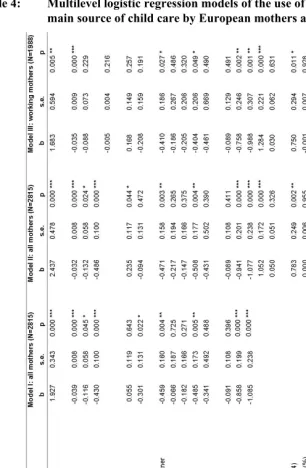
two indicators are added in model II, as well as the coverage rate of formal child care in the country and the indicators on the regional level. Model III only includes European mothers who are in paid work and takes into account their working hours.
As to the individual level covariates in model I, on average across Europe, the age of mothers is associated with a lower probability that grandparents serve as the main child care providers. As expected, this probability also descends with the number of children in the household, presumably because caring for more children implies a heavier task for grandparents. Having grandparents providing the main source of child care for children is significantly less common among mothers in paid work compared to mothers without a job. Mothers without a job probably do not use much of the formal services because they do not need child care on a regular basis. Hence, the times they do need child care, grandparents serve more often as the main providers. The level of education of mothers is also related to their child care use: when compared to mothers with a low level of education, highly educated women are less likely to mainly make use of grandparents as main child care providers, while women with mid-range education are more likely to do so. As to the partnership status, mothers in their first marriage are the most likely to use grandparents as the main source of child care. For never married mothers who are cohabiting with a partner and for divorced mothers without a partner in the household, the probability of relying on grandparents is significantly lower. Also, the probability to have grandparents as the main source of child care is the highest if both maternal grandparents are still alive. However, this probability is not significantly lower if only the mother of the respondent is still alive, also pointing to the gendered nature of providing grandchild care. When only the father is still alive or when both parents of the respondents have deceased, in contrast, the probability that a mother’s children are mainly cared for by grandparents is significantly lower.
Map 5: Estimates of NUTS 1-level random effects in model I
© EuroGeographics for the administrative boundaries CARTOGRAPHY: Didier Willaert, VUB 0 100 200 300 km
0 50 100 150 mi Lambert conformal conic projection
country border NUTS 1 level Effects model I
0.60 – 1.46
0.07 – 0.59
-0.33 – 0.06
-2.29 – -0.34
no data
Source: ESS, round 2
In model II we added our indicators on the country and the regional level, as well as the attitude of the mother towards family norms and whether or not she is living under the same roof with her parents or parents-in-law. The effects of the individual level variables still point in the same direction as before. Moreover, results show that, unsurprisingly, having at least one grandparent living in the household significantly increases the probability that a child is mainly cared for by grandparents when the parents themselves are unable to do so. Mothers’ own individual attitudes towards family and gender do not seem to make an impact upon the likelihood of relying on grandparents for child care provision.
inclined mothers are to use grandparents as the main source of child care for their children. So, it is the regional family culture rather than the attitude individually held that seems to matter for child care practices. The regional indicators of family practices, the percentage of older parents living with adult children, the percentage of parents giving care to and the percentage receiving care form adult children, do not have a statistically significant influence. Also the gross domestic product of the region has no impact on the choice of grandparents over other types of child care. As expected, the availability of formal child care provisions in the country of residence does significantly affect the probability that mothers mainly rely on grandparents for child care: the higher the formal child care coverage rate, the less likely that grandparents serve as the main source of child care.
The labour market participation of mothers is surely connected to their use of child care, and patterns of female and maternal employment vary widely across Europe. As an extra test for the robustness of the effect of regional family norms, we only take into account mothers aged 20-54 in paid work in regression model III. In addition, one extra variable is introduced: the hours normally worked per week. The effects of the aggregate level variables hardly change: in countries with higher formal child care coverage rates and in more progressive regions, also working mothers are less inclined to mainly rely on grandparents for child care. The working hours of these mothers do not play a significant role in their choice for grandparents rather than other types of child care.
6. Conclusions
Child care and regional differences in practices and attitudes towards family life are both important components of European policies aimed at boosting the labour market participation of women. The importance of child care is widely acknowledged, the importance of normative climates is not. Yet, some regions hold a considerable resistance to the idea that also a mother with young children should go out to work. Social policies aiming to encourage the labour market participation of young mothers would benefit from taking this into account.
mothers’ child care choices are related to the family practices and norms prevailing in their region of residence.
Europe has been and continues to be characterized by a great international diversity of attitudes as well as practices in family life. The European picture cannot be summarized by simply making the distinction between familialistic Southern Europe and individualistic Northern Europe. There are differences within these big groups of countries, and not all countries behave like one would expect based on this North-South scheme. In addition, there exists essential heterogeneity within the borders of these countries. In this paper, we attempted to take this regional heterogeneity in family life, across and within countries, into account. Using the second round of the European Social Survey, we scored subnational regions of Northern, Southern, Western as well as Eastern Europe on a number of actual family practices as well as on family norms. More specifically, we constructed an indicator for conservative norms about gender roles in the family, estimated the percentage of older parents co-residing with children, the percentage of older parents providing care or support with housework to adult children outside the household, and the percentage of older parents receiving care or support from children outside the household.
Broadly seen, more conservative family norms were mainly found in Southern and Eastern European regions, where coresidence between older parents and children is also clearly more common than in other parts of Europe. Everyday exchange of support between parents and children living in separate households is most common in Eastern European regions and least common in Southern European regions. In Southern Europe, it seems that coresidence is the typical way of support exchange between older parents and adult children in most regions. When parents and children do not live together, markedly less support appears to be exchanged when compared to most Northern European regions, where coresidence between parents and children is not common. In Central and Eastern European regions, a substantive share of older parents and children do live together, but also when this is not the case, many of them exchange support in housework and care. This very broad summarization does, however, neglect intra-country differences in the various aspects of family practices and norms, as these are clearly present.
research, our analyses show that the availability of formal child care provisions is an important contextual factor: the higher the formal child care coverage rate in a country, the smaller the probability that mothers will count on grandparents as the main source of child care for their children.
Even after controlling for the supply of formal child care, our results showed that European mothers’ child care strategies are also influenced by the normative climate of the region in which they live. While the attitudes towards family and gender held individually by the mothers themselves have no significant impact, the attitudes prevailing in the region of residence do have an impact on the likelihood of mainly relying on grandparents for child care. Mothers in more conservative regions are clearly more inclined to use grandparents as the main source of child care for their children instead of formal alternatives. These preferences can be important in making national and European policies to sustain families and encourage the labour market participation of young mothers.
A methodological limitation of this study is the low reliability of the measures of family norms and practices in some regions. For countries that are divided in a large number of NUTS 1 regions, like Germany, the number of ESS2 respondents per region becomes very small. This reduced reliability introduces noise in the analyses, and this noise implies that our estimates of association between the regional indicators and the use of grandparents as main child care providers should be considered as conservative ones. Therefore we feel confident in concluding that European patterns of child care use are not only subject to structural factors as the supply of formal care provisions for children. Preferences and attitudes prevalent in the regions in which young parents live form an important part of the picture too.
7. Acknowledgements
References
Albertini, M., Kohli, M., and Vogel, C. (2007). Intergenerational transfers of time and money in European families: Common patterns - different regimes? Journal of European Social Policy 17(4): 319-334. doi:10.1177/0958928707081068. Arpino, B., Pronzato, C., and Tavares, L. (2010). All in the family: Informal child care
and mothers' labour market participation. Essex: Institute for Social and Economic Research (ISER Working Paper Series; 2010-24).
Attias-Donfut, C., Ogg, J., and Wolff, F.-C. (2005a). Family Support. In: Börsch-Supan, A. (ed.). Health, Ageing and Retirement in Europe. First results from the Survey of Health, Ageing and Retirement in Europe. Mannheim: Mannheim Research Institute for the Economics of Aging: 171-178.
Attias-Donfut, C., Ogg, J., and Wolff, F.-C. (2005b). European patterns of intergenerational financial and time transfers. European Journal of Ageing 2(3): 161-173. doi:10.1007/s10433-005-0008-7.
Bettio, F. and Plantenga, J. (2004). Comparing care regimes in Europe. Feminist Economics 10(1): 85-113.doi:10.1080/1354570042000198245.
Beugelsdijk, S., Van Schaik, T., and Arts, W. (2006). Toward a unified Europe? Explaining regional differences in value patterns by economic development, cultural heritage and historical shocks. Regional Studies 40(3): 317-327.
doi:10.1080/00343400600631590.
Brandis, J. (2003). Grandparents as child care givers for working mothers. A literature review in Spain and other advanced societies. Madrid: Universidad Carlos III de Madrid.
Brandt, M., Haberkern, K., and Szydlik, M. (2009). Intergenerational help and care in Europe. European Sociological Review 25(5): 585-601. doi:10.1093/esr/jcn076. Croda, E. and Gonzalez-Chapela, J. (2005). How do European Older Adults Use Their
Time? In: Börsch-Supan, A. (ed.). Health, Ageing and Retirement in Europe. First results from the Survey of Health, Ageing and Retirement in Europe. Mannheim: Mannheim Research Institute for the Economics of Aging: 265-271. Daatland, S.O. and Herlofson, K. (2003). ‘Lost solidarity’ or ‘changed solidarity’: A
Danielsbacka, M., Tanskanen, A.O., Jokela, M., and Rotkirch, A. (2011). Grandparental child care in Europe: Evidence for preferential investment in more certain kin. Evolutionary Psychology 9(1): 3-24.
Dunne, E.G. and Kettler, L.J. (2007). Grandparents raising grandchildren in Australia: Exploring psychological health and grandparents’ experience of providing kinship care. International Journal of Social Welfare 17(4): 333-345.
doi:10.1111/j.1468-2397.2007.00529.x.
Duranton, G., Rodríguez-Pose, A., and Sandall, R. (2007). Family types and the persistence of regional disparities in Europe. Bruges: College of Europe (Bruges European Economic Research Papers; 10).
Dykstra, P.A. (2012). Families: In alle staten? Rede uitgesproken bij de openbare aanvaarding van het ambt van hoogleraar Empirische Sociologie aan de Erasmus Universiteit Rotterdam op 27 januari 2012 [electronic resource]. Rotterdam: Erasmus Universiteit Rotterdam. http://www.eur.nl/fileadmin/ASSETS/fsw/ nieuws/Oratie_Pearl_Dykstra_-_Families_in_alle_staten.pdf.
Dykstra, P.A. and Fokkema, T. (2011). Relationships between parents and their adult children: A West European typology of late-life families. Ageing and Society 31(4): 545-569. doi:10.1017/S0144686X10001108.
Erbert, L.A. and Alemán, M.W. (2008). Taking the grand out of grandparent: Dialectical tensions in grandparent perceptions of surrogate parenting. Journal of Social and Personal Relationships 25(4): 671-695.doi:10.1177/0265407 508093785.
ESS Central Coordinating Team (2010). ESS 2 – 2004 Summary and deviations [electronic resource]. Norwegian Social Science Data Services. http://ess.nsd.uib.no/ess/round2/deviations.html.
European Commission (2005). Green Paper ‘Confronting demographic change: A new solidarity between the generations’. Luxembourg: Office for Official Publications of the European Communities.
European Monitoring Centre on Change (2006). Sector Futures. Child care services sector. Dublin: European Foundation for the Improvement of Living and Working Conditions.
Fergusson, E., Maughan, B., and Golding, J. (2008). Which children receive grandparental care and what effect does it have? Journal of Child Psychology and Psychiatry 49(2): 161-169. doi:10.1111/j.1469-7610.2007.01840.x.
Fokkema, T., Ter Bekke, S., and Dykstra, P.A. (2008). Solidarity between parents and their adult children in Europe. Den Haag: Netherlands Interdisciplinary Demographic Institute (NIDI reports; 76).
Fuller-Thomson, E. and Minkler, M. (2001). American Grandparents Providing Extensive Child Care to Their Grandchildren: Prevalence and Profile. The Gerontologist 41(2): 201-209. doi:10.1093/geront/41.2.201.
Georgas, J., Mylonas, K., Gari, A., and Panagiotopoulou, P. (2004). Families and values in Europe. In: Arts, W. and Halman, L. (eds.). European Values at the Turn of the Millennium. Leiden: Brill: 167-202.
Ghysels, J. (2011). The provision of informal child care by European grandparents: Constraints versus selective preferences. Antwerp: Herman Deleeck Centre for Social Policy (CSB Working Papers; 11/08).
Gray, A. (2005). The changing availability of grandparents as carers and its implications for child care policy in the UK. Journal of Social Policy 34(4): 557-577. doi:10.1017/S0047279405009153.
Guzman, L. (2004). Grandma and Grandpa Taking Care of the Kids: Patterns of Involvement. Washington D.C.: Child Trends (Child Trend Research Briefs; 2004-17).
Hank, K. (2007). Proximity and contacts between older parents and their children: A European comparison. Journal of Marriage and Family 69(1): 157-173.
doi:10.1111/j.1741-3737.2006.00351.x.
Hank, K. and Buber, I. (2009). Grandparents caring for their grandchildren: Findings from the 2004 survey of health, ageing and retirement in Europe. Journal of Family Issues 30(1): 53-73. doi:10.1177/0192513X08322627.
Heady, P. and Kohli, M. (2010). Introduction: Towards a political economy of kinship and welfare. In: Heady, P. and Kohli, M. (eds.). Family, Kinship and state in contemporary. Volume 3. Perspectives on theory and policy. Frankfurt: Campus: 15-30.
Igel, C., Brandt, M., Haberkern, K., and Szydlik, M. (2009). Specialization between family and state. Intergenerational time transfers in Western Europe. Journal of Comparative Family Studies 40(2): 203-226.
Igel, C. and Szydlik, M. (2011). Grandchild care and welfare state arrangements in Europe. Journal of European Social Policy 21(3): 210-224. doi:10.1177/ 0958928711401766.
Immervoll, H. and Barber, D. (2006). Can Parents Afford to Work? Child care Costs, Tax-Benefit Policies and Work Incentives. Bonn: The Institute for the Study of Labor IZA (IZA Discussion Papers; 1932).
Inglehart, R. and Baker, W.E. (2000). Modernization, Cultural Change, and the Persistence of Traditional Values. American Sociological Review 65(1): 19-51.
doi:10.2307/2657288.
Inglot, T. (2008). Welfare States in East Central Europe: 1919 -2004. Cambridge: Cambridge University Press. doi:10.1017/CBO9780511510175.
Kalmijn, M. and Saraceno, C. (2008). A comparative perspective on intergenerational support. Responsiveness to parental needs in individualistic and familialistic countries. European Societies 10(3): 479-508. doi:10.1080/14616690701744364.
Kalmijn, M. and Uunk, W. (2007). Regional value differences in Europe and the social consequences of divorce: A test of the stigmatization hypothesis. Social Science Research 36(2): 447-468. doi:10.1016/j.ssresearch.2006.06.001.
Keck, W., Hessel, P., and Saraceno, C. (2009). Multilinks Database on Intergenerational Policy Indictors. Methodological Report. Berlin: Social Science Research Center Berlin.
Knijn, T.C.M. and Liefbroer, A.C. (2006). More kin than kind: Instrumental support in families. In: Dijkstra, P.A., Kalmijn, M., Knijn, T.C.M., Kompter, A.E., Liefbroer, A.C., and Mulder, C.H. (eds.). Family solidarity in the Netherlands. Amsterdam: Dutch University Press: 89-105.
Kocourková, J. (2002). Leave arrangements and child care services in Central Europe: Policies and practices before and after the transition. Community, Work and Family 5(3): 301-318. doi:10.1080/1366880022000041793.
Kohli, M. and Heady, P. (2010). Conclusion: Implications for policy. In: Heady, P. and Kohli, M. (eds.). Family, Kinship and state in contemporary. Volume 3. Perspectives on theory and policy. Frankfurt: Campus: 395-410.
Kohli, M., Künemund, H., and Lüdicke, J. (2005). Family Structure, Proximity and Contact. In: Börsch-Supan, A. (ed.). Health, Ageing and Retirement in Europe. First results from the Survey of Health, Ageing and Retirement in Europe. Mannheim: Mannheim Research Institute for the Economics of Aging: 164-170. Leder, S., Nicholson Grinstead, L., and Torres, E. (2007). Grandparents raising
grandchildren. Stressors, social support, and health outcomes. Journal of Family Nursing 13(3): 333-352. doi:10.1177/1074840707303841.
Lewis, J., Campbell, M., and Huerta, C. (2008). Patterns of paid and unpaid work in Western Europe: Gender, commodification, preferences and the implications for policy. Journal of European Social Policy 18(1): 21-37. doi:10.1177/ 0958928707084450.
Micheli, G.M. (2012). Two strong families in Southern Europe? Re-examining the geography of kinship regimes stemming from the reciprocity mechanisms between generations. European Journal of Population 28(1): 17-38.
doi:10.1007/s10680-011-9245-y.
OECD (2008a). OECD Family Database. Public spending on child care and early education [electronic resource]. Paris: OECD - Social Policy Division - Directorate of Employment, Labour and Social Affairs. http://www.oecd.org/els/ social/family/database.
OECD (2008b). OECD Family Database. Enrolment in day-care and pre-schools [electronic resource]. Paris: OECD - Social Policy Division - Directorate of Employment, Labour and Social Affairs. http://www.oecd.org/els/social/ family/database.
Plantenga, J. and Remery, C. (2009). The provision of child care services. A comparative review of 30 European countries. Luxembourg: Office for Official Publications of the European Communities.
Reher, D. (1998). Family ties in Western Europe: Persistent contrasts. Population and Development Review 24(2): 203-234. doi:10.2307/2807972.
Różańska-Putek, J., Jappens, M., Willaert, D., and Van Bavel, J. (2009). Recoding the Regions of the European Social Survey into the NUTS 1 Regional Classification. Illustration: Regional indicators of intergenerational solidarity. Brussels: Vrije Universiteit Brussel (Interface Demography Working Papers; 2009-6).
Sannen, L. and Hedebouw, G. (2002). Grootouders of andere familieleden en kinderopvang. Betrokkenheid, motieven, evaluatie en toekomstige bereidheid. Leuven: Hoger instituut voor de arbeid.
Santarelli, E. and Cottone, F. (2009). Leaving home, family support and intergenerational ties in Italy: Some regional differences. Demographic Research 21(1): 1-22. doi:10.4054/DemRes.2009.21.1.
Saraceno, C. (2011). Child care needs and child care policies: A multidimensional issue. Current Sociology 59(1): 78-96. doi:10.1177/0011392110385971.
Schenk, N., Dykstra P., and Maas, I. (2009). De invloed van Europese verzorgingsstaten op financiële overdrachten binnen families. Een benadering op microniveau. Mens en Maatschappij 84: 329-355.
Settles, B.H., Zhao, J., Doneker Mancini, K., Rich, A., Pierre, S., and Oduor, A. (2009). Grandparents caring for their grandchildren: Emerging roles and exchanges in global perspectives. Journal of Comparative Family Studies 40(5): 827-848. Smith Koslowski, A. (2009). Grandparents and the care of their grandchildren. In:
Stillwell, J., Coast, E., and Keele, D. (eds.). Fertility, Living Arrangements and Care: Understanding Population Trends and Processes. Dordrecht: Springer: 171-190. doi:10.1007/978-1-4020-9682-2_9.
Szelewa, D. and Polakowski, M.P. (2008). Who cares? Changing patterns of child care in Central and Eastern Europe. Journal of European Social Policy 18(2): 115-131. doi:10.1177/0958928707087589.
Tobío, C., Tomás, S.A., Gómez, V., and Paloma, T.M. (2010). Caring for others: A challenge for the 21st century. Barcelona: Fundación “La Caixa” (Social Studies Collection; 28).
Todd, E. (1990). L’invention de l’Europe. Paris: Seuil.
Unesco (2006). International Standard Classification of Education ISCED 1997. Montreal: Unesco Institute for Statistics.
Van Bavel, J. (2004). Beroepsarbeid van vrouwen en de daling van de vruchtbaarheid in het Westen, 1850-2000. Is er een oorzakelijk verband? Bevolking en Gezin 33(1): 61-90.
Vandell, D.L., McCartney, K., Owen, M.T., Booth, C., and Clarke-Stewart, A. (2003). Variations in child care by grandparents during the first three years. Journal of Marriage and Family 65(2): 375-381. doi:10.1111/j.1741-3737.2003.00375.x.
Viazzo, P.P. (2003). What’s so special about the Mediterranean? Thirty years of research on household and family in Italy. Continuity and Change 18(1): 111-137. doi:10.1017/S0268416003004442.
Voicu, M. (2004). Work and family life in Europe: Value patterns and policy making. In: Arts, W. and Halman, L. (eds.). European Values at the Turn of the Millennium. Leiden: Brill: 231-254.
Wheelock, J. and Jones, K. (2002). ‘Grandparents are the next best thing’: Informal child care for working parents in urban Britain. Journal of Social Policy 31(3): 441-463. doi:10.1017/S0047279402006657.
Wolff, F.-C. and Attias-Donfut, C. (2007). Les comportements de transferts intergénérationnels en Europe. Economie et Statistique 403(403-404): 117-141.
doi:10.3406/estat.2007.7091.