The combined effects of task complexity and recast on
Iranian intermediate EFL learners' acquisition of
conditional constructions
Khanmohamadi, Samira
SobheSadegh Institute of Higher Education, Isfahan, Iran ([email protected])
Rezvani, Ehsan
SobheSadegh Institute of Higher Education, Isfahan, Iran ([email protected])
Received: 9 November 2015 Revised: 23 November 2015 Accepted: 2 February 2016
Available Online: 16 February 2016 DOI: 10.5861/ijrsll.2016.1370
ISSN: 2243-7754 Online ISSN: 2243-7762
OPEN ACCESS
Abstract
The current study aimed at examining the combined effects of task complexity and recasts on
the acquisition of conditional sentences. For this purpose, 90 female students from Sadr
institute of higher education in Isfahan were selected. An Oxford Placement Test (OPT) was
run to homogenize participants in terms of their English proficiency. Then, a pre-test was
administered to determine the learners’ level of knowledge with regard to the target structures.
Participants were assigned to three groups; two experimental groups (Complex Task Group
(CTG) and Simple Task Group (STG)), and a control group. The two experimental groups
differed as to whether or not they could view the pictures while doing the particular task
which is conditionally based. The control group received a placebo task with no special
treatment. After the treatment, a post-test was administered to measure the effectiveness of the
instruction employed for each group. The results showed that both experimental groups
displayed evidence of significant improvement from pre-test to post-test; however, the
treatment for the CTG was found to be more effective than that used for the STG.
The combined effects of task complexity and recast on Iranian intermediate EFL
learners' acquisition of conditional constructions
1. Introduction
Over the past few decades, task-based language teaching has received tremendous attention in foreign language acquisition research. Due to importance of task-based language teaching, a wide range of studies have been done to investigate different aspects of it. The increasing use of interactional tasks in foreign language classrooms has led researchers to realize their significant role in the process of language acquisition. Factors affecting the learners’ interactional processes have been examined and investigated by many researchers. For instance, the Cognition Hypothesis (Robinson, 2001a) states that requiring L2 learners to engage in complex tasks facilitate L2 learning by promoting interaction focus on form, and attention to more complex linguistic structures. Task complexity, cognitive resources and syllabus design are the basic frameworks for examining task influences on language acquisition. The majority of previous empirical studies have examined the effects of task complexity on L2 learners’ oral task performance (Robinson, 1995, 2001a, 2007; Rahimpour, 1997, 1999, 2007; Foster & Skehan, 1999; Skehan & Foster, 1999; Ortega, 1999; Yuan & Ellis, 2003; Ishikawa, 2008; Kim, 2009).
Task-based syllabi consist of pedagogic tasks where, according to Ellis (2003), a task can be defined as:
A work plan that requires learners to process language pragmatically in order to achieve an outcome that can be evaluated in terms of whether the correct or appropriate propositional content has been conveyed. To this end, it requires them to give primary attention to meaning and to make use of their own linguistic resources, although the design of the task may predispose them to choose particular forms. A task is intended to result in language use that bears a resemblance, direct or indirect, to the way language is used in the real world. Like other language activities, a task can engage productive or receptive, and oral or written skills, and also various cognitive processes (p. 16).
In addition, one factor that elevates learners' consciousness in their production is teachers' feedback. Recast has generally been regarded as a form of implicit corrective feedback, but as currently pointed out by several researchers (e.g., Ellis & Sheen, 2006; Nassaji, 2009), recasts in some studies were quite explicit; some were more explicit than even the explicit types of corrective feedback. It is worth mentioning that although a number of articles have focused on recast in the process of second and foreign language acquisition, little investigation has been done considering the role of recast in learning a grammatical aspect of a foreign language; more specifically, few studies shed light on the combined effect of task complexity and recast.
As far as grammar was concerned, in 1970s, the Communicative method of language teaching oppressed and thrown away grammar and totally hindered the long-established method of grammar-teaching in language classes, in fact, this approach gives rise to meaning rather than form. These days; however, with more focus on Swain’s (1985), Output hypothesis, cited in Swain and Lapkin (1995), one can find that mere exposure to comprehensible input would not be adequate for language acquisition to happen and in fact concept of focus on form has been supported.
2. Literature Review
communicative requirements, and that these ought to be reflected, both in the content of the curriculum and learning processes, was also reinforced by an ideological shift in focus away from the teacher and the textbook and toward the learner (Nunan, 2001).
Coughlan and Duff (1994) believed that the participants in task-based language teaching can negotiate their ideas throughout the task. In this sense, the same task may be introduced through different activities among different people; even if they are in the same context and using the same resources, they cannot be said to be doing the same task because the activity they perform has a different meaning for each of them. Nunan (1989) also suggested that tasks can be conceptualized in terms of specific goals they are intended to serve, the input data, which forms the point of departure for the task, and the related procedures, which the learners undertake in the completion of the tasks (Jeon & Hahn, 2005).
Doing a task successfully requires determining the complexity of the individual task. Ellis (2003) defined tasks complexity as the extent to which a particular task is inherently easy or difficult. Different dimensions of tasks complexity are code complexity, cognitive complexity, and context dependency. The ease with which learners are able to perform different tasks depends on sets of factors. There are the inherent characteristics of the task itself. Robinson (2001a) defines task complexity as follows:
Task complexity is the result of the attentional memory, reasoning, and other information processing, demands imposed by the structure of the task on the language learner. These differences in information processing demands, resulting from design characteristics, are relatively fixed and invariant (p. 29).
2.1 Studies on Task-Based Language Teaching
Rahimpour and Hosseini (2003) investigated the impact of task complexity on L2 learners’ written narratives. They asked 52 Iranian English learners to write two narratives based on two different picture stories. First, they performed the here-and-now task (present tense and context-supported) and then, they performed the there-and-then task (past tense and context-unsupported). Next, to measure the accuracy, fluency, and complexity, they coded the written narratives. The results of their study demonstrated that cognitively more demanding tasks were more fluent and no significant effects on written narratives were observed on the measures of accuracy and complexity.
In another study, Heydari et al. (2011) attempted to find the effects of manipulating task complexity on the occurrence of language-related episodes during learner-learner interaction on forty EFL learners. In their study, task complexity was manipulated using two factors: (1) reasoning demands; and (2) number of elements. Participants performed four tasks of two types (picture narration and picture difference). They claimed that while in some versions of the tasks there was positive correlation between task complexity and the occurrence of language related episodes (supporting Cognition Hypothesis), this pattern did not hold true for all the tasks and proficiency levels. Moreover, they observed increase in lexical language-related episodes rather than in grammatical ones indicating more focus on meaning than form (more in line with Skehan’s Model).
2.2 Studies on Recast
Mackey and Philip (1998) examined the effects of intensive recasts on the acquisition of English questions. In their study, adult learners of English are asked to hear and produce questions. Both groups received interactionally modified input, while one group received intensive recasts. Mackey and Philip found that in the utterances that occurred after recasts immediately, students rarely made changes that led to a correction of their original sentences. Advanced learners benefited more from the interaction with recasts than they did from interaction without recasts.
In a study, Nicholas, Lightbown, and Spada (2001) reviewed research on the effectiveness of recasts in the first and second language acquisition and they wanted to know how their impacts have been assessed in observational and experimental studies. They concluded that recasts appear to be the most effective in context where it is clear to the learner that the recast is a reaction to the accuracy of the form, not the content, of the original utterance.
In another study, Rashidi and Babaie (2013) investigated the effects of three computer-mediated feedback modalities, including elicitation, recast, and meta-linguistics, on the learning of English participial, gerund, and infinitival phrases among Iranian intermediate-level EFL learners. Their experiment revealed that meta-linguistic feedback in comparison with elicitation and recast yielded the strongest immediate and sustained effects. Likewise, while recast produced stronger immediate effects on learning as compared to those of elicitation, its sustained effects were much smaller than those of elicitation and meta-linguistic feedback.
2.3 Research Questions
The present study aims at examining the combined effects of task complexity and recasts on the acquisition of conditional sentences in Iranian intermediate EFL learners. To achieve the purpose of the study, the following research questions were focused on:
Does providing Iranian intermediate EFL learners with recasts exert a significant effect on their production of conditional constructions in simple tasks?
Does providing Iranian intermediate EFL learners with recasts exert a significant effect on their production of conditional constructions in complex tasks?
Is there any significant difference between Iranian intermediate EFL learners’ production of conditional constructions after receiving recasts in simple vs. complex tasks?
3. Method
3.1 Participants
The participants of the study included 90 male and female intermediate EFL learners whose age ranged between 18 and 30 randomly selected from Sadr institute of higher education in Esfahan. None of the participants had the experience of residence in the English speaking countries and none of the participants reported any significant out-of-class contact with English native speakers.
Experimental group 1: the participants in this group learnt conditional sentences through a simple task and recast.
Experimental group 2: the participants in this group learnt conditional sentences through a complex task and recast.
Control group: the participants in this group received a placebo task of reading certain comprehension passages containing conditional structures. In fact, they received no special treatment on conditional structures.
3.2 Materials and Instruments
In conducting the present study the following instruments were used:
Oxford Placement Test (OPT):70 questions of the grammar section of the OPT were administered to ensure the homogeneity of learners.
Pre-test: A researcher-made pre-test was administered to determine the subjects’ level of knowledge with regard to the target structures. The pre-test test consisted of twenty multiple choice questions along with two cloze tests including ten questions.
Textbooks: Conditional sentences (type1, 2, 3) were selected from the “Speak Now” (Richards and Bohlk, 2012) English teaching series. The rules for making conditional sentences were presented indirectly through reading passages and conversations.
Post-test: To measure the difference in the achievements of the groups with respect to the type of instruction employed for each group separately, a researcher-made post-test which was parallel in structure to the pre-test was administered.
In this study, the reliability of the pre and post-tests was calculated using an alpha Cronbach method. In order to determine the content validity of the tests, two language experts were asked to review the two tests.
3.3 Procedures
The following steps were taken in conducting the present study:
Firstly, all participants were given the grammar section of the Oxford Placement Test (OPT, 1995 version). This test was administered as a standardized measure to check the homogeneity of subjects in terms of language proficiency. Having obtained the proficiency test results, the researcher decided to choose those participants whose score range fell one standard deviation above and below the mean (i.e.mean±1). Then, ninety homogeneous participants were given a researcher-made pre-test on conditional sentences. This test was designed for the purpose of having a criterion for comparing the subjects’ level of knowledge after receiving treatment. The pre-test consisted of twenty multiple choice questions along with two cloze tests including ten questions each. Next, the participants were randomly divided into three groups; two experimental and one control group. The participants of the two experimental groups then received four sessions of treatment on conditional constructions (type1, 2 and 3). The treatment for the two experimental groups, namely Simple Task Group (STG) and Complex Task Group (CTG) was carried out in the following way:
fetched me some milk.” and after being exposed to the related pictures, they were asked to make a sentence with these cue words: “give/I/you/fetched/milk/tail” as they saw the related picture again. It should be noted that the subjects’ productions were followed by teachers’ recasts whenever they produced erroneous structures. For this purpose, after finishing each sentence in the task, the researcher asked one of the participants to read the correct sentence aloud.
The same treatment was run for the CTG group with the only difference was run that in the second phase of their treatment they were asked to make sentences containing conditional constructions with the given cue words without having access to the visual support. In fact, the absence of visual support made the task a more complex task to complete. The participants in the control group received the same reading comprehension text along with ten multiple choice reading comprehension questions, serving as a placebo task. After the treatment phase, the participants in the three groups took the post-test of the study on conditional constructions which was parallel in structure to the pre-test.
4. Results
4.1 The First Research Question
To unravel the possible effect of recasts on the production of conditional constructions on simple tasks by EFL learners, the pre-test and post-test scores of the learners in STG were compared via a paired-samples t test. Table 1 shows the results of descriptive statistics performed for this purpose.
Table 1
Descriptive Statistics for Comparing the Pre-test and Post-test Scores of the STG Learners
Tests N Mean Std. Deviation Std. Error Mean
Pre-test 30 7.50 2.98 .54
Post-test 30 16.51 1.47 .26
For the STG, the pre-test mean score (M = 7.50) was noticeably different from the post-test mean score (M = 16.51). Whether this difference between the pre-test and post-test scores of the STG was statistically significant or not could only be determined by checking the p value under the Sig. (2-tailed) column in the paired-samples t-test table below.
Table 2
Paired-Samples t-Test Results for Comparing the Pre-test and Post-test Scores of the STG Learners
t df Sig.
(2-tailed)
Std. Deviation
Std. Error Mean
95% Confidence Interval of the Difference
Lower Upper
STG Pre-test - Post-test -20.47 29 .000 2.41 .44 -9.91 -8.11
According to Table 2, there was a statistically significant difference between the pre-test and post-test scores of STG learners since the p value was smaller than the specified level of significance (.000 < .05). It could be thus concluded that the treatment (in this case, recast along with simple tasks) helped intermediate EFL learners improve their knowledge of conditional constructions significantly.
4.2 The Second Research Question
Table 3
Descriptive Statistics for Comparing the Pre-test and Post-test Scores of the CTG Learners
Tests N Mean Std. Deviation Std. Error Mean
Pre-test 30 8.95 3.39 .62
Post-test 30 17.00 1.13 .20
As was the case with STG learners, for the CTG learners, there was a considerable difference in the pre-test mean score (M = 8.59) and the post-test mean score (M = 17.00). To figure out whether this difference between the pre-test and post-test scores of the CTG was of statistical significance or not, one should examine the p value under the Sig. (2-tailed) column in the paired-samples t-test table (Table 4).
Table 4
Paired-Samples t-Test Results for Comparing the Pre-test and Post-test Scores of the CTG Learners
t df Sig.
(2-tailed)
Std. Deviation
Std. Error Mean
95% Confidence Interval of the Difference
Lower Upper
STG Pre-test-Post-test -14.89 29 .000 2.96 .54 -9.15 -6.94
Based on the information presented in Table 4, there was a statistically significant difference between the pre-test and post-test scores of CTG learners owing to the fact that the p value was found to be less than the level of significance (.000 < .05). Therefore, it could be inferred that the treatment provided for the CTG (i.e. recast together with complex tasks) caused intermediate EFL learners to promote their knowledge of conditional constructions to a substantial extent.
4.3 The Third Research Question
To answer the third research question of the study, the post-test vocabulary scores of the STG, CTG and CG needed to be compared via one-way between-groups ANOVA. Before doing that, however, one-way ANOVA was used to make sure the pre-test scores of the three groups were not significantly different. This section, thus, presents the results of one-way ANOVA used to compare (a) the pre-test scores of the STG, CTG, and CG, and (b) the post-test scores of the three groups.
4.4 Pre-test Results
The results of the comparison of the three groups on the pre-test are displayed in Tables 5 and 6.
Table 5
Descriptive Statistics Results Comparing STG, CTG, and CG Mean Scores on the Pre-test
95% Confidence Interval for Mean
N Mean Std. Deviation Std. Error Lower Bound Upper Bound Minimum Maximum
STG 30 7.50 2.98 .54 6.38 8.61 4.00 13.00
CTG 30 8.95 3.39 .62 7.68 10.21 5.00 14.00
CG 30 7.41 1.93 .35 6.69 8.14 4.00 10.00
Total 90 7.95 2.89 .30 7.34 8.56 4.00 14.00
The mean scores of the STG (M = 7.50), CTG (M = 8.95), and CG (M = 7.41) were different from one another on the pre-test. To figure out whether the differences among these mean scores were significant or not, one needs to check the p value under the Sig. column in the ANOVA table below.
not significantly differ prior to the commencement of the experiment. This made the three groups comparable.
Table 6
Results of One-Way ANOVA for Comparing STG, CTG, and CG Mean Scores on the Pre-test
Sum of Squares df Mean Square F Sig.
Between Groups 44.60 2 22.30 2.76 .69
Within Groups 702.21 87 8.07
Total 746.82 89
4.5 Post-test Results
The results obtained upon the administration of the post-test are presented in this section. Table 7 shows the descriptive statistics for the comparison of the three groups on the post-test.
Table 7
Descriptive Statistics Results Comparing STG, CTG, and CG Mean Scores on the Post-test
95% Confidence Interval for Mean
N Mean Std. Deviation Std. Error Lower Bound Upper Bound Minimum Maximum
STG 30 16.51 1.47 .26 15.96 17.06 14.00 19.00
CTG 30 17.00 1.13 .20 16.57 17.42 15.00 19.00
CG 30 11.75 2.20 .40 10.92 10.92 5.00 14.00
Total 90 15.08 2.89 .30 14.48 14.48 5.00 19.00
Based on Table 7, the mean scores of the STG (M = 16.51), CTG (M = 17.00), and CG (M = 11.75) were different from each other. To find out whether the differences among these mean scores were of statistical significance or not, one should look down the Sig. column Table 8 below.
Table 8
Results of One-Way ANOVA for Comparing STG, CTG, and CG Mean Scores on the Post-test
Sum of Squares df Mean Square F Sig.
Between Groups 505.17 2 252.58 91.32 .000
Within Groups 240.61 87 2.76
Total 745.78 89
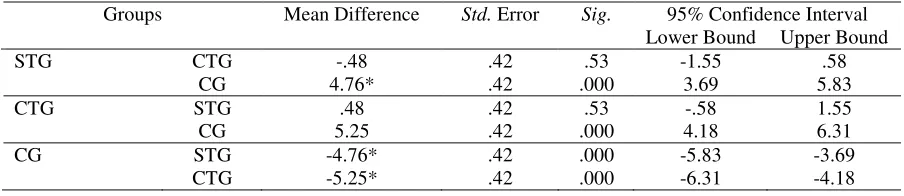
As could be seen in Table 8, there was a statistically significant difference in post-test scores for STG (M = 16.51, SD = 1.47), CTG (M = 17.00, SD = 1.13), and CG (M = 11.75, SD = 2.20) since the p value under the Sig. column was less than the specified level of significance (i.e. .000 < .05). To find out where exactly the differences among the three groups lay, the Scheffe post hoc test was conducted.
Table 9
Results of the Scheffe Post Hoc Test for Comparing STG, CTG, and CG Mean Scores on the Post-test
Groups Mean Difference Std. Error Sig. 95% Confidence Interval Lower Bound Upper Bound
STG CTG
CG -.48 4.76* .42 .42 .53 .000 -1.55 3.69 .58 5.83
CTG STG
CG .48 5.25 .42 .42 .53 .000 -.58 4.18 1.55 6.31
CG STG
CTG -4.76* -5.25* .42 .42 .000 .000 -5.83 -6.31 -3.69 -4.18
difference between STG learners and CG learners (M = 11.75) was statistically significant. Likewise, the difference between CTG learners and the learners of the control group reached statistical significance. To sum up, the two experimental groups outperformed the control group significantly, and these two experimental groups did not significantly differ on the post-test.
5. Discussion and Conclusion
The present study was designed to examine the combined effect of recast and task complexity (i.e. simple vs. complex task conditions) on the production of conditional sentences by Iranian EFL learners. As far as the first research question was concerned, “Does providing Iranian intermediate EFL learners with recasts exert a significant effect on their production of conditional constructions in simple tasks?” the current study found that the participants in STG group did perform significantly better on the post-test than they did on the pre-test of conditional constructions. Therefore, the results uniformly rejected the first hypothesis. A possible explanation for this might be accounted for by Paivio’s (1986, 1991, 2007) dual coding theory (DCT), which asserts that words and images have different cognitive representations; hence, the human brain uses separate systems for different types of information: the verbal system and the imagery system. The verbal system deals with linguistic codes, such as words, speech, or language; on the other hand, the imagery system primarily deals with visual codes, such as images, pictures, or concrete objects. Paivi(2007) emphasized the interconnectedness of the two distinct cognitive systems – verbal and visual. He indicated that as verbal information moves to the verbal system and visual information moves to the imagery system, information in either system can activate information in the other. An example that is often cited is the word Shrek, where this word confuses students when they first see it. However, those who have seen the movie “Shrek” may immediately think of an image of green ogre by triggering the image processor. Therefore, cognitive interaction verbal and imagery systems works better than either one alone (Lai, 2000).
As for the second research question, “Does providing Iranian intermediate EFL learners with recasts exert a significant effect on their production of conditional constructions in complex tasks?”, the analysis of data revealed that recast did have a significant impact on the participants’ production of conditional constructions while performing complex tasks since the CTG learners managed to obtain significantly higher scores on the post-test compared with their pre-test scores. The second null hypothesis of the study was, thus, rejected. The reason for obtaining such a result could be purported to be the fact that recast, as one way of correction, made the learners aware of their problems with the target structure and help them produce grammatically correct forms to a greater extent on the post-test than they did on the pre-test. This being so, the results obtained could lend support to the claim made by some SLA researchers who argued that the juxtaposition of the learner’s incorrect utterance with the feedback provider’s grammatical reformulation may induce the learner to notice the gap and subsequently make a cognitive comparison between the target-like utterance and his or her own interlanguage utterance (Doughty, 2001; Long, 1996; Long, 2007).
With regard to the third research question, which posited “Is there any significant difference between Iranian intermediate EFL learners’ production of conditional constructions after receiving recasts in simple vs. complex tasks?”, it was found that the recast treatment without photo support was more effective in improving the learners’ knowledge of, and ability to use the conditionals than the recast treatment with photo support. The result obtained could be justified by Robinson’s (2001b, 2003) and Long’s (2007) speculation that the cognitive complexity of tasks has the capacity to modulate the efficacy of recasts. Even though it might seem that visual presentation of materials helps language learners (as it really did as it was found in the results of the first research question), the CTG learners who were exposed to recasts without any accompanying pictorials were found to do better than their STG counterparts, due partly to the fact that the complexity of the task made the CTG learners invest more attention and concentration on the task in order to be able to complete the task, and this might have led them to gain significant results in the end.
effective depending on the complexity of the task during which they occur. It should be noted that in Revesz and Han’s study, the effects detected for the two task variables examined–task content familiarity and task type–appeared more formidable. A possible explanation for the smaller impact found in the present study is that there were less marked differences between the [+photo] and [-photo] conditions than between the familiar/unfamiliar and notes-primed/video-primed conditions in Revesz and Han’s study.
Therefore, the following results were reached upon the completion of the experiment: (a) both experimental groups displayed evidence of significant improvement from pre-test to post-test, (b) the two experimental groups were found to outperform the CG on the post-test, and (c) pairwise comparison of the STG and CTG on the post-test revealed that the treatment for the CTG was found to be more effective than that used for the STG. In another word, providing Iranian EFL learners with recasts in both STG and CTG exerts a significant improvement on their production of conditional constructions over their peers that weren’t introduced to recasts. Moreover, those learners who were instructed with recasts along with complex tasks slightly outperformed their peers who were instructed with recasts along with simple tasks on their production of conditional constructions.
In conclusion, as Robinson (2003) contends, increasing task complexity along resource-directing dimensions can push learners to go beyond their level of proficiency/knowledge and prompt learners to extend, stretch and make more elaborate an existing L2 knowledge base. As he explains, more complex tasks along these dimensions, and the increased conceptual/cognitive demands they entail, have the potential to direct learners’ attention to the way these complex concepts are structured and encoded in the L2, eventually leading to the development of new interlanguage knowledge.
6. References
Brown, R. (1973). A first language: The early stages. Cambridge, MA: Harvard University Press. http://dx.doi.org/10.4159/harvard.9780674732469
Chou, Ch. L. (2014). Chinese speakers` acquisition of English conditionals: acquisition order and L1 transfer effects. Second language studies, 19(1), 57-98.
Coughlan, P., & Duff, P. (1994).Same task, different activities: Analysis of a second language acquisition task from an activity theory perspective. Norwood, NJ: Ablex.
Doughty, C. J. (2001). Cognitive underpinnings of focus on form.In P. Robinson (Ed.), Cognition and second language instruction (pp. 206-257). Cambridge, UK: Cambridge University Press.
http://dx.doi.org/10.1017/CBO9781139524780.010
Ellis, R. (2003). Task-based language learning and teaching. Oxford: Oxford university press.
Ellis, R., & Sheen, Y. (2006).Reexamining the role of recasts in second language acquisition. Studies in Second Language Acquisition, 28, 575-600. http://dx.doi.org/10.1017/s027226310606027x
Foster, P., & Skehan, P. (1999). The influence of source of planning and focus of planning on task-based performance. Language Teaching Research, 3(3), 215-247.
http://dx.doi.org/10.1177/136216889900300303
Ishikawa, T. (2008). The effects of task demands of intentional reasoning on L2 speech performance. The Journal of Asia TEFL, 5(1), 29-63.
Jeon, I. J., & Hahn, J. W. (2005). Exploring EFL teachers' perceptions of task-based language teaching: A case study of Korean secondary school classroom practice. Asian EFL Journal. Retrieved from
http://www.asian-efl-journal.com/March06_ijj&jwh.pdf
Kim, Y. (2009). The effects of task complexity on learner-learner interaction. System, 37, 254-268. http://dx.doi.org/10.1016/j.system.2009.02.003
Lai, S. L. (2000). Influence of audio-visual presentations on learning abstract concepts. International Journal of Instructional Media, 27(2), 199-206.
Long, M. (1983). Does second language instruction make a difference? A review of research. TESOL Quarterly, 17, 359-382. http://dx.doi.org/10.2307/3586253
K. Bhatia (Eds.), Handbook of second language acquisition (pp. 413-468). San Diego, CA: Academic press. http://dx.doi.org/10.1016/b978-012589042-7/50015-3
Long, M. H. (2007). Recasts: The story thus far. In M. H. Long (Ed.), Problems in SLA (pp.75-116). Mahwah, NJ: Lawrence Erlbaum.
Mackey, A., & Philip, J. (1998). Conversational interaction and second language development: Recasts, responses and red herrings? Modern Language Journal, 82, 338-356.
http://dx.doi.org/10.1111/j.1540-4781.1998.tb01211.x
Nassaji, H. (2009). Effects of recasts and elicitations in syadic interaction and the role of feedback explicitness. Language Learning, 59, 411-452. http://dx.doi.org/10.1111/j.1467-9922.2009.00511.x
Nicholas, H., Lightbown, P., & Spada., N. (2001). Recasts as feedback to language learners. Language Learning, 51, 719-758. http://dx.doi.org/10.1111/0023-8333.00172
Nunan, D. (1989). Designing tasks for the communicative classroom. Cambridge: Cambridge University Press. Nunan, D. (2001). Second language teaching and learning. Boston: Heinle & Heinle Publisher.
Ortega, L. (1999). Planning and focus on form in L2 oral performance. Studies in Second Language Acquisition, 21, 109-148. http://dx.doi.org/10.1017/s0272263199001047
Paivio, A. (1986). Mental representation: A dual-coding approach. New York: Oxford university press. Paivio, A. (1991). Images in mind: The evolution of a theory. Sussex, U.K.: Harvester Wheatsheaf. Paivio, A. (2007). Mind and its evolution: A dual coding theoretical approach. Mahwah, NJ: Erlbaum. Rahimpour, M. (1997). Task complexity, task condition, and variation in L2 oral discourse. Unpublished
Doctoral dissertation, University of Queensland, Australia.
Rahimpour, M. (1999). Task complexity and variation in interlanguage. In N. O. Jungheim & P. Robinson (Eds.), Pragmatic and pedagogy: Proceeding of the 3rd pacific second language research forum (pp. 115-134). Tokyo, Japan: Pac LRF.
Rahimpour, M. (2007).Task complexity and variation in L2 learners’ oral discourse. Working Papers in Language and Linguistics (pp. 1-47). University of Queensland.
Rashidi, N., & Babaie, H. (2013). Elicitation, recast, and meta-linguistic feedback in form-focused exchanges: effects of feedback modality on multimedia grammar instruction. The Journal of Teaching Language Skills (JTLS), 4(4), 35-59.
Revesz, A., & Han, Z-H. (2006). Task content familiarity, task type, and efficacy of recasts. Language Awareness, 3, 160-179. http://dx.doi.org/10.2167/la401.0
Robinson, P. (2001a). Task complexity, task difficulty, and task production: Exploring interactions in a componential framework. Applied Linguistics, 22(1), 27-57. http://dx.doi.org/10.1093/applin/22.1.27 Robinson, P. (2001b). Task complexity, cognitive resources, and syllabus design: A triadic framework for
investigating task influences on SLA. In P. Robinson (Ed.), Cognition and second language instruction (pp. 287-318). New York: Cambridge University Press.
http://dx.doi.org/10.1017/CBO9781139524780.012
Robinson, P. (2003). Attention and memory during SLA. In C. J. Doughty & M. H. Long (Eds.), The handbook of second language acquisition (pp. 631-678). Malden, MA: Blackwell.
http://dx.doi.org/10.1002/9780470756492.ch19
Robinson, P. (2007). Task complexity, theory of mind, and intentional reasoning: effects on L2 speech production, interaction, uptake and perceptions of task difficulty. International Review of Applied Linguistics, 45(3), 193-213. http://dx.doi.org/10.1515/iral.2007.009
Skehan, P., & Foster, P. (1999).The influence of task structure and processing conditions on narrative retellings. Language Learning, 49(1), 93-120. http://dx.doi.org/10.1111/1467-9922.00071
Swain, M. & Lapkins, S. (1995). Problems in output and the cognitive process they generate: a step towards second language learning. Applied linguistics, 16(3), 371-391. http://dx.doi.org/10.1093/applin/16.3.371 Swain, M. (1985). Communicative competence: Some roles of comprehensible input and comprehensible output
in its development. In S. M. Gass & C. G. Madden (Eds.), Input in second language acquisition (pp. 235-253). Rowley, MA: Newbury House.