A Real Time Traffic Sign Detection and Recognition
Algorithm based on Super Fuzzy Set
A. Khodayari*1, A.Ghaffari2, E.Fanni3
1. Associate Professor, Mechanical Engineering Department, Pardis Branch, Islamic Azad University, Tehran, Iran.2. Professor, Mechanical Engineering Department, K.N.Toosi University of Technology, Tehran, Iran. 3. M.Sc., Mechatronics Engineering Department, South Tehran Branch, Islamic Azad University, Tehran, Iran..
Abstract
Advanced Driver Assistance Systems (ADAS) benefit from current infrastructure to discern environmental information. Traffic signs are global guidelines which inform drivers from near characteristics of paths ahead. Traffic Sign Recognition (TSR) system is an ADAS that recognize traffic signs in images captured from road and show information as an adviser or transmit them to other ADASs. In this paper presents a novel machine vision algorithm for traffic sign recognition based on fuzzy sets. This algorithm is a pipeline consists of multiple fuzzy set that create a fuzzy space here called Super Fuzzy Set (SFS). SFS helped to design a flexible and fast algorithm for recognizing traffic signs in a real-time application. Designed algorithm was implemented in computer-based system and checked on a test car in real urban environment. 83.34% accuracy rate was obtained in real-time test
.
Keywords: Advanced Driver Assistance Systems, Traffic Sign Recognition, Super Fuzzy Set, Vision Algorithm.
1. Introduction
Driver assistance systems help drivers to increase driving quality. Traffic sign recognition (TSR) system is an intelligent driver adviser that provides road information by extracting the meanings of traffic signs. Traffic signs are visual information that consist of standard shapes and symbols combination. Artificial intelligence methods improve image processing and machine vision algorithms for extracting the traffic sign’s meanings.
In recent years, image processing and machine vision algorithms have been developing for traffic sign detection and recognition [1,2,3]. Extracting traffic signs’ meanings is divided to three primary stages. The first stage in all image processing algorithms is preprocessing. Second stage is detection, that seeks sign region in an image. In the third stage, the algorithm looks in the detected regions to find traffic signs and extract their meanings.
A soft computing method witch was used mostly in artificial intelligence sciences is fuzzy logic [4]. It benefits from the human’s experiences to make decisions for different processes. In TSR systems based on image processing, many researchers have
been using fuzzy sets in their algorithms. In an image, standard colors of traffic signs are interest to find candidate regions. In [5] and [6], fuzzy sets were used in preprocessing stage for color segmentation. But during the day environmental illumination varies. Change in the captured images brightness is a difficult challenge for segmentation algorithms. So a fuzzy inference method presented by [7] was used to evaluate the input image illumination conditions in order to apply appropriate preprocessing operations.
Making decision in detection and recognition stages is very important. Because a wrong decision in preprocessing stage will decrease only the algorithm accuracy, but a wrong decision in recognition stage will result in a failure in the algorithm. In [5], four kinds of traffic sign shapes are detected based on fuzzy inference system (FIS). Two Fuzzy ARTMAP Neural Networks with separate training sets trained in [8] for traffic signs detection and recognition stages. Also a fuzzy-neural technique based on back-propagation neural network (BNN) modeled in [9] and an adaptive neuro fuzzy inference system (ANFIS) presented in [10] for recognizing traffic signs were utilized. Chiang et al. were proposed a fuzzy adaptive-kernel-based learning vector
are training with sets of patterns. Neural network is not necessarily combined with FIS in TSR systems [13,14]. Support vector machine (SVM) is a kind of machine learning algorithms. It was used in [15] for detection and in [16] and [17] for traffic sign recognition. Other machine learning algorithms consist of nearest neighbors and decision trees are used in [18] and [19] respectively.
Another method used in recognition stage is matching approach. Pattern-based matching approach needs a matching algorithm to compare input image with traffic signs patterns considered in data base [20,21]. The patterns generally have the form of either sequences or tree structures. Liu et al. recognized speed limit traffic signs with fuzzy template-based matching method [22]. Template consists of all sample pixels that have to be compared with input image. If recognition target has strong features, feature-based matching is a proper approach. In [23], discriminative features were used for traffic sign recognition.
In this paper a novel machine vision algorithm based on fuzzy logic will be presented for traffic sign recognition system. So first, the Super Fuzzy Set (SFS) approach and design the traffic sign recognition algorithm is described in three stages, preprocessing, detection and recognition. Then the results of implementation and practical test are described and compared with other researches.
2
. Super Fuzzy Set ApproachProposed intelligent algorithm for traffic sign detection and recognition consists of preprocessing, detection and recognition stages. Here has benefited
here.
Figure 1 shows traffic sign detection and recognition algorithm diagram. The purple region is super fuzzy set. First, a fuzzy image from primary image by fuzzification operator was created. Then a fuzzy adaptive denoising algorithm clears unwanted pixels of fuzzy image. In a parallel process, edges of primary image were detected by Sobel algorithm. Edge image must convert to fuzzy edge image for entering the SFS. Then a logical AND operates on the final images of two parallel process. So edge pixels were removed from image and it is ready for labeling operation. In labeling operation, connected components that have same color mark as a label.
In detection stage, the aim is finding some traffic signs’ primary features in extracted labels and canceling none traffic sign labels. So operational accuracy and velocity are increased in recognition stage. Beside color, standard shapes are good feature to detect traffic signs. In this paper, feature points method of invariant features [24] is used. Feature points match with candidates at feature points position operation to obtain appropriate data for detection inference engine. In feedback process a rotation and scaling operation designed to detect traffic signs at various space terms.
Candidates detected as traffic signs have to pass the recognition stage. In this stage like detection stage, feature points are extracted and conceded to recognition inference engine. For each candidate decision is made to recognize traffic sign concepts. Finally, SFS result was converted to a numerical variable by defuzzification operation
.
Fig1.Proposed algorithm diagram.
Fig2.. The meaning of fuzzy image.
Fig3.Sobel edge detection.
2.1. Preprocessing
Captured image from camera is in RGB format. First it is converted to HSV (Hue-Saturate-Value) space. In HSV space the illumination variation just efficacy on V parameter, but H is color parameter that must be processed here. Traffic signs have standard pure colors, so HSV space can help to detect them in environmental image. Also one parameter processing in HSV space increase process speed versus three parameters processing in RGB space for color segmentation operation [25].
A fuzzy color segmentation designed to collect interest colors from image. Fuzzy Image is output of this operation. In Fuzzy Image each pixel characterizes describe with linguistic variables. Fuzzy color segmentation is an entering gate to SFS. Figure 2 shows the meaning of Fuzzy Image.
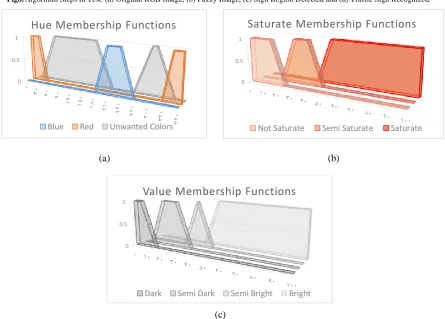
H parameter is pixel color in HSV space. This parameter has all colors spectrum mapped on 0 to 360 degrees. Thus can create a fuzzy membership function for H parameter for color fuzzification.
Some linguistic variables like “colorless” or “colorful” are described with S parameter membership function and some others like “bright” or “dark” can be described with V parameter membership function.
Fuzzy Image has some undesirable color pixels. They are consisted of single outspread pixels that must cancel with denoising operation. A fuzzy adaptive denoising algorithm designed to compare color of pixels in a 3×3 sliding window to making decision for color of central pixel.
After denoising operation, image is ready for labeling. But there are some traffic sign detection challenges in urban environment. One is background color similar to that of traffic sign. In this case, in fuzzy image a correct detection cannot be made. Because the created fuzzy image consists of some basic discrete colors. So a color spectrum in primary image, have single linguistic value in fuzzy image. Here Sobel edge detection algorithm [26] is used to confuse this challenge by extracting primary image edges showed in a parallel process path in Figure 1. Figure 3 shows a traffic sign and its edge image.
Sobel edge detection operate in numeric space. For entry the SFS it must fuzzify. Then a logical
HB: High- Blue
B: Blue
LB: Low- Blue
LR: Low- Red
R: Red
operation. Labeling operation looks in image for regions containing neighbor pixels with same color. Then assign a unique number as a label to a set of connected pixels. There are two methods for component labeling: Sequential and Recursive [27]. Recursive labeling method is used in present algorithm. After that detection stage is operating on labeled regions.
2.2. Detection
Feature based methods were usually used for object detection and recognition in machine vision [28]. Features are some unique properties of object that distinguish it from other same objects. Size, angle view, brightness, etc. of objects in different images always vary. So features chosen for detection and recognition must be useful in different situation. Generally, there are two kinds of features [24]. First, Local Features that include points, edges, etc. and second Global Features that include some methods like histogram analysis.
Detection operation steps will be described.
Extracted labels from Fuzzy Image have to check in detection algorithm. But all labels are not traffic signs. Before detection stage labels are filtered with low level and high level thresholds on total pixels in a label. Then they are filtered with dimensional ratio. Labels that passed these filters will be sent to detection stage.
Connected components must be check separately in detection algorithm. Geometric shapes of traffic signs are square, circle, triangle, hexagonal and diamond but in this paper square, circle and triangle were considered. In order to detect these shapes, 10 points were selected that are shown on Figure 4.a. Color linguistic value of each feature points makes an input for detection inference engine. Special compositions of feature points that are consider for desired shapes has been shown in Figure 4.b,c,d. For example, fuzzy rule for detecting triangle that used feature points in Figure 4.d is:
If C&F&H&I is Red & B&E&G&J is NOT Red Then Shape is Triangle with Red Rim.
(a) (b)
(c) (d)
Fig4.Feature points selected for detection stage. a) All feature points. b) Square feature points. c) Red rim circle. d) Red rim triangle.
Inputs A and D is not used in this rule. It means their values are not important in triangle detection.
Here, patterns dimensions are 41×41 pixels. Each point is stored by Polar coordinate system according to Equation 1 and 2.
𝑟𝐴= √𝑥𝐴2+ 𝑦𝐴2 (1)
𝜃𝐴= 𝑎𝑟𝑐𝑡𝑎𝑛 (𝑦𝑥𝐴
𝐴) (2)
In equations, xA and yA are Cartesian coordinate of point A in pattern format, rA and θA are corresponding Polar coordinate of point A.
Figure 5 shows the schematic of detection stage. Feature Points Position operation is in relation with final image of preprocessing stage and Data Base. Polar coordination of feature points is stored in Data Base. Feature points Coordination is extracted from ideal patterns in laboratory conditions. But performance improvements of proposed algorithm in real environments needs to consider sign scaling and rotation. So Feature Points Position operation calculates the dimension ratio between pattern and candidate component in image. Then it scales feature points by varying the radius and extract the data of feature pixels. In most similar researches, Because of use fixed patterns, candidate segment of input image is adapted with pattern [29]. But in proposed intelligent algorithm, pattern and candidate segment are adapted by varying feature points data.
Each feature point Cartesian coordinate is restored by Equation 3 and 4.
𝑥𝑓 = 𝑥(𝑚𝑖𝑑)𝑠𝑒𝑔∙+ {𝑘 (
𝑥(𝑚𝑎𝑥)𝑆𝑒𝑔∙
𝑥(𝑚𝑎𝑥)𝑃𝑎𝑡∙) 𝑟 𝑐𝑜𝑠(𝜃 + 𝜑)}
(3)
𝑦𝑓= 𝑦(𝑚𝑖𝑑)𝑠𝑒𝑔∙+ {𝑘 (
𝑦(𝑚𝑎𝑥)𝑆𝑒𝑔∙
𝑦(𝑚𝑎𝑥)𝑃𝑎𝑡∙) 𝑟 𝑠𝑖𝑛(𝜃 + 𝜑)}
(4)
Factor k is scale ratio due to φ degrees rotate of pattern around axis perpendicular to the image plane and limited to fixed frame. Values xf and yf are final coordinate of each feature point. Also terms Seg. and Pat. introducing candidate segment of image and pattern respectively.
Data of feature points are sent to Fuzzy Detection Inference Engine. This operation according to rules defined in Rule Base and inputs is making detection decision. If sign is not detected in process, pattern is rotated by feedback path operation. Fuzzy Rotation & Scale Inference Engine operation rotate the feature points by varying the angle. If square and triangle shapes rotate in a fixed frame (here 41×41 pixels) then their dimension will change. So the radius must scale too. Then candidate is checked with new r and theta ratio. continuance necessity of this loop is determined by Fuzzy Rotation & Scale Inference Engine operation.
2.3. Recognition
The recognition stage is final decision making stage in proposed SFS. It focuses on traffic signs character to extract their concepts. Proposed recognition algorithm is based on fuzzy logic and feature points method similar to detection algorithm. But here feature points coordinate and fuzzy rules are different. Also each kind of traffic signs needs a different set of feature points. Figure 6 shows the schematic of recognition stage.
According to Figure 6, Final Detection, r, Theta and candidate region detected as traffic sign in B&W format are inputs of recognition stage
Fig5.Schematic of Detection Stage
Fig6.Schematic of Recognition Stage
Fig7.Equipped trial car in AVCSLab.
. Final Detection is decision made in preview stage for each candidate. Also r and Theta correspond to rotation angle of traffic sign in image calculated in feedback of detection stage.
Feature Points Position operation in Figure 6 has different database of the same operation in detection stage. So this operation according to stage inputs and points polar coordinates stored in Data Base extract the color of feature points in candidate regions. Fuzzy Recognition Inference Engine makes final decision about concepts of traffic signs base on designed Rule Base.
3. Experimental Results
A system is collected to test and validate the proposed traffic sign recognition algorithm in real-time and urban environment. This system is based on software programming with OpenCV library.
OpenCV was designed for computational efficiency with a strong focus on real-time applications [30]. Here an action camera in car-mode is used to capture images with a telephoto lens mounted on it. Figure 7 shows the trial vehicle and the camera mounted on it. This platform prepared in Advanced Vehicle Control Systems (AVCS) laboratory in K.N. Toosi University of Technology and used to test the proposed algorithm in real environment.
Figure 8 shows the results of algorithm steps. Figure 8Error! Reference source not found..a is the original input image. It was captured from urban environment to test the algorithm. First some defined sampling points extract from image. Analysis of them helps to create adaptive contrast and brightness filters to enhance image against light variation. In this application, just Red, Blue and Black colors are interest. So color fuzzification operation discards unwanted colors and fuzzy rules defined for interest colors. Figure 8.b shows fuzzy image.
Membership functions Designed to create fuzzy image are shown in Figure 9.
Finally, recognition inference engine checks candidate regions to detect traffic signs. In sample, Figure 8.c shows the image region that cropped by detection stage and Figure 8.d shows the recognition
result. It is a sample of patterns used to interest points election and design rules of recognition FIS.
In real-time application, the system achieved 6 frames per second. It is an appropriate frame rate for urban environment. The result is shown in Table 1 and compared with other similar works.
(a) (b)
(c) (d)
Fig8.Algorithm Steps in Test. (a) Original RGB image, (b) Fuzzy Image, (c) Sign Region Detected and (d) Traffic Sign Recognized.
(a) (b)
(c)
Fig9.. Membership Functions of Fuzzy Inference System for Create Fuzzy Image, (a) Hue Membership Functions, (b) Saturate Membership Functions, (c) Value Membership Functions.
0 0.5
1
0
30 60 90 120 150
180 210 240 270
300 330
360
Hue Membership Functions
Blue Red Unwanted Colors
0 0.5
1
0 10 20 30 40 50 60
70 80
90 100
Saturate Membership Functions
Not Saturate Semi Saturate Saturate
0 0.5
1
0 10 20 30 40 50 60
70 80
90 100
Value Membership Functions
Dark Semi Dark Semi Bright Bright
Sindha [31] 92.08% 3.96% 3.96%
Kardkovacs [32] 78.4% 12.6% 3%
Proposed Algorithm 83.34% 5.55% 11.11%
4. Conclusions
In this paper, a novel algorithm based on Supper Fuzzy Set (SFS) is presented in a machine vision system. SFS has general application in control and making-decision systems. Here it is used to design a traffic sign recognition system to analyze images captured from real road environment.
Designed algorithm has been implemented and checked with a test car in a real-time scenario and real environment. Results show the suitable functioning of the system compared with similar researches.
5. Acknowledgment
This work has been done and financially supported by the Advanced Vehicle Control Systems Laboratory (AVCSLab) at the Mechanical Engineering Department of K. N. Toosi University of Technology, Tehran, Iran.
References
[1]. Yin, S., Ouyang, P., Liu, L., Guo, Y., and Wei, S., 2015. “Fast Traffic Sign recognition with Rotation Invariant Binary Pattern Based Feature”. Sensors, 15, pp. 2161-2180.
[2]. Zhou, L., and Deng, Z., 2014. “LIDAR and Vision-Based Real-Time Traffic Sign Detection and Recognition Algorithm for Intelligent Vehicle”. IEEE 17th International Conference on Intelligent Transportation Systems (ITSC), Qingdao, China, Oct., pp. 578-583.
[3]. Lillo-Castellano, J.M., Mora-Jimenez, I., Figuera-Pozuelo, C., and Rojo-Alvarez, J.L., 2015. “Traffic Sign Segmentation and Classification Using Statistical Learning Methods”. Neurocomputing, 153, pp. 286-299. [4]. Mardani A., Jusoh A., Zavadskas E.K., 2015.
“Fuzzy Multiple Criteria Decision-Making Techniques and Applications – Two Decades Review from 1994 to 2014”. Expert Systems and Applications, 42, pp. 4126-4148.
[5]. Fleyeh, H., 2008. “Traffic Sign Recognition by Fuzzy Sets”. IEEE Intelligent Vehicles Symposium, Eindhoven University of Technology, Eindhoven, The Netherlands, June, pp. 422-427.
[6]. Wanitchai, P., and Phiphobmongkol, S., 2008. “Traffic Warning Signs Detection and Recognition Based on Fuzzy Logic and Chain Code Analysis”. IEEE Second International Symposium on Intelligent Information Technology Application, pp. 508-512.
[7]. Lin, C.C., Wang, M.S., and Yang, T.C., 2010. “Fuzzy Adaptive Pre-processing Models for Road Sign Recognition”. Second World Congress on Nature and Biologically Inspired Computing, Kitakyushu, Fukuoka, Japan, Dec., pp. 642-647.
[8]. Fleyeh, H., Gilani, S.O., and Dougherty, M., 2006. “Road Sign Detection and Recognition Using Fuzzy ARTMAP: A Case Study Swedish Speed-Limit Signs”. Proceeding of the 10th IASTED International Conference on Artificial Intelligence and Soft Computing, Palma de Mallorca, Spain, Aug., pp. 242-249.
[9]. Kantawong, S., 2007. “Road Traffic Signs Guidance Analysis for Small Navigation Vehicle Control System”. IEEE International Conference on Vehicular Electronics and Safety (ICVES), pp. 1-6.
[10].[Billah, M., Waheed, S., Ahmed, K., and Hanifa, A., 2015. “Real Time Traffic Sign Detection and Recognition Using Adaptive Neuro Fuzzy Inference System”. Communications on Applied Electronics (CAE), Foundation of Computer Science (FCS), New York, USA, Vol. 3, No. 1, pp. 1-5.
[11].Chiang, H.H., Chen, Y.L., and Lee, T.T., 2013. “Multi-Stage with Neuro-Fuzzy Approach for Efficient On-Road Speed Sign Detection and Recognition”. International Journal of Innovation Computing, Information and Control (ICIC), Vol. 9, Num. 7, pp. 2919-2939.
[12].Harrington, P., 2012. “Machine Learning in Action”. Manning Publications Co, ISBN 9781617290183.
[13].Wang, S., Zhang, P., Dai, Z., Wang, Y., Tao, R., and Sun, S., 2013. “Research and Practice of Traffic Lights and Traffic Signs Recognition System Based on Multicore of FPGA”. Communications and Networks. SciRes, 5, pp. 61-64.
[14].Sun, Z.L., Wang, H., Lau, W.S., Seet, G., and Wang, D., 2014. “Application of BW-ELM Model on Traffic Sign Recognition”. Neurocomputing. Elsevier B.V., 128, pp. 153-159.
[15].Park, J.G., and Kim, K.J., 2013. “Design of a Visual Perception model with Edge-Adaptive Gabor Filter and Support Vector Machine for Traffic Sign Detection”. Expert Systems with Applications. Elsevier Ltd, 40, pp. 3679-3687. [16].Bui-minh, T., Ghita, O., Whelan, P.F., and
Hoang, T., 2012. “A Robust Algorithm for Detection and Classification of Traffic Signs in Video Data”. International Conference on Control, Automation and Information Sciences (ICCAIS), IEEE, pp. 108-113.
[17].[17] Azad, R., Azad, B., and Kazerooni, I.T., 2014. “Optimized Method for Iranian Road Signs Detection and Recognition System”. International Journal of Research in Computer Science, Vol. 4, Issue 1, pp. 19-26.
[18].Zi-xing, C., and Ming-qin, G., 2013. “Traffic Sign Recognition Algorithm Based on Shape Signature and Dual-Tree Complex Wavelet Transform”. Journal of Central South University Press, Springer-Verlag, Berlin, Heidelberg, 20, pp. 433-439.
[19].Zaklouta, F., and Stanciulescu, B., 2014. “Real-Time Traffic Sign Recognition in Three Stage” Robotics and Autonomous Systems. Elsevier B.V., 62, pp. 16-24.
[20].Waite, S., and Oruklu, E., 2013. “FPGA-Based Traffic Sign Recognition for Advanced Driver
Science Issues, Vol. 8, Issue 6, No. 1, pp. 402-408.
[22].Liu, W., Yu, H., Yuan, H., and Zhao, H., 2010. “Real-Time Speed Limit Sign Detection and Recognition from Image Sequences”. International Conference on Artificial Intelligence and Computational Intelligence, pp. 262-267.
[23].Oruklu, E., Pesty, D., Neveux, J., and Guebey, J.E., 2012. “Real-Time Traffic Sign Detection and Recognition for In-Car Driver Assistance Systems”. IEEE 55th International Midwest Symposium on Circuits and Systems (MWSCAS), pp. 976-979.
[24].Tuytelaars T., and Mikolajczyk K., 2007. “Local Invariant Feature Detectors: A Survey”. Foundation and Trends® in Computer Graphics and Vision, Vol. 3, No. 3, pp. 177-280.
[25].Perez, F., and Koch, C., 2005. “Toward Color Image Segmentation in Analog VLSI: Algorithm and Hardware”. International Journal of Computer Vision, 12, 1, pp. 17-42.
[26].Blackledge, J., 2005. Digital Image Processing Mathematical and Computational Methods. Horwood Publishing, ISBN: 1-898563-49-7. [27].Jain, R., Kasturi, R., and Schunck, B.G., 1998.
Machine Vision. United States of America: McGraw-Hill, Inc.
[28].Solanki, D.S., and Dixit, G., 2015. “Traffic Sign Detection Using Feature Based Method”. International Journal of Advanced Research in Computer Science and Software Engineering, 5(2), pp. 340-346.
[29].Souani, C., Faiedh, H., and Besbes, K., 2014. “Efficient Algorithm for Automatic Road Sign Recognition and Its Hardware Implementation”. Journal of Real-Time Image Processing, 9, pp. 79-93.
[30].Bradski, G., and Kaehler, A., 2016. Learning OpenCV: Computer Vision in C++ with the OpenCV Library. O’Reilly Media.
[31].Sindha, P.D., Shah, D.M., and Patel, A., 2015. “Multimedia based Real Time Traffic Sign Recognition System and its Analysis”. Indian Journal of Science and Technology, Vol. 8(15), pp. 1-6.
[32].Kardkovacs, Z.T., Paroczi, Z., Varga, E., Siegler, A., and Lucz, P., 2011. “Real-time Traffic Sign Recognition System”. IEEE Xplore.