Prediction of self-destruction based on depression symptoms,
internalized self-criticism, shame and guilt
Ashraf-Sadat Mousavi
1, Parviz Azadfalah
1, Mohsen Dehghani
2, Hojatollah Farhani
31Department of Psychology, Faculty of Humanities, Tarbiat Modares University, Tehran, Iran. 2Department of Psychology, Faculty of Education and Psychology,Shahid Beheshti University,
Tehran, Iran.
3Department of Psychology, School of Medicine, Islamic Azad University, Tehran Medical
Branch, Tehran, Iran Submitted: 9 April 2016 Accepted: 12 August 2016
Int J Behav Sci. 2016; 10(2): 57-62
Corresponding Author: Parviz Azadfalah, PhD Department of Psychology, Faculty of Humanities, Tarbiat Modares University, Tehran,
Iran.
E-mail: [email protected]
Abstract
Introduction: Psychological theories and literature have confirmed self-destructiveness patterns in human beings. Chronic self-destructiveness has been defined as a tendency to behaviors that increase negative consequences and decrease potential success in the future. The aim of this study was to investigate the prediction of chronic self-destructiveness based on depression symptoms, internalized self-criticism, shame and guilt, and sex differences in this area.
Method: Hundred and six under-graduate students (59 women and 47 men) of the University of Tehran responded to the questionnaires, in convenience sampling. The Chronic Self-Destructiveness Scale (CSDS), Personal Feeling Questionnaire (PFQ), Levels of Self-Criticism Scale (LSCS) and Beck Depression Inventory-II (BDI-II) were used. Data analysis was performed using Pearson correlation coefficients and standard multiple regression.
Results: Data showed that depression could predict self-destructiveness in both sex. As expected, after adding internalized criticism in the next step, the role of depression decreased in predicting self-destructiveness, but internalized self-destructiveness could predict self-destructiveness beyond depression, only in men. In the next step, after adding guilt and shame subscales in the equation, guilt could predict self-destructiveness, beyond other variables in women, and in men. Also, internalized self-criticism could predict self-destructiveness better than the other variables.
Conclusion: Our findings affirmed that self-destructiveness could be predicted by depression, internalized criticism and guilt. Internalized criticism and guilt could predict self-destructiveness, beyond other variables, in men and women respectively.
Keywords: Chronic Self-Destruction, Sex Differences, Internalized Self-Criticism, Guilt, Prediction
Introduction
These features are efforts for regulation of affective, cognitive or social experiences, which are related to various sorts of mental disorders (e.g. depression, anxiety and externalized disorders)[3].
Patterns of self-destruction lead theoreticians to claim that human beings have inner self-destructive tendencies (e.g. Freud, 1965, cited in 4], or suggest that some human beings desire self-hurt or self-harm under the pressure of guiltiness or other emotional distresses[4] or, the mild ones, act in a way that its negative consequence is predictable, but there is no desire to it[5]. The ‘sub-intentioned death’ is applied to describe death, which is a consequence of the person’s behavior, although there is no deliberate intent for it. However, it is obvious that patterns of self-destructive tendencies and behaviors are frequent - even in people who are supposed to belong to a normal and healthy population[4].
Kelly et al.[6] have defined self-destruction as behaviors that increase the probability of negative consequences and decrease the probability of future successful events. In other words, patterns of indirect self-destruction are a collection of pervasive and rigid behaviors which negative and long-term consequences are prevailing to its short-term and immediate advantages[5]. Kelly et al.[6] invented the ‘Chronic Self-Destructiveness Scale’ which is aimed at assessing the person’s tendency to act in a self-destructive manner and its items include four constituents of carelessness, poor health maintenance, evidence of transgressions and lack of planfulness. Based on the analysis of the inner consistency of items, two 52-item versions of chronic self-destruction were suggested for both male and female.
Few researches have studied the gender-related differences in chronic self-destructive behaviors, although most of the researches have focused on direct self-destruction[2]. Research show that regarding gender-related differences in chronic self-destructive behaviors, men are more prone to risky behaviors such as alcohol abuse, not fastening their seatbelts, preferring risky jobs and criminal activities[2]. In another study in which the chronic self-destruction scale was used, findings showed that the scores of delinquent girls are lower than the scores of delinquent boys, and their scores were closer to non-delinquent men[7]. Another study revealed a close relationship between indirect self-destruction and psychological gender: direct relationship with the psychological dimensions of masculinity and a converse relationship with the psychological dimensions of femininity[8]. Moreover it has been revealed that women with self-destructive tendencies are more prone to negative features of masculinity (e.g. arrogance) and verbal aggression, though they are less prone to positive features of masculinity (e.g. comprehensiveness) and positive features of femininity (e.g. sensitivity)[9]. Thus, the literature review in this field indicates the higher severity and amount of self-destruction in men, while qualitative differences in self-destruction and types of effective variables have been studied insufficiently.
On the other hand, research findings on relationship between psychological variables and mental health have
shown that heavy irrational guiltiness and shame lead to distress, disorganized interpersonal relationships and psychopathology[10]. Clinical and experimental researches[5] have shown that depression is intertwined with shame and guiltiness, and due to close relations between depression and self-destruction[3], it is expected that self-destruction would be related to a potential probability of shame and guilt. Self-criticism is a variable which is defined based on severe inferiority, guiltiness feeling, worthlessness and failure in fulfillment of expected standards. Internalized self-criticism is defined as negative attitudes towards oneself, because of self-comparison with internalized and personal standards. As these standards are very ideal, actualizing them is practically impossible. Self-critic individuals are extremely vulnerable while facing obstacles through reaching their goals, and thus, they are prone for depression[11]. Research findings show that perfectionism has a direct and positive effect on procrastination[12] and self-handicapping[13], both of which show self-destructiveness behaviors. A recent research[14] shows that self-destruction could be measured with high fitness by five constituents of knowledge, internalized self-criticism, externalized self-self-criticism, guiltiness and shame. Based on the above introduction, the present article has aimed to evaluate the relationship of predictive variables of depression, inner self-criticism, guiltiness and shame, with chronic self-destruction, regarding the probable role of sex in this field.
Method
One hundred and sixteen graduated students of the University of Tehran, who were studying various courses in 2014, had participated in this study. It is noteworthy that while the study concentrated on the symptoms of self-destruction and depression, self-destruction and depression in the forms of symptoms were evaluated and thus, sampling was carried out in the subclinical population. The sample consisted of 47 male and 59 female, with the mean age of 22.68 (SD=3.34) and 21.13 (SD=2.47) respectively.
preservation and planning). The Cronbach’s alpha of men- and women-specific factors were 0.698-0.865 and 0.685-0.800 respectively[15].
Personal Feeling Questionnaire (PFQ): This scale, having two subscales of shame and guilt, contains 22 sorts of feelings and mental states, which are responded on a 5-point Likert scale. Test-retest reliability for shame and guilt has been reported as 0.93 and 0.85 respectively[16]. Also, the validity of the scale has been confirmed through a strong correlation with derogation (r=0.50), self-instability (r=0.34), social anxiety (r=0.37) and external focus of control (r=0.21)[17]. In a study on the Persian healthy subjects, Cronbach’s alpha in two subscales of shame and guiltiness was reported as 0.82 and 0.62 respectively[18].
Levels of Self-Criticism Scale (LSCS): This scale, having two subscales of comparative self-criticism and internalized self-criticism, is consisted of 22 items, which are responded on a 7-points continuum. The Cronbach’s alpha of comparative and internalized self-criticism have been reported as 0.84 and 0.88 respectively, and the correlations of the two subscales with Neuroticism of NEO have been reported as 0.60 and 0.54 respectively[19]. In a recent study on an Iranian sample, the Cronbach’s alpha
of comparative and internalized self-criticism was reported as 0.87 and 0.55 respectively[14]. At the present study, we only used subscale of internalized self-criticism.
Beck Depression Inventory-II: This inventory, which contains of 21 items, is in accordance with the DSM-IV depression criterions[20]. Cronbach’s alpha and one-week test-retest reliability of this inventory have been reported as 0.91 and 0.83, respectively in the English version[21], and as 0.78 and 0.73, respectively, in the Persian version[22].
The above mentioned scales were administered in class groups, while participants responded anonymously and their informed consent was obtained. Hence, more than 120 copies were filled out, and after the exclusion of incomplete ones, 116 cases were entered to the analysis
phase. Data were analyzed through Statistical Package for
the Social Science - version 21 (SPSS-21), and Pearson correlation and standard multiple regression was carried out.
Results
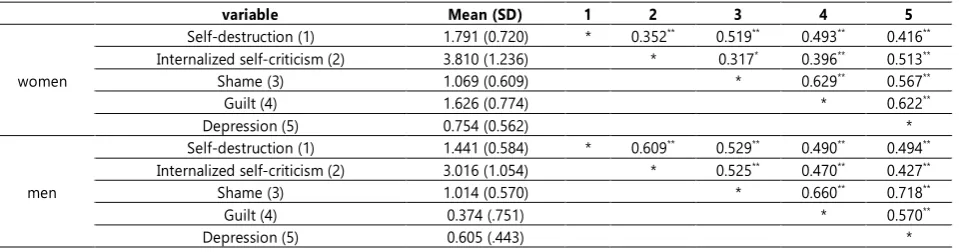
Means, standard deviations and correlations of variables with each other are shown in Table 1. As it can been seen, all of the correlations were positive and significant.
Table 1. Means (and Standard deviations) and Pearson correlations of variables
5 4
3 2
1 Mean (SD)
variable
0.416**
0.493**
0.519**
0.352**
* 1.791 (0.720) Self-destruction (1)
women
0.513**
0.396**
0.317*
* 3.810 (1.236)
Internalized self-criticism (2)
0.567**
0.629**
* 1.069 (0.609)
Shame (3)
0.622**
* 1.626 (0.774)
Guilt (4)
* 0.754 (0.562)
Depression (5)
0.494**
0.490**
0.529**
0.609**
* 1.441 (0.584) Self-destruction (1)
men
0.427**
0.470**
0.525**
* 3.016 (1.054)
Internalized self-criticism (2)
0.718**
0.660**
* 1.014 (0.570)
Shame (3)
0.570**
* 0.374 (.751)
Guilt (4)
* 0.605 (.443)
Depression (5) *P≤.05 **P≤.001
In order to evaluate the predictability of self-defeating based on depression, internalized self-criticism, shame and guiltiness, all of the variables were entered to the equation simultaneously. Moreover, in order to assess each variable’s predictability, variables were added to the equation step by step. First of all, regarding the relationships among the variables, the depression predictability power-as a variable which has other variables under its inclusion- was analyzed. In the second step, internalized self-criticism, and at the end, shame and guilt, as simpler variables in comparison to self-criticism and depression, were added to the previous variables.
First of all, we analyzed multicollinearity: all three indicators showed no correlation of multicollinearity. In both genders, Variance Inflation Factor (VIP) was less than 10, tolerance amount was more than 0.01 and finally, condition index was less than 30. Thus, the favorite range of these amounts let us administer the regression analysis (Table 2). Based on the T-student test, we can assess the exclusive ratio of each variable in predicting dependent variables. The results demonstrate that in both genders, depression can predict self-destruction. At the next step,
after adding internalized self-criticism to the equation, the ratio of depression in the prediction of self-destruction was reduced, but only in men, internalized self-criticism could predict self-destruction more than depression. In the third step, after the entrance of shame and guiltiness to the equation, guiltiness, only in women, could predict self-destruction more than other variables. This is while still in this step in men, internalized self-criticism could predict self-destruction more than all the other variables. These findings are detectable in each step through the β
and t-student test (Table 2).
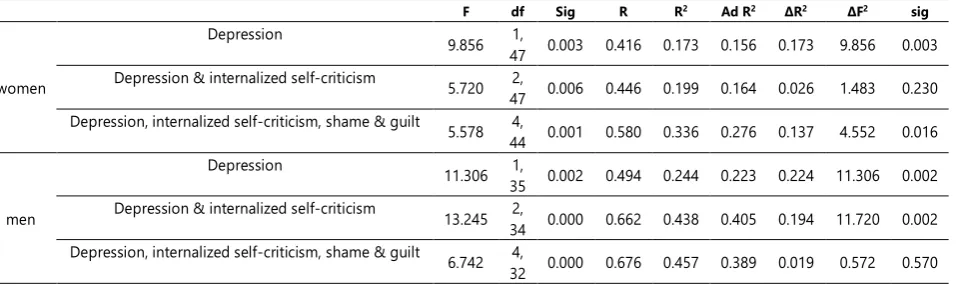
independent variables, but after the entrance of all of the variables to the equation, internalized self-criticism, in men, and guilt, in women, could predict self-destruction more than other variables. These results were detectable through modifications in explanation coefficient (∆R2),
modifications in parameter F (∆F2) and signification level
alterations (sig.). As it can be seen in Table 3, after the entrance of guilt and shame, from the second step to the third step, the explanation coefficient was increased to 0.137 in women, and after the entrance of internalized self-criticism, from the first step to the second step, the amount of R2 increased to 0.194 in men.
Table 2. Indexes of multicollinearity and regression analysis in men and women
SE sig t Beta b Condition Index tolerance VIF 0.170 0.003 3.139 0.416 0.534 3.041 1.000 1.000 Depression women 0.197 0.090 0.043 0.230 2.083 0.320 0.187 0.410 0.109 3.592 8.138 0.736 0.736 1.358 1.358 Depression Internalized Self-Criticism 0.225 0.084 0.195 0.163 0.911 0.294 0.050 0.220 0.113 1.063 1.952 1.245 0.020 0.153 0.322 0.218 0.025 0.089 0.038 0.202 4.556 5.942 8.046 10.713 0.489 0.727 0.554 0.494 2.046 1.376 1.806 2.023 Depression Internalized Self-Criticism Guilt Shame 0.193 0.002 3.362 0.494 0.650 3.090 1.000 1.000 Depression men 0.187 0.079 0.050 0.002 2.013 3.423 0.286 0.487 0.377 0.270 3.596 7.396 0.818 0.818 1.223 1.223 Depression Internalized Self-Criticism 0.251 0.086 0.139 0.220 0.389 0.011 0.481 0.638 0.874 2.717 0.713 0.475 0.167 0.424 0.128 0.102 0.219 0.235 0.099 0.105 4.483 6.590 8.234 9.658 0.467 0.696 0.528 0.367 2.143 1.438 1.896 2.725 Depression Internalized Self-Criticism Guilt Shame
Table 3. Results of ANOVA and changes in R2, according to adding variables, in each step
sig ∆F2 ∆R2 Ad R2 R2 R Sig df F 0.003 9.856 0.173 0.156 0.173 0.416 0.003 1, 47 9.856 Depression
women Depression & internalized self-criticism 5.720 47 2, 0.006 0.446 0.199 0.164 0.026 1.483 0.230 0.016 4.552 0.137 0.276 0.336 0.580 0.001 4, 44 5.578 Depression, internalized self-criticism, shame & guilt
0.002 11.306 0.224 0.223 0.244 0.494 0.002 1, 35 11.306 Depression
men Depression & internalized self-criticism 13.245 34 2, 0.000 0.662 0.438 0.405 0.194 11.720 0.002 0.570 0.572 0.019 0.389 0.457 0.676 0.000 4, 32 6.742 Depression, internalized self-criticism, shame & guilt
Discussion
The present study aimed at evaluating the predictability of chronic self-destruction through the following variables: guilt, shame, internalized self-criticism, and depression. Our findings revealed that along a significant correlation among all the variables, in both genders, a linear composition of independent variables which entered the equation, could predict self-destruction. A broad literature review exposed a strong relationship between self-destruction and aforementioned variables (i.e. internalized self-criticism, depression, shame and guilt). For instance, it has been shown that self-destructive tendencies are correlated to shame[5, 18], guilt[10, 18] and self-criticism[11, 19, 23]. Concerning the relationship between depression and self-defeating, a psychodynamic explanation might suggest that depression is a sort of adjustment in a psychopathologic context. In this viewpoint, depression is recognized as an aggression which has been redirected to self in a self-defeating framework[24]. Since guiltiness is an emotional manifestation of depression and also, negative feedback and permanent self-criticism are cognitive manifestations of depression[25], and according to psychodynamics
viewpoint, self-defeating tendencies are evident in depressed people. Thus it is expected that there could be a significant relationship among self-destruction with shame, guiltiness and self-criticism tendencies. A recent study, which was carried out using structural equations[14], demonstrated that self-defeating could be assessed by means of five constituents, i.e. knowledge, internalized criticism, comparative self-criticism, guilt and shame. Therefore, according to the findings of the present study and related studies, cited in the literature review, we can conclude that in both genders, self-destruction is predictable based upon various variables, e.g. depression, internalized self-criticism and guiltiness.
self-destruction, there are a few which have focused on sexual and gender differences. A recent study[26], using a Polish version of the CSDS, which aimed at assessing gender differences in responding to the CSDS, revealed that women have higher scores in poor health maintenance, and men have higher scores in personal and social carelessness, lack of planfulness and helplessness. In the mentioned research, severity of self-destruction didn’t show any differences in male and female, and differences were displayed in different constituents of destruction. In studying gender differences in self-destruction, one research[2] showed feminine and masculine psychological dimension is protective and predisposing element to self-destruction, respectively. In the view of Kelly et al.[9], self-destruction is sex-dependent, so in scale invention, different items are specified to each sex. This difference has been clearly shown; inconsideration and lack of responsibility, neglect, risk taking and stupefaction factors obtain in men, and neglect and risk taking, irregularity, and lack of preservation and planning factors in women[15].
In the association of sex and self-destruction, the findings of almost all researches show greater amount and severity of self-destruction in male compared to female. For example, one research shows that men who consume heroin, in comparison to women, have more non-suicidal heroin overdose experiences. Also, men had been arrested more, due to driving after consuming heroin, and had experienced car accident much more compared to women[27]. It can be mentioned that, no research has been carried on sex differences in the predictive variables of self-destruction. A research[15] showed that the total score and the scores of all subscales of SDCD were correlated with internalized self-criticism in men. Researches show self-critical individuals would be vulnerable when facing an obstacle in reaching their goals and would eventually be prone to depression[11]. It can be said that sensitivity to mistakes is an important predictive variable for perfectionism in men, an important psychological structure that has a role in internalized self-criticism. This study shows ) that more sensitivity to mistakes in men is accompanied with more problems in behavioral and emotional regulation[28].
Exaggeration, irrational guiltiness and shame could be resulted in general distress, non-appropriate relationships and mental psychopathology[10]. In regards to sex differences in guiltiness, studies showed that women are more prone in experiencing guiltiness compared to men[29]. For example, a study has shown that shame and guiltiness could cause depression, both of which are more severe in women compared to men[30]. Another study has shown that the reactions of women to behaviors which attend to guilt are more severe than men[29].
Although in correlation and regression researches, extreme numbers of samples could reduce the validity, but performing this research with a rational amount of sample number and with a random sampling could be helpful. It is recommended that in future studies, in addition to the variables that were studied in this research, based on theoretical literature, other underlying variables
must enter the equation to find basic variables in predicting self-destruction.
Conclusion
Self-destruction could be predictable with depression, internalized criticism and guilt. Internalized criticism in men and guilt in women could predict self-destruction much better than other variables. Attending to predictive variables for self-destruction, could be helpful in better understanding self-destruction in therapeutic attempts.
References
1. Turp M. The many faces of self-harm. Psychodynamic Practice,. 2002;8(2):197-217.
2. Konstantinos T, Gruszczyński W, Tsirigotis-Maniecka M.
Indirect self-destructiveness and psychological gender. Psychiatr Pol. 2014;48(4):759–71.
3. Nock MK. Self-injury. Annu Rev Clin Psychol. 2010;6:339-63. Epub 2010/03/03.
4. Twenge J, Catanese K, Baumeister R. Social Exclusion Causes Self-Defeating Behavior. Journal of Personality and Social Psychology. 2002;83(3):606–15.
5. Baumeister RF, Scher SJ. Self-defeating behavior patterns among normal individuals: review and analysis of common self-destructive tendencies. Psychol Bull. 1988;104(1):3-22. Epub 1988/07/01.
6. Kelley K, Byrne D, Przybyla D, Eber|y C, Ebedy B, Greendlinger V, et al. Chronic self-destructiveness: Conceptualization, measurement, and initial validation of the construct. Motivation and Emotion. 1985;9(2):135-51. 7. Dolin I, Kelly D, Beasley T. Chronic self-destructive behavior in normative and delinquent adolescents. J Adolesc. 1992;15:57-66.
8. Tsirigotis K, Gruszczyński W, Tsirigotis-Maniecka M. Gender
differentiation of indirect self-destructiveness J Occup Med Environ Health. 2013;1:39-48.
9. Kelley K. Perspectives on females, males and sexuality. In: Kelley K, editor. Females, males and exuality Theories and research. Albany: New York Press; 1987. p. 1-12.
10. O'Connor LE, Berry JW, Weiss J, Bush M, Sampson H. Interpersonal guilt: the development of a new measure. J Clin Psychol. 1997;53(1):73-89. Epub 1997/01/01.
11. Bagby RM, Rector NA. Self-criticism, dependency and the five factor model of personality in depression: assessing construct overlap. Pers Individ Dif. 1998;24(6):895-7. 12. Hajloo N, Sobhi-Gharamaleki N, Bagheri S. The relationship
of perfectionism, self-efficacy, consciousness and stress with procrastination. J Behav Sci. 2013;6(5):307-14. 13. Niknam m, Hosseinian S, S. Y. Relationship between
perfectionism beliefs and self-handicapping behaviors in university students. J Behav Sci. 2010;4(2):103-8.
14. Mousavi A, Ghorbani N, Ghazitabatabaee M. An investigation of psychological destruction via self-knowledge, self-criticism and feelings of shame and guilt among patients with autoimmune and non-autoimmune disorders alongside healthy individuals. J Behav Sci. 2014;8(1):1-9.
15. Mousavi A, Azadfalah P, Farahani H, Dehghani M. Validity, reliability and factor structure of chronic self-destructiveness scale. Iran J Psychiatry Clin Psychol. 2015;21(2):132-43.
16. Harder DH, Zalma A. Two promising shame and guilt scales: a construct validity comparison. J Pers Assess. 1990;55(3-4):729-45. Epub 1990/01/01.
for the Harder Personal Feelings Questionnaire-2 (PFQ2): a measure of shame and guilt proneness. J Clin Psychol. 1993;49(3):345-8. Epub 1993/05/01.
18. Mousavi A. Studying of guilt feeling, critisim, and self-knowledge in autoimmune patients, non autoimmune patients, and healthy individuals. Trhran: Tehran University; 2005 [Persian].
19. Thompson R, Zuroff DC. The Levels of Self-Criticism Scale: comparative self-criticism and internalized self-criticism. Pers Individ Dif. 2004;36(2):419-30.
20. American Psychiatric Association. Diagnostic and statistical manual of mental disorders. 4thed. Washington, DC: American Psychiatric Association; 1994.
21. Beck A, Steer R, Brown G. Manual for the BDI-II. San Antonio, TX: The Psychological Corporation; 1996. 22. Zarean M. The relation of personality factors and
dimensions of the integrative hierarchical model with anxiety and depression symptoms: Testing the mediatory role of metacognition. Tehran: University of Social Welfare and Rehabilitation; 2009 [persian].
23. Ghorbani N, Mousavi A, Watson P, Chen Z. Integrative self-knowledge and the harmony of purpose model in Iranian autoimmune patients. Electronic Journal of Applied Psychology 2011;7(2):1-8.
24. Ogden T. Subjects of Analysis. Northvale, NJ: Jason Aronson; 1994.
25. Dadsetan P. Developmental Psychology. From infancy through adulthood. Tehran: Samt Publicatin; 2001 [Persian].
26. Tsirigotis K, Gruszczyn W, Tsirigotis-Maniecka M. Gender differentiation in indirect self-destructiveness and suicide attempt methods (gender, indirect self-destructiveness, and suicide attempts). Psychiatr Q. 2014;85:197–209. 27. Saxon S, Kuncel E, Kaufman E. Self-Destructive Behavior
Patterns in Male and Female Drug Abusers. In: Schecter A, editor. Drug Dependence and Alcoholism. Seattle, Wash: Library of Congress Cataloging in Publication Data; 1987. p. 779-87.
28. Rice KG, Leever BA, Noggle CA, Lapsley DK. Perfectionism and depressive symptoms in early adolescence. Psychology in the Schools. 2007;44(2):139-56.
29. Heying RH, Korabik K, D.C. M. Sex Differences In Expected Guilt Reactions To Hypothetical Behaviors Of Sexual, Hostile, And Moral Substance Perceptual and Motor Shills. 1975;40:409-10.