document has been scanned from original documents. If you find this document is not readible, or you suspect there are some problems, please let us know and we will correct that.
Rothamsted Experimental
Station Report for 1968
-Part 2
Full Table of Content
2. Historical Introduction
A. E. Johnston and H. V. Garner
2. Historical Introduction , A. E. Johnston and H. V. Garner (1969) Rothamsted Experimental Station Report For
1968 - Part 2, pp 12 - 25 - DOI: https://doi.org/10.23637/ERADOC-1-34916
2.
HISTORICAL INTRODUCTION
A.
E.
JOHNSTON
and
H.
V. GARNER
The
early
l8,l0s, when Lawes started his experimentswith
manures and crops, were the beginningof
a periodof
considerable change in Europeanag
culture which,
for
many
centuries,had
produced cereal grainsfor
human consumption,
initially
by shilting cultivation, then by
a cycleof
cereal cropping andfallow.
It
had long been known that some crop otherthan a
cereal could replace thefallow
andthat
whengrown after
peas, beans or vetches, cerealsdid
as well as after afallow
and that after cloveror
trefoil
they yielded better. During the earlyl8th
century root crops wereintroduced and farmers began
to
grow cropsin
rotation.
The best knownrotation,
theNorfolk
four-course, was aroot
crop, cereal, legume, cereal.There
is
some evidenc€that
at
Rothamsteda
five-courserotation
was practised in the 1840swith
a second cereal taken in theflfth
year. Only theroot
crop was manured, usuallywith
farmyard manure(FYM)
made byanimals fed on the produc€ from the arable crops and permanent meadows
ofthe farm;
only animal products and cereal grains were soldoffthe
farm.It
was soon realisedthat this
systemof
farming maintainedor
increased yields ofcereals and attempts were made to explain its greater success than monoculture. However,too
little
was known aboutnutrition,
physiologyand pathology
to
provide explanations.Early
theories aboutplant
nutrition
postulatedthat
plants derivedall
their substance
fron
one source or'principle'
of vegetation bytransforma-tion
ofelements; the two most favoured principles were water and humus. Even as late as 1796it
wasstill
thought that plants could generate alkaliesand silica.
Between 1750and
1800 the compositionsof
both the
atmo-sphere and water were established, and the
fact that
plants derivedtheir
carbon
and
oxygenfrom the
atmosphereand
hydrogen
and
oxygenfrom
water taken
up by
the roots. The
role
of
light
in
photosynthesiswas shown, and
that
plants respired and evolved carbondioxide
in
thedark.
In
18M, de Saussure published analysesof
the ashof
many plants andconcluded
that
these incombustibleor
mineral constituents were derivedfrom
thesoil.
Hefurther
concludedthat
plants obtainedtheir
nitrogenfrom
nitrogenous compoundsin
the soil
andfrom
the
small amountof
ammonia carried
into
the soil
from
the
atmosphereby rain.
In
1834Boussingault, a chemist, became
joint
ownerof
an estatein
Alsac€; hispartner was both a chemical manufacturer and a farmer who recorded the
weights
of
manure
usedand
crops
and
cattle
producedon
his
farm. Boussingault extended these simple measurementsinto
field
e4)erimentsand
within
the considerablelimitations
of the analytical procedures at hisdisposal
had,
before
18,10,produced
a
nutrient
balance sheetfor
fivedifferent rotations
of
crops. He concludedthat:
BROADBALK:
HISTORICAL INTRODUCTION
l.
The best rotations were those that accumulated most nitrogen andcarbon because crops removed more
of
thesetwo
elementsthan
were suppliedin
manure.2. Some plants, especially legumes, not only accumulated more
nitro-gen than others in
their
produce but alsoleft
some in the soil.3. The value
of
a
manure wasto
a
great extent measurableby
the nitrogenit
contained.The
British
Associationfor
the Advancementof
Science askedLiebig
to prepare a report on agriculture and chemistry and this was first published
in
l84O under thetitle,
'Organic Chemistryin
its Applicationsto
Agricul-ture
and Physiology'.In
this
he discussed thework
of
others, oftenwith
considerable scorn andridicule,
andhis
own.Written
moreclearly
andwith fewer contradictions than was usual at this period,
it
stimulated muchfurther
work.
Liebig
stated theplant's
sourcesof
carbon, hydrogen andoxygen; he agreed
with
Boussingault about the importanc€ and sourcesof
nitrogen, especially the ammonium-N in manures and, using de Saussure's results, also stressed the importance
of
the inorganic or mineralconstitu-ents taken up
from
the soil. He was awareof
theinsolubility
of many soil mineralsand
consideredthe function
of
humus wasto
provide
carbondioxide which
reactedwith
waterto
give carbonic acid ableto
dissolve compounds containing alkalies.To
maintain soilfertility
he consideredit
necessaryto retum to
the soil as manure the mineral constituents and the nitrogen removedin
the crop, and he extended this thesisto
suggestthat
suitable manures
could be
developedfor
eachcrop
from
preciseplant
analyses.
While
at Oxford,
Lawes attended lectures given by Professor Daubenyand must also have seen his experiments
with
plants donein
pots and on smallplots
in
the Botanic
Garden. Theseplots
were designedto
showwhether
soil
exhaustionor
injurious
excretionsfrom
roots
were respon-siblefor
a crop grownin
monoculture yielding lessthan
whengrown
in
rotation.
Returningto
Rothamsted, Lawes had tested,b€lore
18,10,how
various
mineral
andother
substances addedto
Rothamstedsoil
in
pots and small plots affected thegrowth of
different crops. He was impressed by the eflectsof'earthy
phosphates decomposed by sulphuric acid', which later ledto
his patentfor
superphosphate manufacture and the startofhis
manure business. The results
of
these early experiments appearedin
theGardener's Chronicle,
but
it
wasnot
until
1847that
Lawes sent hisfirst
paper to the Royal
Agricultural
SocietyofEngland
(R.A.S.E.)for
publica-tion
in
their
Journal, which hadfirst
appearedin
l8ul0.During the early l8,l0s both these joumals were publishing the results
of
experimentsby
farmerswith
various
manures, dissolved bones, guano, rape cake, saltpetre andFYM.
Usually onlytwo
or three materials were testedin
each experiment using single plots, and the results wereinconsis-tent
eyenif
not
contradictory.At tlis
time,
Henslowat
Cambridge and Johnston at Durham were campaigningfor
more carefully conducted andsystematic exp€riments.
In
his
publishedwork
betweenl84l
and
1849Johnston advocated testing the eflects
of
single substances and estimatingerror from
natural
causesby
usingtwo
untreatedplots on
eachROTHAMSTED REPORT
FOR
1968,PART
2mental site. He also suggested using various amounts offertilisers and
fore-saw interactions between
individual fertilisers
andwith
variety
and soiltype.
Most
important,
he appreciatedthat
badly
made experiments can leadto
the spreadof
erroneous deduction andopinion
and financial loss(Johnston,
18A,
1849).
In
1841,Daubeny,
invited
to
lecture
to
the R.A.S.E., pleaded eloquentlyfor
organised experimentsin
agriculturein
England, 'the only civilised countryin
Europewithout
a public establish-m€ntfor
such experiments' (Daubeny,1842).
He saw the need for experi-mental farmsfor
research and model or example farms fordemonstration-He thought that the running of an experimental farm could well be one
of
the objects
of
the R.A.S.E. rather than any one person,for
he noted'the
difficulty
of
meetingin
any
oneindividual
with
that union
of
science, perseverance, capital and devotionboth of
time
and moneywhich
such experimentsinvolve'.
However,it
was oneof
Daubeny'sformer
pupilswho proved
to
be such an individual,for,
in addition to the other qualitiesenumerated, Lawes
during the
l8zlOs spent morethan
f,1000 per year on his field experiments alone.Lawes defined agriculture as
'the production of food
for
manor
other animals on a spaceof
ground incapableof
supporting themin
its naturalstate', and from this definition he saw the great problem
to
be,'What
sub-stances isit
necessary to supply to the soil in order to maintain a remunera-tiyefertility
?' (Lawes,1847).
To answerthis
question he had decidedby
1843
'to
make experiments at onc€ more systematic and on a larger scale,on some
of
the mostimportant
cropsof our rotations'
(Lawes&
Gilbert,
1864).
Whereas Boussingault had studied thetotal
manuringof
arota-tion ofcrops,
Lawes made an important decision when he decided to study the manuringof
theindividual
crops commonly grownin
rotation,
con-sideringthat
'comparative results obtainedby
growing
crops year after yearon
the same landwithout
manure andwith
diflerent manurial con-stituents singly andin
admixture arefar
better calculatedto
indicatein
what constituent or constituents the soil is relatively deficient so far as the available supply
for
the
crop
to
begrown
is
concerned.
..'
(Lawes&
Gilbert, 1873).
In
the
springof
1843turnips
were sorvnon
Barnfield, which wasto
be the fieldfor
root experiments. This was startedjust
before Lawes appointedGilbert,
as chemist,in
June.In
the autumnof
1843 thefust
experimental wheat crop was sownon
Broadbalk.This
l4acre
field
was cbosen because
it
'had grown turnips,
barley, peas, wheat and oats since the applicationof
manure, andwould,
therefore, accordingto
the ordinary rulesof
practice, be considered so far exhausted asto
requireto
be remanured before growing another
crop'
(Lawes&
Gilbert,
1864).
It
was therefore a suitable site
for
a manuring experiment.A
secondimportant
decision made by Lawes when he started the exp€ri-ments on Barnfield and Broadbalk was to have large plots. Their large sizehas been of supreme importance, not only as an acceptable demonstration
to
farmersin
the early yearsbut
also becauseit
allowed theplots
to
be sub-dividedin
the 1920s and 1960s and increased their usefulness.In
bothBROADBALK: HISTORICAL
INTRODUCNON
There were 23 plots each about one-third of an acre on Barnfield and each
received
a
different manurial treatment.
On
Broadbalk
the plots
wereeither one or
two
lands wide, that is, about either one-third or two-thirdsacre. Each
plot
received a different manurial treatment.In
the second yearon Broadbalk the same plots were used, but
for
thethird
crop the 'doubleland'
plots were halved(half-plot
'a'
on
thenorth and
'b'
on the
southside), and
for
the next few
yearsmany
of
the
halves received differentmanures.
From
1852, however,the
halves,other than
9a,9b,
l5a,
l5b,
received the same manures
but
were harvested separatelyfor
yield
until
1893.
The pathsthat now
separate the plots werenot
madeuntil
1894,when the
'a'
and'b'
halvesof
eachplot
were'thrown
together' andhar-vested as one
unit.
At
this time a path was made separating the plotsinto
\vest and east halves. This arrangement
of
the plots continueduntil
1926when each was divided
into
fiye sections, sectionI
at
the western, upper end. On the five sections a cycle of 4 years cropping andI
year fallow wasintroduc€d,
the fallow
wascultivated
to
control
weeds. SectionI
was halvedinto
'A'
and'B'
subsectionsin
autuml
1955, beforeit
was duefor
fallow
in
1956; sectionIA
was croppedin
1956, sectionIB
was fallowed. Thus sectionIA
was last fallowedin
1951 and has grown wheat continu-ously since,with
we€ds controlled by herbicides. SectionV
was dividedin
autumn 1954for
a test ofliming,
sectionVB
received 5 tons CaCOr/acre.This
test was discontinuedin
autumn
1962; sectionVB
was croppedin
1963 instead
of
fallowed and continuous wheat was reintroducedto
thispart
ofthe
field. SectionVA
received a heavy dressingofchalk
in
autumn1963
(for
details see Table 2.2).On
Broadbalk the simple arrangementof
plots and treatments hasre-mained basically unchanged, whereas Lawes
and
Gilbert
modified
andimproved the design used on Barnfield.
In
1845 thePKNaMg
treatmentson
Barnfield were restrictedto
strips,mostly
madeby
combining threeof the original plots, which were crossed at
right
angles by various nitrogentreatments.
In
1852, when the barley experiment on Hoosfield was set out,the
PKNaMg
treatments were again in strips crossed atright
angles by the nitrogen treatments, but a smallgoup
ofplots,
'the gauge series', includingan
FYM
and second unmanured plot, were set out to one sideofthe
experi-ment.
In
1856 further.modifications were made on Barnfield whenFYM
andFYM
f
P (later PK) were introduced as main strip treatments crossedby
the
nitrogen
treatments,so that
all
combinations
of
unmanured,fertiliser,
FYM
andFYM
-|
fertiliser treatments were tested.A
third important
decision Lawes madein
1843 wasto
test severalfer-tilisers singly and
in
combination
in
each experiment.On
Barnfield
he used those he hadfound improved
grovth
in
pots and smallplots
and these were consistentwith
Liebig's early views on the relative importanceof supplying mineral constituents and nitrogen. The early growth ofturDips
was greatly increased by phosphatic manures,
FYM,
rape cake and guano. There waslittle
efect from
nitrogen, probably because the manures weredrilled
with
the
seed and the inorganic nitrogenous manures greatly de-creasedplant
numbers. Having observed these effects on the growing tur-nips, Lawes andGilbert
decided themanurial
treatmentsto
be used onROTHAMSTED REPORT
FOR
1968,PART
2the standards by which the effects of the other treatments were to
bjudged.
Of the remainingl8
plots all had some form of mineral manure, 3 had rapecake,
but
only
5
hadinorganic N-fertiliser and then
in
small amounts.K,
Na,
Mg
were tested as phosphatesor
silicates, because the chemistsof
this period, balancing out the acids and bases found by analysiso[
theplant
ash, thought that these cations were unitedwith
phosphate.The inorganic
or
mineral manures by themselves producedlittle or
no increasein
the yieldof
thefirst winter
wheat crop harvestedin
18,+4,but
ammonium sulphate supplying only about 12
lb
N/acre produced a much larger crop. This resultdid not
support Liebig's latest viewsput forward
in the 3rd edition of his book, published in August 1843, which omitted
all
reference
to
the needto
supply nitrogenin
manures and maintainedthat
the
total
nitrogen requirementof
a crop was met by the ammoniain
theatmosphere. So in the second year Lawes and Gilbert, quick
to
appreciatethe
signiflcanceof
the first year's results, applied inorganicN
to
14 plotsand tested 20, 40, 60
lb
N/acre.An
increase in yield was obtained for eachincrement
of
inorganic-N applied asfertiliser;
the long battlewith Liebig
on the source
from
which plants derive their nitrogen started.During
the next few years the treatments on many plots variedfrom
yearto
year (seeTable 2.1), but always to test some point, the source of a nutrient, whether a fresh supply each year was essential, whether there was any residualvalue.
In
1852 Lawes andGilbert
made afourth important
decision when theyresolved
to
keepthe
manuringon
eachplot
constant andthe
detailsof
manuring and cultivations from that year are shown in Tables
2'l
and 2'2, togetherwith
a planof
the plots.In
the early years detailsof
cultivationsand
notes about thecrop
werewritten by
handin
note books. There is some evidence that about 1860 these notes were copiedinto
a large white-boundbook
andfrom
then on fact and comment were entered each year.Lawes
and Gilbert
kept
one suchbook
for
eachexlrriment
and these records are now referredto
as the'White
Books.'In
addition
to
the
unmanuredand
FYM
plots,
there weretwo
main groupsof
treatments:l.
Amounts
andforms
of
nitrogen, 0, 43, 86, 129lb
N/acre/year asammonium-N
(Lawes andGilbert originally included
172lb
nitrogenalso) and
nitrate-N
at 43 and 86lb
nitrogen were testedin
the presenceof
phosphorus, potassium, sodium and magnesiurn.2. The effects
of
phosphorus, potassium, sodium and magnesiumin
the presence
of
nitrogen were tested.One-year residual effects
ofN
andPKNaMg
were measured, and the effectof
rape cake applied each year.The amounts
of
N,
P andK
used each year were generous and had norelation
to
the amount taken up by the crop.For
this Lawes andGilbert
were often criticised,
but
they repliedto
their criticsin their
barley paperpublished
in
1873 asfollows'.
.
.with
the existing knowledgeat
the timeof
the arrangementof
theexperiments-nay,
evenwith
the present know-ledge,or
rather
ignorance-of the
reactionsof
the
different
manurialsubstances
within the
soit,
of
the
consequentdistribution and
stateof
BROADBALK: HISTORICAL
INTRODUCTION
accordingly, they are available
for
the cropto
be grown,it
would
be themerest pedantry
to
applyonly
so rnuchof
each constituent as had been,or was expected to be, removed in the crop. We have, indeed, followed the plan supposed by our critics,
in
isolated cases,with
the viewof
testing thevalidity of
the assumptions upon whichit
is founded, and the result has beenmost
signalfailure,
sofar
asthe amount
of
the resulting
crop
isconcerned.'
(Lawes&
Gilbert,
1873.)For
plan see over.For
Table 2.1 seep.
19 and Table 2.2 seep.
21.RIFERENCFS
BousstrrGAULT, J. B. (1845) Rural economy, in its relations with chemistry, phtsics arrd
meteorology. Londotr:H.Bailliere,Publisher.690pp.(EaBlishtranslationwitha sumaary of Boussiagault's work up to th.t time).
DAUDENY, C. (1842) Lecture on the application of scienc€ to agriculture delivered before the Eembqs of the Rolzl Agricultual Society of Englatrd, December 1841. "LR.
agric. Soc.3, 136-160.
GREY, E. (1922) Rothansted Expetimenlal Station: reminiscences, tales ond ahecdotes
ofthe laboratories, staf and expe meatal felds, 1872-1922. Londotr: The Danger-field Printi-og Co. Lld., 155 pp.
Jor
sroN, J. F.w'
(1842) Lectures on agricultural chemistry and geology. London:W. Blackwood & Sons, p. 1027.
JoHNsroN, J.
F.
W. (1849) Experimental agricultare. London: W. Blackwood&
Sotrs, 265 pp.
LAWB, J, B. (1847) On agdcultual chemistry.
ll
R. agtic- Soc. a,22G26O.L^wrs, J. B. & GTLBERT, J. H. (1864) Report of experiDents
o[
the growth of wheatfor twenty yeaE itr succession on th€ same
land.
.// .R. agric- Soc.25, 91-185,449-s0t.
LAwEs, J. B. & GUERT, J. H. (1873) Report of experiments on th€ gowth of barley
for twetrty y€ars in succ€ssion otr the same
land. Jl
,R. agric. Soc. SeL2,9,89-186,275-374.
LtEBIc, J.
(l8,lo)
Oryanic chemisttyi
its applications to agricultare and physiology.Irtrdotr: Taylor atrd Walton. 387 pp.
MoFFArr, J. R. (1939) Agdcultural methods adopt€d in the RothaDsted Classical and oodern 6eld expe menls. Emp. J- exp. Agric.7,25t-26n.
SAUSSURE, T. de, (1804) Recherches chimiques sur la yegitation,
Patis.327OO-t7
ROTHAMSTED REPORT
FOR I%8, PART
2BROADBALK
@
lll
NOW
ll
lllll
:EDKIILERS
|lll
Lost Followed
l9s8
r963
r96s
r964
ilt
r967
r966
r95l
IB
IA
BROADBALK WLD€RNEsS
O
50
IOO 2OO t..t
S(ol.
l.--.--L-,--L--zc
l8
I I
TABLE 2.I
MANURIAL HISTORY OP THE BRO,IDBALK WINTER IYHEAT PLOTS 18s2-1967
Plot
2A
FYM since 188528
FYM3
NoneBROADBALK: HISTORICAL
INTRODUCTION
(For tre3trEents 184,+-51 s€e over) Treatment from 1852
Io 1885 this new plot was 6ade from two half plots, the oDe
oo the south had b€eD unmanur€d since 1844 and the other
was half of (he original plot
I
which h.d KNaMg betw€en 18,14 aod 1883 atrd \tras fallowed in 1884.Originally 2 half plots 3 aod 4
3, unmanured
4, l8zl.+-51, NPt; since 1852 unmanured.
Since 1894; previously 9a 1852-54
Nrt,
185*4
Nr.P K Na Mg,1885-93 N,.P K Na M8.
9b 1852-s4
Nrl,
1855_84
N,',
1885-93 Nrr.
5
PKNaMg
6
NrPKNaMg
7
N!
PKNaMs
8
N'
PKNaMg
l0
N,l1
N,P
12
NrP
Nag13
NrPK
l4
N,
P
MCol5
NztP K Na Ms9
N,'P
K Na Ms16
N!.P K Na Mgt7
N,
l8
PKNaMg
19
Castor meat (R)20 N!
KNaMg
Since 1873 all
N
in autumn. See note in Table 2.2 abouttimes N was applied.
l5a 1852-72 N. P K Na
Msl
lsb 1852-72 Nr., P K Na
Mst
+
50O lb rape cakeSirce 1884; previously 1852-54 NrPKNaMg, 1865-E3
unmaluled.
Iapplied in altemate years: PIot 17, N in even years, Plot
Ll8, N in odd yea$
The size of the pres€nt plot only sioc€ 1904. The origiMt plot 19 was a half width plot, 1852-78 Nr.6
+
Pi
+
500lbrape cake, 18?9-1904, rape qrke. In 1894 the
o
ginal plot20 unmaoued, a halfwidth plol 500lks loDg at the west end
ofthe plots was taken iDlo plot
19,
In l9O4 the totalletrgth of the plot was made full width by takiDg itr land from theheadland.
Since 1906, The original plot 20 was unmanurcd after
1846 and was taken in to plot 19 iD 1894. A new plo! 20,
width as plots 3-18 was made on ground prcviously known as Knott Wood Butts artd uamanured. 189,11905
un-maDured.
N
Nitrogen as aomonium salts.Nl
Nitrogen as sodium nitrate.Nt
All tritrogen as amEonium sulphate itr aurum!. S€e note Table 2.2.I
P made with hyd.ochloric acid, all N as a-dEnotrium sulphate.$
S€e Table 2.2 for amount, Na and Mg are applied in chemically equivalent amounts.ROTHAMSTED REPORT
FOR
1968,PART
2IABLE
2 l--continued MANURING 1844_51The manuriog was such as to supply the known constituents of the ash of wheat grain
and straw in various forms. These were the 'itrorganic' or 'mineral' manures:
Potassium as pearl ash (partly purified potassium carbooate derived Irom plant ash) potassium sulphate and potassium silicate;
Sodium as soda-ash and sodium sulphate;
Calcium as calcium sulphate and calcium phosphate;
Mag[esium as magnesium limestone and magnesium sulphate;
Phosphorus, in bone ash made soluble by pretreatm€nt with sulphuric or hydrocNoric
acid (a residue of booes heared lrith HCI was apparcntly a waste product from glue
rnanufacfuae).
Sulphate in most of the abve materials; Chlorine as sodium chloride;
Silica in the potassium silicate.
Nikogen was applied as ammonium sulphate, chloride or carbonate or in sodium
ditrate, in FYM and rape cake.
Non-nitrogenous organic matter, ric., tapioca and straw, which was thought to yield
by decomposition carbonic acid to act oD insoluble soil constituents, was also tested.
In the fust ye3rs Lawes and Gilbert also tested the ash of FYM and Liebig's patent
wheat manure, which supplied the amount of minerals removed by an average crop ; both were without effect.
Plot treatments, especially duriog the first three years, \\'ere armnged
to
answerspecific points, and to determine the effect
of
individual Dutrients and their residualeffects. t-awes and Gilbert soon realised their mistake, made, 'not with that full
apple-ciation
of
the desiBbleness of maintainhg exactly, and e.sily comparable relatioDs between one plot and another for a long series of coNecutive seasons'. After the fourth ye{r the treatments on each plothame
much more unifofin rmd in the ninth year,1852, 'it was definirely arranged to supply, throughout the field, the same maDure year
after year, on the same plot, for many successive seasons' (Lawes & Gilbert, 1864).
BROADBALK: HISTORICAL
INTRODUCTION
TABI,E 2,2
DETAII.S OF MANURES, DR,ITNING, CULTIVAT'IONS AND CROPPING,
BROADBALK WINTER WHEAT, 1844.1967
Fertilise.s and FYM applied annually in autumtr before sowhg, except N, s€e below.
Amourts per acret NITROGEN
AEmonium sulphate at 2lO, 420, 630 lb, (Nr,
\,
N3) supplying 43, 86, 129 lb N.172 lb N (NJ was tested untit 1864.
Before 1917 a mixtu.e
of
equat weiShtsof
arttntonium sulphate aod ammooiumchloride was us€d (except 1887 arnmoaium sulphate ody).
In l90l
the mixed sdtsapplied itr spriog were compared with ammonium biciibotrate on quart€r plots in the
q,Est half of the experiment. From 1844-51 vaiious arrrou[ts of arDmodum sulphate,
a$monium chloride and the mixed salts were us€d,
Sodium nitrate at 275,550lb from 1885,
(N.',
N.)
supplying 43 and 85 lbN;
previously N!* only ftom 1855.
PHOSPHORUS
Superphosphate containing 29-30 lb P, 66-69 lb P.O. (366
lb
18.5% P,O5 super-phosphare).Before 1889 superohosDhate was made on the Farm from calcined bone dusl and acid.
FroE 1844 to 1847 various proportions ofbone dust and sulphu c acid or hydrochloric
acid were used. From 1848 to 1888 2m lb c.lcined boDe dust was teated with 150Ib
sulphuric acid (sp-
g.
1.7).
From 1889 sup€rphosphate ltas supplied ready made aDdthe weight adjusted to give the same aEount of phosphorus as in the period 1848-88-1898-1902 basic slag (,100 lb) used instead of superphosphate.
Phosphorus dressinSs omitted 1915.
POTASSIUM
Potassium sulphate .18J2-.18J8 300lb conraining t20lb K (145 lb K,O) 1859-1967 2N lb containing 80 lb K (96 lb KsO)
Potassium dressirgs omitted 1915, 1917, 1918, 1919.
From 1843 to l85l various weights of pearl ash (45% K) atrd potassium sulphate were tested.
SODIAM
Sodium sulphate 18J?-.1858 200 lb containing 28 lb Na
1859-1967
lN
lb containitrg 14 lb NaSodiuo &essitrgs ooitted
l9l5
erception plot
lZ
1852-1858 550lb cotrtainhg 77 lb Na1859-1967 336+ lb containing 5l lb Na
Sodium dresshgs omitted 1915, 1917, 1918, 1919,
From 1843 ro l85t various amounts of soda ash (34% Na) aDd sodium chloride were tested.
MAGNESIUM
Magnesium sulphate .1852-1 7 1@ lb c..ntajniog l0 lb Mg
Magnesium dressilgs omitted l915
.xception plot 14 1852-1858 4m lb contaidng 42 lb Mg
1859-1967 2ao
b
containing 28 lb MgMaSne.ium dressings omitted 1915, 1917, l9lE, t919.
From 1843 to
l85l
various amounts and forms of magnesium were tested.f
PIot areas. The sizes of the whole plots were decreased in autumn 1893 whetr the 'a' and 'b' halves of the plois were ploughed together lewing a path on either sid€ of theplot; to mahtain the amounts of nutrients per aqe the manures applied per plot were
corespondingly smaller. Since 1926 the s€ction of plots fallowed each year has beeo
utrmanured and since 1954, not limed,
ROTHAMSTED REPORT
FOR
1968,PART
2TABI.E 2.2.---coothued
SILICAT'E TEST
1862-1863. A strip 16.5 ft wide at the €astem end of all plots was dressed with a
mixture of 200 lb sodium silicarc
+
200 lb c{lcium silicate. Another 16.5 ft wide stripreceived a mixture, at il()o lb per acre, of 8 cwt soluble silica rock,
I
cwt fresh bumt lime and 20 lb common washing soda mixed together with hot water to a thick paste.1864-1866. 288 lb of the above silicate rock mixture lested
o!
the 'a' halves ofplots 5, 6, ?, 8, 9, 16, 18.
1868-1879 on the'd' halves of plots 5, 6, 7, 8,11, 1,2,13,14 and of 17 or 18, which-ever received PKNaMg, the total straw grown on that plot the prcvious s€tlsotr w,rs
chafred, spread atrd ploughed h. The straw was us€d as a source of silica aod cotrtinued
the tests of silica made in 1862-{5.
FARMYARD MANURE
14
tons
The analyses Iawes add Gilbert had in the 184Os showed that 14 tons'average'FYM contained 200lb total
N.
In rec.nt years the FYM has boenmade by fattening bullocks treading straw in coveled yards during the winter. C,4STOR MEAL
1852-1E78 5N lb tape cake tested with N and P
1879-1882 17co lb lape cake (probably supplied 86 lb I\0
1883-1940 1889 lb rape cake (probably supplied 89 lb
l0
dressiDss omitted l9l7-20 1941-1954 1889lb castor bean meal19511967 weight per acre of c.rstor bean meal adjusted fo! analysis so that total ritroge.r applied equalled 86 lb N.
LIMING
For an account of the chalking before the experiment started see Avery and Bullock
page 67.
To correct acidity that had developed on parts of some plors, especially
at
theireastem ends, ground chalk (5 tom Caco3iacre) was applied to all of section VB in
autumn 1954 and to all of s€ctiotr VA and plot 19 section
Mn
autunn 1963. To preventfurther acidity developing, a scheme was introduc€d whereby chalk was applied anoually
to the stubble before ploughing, except for the s€ction to be fallowed which also
re-clived
'Io fertilisers. The amount was based oll the acidifyiog effect of the amlnodum
sulphate (100 lb CaCO3 for every 14lb N as amfiodum sulphate) and the castor meal
(50lb CaCO, for every 14lb N as castor meal). The first dlessing in autumn 1954 was
double this amount to assist the recovery of some of the acid plots. A survey of the
surface soil pH values in 1967 showed that some small areas required further chalking
aod various amounts of chalk (23-69 cwt CaCO') were applied
h
autumn 1967.DRAINING
Although Lawes described the soil of Broadbalk as having a good natural draitrage, be-csuse it was an experiment it was lecessary to get on the land for longer periods than
under normal agricultural practice and
it
was decided 1o improve the draiDage. Tiledrains weae put under the centrc furrorr separating the 'a' and 'b' halves of each plot
(except the present plot 20) in autumn 1849. Plot 2A (FYM since 1885) was drained
in autumn 1884 before the first applicarion of FYM was given. Tiles of'horsesho€ and
sole' type (2 in. in diameter) were laid betwe€n 2 atrd 2 5 ft deep exc€pt utrder the west
side of section
III
where they were about 3 ft deep. The fall of the drains was givetr bythe general, but not uniform, slope of the field from west to east, about 12 ft oo plot
19 arrd 16 ft on plot
2.
The tile drains dischaiged into a +in. cross mai[ at the east side of the field; the cross main ran into a well in the chalk, outside thefield at thenorth-east comer. To make drainage better on the westem half of the field about twelve
cross drains were put in under the parallel plot draiDs. These s€condary drains were 3 to 5 ft deep and were led into the Dearest dell. Reclrds suggest they discharyed ioto
some sort of soakaway dug down to the chalk at the centre of the dell.
The system was originally intended only to drain the land but, because thene was one
drain under each plot, I-awes attd Gilbert realis€d rhat they could be used to measuae
losses
of
plant nutrientsin
drainage water from the difrerent fertilis€r heatments.Small pits were dug at the inlersectioo ofeach plot drain aDd the cross maitr io December
18661o saflple the runni[gs from plols 2 to
16.
This was not ideal as there was alwaysrisk of the sample being contaminated. Tbe d.ains from plots 17, !8 and 19 w€re opeo€d
BROADBALK: HISTORICAL
INTRODUCTION
TABLE 2'2-cootimed
ia Novemb€r 1878 and in spriog 1879 thc ariatrgeflEots for collecting the rundngs wer€
iEproved. Thc drail from each plot discharSed into its own pit which overflowed into
a separate, deepened m.itr drain ihich was k€pt op€L In 1897-98 this drain was furthe!
edarSed, the base coocreted and Ihe sides bricked so that
it
b€came asit
is today.CULTIVATIONS
Details of cultivations w€re discuss€d by Moffatt (1939), and in geDeral terms by
Grey (1922) for many years Field Supe trtendetrt.
PLOUGEING AND FERTILISER APPLICATIONS. 1844-1914. Previous crop
stubble was either sballow ploughed or harrowed al1d when there was much weed and plant debris this was carted off the plots. Fertilis€rs and FYM wer€ theq applied and the
plots rcploughed, except l89l-99 wheE the plots were ploughed immediately after
harvest and agaitr just before the fertilisers were applied ; the fertilis€rs were thetr worked
io
by harrowing. Seedbed prcpa.ationa
&illing
was always dotre soon after lhes€cotrd ploughing.
Sirce l9l5 the plots hav€ b€eo ploughed onc!, after the FYM was applied. The ferti-lise8 were then applied by marlure distribulor oD lhe partly prepared s€edbed,6nal
cultivatiols were doDe add the s€ed
&illed.
Before about 1880 the s€ed was usuallydrilled in November, l88G-1945 usually itr October, sincr 1945 often itr November.
N fertilisers have be€tr applied at various times.
1.
Arnmonium salts,after
,ld43-1872 all in autultrnl9l7
aomonium
1873-1877 allin^nt]ufii except plot 15 all io sDrhg
sulphate
]878-.IE8J all in spring except plot 15 all in autumn1EE4-1967 two dressiDgs, 21 5 lb
N
applied in autumn,balance applied in spriog excrpt plot 15 all in
2,
Sodium nitratePreliminary fallowing
autumo.
1867-1967 always apptied
all
in
sFing; from 1899 Oedressing supplyiDg 86
lb
N
in
two
€qualamounts, the dates
of
applicatiotr differiDgfrom 6 days to 6 weeks.
Fallow cycle Section
After the drains \rere put under each plot in the autumn of 1849 (plot 2A was drained
in 1884) the field was always ploughed to leave a wide furrow over the drain, the ddges
o.t the outer edges of the plots being spread back on to the plots by haad or by harrow-ing. The fuffows were not cropped. Since 1894 the 'a' atrd 'b' halves of the plors were
cropped and harvested as one plot. Tmctors were 6ast used for cultivation in 1920 alld
for ploughiog from 1925; the tractor-mounted otre-way plough was used since November
1958.
,yEED CONTROL AND FALLOWING. Up to
l9l4
the plots were hand hoed iD most yea$, wild oats were pulled by hand. Itr 1889 oDly altemate rows were sown on thewest half of the field to rDake hoeilg easiea and itr 1890 alternate rows were sow'n on the €ast half of the feld.
Io
l9O4 aod l9O5 Dorth or soutb halves of the plors oolywere cropped and the fallow halves were worked to kill we€ds. lo
l9l4
the west halvesof all plots w€re fallowed and in l9l5 the €ast halves. Id 1926 the 6eld was divided into
five sections; in 1926 and 1927 the eastem two-fifths was cropped, the westem
tkee-fiftbs was fallowed, in 1928 atrd 1929 the westem two fifths was croppedl and the eastem
three-fifths fallowed.
In
1930all
secrio[s weie cropped. Sincel93l
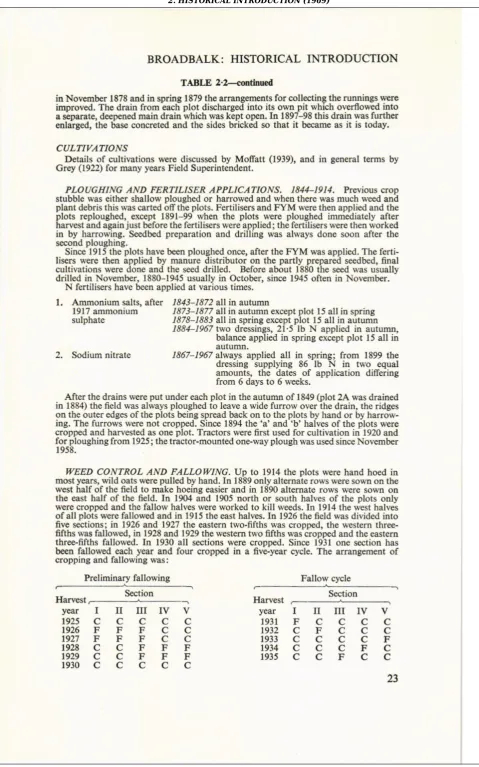
ooe s€ction has beetr fatlowed each year and four cropp€d in a 6ve-year cycle. The arrangemetrt ofGopping and fallowing was:
Section Harvest yesr 1925 1926 1927 1928 t929 1930 f{arvest year t93l 1932 1933 1934 1935
IIIIIIIVV
FCCCC
cFccc
ccccF
cccFc
CCFCC
ROTHAMSTED REPORT
FOR
1968.PART
2TABLE 2.2.---coothued
In autunrn 1955 section
I
(due for fallow in 1956) was halved atrd s€ctionIA
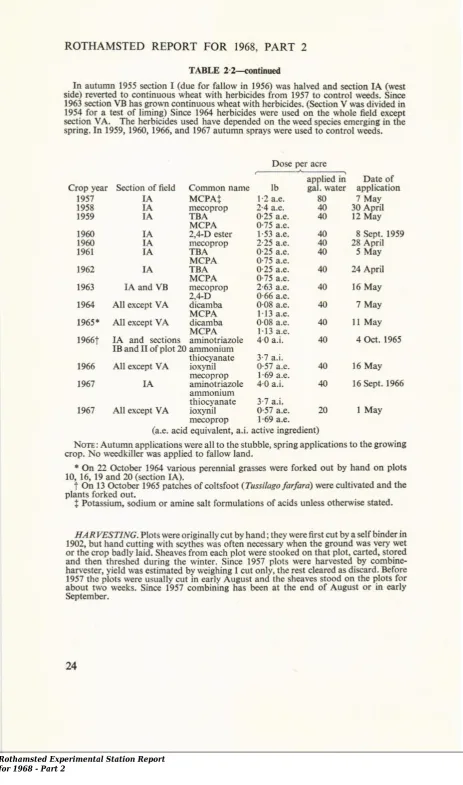
(west side) reverted to contitruous wheat with herbicides from 1957 to control weeds. SiDce 1963 secrioo VB has grown cootinuous wheat with he6icides. (S€ction V was divided in1954 for a test of liming) Sirce 1964 herbicides were used on the whole field except section
VA.
The herbicides used have depended on the weed sp€cies emerging in the spring. I'r 1959, 1960, 1966, and 1967 autumn sp.ays were used to control weeds.Crop year
1957 1958 1959 1960 1960
1961
t9a
1963
t9&
1965.
r966t
Dose per acre
applied
in
Date ofS€ction of
field
Coomonname lb
gal.water
applicationIA
MCPAi
l'2a.e.
80
7 MayIA
mecoprop
2'4a.e.
4
30 AprilIA
TBA
0.25a.e.
4
12 MayMCPA
0 75 a.e.IA
4+D
6tet
t'53a.e.
,10
8 Sept. 1959IA
meoprop
2'25a.e.
4
28 AprilIA
TBA
0.25a.e.
q
5 MayMCPA
0'75 a.e.IA
TBA
0'25a.e.
&
24 AprllMCPA
0'75 a.e.IA and
VB
decoprop
263a.e,
q
16 May2,+D
0 65 a.e.All except
VA
dicamba
0'08a.e.
4
7 MayMCPA
l'13 a.e.A.ll except
VA
dicalnba
0 08a.e.
40
II
MayMCPA
1'13 a.e.IA
and sections aminotriazole 4.0a.i.
&
4 Oct. 1965IB atrd II ofplot 20 ammonium
thiocyaoate
3'7 a.i.1966
All exoeptVA
ioxyDil
0 57a.e.
,l{)
16 Maymecoprop
1 69 a.e.l 7
IA
aminotriazole 4 0a.i.
,l(}
15 Sept, 1966arnmotrium
thiocya[ate
37 ^.i.1967
All exceptYA
ioxynil
0'57a.e.
20
I
May$ecoproP
l'69 a.e.(a.e. acid equivalent, a.i. active ingredieot)
NorE : Autuml applications were all to the stubble, spridg applicatiols to the girowitrg
crop. No weedkiller was applied to fallow land.
t
On 22 October 1964 various peretrnial grasses were forked out by haod otr plots10, 16, 19 aDd m (s€ction IA).
t
OD 13 October 1965 patches of coltsfoot (ra$/agolarlara) werc cultivated and thepla
s forked out.I
Potassium, sodium or amine salt formulations of acids unless otherwise stated.HARVESTING .Plots were origirally cut by hand ; they were fr.st cut by a s€lf binder in
1902, but hand cutting wilb scythes was often necessary when the goutrd was I'ery wet or the clop badly laid. Sheayes from e.ch plot were stooked otr that plot, carted, stored atrd then ihresh;d during the winter. Siirce 1957 plots were harvasted by
combitre-harvester, yield was estimated by weighins I cut onlt, the rest cleared as discard. Before
1957 the fiots were usually cut in eaily iueust and ihe sheaves stood on lhe plots for about
tw;
weeks. Since 1957 combining h--as been at the eDd of August or itr earlySept€mber.
BROADBALK: HISTORICAL
INTRODUCTION
TAELE 2.2.---cootiao.d
CROPPING
Some part of every plot has grown winter wheat each year.
Seed rutes nrged fuom 110 190lb/acre.
Row
spacing
18,U-1E62 rcws al12.5 in. (12 rows on a land)1863-1893 tows at7.8 iD. (18 rows oo a land, i.e. each .a' and .b' hatf
-^^
.
---_ plot except 1889- and 1890, s€e sectio on weed control)1894-1905 rcws at 8.9 in. (28 rows on tbe .Dew' wide Dlots)
l9(E-1927 tows
^t 12 in. (20 rows/plot except t9t 3 ro'ws af 7.6 in.)
1928-1967 tows
^t 7
in-yarietiet
I84l-J818 OId Red I-anrmas1819-1852 Old Red Cluster
,8J}1661 Red Rostock ,882-1899 Red Club
1900-1916 Sqnarchad's Master, except l9O5 cianr Red, l9l0 Browick
R€d, l9l l-12 Little Jost
1917-1945 Ren Statrdard exctpt 1929, 1940,1941,
1
.3 Souarehead'sMaster: 1942. Sratrd up.
194G1 7 Sqtarchead's'Mastir i314,
fot
1963-47 arain from sev€ralplots was bulked esch year, well mixed and us€d as s€ed. Seed dressings.
In l9l2
the seed was dressed with coDper sulDhate andi[
1923 and1924 it was rreated with formalin. From 1932 seed treitid €acti vear with various seed
dr€ssiogs, 1932 62 or8atro m€rcurials with or wirhout hsecticiife (BHO,
fi;;
1963mercurials oDly.