Stock Portfolio-Optimization Model by Mean-Semi-Variance Approach Using of Firefly Algorithm and Imperialist Competitive Algorithm
Hassan Heidari1 Laya Neshatizadeh2
Abstract
Selecting approaches with appropriate accuracy and suitable speed for the purpose of making decision is one of the managers’ challenges. Also investing decision is one of the main decisions of managers and it can be referred to securities transaction in financial markets which is one of the investments approaches. When some assets and barriers of real world have been considered, optimization of stock basket can’t be solved easily, therefore, Meta-Heuristic approach is considered. In this regard, the main goal of this paper is to solve stock portfolio constrained optimization problem by using of Firefly Algorithm (FA) and Imperialist Competitive Algorithm (ICA). In order to do so, daily information of 25 accepted stocks in period of 2010-2016, in Tehran stock market have been used. Results show that Firefly Algorithm (FA) and Imperialist Competitive Algorithm (ICA) showed successful function in constrained optimization of stock portfolio and has acceptable accuracy in finding optimal answers in whole risk and returns levels. Also, the results of comparison of Cardinality Constrained Mean – Variance (CCMV) and Cardinality Constrained Mean – Semi -Variance (CCMSV) portfolios two using of Firefly Algorithm (FA) and Imperialist Competitive Algorithm (ICA) and considering to the findings of two criteria for assessing accuracy in stock basket optimization simultaneously show that Imperialist Competitive Algorithm (ICA) has high speed and accuracy for solving stock basket optimization and could have desirable interaction with real barriers of market. Moreover, there is high accuracy optimization of Cardinality Constrained Mean – Semi -Variance (CCMSV) compared to Cardinality Constrained Mean – Variance (CCMV).
JEL: G40, G11, C61
Keywords: Stock Constrained optimization; Firefly-Algorithm (FA); Imperialist-competitive Algorithm (ICA); Cardinality Constrained Mean – Semi -Variance (CCMSV); Cardinality Constrained Mean – Variance (CCMV).
1Professor of Economics, Department of Economics, Urmia University, Urmia, Iran, Corresponding Author’ email: [email protected]
1. Introduction
Stock basket optimization concepts and diversification have become as a tools in order to financial markets and financial decisions improvement and perception. Harry Markowitz presented the main model of portfolio in 1952 which has based on modern portfolio theory. He claimed that portfolio goal is maximizing expected desirability instead of maximizing the expected returns. Markowitz assumed that all of investors are willing to have a combination of Floor & Ceiling returns; in fact, logical investors are following efficient portfolio because these portfolios cause maximizing of expected returns for certain level of risk or the least risk for expected returns [13]. To determine an efficient portfolio, expected returns and Standard deviation of returns should be determined for each portfolio.
Markowitz model has been used for this purpose as well as calculating of expected returns and its standard deviation. The basic assumptions of Markowitz form his model bases, which are as: investors make returns desirable, they know risk as undesirable, they make decision logically and making decisions which cause maximizing desirable returns. Therefore, desirability of investors is a function of expected returns and risk that both of them are main parameters of investments decisions. With the purpose of optimal portfolio selection, mean, as criterion of returns and variance, is as risk criterion. In other words, he assumed that the higher variance of investment, the higher possibility difference between real returns and expected returns. Markowitz suggested that investor is not only maximizing returns, but also willing to insuring of efficiency. He suggested, as justification of his claim “if investors have followed just maximizing of expected returns, they had invested in an asset with the most returns.” While it can be perceived that investors have owned combination of portfolio securities transaction. Markowitz could inverted complicated problem and multi-dimension portfolio with several assets and various characteristics to two-dimensional mean-variance approach.
According to Markowitz formulation, selecting an efficient portfolio can begin with triple estimates analysis, as,
1. Expected returns for each share,
2. Expected variance –returns for each share,
3. Interactions among securities transaction returns which are measured by covariance criterion between returns of each share with other shares [13].
Securities transaction risk is not only related to its completed securities transaction risk separately, but also it depends on rate of effects which comes from fundamental events, like macroeconomic events [33]. Another important point is that Markowitz has assumed that expected returns is a random variable with normal distribution. Assumption of returns normality mostly is true because many researches show that data distribution function has two thicker ends to normal function or returns distribution is skewed. The other problem is using of variance. In other words, when we use of this criterion, interests which have more distances from mean and desirable for investments are known as risk and is got more weight in optimization process to shares with stretched distribution function [24]. These problems caused more researches about optimal stock basket forming and many people tried to improve the Markowitz’s pattern. Including he himself, Markowitz suggested then that analysis based on semi-variance compared to variance, is making better stock baskets [24].
Generally, one can be said that investments approach in investment basket frame and with Markowitz and Sharp thoughts, has improved and it increased applying mathematic programming, accurate investment decision makings and have been presented different models with the purpose of investment guidance in the framework of investment basket using mathematic programming. Borrowing and lending capital options, as typical ways of capital market, were ignored in the Markowitz model.
William Sharpe expanded Markowitz model in two dimensions, as this model involves assets without risk and possibility of borrowing and lending [13]. Sharpe approach is known as “Capital Market Line (CLM) that is kind of Capital Asset Pricing Model (CAPM). He showed that when a risky portfolio combines with a risk-free portfolio, achieved compound risk fits with relative capital which is invested in risky asset [32]. Arbitrage Theory which was presented in 1980 by Ross & Roll, is similar to capital asset pricing model. Arbitrage Theory says unsystematic risk with diversification can be omitted; therefore, this risk in the market with aero Arbitrage doesn’t have any price [29, 30].
solve it [24]. He suggested that instead of covariance, relation between rates of return in per share, is replaced with Stability index of the market. Sharpe (1964) followed Markowitz approach which was known as “Single indicator model.” Then multi-indicator models were introduced toward controlling of some effects of non-markets which caused change in the price of securities transaction. If other characteristics like the fixed costs and obscurity of the exchange transaction effect on selecting portfolio issues, the model of Markowitz losses its functions. Konno & Yamazaki have developed Mixed – Integer Linear Programming which absolute deviation is representing risk aversion. This pattern can’t response to investors’ requests without attention to Functional constraints [18].
Kellerer et al. (2000) have introduced some kind of Mixed – Integer Linear Programming which is able to encounter with fixed costs and obscurity of the exchange transaction [17]. Also one can be noted that combination of many stocks and High volume of exchange cause increasing of exchange cost. Some preconditions on Markowitz model cause increasing stock combination and the number of exchanges which causes increasing of cost. As the purpose of solving problem, Bertsimas et al. (1999) showed an approach that can form portfolio through Non- Linear Mixed – Integer Programming. That portfolio is close to a target portfolio which builds using of Quadratic Programming of Markowitz model. It has not only equal Liquidity with it and expected returns and its turnover is similar to target portfolio, but also it includes some advantages like Frictional Costs due to selecting less stock as possible[5]. Mansini & Speranza suggested that portfolio selection patterns assumed investment split as unlimited, while securities transaction are exchanged with certain number in real world. Therefore, they suggested that a Mixed – Integer Linear Programming with considering to corresponding constraints to least exchanges is used. It must be noticed that Marquez standard pattern doesn’t have constrains related to selected assets and also constraints related to floor and ceiling limit to investment in each asset [22]. Chang et al (2000) and Fernandez & Gomez (2007) have used Marquez corrected pattern Cardinality Constrained Mean – Variance (CCMV) [6, 11].
on Markowitz model. This model has more flexibility and can adopt itself with rate of investor pessimist-optimist and can balance efficient frontier of Markowitz model due to this topic [19].
bankrupt control in fuzzy investment environment and they used stock box optimization of combined particle mass algorithm. Its results show that particle mass algorithm is effective in selected issues [20]. Mishra et al. (2016) in “prediction of mean-variance model for selecting limited property portfolio” have investigated on selecting limited portfolio with multi-objective evolutionary algorithm. In this research, optimization of the mass of self-regulating multi-objective particles is an effective way of portfolio optimization. For this purpose, multi-objective predictive prediction, mean-variance model was supposed that is a solution for Markowitz mean-variance model that is used for limited portfolio optimization problem [26]. Tilahun & Ngnotchouye (2017) in “Firefly algorithm for discrete optimization issues” has investigated changes done firefly algorithm in the purpose of solving optimization issues with especial discrete variables. So, developing in the using of firefly algorithm for optimization issues of binary numbers, integers and also mixed variables are studied. In this research, firefly algorithm was corrected and used for optimization issues with discrete variables [35].
According to increased importance of investments in financial baskets, two Meta-Heuristic Algorithms in order to solving stock basket optimization problem with the number of stock constraint and also limitation of floor and ceiling rate of each stock with efficient frontier have been shown in this article. Also, in this article Cardinality Constrained Mean – Semi -Variance (CCMSV) and Cardinality Constrained Mean – Variance (CCMV) have been investigated. The only difference between two last patterns is about minimizing of risk aversion.
For the purpose of solving this problem using of Firefly-Algorithm (FA) and Imperialist-competitive Algorithm (ICA) with daily data of 25 companies in Tehran securities transaction stock in period of 2010-2016 have been used.
2. Investments basket optimization patterns
Measuring of maximizing expected returns (R), decreasing expected risk (Q) as standard deviation are the goals of Markowitz model [21].
With portfolio returns ( ) and portfolio variance , maximizing equation is as:
(1)
Portfolio returns achieves from combination of mean of with each share weight [25, 28, 36], which is relation 2,
(2)
Where, is expected returns rate of portfolio; is weight of each share in portfolio which is specified by algorithm; is expected returns rate of i asset and n is the number of selected assets for forming portfolio.
Shares which are existed in portfolio can have direct or indirect relation with together. This relationship is announced by equity correlation coefficient and used by portfolio risk calculation [28]. Portfolio risk can be achieved by:
(3) for i=j =1
Where, is portfolio variance; is standard division of i asset; is standard dilation of j asset; is correlation coefficient between i and j assets, is weight of i asset in portfolio; is weight of j asset in portfolio and n is number of selected assets for portfolio forming.
(4) (5)
As if expected returns of each asset is E ( , standard deviation of asset is equal of and is weight of each asset.
Generally, volatility of investment returns is called investment risk. In other words, the more change of returns of investment, the more risk of investment. Criterion for measuring of whole risk of stock is relation (3). For the purpose of more accurate, consider to mean-variance model as:
s.t: : , (6) ,
We will represent variety assets portfolio. Practically, making decision about asset weight is done with decision on asset and can perceive risk variety better if we select combination of small assets. According to definition of portfolio, investment basket generally and stock basket in particular, investment basket means combination of invested assets by micro investor(individual) or Macro investor (institution). As previously stated, we can make stock baskets with optimization models and using of portfolio modern which has the least risk in compare of expected returns or has the most returns in compare of expected risk. As above, Markowitz had invented a method in which risk of a stock basket is function of each stock variance, its covariance with other stock and stock percentage in basket.
As above, expected returns and portfolio variance can be calculated from (2), (3). Therefore, Markowitz model can be written as problem with dual-purpose function as the following,
(7)
assets; weight of i asset in portfolio; weight of j asset in portfolio and covariance between returns of i and j assets as so, represents variance-covariance matrix n.n assets returns (n: number of selected assets for portfolio forming).
One can be noted that in model (1), the first objective function of a linear function is on W, but the second objective function is as a quadratic function on W.
According to misgivings, Fernandez and Gomez corrected Markowitz model with a stock portfolio-optimization constraints of number of selected stock and floor and ceiling constraint for variables and the developed Cardinality Constrained Mean – Semi -Variance (CCMSV). We will discuss applied constraints:
Cardinality Constraint
Existed stocks number in portfolio are often constrained or specified by given amount. This constraint can be shown through binary variable zi (i.e
if i asset exists in portfolio, it is equal of 1, if it is not existed, it is equal of 0).
(8) Z=
Where
This constraint is composed as the purpose of portfolio management is facilitated and costs of portfolio management are decreased. The above inequality is quite common [16, 21, and 31]. Also, it can be introduced a floor constraint [7,8]:
(9)
But it can be represented as equal form [2, 34]. In this article, it is used of equal or of his constraint:
(10)
One can be noted that portfolio sock number constraint can be considered as objective function [1].
Floor & Ceiling Constraint
With these constraints, there will be a minimum and maximum ( & , respectively) to each weight of asset that maintain in portfolio as . In other words, portfolio share for a certain asset can change in given period [7].
With a stock portfolio-optimization selected assets to have problem, (12) s.t:
,
,
Zi is decision variable about investment in each stock. If zi=1, it meant i
stock will put in basket. Combination of stocks which will be in basket, due to this constraint, is ks and are floor and ceiling constraint for i
variable, respectively.
As above, λ is parameter which is in [0, 1]. As if λ=0, optimal portfolio equation without risk, will be maximum expected returns and if λ =1, optimal portfolio equation without risk, will be minimum expected returns and investor is as conservative. In fact, we can specify efficient frontier with changing λ from zero to 1. We achieved a new point for each λ on efficient frontier which can be made efficient frontier if we conjoin those points together. In fact, different combination of expected returns and desirable stock basket variance form a line in chart which is called “efficient frontier.” Because each points represents the best possible scenario for expected returns and certain variance. As a matter of fact, investor, using efficient frontier, can select optimal portfolio according to his expected returns/risk portfolio requests [11].
Between all critics to modern portfolio theory, we can announce variance is not suitable criterion for risk and distribution of assets’ returns does not match with normal distribution. Because both suitable criteria with the purpose of risk measuring and normal distribution play a very important role in selecting optimal portfolio. For that reason, it is tried to use criterion that match with investors’ perception and corresponding hypothesis fits with reality. According to experts, semi-variance is one of the criteria for risk.
If in (12), s-variance replaced with variance,
(13) s.t: ,
In the above problem, Estrada equation is used for semi-variance calculation [9], which is:
(14)
Generally, collection of Cardinality Constrained Mean – Semi -Variance (CCMSV) and Cardinality Constrained Mean – Variance (CCMV) are combination of Integer Linear Programming and Dual Programming. For accurate solving ofthis kind of problems, there is not efficient algorithms in mathematical programing. In this article, we considered the investigation of specification possibility and portfolio forming by Meta-Heuristic techniques which is aimed on forming optimal portfolio and recognizing efficient frontier investment.
3. Modern methods or Meta-Heuristic
Classic and Numerical techniques have two main weaknesses: positional and process inability on discrete issues. It can be said that classic techniques can find locality optimization and can’t find global optimization based on complicated and multi-dimensions issues and/or issues which have distortion, distinctness, noise, and disturbance of information characteristics or issues that dmension is discontinuous and complicated nonlinear equations [4]. According to this technique, in the purpose of solving local answers, there is not any thought and if they get to fairly optimal answer, they stop it and suggest it as comprehensive and global answer. For the purpose of these troubleshooting, there are variety of techniques like Meta-heuristic. Meta-heuristic techniques are represented to solve those problems. Although there is not any guarantee, test of these techniques in engineering, economics, financial, and … show that if they perform correctly and their internal parameters are chosen suitable and according to problem it can be got more suitable answers like their classic counterparts
global optimal. In other words, although Meta-heuristic techniques do accidently research, possibility of trapping in local optimal is decrease. Heuristic algorithms are algorithms which generally were inspired from nature in which can solve nonlinear with constraint. There are some properties of heuristic techniques:
It doesn’t need to hypothesis on issue, like distinctness, convexity, and etc. therefore it can be done on extensive issues.
Generally, heuristic techniques are global and without convexity. This technique is for continuous and discrete issues. However, this is
very suitable for discrete problems.
There is not any support based on mathematical on performance and convergence which get to optimal answer but it shows itself in convergence act.
Firefly Algorithm (FA) and Imperialist Competitive Algorithm (ICA) are the kinds of heuristic algorithms.
3.1 Firefly Algorithm (FA)
Firefly Algorithm (FA) was designed by Xin-She Yang (2008) benchmarking of the luminance of the firefly. They used rhythmic brightness of firefly for attract hunt and mating. Brightness pattern in each firefly is different. This brightness can be a protective mechanism for firefly. Rate of brightness and distance of brightness cause attraction ofthe couple together. Each bit is a firefly and is updated a multi-dimension research with attract dynamically and according to science about firefly and its neighbors. The searching process is really surprising in which a firefly is compared with all other fireflies, if it has low brightness in compare of other firefly, its mate will choose the other one. This causes that bits attract to other bit with more brightness(light) and if there is more brightness in other algorithm frequency, bits move to a bit that has more brightness. Search steps depend on maximum of frequencies. There are main rules in the FA algorithm:
All of the fireflies are unisex, as a firefly attracts other ones.
Attractiveness of firefly is adopted to its brightness. So every low brightness fireflies will move to high brightness firefly. The more distance, the less brightness. If none of the fireflies have high brightness, firefly will move randomly.
The brightness of firefly is specified amount of target function.
attraction coefficient, their relation is function of r (distance between two fireflies):
(15) I0 is brightness intensity in r=0.
Due to adopting attraction of firefly with brightness, firefly attraction is: (16)
Where β attraction in r=0.
In relations (15) and (16), ɣ is brightness intensity absorb in each firefly. This parameter effects on specifying of convergence rate and algorithm behavior.
Distance between i firefly and j firefly is,
(17)
Where, Xi, Xj are location of i and j firefly. Also, d is number of independence variable of optimization problem (problem dimension). Moving i firefly to j fire is,
(18)
In relation (18), second sentence represent attraction of i firefly to j firefly and third sentence is accidently moving in attraction process which specify rate of jump, also is a random vector achieved from Gaussian distribution or uniform distribution [32].
Pseudo-code FA.
Begin
Insert the objective function f(x), x=(x1, x2… xd) T
Initialize the fireflies population xi, i=1, 2… n Determine the brightness intensity Ii at xi using f (xi)
Set brightness absorption coefficient γ, randomize coefficient α While (t < Max Generation)
For i=1: n all n fireflies For j=1: n
If (Ii < Ij), Move firefly I toward j; end if
Vary attractiveness with distance r via exp [-γr2] Evaluate new solutions and update brightness intensity End for j
End for i
Rank the fireflies and find the current global best End while
3.2. Imperialist Competitive Algorithm (ICA)
Imperialist- competitive algorithm (ICA) was inspired from a social process in 2007 by Smaeil Atash Gargari et al. In Imperialist-competitive Algorithm (ICA), with the purpose of solving optimization problem, N country is chosen and each one will show with a vector and it shows a point in n-dimension space. In fact, countries are possible answers of problem. All countries are categorized in two sets: Imperialist and colony. Colonial countries attract colony countries to themselves with attraction policy (assimilation) in order to different optimization orientations. Imperialistic competition aside assimilation policy forms the main core of this algorithm and leads to moving countries to minimal absolute side of the function.
As mentioned, countries are variables of optimization problem which must be optimized. In the one optimization problem -dimension, a country is an array of .
(19)
Costs of a country can find with evaluate of f function in variables, therefore,
(20)
For start of algorithm, of initial country will be built. s will
be chosen as the best member of this population(countries with the least amount of cost function) as Imperialist and residual of countries are colonies which each one belongs to one Empire.
In the purpose of dividing colonies between Imperials, we give some colonies according to power. For this purpose, cost of all Imperials, their normalized cost is,
(21)
Where, is cost of n Imperils, is the most expense between Imperials, and is normalized cost of this Imperials. The more cost for each Imperils, the less normalizing. If we have normalized cost, relative power of normalized of any imperialist is as, (in which colony countries are divided ween Imperialists),
(22)
(23)
Where, id initial number of colonies of an Empire and is number of al l existed colony countries in primitive countries population. Round is function of the nearest integer to a decimal number. Due to
for each Empire, we select those randomly and give n t Imperial. If we have all primitive of Imperials, Imperialist-competitive Algorithm (ICA) will start. Evolutionary process is in one ring that is stopped with providing one condition.
Assimilation policy was done in purpose of culture and social structure analysis of colonies as aimed to socio-politics dimension close together. Moving of colony country to colonialist with d distance is as,
(24)
Where, is bigger than 1, and close to2. This coefficient causes each colonial country, during moving to colonialist country, close to it from different sides.
In purpose of increasing searching area around colonialist, an angel deviance θ is adhere to random uniform distribution which is a stock portfolio-optimization to main vector:
(25)
is a parameter that control angel deviance area and it is considered close to in experiments.
As during moving colonies to new colonialist, it may moves to better colonialist (reach to cost function that produces less cost in compare of amount of cost function in Imperials position), so, colonialist and colonial change their position with together and its algorithm is found about new position and that time, new Imperial country does assimilation policy to its colonials.
Power of Empire is equal of power of colonialist country a stock portfolio-optimization with percentages of power of all colonies. Therefore, whole cost in Imperial is:
(26) Where, is total cost of Empire n and is a positive number between 0-1 and close to zero. Has the desire answers in most of the performances.
takeover this colonies and raise its power. In the purpose of modeling competition between Imperials for takeover this colony, first we will calculate takeover possibility of each Imperial due to total cost of Imperial. So, total normalized cost calculated from total imperial cost.
(27)
Where, is total cost of n Imperial, total cost of normalized of that Imperial.
If we have total cost of normalized, possibility of colony takeover competition by Imperial is as,
(28)
If we have probable of each Imperial, because of having corresponding colonial randomly but possibility of dependent possible to probable of each imperial, vector P will be,
(29)
Then vector R will be formed as size as vector P. Arrays f this vector are random numbers with normal distribution in [1, 0]:
(30)
Then vector D s formed as:
(31) With given vector D, mentioned colonies will be given to Imperial that its index in vector D is bigger than the others. Then, in Imperialists flow, weak Imperials collapse eventually and their colonies are takeovered by the powerful one. That algorithm will continue up to one independent Imperial and positions, costs of colonies are equal to the cost of Imperial country [3].
Pseudo-code of ICA
5) Pick the weakest colony (colonies) from the weakest empire and give it (them) to the empire that has the most likelihood to possess it (imperialistic competition)
6) Eliminate the powerless empires.
7) If there is just one empire, stop if not go to 2.
4. Conclusion and Policy Implication
In this article, daily stock prices of 25 companies, super in Fourth quarter of year in 2015 have been used. Calculating of stock returns of companies is essential estimating of Cardinality Constrained Mean – Semi -Variance (CCMSV), Cardinality Constrained Mean – Variance (CCMV), and specifying optimal stock basket. In this article, calculating of daily sock returns is done by relation (32) and information of the final daily prices of stock securities transaction companies.
(32)
Where, Rt is daily returns of stock, i and Pt is the final stock price in t day
and Pt-1 is the final stock price in t-1 day.
Risk will explain as possible negative fluctuations of economic returns and will explore as standard deviation and semi-variance.
In a stock portfolio-optimization to,
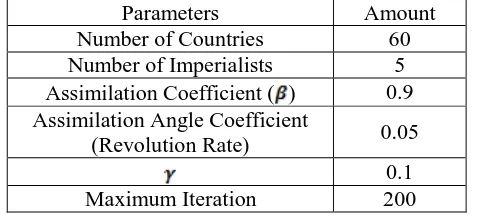
We are going to interoperate and analyze Meta- Heuristic techniques. it can be said, suggested algorithms of article was done by MATLAB R2016b and finally its result will be presented as chart and table. As mentioned, charts (1) and (2), represent Firefly-Algorithm (FA) parameters and Imperialist-competitive Algorithm (ICA) parameters which fit with portfolio problem.
Table (1): Firefly-Algorithm (FA) fitted with portfolio problem
Parameters Amount
Number of Fireflies 60
gamma 1
Initial Beta 2
alpha 0.2
Maximum Iteration 200
Table (2): Imperialist-competitive Algorithm (ICA) parameters fitted with u problem
Parameters Amount
Number of Countries 60
Number of Imperialists 5
Assimilation Coefficient ( ) 0.9 Assimilation Angle Coefficient
(Revolution Rate) 0.05
0.1
Maximum Iteration 200
Source: author
In the chart (1) and (3) variance and in the chart (2) and (4) semi-variance were used as risky factor. As it can be seen, both algorithms are acceptable accurate of finding optimal answers in all levels of risk and returns and could draw efficient frontier of investors well. In charts (5) and (6) achieved efficient frontier were compared with Firefly-Algorithm (FA) and Imperialist-competitive Algorithm (ICA) for Cardinality Constrained Mean – Semi -Variance (CCMSV) and Cardinality Constrained Mean – Variance (CCMV), respectively. Efficient frontier related to CCMV is specified with red line and for CCMSV is with blue
Chart (1) efferent frontiers using of CCMV model-FA
algorithm
Chart (2): efferent frontiers using of CCMSV model-FA
algorithm
Chart (3): efferent frontiers using of CCMV model-ICA
algorithm
Chart (4) efferent frontiers using of CCMSV model-ICA
stars. As variance is as general risk factor, and semi-variance is as estimated of undesirability of portfolio, it seems the CCMSV pattern specifies optimal portfolio more accurately. As Cardinality Constrained Mean – Variance (CCMV) pattern just measures undesired risk of portfolio, it shows less risk compared to Cardinality Constrained Mean – Semi -Variance (CCMSV) in same times. For that reason, the curve related Cardinality Constrained Mean – Variance (CCMV) for ach algorithm in the curve related Cardinality Constrained Mean – Semi -Variance (CCMSV).
Charts (7) and (8) shows path of function evaluation of Firefly-Algorithm (FA) and Imperialist-competitive Algorithm (ICA) with two current research suggested model, respectively, in purpose of optimal point. In these charts horizontal vectors show frequency number and vertical vectors show value of target function.
Chart (5): Comparison of efficient investors using of CCMV and CCMSV- FA
According to population in chart (1) and chart (2), Firefly-Algorithm (FA) and Imperialist-competitive Algorithm (ICA) design 60 baskets and rating them based on risk goal and returns. Showing of several same rate in categories show that these baskets are dominant compared to each other. Therefore, selecting with priority can be according to risk preference o manager risk.
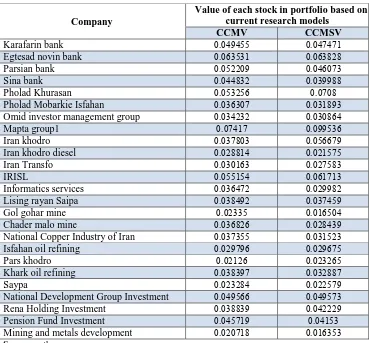
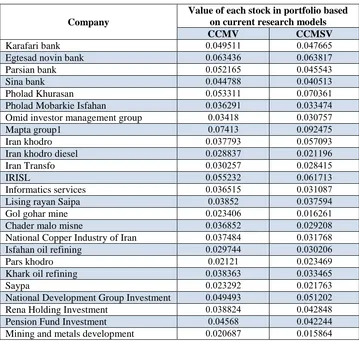
As number of baskets are a lot (60 baskets), we suggest one of the optimal stock basket randomly from tables (3) and (4). Numbers of chart indicate stock which should be selected in portfolio and also show value of each stock in portfolio.
Chart (9): evaluation function path using of ICA -CCMV
Chart (8): evaluation unction path using of FA –CCMSV Chart (7): evaluation function
path using of FA- CCMV
Table (3): Stock and sock ratio in portfolio based on Firefly-Algorithm (FA) and other models in current research
Value of each stock in portfolio based on current research models
Company CCMSV CCMV 0.047471 0.049455 Karafarin bank 0.063828 0.063531
Egtesad novin bank
0.046073 0.052209 Parsian bank 0.039988 0.044832 Sina bank 0.0708 0.053256 Pholad Khurasan 0.031893 0.036307
Pholad Mobarkie Isfahan
0.030864 0.034232
Omid investor management group
0.099536 0.07417 Mapta group1 0.056679 0.037803 Iran khodro 0.021575 0.028814
Iran khodro diesel
0.027583 0.030163 Iran Transfo 0.061713 0.055154 IRISL 0.029982 0.036472 Informatics services 0.037459 0.038492
Lising rayan Saipa
0.016504 0.02335
Gol gohar mine
0.028439 0.036826
Chader malo mine
0.031523 0.037355
National Copper Industry of Iran
0.029675 0.029796
Isfahan oil refining
0.023265 0.02126
Pars khodro
0.032887 0.038397
Khark oil refining
0.022579 0.023284
Saypa
0.049573 0.049566
National Development Group Investment
0.042229 0.038839
Rena Holding Investment
0.04153 0.045719
Pension Fund Investment
0.016353 0.020718
Mining and metals development
Table (4): Stock and sock ratio in portfolio based on Firefly-Algorithm (ICA) and other models in current research
Value of each stock in portfolio based on current research models Company CCMSV CCMV 0.047665 0.049511 Karafari bank 0.063817 0.063436
Egtesad novin bank
0.045543 0.052165 Parsian bank 0.040513 0.044788 Sina bank 0.070361 0.053311 Pholad Khurasan 0.033474 0.036291
Pholad Mobarkie Isfahan
0.030757 0.03418
Omid investor management group
0.092475 0.07413 Mapta group1 0.057093 0.037793 Iran khodro 0.021196 0.028837
Iran khodro diesel
0.028415 0.030257 Iran Transfo 0.061713 0.055232 IRISL 0.031087 0.036515 Informatics services 0.037594 0.03852
Lising rayan Saipa
0.016261 0.023406
Gol gohar mine
0.029208 0.036852
Chader malo misne
0.031768 0.037484
National Copper Industry of Iran
0.030206 0.029744
Isfahan oil refining
0.023469 0.02121
Pars khodro
0.033465 0.038363
Khark oil refining
0.021763 0.023292
Saypa
0.051202 0.049493
National Development Group Investment
0.042848 0.038824
Rena Holding Investment
0.042244 0.04568
Pension Fund Investment
0.015864 0.020687
Mining and metals development
Source: author
have been done. Meta-Heuristic technique is one of the closest to achieved answers of algorithm in different performs. The results show that there is so little difference between the resulting answers from different frequencies that indicate there is high stable of algorithm in different performs. Charts (11) and (12) show assimilation of two algorithms.
At all, criteria which were used in specifying of an algorithm compared to other algorithms in stock basket optimization process are: quality and accuracy of answers and elapsed time in terms of achieving optimal answer. The quality of answer means that how much corresponding algorithm can help to optimization and accuracy and the mean of the accuracy of the provided answer is that in order to all Meta-Heuristic ways depend on initial population, it often produces randomly, how much used algorithm could act in assimilation to optimal answer particularly in the number of frequencies. According to charts (11) and (12), used algorithm in this article, had acceptable accuracy in all of risk and returns.
In conclusion, the results show that performance of Firefly-Algorithm (FA) and Imperialist-competitive Algorithm (ICA) in optimization of stock basket due to real market constraints and different definition is risky. From quality view, it can be said that both of them were good and Imperialist-competitive Algorithm (ICA) was faster and better than
Chart (11): assimilation of FA7 ICA –CCMV
Firefly-Algorithm (FA) related to elapsed time to achieving optimal answer. As specifying value of optimal parameters is one of the Meta-Heuristic properties, so parameters have the main role in reaching algorithm to answer. The less number of parameters in an algorithm, the easier suitable number of these parameters. Firefly-Algorithm (FA) is more suitable than Imperialist-competitive Algorithm (ICA) because this algorithm has 3 parameters and the value can set in Yang (2008) suggested values. In fact, time for drawing efficient frontier for designed algorithm is more than Imperialist-competitive Algorithm (ICA).
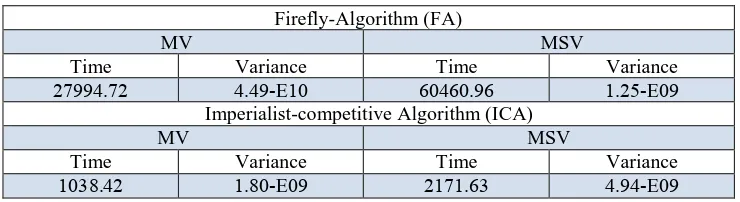
In terms of comparison and evaluation of accuracy in stock basket optimization form two criteria time and variance) for each of the models and applied algorithm have been shown in table (5).
Table (5): comparison of suggested algorithm in used models of current article using of time and variance criterions
Firefly-Algorithm (FA) MSV MV Variance Time Variance Time 09 E -1.25 60460.96 10 E -4.49 27994.72
Imperialist-competitive Algorithm (ICA) MSV MV Variance Time Variance Time 09 E -4.94 2171.63 09 E -1.80 1038.42
Source: author
According to economics theory, the smaller value of the best variance and also the shorter assimilation speed and available time, the more accuracy rate in predicted model. According to results of current article from 25 stocks, the best variance between 100 frequencies for Imperialist-competitive Algorithm (ICA) is smaller than for Firefly-Algorithm (FA) with difference applied models. Also, in this algorithm, Cardinality Constrained Mean – Variance (CCMV) model has smaller variance compared to Cardinality Constrained Mean – Semi -Variance (CCMSV).
According to above reasons, both of the algorithms can achieve global optimal which it seems Imperialist-competitive Algorithm (ICA) is faster than Firefly-Algorithm (FA) I assimilation and Imperialist-competitive Algorithm (ICA) has higher accuracy optimization in compared to Firefly-Algorithm (FA). Also in this algorithm, Cardinality Constrained Mean – Variance (CCMV) has higher accuracy compared to Cardinality Constrained Mean – Semi -Variance (CCMSV). These results are according to literature of current research and most of the research in the field of stock basket optimization. For the future researches the following areas researches can be suggested:
1. This research has been done on stock basket optimization using Meta-Heuristic algorithm. In the future researches can be studied on profit estimation modeling of each stock in Tehran stock using synthesis of artificial neural networks and Meta-Heuristic algorithm.
References
1. Anagnostopoulos. K.P. and Mamanis. G, (2010), “A portfolio optimization model with three objectives and discrete variables”, Computers & Operations Research, Vol 37, PP 1285–1297.
2. Armãnanzas. R. and Lozano. J.A. ,(2005), “A multi objective approach to the portfolio optimization problem”, In Proceedings of the 2005 IEEE Congress on Evolutionary Computation, PP1388–1395.
3. Atashpaz Gargari, Ismaeil (2008), “development of social optimization algorithm and investigation of its efficiency”, M.A thesis, electric and power engineer collage, Tehran University.
4. Bonabeau. E, Dorigo.M, Theraulaz. G, (1999), “From Natural to Artificial Swarm Intelligence”, Oxford University Press, New York. 5. Bertsimas. D, Darnell. C, Soucy. R, (1999), “Portfolio Construction Through Mixed-Integer Programming at Grantham, Mayo, Van, Otterloo and Company”, ProQuest Science Journals, Interfaces 29, PP. 49-66. 6. Chang. T.J, Meade N, Beasley J.E, Sharaiha Y.M, (2000), “Heuristics for cardinality constrained portfolio optimization”, Computers & Operations Research, Vol 27, PP1271-1302.
7. Chiam. S. C., Tan, K. C., and Al Mamum, A. (2008), “Evolutionary multi-objective portfolio optimization in practical context”, International Journal of Automation and Computing, Vol 5, Issue 1, PP67-80.
8. Di Gaspero. L., Di Tollo. G., Roli. A. and Schaerf. A, (2007), “Hybrid local search for constrained financial portfolio selection problems”, In Proceedings of Integration of AI and OR Techniques in Constraintc Programming for Combinatorial Optimization Problems, PP 44–58.
9. Estrada. J, (2002), “Systematic risk in emerging markets: The D-CAPM, Emerging Markets Review”, Vol 3.
10. Estrada. J, (2007), “Mean-semi variance behavior: Downside risk and capital asset pricing”, International Review of Economics and Finance, Vol16.
11. Fernandez. A, Gomez. S, (2007), “Portfolio selection using neural networks”, Computers & Operations Research, Vol 34, PP 1177-1191. 12. Frijns. B, Esther. K, Thorsten. L, (2008), “On the Determinants of Portfolio Choice”, Journal of Economic Behavior & Organization, Vol66, PP 373-386.
14. Hagin. R.L, (2004), “Investment Management-Portfolio Diversification, Risk, and Timing-Fact and Fiction, Hoboken”, New Jersey: John Wiley & Sons, Inc.
15. Hanen.Ould Ali, Faouzi. Jilani, (2014), "Mean-VAR model with stochastic volatility", Procedia - Social and Behavioral Sciences, Vol 109, PP 558-566.
16. Kellerer. H, Maringer. D, (2003), “Optimization of cardinality constrained portfolios with a hybrid local search algorithm”, OR Spectrum, Vol25, Issue 4, PP 481-495.
17. Kellerer. H, Mansini. R, Speranza. M.G, (2000), “Selecting Portfolios with Fixed Costs and Minimum Transaction Lots”, Annals of Operations Research, Vol 99, PP 287-304.
18. Konno. H, Yamazaki. H, (1991), “Mean – Absolute Deviation Portfolio Optimization Model and It’s Applications to Tokyo Stock Market”, Management Science, Vol 37, Issue 5, PP 519-531.
19. Li. J, Xu. J, (2009), “A novel portfolio selection model in a hybrid uncertain environment”, omega the International Journal of Management Science, Vol 37, PP 439-449.
20. Liu. Yong-Jun, Zhang.Wei-Guo, Zhang.Qun, (2016), “Credibilistic multi-period portfolio optimization model with bankruptcy control and affine recourse”, Applied Soft Computing, Vol 38, PP 890–906.
21. Maringer. D, (2005), “Portfolio Management with Heuristic Optimization”, Springer Verlag.
22. Mansini. R, Speranza. M.G, (1999), "Heuristic Algorithms for the Portfolio Selection Problem with Minimum Transaction Lots", European Journal of Operational Research, Vol 114, Issue 2, PP 219-233.
23. Markowitz. H, (1952), “Portfolio Selection”, The Journal of Finance, Vol 7, Issue1, PP 77-91.
24. Markowitz. H, (1959), “Portfolio Selection: Efficient Diversification of Investments”, New York, Publisher: John Wiley & Sons.
25. Meucci. A, (2005), “Risk and asset allocation”, Springer.
26. Mishra.Sudhansu, Panda.Ganapati, Majhi.Babita, (2016), “Prediction based mean-variance model for constrained portfolio assets selection using multi objective evolutionary algorithms”, Swarm and Evolutionary Computation, Volume 28, PP 117-130.
Economics Applications”, Computational Intelligence Society, Vol 17, Issue 3, PP 321 – 344.
28. Rasmussen. M, (2003), “Quantitative portfolio optimization, asset allocation and risk management”, Palgrave Macmillan.
29. Roll. R, Ross. S.A, (1984), “The Arbitrage Pricing Theory Approach to Strategic Portfolio Programming”, Financial Analysts Journal, Vol 40, PP 14-26.
30. Ross. S.A, (1976), “The Arbitrage Theory of Capital Asset Pricing”, Journal of Economic Theory, Vol 13, PP 341-360.
31. Schaerf. A, (2002), “Local search techniques for constrained portfolio selection problems”, Computational Economics, Vol 20, Issue 3, PP 177– 190.
32. Sharpe. W. F, (1967), “Linear Programming Algorithms for Mutual Fund Portfolio Selection”, Management Science Journal, Vol 13, Issue 7, PP 449-510.
33. Sharpe, W. F, (1978), Investments, Englewood Cliffs, U. S. A.: Prentice-Hall, Inc.
34. Soleimani. H, Golmakani. H, Salimi. M.H, (2009), “Markowitzbased portfolio selection with minimum transaction lots, cardinality constraints and regarding sector capitalization using genetic algorithm”, Expert Systems with Applications, Vol 36, PP 5058-5063.
35. Tilahun.Surafel Luleseged, Ngnotchou.e Jean Medard T, (2017), “Firefly Algorithm for Discrete Optimization Problems: A Survey”, KSCE Journal of Civil Engineering, Volume 21, Issue 2, PP 535–545.
36. Wilmott. P, (2007), “Paul Wilmott introduces quantitative finance”. John Wiley & Sons Ltd.
37. Yang. X.S, (2010), “Nature-Inspired Meta- heuristic Algorithms” Second Edition, Publisher: Luniver Press.