1
www.ijmsssr.org Copyright © 2019 IJMSSSR All rights reservedBANKING REFORMS AND THE STABILITY OF THE NIGERIAN BANKING SYSTEM
Inim, VictorE. Department of Accounting, Nile University of Nigeria, Abuja, Nigeria
Njogo, B. O. Department of Economics,
Accounting and Finance,
Bells University of Technology, Ota, Ogun State, Nigeria
Oladele, Jaiyeoba. A. Department of Taxation,
Federal Polytechnic, Ilaro, Ogun State, Nigeria
IJMSSSR 2019 VOLUME 1
ISSUE 6 NOVEMBER – DECEMBER ISSN: 2582-0265 Abstract – This research attempts to establish the impact the banking reforms in Nigeria on the stability of the banking sector. Secondary data from 2005 to 2017 were used for the study. Using Panel Data Regression technique, it was found that total assets, performing loans and operating expenses exerted significant influence on total deposit, which was used as a proxy for banking system stability. It was also observed that non-performing loans, though insignificant had negative influence on total deposits as expected. Based on these findings, it was recommended that the management of banks should not only adopt effective assets-liabilities management strategies to boost their deposit base and sustain it through various deposit stabilization strategies; but also effective cost reduction and control strategies with a view to drastically reducing their operating expenses. Also, the regulatory authorities should continue to ensure effective supervision and regulation, and embark on robust banking reforms occasionally.
Keywords: Banking Reform, Stability, Total Deposits, Loans 1.0 INTRODUCTION
2
www.ijmsssr.org Copyright © 2019 IJMSSSR All rights reserveduneven supervision and enforcement; unstructured governance and weaknesses within the CBN; and weaknesses in the business environment (Sanusi, 2010).
The 2009 reform was a direct response to the above challenges and those created by the Global Financial Crisis. The distress signals displayed by these banks led to the introduction of several remedial measures between 2008 and 2009. These measures were among others reduction in monetary policy rate, cash reserve ratio and liquidity ratio; expansion of the CBN discount window to allow additional instruments and permit banks to borrow for up to 360 days. The banking sector remained extremely fragile as these remedial measures did not fully address the challenges. These factors led to uncertainty about the true financial health of Nigerian banks. Consequently, the CBN and NDIC in 2009 conducted a joint special examination of all the banks in the system to determine the quality of banks portfolio especially their exposure to capital market and oil & gas sectors. The exercise revealed among others, the existence of a significant proportion of non-performing loans. In addition, the management of some banks was discovered to have acted in manners that were detrimental to the interest of their depositors and creditors.
This led to the following immediate remedial measures by the CBN:
Replacement of the Chief Executives and the Executive directors of eight (8) banks with competent CBN appointed management teams;
Injection of a total of N620 billion into nine (9) of the banks to be repaid from proceeds of recapitalization in the future;
Guaranteeing of the interbank market to ensure continued liquidity for all banks;
Guaranteeing foreign creditors and correspondent banks’ credit lines to ensure confidence and maintain the usual correspondent relationship;
Implementation of zero tolerance for false reporting;
Adoption of a common accounting year end for all banks/discount houses;
Review of the Prudential Guidelines;
Review of licensing requirements for all categories of financial institutions with a view to ensuring that they maintain adequate capital to cushion the level of risks in their operations; and
Issuance of guidelines on margin lending to guide the operators and limit the risks inherent in margin lending;
In addition to the above remedial measures, the four (4) long term measures or pillars which anchored the 2009 reform were enhancing the quality of the banks, establishing financial stability, enabling healthy financial sector evolution and ensuring that the financial system contributes to the real economy (Sanusi, 2010). The main objective of the reform programs was to create strong financial institutions that would take advantage of the benefits of size to grow the economy.
Statement of the Problem
3
www.ijmsssr.org Copyright © 2019 IJMSSSR All rights reserved2004). Despite the positive outcomes of the reforms stated in the introductory section, it can hardly be concluded that the Nigerian banking sector is stable due to the aforementioned challenges in the sector.
It is on the basis of this underlying problem that this study attempts to assess the impact of banking reforms on the stability of the Nigerian banking systemwith a view to recommending effective strategies that would engender a safe, sound and stable banking system conducive for banks to play their roles effectively for the economic growth and development of the country.
Objectives of the Study:
The broad purpose is to examine banking reforms and their effects on the stability of the Nigerian banking system. The specific purposeis to empirically identify the relationship betweenthe Nigerian banking system’s total assets, non-performing loans, performing loans, operating expensesanditstotal deposits from 2005 to 2017
Research Questions
This study attempted to answer thefollowing research questions:
Is there any relationship between thetotal assetsof the Nigerian banking sector and its total deposits? What effect does the non-performing loan of the Nigerian banking sector have onits total deposits? Does performing loan of the Nigerian banking sector have any effect on its total deposit?
Is there any relationship between operating expenses of the Nigerian banking sector and its total deposit?
2.0 LITERATURE REVIEW
Conceptual Framework
Banking reform and its objectives have been variously conceptualized. Banking reforms interchangeably called financial reforms aim at providing lasting solutions to financial system challenges (Azeez and Ojo, 2012). According to Omoruyi (1991), the aim of such reformsamong others include to:
i. Improve the regulatory framework and procedures in order to prevent bank crisis.
ii. Reduce government interference in the market to ensure optimum allocation of resources. iii. Provide a conducive enabling environment by laying the basis
for minimal inflationary growth
Generally banking reforms were introduced upon the need to create strong financial institutions that would champion economic growth.
Banks’ Recapitalization
Recapitalization, which literarily means increasing the amount of long term finances used in financing an organization, is a major reform objective. Several authors have variously conceptualized bank recapitalization and its objectives (Dziobek andPazabasioglu, 1998; Asediolen, 2004; Umoh, 2004;Biodun, 2005). In particular, Ajayi (2005) argues that banks’ recapitalization through consolidation is motivated by four key economic factors; economies of scale, economies of scope, potentials for risk diversification and banks’ management personal incentives.
4
www.ijmsssr.org Copyright © 2019 IJMSSSR All rights reserved Theoretical FrameworkSchumpeter (1912) found a positive relationship between financial development and economic growth. Well-functioning financial systemsprovide various intermediary services which lead to robust economic growth. Various authors later popularized his argument (McKinnon, 1973; Fry, 1988;Pagano, 1993; King and Levine, 1993; Neusser and Kugler 1998; and Choe and Moosa, 1999).
Debt-Intermediation Theory
This theory postulates that more savings are attracted by high interest rates (Shaw, 1973). The financial intermediaries then channel the funds generated through increased savings to investment resulting in increased output growth. Also, in both theoretical and empirical studies,the roles of stock markets and banks have been extensively discussed(Levine, 2003). The key findings of the studies are that countries with well-developed financial institutions tend to grow faster; with the size of their banking systems and the liquidity of their stock markets tending to have strong positive impact on economic growth.
In Nigeria, there are some related theoretical studies. For instance, Jegede (2014) found that the reforms greatly influenced the performance of the financial sector. He recommended that banks should improve on the efficiency of their operations and policy makers should give more time to the banks that failed to meet up with the implementation exercise. Okafor (2013) examined the reformsand the attendant human resources challenges from 2004 to 2013. He observed that the reforms subjected workers to psychological and emotional trauma as the surviving workers were overloaded with additional tasks and responsibilities without commensurate rewards. He recommended that reforms should have human face and palliatives should be given to the surviving and other category of workers who had been subjected to prolong period of crisis and uncertainties.
Empirical Review
Consequent upon the establishment of the link between finance reform and bank performance, several empirical studies had been conducted in this area. The general outcome showed that banking reforms benefitted the populace by reverting the unbecoming economic indices. In their study of the effect of the Reform in Nigeria from 2004 to 2013, using the OLS multiple regression technique, Ojong et al (2014), based on their findings, recommended a strict implementation of the rule-based and risk-focused regulatory framework by the bank supervisors..
Nathanael (2014) investigated the effect of the reforms on Nigeria’s economic growth process from 1980 to 2012. He found that the reform enhanced Nigeria’s economic progress. He therefore recommended among others,further increase the minimum capital base by the monetary authorities as well asperpetuation of the expansionary monetary policy.
Ifionu and Keremah(2016) investigated the effect of the reforms on the performance and profitability of Deposit Money Banks in Nigeria from 1995 to 2012 using Bank Performance as the dependent variable and ROA, ROE as the independent variables. Based on their findings from the test for equality between means technique used, they recommended that banks should improve their total asset turnover and diversify in such a way that they can generate more income on their assets.
Ikeora et al. (2015) investigated the effect of the reforms on the performance of the Nigerian economy from 1998 to 2013. Using vector error correction model (VECM) and Ordinary Least Square (OLS) regression techniques, they found a positive relationship between the reforms and the performance of Nigerian economy. They therefore recommended that monetary authorities should be more proactive in bank supervision, pursue a vibrant supervisory framework based on prudence and ensure best practices.
5
www.ijmsssr.org Copyright © 2019 IJMSSSR All rights reservedencourage revenue diversification, reduce operating expenses, minimize credit risk and encourage banks to minimize their liquidity holdings.
A critical examination of the above existing literature revealed none of the studies has specifically investigated how the reforms have affected the Nigerian banking system stability using the variables total deposits, loans (performing and non-performing), total asset and operating expenses. It is this gap that this study attempts to fill.
3.0 METHODOLOGY
Population, Sample and Data
The population consists of the 24 deposit money banks which were in operation during the study period. A sample of 10 was selected from the population using convenience sampling technique. This technique was used to ensure that all the selected banks were not only in operation throughout the study period but also had significant balance sheet size to reflect the true state of the banking sector.
Data were obtained from secondary sources namely, CBNAnnual Reports and Statistical Bulletins as well as the Annual and Performance Reports of the sampled banks. From these sources, data on total deposit, total assets, total loans (performing and non-performing), operating expenses covering the period 2005 to 2017 for all the 10 sampled banks were obtained for the analysis.
Analytical Framework
Panel data regression is the analytical framework used for this study. This is because the data were obtained from individual banks (10) over a period of time (13 years), hence the likely existence of the problem of heterogeneity. Application of panel data regression will take such heterogeneity into account (Baltagi, 2001). In addition, panel data gives more information, more variables, more degrees of freedom and more efficiency Baltagi (1995) in Gujarati and Porter (2009).
Model Specification
This study attempts to examine the effect of total assets, non-performing loans, performing loans and operating expenses on total deposit which is used as a proxy for banking system stability. In order to achieve this objective, the model which is specified below draws considerably from the literature. In particular, this study adopts the model used by Tobias and Themba (2011) to examine the effect of bank sectoral factors on the profitability of commercial banks in Kenya. Apart from using related variables, Kenya is an emerging economy like Nigeria, so we expect the model to be applicable to the Nigerian environment, and hence produce satisfactory results.. Based on the foregoing, the Pooled Ordinary Least Square Estimator (POLSE) was used for the purpose of predicting the dependent variable Yit given the independent variable(s) Xit where i=1,2,…,n, t=1,2,….,T.
The Pooled regression model is functionally specified as;
TDit= f(TAit, NPLit, PLit, OPEit )+eit …1
Where; i = 1, 2,..,10 is the individual (banks) index t = 1, 2, ..., 13 is the time index
The econometric model of the abovefunctional relationship is specified as:
TDit = β0 + β1TAit + β2NPLit + β3PLit + β4OPEit +eit …2 Where; TDit = Total Deposit (N million)
TAit = Total Asset (N million)
NPLit = Non-Performing Loans (N million) PLit= Performing Loans (N million)
OPEit = Operating Expenses (N million) eit= random disturbance term
β0 is the intercept or constant term indicating autonomous total deposit
β1, β2, β3 and β4 are coefficients of total assets, non-performing loans, performing loans and operating expenses respectively. A priori we expect:
6
www.ijmsssr.org Copyright © 2019 IJMSSSR All rights reserved Description and justification of the VariablesIn this study, total deposit is used as a proxy for banking system stability while the explanatory variables, total assets, non-performing loans, performing loans and operating expenses are used as proxies for the various reforms. The assumption is that the reforms must have had significant effects on these explanatory variables. The variables are described as follows:
Total deposit is the total amount generated from the various bank deposit types. It is assumed to be a significant factor in the operations and stability of a bank. Banks cannot operate efficiently without adequate deposits to address their liquidity, lending and investment needs. It is therefore the dependent variable and used as a proxy for banking system stability.
Total asset is a measure of the wealth and size of the banking sector. It is assumed that the higher the assets portfolio of a bank relative to its liabilities portfolio, the more positive the perception of the depositors, and the more the volume of deposits the bank can generate. Therefore this variable is expected to be positively related with total deposits.
Non-performing loans are loans or facilities granted to borrowers but are considered sticky because of their inability to service the debts in accordance with agreed terms. Banks are required to make adequate provisions for such loans and such provisions have adverse effects on their profitability and capital base. Consequently, this variable is expected to be negatively related with total deposits.
Performing loan is any loan in which interest and principal payments are less than 90 days overdue. It can also be described as the proportion of total loan that the borrowers are able to service regularly in accordance with agreed terms. The greater the volume of such loans, the greater the ability of a bank to perform its financial intermediary role, remain profitable and boost depositors’ confidence. Therefore, this variable is expected to have a positive effect on total deposits,
Operating expenses refers to the ongoing or day-to-day running cost incurred by a bank. It is assumed that the higher this cost, the lower the profitability of a bank. This could affect creditors and depositors’ confidence and lead to low volume of deposit mobilization. Consequently, this variable is expected to affect total deposits negatively.
4.0 RESULTS AND DISCUSSION
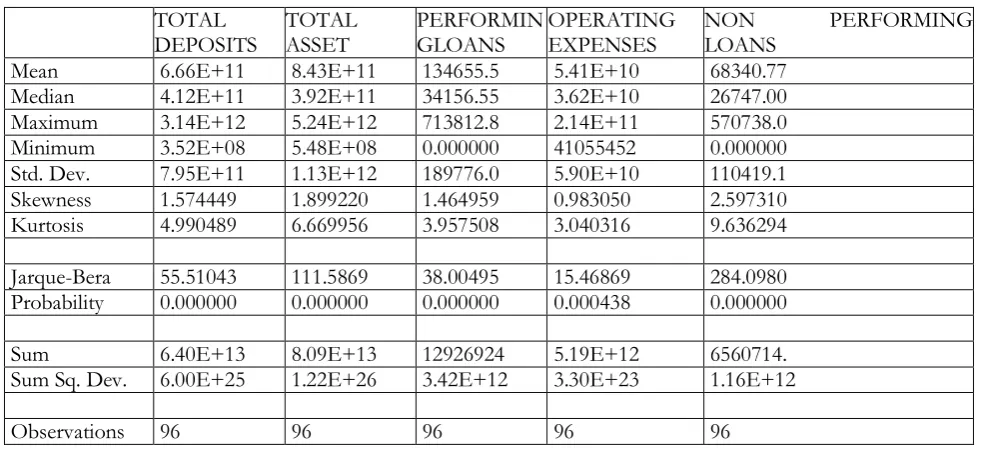
Table 1 presents the descriptive statistics of the variables. From the table, total deposit with a standard deviation of 795,000,000,000 has a mean value of 666,000,000,000 while its maximum and minimum values are 3,140,000,000,000 and352,000,000 respectively. For total asset with a standard deviation of 1,130,000,000,000, its mean value is 843,000,000,000 while its maximum and minimum values are 5,420,000,000 and 548,000,000 respectively. The mean value for non-performing loan with standard deviation of 110,419.1 is 68,340.77, while its maximum and minimum values are 570,738 and zero respectively. For performing loan with a standard deviation of 189,776, its mean value is 134,655.5, while its maximum and minimum values are 713,812 and zero respectively. The mean value for operating expenses with standard deviation of 59,000,000,000 is 54,100,000,000, while its maximum and minimum values are 214,000,000,000 and 41,055,452 respectively. The standard deviation values for all the variables revealed relative dispersion of the variables from their mean values.
7
www.ijmsssr.org Copyright © 2019 IJMSSSR All rights reserved Table 1:Descriptive Statistics of the VariablesTOTAL
DEPOSITS TOTAL ASSET PERFORMINGLOANS OPERATING EXPENSES NON LOANS PERFORMING
Mean 6.66E+11 8.43E+11 134655.5 5.41E+10 68340.77
Median 4.12E+11 3.92E+11 34156.55 3.62E+10 26747.00 Maximum 3.14E+12 5.24E+12 713812.8 2.14E+11 570738.0 Minimum 3.52E+08 5.48E+08 0.000000 41055452 0.000000 Std. Dev. 7.95E+11 1.13E+12 189776.0 5.90E+10 110419.1 Skewness 1.574449 1.899220 1.464959 0.983050 2.597310 Kurtosis 4.990489 6.669956 3.957508 3.040316 9.636294
Jarque-Bera 55.51043 111.5869 38.00495 15.46869 284.0980 Probability 0.000000 0.000000 0.000000 0.000438 0.000000
Sum 6.40E+13 8.09E+13 12926924 5.19E+12 6560714.
Sum Sq. Dev. 6.00E+25 1.22E+26 3.42E+12 3.30E+23 1.16E+12
Observations 96 96 96 96 96
Source: Authors’ Computation Eviews 7.1 (2019)
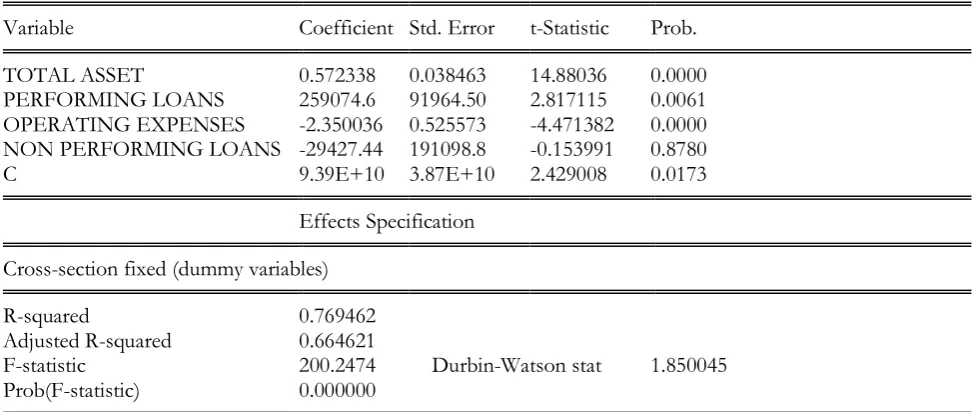
The results of the Panel Data Regression for both the Fixed Effect Model (FEM) and Random Effect Model (REM) were obtained using E-Views 7.1. However, a comparison of the two results revealed that the FEM produced better and more satisfactory results than the REM in terms of the a priori expectations, statistical significance of the coefficients of the variables, F-statistic and Durbin-Watson Statistic.For these reasons, the interpretation and analysis of the results are based on the FEM.
Table 2 presents the panel data regression results of the FEM. The results show that all the explanatory variables had their correct signs. However, while the coefficients of three of the variables, total assets, performing loans and operating expenses were statistically significant in explaining variations in total deposit, the coefficient of non-performing loans was not. The coefficient of total assets (0.57) indicates that if total asset increases by N1 million, total deposits will increase by N0.57 million and vice versa, ceteris paribus. The coefficient of non-performing loan (-29427) indicates that if non-performing loan increases by N1 million, total deposits will reduce by N29, 427 million and vice versa, ceteris paribus. The coefficient of performing loans (259075) indicates that if performing loan increases by N1 million, total deposits will increase by N259,075 million and vice versa, ceteris paribus. Finally, the coefficient of operating expenses (-2.35) indicates that if operating expenses increases by N1 million, total deposits will reduce by N2.35 million and vice versa, ceteris paribus.
8
www.ijmsssr.org Copyright © 2019 IJMSSSR All rights reserved Table 2: Panel Data Regression results – Fixed Effect ModelDependent Variable: TOTAL_DEPOSITS
Variable Coefficient Std. Error t-Statistic Prob.
TOTAL ASSET 0.572338 0.038463 14.88036 0.0000
PERFORMING LOANS 259074.6 91964.50 2.817115 0.0061
OPERATING EXPENSES -2.350036 0.525573 -4.471382 0.0000 NON PERFORMING LOANS -29427.44 191098.8 -0.153991 0.8780
C 9.39E+10 3.87E+10 2.429008 0.0173
Effects Specification
Cross-section fixed (dummy variables)
R-squared 0.769462
Adjusted R-squared 0.664621
F-statistic 200.2474 Durbin-Watson stat 1.850045
Prob(F-statistic) 0.000000
Source: Authors’ Computation Eviews 7.1 (2019)
Discussion of Findings
This study examined the effect of total assets, non-performing loans, performing loans and operating expenses of the Nigerian banking sector on its total deposits between 2005 and 2017. It was found that all the explanatory variables except non-performing loans were significant factors that influenced total deposits. It was also observed that non-performing loans though insignificant had the correct sign as expected. Furthermore, 77 per cent of the systematic variation in the total deposit was explained by all the explanatory variables. This implies that only 23 per cent of the variation in total deposits was attributed to variables that were omitted from the equation, ceteris paribus. The F-statistic (200.2474) and its highly statistically significant probability confirmed the overall significance of the regression equation. The Durbin-Watson statistic (1.85) revealed that there is no problem of autocorrelation.
Having established the adequacy of our model based on these results, we can comfortably proceed to discuss the effects of each of the explanatory variables on the total deposits. First, total asset was found to be statistically significant and positively related to total deposits in accordance with the theoretical expectation. Consequently, the higher the banks’ asset base, the higher the total deposits and vice versa, ceteris paribus. Second, non-performing loan, though statistically insignificant was found to be negatively related to total deposits as expected. Consequently, the higher the value of non-performing loans, the lower the total deposits and vice versa, ceteris paribus. Third, performing loan was found to be statistically significant and positively related to total deposits as expected. This implies that the higher the value of performing loans, the higher the total deposits and vice versa, ceteris paribus. Finally, operating expenses was observed to be statistically significant and negatively related to total deposits as expected. This implies that the higher the operating expenses, the lower the total deposits and vice versa, ceteris paribus. This finding is in tandem with a similar study by Tobias and Themba (2011).
5.0 CONCLUSION AND POLICY RECOMMENDATIONS
Conclusion
9
www.ijmsssr.org Copyright © 2019 IJMSSSR All rights reserved Policy RecommendationsThe following recommendations are made based on the findings of this study:
First, the management of banks should adopt effective assets-liabilities management strategies with a view to boosting their deposit base and sustaining it through various deposit stabilization strategies.
Second, the management of banks should adopt effective cost reduction and control strategies, with a view to drastically reducing their operating expenses.
Third, the regulatory authorities should ensure effective regulation and supervision and also embark on robust banking reforms occasionally for a safe, sound and stable banking sector.
REFERENCES
1. Ajayi, M. (2005). Banking Sector Reforms and Bank Consolidation: Conceptual Framework.Central Bank of Nigeria Bullion,29 (2), 2-10.
2. Asediolen, A. (2004). For the economic and financial interest of Nigeria.Nigerworld, 1 & 2.
3. Azeez, B.A. &Ojo, M.O (2012). A Time Series Analysis of the Impact of Bank Reforms on Nigeria’s Economic Growth. International Journal of economic research 34, 26-37.
4. Baltagi, B. H. (2001). Econometric analysis of Panel Data, John Wiley & Sons
5. Biodun, F. (2005). More Nigerian companies will merge say experts. Financial Standards, May 15. 6. CBN (2004) Fact File on Bank RecapitalizationCentral Bank of Nigeria. Abuja
7. Choe, C. and Moosa, I (1999). Financial System and Economic Growth: The Korean Experience, World Development, 27, 1069-1082.
8. Dziobek, C.&Pazabasioglu, C. (1998).Lesson from systemic bank restructuring. A survey of 24 countries.IMF Working Paper 97.
9. Fry, M. J. (1988). Money, Interest and Banking in Economic Development, John Hopkins University Press, Baltimore.
10. Gujarati, D. N. and Porter, D. C. (2009), Basic Econometrics, McGraw-Hill.
11. Ifionu, E. P. &Keremah, S. C. (2016).Bank Reforms and Deposit Money BanksPerformance: Evidence from Nigeria.European Journal of Business and Management. 8(7)
12. Ikeora, J. J.E, Igbodika, M. N. and Andabai, P. W. (2015). Banking Sector Reforms and the Performance of the Nigerian Economy: A Vector Error Correction Investigation. European Journal of Research and Reflection in Management Sciences, Progressive Academic Publishing, UK. 6.
13. Jegede, C. A. (2014). Banking sector reform in Nigeria: Implication and challenges.Journal of Policy and Development Studies. 9(1)
14. King, R. G. and Levine, R. (1993). Finance, Entrepreneurship and Growth: Theory and Evidence. Journal of Monetary Economics, 32, 513 - 542.
15. Levine, R. (2003). More on Finance and Growth: More Finance, More Growth?,Review of Federal Reserve Bank of St. Louis, 85(4): 31-46.
16. Mckinnon, R. I. (1973). Money and Capital in Economic Development, Brookings Institution,Washington D.C. USA
17. Nathanael O. E (2014).Banking Sector Reforms and Critical Factors in Nigeria’s Economic Growth Process.Journal of Economics and Sustainable Development, 5(17).
18. Neusser, K. and Kugler M, (1998). Manufacturing Growth and Financial Development: Evidence from OECD Countries, Review of Economics and Statistics, 80, 638-646.
19. Ojong, C.M., Ekpuk, A. Ogar, A. and Emori, E. G. (2014), Banking Sector Reform in Nigeria: A Regulatory Imperative for a Sustainable Banking Industry, Research Journal of Finance and Accounting 5(13), 166
20. Okafor, E.E. (2013). Reforms in the Nigerian Banking Sector and Strategies for Managing Human Resource Challenges.European Journal of Business and Management, 5 (18): 127-137.
21. Omoruyi, S.E (1991). The Financial Sector in Africa: Overview and Reforms in Economic Adjustment Programmes. CBN Economic and Financial Review, 29(2), 110-124.
22. Pagano, M. (1993). Financial Markets and Growth: An Overview, European Economic Review, 37, 613-622. 23. Sanusi, S. L. (2010) The Nigerian Banking Industry: What Went Wrong and the Way Forward, lecture
delivered at Bayero University, Kano, February 26, 5-23
24. Schumpeter, J.A (1912). The Theory of Economic Development. Harvard University Press, Cambridge.
10
www.ijmsssr.org Copyright © 2019 IJMSSSR All rights reserved York.26. Soludo .C.C. (2004): Consolidating the banking industry to meet the development challenges of the 21st century; being an address to the special meeting of the bankers committee held on July 16 at the CBN, Abuja
27. Tobias, O. and Themba, M. S. (2011). Effects of Banking Sectoral factors on the Profitability of Commercial Banks in Kenya, Economics and Finance Review 1(5), 01-30.