Volume 3, Issue 4, 2016
117 Available online at www.ijiere.com
International Journal of Innovative and Emerging
Research in Engineering
e-ISSN: 2394 – 3343 p-ISSN: 2394 – 5494
Simulation and Implementation of Multipulse Converter
Sachin R. Dalwadi
ME ELECTRICAL(S.C.E.T, SURAT), A&P: KIM Email ID: [email protected]
ABSTRACT:
Now a days in many application like microprocessor power supply, railway rectifier system, welding transformer, mining industry, aircraft industry, magnetic confinement etc. require more than six pulse or multi pulse as a dc supply which reduce total harmonic distortion (THD) of AC mains current and ripple factor of output DC voltage improve simultaneously and also the improvement is independent of supply frequency variation, unlike passive filters. Conventional converter which gives up to six pulse have some limitations which can be eliminated by using multi-pulse converter. The line current THD of the 12-pulse rectifier normally does not satisfy the harmonic guidelines set by IEEE standard 519-1992. The 18 pulse rectifier has better line current harmonic profile, while the 24 pulse rectifier provides a superior harmonic performance. In this project the simulations of multi-pulse controlled converters is included using different phase shifting transformer design such as delta, wye, zig-zag, star, polygon, etc. using MATLAB Simulink software. After that implementation of multi-pulse controlled converter of 24-pulse will be design using suitable technique.
Keywords: Auto-transformer, multi-pulse AC–DC converter, power-quality improvement, speed controlled DC motor drive, Total harmonic distortion(THD).
I. INTRODUCTION
Converter providing more than six pulses of DC voltage per cycle is known as multi-pulse converter[1]. Convention ac-dc converters are developed using diodes or thyristors to provide controlled or uncontrolled unidirectional and bidirectional dc power , however, these converters have problem of poor power quality in terms of injected current harmonics, resultant voltage Distortion and slowly varying rippled dc output at load end, low efficiency, and large size of ac and dc filters[2],[3]. To overcome these drawbacks like reducing harmonic current, higher power factor, at input ac mains and well-regulated dc output multi-pulse converter comes into picture.
In [2] the simulation of 6, 12, 18, 24, 36 & 48 pulse controlled rectifier and also done the comparative study of it. From that simulation they had observed the Total harmonic distortion (THD) in the input current, Ripple in the output voltage, and also the power factor. The thyristor are fired at different firing angle and the different characteristics are obtained. From the simulation results they had conclude that as the number of converter are increased the THD is decreased also the ripple in the output voltage is decreased And the power factor is improved. It is also observed that the THD, ripple factor and power factor are poor when the thyristor are fired at 20 degree instead of 10 degree.
In [3] the simulation of 12 pulse converter or rectifier with four different topologies of auto transformer for the vector control induction motor drive for retrofit application. The basic thing required that the transformer should have to maintain the phase shift of 30 degree. And in the reference paper the design of the autotransformer is also discuss. And at last the simulation results are obtained for the light load as well as for the full load and it was compared with four topologies. It is measured that the THD, ripple factor and the power factor are reduced for the light load instead of full load.
In [4] around 250 research publications are refered and had prepared the simulation of 12, 18, 24 pulse converter using different configuration of transformer like star, delta, T-connection, zigzag, fork, extended delta and double star, polygon, reduced rating auto-transformers. They had implement the simulation for unidirectional and bidirectional multi-pulse converter. They had also implement the novel topology for 24 pulse converter using only two converters. They had also divided the simulation by both full wave and bridge rectifier and observed different parameters.
118 In this paper the simulation of 24 pulse converter is done which is having no zig-zag or polygon transformers. Only using the star, delta and the step-down transformer we are getting the phase shift of 15 degree. The simulation of 24 pulse close loop converter is also done which is for the speed control of the dc motor.
II. SIMPLIFIED STEPS FOR TRANSFORMER DESIGN
(1) Three Phase Transformer (△/△Y).
(a) Steps of Determination of Main Dimensions for Core, Window, and Yoke Step – 1: Calculate voltage per turn
𝐸𝑡=k√𝑄 volts
Step – 2: Find net cross sectional area of the core 𝐸𝑡=4.44f∅𝑚
=4.44f𝐵𝑚𝐴𝑖
Where, 𝐴𝑖= 𝐸𝑡 4.44𝑓𝐵𝑚𝑚
2
Step -3: Determine the diameter of the circumscribing circle 𝐴𝑖=K𝑑2
Where, d=√𝐴𝑖/𝐾 m
Step -4: Find the width of the window 𝑊𝑤= (D-d) m
Step-5: Obtain window area For three phase transformer
Q = 3.33f𝐵𝑚 𝛿𝐾𝑤 𝐴𝑖𝐴𝑤 𝑋 10−3 kva
Step-6: Find height of the window Hw =
𝐀𝐰 Ww m Aw= Hw × Ww Hw
Ww = 2 to 4.
Step-7: Obtain the depth and height of yoke
𝐷𝑦 (Depth of the yoke) = a𝐻𝑦(Height of the yoke) = a
Step-8: Obtain the overall height and length H = (𝐻𝑤+2𝐻𝑦) mW = (2D +a) m
(b) Design Steps for LV Winding Design Step-1: Calculate number of turns
𝑇𝑠 = 𝑉𝑠
𝑬𝒕 ;where 𝑉𝑠 = secondary voltage
Et= voltage per turn
Step-2: Find secondary phase current For three phase transformer,
𝐼𝑠= kva ×103
3 𝑋 𝑉𝑠 A
Step-3: Obtain the cross sectional area of the secondary as =
Is δs
Where,𝛿𝑠=current density in A/m𝑚2
(c) Design steps for HV winding design Step -1:Number of turns in HV side
𝑇𝑝=No.of LT side turns X
voltage rating of HV side voltage rating of LV side
Step -2: if tapping are provided 𝑇𝑝(𝑛𝑒𝑤)=1.05 X 𝑇𝑝
Step -3: HV side current 𝐼𝑝=
𝐤𝐯𝐚 ×𝟏𝟎𝟑
𝟑 𝐗 HT side voltage ratingA
OUTPUT:
Volume 3, Issue 4, 2016
119 Aw= 175 mm2
For △/Y
Vp=415 v; Vs=12v Tp=3772 ;Ts=110 Ip=0.0481A; Is=1.666 A
For △/△
Vp=415 v;Vs=12v Tp=3772;Ts=110 Ip=0.0481A; Is=1.666 A
(2) Single-Phase Transformers:
There are six single-phase transformers whose primary windings are used to isolate two sets of line voltages, Va0b0,
Vb0c0, Vc0a0 and Va-30b-30,Vb-30c-30, Vc-30a-30 pertaining to the wye (yo) and delta (d1) secondary windings respectively of the main
transformer. The six secondary windings of the single-phase transformers are segregated into three pairs, with each pair comprising two relevant secondary windings corresponding to the voltage combinations Va0b0and Va-30b-30, Vb0c0 and Vb-30c-30,
and Vc0a0 and Vc-30a-30 that are synthesized by series cascade connection to obtain the line voltages Va-15b-15, Vb-15c-15 and V c-15a-15 respectively. The synthesis of the voltage combinations is as per eq (1). The synthesis of Va0b0 and Va-30b-30 as per eq (1)
yields Va-15b-15 as follows:
Va0b0 = 12/30º V
Va-30b-30 = 12/0º V
i.e. Va-15b-15 =( 122 + 122 + 2×12×12×Cos 300 )1/2V
i.e. Va-15b-15 = 23.18/15º V
Similarly, the line voltages Vb-15c-15 and Vc-15a-15 are obtained by the synthesis of the relevant voltage combinations. The
synthesis yields magnitudes as follows:
│Va-15b-15│ = │Vb-15c-15│ = │Vc-15a-15│ = 23.18 V
The three secondary pairs are connected in delta to form a 3-phase winding with Va-15b-15, Vb-15c-15 and Vc-15a-15 as the line
voltages. The delta winding feeds the diode bridge DBIII and thereforeas per eq (4) the desired magnitudes the line voltages have to be as follows:
| Va-15b-15 | = | Vb-15c-15| = | Vc-15a-15 | = 12 V
The turns ratio of each single-phase transformer is thus: N2/N1 = 12 / 23.18 = 0.5176 = 0.52
(3) Delta-Star Transformer (△/Y)
The voltages Va-15b-15, Vb-15c-15and Vc-15a-15 are fed to a Yd1 transformer to obtain line voltages Va-45b-45, Vb-45c-45and Vc-45a-45 that
lag the input wye voltages by 30° and feed diode bridge DBIV. The magnitudes of the line voltages on wye and delta sides must be equal
i.e. | Va-15b-15| = | Vb-15c-15| =| Vc-15a-15| =| Va-45b-45| = | Vb-45c-45| = | Vc-45a-45 | =12 V.
Thus, the turns is given by
N2/N1 = √3 = 1.7321.
III. Harmonic Cancellation
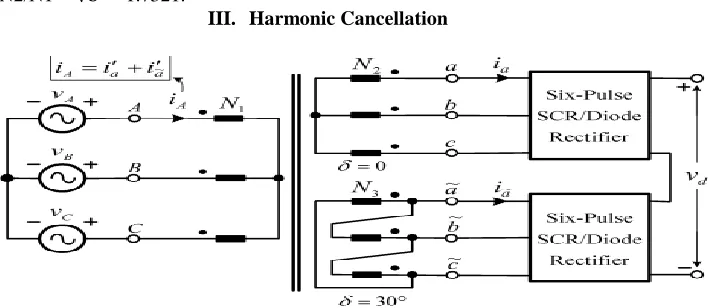
Figure 1. An example of harmonic current cancellation
To illustrate how the harmonic currents are canceled by a phase shifting transformer, let’s examine a 12-pulse rectifier shown in Fig.. The phase-shifting angle δ of the wye- and delta-connected secondary windings is 0° and 30°, respectively. The voltage ratio is 𝑉𝐴𝐵/𝑉𝑎𝑏= 𝑉𝐴𝐵/𝑉𝑎̃𝑏̃= 2. The line currents in the secondary windings can be expressed as
𝑖𝑎= ∑ 𝐼̂𝑛
∞
𝑛=1,5,7,11,13,…
120
𝑖𝑎̃= ∑ 𝐼̂𝑛
∞
𝑛=1,5,7,11,13,…
sin(𝑛(𝜔𝑡 + 𝛿))
When 𝑖𝑎 is referred to the primary side, the phase angle of all the harmonic currents remains unchanged due to the Y/Y
connection. The referred current 𝑖𝑎′ is then given by
𝑖𝑎′ =
1
2(𝐼̂1sin(𝜔𝑡) + 𝐼̂5sin(5𝜔𝑡) + 𝐼̂7sin(7𝜔𝑡) + 𝐼̂11sin(11𝜔𝑡) + 𝐼̂13sin(13𝜔𝑡) + ⋯) To transfer I ã to the primary side, we can make use, from which
𝑖𝑎̃′ =
1
2( ∑ În
∞
n=1,7,13,…
sin(n(ωt +δ) +δ) + ∑ În
∞
n=5,11,17,…
sin(n(ωt +δ) −δ))
=1
2(𝐼̂1sin(𝜔𝑡) − 𝐼̂5sin(5𝜔𝑡) − 𝐼̂7sin(7𝜔𝑡) + 𝐼̂11sin(11𝜔𝑡) + 𝐼̂13sin(13𝜔𝑡) − ⋯) For δ = 30°
The primary line current iA can then be found from
𝑖𝐴= 𝑖𝑎′ + 𝑖𝑎̃′ = 𝐼̂1sin 𝜔𝑡 + 𝐼̂11sin 11𝜔𝑡 + 𝐼̂13sin 13𝜔𝑡 + 𝐼̂23sin 23𝜔𝑡
where the 5th, 7th, 17th, and 19th harmonic currents in 𝑖
𝑎 and 𝑖𝑎′ are 180° out of phase, and therefore canceled.
Same we can derive for 24 pulse converter.
IV. SIMULINK MODEL & WAVEFORMS OF MULTI-PULSE CONVERTER
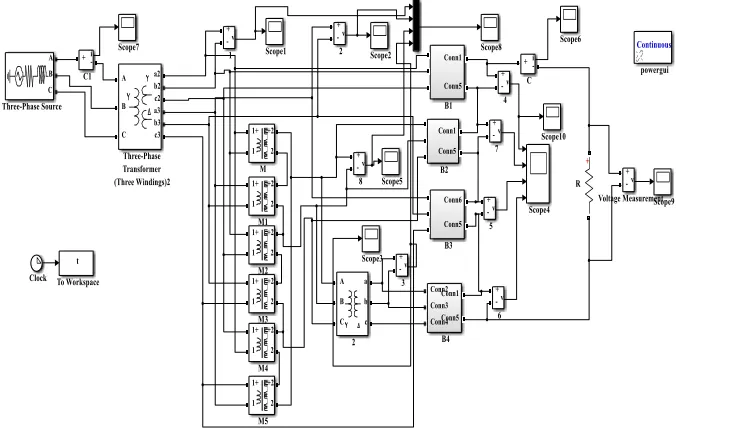
Figure 2. Simple Block diagram of open loop multi-pulse converter.
In open loop controlled converter the transformer is connected in parallel with the three phase ac source and the thyristor switches are connected in series with the transformer. The pulse generator is used to switch on or providing the gate pulse to the thyristor. In open loop system we just have to put the delay angle in the pulse generator and the gate pulse have angle of α is given to the thyristor. All pulse generator in a bridge are 60o shifted with each other and all bridges are α degree shifted with
other.
The open loop converter simulation for 12, 18, and 24 pulse converter is shown in the figure below. The analysis of THD is also observed which is shown in the table. The sub-system shows the connection diagram of different transformer connection using single phase transformer.
Figure 3. Easy topology to get 15° phase shift
3-ϕACSUP
PLY
TRANFORMERS
RECTIFIER
BRIDGE
Volume 3, Issue 4, 2016
121
Waveforms for 10 degree delay:
THD Analysis:
Waveforms for 30 degree delay :
122
FOR CLOSE LOOP SYSTEM
Figure 4. Simulink model of 24-Pulse Converter
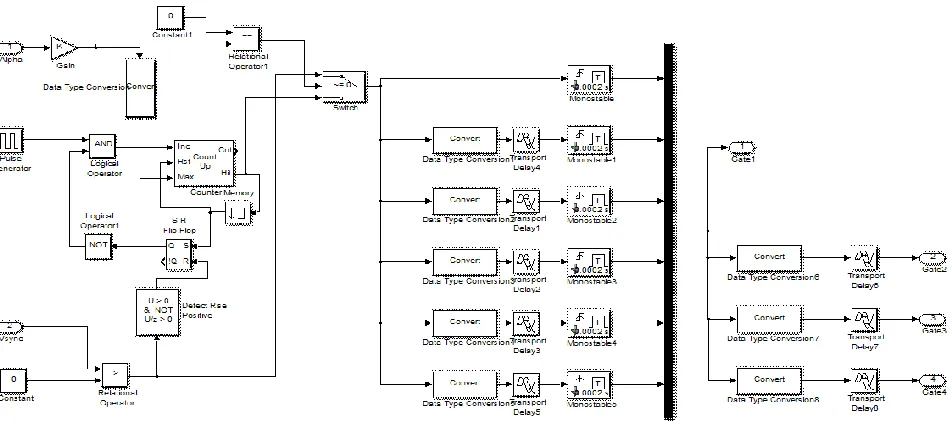
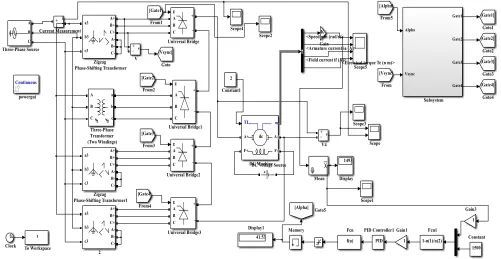
In the close loop system the control part is added. The fig shows the close loop operation of multi pulse converter. As shown in fig the output voltage is sensed and compared with the reference voltage and given to the PI controller and the alpha is calculated. Now the calculated alpha and vsynch as shown in fig is given into the pulse controller.
In the pulse controller, counter is placed which is incremented at every 0.45o and when the incremented value is equal
to the value mentioned in the reference voltage then the counter will overflow and the pulse is generated. This pulse is for one pulse generator and all the pulse generator connected in one bridge is 60o shifted with each other and all the bridge are 15o
shifted with each other. This is the basic concept of generating pulse in close loop system and it will provided constant required voltage to the load.
Sub- system of pulse controller
Sub-system of Pulse Controller
TRANFORMERS RECTIFIER
BRIDGE
L O A D
V
sy
n
PI
C
ON
T
R
OL
L
E
R
α
PULSE CONTROLLER
VREF
Volume 3, Issue 4, 2016
123
Simulink model of 24 pulse close-loop system
Figure 5.Simulink model of 24-Pulse Converter
Waveforms for 1500 rpm speed:
124
Waveforms for 500 rpm speed:
Speed & THD Analysis:
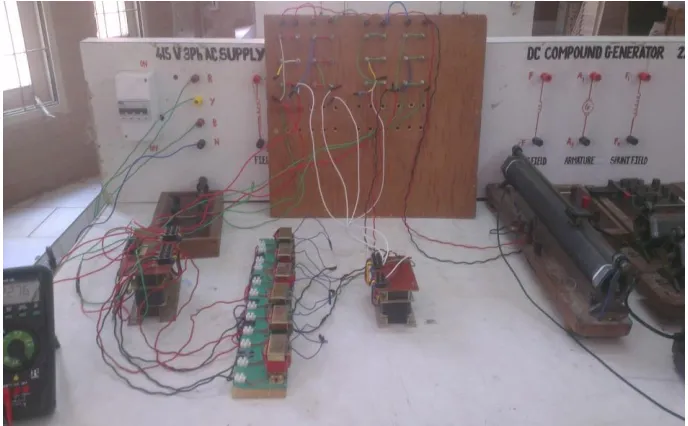
Hardware model of pulse converter
Volume 3, Issue 4, 2016
125
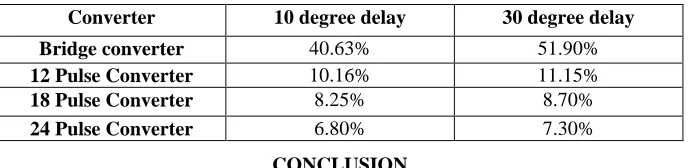
TABLE 1. Comparison analysis % THD
CONCLUSION
Three phase multi-pulse AC-DC converter are developed for improving power quality & reduce harmonics in ac mains & ripple in dc output. Multi-pulse converter can be considered better alternatives for power quality improvement. Here the various multi-pulse converter configurations were simulated using the software MATLAB and the results have been presented. Comparison of various topologies has been presented in the report which clearly show that as number of pulses increases, % THD decreases and as the phase delay are increased the % THD is increased.
REFERENCE
[1] Bin Wu, “High-Power Converters and AC Drives”, Wiley-IEEE Press, 2006.
[2] AbhayChaturvedi, DeepikaMasand, Saurabh Gupta, SachinTiwari, Monika Jain “Comparative Analysis of Three Phase AC-DC Controlled Multi Pulse Converter” IEEE Students’ Conference on Electrical, Electronics and Computer Science, vol-1, pg. 1-4, 1-2 march 2012.
[3] Bhim Singh, G. Bhuvaneswari, VipinGarg“Harmonic Mitigation Using 12-Pulse AC–DC Converter in Vector-Controlled Induction Motor Drives”, IEEE Transactions, Volume 21, pg. 1483-1492, July 2006.
[4] Singh B.N, Chandra A, Al-Haddad K, Pandey A, Kothari, D.P.,“A review of three-phase improved power quality AC-DC converters” IEEE Industrial Electronics, Volume:51,pg.641 – 660, june 2004.
[5] RakeshMaurya, PramodAgarwal and S.P.Srivastava, “Performance Investigation of Multipulse Converter for Low Voltage High Current Applications” IEEE international conference, Vol-1, pg. 211-216, June 2011.
[6] Bhim Singh, G. Bhuvaneswari, VipinGarg“Eighteen-Pulse AC-DC Converter for Harmonic Mitigation in Vector Controlled Induction Motor Drives”, IEEE Transactions, Vol-2, pg. 1514 - 1519, July 2005.
[7] Bhim Singh, G. Bhuvaneswari, VipinGarg“Polygon-Connected Autotransformer-Based 24-Pulse AC–DC Converter for Vector-Controlled Induction-Motor Drives”, IEEE Journals, Vol-55, pg. 197-208, July 2008.
[8] N.Mohan, T.M.Undeland, W.P.Robbins,“Power Electronics: Converters, Applications, and Design”, 3rd Edition, 2002.
[9] G.K.Dubey, S.R.Doradla, A.Joshi, R.M.K.Sinha, “ThyristorisedPower Controllers”, New Age International publishers, July 1996.
Converter 10 degree delay 30 degree delay Bridge converter 40.63% 51.90%
12 Pulse Converter 10.16% 11.15%
18 Pulse Converter 8.25% 8.70%