Volume 4, Issue 7, 2017, pp. 154-164 Available online at www.jallr.com ISSN: 2376-760X
* Correspondence: Mojtaba Aghajani, Email: Mojtaba_Aghajani45 yahoo.com
© 2017 Journal of Applied Linguistics and Language Research
The Effect of Anxiety on Speaking Ability: An Experimental
Study on EFL Learners
Mojtaba Aghajani *
Khatam ol-Anbia University, Tehran, Iran.
Hanieh Amanzadeh
Alzahra University, Tehran, Iran.
Abstract
The study is aimed to investigate the relationship between students’ anxiety and their communication performance. To this end, 40 upper-intermediate adult (male and female) EFL learners were chosen through convenience sampling. A speaking test was administered which were scored from 0 to 10 and then answered a 33-item 5-point Likert scale FLCAS questionnaire. The results of the study indicated that there is a significant negative relationship between students’ anxiety and their communication performance. Consequently, it could be concluded that (high) anxiety was effective (negatively) in the performance of students.
Keywords: anxiety, speaking, performance, communication, EFL learner
INTRODUCTION
Investigation in to anxiety has been an important aspect of psycholinguistics. Anxiety is considered as one of the factors that affects the performance of language learners. Moreover, people learning English are always judged by their speaking ability. In a recent study, Marcos-Llinas and Garau (2009) suggested that anxiety and in this case foreign language anxiety is the result of language problems that learners may have during their course. Macintyre and Garder (1991a) pointed out that most of the problems that students encounter during the language learning are due to the foreign language anxiety which hinder learning process as well as the production of the target language. It is also considered a common phenomenon among foreign/second language learners (Saito & Samimy, 1996).
willing to participate in class activities and conversations, but due to foreign language anxiety which is the result of lack of English knowledge, low communication proficiency, and being unprepared, they proffered not to take any risks by speaking in front of other students. Since it is a known fact that the purpose of learning a second language is to communicate and communication is the most important aspect in language learning, it is important to find out how much anxiety can affect the communication performance of language learners. Liu and Jackson (2008) in their study found out that more than one third of the students were experiencing foreign language anxiety in the language learning process. The main reason for this, as they said, was the fear of being negatively evaluated by other students or by the teacher. Their results showed a significance correlation between foreign language anxiety and the unwillingness to communicate in class.
Generally, the main aim of this study is to investigate the relationship between foreign language anxiety and communication performance (speaking) and to define to what extent foreign language anxiety affects the communication performance among Iranian adult EFL learners.
This study attempts to answer these questions:
1. To what extent foreign language anxiety affects adult EFL learners’ speaking? 2. What is the relationship between foreign language anxiety and speaking ability
of adult EFL learners? REVIEW OF LITERATURE
well-understood construct (Scovel, 1978). Criteria such as course scores, proficiency, and production of language as output level is the main understandable result of foreign language anxiety tests (Macintyre & Gardner, 1991a). Scovel (1978) suggested three ways to measure the anxiety: behavioral tests, which the action or the activity of the subject is observed, subject’s self-reports, which the participant him/herself will report on his/her experience of anxiety, and physiological tests, which measures heart rate, blood pressure, and amount of sweating.
In order to study the foreign language anxiety, one can distinguish the anxious students from normal students. Many students at least in some aspects of language learning experience the foreign language anxiety and the reactions of anxious students can be vary from one another (Horwitz et al., 1986). In their study, they suggested that anxious students often complain about the difficulties of recognizing the target language sounds and structures, and understanding the content of the lesson is problematic. Also these students are usually comfortable with written test but they often “freeze” as they are asked to take part in a role-play situation. Moreover, Horwitz et al. (1986) in their study suggested that anxious students avoid using complicated and difficult messages and structures in their speech which is the result of the effect of anxiety on communication strategies of the language learners. Liu (2006) noted that if a high anxious student is asked to present orally in classroom, his tense can be seen in his voice, and his legs will shake during the presentation. Liu concluded that this is one of the reasons that students with anxiety try to avoid participating in class activities and discussions. In her study, Liu found out that more than one-third of the students show the signs of anxiety while presenting orally in English classroom.
There are reports that indicate students, especially when they are not prepared for the course, show a higher level of nervousness and self-conscious when they have to speak in foreign language in front of other (Sinnasamy & Abdul Karim, 2014). Another situation where foreign language anxiety shows up is during the tests. It was reported by students that despite that they “know” something; they cannot remember it during the exam (Horwitz et al., 1986).
increases the level of anxiety in students is the teachers who talk fast or have an unusual teaching method (Chen & Cheng, 2004).
Young (1986) suggested that anxiety is a factor that can affect communication performance. Woodrow (2014) found a strong relationship between foreign language anxiety and oral performance in her recent study. Participants recognized the interactions with native speakers as the main reason of anxiety in the study. When a student with language anxiety is asked to put his language skills to test by speaking in a foreign language in front of others, he will develop a sense of self-unconsciousness (Horwitz et al., 1986). Horwitz et al. (1986) also noted that the level of anxiety will arise when the students need to use English outside the classroom.
Lack of concentration, forgetting lessons, sweat, and using avoidance behaviors such as missing a class on purpose or avoid doing the homework are other sign of an anxious student (Horwitz et al., 1986). One of the factors that affect the level of foreign language anxiety is fear and inconvenience of speaking in a foreign language (Sinnasamy & Abdul Karim, 2014). As Yim (2014) pointed out in his recent study, a factor that leads the students of foreign language to anxiety is the lack of exposure to a context where target language is spoken. It is reported that the students who traveled abroad to a foreign language speaking country, show a lower level of anxiety in classroom (Matsuda & Gobel, 2004). However, Foreign language anxiety doesn’t only affect the class oral presentation, but it can affect the whole learning process too (Sinnasamy & Abdul Karim, 2014). In a study on French language learners, there was a clear relationship between foreign language anxiety and foreign language proficiency which exists in both learning and production stages of the language learners (Macintyre & Gardner, 1989). Based on Alpert and Herber’s anxiety scale, there are two types of foreign language anxiety: (a) Debilitative, and (b) facilitative (Young, 1986). The fact that some of the students who show a high level of anxiety will not necessarily show score low in the tests is that there are some types of anxiety that helps the student to improve his skills and keeps him motivated (Marcos-Llinas & Garau, 2009). Scovel (1978) reported that at higher level of IQ, anxiety shows up as a positive factor while at lower IQ it is associated with poorer performance in students. Based on Young (1986) study, facilitating anxiety helps the student to improve his skills during the language learning process, while debilitating anxiety makes a barrier toward learning or improving ones skills. Most common interoperation for anxiety encountered by researchers is debilitating anxiety (Macintyre & Gardner, 1989). Although most of the studies deals with the debilitative anxiety which shows negative relationship between performance and foreign language anxiety, but there are reports on facilitative anxiety as well (Matsuda & Gobel, 2004). Woodrow (2014) noted in her study that anxiety may have negative or debilitative effect on one’s language performance.
Communication apprehension is the shyness and fear about communication in target language. It could be oral communication anxiety, stage fright, or receiver anxiety. Communication apprehension plays an important role in foreign language anxiety. Test anxiety deals with fear of failure that comes to a student before or during a test. They often set their goal so high and feel failure if they cannot reach that specific goal in exams. It is reported that there is a potential that both communication apprehension and test anxiety can occur in an oral test. Fear of negative evaluation is the fear of students from other’s negative critics and evaluation. It is similar to the test anxiety but fear of negative evaluation does not have to be in a test situation to happen. It may happen in everyday social life of a second language speaker. However, Horwitz et al. (1986) suggested that foreign language anxiety doesn’t just come from these fears. It can be arising from the certain language learning process which is based on a complex set of feelings, behavior, and self-perceptions.
Based on the literature review and the previous studies in the field of foreign language anxiety, it is hypothesized for this study that there will be a notable negative relationship between foreign language anxiety and communication performance among Iranian adult EFL learners.
METHOD
For the purpose of this research, 40 upper-intermediate adult (male and female) EFL learners were chosen through convenience sampling. This study adopted a correlational method in order to calculate and find the relationship between the two variables. In this study, foreign language anxiety is the independent variable and speaking is the dependent one. Also, for the sake of limitation of the results, a control variable of Iranian Adult EFL learners had been set.
Participants
For this study, a sum of 40 adult EFL learners (21 male & 19 female) aged 18 to 28, participated. They were upper-intermediate level language learners who were randomly selected from 2 different private language institutes in Tehran. Participants were studying English as foreign language for 2 years in average.
Materials
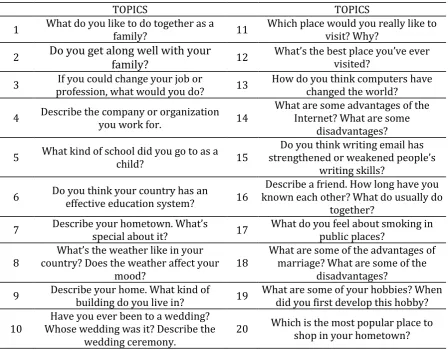
Table 1. The list of IELTS topics
TOPICS TOPICS
1 What do you like to do together as a family? 11 Which place would you really like to visit? Why?
2 Do you get along well with your family? 12 What’s the best place you’ve ever visited?
3 profession, what would you do? If you could change your job or 13 How do you think computers have changed the world?
4 Describe the company or organization you work for. 14
What are some advantages of the Internet? What are some
disadvantages?
5 What kind of school did you go to as a child? 15 strengthened or weakened people’s Do you think writing email has
writing skills?
6 Do you think your country has an effective education system? 16 known each other? What do usually do Describe a friend. How long have you together?
7 Describe your hometown. What’s special about it? 17 What do you feel about smoking in public places?
8 country? Does the weather affect your What’s the weather like in your mood?
18 What are some of the advantages of marriage? What are some of the disadvantages?
9 Describe your home. What kind of building do you live in? 19 What are some of your hobbies? When did you first develop this hobby?
10 Whose wedding was it? Describe the Have you ever been to a wedding? wedding ceremony.
20 Which is the most popular place to shop in your hometown?
Procedure
Data Analysis
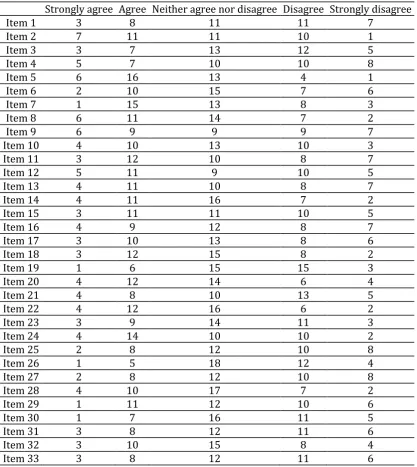
The data collected from teacher’s notes, physical condition notes and questionnaires were entered into IBM SPSS software. The speaking presentation was also scored based on teacher evaluation. Afterward, the correlation between the questionnaire data and the speaking test score were calculated via bivariate Pearson r correlation. The speaking test score were correlated by all 33 questionnaire items. Table 2 shows the means of speaking test scores, minimum and maximum scores, and standard deviation. Table 3 shows the frequency of questionnaire answers.
Table 2. The means, minimum and maximum scores, and standard deviation of
speaking test scores
N Minimum Maximum Mean Std. deviation
Test scores 40 3.00 10.00 6.5000 2.36426
Table 3. Frequency of questionnaire answers
Strongly agree Agree Neither agree nor disagree Disagree Strongly disagree
Item 1 3 8 11 11 7
Item 2 7 11 11 10 1
Item 3 3 7 13 12 5
Item 4 5 7 10 10 8
Item 5 6 16 13 4 1
Item 6 2 10 15 7 6
Item 7 1 15 13 8 3
Item 8 6 11 14 7 2
Item 9 6 9 9 9 7
Item 10 4 10 13 10 3
Item 11 3 12 10 8 7
Item 12 5 11 9 10 5
Item 13 4 11 10 8 7
Item 14 4 11 16 7 2
Item 15 3 11 11 10 5
Item 16 4 9 12 8 7
Item 17 3 10 13 8 6
Item 18 3 12 15 8 2
Item 19 1 6 15 15 3
Item 20 4 12 14 6 4
Item 21 4 8 10 13 5
Item 22 4 12 16 6 2
Item 23 3 9 14 11 3
Item 24 4 14 10 10 2
Item 25 2 8 12 10 8
Item 26 1 5 18 12 4
Item 27 2 8 12 10 8
Item 28 4 10 17 7 2
Item 29 1 11 12 10 6
Item 30 1 7 16 11 5
Item 31 3 8 12 11 6
Item 32 3 10 15 8 4
RESULTS & DISCUSSION
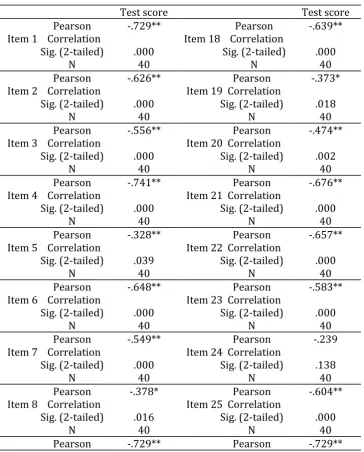
The summary of the result can be found in table 4. It is clear that there is a significance correlation between test score and 31 out of 33 items of the questionnaire. For example there is a strong correlation between test score of the students and item 7 of the questionnaire (r=741 and α<0.01). This indicates that the correlation between the two variables is strong and negative, which matches the results of the previous studies and therefore our hypothesis is accepted.
The results in table 4 show that the students’ communication performance, which was evaluated via a speaking test, is negatively related with the answers in their questionnaire. That is the more anxious a student, the poorer communication performance and therefor lower tests score. It can be explained based on the result of the table 4 that the debilitative anxiety has the most effect on students’ communication performance.
Table 4. Pearson correlation of items
Test score Test score
Pearson Item 1 Correlation Sig. (2-tailed) N -.729** .000 40 Pearson Item 18 Correlation Sig. (2-tailed) N -.639** .000 40 Pearson
Item 2 Correlation Sig. (2-tailed) N -.626** .000 40 Pearson Item 19 Correlation Sig. (2-tailed) N -.373* .018 40 Pearson
Item 3 Correlation Sig. (2-tailed) N -.556** .000 40 Pearson Item 20 Correlation Sig. (2-tailed) N -.474** .002 40 Pearson
Item 4 Correlation Sig. (2-tailed) N -.741** .000 40 Pearson Item 21 Correlation Sig. (2-tailed) N -.676** .000 40 Pearson
Item 5 Correlation Sig. (2-tailed) N -.328** .039 40 Pearson Item 22 Correlation Sig. (2-tailed) N -.657** .000 40 Pearson
Item 6 Correlation Sig. (2-tailed) N -.648** .000 40 Pearson Item 23 Correlation Sig. (2-tailed) N -.583** .000 40 Pearson
Item 7 Correlation Sig. (2-tailed) N -.549** .000 40 Pearson Item 24 Correlation Sig. (2-tailed) N -.239 .138 40 Pearson
Item 8 Correlation Sig. (2-tailed) N -.378* .016 40 Pearson Item 25 Correlation Sig. (2-tailed)
N
-.604**
.000 40
Item 9 Correlation Sig. (2-tailed)
N .000 40
Item 26 Correlation Sig. (2-tailed)
N .000 40
Pearson Item 10 Correlation Sig. (2-tailed) N -.770** .000 40 Pearson Item 27 Correlation Sig. (2-tailed) N -.207 .200 40 Pearson
Item 11 Correlation Sig. (2-tailed) N -.316* .047 40 Pearson Item 28 Correlation Sig. (2-tailed) N -.639** .000 40 Pearson
Item 12 Correlation Sig. (2-tailed) N -.690** .000 40 Pearson Item 29 Correlation Sig. (2-tailed) N -.627** .000 40 Pearson
Item 13 Correlation Sig. (2-tailed) N -.654** .000 40 Pearson Item 30 Correlation Sig. (2-tailed) N -.546** .000 40 Pearson
Item 14 Correlation Sig. (2-tailed) N -.490** .001 40 Pearson Item 31 Correlation Sig. (2-tailed) N -.498** .001 40 Pearson
Item 15 Correlation Sig. (2-tailed) N -.573** .000 40 Pearson Item 32 Correlation Sig. (2-tailed) N -.539** .000 40 Pearson
Item 16 Correlation Sig. (2-tailed) N -.710** .000 40 Pearson Item 33 Correlation Sig. (2-tailed) N -.647** .000 40 Pearson
Item 17 Correlation Sig. (2-tailed)
N
-.546**
.000 40
*. Correlation is significant at the 0.05 level (2-tailed)
**. Correlation is significant at the 0.05 level (2-tailed).
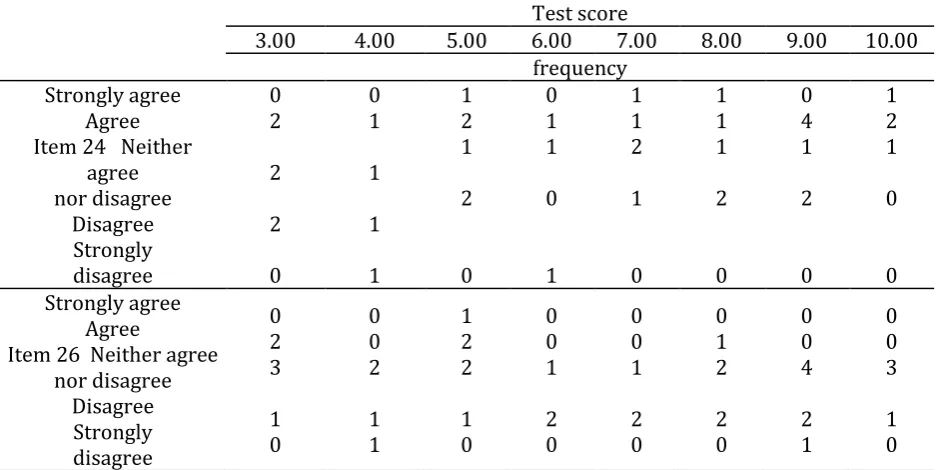
Table 5. Frequency of the questionnaire item 24 and 26 answers across the test scores
Test score
3.00 4.00 5.00 6.00 7.00 8.00 9.00 10.00
frequency Strongly agree
Agree Item 24 Neither
agree nor disagree Disagree Strongly disagree 0 2 2 2 0 0 1 1 1 1 1 2 1 2 0 0 1 1 0 1 1 1 2 1 0 1 1 1 2 0 0 4 1 2 0 1 2 1 0 0 Strongly agree Agree
Item 26 Neither agree nor disagree Disagree Strongly disagree 0 2 3 1 0 0 0 2 1 1 1 2 2 1 0 0 0 1 2 0 0 0 1 2 0 0 1 2 2 0 0 0 4 2 1 0 0 3 1 0
For answering our first research question, we can suggest that there is a significance correlation between the speaking test score and the students’ anxiety in classroom. The communication performance is highly correlated with test score. This correlation leads us to answering second research question. The correlation we found in the result was negative between test scores and questionnaires in 31 out of 33 items. This indicates that anxious students tend to have lower scores and poorer communicative performance ability.
CONCLUSION
the result of lower self-esteem when they are trying to speak in a foreign language. The result in a setting where the exposure to second/foreign language is easier and more common could be different. And third, this study just investigated the relationship between communication performance and anxiety, there was no treatment performed in the classroom in order to reduce the students’ anxiety. A study where there is a teaching method was used for reducing the anxiety can help the teacher during speaking courses either to reduce the overall students’ anxiety or turn that anxiety from debilitative to facilitative anxiety.
REFERENCES
Scovel, T. (1978). The effect of affect on foreign language learning: A review of literature of the anxiety research. Language Learning, 2(1), 129-142.
Young, J. (1986). The relationship between anxiety and foreign language oral proficiency ratings. Foreign Language Annals, 19(5), 439-445.
Horwitz, E. K., Horwitz, M. B., & Cope, J. (1986). Foreign Language Classroom Anxiety. Modern Language Journal, 70(2), 125-132.
Macintyre , P. D., & Gardner, R. C. (1989). Anxiety and second language learning: Toward a theoretical clarification. Language Learning 39(2), 251-275.
Macintyre , P. D., & Gardner, R. C. (1991). Methods and results of anxiety and language learning: A review of the literature. Language Learning, 41(1), 85-117.
Macintyre , P. D., & Gardner, R. C. (1991). Learners’ anxiety: Its relationship to other anxieties and to processing in native and second language. Language Learning, 41(4), 513-534.
Young, D. J. (1992). Language anxiety from the foreign language specialists’ perspective: Interviews with Krashen, Omaggio Hadley, Terrell, and Rardin. Foreign Language Annals, 25(2), 157-172.
Saito, Y., & Samimy, K. K. (1996). Foreign language anxiety and language performance: A study of learner anxiety in beginning, intermediate, and advanced level college students of Japanese. Foreign Language Annals, 29(2), 239-249.
Chen, T., & Chang, G. B. Y. (2004). The relationship between foreign language anxiety and learning difficulties. Foreign Language Annals, 37(2), 279-289.
Matsuda, S., & Gobel, P. (2004). Anxiety and predicators of performance in the foreign language classroom. System, 32, 21-36.
Liu, M. (2006). Anxiety in Chinese EFL students at different proficiency levels. System, 34, 301-316.
Liu, M., & Jackson, J. (2008). An exploration of Chinese EFL learners’ unwillingness to communicate and foreign language anxiety. The Modern Language Journal, 92(1), 71-86.
Marcos-Llinas, M., & Garau, M. J. (2009). Effects of language anxiety on three proficiency-level courses of Spanish as a foreign language. Foreign Language Annals, 42(1), 94-111.
Woodrow, L. (2014). Anxiety and speaking English as a second language. Regional language Center Journal, 37(3), 308-328.
Sinnasamy, J., & Abdul Karim, N. H. (2014). A correlational study of foreign language anxiety and library anxiety among non-native speakers of English a case study in a Malaysian public university. The Journal of Academic Liberian ship, 40, 431-435. Yim, S. Y. (2014). An anxiety model for EFL young learners: A path analysis. System, 42,