Issues
ISSN: 2146-4138
available at http: www.econjournals.com
International Journal of Economics and Financial Issues, 2018, 8(2), 14-24.
Dollarization in Jordan
Issa Hijazeen
1*
‡, Ali Al-Assaf
21Senior Economist, Research Department, Central Bank of Jordan, 2Head of Economic Division, Center for Strategic Studies at the University of Jordan. *Email: [email protected]
‡The views in this paper are those of the author and do not necessarily represent the views if the Central Bank of Jordan
ABSTRACT
The study has investigated the main determinants of dollarization on the assets side and the liability side and financial dollarization using different
measures. Following (Mogardini and Mueller, 1999), the econometric results indicated that interest rate differentials have little effect on currency substitution and deposit dollarization measures. Also, they implied that the real effective exchange rate (REER) movements do not contribute in the
portfolio choice determination for depositors. However, the effect of international reserves was found to be significant and adversely related with dollarization. As for asset, the results illustrated that the effects of monetary policy decisions on extended foreign currency credit are significant only in the short run. The REER movements have a positive effect in the short run. The effect of reserves on asset dollarization was significant and positive only in the short run. As for financial dollarization, interest rate differentials had no significant impact indicating that portfolio allocation choices are determined by the volatility of inflation and the REER movements, which could be verified by the positive effect of the REER, whereas reserves had a significant negative impact on financial dollarization in the short and long run. The ratchet effect coefficient has a positive sign in all four models and its coefficients were significant in the short run and long run indicating the persistence of dollarization phenomenon in Jordan.
Keywords: Dollarization, Financial Dollarization, Currency Substitution, Ratchet effect, Jordan, Monetary Policy, Ratchet Effect JEL Classifications: E44, F3, G17
1. INTRODUCTION
The Asian crisis in 1997 has triggered many debates across the globe about macroeconomic management and the institutional and macroeconomic policies that are adopted with regards to; structural reforms, imposing restrictions over cross border
financial transactions, and exchange rate regimes, especially in the
emerging markets. Many economists in the aftermath of this crisis
have shifted towards favoring the adoption of floating exchange
rate regimes to ensure the resilience of the economy to exogenous shocks. However, many policy makers were not fully swayed by the proposition and continued to de-facto pegging their national currencies to major foreign currencies, such as the US dollar even
if the country is considered a de-jure floater through intervening in foreign exchange markets (Slavov, 2013). Furthermore, many
countries have changed their exchange rate regimes, moving from
crisis-prone soft pegs to hard pegs or floating regimes.
Jordan as a developing country1 has been pegging their national currency with the US dollar at an officially acknowledged
exchange rate of 0.709 Jordanian Dinar per U.S. dollar for around
23 years despite the massive evolution in its fundamentals during this relatively long time span. Pegging the domestic currency with the US dollar at a pre-determined rate came in parallel with the
market oriented reforms which started in early 1990s, after the
Jordanian economy suffered from a balance of payments crisis in 1989. The reasoning behind that was to bring price stability in the Kingdom through providing the monetary policy with a clear anchor, and to align the economy with the Gulf Cooperation Council (GCC) countries’ exchange rates through mitigating the exchange rate risk as most of Jordanian expatriates are working
there and to promote the flows of foreign investments from the GCC to Jordan (Schlumberger, 2002). The level of dollarization
1 According to the World Bank country classification, Jordan is considered
since adopting the peg has been affected by multiple exogenous shocks, the Iraqi war and the uncertainty in the region back in
2003, the global financial crisis and its spillovers on the Middle
East and North Africa (MENA) region, the Arab spring, the Syrian humanitarian crisis; those shocks have affected the dollarization level and posed serious challenges on authorities to achieving economic and monetary stability.
This study aims at investigating the main determinants of the dollarization phenomenon in Jordan and the presence of currency substitution (CS) in the liability and the asset side at the banking system. Accordingly, CS refer to foreign currency deposits to broad money, whereas liability dollarization refers to foreign currency deposits to total deposits at the banking system, asset dollarization refers to foreign credit extended by banks to total extended credit. Financial dollarization will be measured by the level of foreign currency credit and deposits to total credit and deposits at the banking system. The remainder of this paper will be structured as follows; the next section provides a brief review of the existing literature. Section III presents the development of the dollarization ratio in Jordan. Section IV contains the empirical
specification and data sources that are used in the study. Section V
presents the results. Section VI provides policy implications and
a summary of the main findings of our analysis.
2. LITERATURE REVIEW
There is no general consensus on a specific definition to use
when measuring dollarization. The literature in early stages was concerned about CS that describes the use of any foreign currency as an appropriate substitute for local currency, and the dollarization term was used in the same context to describe this phenomenon. It is useful to distinguish between three types of dollarization according to the uses of dollars by domestic residents: Payments dollarization (dollars are used as a means of payment); Financial
dollarization (domestic residents hold financial assets in dollars);
and Real dollarization (local prices and wages are set in dollars). Also, economies could be fully or partially dollarized depending
on the adoption of the dollar as a legal tender (Heysen, 2005).
The persistent rise in domestic inflation rates and devaluations
are associated with increasing costs of holding a certain currency,
which lead to a loss of confidence in the currency. Accordingly,
economic agents would replace their holdings of assets in domestic currency to another foreign currency for partial or all usages of
money, which would influence the use of foreign currency not as
a unit of account only, but also as a medium of exchange and store of value. The transfer of currency for other functions of money is described as dollarization whereas CS is viewed as a transfer of transaction function of local currency (Calvo and Vegh, 1992).
Another, definition for dollarization was suggested by Savastano
(1996) as the substitution of domestic currency. However, others have suggested that CS describe the reversibility of the demand for foreign currency, whereas dollarization describes its irreversibility
(Mueller, 1994). Consequently, we can define dollarization, in
general, as the process of substituting a foreign currency for a
domestic currency to fulfill the essential functions of money CITATION Cas13 \l 1033 (Castillo, et al., 2013)
Dramatic and costly devaluations of the national currency were common to most crises, which led to a renewed search for alternative exchange rate arrangements as it would lead to the loss of value and the erosion of the purchasing power of the local currency against other traded currencies (Calvo and Vegh, 1992). Economic agents will try to preserve their wealth through holding assets in foreign currencies or by holding domestic/foreign accounts with foreign currencies. The change of preference of
currency holding to fulfill the basic functions of money is known
as partial dollarization. Accordingly, partial dollarization can be
classified to; transaction dollarization, or CS, price dollarization and financial dollarization (Castillo, et al., 2013).
The difference in defining dollarization have led to the existence of
multiple statistical measures that tries to estimate the phenomenon
numerically, despite the fact that it is difficult to quantify some
of these measures due to data limitations. Deposit dollarization, measured by the quantity of foreign exchange deposits to broad money, is widely used to express this phenomenon (Clements and Schwartz, 1993; Agenor and Khan, 1996; Balino, et al., 1999;
Oomes and Ohnsorge, 2005; Yinusa, 2008 even if it neglects
other variables such as the foreign currency used in circulation.
Other researchers (De Nicoló, et al., 2005; Levy-Yeyati, 2006; Nussir and Ajlouni, 2009) have estimated deposit dollarization
considering the proportion of foreign currency deposits to total deposits at the banking system.
However, this measure only takes into account onshore dollarization and don’t incorporate offshore dollarization due to data limitations. Researchers have tried to bridge the gap between dollarization measures and its theoretical framework by expanding them to incorporate liability dollarization by taking
into account foreign currency loans issued by domestic financial institutions and the debt of the firms from abroad in their own
country’s currency (Eichengreen and Hausmann, 1999). Other researchers have constructed composite indices for deposit and liability dollarization to increase the capacity of capturing the phenomenon through including foreign currency deposits to broad money, external debt to gross domestic product, domestic debt of the government dominated in foreign currencies (Reinhart,
et al., 2003). The complexity and variety of proposed measures
bay researchers indicate that the dollarization phenomenon has multiple angles that should be taking into consideration while analyzing its occurrence and persistence.
The increased reliance of some developing countries on the use of foreign currencies is a remarkable feature, which was accompanied
with periods of high inflation and continued depreciation of the
national currencies. It allowed economic agents to diversify their
portfolios regardless of the reservations of regulators. Official
dollarization emerged then as a feasible possibility. By embracing
official dollarization, a developing country would accept three
consequences: The government would give up Seigniorage; the central bank would no longer serve as a lender of last resort; and it would have little control over domestic monetary policy. On the
other hand dollarization may have at least two benefits; lowering
the country’s cost of foreign credit; enhancing the credibility of
In Jordan researchers have stressed the importance of the existence of a clear nominal anchor for monetary policy to achieve price
stability (Bhattacharya, 2003; IMF, 2005). The choice of an
appropriate nominal anchor depends on the degree of CS in the economy. The higher the degree of CSs and the larger the
holdings of foreign money in circulation, the more difficult it
is for monetary authorities to control the money supply if the
exchange rate is allowed to vary. Money aggregates that influence
domestic prices and economic activity may include large holdings of foreign money, which decreases the level of control by monetary authorities, thus, losing its nominal anchor and money supply become endogenous, under which monetary authorities will be
unable to reduce inflation by tightening the domestic component
of money supply. Others have argued that the level of dollarization in Jordan may create a problem for the monetary authorities if it
shifts toward a flexible exchange rate.
The increase of CS will make it difficult for the monetary policy
to control the money supply and increase the volatility of the exchange rate, especially when the monetary authority lacks credibility in the eyes of the public (Shotar and El-Mefleh,
2009). Nussir and Ajlouni (2009) analyzed the effects of deposit
dollarization on Jordanian banks’ performance and stability for
the period (2000-2007) for three types of banks; commercial,
investment, and Islamic banks. Their results indicated that there is
no significant impact of dollarization on their performnace. Similar
results were found for the impact of dollarization on bank stability.
They explained their results through the nature of the financial
system in Jordan, which is not dollarized and the relatively high credibility of the exchange rate regime in Jordan.
3. STYLIZED FACTS ABOUT
DOLLARIZATION IN JORDAN
Since pegging the Jordanian Dinar with the US dollar in 1995, the Jordanian economy witnessed an accelerated growth pace driven by the increased external demand on Jordanian goods and
services and the rise of investment inflows to the Kingdom (CBJ, 2004; IMF, 2005). These developments were driven by the adopted
structural adjustments that were backed by the International
Monetary Fund (IMF) and the World Bank (IMF, 2005). Liability
dollarization2 experienced a relatively mild growth rate of 1.2% on
average during (1995-2002), whereas asset dollarization3 increased in an accelerated pace during the same period; averaging around 6.5% annually due to the rise in real growth rates, which averaged
4.2% for the period (1995-2002), boosted by the increased demand
on Jordanian exports from the Iraqi market and the exports
from the newly established Qualified Industrial Zones to the US market as it acquired around 90% of clothing exports during the period (2001-2002) (CBJ, 2004). Inflation rates developments were moderate during (1995-2002), averaging 2.5%, as the CBJ
monetary policy had a clearer anchor, which is the peg, and manipulated key monetary policy instruments to preserve price
2 Liability dollarization is the foreign exchange deposits to total deposits in
the banking system.
3 Asset dollarization is the foreign exchange credit to total extended credit by the banking system.
stability and the credibility of the peg in line with the movements of the movements of the US key interest rates. The Jordanian authorities during that period widened the interest rate spread in order to prevent a shift out of dinars during periods of uncertainty. Accordingly, the real effective exchange rate4 (REER) of the Jordanian Dinar witnessed a mild appreciation, averaging 1.7%
during (1995-2002). These events led to the buildup of reserves
to reach JD 2.5 billion, thus, covering more than six months of
imports. (IMF, 2005).The American-led war against Iraq in 2003
has had serious consequences on the Jordanian economy. The war disrupted the traditional trade relationship between Jordan and Iraq and cut Jordan off from the subsidized oil that it had been receiving from Iraq. The Iraqi Market acquired around
13% of the total Jordanian trade during (1995-2002). However, after the 2003 war, the share of the Iraqi market decreased to reach around 4.7% of total Jordanian trade during (2003-2007) (Saif and DeBartolo, 2007). The decline in foreign demand on
Jordanian goods resulted in a decrease in real growth to reach
4.2% in 2003 compared to 5.8% in 20025. Furthermore, the influx
of Iraqi refuges contributed significantly in rising inflation rates which averaged 4.3% during (2003-2007). The CBJ increased its interest rates during that period to curb inflationary pressures and preserving price stability (CBJ, 2007). The REER decreased on
average 2.2% during the same period resulting from decreasing US dollar against major currencies and the increase in the CPI
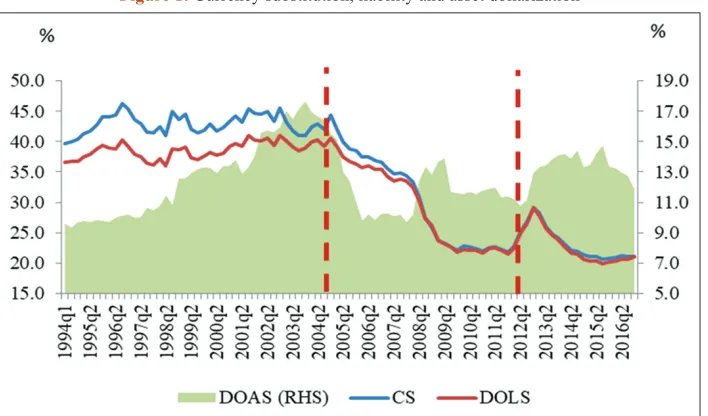
in trading partner countries by 4.3% on average during (2003-2007). The influx of Iraqi refugees, rising interest rates, and the “graduation” of Jordan from the IMF programs in 2004 increased the confidence in the Jordanian economy, thus, investment inflows to the Kingdom increased markedly, peaking in 2006 to reach JD 2.5 billion (IMF, 2005) (Figure 1).
However, these circumstances did not last as the prices of basic
commodities and crude oil rose significantly in the first three quarters of 2008, which resulted in a significant increase in inflation by 14.9%, which led the REER of the Jordanian dinar to increase by 5.8% in 2008. However, the economy registered
a real growth rate of 7.2%. Furthermore, the spillovers from the
global financial crisis affected the global demand of the Jordanian
exports of goods and services negatively. Accordingly, the CPI
and real growth rate declined markedly to reach -0.7% and 5.4%, respectively in 2009 (CBJ, 2010). Exogenous shocks intensified in later years as the political turmoil and military conflicts in the
region heightened, which adversely affected investors sentiment and the supply chains in the region. Furthermore, sabotage acts
in the Saini peninsula, the large influx of Syrian refugees and the
costs of accommodating them have increased the pressures on
the budget and resulted in deterioration in the fiscal and external positions of the Kingdom (IMF, 2013).
The interruption of Egyptian gas due to a continuous sabotage of the pipeline in Sinai peninsula increased the reliance on petroleum products as a substitute for electricity generation
which resulted in a significant increase in our energy imports
bill while crude oil prices where high, which increased by
60.6% in 2011 and 19.7 in 2012 (IMF, 2013). Moreover, these
exogenous shocks to the energy sector caused losses of the publicly owned National Electric Power Company (NEPCO) to increase. These losses were financed through central government guaranteed bonds, borrowings from domestic banks, as well as arrears to suppliers. With widening losses
of NEPCO and the government deficit, public and guaranteed fiscal deficit increased significantly to reach 70.7% at the end of 2011 (IMF, 2012).
Further, the accelerated influx in Syrian refugees and the lack of sufficient international aid have weighted additional pressures on the fiscal position by more than USD 500 million yearly. Also, a complete halt of the Jordanian transport fleet and the
interruption of Jordanian exports, particularly agricultural
products to Lebanon, Turkey and Europe via Syria were caused
by the conflict. These events compelled the producers to find
other roots for their exports resulting in an increase of costs and a decrease in the competitiveness of Jordanian exports. As
a result, Jordanian exports decreased by 1.2% in 2012 (IMF, 2013).
In response to the negative external shocks, the Jordanian
government adopted a national reform program in May 2012,
supported by a USD 2 billion SBA loan from the IMF aiming at
correcting the fiscal and external imbalances while strengthening
growth prospects. At the center of our program were several
measures taken to bring back fiscal and energy policies to a sustainable path. By end 2012 Jordan was the only country in
the MENA region that ended subsidy to oil derivatives as part of wider of energy policy. Cash transfers program was developed to protect to the vulnerable parts of the population. In addition, several revenue and expenditure measures were taken to reduce
the fiscal deficit. To deal with the energy challenge, Jordan
adopted an energy strategy that will increase the dependence on renewable energy resources, thus, making the energy sector as an engine of growth over the medium-to-long term (IMF,
2015). The program helped the Jordanian economy to regain
macroeconomic stability through weathering extreme exogenous shocks.
Fiscal consolidation efforts had limited success as putting public debt on a sustainable path is still a challenged faced by the authorities. Furthermore, real growth levels were at the same
levels since 2010. Accordingly, the authorities were re-engaged
in another 3 years program backed by the IMF in the amount of
USD 723 million to advancing fiscal consolidation to lower public
debt and broad structural reforms to enhance the conditions for more inclusive growth. The program was designed to back the
authorities 10 years plan (Vision 20256) and the implementation of structural reform agenda to enhance the conditions for more inclusive growth and preserve macroeconomic stability (IMF,
2016).
4. EMPIRICAL SPECIFICATION AND DATA
SOURCES
The dollarization phenomenon has been heavily investigated in literature. However, it was relatively disregarded, to our best knowledge, due to the limited availability of data and
the adoption of a fixed exchange rate regime by most of those
countries.
4. 1. Data Sources
The data used in this research has been acquired from the Central Bank of Jordan database as well as the Department of statistics in Jordan. Also, the interest rate for the US has been acquired from the Federal Reserve database. Quarterly frequency was used for
the period (1994-2016). The reason for that is Jordan has pegged
its exchange rate with the US dollar in 1995. The ratchet variable
6 A structural reform program adopted by Jordanian authorities with 10-year framework for applying economic and social policies to boost confidence,
resilience, and economic growth.
Figure 1: Currency substitution, liability and asset dollarization
was defined as the past peak value of the dollarization measures
ratio following (Mogardini and Mueller, 1999):
Rt=maxCS,DOLS,DOAS,FDOi,i=0,1,…,t−1 (1)
Where CS refers to CS, Liability Dollarization DOLS is the deposit
dollarization, DOAS is the asset side dollarization and FDO is
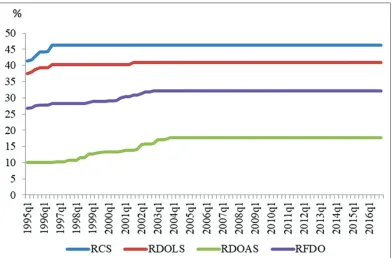
financial dollarization. Figure 2 illustrate the ratchet variables for
the dependent variables (Annex 1). The CS, DOLS, DOAS and FDO have started at relatively low levels in the first quarter of 1995 at 41.3%, 37.5%, 10.0% and 26.9%, respectively. They have
reached their peak value in quarter three 1996 (46.3%), quarter
three 1996 (40.2%), quarter four 2003 (17.7%) and in quarter four 2002 (32.1%), respectively. Economic models that introduce
a ratchet effect assume an asymmetric change of the dependent variables to changes in one of the explanatory variables. The ratchet effect has been widely used in the empirical literature of money demand functions (Enzler, et al., 1976; Piterman, 1988).
4. 2. Empirical Specification
The theoretical framework is based on agent optimization problem (Rojas-Suarez, 1992) which is based on maximizing the consumer’s function of holding domestic and foreign currencies and maximizing their consumption of tradable and non-tradable goods within the budget constraint. Residents will allocate their portfolio between holdings of domestic money and foreign money as a means to store wealth and pay for consumption goods.
Following (Mogardini and Mueller, 1999; Samreth, 2011) the
extended models will be as follows:
Ln(CS,DOLS,DOAS,FDO)t= ∝+ β1I R Dt+ β2L n ( R E E R )
t+β3Ln(RAT)t+β4LRESt+εt (2)
Were the dependent variables (LHS) represents CS, measured by foreign currency deposits to broad money (M2), Liability Dollarization (DOLS), measured by foreign currency deposits
to total deposits at the banking system, Asset Dollarization (DOAS), estimated through foreign credit extended by banks to total extended credit, and Financial Dollarization (FDO), which is measured by the level of foreign currency credit and deposits to total credit and deposits at the banking system. (IRD) refers to interest rate differentials between interbank and Fed fund rate. (RAT) refers to the ratchet effect of the past peak value of the dollarization ratio.
(LRES) refers to international reserves held at the central bank of Jordan. (LREER) refers to the real effective exchange rate.
5. MAIN RESULTS
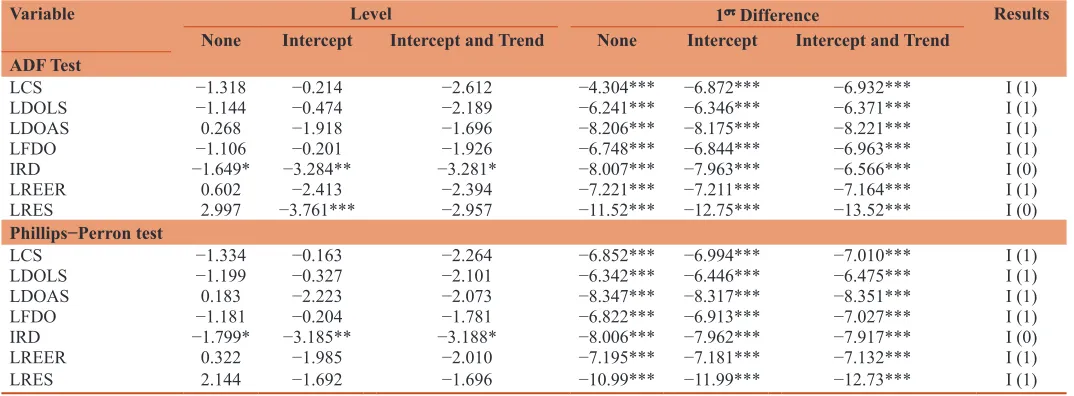
The ADF test accommodate general ARMA (p, q) models with unknown orders through augmenting the basic autoregressive unit root test (Said and Dickey, 1984), while the PP test corrects for any serial correlation and heteroscedasticity in the errors of the test regression by directly modifying the test statistics. The ADF unit root test cannot distinguish highly persistent stationary processes from nonstationary processes very well. Also, the power of unit root tests diminish as deterministic terms are added to the test regressions. That is, tests that include a constant and trend in the test regression have less power than tests that only include a constant in the test regression (Hamilton, 1994). The ADF test provides a similar result about the characteristics of variables under investigation to that of the PP test. The results indicate that none of the variables are I(2). However, IRD was found to be I(1), whereas
there are mixed results regarding (LRES). These results justify the use of the ARDL approach instead of the maximum likelihood
approach for co-integration analysis proposed by (Johansen and
Figure 2: Ratchet variables for the period (1995-2016)
Juselius, 1990). The ARDL co-integration approach, developed by developed by (Pesaran and Shin, 1998; Pesaran, et al., 2001),
has some advantages over other co-integration methods. The applicability of the model without the need of unit root testing
and classifying the variables according into I(1) or I(0). Further, the ARDL procedure do not require a large sample to validate
the existence of a co-integrated relationship, and allows different optimal lags for the independent variables, which is impossible
in other conventional co-integration methods. Finally, the ARDL
approach estimate the long-run relationships using a single reduced form equation whereas conventional methods estimate long-run relationships using a system equations (Table 1).
The next step will be proceeding with the estimation of the log run
coefficients between variables as suggested by Pesaran and Shin, (1998). Accordingly, equation (3) could be expressed in ARDL
form, in order to estimate the conditional error correction (EC)
version of the ARDL, as follows:
∆LCSt ∝ ϕ ∆LCS ϕ ∆IRD ϕ ∆LREER
i k t i i k t i i k t i i = + + + + = − = − = − =
∑
∑
∑
1 1 1 2 1 3 1 kk t i i kt i t i
t i t i
RAT LRES IRD
LREER RAT
∑
−∑
= − − − − + + + + +ϕ ∆ ϕ ∆ δ
δ δ
4
1
5 1
2 3 δδ4LRESt i− +δ5LCSt i− +εt
Where Δ is the first difference operator and k is the optimal lag length. Furthermore, lag selection was based on Akakie Information Critertion. The bound testing approach is based on the joint F-statistic to test for no co-integration against the alternative hypothesis. If the calculated F statistic above the upper bound we can reject the null hypothesis, which indicate the existence of a cointegration. On the other hand, if the calculated F-statistic is below the lower bound, we cannot reject the null hypothesis. The
critical bounds values can be obtained from Pesaran, et al., (2001).
The following Table 2 illustrates the long run coefficients, whereas short run coefficients are illustrated in Annex II.
Table 2 reports the results of the long run coefficients and the
diagnostic tests for the models, which indicated the existence of a cointegration between the dependent and independent variables. Also, it illustrates the validity of the employed model as the residual tests for normality, serial correlation, and heteroscedasticity have indicated the existence of a normal distribution, the rejection of the existence of serial correlation and he heteroscedasticity. Furthermore, the CUSUM and CUSUMQ tests (Annex III) have
been employed to check the stability of the short run coefficients
due to the structural changes which makes the variables’ series susceptible to multiple structural breaks (Brown, et al., 1975).
The results indicated that the short run coefficients are stable at a 5% level.
The error correction term is statistically significant with a negative sign for all four models at a 1% level ranging from (−0.068 to −0.09) for CS and liability dollarization measures at the banking
system, which implies that the speed of adjustment after a shock to
equilibrium is relatively slow as around (6.8–9.0) % of adjustment
will take place in the 1st year. The error correction term for asset dollarization, measured by the level of foreign currency credit to total credit extended by the banking system, is statistically
significant with a negative sign (−0.229) which indicates a
relatively high speed of adjustment of 91.6% in the 1st year. As for
the error correction term for the fourth model, it was significant at 1% level with a negative sign (−0.15). It also indicates that it
takes around 7 quarters to converge to equilibrium.
5. 1. Interest Rate Differentials
For the CS measure (Model (1)), short run coefficient of the interest rate differentials are statistically significant at 5% level. The short run coefficient was relatively small (−0.007) and increasing in the long run to reach (−0.085), which indicate that the effects
of a tight monetary policy with higher interest rates will have a relatively small effect in the short run on dollarization. The effects will increase in the long run, thus, having a higher impact on portfolio choices implying that monetary policy may still have an impact on the portfolio decisions of the private sector. However,
Table 1: Unit root tests
Variable Level 1st Difference Results
None Intercept Intercept and Trend None Intercept Intercept and Trend ADF Test
LCS −1.318 −0.214 −2.612 −4.304*** −6.872*** −6.932*** I (1)
LDOLS −1.144 −0.474 −2.189 −6.241*** −6.346*** −6.371*** I (1)
LDOAS 0.268 −1.918 −1.696 −8.206*** −8.175*** −8.221*** I (1)
LFDO −1.106 −0.201 −1.926 −6.748*** −6.844*** −6.963*** I (1) IRD −1.649* −3.284** −3.281* −8.007*** −7.963*** −6.566*** I (0) LREER 0.602 −2.413 −2.394 −7.221*** −7.211*** −7.164*** I (1)
LRES 2.997 −3.761*** −2.957 −11.52*** −12.75*** −13.52*** I (0)
Phillips−Perron test
LCS −1.334 −0.163 −2.264 −6.852*** −6.994*** −7.010*** I (1)
LDOLS −1.199 −0.327 −2.101 −6.342*** −6.446*** −6.475*** I (1)
LDOAS 0.183 −2.223 −2.073 −8.347*** −8.317*** −8.351*** I (1)
LFDO −1.181 −0.204 −1.781 −6.822*** −6.913*** −7.027*** I (1) IRD −1.799* −3.185** −3.188* −8.006*** −7.962*** −7.917*** I (0) LREER 0.322 −1.985 −2.010 −7.195*** −7.181*** −7.132*** I (1)
LRES 2.144 −1.692 −1.696 −10.99*** −11.99*** −12.73*** I (1)
in the deposit dollarization measure (Model (2)) the short term
coefficients were only significant in the short run (−0.011) at 5%
level; indicating that the interest rate differentials have an effect in the short run on deposit dollarization, whereas in the long run depositors which means that the increase in local currency interest rates gives incentives to depositors to keep their savings in the local currency only in the short run. However, we have not found
any significant effects on the long run, which is compatible with
the used dollarization measure that takes only into account the domestically foreign currency deposits (Mueller, 1994).
As for the dollarization phenomenon on the assets side (Model
(3)), the short run coefficients were statistically significant at 10% level with a positive sign (0.015), which illustrates the effects of
monetary policy decisions on extended foreign currency credit, a wider interest rate differentials increases the banking activities in lend in foreign currency to domestic borrowers, which could be explained by the increased access of foreign funds by banks, which tend to increase credit dollarization but it decrease the dollarization
of deposits (Basso, et al., 2007). However, the used model did not find any significant impact of interest rate differentials on
dollarization in the long run. Financial dollarization, which covers
both sides of the balance sheets, short run and long run coefficients were statistically insignificant, which indicates that portfolio allocation choices are determined by the volatility of inflation and
the real exchange rate movements.
5. 2. Real Effective Exchange Rate
The results indicate that short run and long run coefficients of the first two models are insignificant, which imply that the
REER movements do not contribute in the portfolio choice
determination for depositors. Moreover, the short run coefficient
of the dollarization phenomenon on the assets side (Model (3))
was insignificant. However, in the long run the REER coefficient was statistically significant at 5% (2.814), which indicate that
an appreciation in the REER will increase the level of extended foreign currency credit in response to the increased demand on
imported goods. Furthermore, the long run coefficient of financial dollarization (fourth model) was statistically significant and had a
positive sign (2.233) which illustrate that the portfolio choice of banks depends on the REER movements in the long run.
5. 3. Foreign Currency Reserves
Countries with fixed exchange regimes use international reserves
to back their domestic currency, but it could be argued that liability dollarization is partially resulted from the pegged exchange rate
regime (Reinhart and Calvo, 2007). For the CS measure (Model (1)), both short run coefficients are statistically significant at 1% level with a negative sign (−0.177 in the short run and −0.426 in
the long run) which indicate that an increase in the level of foreign currency reserves held at the central bank by 1% will decrease the
level of dollarization by 0.426% in the long run. Similar results
were found by using the deposit dollarization measure were an increase in the level of foreign currency reserves held at the central
bank by 1% will decrease the level of dollarization by 0.588% in
the long run. In contrast, the effect of international reserves on
assets dollarization was found to be significant only in the short run (0.139) at 5% level with a positive sign, which is in line with
the use of foreign currency credit as means of payment. Moreover,
the effect of international reserves on financial dollarization was found to be significant at 1% level in the short run and the long run (−0.119, −0.438 respectively), which indicate that currency
portfolio allocations are affected by the level of foreign currency reserves held at the central bank.
Table 2: Long run coefficients
Variable Model (1) LCS
(1, 0, 0, 1, 0) Model (2) LDOLS (1, 0, 0, 4, 3) Model (3) LDOAS (5, 1, 6, 1, 2) Model (4) LFDO (2, 3, 8, 1, 0)
Constant −17.870** −41.386*** −12.13*** −14.452***
RAT 6.681*** 12.874*** 0.834** 3.177***
LREER −0.137 0.451 2.814*** 2.233***
LRES −0.426*** −0.588*** −0.089 −0.438***
IRD −0.085*** −0.055 0.016 −0.0161
Diagnostic Tests
Obs. 92 92 92 92
R- Squared 0.99 0.992 0.937 0.991
ARDL bound test 4.237** 7.011*** 4.247** 4.634**
F-statistic 1363.916*** 781.753*** 48.789*** 419.497***
Normality test (JB) 5.370 0.179 1.692 4.326
Serial Correlation
LM test F (9,72): 0.932 F (5,70): 0.195 F (5,77): 1.256 F (9,52): 0.881
Heteroscedasticity
test (ARCH) F (9,69): 1.446 F (5,77): 1.235 F (7,67): 0.109 F (9,61): 0.232
*Significant at 10%, **Significant at 5% ***Significant at 1%
Table 3: Short and long run ratchet effect coefficients Variable Model (1) LCS
(1, 0, 0, 1, 0) Model (2) LDOLS (1, 0, 0, 4, 3) Model (3) LDOAS (5, 1, 6, 1, 2) Model (4) LFDO (2, 3, 8, 1, 0)
Short Run 0.603** 0.881*** 1.142*** 1.922***
Long Run 6.681*** 12.874*** 0.834** 3.177***
5. 4. The Ratchet Effect
The ratchet effect coefficient has a positive sign in all four models. Also, its coefficients were significant in the short run and the long
run at 5% level as illustrated in Table 3. Although dollarization
is associated with high inflation periods and depreciation of the
national currency, the stabilization of the economy does not always lead to a lessening of dollarization.
The positive sign of the ratchet effect in both short and long run indicate the persistence of dollarization phenomenon in Jordan. The existence of a strong effect of the ratchet effect may cause
a negative influence on monetary policy ability to achieve its
objectives. Furthermore, the increases in the ratchet effect
coefficient in the long run indicate that the persistence of the
dollarization phenomenon increases overtime.
6. POLICY IMPLICATIONS
The dollarization phenomenon has been heavily investigated in the literature due to its importance and effects on monetary policy and on currency portfolios. The study has investigated the main determinants of dollarization on the assets side (credit) and the
liability side (deposits) and financial dollarization using different
measures, however, the lack of data regarding Jordanians offshore deposits in foreign and domestic currencies as well as the level of circulating foreign currency domestically and the domestic currency abroad have limited our ability to use different measures to capture the phenomenon.
The econometric results indicated that the increase in interest rate differentials due a tight monetary policy with higher interest rates have a relatively small effect on CS in the long run implying that monetary policy may still have an impact on the portfolio decisions
of the private sector. Also, we have not found any significant effects
on the long run, which is compatible with the used dollarization measure that takes only into account the domestically foreign currency deposits (Mueller, 1994). Furthermore, econometric results implied that the REER movements do not contribute in the portfolio choice determination for depositors. However, the effects of international reserves on dollarization found to be
significant and inversely related with dollarization, which stresses the importance of having sufficient reserves at the central bank to instill confidence in the JD denominated assets in the private sector.
As for the dollarization phenomenon on the assets side, the results illustrated that the effects of monetary policy decisions on extended
foreign currency credit are significant in the short run. A wider
interest rate differentials increases the banking activities in lend in foreign currency to domestic borrowers, which could be explained by the increased access of foreign funds by banks, which tend to increase credit dollarization but it decrease the dollarization of
deposits (Basso, et al., 2007). However, no significant impact
of interest rate differentials on dollarization in the long run. The
REER coefficient was statistically significant with a positive sign
only in the short run; indicating that that an appreciation in the REER will increase the level of extended foreign currency credit in response to the increased demand on imported goods. Also, the effect of international reserves on assets dollarization was found to
be significant only in the short run with a positive sign, which is in
line with the use of foreign currency credit as means of payment.
As for financial dollarization, interest rate differentials have
had little impact indicating that portfolio allocation choices are
determined by the volatility of inflation and the real exchange rate movements, which could be verified by the positive effect of the REER. Also international reserves have a significant negative impact on financial dollarization in the short and the long run,
which indicate that currency portfolio allocations are affected by the level of foreign currency reserves held at the central bank.
The ratchet effect coefficient has a positive sign in all four models. Also, its coefficients were significant in the short run and the
long run at 5% level indicating the persistence of dollarization phenomenon in Jordan. The existence of a strong effect of the
ratchet effect may cause a negative influence on monetary policy
ability to achieve its objectives. Furthermore, the increases in the
ratchet effect coefficient in the long run indicate that the persistence
of the dollarization phenomenon increases overtime which implies the need for strong macroeconomic policies over an extended period of time to reduce the level of the phenomenon in the country.
REFERENCES
Agenor, P.R., Khan, M.S. (1996), Foreign currency deposits and the demand for money in developing countries. Journal of Development
Economics, 50(1), 101-118.
Balino, T., Bennett, A., Borensztein, E. (1999), Monetary Policy in Dollarized Economies. International Monetary Fund Working Papers WP No. 99/171.
Basso, H., Calvo-Gonzalez, O., Jurgilas, M. (2007), Financial
dollarization: The role of banks and interest rates. European Central Bank Working Paper Series, 748, 1-74.
Bhattacharya, M.R. (2003), Exchange rate regime considerations for Jordan and Lebanon. International Monetary Fund, 3-137, 1-41.
Brown, R., Durbin, J., Evans, J. (1975), Techniques for testing the consistency of regression relations over time. The Royal Statistical Society, 37, 149-192.
Calvo, G.A., Vegh, C.A. (1992), Currency Substitution in Developing Countries: An Introduction. International Monetary Fund Working
Papers No. WP/92/40.
Castillo, P., Montoro, C., Tuesta, V. (2013), An estimated stochastic
general equilibrium model with partial dollarization: A Bayesian approach. Open Economies Review, 24(2), 217-265.
CBJ. (2004), Annual Report. Amman: Central Bank of Jordan. CBJ. (2007), Annual Report. Amman: Central Bank of Jordan. CBJ. (2010), Annual Report. Amman: Central Bank of Jordan.
Chang, R. (2000), Dollarization: A scorecard. Federal Reserve Bank of
Atlanta Economic Review (Third Quarter), 83(3), 1-11.
Clements, B., Schwartz, G. (1993), Currency substitution: The recent experience of Bolivia. World Development, 21(11), 1883-1893.
De Nicoló, G., Honohan, P., Ize, A. (2005), Dollarization of bank deposits:
Causes and consequences. Journal of Banking and Finance, 29(7), 1697-1727.
Eichengreen, B., Hausmann, R. (1999), Exchange Rates and Financial Fragility. NBER Working Paper No. 7418.
Enzler, J., Johnson, L., Paulus, J. (1976), Some Problems of Money
Demand. Brookings. p261-276.
Heysen, S. (2005), Dollarization: Controlling risk is key. Finance and
Development. 42, 44-45.
IMF. (2005), IMF Support to Jordan (1989-2004). Washington, DC: Independent Evaluation Office.
IMF. (2012), Jordan: Request for a Stand-By Arrangement—Staff Report.
Washington, D.C: International Monetary Fund.
IMF. (2013), Jordan: First Review Under the Stand-By Arrangement.
Washington, DC: International Monetary Fund.
IMF. (2015), Sixth Review Under the Stand-by Arrangement. Washington,
DC: International Monetary Fund.
IMF. (2016), Request For an Extended Arrangement Under the Extended
Fund Facility-Staff Report. Washington, DC: International Monetary Fund.
Johansen, S., Juselius, K. (1990), Maximum likelihood estimation and
inference on cointegration with applications to the demand for
money. Oxford Bulletin of Economics and Statistics, 52, 169-210. Levy-Yeyati, E. (2006), Financial dollarization: Evaluating the
consequences. Economic Policy, 21(45), 61-118.
Mogardini, J., Mueller, J. (1999), Ratchet Effects in Currency Substitution: An Application to the Kyrgyz Republic. International Monetary Fund
Working Papers No. 99/102.
Mueller, J. (1994), Dollarization in Lebanon. International Monetary
Fund Working Papers No. WP No. 94/129.
Nussir, N., Ajlouni, M. (2009), The Effect of Deposit Dollarization
on Jordanian Banks: Performance and Stability, s.l.: Doctoral Dissertation.
Oomes, N., Ohnsorge, F. (2005), Money demand and inflation in
dollarized economies: The case of Russia. Journal of Comparative Economics, 33(3), 462-483.
Pesaran, M.H., Shin, Y. (1998), An autoregressive distributed-lag
modelling approach to cointegration analysis. Econometric Society Monographs, 31, 371-413.
Pesaran, M.H., Shin, Y., Smith, R.J. (2001), Bounds testing approaches to
the analysis of level relationships. Journal of Applied Econometrics,
16(3), 289-326.
Piterman, S. (1988), The irreversibility of the relationship between
inflation and real balances. Bank of Israel Economic Review, 60(1),
72-83.
Reinhart, C., Calvo, G. (2007), Capital Flow Reversals,the Exchange
Rate Debate,and Dollarization. MPRA No. 8951.
Reinhart, C.M., Rogoff, K.S., Savastano, M.A. (2003), Addicted to Dollars. NEBR Working Papers No. 10015.
Rojas-Suarez, L. (1992), Currency Substitution and Inflation in Peru.
International Monetary Fund Working Papers No. 92/33.
Said, S.E., Dickey, D.A. (1984), Testing for unit roots in autoregressive-moving average models of unknown order. Biometrika, 71(3),
599-607.
Saif, I., DeBartolo, D. (2007), The Iraq War’s Impact on Growth and Inflation in Jordan. Amman: Center for Strategic Studies.
Samreth, S. (2011), An empirical study on the hysteresis of currency
substitution in Cambodia. Journal Asian Economic, 22, 518-527.
Savastano, M.M.A. (1996), Dollarization in Latin America-Recent
Evidence and Some Policy Issues. International Monetary Fund Working Papers WP No. 96/4.
Schlumberger, O. (2002), Jordan’s economy in the 1990s: Transition to development. In: Jordan in Transition. London: C. Hurst & Co.,
225-253.
Shotar, M., El-Mefleh, M. (2009), Economic exposure to exchange rates
in Jordan Companies: A monthly econometric model of the rate of
return of firms, 2004-2007. Applied Econometrics and International
Development, 9(1), 133-142.
Slavov, S.T. (2013), De jure versus de facto exchange rate regimes in
sub-Saharan Africa. Journal of African Economies, 22(5), 732-756.
Yinusa, D.O. (2008), Between dollarization and exchange rate volatility:
Nigeria‘s portfolio diversification option. Journal of Policy
Modelling, 30(5), 811-826.
Available form:
http://moict.gov.jo/uploads/Policies-and-Strategies-Directorate/Strategies/Jordan-2025-En.pdf
ANNEX ES
Annex I: Correlation matrix of the used variables
Variables LCS LDOAS LDOLS LFDO LRES LREER IRD
LCS 1 - - -
-LDOAS −0.024 1 - - - -
-LDOLS 0.995 −0.008 1 - - -
-LFDO 0.974 0.186 0.979 1 - -
-LRES −0.809 0.356 −0.772 −0.700 1 -
-LREER −0.057 0.369 −0.096 −0.013 0.111 1
-IRD −0.261 −0.151 −0.283 −0.322 −0.102 −0.044 1
Annex II: Short Run Coefficients
Model 1: Dependent variable LCS
Variable Coefficient Std. Error t-Statistic
D (LRCS) 0.603** 0.264 2.283
D (LREER) −0.012 0.072 −0.169
D (LRES) −0.177*** 0.030 −5.722
D (IRD) −0.007** 0.003 −2.360
CointEq(-1) −0.090*** 0.027 −3.264
Model 2: Dependent variable DOLS
Variable Coefficient Standard Error t-Statistic
D (LRDOLS) 0.881*** 0.265 3.325
D (LREER) 0.030 0.052 0.587
D (LRES) −0.188*** 0.040 −4.643
D (LRES(−1)) 0.005 0.030 0.173
D (LRES(−2)) −0.044* 0.025 −1.751
D (LRES(−3)) −0.044** 0.017 −2.526
D (IRD) −0.009 0.005 −1.654
D (IRD(−1)) −0.011** 0.005 −2.187
D (IRD(−2)) −0.006 0.005 −1.335
CointEq(−1) −0.068*** 0.027 −2.465
*Significant at 10%, **Significant at 5%, ***Significant at 1%
Model 3: Dependent variable DOAS
Variable Coefficient Standard Error t-Statistic
D (LDOAS(−1)) −0.038 0.107 −0.360
D (LDOAS(−2)) 0.032 0.105 0.308
D (LDOAS(−3)) 0.249** 0.106 2.350
D (LDOAS(−4)) 0.245** 0.116 2.111
D (LRDOAS) 1.142*** 0.372 3.067
D (LREER) 0.409 0.403 1.014
D (LREER(−1)) −0.619 0.604 −1.023
D (LREER(−2)) 1.110* 0.564 1.966
D (LREER(−3)) −0.215 0.548 −0.391
D (LREER(−4)) 0.425 0.552 0.770
D (LREER(−5)) −0.916** 0.364 −2.514
D (LRES) 0.139** 0.059 2.335
D (IRD) 0.015* 0.008 1.716
D (IRD(−1)) 0.015 0.009 1.592
CointEq(−1) −0.229*** 0.054 −4.235
*Significant at 10%, **Significant at 5%, ***Significant at 1%
Model 4: Dependent variable FDO
Variable Coefficient Standard Error t-Statistic
D (LFDO(−1)) 0.195* 0.100 1.950
D (LRFDO) 1.922*** 0.688 2.791
D (LRFDO(−1)) −0.232 1.043 −0.222
D (LRFDO(−2)) −1.050 0.728 −1.442
D (LREER) 0.083* 0.190 0.440
D (LREER(−1)) −0.554* 0.290 −1.910
D (LREER(−2)) 0.524 0.295 1.774
D (LREER(−3)) −0.170 0.292 −0.583
D (LREER(−4)) −0.076 0.288 −0.263
D (LREER(−5)) 0.009 0.277 0.032
D (LREER(−6)) 0.113 0.265 0.426
D (LREER(−7)) −0.316* 0.167 −1.892
D (LRES) −0.119*** 0.025 −4.630
D (IRD) −0.002 0.002 −0.914
CointEq(−1) −0.150*** 0.040 −3.730
Model 1: Dependent variable LCS
Model 2: Dependent variable DOLS
Model 3: Dependent variable DOAS
Model 4: Dependent variable FDO