ISSN: 2231-5373
http://www.ijmttjournal.org
Page 50
Support Independence in Graphs
Selvam Avadayappan, M. Bhuvaneshwari and Rajeev Gandhi Research Department of Mathematics
VHNSN College, Virudhunagar – 626001, India.
Abstract
In any graph G, the support of a vertex is defined as the sum of degrees of its neighbours. A graph G is said to be balanced, if every vertex of G has same support. G is called highly unbalanced when no two vertices of G have same support. In this paper, we introduce the concept of support independence in graphs. A subset S of a vertex set is said to be support independent, if no two vertices in S are having same support. The support independence number of G is the cardinality of maximum support independent set in G. We obtain the support independence number of some standard graphs and derived graphs.
Keywords: Splitting graphs, cosplitting graphs, Support of a vertex, Support independence.
AMS Subject Classification Code (2010): 05C (Primary)
1 Introduction
Only finite, simple, undirected graphs are considered in this paper. We refer [7] for further notations and terminology.The degree of a vertex v is denoted by d(v). A full vertex of G is a vertex which is adjacent to every other vertices of G.A graph G is said to be r – regular, if every vertex of G has degree r. D(G)denote the set of degrees of all vertices in G.
In a graph G(V, E), for any vertex v V, the open neighbourhood of v is the set of all vertices adjacent to v. That is, N(v) = {u V(G) / uv E(G)}. The closed neighbourhood of v is defined by N[v] = N(v) {v}. Clearly, if
N[u] = N[v], then u and v are adjacent and d(u) = d(v).
The concept of support of a vertex has been introduced and studied by Selvam Avadayappan and G. Mahadevan [6]. The supports(v) of a vertex v is the sum of degrees of its neighbours. That is, s(v) = 𝑢∈𝑁(𝑣)𝑑(𝑢). Note that the support of any vertex in an r – regular graph is r2.
A graph G is said to be a balanced graph, if any two vertices in G have the same support. It is easy to observe that the complete bipartite graphs Km,n and any regular graphs are balanced graphs. A graph G is said to be highly unbalanced, if distinct vertices of G have distinct supports. For example, a highly unbalanced graph is shown in Figure 1.
ISSN: 2231-5373
http://www.ijmttjournal.org
Page 51
The following results have been proved in [6]:Result A 𝑣∈𝑉𝑠(𝑣) = 𝑣∈𝑉𝑑(𝑣)2.
Result B For any balanced graph G, (G) = 1 if and only if G K1,n, n ≥ 1.
The study on this parameter has its own importance as any two vertices of same degree need not be of same importance in any graph unless they are isomorphic images of each other. The degrees of its neighbours contribute much in determining the weightage of a vertex in a graph. Hence it becomes essential to study about the support of the vertices also.
The concept of splitting graph of a graph was introduced by Sampath Kumar and Walikar [8]. For a graph
G, the graph S(G), obtained from G, by adding a new vertex w for every vertex v V and joining w to all vertices of
G adjacent to v, is called the splitting graph of G. For example, a graph G and its splitting graph S(G) are shown in Figure 2.
w1 w5
v1 v5 w3
v3 v4 v1 v5
v2 v6 v2 v3 v4 v6
G w4
w2 w6
S(G)
Figure 2
A necessary and sufficient condition for a graph to be a splitting graph is given in [8].
Result D[8] A graph G is a splitting graph if and only if V(G) can be partitioned into two sets V1and V2 such that
there exists a bijective mapping f from V1 to V2 and N(f(v)) = N(v) V1, for any v V1.
Let G be a graph with vertex set {v1, v2, … , vn}. The cosplitting graphCS(G) is the graph obtained from G,
by adding a new vertex wifor each vertex vi and joining wi to all vertices which are not adjacent to vi in G. For
example, a graph G and its cosplitting graph CS(G) are shown in Figure 3.
G CS(G)
ISSN: 2231-5373
http://www.ijmttjournal.org
Page 52
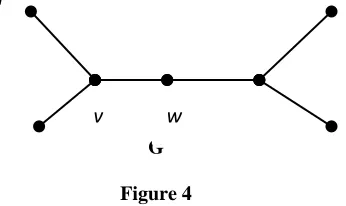
For further details on various other types of splitting graphs, one can refer [1], [2], [3] and [4].In a graph G, deleting an edge uv and introducing a new vertex w and the new edges uw and vw is called the subdivision of the edge uv. The subdivision graph, denoted by S1(G), is obtained from the graph G by
subdividing every edge of Gonce. For example, S1(K1,5) is shown in Figure 4.
K1,5 S1(K1,5)
Figure 4
In literature, a lot of work has been done based on support of vertices. One such is a kind of classification of irregular graphs, namely support neighbourly irregular graphs which has been introduced in [5]. A connected graph is said to be support neighbourly irregular (or simply SNI), if no two vertices having same support are adjacent.
A graph proving the existence of SNI graphs is shown in Figure 5. Of course, all highly unbalanced graphs are SNI.
Figure 5
In [5], the following result has been proved which is needed for further discussion of our paper.
Result D A graph G is balanced if and only if G is a regular graph or a biregular bipartite graph with each partition having vertices of same degree.
In this paper, we introduce the concept of support independence in graphs and obtain some interesting results.
2 Support independence in graphs
In this section, we first introduce the concept of support independence number of a graph and compute the same for some standard graphs and the complement of a graph.
ISSN: 2231-5373
http://www.ijmttjournal.org
Page 53
A subset S of V is said to be support independent if no two vertices in Shave same support. A support independent set is said to be maximal if there exists no support independent set S’ such that SS’.In particular, S is said to be maximum if there exists no such S’ with| S | < | S’|. The Support independence numberS is the cardinality of a maximum support independent set. Any support independent set with |S| vertices is
simply called S – set.
For example, S = 3 for the graph G shown in Figure 4 with a S – setS = {u,v,w}.
G
Figure 4
It is clear that ifS(G) denotes the support set of a graph G, that is, a set containing supports of all vertices in G, then Sis nothing but | S(G) |.
The following facts can be easily verified for support independent sets:
Fact 2.1 S (Kn) = 1, for n ≥ 1.
Fact 2.2 S (Km,n) = 1 for m, n ≥ 1.
Fact 2.3S (Cn) = 1, for n ≥ 3.
Fact 2.4 S (Wn) = 2, for n ≥ 4, where Wn is a wheel graph which is nothing but C1Kn.
Fact 2.5 S(𝐾𝑛𝑐) = 1, for n ≥ 1.
Fact 2.6S (Pn) = 1, n 3; S (P4) = 2; S (Pn) = 3, n ≥ 5.
Fact 2.7 For any balanced graph G, S(G) = 1.
Proposition 2.8 S(G) = 1 if and only if G is a regular graph or a biregular bipartite graph with each partition having
vertices of same degree.
Proof For any balanced graph G, S(G) = 1.The result follows from Result D. ■
Fact2.9For ahighly unbalanced graph G,S(G) = n.
Proposition 2.10For any graph G of order n, 1 S(G) n.
From Fact 2.7 and Fact 2.9, we note that the above inequality is sharp.When we compare the parameters and S of a graph G, we find that they are independent of each other. Kn proves the existence of graphs with = S
whereas, Pn,n ≥ 5 stands as an example for graphs with >S. Finally highly unbalanced graphs are graphs with
<S. It is interesting to note that in Kn, +S = 2 and in the graph Kn×K2, +S= 3.
Theorem 2.11For any two given integers k and n such that 2k n, there exists a graph of order n with +S =k. u
ISSN: 2231-5373
http://www.ijmttjournal.org
Page 54
ProofWhen k = 2, Kn is the required graph of order n.And for k = 3, Kn-2 ×K2serves as an example for the family ofa graph of order n and +S =3. Assume that 4k n.Construct a graph G with the vertex set V(G) = {u1,u2,…,uk-3, v1, v2, …, vn-k+3} and the edge set E(G) ={ujv1,vsvr| 1 j k – 3;1 r,s n – k+3; rs}. Clearly G is of order n. Also
we note that {v2, uj| 1 j k – 3} is a maximum - set of G. Hence (G)=k-2. In addition, {u1,v2} is a maximum S –
set in Gfixing S(G)=2. All these facts prove the existence of a graph with the required properties. ■
For k = 5 and n = 7, the constructed graph with +S =5 is shown in Figure 5. Here {u,v,w} is a maximum
independent set whereas {u,w} is a maximum support independent set.
Figure 5
It is trivial that +S = 2 if and only if G ≅ 𝐾𝑛. In the next theorem, we characterise the graphs for which +S = 3.
Theorem 2.12 Let G be any connected graph. Then +S =3 if and only if G is balanced of independence number
two.
Proof It is obvious that both and Sare positive integers. For both parameters having a total of three, there are only
two possibilities = 1 and S = 2 or = 2 and S =1. Discussing the first case, = 1 is possible only when G is
complete, for which S = 1, leading to a contradiction. Now considering the second case, =2 andS =1 weget G to
bebalanced with independence number two. ■
For example, a balanced graph with independence number two for which +S =3 isshown in Figure 6.
Suppose {u,v} is a - set of G. Then every other vertex in V(G)\{u,v} must be adjacent either to u or to v. Therefore
N[u] N[v] = V(G) for two non-adjacent vertices u and v in G.
G Figure 6
Note that if (G) = 1, then G is complete for which S(G) = 1. But the converse need not be true. u
v
w
u
ISSN: 2231-5373
http://www.ijmttjournal.org
Page 55
Theorem 2.13For any given integer k 2, there exists a graph G with S(G) = 1 and (G) = k.Proof Consider K2,k. Since it is a balanced graph, S(G) = 1 and also (G) = k. ■
Theorem 2.14There exists a graph G in which S(G) =(G) = (G) = k for any k 2.
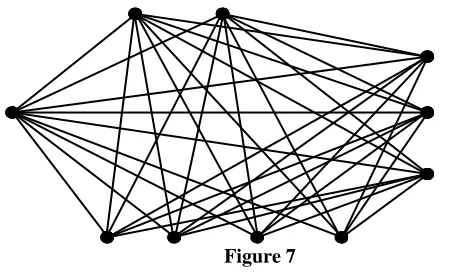
Proof Construct the completek – partite graph G = K1,2,…,kwith vertex set V(G) = {vij /1 i k; 1 j i} and the edge
set E(G) = {vijvrs / 1 i, r k; 1 j i;1 r s and i r}. Here we note that {vi1 / 1 i k} is a S - set of G whereas {vkj /1 j k} is a - set of G. Therefore S(G) =(G) = k. Also since G isk – partite, we have(G) = k. Hence the
result. ■
As an illustration, for k = 4, the constructed graph with S(G) =(G) = (G) =4 is shown in Figure 7.
Figure 7
Next we concentrate on the support of a vertex in the complement of a graph.
Lemma 2.15 Support of any vertexv in𝐺 , 𝑠𝐺 𝑣 = (𝑛 − 1)2− 2m + sG 𝑣 − 𝑑𝐺(𝑣)(𝑛 − 2), where m is the size of the graph G.
Proof Let us calculate support of a vertex in𝐺 . The support of any vertex v in 𝐺 , 𝑠𝐺 𝑣 = 𝑢∈𝑁𝐺 (𝑣)𝑑𝐺 𝑢 =
𝑢∈𝑁𝐺 (𝑣)(𝑛 − 1 − 𝑑𝐺 𝑢 ) = 𝑢∈𝑁𝐺𝑐[𝑣](𝑛 − 1 − 𝑑𝐺 𝑢 ). Also we know that |𝑁𝐺𝑐 𝑣 | = n – 1 – dG(v). Therefore (𝑛 − 1 − 𝑑𝐺 𝑢 ) = 𝑛 − 1 − dG v n − 1 − 𝑢∈𝑁𝐺𝑐[𝑣]𝑑𝐺 𝑢 = 𝑛 − 1 − dG v n − 1 − 2m + 𝑢∈𝑁𝐺𝑐[𝑣]
sG 𝑣 + 𝑑𝐺(𝑣), since we know that 𝑢∈𝑁𝐺𝑐[𝑣]𝑑𝐺 𝑢 + 𝑢∈𝑁𝐺(𝑣)𝑑𝐺 𝑢 + dG v = 2m.On simplification, we get the lemma.■
Proposition 2.16 The complement of a balanced graph is balanced if and only if it is regular.
ProofLet G be a balanced graph. Then by Proposition 2.8, we have, G is a regular graph ora biregular bipartite graph with each partition having vertices of same degree. The complement of a regular graph is also regular and hence balanced. Suppose 𝐺is (r,k) - biregular bipartite with vertices of same degree in same partition.Then 𝐺 is a (n – 1 – r, n – 1 – k) – biregular graph in which vertices of degreen – 1 – karehaving support (n – 1 – k)2and the remaining vertices are of degree (n – 1 – r)2. Since r k, 𝐺 cannot be balanced.
■
Theorem 2.17For any highly unbalanced graph G, 𝐺 is also highly unbalanced if there do not exist vertices u andvin
G,with dG(u) ≠ dG(v) and sG(u) ≠ sG(v) such that dG(u) – dG(v) =
𝑠𝐺 𝑢 − 𝑠𝐺(𝑣)
𝑛−2 .
Proof Let G be a highly unbalanced graph and βS(G) be its support independence number. Then βS(G)=|V(G)|. By
ISSN: 2231-5373
http://www.ijmttjournal.org
Page 56
Then either the verticesu and v have the same degree and the same support in G ordG(u) – dG(v) =𝑠𝐺 𝑢 − 𝑠𝐺(𝑣)
𝑛−2 .The first case is impossible, since G is highly unbalanced. Hence the theorem. ■
Now we introduce a relation on the vertex set of G such that for any two vertices u and v in G, u v if and only if d(u) = d(v) and s(u) = s(v).One can easily verify that is an equivalence relation defined on V(G).
Therefore V(G) can be partitioned into equivalence classes induced by .
Theorem 2.18 For any graph Gof order n,S(𝐺 )(and also S(G) ) where is the number of equivalence classes
induced by defined as above in V(G). And the equality holds if and only if G has no two vertices u and v such that
dG(u) – dG(v) =
𝑠𝐺 𝑢 − 𝑠𝐺(𝑣)
𝑛−2 .
Proof Let G be any graph of order n.It is obvious that S(G).We know that the vertices of same degree and same
support in G will be of same degree and same support in 𝐺 too. Hence each equivalence class induced by contributes atmost one to anyS – set of 𝐺 . That is, S(𝐺 ).
Also as in the discussion of Theorem 2.17, two vertices u and v in 𝐺 have same support, if and only if they belong to same equivalence class induced by in V(G) or dG(u) – dG(v) =
𝑠𝐺 𝑢 − 𝑠𝐺(𝑣)
𝑛−2 .If no two such vertices exist in
G, then S – set of 𝐺 contains exactly one vertex from each equivalence class induced. Therefore S(𝐺 )=.
■
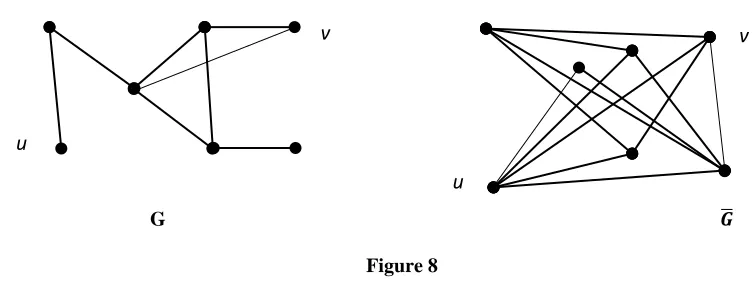
For example,a graph G with its complement𝐺 , for which S(𝐺 )<is shown in Figure 8. Here in G, no two
vertices have the same degree and the same support and hence = 7.But the pendant vertex u and the vertex v of degree 2 satisfies dG(u) – dG(v) =
𝑠𝐺 𝑢 − 𝑠𝐺(𝑣)
𝑛−2 . They have same support in 𝐺 . We note that S(𝐺 )=6.
𝑮
G
Figure 8
Theorem 2.18 can be restated as follows:
Theorem 2.19 For any graph G, S(G) = S(𝐺 ) = if and only if G has no two vertices u and v of different degrees
with same support or such that dG(u) – dG(v) =
𝑠𝐺 𝑢 − 𝑠𝐺(𝑣)
𝑛−2 . ■
As an illustration, one can verify the following graph G for which = 3 is given by Figure 9. It contains no two vertices u and v such that dG(u) – dG(v) =
𝑠𝐺 𝑢 − 𝑠𝐺(𝑣)
𝑛−2 . The graph 𝐺 with S(𝐺 )= =3 is also given. u
v
u
ISSN: 2231-5373
http://www.ijmttjournal.org
Page 57
G 𝑮
Figure 9
Now we examine the relation between the support independence number of a graph and that of its splitting graph.
Theorem 2.20 For any graph G, S(S(G)) = 2S(G), where S(G) is its splitting graph.
Proof Let G be a graph and S(G) be its splitting graph with the vertex set V(G) = {v1, v2, ..., vn} and V(S(G)) = V(G)
{w1, w2, ..., wn} such that wiis the corresponding newly added vertex with respect to vi. It is easy to note that dS(G)(vi) = 2dG(vi) and dS(G)(wi) = dG(vi)
Now let us first calculate the support of any vertex vi in S(G). 𝑠𝑆(𝐺)(vi) = 𝑢∈𝑁𝑆 𝐺 𝑣𝑖 𝑑𝑆 𝐺 𝑢 =
𝑣𝑗∈𝑁𝐺(𝑣𝑖)𝑑𝑆 𝐺 𝑣𝑗 + 𝑣𝑗∈𝑁𝐺(𝑣𝑖)𝑑𝐺(𝑤𝑗) = 2sG(vi) +sG(vi), since dS(G)(vi) = 2dG(vi) and dS(G)(wi) = dG(vi). Hence
we conclude that 𝑠𝑆(𝐺)(vi) = 3sG(vi).
For any newly added vertex wi, 𝑠𝑆(𝐺)(wi) = 𝑢∈𝑁𝐺 𝑣𝑖 𝑑𝑆 𝐺 𝑢 = 2 𝑢∈𝑁𝐺 𝑣𝑖 𝑑𝐺 𝑢 = 2sG(vi). Therefore
every support independent set in G is a support independent set in S(G) also. In addition, any set of newly added vertices corresponding to vertices in a support independent set is also a support independent set in S(G).
Of them one can easily note that the set of vertices in a maximum support independent set of G along with their corresponding newly added vertices is the maximum support independent set in S(G). In other words, S(S(G)) = 2S(G). ■
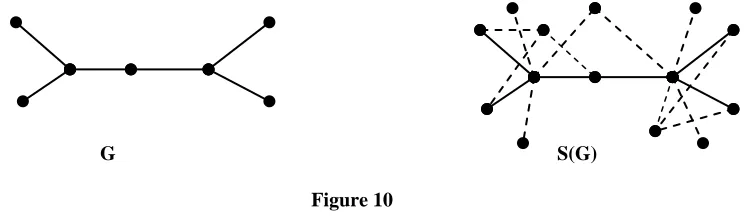
For example, a graph G with S(G) = 3 and its splitting graph withS(S(G)) = 6 are shown in Figure 10.
G S(G)
Figure 10
Lemma 2.21Let G be a graph of order n and size m. If v is a vertex in G, then the support of v in a cosplitting graph
CS(G) ofG is nd(v). Also if w is the newly added vertex in CS(G) corresponding to a vertex v in G, then the support of w in CS(G) isn2 +s(v) -2m.
Proof Let G be a graph and CS(G) be its cosplitting graph with the vertex set V(G) = {v1, v2, ..., vn} and V(CS(G)) = V(G) {u1, u2, ..., un} such that ui is the corresponding newly added vertex with respect to vi. Now support of the
vertex ui, for any i, 1 i n is nd(ui) and for every vertex vi, s(vi) =
𝑑𝐶𝑆 𝐺
ISSN: 2231-5373
http://www.ijmttjournal.org
Page 58
The degree of viin CS(G) is nfor any i andthe degree of wjis n – d(vj)for any j. Hence, sCS(G)(vi) = ndG(𝑣𝑖) + 𝑣𝑗∈𝑁𝐺𝑐(𝑣𝑖)(𝑛 − 𝑑(𝑣𝑗))= ndG(vi)+(n-dG(vi))n - 𝑣𝑗∈𝑉(𝐺)𝑑𝐺(𝑣𝑗)+sG(vi). That is, we get sCS(G)(vi)= n2 +s(v) -2m.■
Theorem 2.22For any graph G, S(CS(G)) S(G) + |D(G)|, where CS(G) is the cosplitting graph of G.
Proof Let G be a graph and CS(G)beits cosplitting graph. By above lemma, it is quite obvious that any two vertices which are of same support in G will be of same support in CS(G). Hence a maximum support independent set of G is a support independent set of CS(G) also.
In addition, it follows from above lemma that the newly added vertices which correspond to the vertices of same degree in G have same support in CS(G). Every set consisting of newly added vertices that correspond to vertices of distinct degrees in G forms a support independent set in CS(G). If CS(G) contains no two vertices viand wjwith same support, it becomes obvious thatS(CS(G)) =S(G) + |D(G)|. Otherwise S(CS(G)) <S(G) +
|D(G)|. ■
Note that for the graph G shown in Figure 11, S(CS(G)) <S(G) + |D(G)|. Here we note that S(G) = 5and |D(G)|=4. But S(CS(G)) = 8.
G CS(G)
Figure 11
Also a graph G and its cosplitting graph CS(G) with S(CS(G)) =S(G) + |D(G)|are shown in Figure 12.
G CS(G)
ISSN: 2231-5373
http://www.ijmttjournal.org
Page 59
Let G be any graph and S1(G) be its subdivision graph. Now we compute the support of any vertex v in S1(G). If v is already a vertex ofG, then it is obvious that s(v) = 2d(v). On the other hand, if v is the newly addedvertex in S1(G) when subdividing the edge uw of G, then s(v) = d(u) + d(w).
Proposition 2.23The support independence number of a subdivision graph S(S1(G)) |D(G)|.
Proof Let G be a graph whose subdivision graph is S1(G). From the above discussion, we have thevertices of distinct
degrees in G have distinct supports in S1(G). Hence any set of vertices of distinct degrees inG forms a support
independent set of S1(G). Therefore S(S1(G)) |D(G)|. ■
Theorem 2.24For any graph of order n and size m, if G contains no two vertices u and v such that sG(v) – sG(u) = p(dG(u) – dG(v), thenS(G 𝐾𝑝𝑐) = nor n + 1, for any p 1.
Proof Let us first find the support of a vertex v in the graph H = G 𝐾𝑝𝑐. Now the degree of every vertex v of G gets increased by p in H. In addition, each vertex v in G has p new neighbours of degree n in H. Hence sH(v) = sG(v)+ pdG(v) + np. Suppose w1, w2, …,wp are newly added vertices in H, then sH(wi) = 2m + npfor any i, 1 i p.We can
note that for any two vertices u and vin G,sH(v) = sH(u) only whensG(v) – sG(u) = p(dG(u) – dG(v)) which is
impossible.In addition,if G contains a vertex v such that sG(v) = 2m – pdG(v), then sH(wi) = sH(v) for any i, 1 i p
and in this case S(G 𝐾𝑝𝑐) = n.Otherwise,S(G 𝐾𝑝𝑐) = n+1. ■
References
1. Selvam Avadayappan and M. Bhuvaneshwari, Cosplitting and coregular graphs, International Journal of Mathematics and Soft Computing,
Vol.5, No.1,(2015), 57 -64.
2. Selvam Avadayappan, M. Bhuvaneshwari and R. Iswarya, -splitting graphs, International Journal for Research in Applied Science & Engineering Technology, Vol. 4, Issue III, March 2016, 670 – 680.
3. Selvam Avadayappan, M. Bhuvaneshwari and Rajeev Gandhi, Distance in splitting graphs, International Journal of Engineering Sciences
and Management Research, 2(12), 50 -54, December 2015.
4. Selvam Avadayappan, M.Bhuvaneshwari and B.Vijaya Lakshmi, - Splitting graphs, International Journal of Scientific Review and
Research in Engineering and Technology, Vol. 1(3), Mar. – Apr. 2016, 84 – 101.
5. Selvam Avadayappan, M.Bhuvaneshwari and R. Sinthu, Support neighbourly irregular graphs, International Journal of Scientific Research
and Management , Vol. 4, Issue 3, pp. 4009 – 4014, 2016.
6. Selvam Avadayappan and G. Mahadevan, Highly unbalanced graphs, ANJAC Journal of Sciences, 2(1), 23-27, 2003.
7. R.Balakrishnan and K. Ranganathan, A Text Book of graph Theory, Springer-Verlag, New York, Inc(1999).
![Figure 2 A necessary and sufficient condition for a graph to be a splitting graph is given in [8]](https://thumb-us.123doks.com/thumbv2/123dok_us/9725756.1956149/2.612.92.533.569.722/figure-necessary-sufficient-condition-graph-splitting-graph-given.webp)
![Figure 5 In [5], the following result has been proved which is needed for further discussion of our paper](https://thumb-us.123doks.com/thumbv2/123dok_us/9725756.1956149/3.612.216.396.396.479/figure-following-result-proved-needed-discussion-paper.webp)