The Thirty-Third AAAI Conference on Artificial Intelligence (AAAI-19)
HERS: Modeling Influential Contexts with
Heterogeneous Relations for Sparse and Cold-Start Recommendation
Liang Hu,
1,2Songlei Jian,
1,3Longbing Cao,
1Zhiping Gu,
4Qingkui Chen,
2Artak Amirbekyan
51Advanced Analytics Institute, University of Technology Sydney, Australia
2University of Shanghai for Science and Technology, China,3National University of Defense Technology, China 4Shanghai Technical Institute of Electronics Information, China,5Commonwealth Bank of Australia
[email protected], [email protected], [email protected] [email protected], [email protected], [email protected]
Abstract
Classic recommender systems face challenges in addressing the data sparsity and cold-start problems with only modeling the user-item relation. An essential direction is to incorporate and understand the additional heterogeneous relations, e.g., user-user and item-item relations, since each user-item inter-action is often influenced by other users and items, which form the user’s/item’s influential contexts. This induces im-portant yet challenging issues, including modeling heteroge-neous relations, interactions, and the strength of the influence from users/items in the influential contexts. To this end, we design Influential-Context Aggregation Units (ICAU) to ag-gregate the user-user/item-item relations within a given con-text as the influential concon-text embeddings. Accordingly, we propose a Heterogeneous relations-Embedded Recommender System (HERS) based on ICAUs to model and interpret the underlying motivation of user-item interactions by consider-ing user-user and item-item influences. The experiments on two real-world datasets show the highly improved recommen-dation quality made by HERS and its superiority in handling the cold-start problem. In addition, we demonstrate the inter-pretability of modeling influential contexts in explaining the recommendation results.
Introduction
Recommender systems (RSs) are essentially embedded with heterogeneous relations: user-user couplings, item-item cou-plings, and user-item couplings (Cao 2015), with which we call Heterogeneous relations Embedded Recommender Sys-tems (HERS). It is increasingly recognized that modeling such multiple heterogeneous relations is essential for un-derstanding the non-IID nature and characteristics of RSs (Cao 2016) and addressing such challenges as social, group-based, context-group-based, cross-domain, sparse, cold-start, dy-namic and deep recommendation (Tang, Hu, and Liu 2013; Hu et al. 2014; 2017b; 2016; Do and Cao 2018a; 2018b; Zhang et al. 2018).
Figure 1 illustrates the concept and motivation of a HERS containing user-user relations (e.g., friendship), item-item relations (e.g., the same category), and user-item relations (e.g., users’ purchase or feedback on items). Given a user
utin the user social network, her/his selections are often in-fluenced by friends (Friedkin and Johnsen 2011). Moreover,
Copyright c2019, Association for the Advancement of Artificial
Intelligence (www.aaai.org). All rights reserved.
User-user Relation User-item Relation Item-item Relation
us
ut
is
it
Cu
Cu
Ci
Ci
s
t
s
t
Figure 1: An HERS consists of three heterogeneous re-lations: user-user, item-item, and user-item. Each user’s choice is relevant to the corresponding user’s and item’s in-fluential contexts.
the influences from friends’ friends may transitively influ-enceut’s choice.Cut signifies the influential context w.r.t. ut, which outlines ut’s influential neighbors and the rela-tionships between them. Those users inCut have the
con-siderable influence on ut’ selection. Similarly, user selec-tion on an item itis also influenced byit’s relevant items which formit’s influential contextCit. For example, we can
infer thatutmore probably selectsit(Android watch) than
is(Apple watch) if we consider the corresponding influen-tial contexts Cut,Cit and Cis, i.e., the choices fromut’s
friends and the compatibility of electronic products. This ex-ample shows that the influential contexts of users and items indicate how a user’s choice on items is made, thus making recommendation more accurate and interpretable. The view-point of HERSs and influential contexts can further address the sparsity of user-item interactions and both user and item cold-start problems by referring to the influential users and items in the contexts.
each user/item in one context is also different.
Some relevant work includes social RSs (Tang, Hu, and Liu 2013; Jiang et al. 2014; Hu et al. 2017a) which com-bine collaborative filtering (CF) and social network analysis (Vasuki et al. 2010; Tang et al. 2012) by co-factorizing the rating matrix and the social-relation matrix (Ma et al. 2008; Jamali and Ester 2010) and adding regularization term ac-cording to the social closeness (Ma et al. 2011) in matrix factorization (MF). However, they only consider user rela-tionships but ignore the influence of relevant items and only model first-order influences from neighbors and fail to con-sider higher-order influences from indirect users. Factoriza-tion machine (FM) (Rendle 2012) represents multiple rela-tions with a design matrix (Rendle 2013). However, using a single design matrix for all relations implicitly assumes the homogeneity of these relations. FM is unable to model the strengths of influence from the same users/items in different influential contexts w.r.t. different target users/items. Recent work on non-IID Rs includes modeling user/item couplings in explicit user/item metadata and latent user/item factors by coupled MF (Li, Xu, and Cao 2015), coupled Poisson fac-torization (Do and Cao 2018a) and deep models CoupledCF (Zhang et al. 2018).
In this paper, we design Influential-Context Aggregation Units (ICAUs) to aggregate all user/item influences in a con-text into an embedding, namely Influential Concon-text Embed-ding (ICE). Taking ICAUs as the builEmbed-ding blocks, we con-struct an HERS that considers both user’s and item’s influ-ential contexts when making recommendations. The main contributions of this work include:
• An HERS framework is proposed to model the heteroge-neous relations in recommendation tasks by considering both the user’s and the item’s influential contexts.
• As the building block of the HERS framework, ICAUs are designed to aggregate all users’/items’ influences in a context into an ICE as the representation of this influential context.
• The ICAU-based HERS empowers the interpretability on recommended results in terms of measuring the strength of influence from relevant users and items.
We conduct extensive experiments on two real datasets with heterogeneous relations. The results show the effectiveness of our method on recommendation quality and its superior-ity in terms of handling both user and item cold-start and sparsity problems. In addition, we visualize the learned in-fluential contexts to interpret the recommendations.
Related Work
We mainly review the work which somehow incorporate the user-user, user-item and item-item coupling relationships in RS (Cao 2016). With regard to the user-user relation, clas-sic RSs consider social relationships in RS by extending CF models such as by modeling social network relations (Tang, Hu, and Liu 2013), SoRec (Ma et al. 2008) to co-factorize the user-item matrix and the user-user social relation matrix by sharing the common user latent factor matrix, and So-cialMF (Jamali and Ester 2010) and SoReg (Ma et al. 2011)
to regularize the user latent factor vector of a target user via the user latent factor vectors of their trusters. However, so-cial RSs only incorporate additional information from user side but ignoring the relevance between items.
Several recent works jointly model multiple relations. Collective Matrix Factorization (CMF) (Singh and Gordon 2008) represents these relations in terms of a collection of coupled matrices with sharing the latent factors along the coupled dimensions. Then, CMF conducts co-factorization on these coupled matrices to learn the latent factor matri-ces. Factorization Machine (FM) (Rendle 2012) factorizes the interactions between each pair of features via a design matrix to represent multiple relations (Rendle 2013). How-ever, the above models assume the relations are homoge-neous but ignore the heterogehomoge-neous interactions within and between users and items. These factorization methods only model the first-order influences from direct neighbors and fail to consider to higher order influences in a context.
More recent work is to model both explicit and implicit user-user, item-item, and user-item couplings (Cao 2015; 2016). Coupled Matrix Factorization (Li, Xu, and Cao 2015) involves user couplings and item couplings into MF. Cou-pled Poisson Factorization (Do and Cao 2018a) integrates user/item metadata and their relations into Poisson Factor-ization for large and sparse recommendation. Dynamic Ma-trix Factorization mGDMF (Do and Cao 2018b) involves a conjugate Gamma-Poisson model by incorporating meta-data influence to effectively and efficiently model massive, sparse and dynamic recommendations. Deep neural mod-els have also been incorporated into RSs, e.g., (Wang et al. 2017) extended the Neural Collaborative Filtering (NCF) (He et al. 2017) to cross-domain social recommendations, and a Neural Social Collaborative Ranking (NSCR) model based on NCF (Wang et al. 2017) seamlessly integrates item interactions from the information domain and the user-user relationships from the social domain. The Neural Fac-torization Machine (NFM) extends FM with neural networks by adding multiple hidden layers to learn non-linear interac-tions. CoupledCF (Zhang et al. 2018) learns explicit and im-plicit user-item couplings in recommendation for deep col-laborative filtering. However, all these methods only model pairwise interactions instead of all influences in the influ-ential contexts. Moreover, they cannot tell the strengths of influence from each user or item.
The Neural Factorization Machine (NFM) extends FM with neural networks by adding multiple hidden layers to learn non-linear interactions. However, all these methods only model pairwise interactions instead of all influences in the influential contexts. Moreover, they cannot tell the strengths of influence from each user or item.
Problem Formulation and Model Architecture
In this section, we formulate the influences of multiple het-erogeneous relations in RSs, and then present the framework of modeling influential user/item contexts.Problem Formulation
UIC Aggregator: AU IIC Aggregator: AI
User-item Interaction Scorer: SUI
Item ICE
... ...
User ICE
et e1 ...
rU
t rIt
User Representer: EU
Target User Embedding
Influential Users’ Embeddings
eM vt
Target Item Embedding Influential Items’
Embeddings ... vN
v1
User Influential Context Item Influential Context
User-item Interaction
it ut
Item Representer: EI
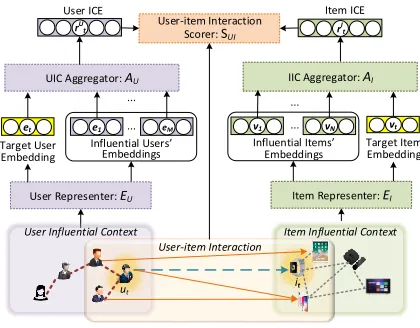
Figure 2: The architecture of HERS for modeling user-item interaction with user’s and item’s influential contexts
relations for more effective recommendation. The architec-ture of proposed HERS model is illustrated in Figure 2.
LetuandU =
u1, u2,· · ·, u|U | denote a user and the
whole user set.RU denotes the user-user relation. Letiand
I =
i1, i2,· · ·, i|I| denote an item and the whole item
set.RI denotes the item-item relation. The user-item
inter-actions are denoted as RU I = {yu,i|u ∈ U, i ∈ I}, and
yu,icould be explicit feedback, e.g., ratings or implicit feed-back, e.g., clicks. Generally, each user-item interactionyu,i is not only decided by useruand itemibut also other users and items in the influential context (Cao 2016). Hence, we formally define a user’s and an item’s influential contexts to model the user-item interactions.
Definition 1. User Influential Context (UIC): Given a tar-get useru, the UIC denotesCu = {Uu,Ru}, whereUu =
{u,Uc
u}consists of target useruand all influential users rel-evant tou,Rudenotes the user relationships overUu.
Definition 2. Item Influential Context (IIC): Given a target itemi, the IIC denotesCi ={Ii,Ri}, whereIi = {i,Iic} consists of target itemiand all influential items relevant to
i,Ridenotes all the item relationships overIi.
Interaction Score Decomposition:Each user-item inter-actionyu,ican be measured by a score functionsin terms of the UICCuand the IICCi; formally,s:s(Cu,Ci, yu,i)7→
shCu,Cii. According to Definitions 1 and 2, the overall
inter-action scoreshCu,Ciican be decomposed into four scores: shCu,Cii=λ1shu,ii+λ2shu,Iici+λ3shUuc,ii+λ4shUuc,Iici (1)
whereshu,ii scores user u’s preference on item i; shu,Ic ii
scoresu’s preference on influential itemsIc i;shUc
u,iiscores
relevant users’ preference oni, andshUc
u,Iciiscores the
sub-sidiary preference between influential users and influential items.λ1, λ2, λ3, λ4 are the scale parameters for weighing
these scores.
Model Architecture
The architecture of HERS with the user’s and item’s in-fluential contexts is illustrated in Figure 2, which consists
of five components: User RepresenterEU, UIC Aggregator
AU, Item RepresenterEI, IIC AggregatorAI and user-item interaction scorer SU I. Given a target userutand the cor-responding UICCut, a target itemitand the corresponding
IICCit:
• User RepresenterEU: it maps target userutand its influ-ential users in UIC to the corresponding user embeddings, i.e.,EU(Uut)7→ EutwhereEut={et,e1,· · ·eM}.
• Item RepresenterEI: it maps target itemitand its influ-ential items in IIC to the corresponding item embeddings, i.e.,EI(Iit)7→ EitwhereEit ={vt,v1,· · ·vN}.
• UIC AggregatorAU: it learns a representationrUt for the influential contextCut, namely influential context
embed-ding (ICE). Formally, we haveAU(Cut,Eut)7→r
U t.
• IIC AggregatorAI: it learnsit’s ICE by aggregating the influential contextCit, that is,AI(Cit,Eit)7→r
I t.
• User-item Interaction Scorer SU I: it learns to score the interaction strength between the target user-item pair
hut, itiin terms of the user ICErUt and the item ICErIt, namelySU I(rUt,rIt, yut,it)7→shCu,Cii(cf. Eq. 1).
This architecture can be implemented w.r.t. many concrete methods, e.g., a mixture model. In this paper, we implement it w.r.t. neural networks which have been proved mostly ef-fective and efficient in recent years.
Neural ICAU-based HERS Model
In this section, we present the details of a neural model to implement the HERS architecture illustrated in Figure 2. Specially, we design the neural ICAUs to learn ICEs as the core component of this HERS model.Influential-context Aggregation Unit
The ICAUs aim to aggregate the user embeddings Eut or
the item embeddingsEitin a context into an ICE according
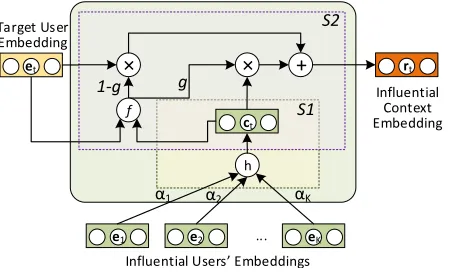
to the strength of influence from each user or item. Figure 3 demonstrates an ICAU for aggregating user embeddings
Eut, which consists of a two-stage aggregation: S1 and S2.
S1: This stage outputs the subsidiary influence embed-dingctthrough an aggregation functionh(·)over the influ-ential users’ embeddings:
{α1,· · ·αK}=a(e1,· · ·eK) (2)
ct=h(e1,· · ·eK|α1,· · ·αK). (3)
whereαidenotes the influential strength modeled by a func-tiona(·).
S2:This stage generates the ICE by aggregating the sub-sidiary influence context embeddingctand the target em-beddingetthrough a gate functionf(·):
g=f(ct,et) (4)
rt=gct+ (1−g)et (5)
S2
...
e1
h
×
g
×
1-g+
f
α1
eK α2
e2
αK
Influential Users’ Embeddings
Influential Context Embedding
ct
et rt
Target User Embedding
S1
Figure 3: Influential-Context Aggregation Unit (ICAU): A two-stage aggregation model to construct ICE
User’s Influential Context Embedding
Given a user influential contextCut ={Uut,Rut}(cf.
Def-inition 1), Uut consists of the target user ut and her/his
first-order influential neighbors {ut,m}1≤m≤M, and each
ut,m’s neighbors{ut,m,k}1≤k≤Km, i.e., second-order
influ-ential neighbors ofut, according to the relationshipsRut.
To learn the ICE from the UICCut, we first employ the
User Representer EU to extract the user embeddings for all users inUut. The embedding for a first-order neighbor ut,mis denoted as et,m, and the embedding for a second-order neighborut,m,kis denoted aset,m,k. To generate the ICE forCut, we construct an ICAU-based two-level tree-like
model as the UIC AggregatorAU to recursively embed both second-order and first-order neighbors’ influences. Firstly, the second level ICAUs are used to generate the ICErt,m w.r.t. each first-order neighbor ut,m. Then, the first level ICAU recursively generates the target ICErU
t by aggregat-ing these first-order ICEs{rt,m}. More details are presented as follows.
The Second Level ICAUs Taking a first-order influential neighborut,mof target userutas an example, we present how to implement an ICAU with neural networks for gener-ating the ICErt,mw.r.t.ut,min two stages.
S1:We adopt the attention mechanism to model the influ-ential strength for each neighborut,m,kofut,m. Specifically, we construct a three-layer attention neural network to weight the influence according to the user embeddinget,m,k. First,
et,m,kis projected into hidden units by atanhlayer to cap-ture nonlinear interaction:
ht,m,k= tanh(W(1)et,m,k+b) (6)
where the weight matrixW(1) ∈
RL×L and we omit the
bias termbin the following equations for concision. Then, the normalized influence for each neighbor is scored by thesoftmax(xk) =exk/Pje
xj function:
αUt,m,k= softmaxisrθ W(2)ht,m,k
(7)
where the weight matrixW(2) ∈
R1×Landisrθis an in-verse square root unit which is defined as follows:
isrθ(x) =
x
√
1 +θx2 (8)
whereθis the parameter which decides the range of function
isrθ(·). A largeθmakes the upper bound and lower bound close to 0; as a result, the softmax tends to output uniform weights. On the contrary, the softmax tends to output a sin-gle large weight with a smallθ.
Further, the subsidiary influence embedding ct,m is aggregated from the influential neighbors’ embeddings
{et,m,k}according to their influence strengths{αUt,m,k}:
ct,m=
XKm
k=1α
U
t,m,ket,m,k (9)
S2:The ICErt,mw.r.t. the first-order userut,mis calcu-lated as follows:
rt,m=gt,mct,m+ (1−gt,m)et,m (10)
whereg measures the influence strength from the second-order neighbors. The influential gategis modeled by a gate neural network:
gt,m=σ
isrθ W(3)tanh W(4)ct,m+W(5)et,m
(11) where σ(z) = 1/(1 +e−z), W(4),W(5) ∈
RL×L and
W(3)∈
R1×L.
The First Level ICAU When we obtain the ICEs{rt,m} w.r.t. all first-order influential neighbors, another ICAU at the first level is used to learn the target ICE:
cUt =
XM
m=1α
U
t,mrt,m (12)
where αU
t,m denotes the influence strength w.r.t. the first-order ICErt,m, which is calculated by another three-layer attention network with the same form as Eqs. 6 and 7. Then, we get the ICErU
t w.r.t. the target userut:
rUt =gUtctU+ (1−gtU)et (13)
wheregU
t is learned by a gate neural network which has the same structure with Eq. 11.
Item’s Influential Context Embedding
Given an IICCi ={Ii,Ri},Riis often built with the item relevance. Different from the indirect influence in user-user relation modeling, a user normally only consider those items directly relevant to the target item when they make a choice. Therefore, we only consider the first-order influential neigh-bors of a target item for modeling IIC. Given{it,n}1≤n≤N w.r.t. target itemit, their corresponding embeddingsvtand
{vt,n}1≤n≤N are retrieved by Item RepresenterEI. As a re-sult, we use an ICAU to learn the item ICE. The subsidiary influence embeddingcI
tis calculated as:
cIt =XN
n=1α
I
t,nvt,n (14)
where the influential strengthαI
t,nofvt,nis calculated by a three-layer attention network as in the UIC Aggregator.
αIt,n= softmaxisrθ W(6)tanh (W(7)vt,n)
(15)
Subsequently, the ICErIt w.r.t. it is obtained by aggre-gating the subsidiary influence embeddingcI
t and the target item embeddingvt:
rIt =gtIctI+ (1−gtI)vt (16)
where the influential gategI
t is also learned from a three-layer gate neural network as in Figure 3.
gtI =σ
isrθ W(8)tanh W(9)cIt+W
(10)
vt
(17)
whereW(8),W(9)∈RL×LandW(10)∈R1×L.
User-item Interaction Ranking
Each user-item connection denotes a user’s selection on an item. User-item connections can be regarded as one-class preference data (Hu et al. 2016) which cannot differentiate user preferences. To handle the one-class problem, we treat the learning on the user-item interactions as a ranking prob-lem (Rendle et al. 2009). Given a user ut, we construct a contrastive item pair to specify the preference order. A pos-itive itemipis the one which has an observed connection to
utw.r.t. user-item relations, i.e., a user-selected item, while a pseudo-negative itemin refers to the one without a con-nection tout. Then, we have the preference orderhut, ipi
hut, ini. Accordingly, we have Shut,ipi ≥ Shut,ini where Shut,iidenotes the preference score on itemiby the inner
product ofrtandri:
Shut,iti=r
U>
t r I
t (18)
Then, we use the max-margin loss (LeCun et al. 2006) to optimize the ranking order over pairs:
Lhut,ipihut,ini= max{0, m−Shut,ipi+Shut,ini} (19)
wherem= 10is set as the maximum margin in this paper. Remark for Scoring Model:if we expand Eq. 18, we obtain the following form by using Eqs. 13 and 16:
Shut,iti= g
U tc
U
t + (1−g U t)et
>
gtIcIt+ (1−gtI)vt
= (1−gtU)(1−gtI)e>t vt+gtU(1−g I t)c
U>
t vt
+ (1−gUt)gtIe>tcIt+gtUgtIcUt>cIt (20)
According to Eq. 1, we find that (i) shu,ii is modeled by
e>tvt; (ii)shu,Ic
iiis modeled bye >
tc I
t; (iii)shUc
u,iiis
mod-eled bycU>
t vt, and (iv)shUc
u,Iiciis modeled byc
U>
t cIt. Cor-respondingly,λ1 = (1−gtU)(1−gIt),λ2 = gtU(1−gIt),
λ3 = (1−gUt)gtI and λ4 = gtUgIt are learned to weigh these scores. Therefore, the above-expanded terms provide an insight into how the influences in the UIC and the IIC are embedded in our model to affect the final recommendation.
Training Procedure
For each user selection hut, ipi, we can construct a triplet
hut, ip, ini to optimize the ranking loss Lhut,ipihut,ini.
Then the loss of a mini-batchBfor training is given as:
L= 1
|B| X
hut,ip,ini∈B
Lhut,ipihut,ini (21)
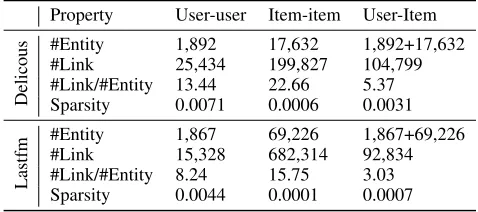
Table 1: Statistics of the datasets: Delicious and Lastfm
Property User-user Item-item User-Item
Delicous
#Entity 1,892 17,632 1,892+17,632
#Link 25,434 199,827 104,799
#Link/#Entity 13.44 22.66 5.37
Sparsity 0.0071 0.0006 0.0031
Lastfm
#Entity 1,867 69,226 1,867+69,226
#Link 15,328 682,314 92,834
#Link/#Entity 8.24 15.75 3.03
Sparsity 0.0044 0.0001 0.0007
To learn the parameters, we adopt a gradient decent-based algorithm over ∂L/∂W w.r.t. each weight matrix
W in our model. We implement our model using Keras (Chollet and others 2015) with Tensorflow GPU version as backend. We use Adam (Kingma and Ba 2014) as the gradient optimizer and the mini-batch size is set to 200. The code is available at: https://github.com/rainmilk/ aaai19hershttps://github.com/rainmilk/aaai19hers.
Experiments
In this section, we conduct experiments on two real datasets to compare the recommendation quality of our approach with other state-of-the-art recommendation methods.
Data Preparation
Most public datasets for recommendation only involve the user-item relation, so it is not easy to find a dataset contain-ing all user-user, user-item and item-item relations. Fortu-nately, two datasets, Delicious1 and Lastfm2, provided by RecSys Challenge 2011 (Cantador, Brusilovsky, and Kuflik 2011) can satisfy our requirement.
The Delicious dataset contains social networking, book-marking, and tagging information from the Delicious so-cial bookmarking system. Contact relationships are identi-fied between users when they are mutual fans in Delicious, which is used as the user-user relation. The user-item rela-tionships are constructed from users and their bookmarked items. The item-item relationships are built on the common tags between items. Given a target item, we assign links to top 10 items which have the most common tags.
The Lastfm dataset contains social networking, tagging, and music artist information from the Last.fm online music system. The friendships between users are used as the user-user relation. The items are artists who are connected with users if the artists’ musics are listened by these users. The listening relationships between users and artists are served as the user-item relation. The item-item relationships are built through the tags using the same method as Delicious. The statistics of the datasets are summarized in Table 1 which contains the number of entities (i.e., users, items), the number of links (i.e., user-user relationships, item-item re-lationships, user-item interactions), the number of average links per entity, and the sparsity for each type of relations.
1
http://www.delicious.com
2
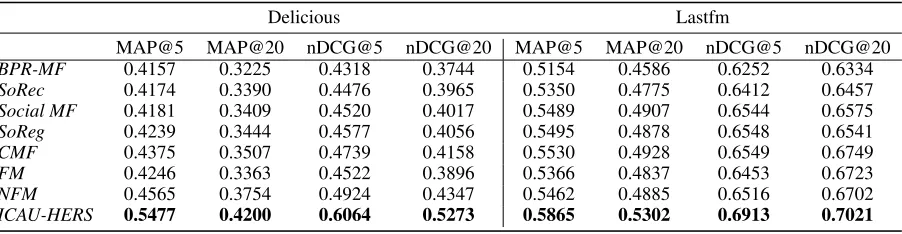
Table 2: Item recommendation for test users of Delicious and Lastfm
Delicious Lastfm
MAP@5 MAP@20 nDCG@5 nDCG@20 MAP@5 MAP@20 nDCG@5 nDCG@20
BPR-MF 0.4157 0.3225 0.4318 0.3744 0.5154 0.4586 0.6252 0.6334
SoRec 0.4174 0.3390 0.4476 0.3965 0.5350 0.4775 0.6412 0.6457
Social MF 0.4181 0.3409 0.4520 0.4017 0.5489 0.4907 0.6544 0.6575
SoReg 0.4239 0.3444 0.4577 0.4056 0.5495 0.4878 0.6548 0.6541
CMF 0.4375 0.3507 0.4739 0.4158 0.5530 0.4928 0.6549 0.6749
FM 0.4246 0.3363 0.4522 0.3896 0.5366 0.4837 0.6453 0.6723
NFM 0.4565 0.3754 0.4924 0.4347 0.5462 0.4885 0.6516 0.6702
ICAU-HERS 0.5477 0.4200 0.6064 0.5273 0.5865 0.5302 0.6913 0.7021
As both datasets are very sparse, the additional information leveraged from the social networks and the item-item rela-tions will benefit the recommendation.
Experimental Settings
To evaluate the ranking accuracy, we adopt two metrics:
Mean Average Precision(MAP) andnormalized Discounted Cumulative Gain(nDCG), to measure the quality of prefer-ence ranking and top-N recommendation.
Comparison Methods: The following representative methods are selected for comparison:
• BPR-MF(Rendle et al. 2009): it uses the BPR-based op-timization on the user-item relation by MF.
• SoRec (Ma et al. 2008): it jointly factorizes the social-relation matrix and a user-item interaction matrix.
• SoicalMF(Jamali and Ester 2010): it adds regularization into MF according to social information.
• SoReg(Ma et al. 2011): it leverages social relationships to regularize the user’s latent factors.
• CMF (Singh and Gordon 2008): it is adopted to co-factorize the user-user, user-item and item-item relations.
• FM(Rendle 2012): it embeds features into a latent space and models the interactions between each pair of features. We integrate user-user, user-item, item-item relations as the features.
• NFM(He and Chua 2017): a deep neural network-based FM with multiple hidden layers to learn non-linear inter-actions.
• ICAU-HERS: ICAU-based HERS proposed in this paper.
Parameter Settings: The lengths of user/item embed-dings and context embedembed-dings are set to 128. To acceler-ate the model, we choose top 10 first-order neighbors for each target user and 10 second-order neighbors for each first-order neighbor, and 10 neighbors for each item in the item-item relation ranked by the influence weights, cf. Eq. 7. Theθin Eq. 19 is set to 16.
Recommendation Performance
We construct the testing set by holding out 20% user-item interactions as the ground truth. For each hold-out test sam-ple in the testing sets, we randomly draw ten noisy samsam-ples
to test whether the testing methods can successfully rank the true test sample at a top position out of the noisy samples. The remaining data of the user-item relation is used for train-ing, together with the user-user and the item-item relations.
Overall Comparison:Table 2 reports MAP and nDCG at top 5 and 10 over all testing users. Among all methods, ICAU-HERS achieves the best performance in terms of all metrics on both datasets. Specifically, ICAU-HERS demon-strates approximately 20% improvement over the second-place method NFM on Delicious and 6.1% improvement over the second-place method CMF on Lastfm in terms of MAP@5.
Effect of User-user Relation Modeling: BPR-MF more easily suffers from data sparsity than other comparison methods, because it cannot borrow information from the so-cial relationships. As a result, it achieves the worst perfor-mance. In comparison, other methods benefit from the infor-mation in the user social network. Especially, ICAU-HERS outperforms all other methods, which should thank to ICAU for precisely weighing the influence from different users and aggregating high-order influences.
Effect of Item-item Relation Modeling: CMF, FM and NFM consider the item-item relation, which makes the recommendation more effective than the social relation only methods. Compared with MF and FM-based methods, ICAU-HERS demonstrates its superiority on integrating het-erogeneously relational recommendation data with the influ-ence aggregation modeling.
Recommendation for Cold-start Users and Items
The cold-start problem is ubiquitous in RSs which can be categorized into cold-start users and cold-start items. In the user cold-start problem, for new users, we recommend items to them. The ranks over the recommended items are re-garded as the evaluation criteria. In the item cold-start prob-lem, for new items, we recommend them to different users. The ranks over the recommended users are used to evalu-ate the performance. In this section, we show the ICAU-HERS ability against comparison methods of handling user and item cold-start problem respectively.
MAP@5 nDCG@5 0 0.1 0.2 0.3 0.4 0.5 SocRec Social MF SocReg CMF FM NFM ICAU-HERS (a) Delicious MAP@5 nDCG@5 0 0.1 0.2 0.3 0.4 0.5 0.6 (b) Lastfm
Figure 4: Item recommendation for cold-start users of Deli-cious and Lastfm
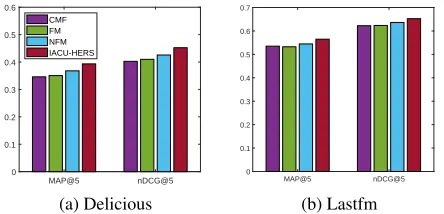
MAP@5 nDCG@5 0 0.1 0.2 0.3 0.4 0.5 0.6 CMF FM NFM IACU-HERS (a) Delicious MAP@5 nDCG@5 0 0.1 0.2 0.3 0.4 0.5 0.6 0.7 (b) Lastfm
Figure 5: User recommendation for cold-start items of Deli-cious and Lastfm
with other methods are shown in Figure 4. ICAU-HERS sig-nificantly outperforms other methods on both datasets. On Delicious, in terms of MAP@5, the relative improvement of ICAU-HERS over SoRec, Social MF, SoReg, CMF, FM and NFM is 42.3%, 32.2%, 29.4%, 21.6%, 19.7% and 12.6% re-spectively. On Lastfm, in terms of MAP@5, the relative im-provement of ICAU-HERS over SoRec, Social MF, SoReg, CMF, FM and NFM is 55.1%, 58.2%, 36.6%, 54.2% 30.7% and 26.1% respectively. Eq. 20 gives the insight into why ICAU-HERS can handle this cold-start problem more effec-tively. This is because the ICEs of users have embedded the information from their neighbors in the influential context, even when no historical user selection is observed.
Cold-start Items:To cope with cold-start items, we ran-domly remove 20% items and all their connected edges from the user-item relation. For each testing item, we rank the pre-dictive scores over users. The MAP and nDCG results are shown in Figure 5. Since SoRec, Social MF and SoReg only model the user-user relation, they cannot handle cold-start items. Compared with CMF, FM and NFM, ICAU-HERS achieves the best performance on both datasets. Note that ICAU-HERS’s performance on cold-start items is not as sig-nificant as that for cold-start users. This can be interpreted that the impact from other users is higher than the impact from relevant items on user’s item selection. However, the embedded influential item context can still provide useful information when no selection is available for a new item.
41 Raised Fist
1348 184 611 1808 799 1067 993 1276 163 170 1165 1219 1143 1191 360 219 1240 658 1673 1346 1559 57 1626 1597 1137 1580 1527 1444 29 488 514538 584 796 1743 1757 1779 1333 789 864 75 778 1891 950 1828 103 711 791 287 1875 1063 878 49 1369 200 1057 399 418 650 1555 1142 424 291 644 985 716 1544 1417 334 1186 226 1027 1416 242 225 188 252 284 1099 1890 1872 726 1400 1360 1328 553 1188 1411 638 1238 1341
1338 Ratos de Porão
DS-13 seis35 Russian singer Lagwagon Killing Chainsaw Suicidal Tendencies Russian band A Wilhelm Scream
Golliwog
Figure 6: The visualization of influential contexts of a sam-pled user selection on an artist in the Lastfm dataset. The artists in the item network are labeled by their names and the anonymous users in the user network are labeled with their IDs. The thickness of edges specifies the significance of influence.
Visualization and Interpretation
To interpret the influence from influential users and items when a user makes an item selection, we randomly choose a user and her/his selection on an artist (User 41 with Raised Fist) from the LastFM dataset as a case study. We visualize the influential context w.r.t. the target user and the target item in Figure 6 by differentiating the influence with different edge thickness. We can find that the influence from different users/items is quite different, for example, User 1808 and User 184 have the common neighbor 1626 but the influence of User 1626 on User 184 is much larger than that on User 1808. In the item network, we observe similar cases from the influential context w.r.t. Raised Fist. Therefore, these in-fluential contexts can provide the interpretation of how the target users and the target items are influenced by the influ-ential users and items to form the connection.
Conclusion
We propose a framework for modeling influential contexts in recommender systems with the user-user, the item-item and the user-item relations, and further implement a neu-ral ICAU-based HERS model. In particular, this HERS can effectively learn the ICEs from user’s and item’s influen-tial contexts through ICAU. Extensive experiments show that ICAU-HERS outperforms other state-of-the-art meth-ods and it is effective for handling the user/item cold-start and sparsity problems. In addition, we demonstrate the in-terpretability of ICAU-HERS with a real case study.
Acknowledgements
The paper is partially supported by the National Natural Sci-ence Foundation of China (61572325); Shanghai Key Pro-grams of Science and Technology(16DZ1203603); Shang-hai Engineering Research Center Project (GCZX14014 and C14001).
References
Cantador, I.; Brusilovsky, P.; and Kuflik, T. 2011. 2nd workshop on information heterogeneity and fusion in rec-ommender systems (hetrec 2011). InHetRec ´2011.
Cao, L. 2015. Coupling learning of complex interactions.
Information Processing & Management51(2):167–186. Cao, L. 2016. Non-iid recommender systems: A review and framework of recommendation paradigm shifting. En-gineering2(2):212–224.
Chollet, F., et al. 2015. Keras. https://github.com/fchollet/ keras.
Do, T. D. T., and Cao, L. 2018a. Coupled poisson fac-torization integrated with user/item metadata for modeling popular and sparse ratings in scalable recommendation. In
AAAI’2018, 2918–2925.
Do, T. D. T., and Cao, L. 2018b. Gamma-poisson dynamic matrix factorization embedded with metadata influence. In
NIPS’2018.
Friedkin, N. E., and Johnsen, E. C. 2011. Social influence network theory: A sociological examination of small group dynamics, volume 33. Cambridge University Press.
He, X., and Chua, T.-S. 2017. Neural factorization machines for sparse predictive analytics. InSIGIR’2017, 355–364.
He, X.; Liao, L.; Zhang, H.; Nie, L.; Hu, X.; and Chua, T.-S. 2017. Neural collaborative filtering. InWWW’2017, 173– 182.
Hu, L.; Cao, J.; Xu, G.; Cao, L.; Gu, Z.; and Cao, W. 2014. Deep modeling of group preferences for group-based rec-ommendation. InAAAI’2014, 1861–1867.
Hu, L.; Cao, L.; Cao, J.; Gu, Z.; Xu, G.; and Yang, D. 2016. Learning informative priors from heterogeneous domains to improve recommendation in cold-start user domains. ACM Transactions on Information Systems (TOIS)35(2):13.
Hu, L.; Cao, L.; Cao, J.; Gu, Z.; Xu, G.; and Wang, J. 2017a. Improving the quality of recommendations for users and items in the tail of distribution. ACM Transactions on In-formation Systems (TOIS)35(3):25.
Hu, L.; Cao, L.; Wang, S.; Xu, G.; Cao, J.; and Gu, Z. 2017b. Diversifying personalized recommendation with user-session context. InIJCAI’2017, 1858–1864.
Jamali, M., and Ester, M. 2010. A matrix factorization tech-nique with trust propagation for recommendation in social networks. InRecSys’2010, 135–142. ACM.
Jian, S.; Hu, L.; Cao, L.; Lu, K.; and Gao, H. 2019. Evo-lutionarily learning multi-aspect interactions and influences from network structure and node content. InAAAI’2019.
Jiang, M.; Cui, P.; Wang, F.; Zhu, W.; and Yang, S. 2014. Scalable recommendation with social contextual informa-tion. IEEE Transactions on Knowledge and Data Engineer-ing26(11):2789–2802.
Kingma, D., and Ba, J. 2014. Adam: A method for stochastic optimization. arXiv preprint arXiv:1412.6980.
LeCun, Y.; Chopra, S.; Hadsell, R.; Ranzato, M.; and Huang, F. 2006. A tutorial on energy-based learning. Predicting Structured Data1:0.
Li, F.; Xu, G.; and Cao, L. 2015. Coupled matrix factoriza-tion within non-iid context. InPAKDD’2015, 707–719. Ma, H.; Yang, H.; Lyu, M. R.; and King, I. 2008. Sorec: social recommendation using probabilistic matrix factoriza-tion. InCIKM’2008, 931–940. ACM.
Ma, H.; Zhou, D.; Liu, C.; Lyu, M. R.; and King, I. 2011. Recommender systems with social regularization. In
WSDM’2011, 287–296. ACM.
Rendle, S.; Freudenthaler, C.; Gantner, Z.; and Schmidt-Thieme, L. 2009. Bpr: Bayesian personalized ranking from implicit feedback. InUAI’2009, 452–461.
Rendle, S. 2012. Factorization machines with libfm. ACM Transactions on Intelligent Systems and Technology (TIST)
3(3):57.
Rendle, S. 2013. Scaling factorization machines to relational data. InProceedings of the VLDB Endowment, volume 6, 337–348. VLDB Endowment.
Singh, A. P., and Gordon, G. J. 2008. Relational learning via collective matrix factorization. InKDD’2008, 650–658. Tang, J.; Gao, H.; Liu, H.; and Das Sarma, A. 2012. etrust: Understanding trust evolution in an online world. In
KDD’2012, 253–261.
Tang, J.; Hu, X.; and Liu, H. 2013. Social recommendation: a review. Social Network Analysis and Mining3(4):1113– 1133.
Vasuki, V.; Natarajan, N.; Lu, Z.; and Dhillon, I. S. 2010. Af-filiation recommendation using auxiliary networks. In Rec-Sys’2010, 103–110.
Wang, X.; He, X.; Nie, L.; and Chua, T.-S. 2017. Item silk road: Recommending items from information domains to social users. InSIGIR’2017, 185–194. ACM.