R E S E A R C H
Open Access
Some array polynomials over special monoid
presentations
Ahmet Sinan Cevik
1*, Kinkar Chandra Das
2, Yilmaz Simsek
3and Ismail Naci Cangul
4*Correspondence:
[email protected] 1Department of Mathematics,
Faculty of Science, Selçuk University, Campus, Konya, 42075, Turkey Full list of author information is available at the end of the article
Abstract
In a recent joint paper (Ceviket al.in Hacet. J. Math. Stat., acceptted), the authors have investigated thep-Cockcroft property (or, equivalently, efficiency) for a presentation, sayPE, of the semi-direct product of a free abelian monoid rank two by a finite cyclic monoid. Moreover, they have presented sufficient conditions on a special case forPE to be minimal whilst it is inefficient. In this paper, by considering these results, we first show that the presentations of the formPEcan actually be represented by
characteristic polynomials. After that, some connections between representative characteristic polynomials and generating functions in terms of array polynomials over the presentationPEwill be pointed out. Through indicated connections, the existence of an equivalence among each generating function in itself is claimed studied in this paper.
MSC: 11B68; 11S40; 12D10; 20M05; 20M50; 26C05; 26C10
Keywords: minimality; characteristic polynomials; array polynomials
1 Introduction and preliminaries
In a recently published joint paper [], the authors computed algebraic relations in terms of Ramanujan-Eisenstein series. Furthermore, although there are so many similar studies about figuring out the relationship between algebraic relations (or algebraic structures) and special generating functions (cf., for instance, [–]; see also the references cited in each of them for other works) in the literature, we have not seen any such studies of rela-tionship between (or monoid)presentationsandgenerating functions. In fact, in terms of efficiency and inefficiency (while satisfying minimality) over group and monoid presenta-tions, very important characterizations are given for related algebraic structures (see, for instance, [–]; see also the references cited in each of these earlier works). It is also well known that generating functions still attract much interest from all mathematicians and physicians (see, for instance, [, ] in addition to the above citations). Thus, it would be quite interesting for future studies to connect these two important areas and then search for possible properties about this linkage.
A similar connection exists between graphs and special functions since the number of vertex-colorings of a graph is given by a polynomial based on the number of used colors (see []). Based on this polynomial, one can define the chromatic number as the minimum number of colors such that the chromatic polynomial is positive. Recently, the paper [] has come to our attention. It is a generalization on the chromatic polynomial of a graph subdivision, and basically the authors determine the chromatic number for a simple graph
and then present a generalized polynomial for the particular case of graph subdivision. In this reference, the main idea was to express some graph theoretical parameters in terms of special functions. In a similar manner within algebra, by considering a group or a monoid presentationP, an approximation from algebra to analysis has been recently developed []. In this reference, the authors supposed thatP satisfies the special algebraic proper-ties either efficiency or inefficiency while it is minimal. (The reason for choosing efficiency or (minimal) inefficiency was to have an advantage to work on a minimal number of gen-erators.) Then it was investigated whether some generating functions can be applied, and then studied what kind of new properties can be obtained by considering special generat-ing functions overP. Since the results in [] imply a new studying area for graphs in the meaning of representation of parameters by generating functions, the results in [] will also give an opportunity to make a new classification of infinite groups and monoids by using generating functions.
There has been also some interest in equivalence relations among generating functions (see, for instance, [, ]). However in these studies, the authors were mainly interested in an equivalence relation that gives an opportunity to obtain generating functions one from another. In the literature, we have not seen any other paper that presents such a relation inside the related generating function. So, we believe that it is worth investigating whether there exist equivalence (or maybe congruence) relations among special generating func-tions depicted in here.
The ingredient of this paper should be thought of as not only computational but also theoretical. Hence it will be presented as three main parts including introduction. In Sec-tion , by reminding the results in [], we will define characteristic polynomials related to the efficient and inefficient presentations, and then we will investigate the generating functions (in terms of array polynomials) over both these presentations and characteristic polynomials. In Section , we will provide some conclusions that will be studied as future projects.
2 Generators for the semi-direct product of free abelian monoids rank two by finite cyclic monoids
This main section will be given as three subsections under the names ofGenerating pic-tures(as Part I),Characteristic polynomials(as Part II) andArray polynomials(as Part III). In our study, we will consider a special presentationPE(see () below). Since we will
define characteristic polynomials and generating functions by considering the exponent sums of the generating pictures overPE, the first subsection is aimed at presenting these
generating pictures and the related results about them.
2.1 Part I: Generating pictures ofPE
It is strictly referred to [–] for fundamentals and properties of the algebraic subject used in this subsection. We further note that most of the material in here can also be found in [].
We will mainly present the efficiency (equivalently,p-Cockcroft property for a primep) for the semi-direct product of free abelian monoidKhaving rank two by a finite cyclic
monoidAof orderk. Hence, for ≤l<kandl,k∈Z+, letP
A= [x;xk=xl] be a
presen-tation ofAandPK = [y,y;yy=yy] be a presentation ofK. Suppose thatψ is the
endomorphismψMofK, whereM= α α
αα
such that the entriesαij’s are the
(x∈x) induces a well-defined monoid homomorphismθ :A–→End(K) if and only if
M[xk]=M[xl], or equivalently,
Mk≡Ml modd, ()
whered|(k–l) (see [] for the details). Since there exists an ordering between the re-lators ofA, that is, fork,l∈Z+, we have ≤l<k, it implies that to define an induced
homomorphismθ :A–→End(K), that is, to defineKθA, we must take congruence
relation betweenMkandMlas given in () with the assumptiond|(k–l). By [], thekth
andlth powers of the matrices can be obtained by ordinary matrix multiplication. Thus, let us suppose that thekth (k∈Z+) power ofMis defined as
Mk=
ak– bk–
ck– zk–
α α α α
=
ak–α+bk–α ak–α+bk–α
ck–α+zk–α ck–α+zk–α
=
ak bk
ck zk
,
while, applying a similar idea, thelth (l∈Z+) power ofMis defined asMl=albl
cl zl
. Now suppose that () holds. Then the semi-direct productE=KθAhas a presentation
PE= [y,y,x;S,R,Tyx,Tyx], ()
whereS:yy=yy,R:xk=xl,Tyx:yx=xy
α
y
α
andTyx:yx=xy
α
y
α
, respectively.
In the rest of this paper, we will assume that Equality () always holds when we talk about the semi-direct productEofKbyA.
We know that thetrivializer set(see []) ofXEofD(PE) consists of the trivializer set XK ofD(PK),XAofD(PA) and the setsC,C(see [, Lemma .]). In our case, by [],
XK is equal to the empty set since, for the relatorS, we haveι(S+)=ι(S–). ThusPK is
aspherical and sop-Cockcroft for any primep. Nevertheless, the trivializer setXAof the
Squier complex D(PA) can be found in [, Lemma .]. Finally, the subsets C andC
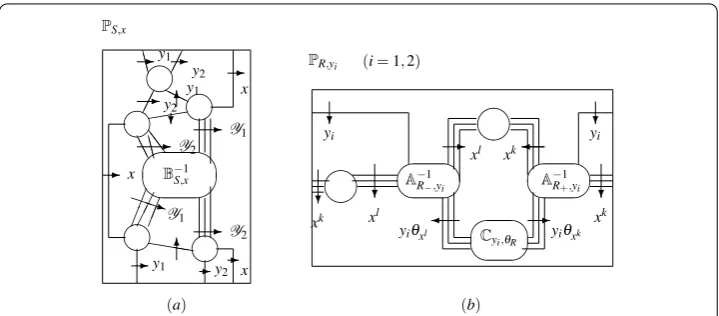
contain the generating pictures PS,x (which contains a non-spherical subpictureBS,xas
depicted in []),PR,y andPR,y of the trivializer setXE. These pictures can be presented
as in Figure (a) and (b).
For simplicity, let us define thesum of each entriesof power matrices
a+a+· · ·+ak– asak, a+a+· · ·+al– asal,
b+b+· · ·+bk– asbk, b+b+· · ·+bl– asbl,
c+c+· · ·+ck– asck, c+c+· · ·+cl– ascl,
z+z+· · ·+zk– aszk, z+z+· · ·+zl– aszl. ⎫ ⎪ ⎪ ⎪ ⎬ ⎪ ⎪ ⎪ ⎭
()
Suppose that the positive integerd, defined in (), is equal to a primepsuch thatp|(k–l). Then, in [], the following result has been recently obtained.
Proposition ([]) Let p be a prime or.Then the presentationPE, as in(), for the
Figure 1 In the picturePS,x, for simplicity, relatorsyα111y α12 2 andy
α21 1 y
α22
2 are labeled byY1andY2,
respectively.
(b)
ak≡zl modp, bk≡cl modp,
ck≡bl modp, zk≡al modp.
According to the above proposition, let us take an efficient presentation
PE=
y,y,x;yy=yy,xp+=x,yx=xyαy
α
,yx=xyαy
α
. ()
Suppose thatpis an odd prime. Then, in particular,PEin () is not efficient ifdetMis
either equivalent to orp– by modulop. Therefore one of the consequences of Propo-sition is the following.
Proposition ([]) The presentationPE in()is minimal but inefficient if p is an odd
prime and
either
⎧ ⎪ ⎨ ⎪ ⎩
α=p– , α=α= , α=
or
⎧ ⎪ ⎨ ⎪ ⎩
α= , α=α= , α=p– .
2.2 Part II: Characteristic polynomials overPE
Let us reconsider the semi-direct product ofKbyAwith a presentationPEas defined in
(). Now it is well known that if one wants to define such a presentationPE, then it must
satisfy condition (). Therefore we certainly have ×-matricesM,MkandMl, and so
we can consider the related characteristic polynomials of these matrices.
Letλandλbe the only eigenvalues of the matrixM. Since the entries ofMare
pos-itive integers,λandλcould be any numbers including complex ones. As a restriction,
throughout all paper, we will assume that these eigenvalues are real. By using the basic fact of linear algebra, we then have the eigenvalues ofMkasλk
andλkwhile the eigenvalues
ofMlasλl
matricesM,MkandMlwill be of the form
pl
k(ν)λ=ν– (λ+λ)ν+λλ
pl
k(ν)λk=ν– (λk+λk)ν+λkλk plk(ν)λl=ν– (λl+λl)ν+λlλl
⎫ ⎪ ⎬ ⎪
⎭, ()
respectively.
Now let us think of () as a piece of the system of characteristic polynomials that are obtained from any ×-matrix. In fact, there are an infinite number of polynomials of the type () since one can find an infinite number of matrices having positive integer entries that satisfy condition (). On the other hand, by the definition of finite monogenic monoids and semigroups (see []), for a fixed value ofk, one can choose the valuelfrom the set
{, , . . . ,k– }. It is clear that each of these systems in () will be constructed as a choice of lin this set, and so we will havek– times different systems of characteristic polynomials as in () such that each of them contains an infinite number of polynomials. The following proposition will be based on this fact.
Proposition Each characteristic polynomial obtained from×matrices,as in system (),appears to be a congruence class.
Proof Before giving the proof, we note that this result can of course be adapted ton×n matrices, which will not be needed in here.
Thenormal form theorem[], NFT for short, basically says that each congruence class contains a unique reduced word. It is well known in the branch ofcombinatorial group theorythat the idea of this theorem is the main point when one tries to define a presen-tation for the related algebraic structure. Therefore, since each presenpresen-tationPAandPK
has been obtained by considering NFT, the presentationPEin () must also satisfy NFT.
(Although we reminded this theorem by considering only thewordsover free generators, the idea of NFT can actually be seen inQasfractalsor in matrix theory asechelon forms.) For a fixed modulod, let us think about the set, sayνd, of all characteristic polynomials, written as in system (), having the conditionMk≡Ml modd, whered|k–landl∈
{, , . . . ,k– }. We note that the cardinalitys(ν
d) =k– .
Nevertheless, for each different ≤l≤k– , since one can find matrices satisfying the condition in (), the setν
dcan be constructed as a union ofk– times congruence classes,
i.e.,l-classes. Moreover, again by (), for each ≤l≤k– , since we also have
λki ≡λli≡λi modd, where ≤i≤, ()
each of thesel-classes contains the characteristic polynomials having eigenvaluesλki,λli
andλi(for ≤i≤). On the other hand, by (),plk(ν)λcan be taken as the simplest element
(characteristic polynomial) having eigenvaluesλandλin eachl-class.
Thus, let us choose a powerlfrom the set{, , . . . ,k– }for a fixedk. Then the setνd
will be constructed for a suitable modulodaccording to our choice ofl, which satisfies (). Now, by (), we have
in system (). In other words, for a fixedkand modulod, there existsplk(ν)λ=plk(ν)λk= pl
k(ν)λl, where each class contains an infinite number of elements (polynomials). Therefore
pl k(ν)λ=
plk(ν)λ,plk(ν)λk,plk(ν)λl, . . .
,
where ≤l≤k– . As a summary, for a chosend,
νd=pl
k(ν)λ:k∈Z
+is fixed, ≤l≤k– ,dis fixed withd|k–l
such that≤l≤k–plk(ν)λ=ν
dand
≤l≤k–plk(ν)λ=∅.
Hence the result.
As a next step of Proposition , the following result basically states that each semi-direct product presentation as in () which is obtained by condition () has a characteristic poly-nomial.
Theorem The presentationPEin()is represented by a unique(up to equivalence)
char-acteristic polynomial defined as in system().
Proof By Proposition and as a result of NFT, the simplest (unique reduced) characteristic polynomial in system () represents the congruence class of the relatedl-classes. From (), we haveak≡al modd,bk≡bl modd,ck≡cl moddandzk ≡zl modd, where
d|(k–l). Thus, by (), we clearly obtain the equivalences
λk+λk≡λl+λl≡λ+λ and λkλk≡λlλl≡λλ ()
by modulod. Shortly,tr(Mk)≡tr(Ml)≡tr(M) modd, wheretr(·) denotes the trace of
these matrices, anddetMk≡detMl≡detM modd. This implies that each
character-istic polynomial in system () is congruent to another by modulod, and so the simplest polynomial
ν–tr(M)ν+detM ()
can be chosen as a representative characteristic polynomial for the presentationPE in
() since all these polynomials are in the samel-class. As a result, sincePE is obtained
by using both unique reduced words (according to NFT) and the matrixMas the endo-morphismψM, polynomial () represents this presentation uniquely as a characteristic
polynomial.
As a consequence of Theorem and Proposition , we can give the following result which is a simpler version of Proposition since the efficiency conditions can be expressed as a unique statement.
Theorem For any prime p or,the presentationPEin()is p-Cockcroft if and only if
Proof Now, by Theorem , it is known thatPEin () has a characteristic polynomial as in
() with a base ×-matrixM. Letpbe any prime or , and letλ<λbe the eigenvalues
ofM. Thus, we clearly havetr(M) =λ+λanddet(M) =λλ. By Proposition , since
thesufficiencypart is clear, let us show thenecessityof the proof.
Assume thatdet(M)≡ modp. Also, let us consider the power matricesMkandMl
which certainly exist sincePEin () is a semi-direct product presentation. So,λkλk≡
modpandλl
λl≡ modp. In other words, by considering the sums presented in (),
akzk–bkck≡ modp =⇒ akzk=pt+ +bkck
and
alzl–blcl≡ modp =⇒ alzl=pt+ +blcl,
for some integerstandt. Hence, by applying side by removing, we get
akzk–bkck≡alzl–blcl modp, ()
which actually implies the truthfulness of the second part of (). On the other hand, by Theorem ,
akzk≡alzl modp
since each characteristic polynomial in system () must be in the samel-class. From the above equivalence, we definitely getak≡zl modpandal≡zk modpsince our
assump-tiondet(M)≡ modpdoes not permit another equivalence option. Furthermore, by keeping in our mind these last equivalences, if we consider () again, then we can get
bk≡cl modpandck≡bl modpsince again the assumption on the determinant is
en-forced to not get another equivalence option.
Notice that the above processes show that this unique assumption on the determinant of Mimplies the remaining conditions of Proposition . Thus, as a next step of Proposition , we clearly getPEisp-Cockcroft (equivalently, efficient) for any primepor .
Example By considering the matrixM, one can give the following examples for Theo-rem :
(i) For an odd primep, if we takeα= ,α=t(t∈Z+),α= andα= , then we getλλ= whileMp+≡M modp. Hence, we get an efficient presentation. However, for even prime, we can still get a semi-direct product presentation for the same matrix entries sinceM≡M mod. But the presentation will be
inefficient.
(ii) For any primepandt∈Z+, again by taking
t
or
t
,
we can getMp+≡M modp, and alsoλ
λ= . Hence we obtain an efficient presentation which can always be represented by a characteristic polynomial
(iii) Similarly, for any primep, by choosingeitherα=pt+ (t∈Z+),α= , α= andα= orα= ,α= ,α= andα=pt+ (t∈Z+), we can still obtain efficient presentations with the equivalenceMp+≡M modp. Further, the representative characteristic polynomial for the related presentation is of the formν– (pt+ )ν+pt+ .
(iv) The above examples can be extended forMnp+≡M modp, wheren∈Z+.
As another consequence of Theorem , we obtain the following result by considering Proposition .
Theorem For an odd prime p,the presentationPE in()is minimal but inefficient if
Mis a diagonal matrix and the representative characteristic polynomial is of the form
ν–pν+ (p– )which has a strict ordering < (p– )between roots.
Proof LetMbe a diagonal matrix. For an odd primep, letν–pν+ (p– ) be the represen-tative characteristic polynomial forPE. Clearly, the roots andp– will be the eigenvalues λandλofM. Then, by (), we havetr(M) =panddet(M) =p– . By Proposition , this
determinant value implies thatPEis inefficient. Notice that sincePEin () is a semi-direct
product presentation, Mp+≡M modpmust be held. Therefore we have λp+ ≡λ
modp. So, by Proposition , the polynomial with rootsλp+ andλis in the same
congru-ence class as the simplest characteristic polynomialν–pν+ (p– ). In addition, by the assumption, the entries ofMshould be eitherα= ,α=p– orvice versaα= =α.
Then, again by Proposition ,PEis minimal, as required.
Example Letp= andM= with determinant . ThusM≡M mod holds,
and the relators of the semi-direct product presentation, as in (), will beyy=yy,x=x,
yx=xy andyx=xy. By Theorem , the simplest (unique) characteristic polynomial ν– ν+ represents this inefficient but minimal presentation. A similar example can also be obtained by considering the matrix .
Conjecture Let us consider a×-matrixMwith eigenvaluesλandλ,respectively.
Then,by consideringtr(M) =λ+λanddet(M) =λλ,one can investigate whether the
minimality conditions of Theoremcan be expressed as a unique statement
gcdtr(M),det(M)= .
2.3 Part III: Array polynomials overPE
In this section, we are mainly interested in the generating functions (in terms of array polynomials) related to the presentations defined in () and (). In [, ], by considering the generating pictures in two different group and monoid extensions, the authors have investigated the related generating functions over the presentations of them. However, in a different manner, here we will investigate the array polynomials (as generating functions) in the meaning of characteristic polynomials obtained in the previous section. In other words, by taking into account Proposition and Theorems , and , we will reach our aim using semi-direct products of monoids studied in this paper.
with a minimal number of elements gives a great opportunity to define related generating functions over this presentation. This will be one of the key points in our results.
Our first result of this section is related to the connection of the monoid presentation in () with array polynomials. In fact,array polynomials Sn
a(x) are defined by means of the
generating function
(et– )aetx
x! =
∞
n=
Sna(x)t
n
n!
(cf.[–]). According to the same references, array polynomials can also be defined as follows:
Sna(x) = a!
a
j=
(–)a–j
a j
(x+j)n. ()
Since the coefficients of array polynomials are integers, they find a very large application area, especially in system control (cf.[]). In fact, these integer coefficients give us an opportunity to use the polynomials in our case. We should note that there also exist some other polynomials, namely Dickson, Bell, Abel, Mittag-Leffleretc.having integer coeffi-cients which will not be handled in this paper. Now, by using () and keeping in our mind that the coefficients of array polynomials are integers, we clearly have
Sna(b) =
⎧ ⎪ ⎨ ⎪ ⎩
bn; a= ,
b; a= andn= , ; a=norn=a= .
()
Therefore we have the following theorem.
Theorem The presentationPEdefined in()has a set of generating functions p(x) =
[Sk(x)] – [Sl(x)]and
p(yi) =S(x) +
Sαim
(y)
+Sαim
(y)
+ S
(x)
,
where Sn
a(x)and Sna(yi)are defined as in(),αim’s are the entries ofMand≤i,m≤.
Proof Let us consider the presentationPEin (). We recall that forPEto be a semi-direct
product presentation of the free abelian monoidKrank two by cyclic monoidAof orderk, by (), the power matricesMkandMl(≤l<kandl,k∈Z+) must be congruent to each
other by modulod, whered|k–l. By the meaning of endomorphism, this congruence actually comes from the existence of the relator
xk=xl,
wherexis the unique generator ofA. In this relator, by replacingxby an array polynomial S(x) and also considering the status modulod, we can getp(x) as a generating function.
Basically, the functionp(x) must exist in all such sets that contain generating functions
Now, let us give our attention to investigating the existence of generating functions of the formp(yi). Actually, the existence of these functions is again based on the existence
of the equality in (). Because the relators
yx=xyαy
α
and yx=xyαy
α
have been obtained by the meaning of endomorphism on the base matrixM, it is clearly seen that while the first row ofMgives the above first composite relator, the second row gives the second one. Thus, by replacingyby the array polynomialS(y) andyby the
array polynomialS(y) into the above relators, we get the required functions. Notice that
although in monoids we are not allowed to apply the inverse elementx–, by the meaning
of functions, we can use this inverse element as a fractal of the form
S(x).
Notice also that in the light of the above material, for the relatoryy=yy, the
gener-ating function will only be the zero function.
Nevertheless, by considering Theorem and Equation (), we can also get the following result.
Theorem The presentationPEdefined in()has a single generating function
p(ν) =S(ν) – (λ+λ)S(ν) + (λλ)Snn(ν), ()
whereνrepresents three-ordered variables(x,y,y)andλ,λare the eigenvalues ofM.
Proof Since, by Theorem , the presentationPEcan be represented by a unique
character-istic polynomial as in (), the function obtained from this polynomial should be the unique generating function. However, since this unique function must represent the whole pre-sentation, it should be constructed by all generators ofPE. In other words, the required
function should be defined as multi-variable (x,y,y). Hence, by replacing variables by
array polynomials as previously, we can get the generating function as given in ().
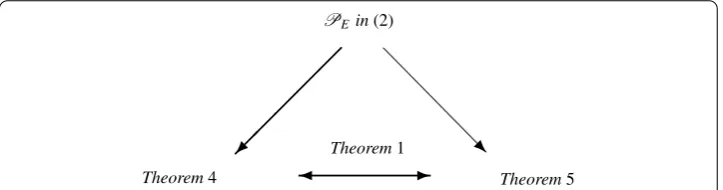
Conjecture By taking into account Theorems, and,one can investigate whether there exists an equivalence between the generating functions that represent the presentation PEin()as indicated in Figure.
By considering Proposition , Theorem and Theorem , respectively, we further obtain the following corollary.
Theorem SupposePEin()is an efficient presentation.Then it accepts
p(x) = [λλ– ]S(x)
as a generating function including the functions defined in Theorem,where Sn
a(x)is defined
as in()andλ,λare the eigenvalues ofM.
Proof By Theorem , we have the generating functionsp(x) andp(yi) (≤i≤).
How-ever, sincePEis given as an efficient presentation, we also need to add a function related
to its efficiency. At this stage, we can think about Theorem which basically says thatPE
is efficient ifλλ– ≡ modp. Moreover, this condition is directly related to the
gen-eratorxinPE(cf.[, Theorem .]). Therefore this last generating function should be of
the form [λλ– ]S
(x), as required.
The following corollary is a consequence of Theorem which states that the expression of Theorem can also be given as a single condition.
Corollary SupposePEin()is an efficient presentation.Then it accepts p(ν) =S(ν) –
(λ +λ)S(ν) + as a generating function, whereν represents three-ordered variables
(x,y,y)andλ,λare the eigenvalues ofM.
The sketch of proof Since the efficiency of a presentation impliesλλ≡ modpfor any
primepor , we can takeλλ= in () because, by NFT, the simplest (reduced) form
represents all other generating functionsp(ν). Thus, depending on the constants, the func-tionp(ν) in the result can be thought to be in the congruence class of all such functions.
Remark From Corollary and by considering Theorem , we can easily deduce that
the set of generating functions for an efficient presentation can be presented as a single element. This actually shows the importance of efficiency during the study of generating functions.
In Proposition and also in Theorem , we expressed the minimality (while satisfying inefficiency) of the presentationPEin () in two different versions, respectively. As a next
step of Theorem and as a consequence of Theorem , we will deal with the array poly-nomials which are obtained from a minimal but inefficient presentation. The following lemma will be needed in the proof of our next result.
Lemma There always exists(p– )p≡ modp for any prime p.
Proof We first note that the lemma is clear forp= . So, let us assume thatpis an odd prime.
Suppose that (p– )p≡ modp. So, by the meaning of congruence, we must have (p– )p=pt for at∈Z+. In fact, the left-hand side of this equality can be written as a
binomial sum
In this sum, each term except the last one, which is , is congruent to by modulopsince each of them containspas a factor. Thus, (p– )pcannot be congruent to by modulo punless we add – to both sides of this congruence. Therefore (p– )p≡ modp, as
required.
Theorem For an odd prime p,the minimal but inefficient presentation
PE=
y,y,x;yy=yy,xp+=x,yx=xyp– ,yx=xy
has a set of generating functions
p(x) =
Sp+ (x)–S(x), p(y) =S(x) +
Sp–(y)
+ S
(x)
,
p(x) = [λλ–p+ ]S(x), p(y) =S(x) +
S(y)
+ S(x),
where Sn
a(x)and Sna(yi)are defined as in().
Proof Letp be an odd prime. We first need to show that PE in the theorem actually
presents a semi-direct product of a free abelian monoid rank two by a finite cyclic monoid as defined in (). To do that, we just have to ensure that Equation () holds.
FromPE, one can easily obtain a diagonal matrixM= p–
whichdetM=λλ=p–
for eigenvaluesλ andλ. Moreover, by Lemma , we obviously get (p– )p+ ≡p–
modpsimilarly as the other p+ th powers of entries. Thus we obtain
Mp+≡M modp,
which implies thatPEactually presents the required semi-direct product. Hence, as
in-dicated in the proof of Theorem , we have the generating functionsp(x) andp(yi) for
≤i≤ (by Theorem ).
However, again as in the proof of Theorem , we need to find a new function (array polynomial) which is related to the minimality (having inefficiency) status ofPE. To do
that, we will take into account the same way which was obtaining the functionp(x) =
[λλ– ]S(x) in Theorem . From Proposition , we know that any semi-direct product
presentation is not efficient if the determinant of the base matrixMis equivalent to orp– by modulop, and also by Proposition , this presentation is minimal (whilst it is efficient) if the primepis odd and the entries of the main diagonal arep– and (orvice versa) in the diagonal matrix. It is clear that all these situations are suitable for our case in this proof. Therefore, since we haveλλ=p– , there must exist [λλ– (p– )]S(x) as a
generating function.
Hence the result.
Corollary Let us consider the minimal but inefficient presentationPE in Theorem.
Then it accepts p(ν) =S
(ν) –pS(ν) +p– as a generating function,whereνrepresents
three-ordered variables(x,y,y).
Similarly to Corollary , the functionp(ν) in the above corollary can be taken as the sim-plest (reduced) form being in the same congruence class as all other generating functions p(ν) that represent this minimal presentation.
Remark From Corollary and by considering Theorem , we can easily deduce that the set of generating functions for a minimal but inefficient presentation can be presented as a single element. Therefore, as pointed out in Remark , this shows the importance of minimality (even holding inefficiency) in the meaning of the study of generating functions.
As a result of Theorem and Corollaries , , we can state that array polynomials ob-tained in this paper are congruent to each other and so they construct congruence classes. Since these results are based on the characteristic polynomials, the proof of the following main theorem of this papercan be seen quite similar to the proofs of Proposition and Theorem .
Theorem Each array polynomial obtained from the presentationPEin()appears to be
a congruence class.Moreover,this presentation is represented by a single type of array poly-nomials depending on this congruence.This single type may contain a unique congruence class of array polynomials in the case of efficiency or minimality status ofPE.
3 Conclusions
In this part of the paper, we will discuss some problems which can be thought of as con-jectures or conclusions and so can be studied in the future projects.
The first project would be the following: In Conjecture , by considering a ×-matrix Mwith eigenvaluesλandλ, we inquired whether the statementgcd(tr(M),det(M)) =
is enough to get minimality of the presentation. In fact, if one can manage to extend it to a larger situation such as
gcd(λ+λ+· · ·+λn,λλ· · ·λn) =
for ann×n-matrixM, then this would cover a more general situation.
The equivalence indicated in Conjecture can probably be obtained by the following idea. Let us think about the generating functions defined in Theorem as of the elements of a topological spaceTand, similarly, the generating functions defined in Theorem as
of the elements of a topological spaceT. Then, by investigating the homotopy equivalence
betweenTandT, we can check the existence of required equivalence.
Another outcome of this paper can be seen in Remarks and . It is understood that to study efficient or minimal presentations (and so with the minimal number of generators) implies the minimal number of generating functions. In addition to the material given in the above paragraph, one can also investigate whether the set, sayB, of this minimal number of generating functions can be a generating set of this type of functions. Math-ematically, we can study whether there exists an equality B=i∈IGi, where eachGi
After all the above discussions, as a general case, one may ask whether the equivalence of constants of generating functions implies the equivalence of generating functions directly.
Competing interests
The authors declare that they have no competing interests.
Authors’ contributions
All authors completed the paper together. All authors read and approved the final manuscript.
Author details
1Department of Mathematics, Faculty of Science, Selçuk University, Campus, Konya, 42075, Turkey.2Department of
Mathematics, Sungkyunkwan University, Suwon, 440-746, Republic of Korea.3Department of Mathematics, Faculty of Art and Science, Akdeniz University, Campus, Antalya, 07058, Turkey.4Department of Mathematics, Faculty of Arts and Science, Uludag University, Gorukle Campus, Bursa, 16059, Turkey.
Acknowledgements
Dedicated to Professor Hari M Srivastava.
The first, third and fourth authors are partially supported by Research Project Offices of Selcuk (13701071), Uludag (2012-15 and 2012-19) and Akdeniz Universities, respectively. Also the second author is supported by Sungkyunkwan University BK21 Project, BK21 Math Modeling HRD Div. Sungkyunkwan University, Suwon, Republic of Korea.
Received: 2 December 2012 Accepted: 10 February 2013 Published: 28 February 2013 References
1. Elsner, C, Shiokawa, I: On algebraic relations for Ramanujan’s functions. Ramanujan J.29, 273-294 (2012)
2. Simsek, Y, Kim, T, Park, DW, Ro, YS, Jang, LJ, Rim, SH: An explicit formula for the multiple Frobenius-Euler numbers and polynomials. JP J. Algebra Number Theory Appl.4, 519-529 (2004)
3. Srivastava, HM, Coi, J: Series Associated with the Zeta and Related Functions. Kluwer Academic, Dordrecht (2001) 4. Srivastava, HM: Some generalizations and basic (orq-) extensions of the Bernoulli, Euler and Genocchi polynomials.
Appl. Math. Inf. Sci.5, 390-444 (2011)
5. Woodcock, CF: Convolutions on the ring ofp-adic integers. J. Lond. Math. Soc.20(2), 101-108 (1979)
6. Ate¸s, F, Cevik, AS: Thep-Cockcroft property of central extensions of groups II. Monatshefte Math.150, 181-191 (2007) 7. Cevik, AS: Thep-Cockcroft property of the semi-direct products of monoids. Int. J. Algebra Comput.13(1), 1-16 (2003) 8. Cevik, AS: Minimal but inefficient presentations of the semi-direct products of some monoids. Semigroup Forum66,
1-17 (2003)
9. Cevik, AS, Das, KC, Cangul, IN, Maden, AD: Minimality over free monoid presentations. Hacet. J. Math. Stat. (acceptted) 10. Shiratani, K, Yokoyama, S: An application ofp-adic convolutions. Mem. Fac. Sci., Kyushu Univ., Ser. A, Math.36(1),
73-83 (1982)
11. Birkhoff, GD, Lewis, D: Chromatic polynomials. Trans. Am. Math. Soc.60, 355-451 (1946)
12. Cardoso, DM, Silva, ME, Szymanski, J: A generalization of chromatic polynomial of a graph subdivision. J. Math. Sci.
182(2), 246-254 (2012)
13. Cangul, IN, Cevik, AS, Simsek, Y: A new approach to connect algebra with analysis: relationships and applications between presentations and generating functions. Bound. Value Probl.2013, 51 (2013).
doi:10.1186/1687-2770-2013-51
14. Remmel, J, Riehl, M: Generating functions for permutations which contain a given descent set. Electron. J. Combin.
17(1), R27 (2010)
15. Srivastava, HM: An equivalence theorem on generating functions. Proc. Am. Math. Soc.52(1), 159-165 (1975) 16. Ivanov, SV: Relation modules and relation bimodules of groups, semigroups and associative algebras. Int. J. Algebra
Comput.1, 89-114 (1991)
17. Clifford, AH, Preston, GB: The Algebraic Theory of Semigroups. Volumes I and II, 2nd edn. Am. Math. Soc., Providence (1964)
18. Cohen, DE: Combinatorial Group Theory: A Topological Approach. London Mathematical Society Student Texts, vol. 14. Cambridge University Press, Cambridge (1989)
19. Cangul, IN, Cevik, AS, Simsek, Y: Analysis approach to finite monoids. Fixed Point Theory Appl.2013, 15 (2013). doi:10.1186/1687-1812-2013-15
20. Chang, CH, Ha, CW: A multiplication theorem for the Lerch zeta function and explicit representations of the Bernoulli and Euler polynomials. J. Math. Anal. Appl.315, 758-767 (2006)
21. Simsek, Y: Generating functions for generalized Stirling type numbers, array type polynomials, Eulerian type polynomials and their applications. arXiv:1111.3848v2 [math.NT] 23 Nov 2011
22. Simsek, Y: Interpolation function of generalizedq-Bernstein type polynomials and their application. In: Curve and Surface. LNCS, vol. 6920, pp. 647-662. Springer, Berlin (2011)
23. Mismar, MJ, Abu-Al-Nadi, DI, Ismail, TH: Pattern synthesis with phase-only control using array polynomial technique. In: 2007 IEEE International Conference on Signal Processing and Communications (ICSPC 2007), Dubai, UAE, 24-27 November 2007 (2007)
doi:10.1186/1687-1812-2013-44