197
Copyright © 2011-15. Vandana Publications. All Rights Reserved.
Volume-5, Issue-2, April-2015
International Journal of Engineering and Management Research
Page Number: 197-201
Importance of Supply Chain Management
Radhey Shyam
Assistant Professor, Mechanical Engineering Department, Techno India NJ Institute of Technology, Udaipur, INDIA
ABSTRACT
This paper analyzes the importance of Supply Chain Management to ensure technological development as well as welfare of society as a whole. There are mainly three stages of supply chain namely procurement, production and distribution. With the fall of European Socialist-Bloc and opening up of the Asian markets, the trade barriers began to fall during the 1980’s and continued throughout the 1990’s. This development led to organizations having a supply chain, that criss-crossed the whole globe. The Integrated Supply Chain Management (ISCM) is now not only a problem of integrated logistics (as a process) but also demands that the
supply chain management (SCM) must look into the ramifications of these arrangements on the cost of transportation (including tariffs or duties) of products within a trade zone and outside it, besides, developing logistics strategies.
Index terms---- Supply chain management (SCM), Suppliers, Strategic management, Integrated Supply Chain Management (ISCM), Logistical Execution System (LES), stock-keeping unit (SKU)
I.
INTRODUCTION
The term supply chain management (SCM) is made up of three words, supply + Chain + Management .The term supply chain management was coined in 1982. Current research work of supply chain management includes all activities and processes involving planning, coordination, control, operation and optimization of the whole supply chain system.
1.1 Definitions:
There are various definitions cited by different specialists. Some of these are:
Berry et al. (1994): Supply chain management aims at building trust, exchanging information on market needs, developing new products, and reducing the supplier base to a particular OEM (original equipment manufacturer) so as to release management resources for developing meaningful, long term relationship.
Lee and Ng (1997): A network of entities that starts with the suppliers' supplier and ends with the customers' custom the production and delivery of goods and services.
Figure1: Main elements SCM
Supply chain management focuses on how firms utilise their suppliers' processes, technology and capability to enhance competitive advantage. It is a management philosophy that extends traditional intra-enterprise activities by bringing trading partners together with the common goal of optimization and efficiency.
198
Copyright © 2011-15. Vandana Publications. All Rights Reserved.
1. Institutions associated with supply chain Management for literature:
The supply chain was developed along the concept of physical distribution and transportation.
II.
STRATEGIC FACTORS IN SUPPLY
CHAIN MANAGEMENT
Figure2: Main elements of industry framework
Supply chain strategies generally conform to one of six types.
Supply chains encompass the end-to-end flow of information, products, and money. In this context, the proper alignment of the supply chain with business strategy is essential to ensure a high level of business performance.
"Supply Chain Roadmap," provides:
(i)a compilation of the most relevant key drivers of a supply chain strategy;
(ii)an understanding of the interrelation of these key drivers with an industry's competitive framework and a business's competitive positioning; and
(iii)The characteristic profile of six generic supply chain types: efficient, fast, continuous-flow, agile, custom-configured, and flexible.
3.1 Industry framework. "Industry framework" refers to the interaction of suppliers, customers, technological developments, and economic factors that affect competition in any industrial sector. Within this
framework are four main drivers affecting supply chain design, all of them interrelated:
III.
THE FOUR ELEMENTS OF SUPPLY
CHAIN STRATEGY
Supply chain strategy defines the connection and combination of activities and functions throughout the value chain, in order to fulfill the business value proposal to customers in a marketplace.
An organization's supply chain strategy is shaped by the interrelation among four main elements, which are: the industry framework (the marketplace); the organization's unique value proposal (its competitive positioning); its internal processes (supply chain processes); and its managerial focus (the linkage among supply chain processes and business strategy).
(i)Demand variation, or demand profile, influences the stability and consistency of the manufacturing assets' workload, and consequently is a main driver of production efficiency and product cost.
(ii)Market mediation costs. Market mediation costs, as defined by Marshall Fisher, are costs associated with the imbalance of demand and supply. Product lifecycle, which is continually getting shorter in response to the speed of change in technology, fashion, and consumer product trends, affects the predictability of demand and market mediation costs.
(iii)Relevance of the cost of assets to total cost becomes critical in industrial sectors where business profits are highly correlated with the asset-utilization rate.
3.2 Unique value proposal: The second element, the unique value proposal, requires a clear understanding of the organization's competitive positioning in terms of its supply chain. A good approach to this is the concept of "order qualifiers" and "order winners" described in 1995 by Alex and Terry Hill.
3.3 Managerial focus:
This focus is the most important factor in ensuring coherence between supply chain execution and a business's unique value proposal.
3.4 Internal processes:
Figure3: Internal processes in the industry
The fourth element, internal processes, provides an orientation that ensures a proper connection and combination within the supply chain activities that fall under the categories of source, make, and deliver. Among the many factors encompassed by this element, the most important are asset utilization and the location of the decoupling point. The decoupling point is the process in the value chain where a product takes on unique characteristics or specifications for a specific customer or group of customers. There is a high degree of interdependence between these two factors, and they in turn govern other factors:
199
Copyright © 2011-15. Vandana Publications. All Rights Reserved.
the output point for the most relevant manufacturing assetin terms of cost.
(b)Prior to the decoupling point, processes are "push," therefore the workload leveling is smoothed by the forecast, the production cycle tends to be long in order to increase production efficiency, and the asset-utilization rate is high.
(i)After the decoupling point, processes are "pull," therefore asset utilization hovers around the medium level, the workload is driven by demand and is therefore highly variable, and the production cycle tends to be shorter in order to reduce the order cycle time and increase customers' positive perception of service.
(ii)The largest portion of the inventory, which is partially manufactured and ready to configure according to customers' requirements, is concentrated just before the decoupling point.
(iii)When the decoupling point is located farthest from the customer's end of the supply chain, product customization increases, therefore demand buffering should be supported by excess capacity.
(iv)When the decoupling point is located toward the customer's end, product customization diminishes.
IV.
SIX GENERIC SUPPLY CHAIN
MODELS
Once a company understands the factors driving its business, then it can determine which of six common supply chain models identified by the Supply Chain Roadmap best matches those criteria. These six are grouped in two categories: supply chain models that are oriented to efficiency, and those that are oriented to responsiveness.
Managers should focus on promoting maximum end-to-end efficiency. There are two main actions they can take to accomplish this. First, they should ensure high rates of asset utilization coupled with high overall equipment efficiency (OEE) in order to reduce cost. And second, they should ensure high levels of forecast accuracy to guarantee product availability and consequently, perfect order fulfillment.
(i)There should be extra capacity in outbound logistics, to absorb demand peaks without affecting the ability to meet customers' expected receiving dates.
(ii)The SKU portfolio should be trimmed back to reduce the number of "high variation, low demand" SKUs, which create complexity in production and service.
(iii)When transportation cost is highly relevant to the total cost, a minimum order-size policy of a full truckload is recommended.
4.2 The "fast" supply chain model
The fast supply chain is best for companies that produce trendy products with a short lifecycle. This focuses competition in the market on manufacturers' ability to continuously develop new products they can sell at an affordable price. As a result, the main driver of competitiveness is the reduction of market mediation costs. In an industry framework characterized by a short lifecycle, this might appear to be a conundrum, but with an understanding of market trends and consumers' habits, it is possible to maintain market mediation cost at an optimal level.
Production should be scheduled in a single batch per SKU, with its size defined by sales expectations for the sales season (or collection, in the fashion industry), using a model based on a "make to forecast" decoupling point. Management should focus on promoting continuous portfolio renewal, which is supported by three main capabilities: short time from idea to market, maximum levels of forecast accuracy in order to reduce market mediation cost, and end-to-end efficiency to ensure affordable costs for customers.
For this supply chain model to be successful, the following factors should be in place:
(i)For companies with high levels of seasonal demand, there must be a pool of suppliers that can provide additional capacity as needed.
(ii)"Classic" SKUs, defined as those that have a permanent presence in the product portfolio, should be replenished under a continuous-flow supply chain model.
(iii)The fast supply chain model is the most demanding in terms of forecast accuracy.
(iv)Because product portfolios are extensive and change frequently, there will be many SKUs with low sales volumes.
(v)Standardization of raw materials and limiting their variety reduces sourcing complexity.
4.1 Supply chains oriented to efficiency
In industries where the value proposal is oriented toward low cost and/or high relevance of asset utilization to total cost, end-to-end efficiency is a must. Examples of such industries include cement, steel, paper, commodities, and low-cost fashion, among others. They are best suited to one of three supply chain types—"efficient," "fast," and "continuous-flow"—that are best able to maximize asset utilization:
4.1.1 The "efficient" supply chain model
The efficient supply chain is best suited to industries that are characterized by intense market competition, with several competitors fighting for the same group of customers who may not perceive major differences in their value proposals. In effect, competition is virtually always based almost solely on price.
200
Copyright © 2011-15. Vandana Publications. All Rights Reserved.
4.3 The continuous-flow supply chain model
The main features of this model are supply and demand stability, with processes scheduled in such a way as to ensure a steady cadence and continuous flow of information and products.
Companies should use a prescheduled order cycle.
(i)High-variance SKUs should be buffered with higher levels of inventory in order to avoid unexpected changes in the production schedule.
(ii)The production cycle should be scheduled in a logical sequence of SKUs, with the aim of reducing setup time between each pair of adjacent SKUs.
(iii)Collaborative efforts should be oriented toward customers that generate higher sales and those with high demand variability.
4.4 Supply chains oriented to responsiveness
These include the "agile," "custom-configured," and "flexible" models.
4.4.1 The "agile" supply chain model
The agile type of supply chain is useful for companies that manufacture products under unique specifications for each customer. They use a "make to order" decoupling point, producing the item after receiving the customer's purchase order to avoid manufacturing products that have no certainty of future sales.
As a result, the main driver of competitiveness is agility—the ability to meet unpredictable demand, in quantities exceeding the customer's forecast and/or within a shorter lead time than agreed.
(a)In order to reduce lead time, materials and components should be designed for a common platform and they should always be available in inventory.
(b)Low-variance customers should be protected by lower prices to prevent their defection to efficient competitors. (c)If extra capacity gradually decreases to low levels, the company should invest in additional assets so it can maintain its ability to be agile.
4.4.3 The "flexible" supply chain
It is suited for companies that must meet unexpected demand.
(i)Companies should keep critical resources available on stand-by.
(ii)Adaptability is based on having many resources of low to medium capacity.
(iii)A well-designed order-entry process is necessary.
4.5 The custom-configured supply chain model :
Product configuration and downstream processes are scheduled after receiving the customer's order.
(a)The order-entry system should be detailed and accurate as well as user-friendly.
(b)The most popular product configurations should be available in finished-goods inventory.
Organizations want their supply chains to have multiple capabilities: efficient, fast, agile, custom-configured, and flexible.
4.6 Simultaneous capabilities or multiple supply chains
The most powerful benefits of the "Supply Chain Roadmap" arise from its ability to help demystify the process of formulating supply chain strategy.
V.
SUPPLY CHAIN
The traditional objective of supply chain management is to minimize total supply chain cost to meet fixed and given demand. Total cost may include:
(a)raw material and other acquisition costs (b)in-bound transportation costs
(c) Facility investment costs
(d)direct and indirect manufacturing costs (e) Inventory holding costs
(f) Inter-facility transportation costs (g) Out-bound transportation costs
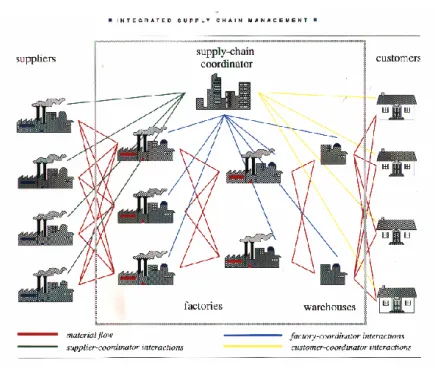
5.1 Integrated Supply Chain
Figure 4: integrated supply chain system
Supply chain management refers to integrated planning. First, it is concerned with functional integration of purchasing, manufacturing, transportation and warehousing activities. It also refers to spatial integration of these activities across geographically dispersed vendors, facilities, and markets. Finally, it refers to inter-temporal integration of these activities over strategic, tactical and operational planning horizons.
201
Copyright © 2011-15. Vandana Publications. All Rights Reserved.
demand. The operational level executes plans. Thedynamics of the enterprise and the market make this difficult; materials do not arrive on time, production facilities fail, workers are ill, customers change or cancel orders, etc. causing deviations from plan.
The Integrated Supply Chain Management (ISCM) project addresses coordination problems at the tactical and operational levels. It is composed of a set of cooperating, intelligent agents, each per-forming one or more supply chain functions, and coordinating their decisions with other agents - called a Logistical Execution System (LES).
Coordination occurs when agents develop plans that satisfy their own internal constraints but also the constraints of other agents. Negotiation occurs when constraints, that cannot be satisfied, are modified by the subset of agents directly concerned.
The objectives of the project are to:
(i)Develop a sharable representation of supply chain knowledge.
(ii)Identify an appropriate decomposition of supply chain functions and encapsulate into
agents.
(iii)Extend each function oriented agent so that it is able to answer more questions within its functional domain.
VI.
CHALLENGES
One of the major supply chain challenges that companies face is to reliably and profitable meet global demand. Supply chain decision-makers worry in the field of Outsourced manufacturing, lengthy global supply chains, a large number of suppliers, and volatile demand all create an environment that they think, they can't deliver on promises they've made. These decisions are possible by cloud-based supply chain technology.
REFERENCES
[1] Supply chain management: theory, practice and future challenges, by:
John Storey and Caroline Emberson, The Open University Business School, Milton Keynes, UK, and Janet Godsell and Alan Harrison, Cranfield School of Management, Cranfield, UK
[2] Supply chain management and advanced planning–– basics, overview and challenges
Hartmut Stadtler; Science Direct (EJOR)
[3] White papers on Supply Chain Management, Google search
[4] Supply chain management: an analytical framework for critical literature review
Simon Croom, Pietro Romano", Mihalis Giannakis!! Warwick Business School, University of Warwick, Coventry CV4 7AL, UK; "Department of Management and Engineering, University of Padua, Vicenza, Italy .