Volume-6, Issue-6, November-December 2016
International Journal of Engineering and Management Research
Page Number: 359-363
Impact of Industrial Package on Industrial and Economic Development of
Himachal Pradesh
Surjit Kumar1, Bharat Bhatt2
1,2Assistant Professor, Department of Commerce, Zakir Husain Delhi College, University of Delhi, Jawaharlal Nehru Marg
New Delhi, INDIA
ABSTRACT
Industrialization is the only way to solve the main problems like unemployment, poverty, regional imbalances etc. To absorb the pressure of population, it is essential to industrialize the country and that too quickly. It is the establishment of industries alone that can generate employment opportunities to an accelerated rate. To establish industries government commitment and support are key factors. Incentives and other support measures to industries play a significant role to attract new entrepreneurs to less developed industrial regions. But sometimes this support becomes the political issue. Same is the case with hill state Himachal Pradesh (H.P.) after the withdrawal of industrial package which was announced in 2003. To address this issue it is very much important to analyse the impact of this industrial package in the state. In this paper an attempt has been made to analyze the impact of this industrial package on industrial and economic development of Himachal Pradesh. This study resulted into a new model of economic development.
Keywords— Industrialization, Economic Development
I.
INTRODUCTION
Industries, which act as an engine of growth and development of any country, play a pivotal role on the over-all economic development of India too. Every country in the world is striving to achieve maximum industrialization because industrialization is not only significant for stability and security of a country but it ensure optimum use of both natural and human resources and diversifies the socio-economic pattern. Indian economy is characterized by surplus labour and rapidly growing population. To absorb these pressures of population at a rate commensurate with the addition to the unemployment pool of labour, it is essential to industrialize the country and that too quickly. In Indian states where most of the economies are totally depend on
agriculture, it is necessity to industrialize these states and same is the case with hill state Himachal Pradesh.
Recognizing the importance of industries for overall economic development of the state, the government has created a congenial industrial environment through various industrial policies and investor friendly measures. The various initiatives taken by the government are in the form of development of quality industrial infrastructure, quality of power and reasonable power tariff structure, simplification and rationalization of rules and procedures, labour reforms, interest subsidies to small units, state level single window clearance and monitoring cell to give government approval to the medium and large scale industries and to make the project clearance process simple, transparent and accountable, setting up of social infrastructure like specialized health institution, housing facilities, technical and professional educational institutions and providing basic amenities. The efforts of the State Government to promote industrialization have received further impetus with the notification of special package of incentives by the Central Government on 07-01-2003.
After the notification of Special Incentives Package by Government of India in January,2003, 7,050 small scale industrial units (292 expansion and existing units) and 264 medium and large scale units having a total investment of Rs.10,103.74 crore have been actually set and employment opportunities were provided to 95,615 persons.In order to provide infrastructural facilities to the entrepreneurs, the state Govt. has already developed 40 industrial areas and 15 industrial estates with all basic amenities. The economy of Himachal Pradesh has also shown a shift from agriculture sector to industries as the percentage contribution of agriculture and allied sectors in total State Domestic Product has declined from 57.9 percent in 1950-51 to 11.7 percent in 2009-10.
Prasad (1957) was of the view that industrialization not only affects the economic part of the people’s life, but it also influences the social and cultural life with increased opportunities for education, superior housing, public health and other infrastructural facilities.
Rao and Reddy (1977) in their paper they had discussed the role of small scale and cottage industry in rural re-construction in India. The research has stressed the role of appropriate technologies to suit these industries in the light of availability of productive resources and the social and economic objectives. It was concluded that the development of modernized cottage and small-scale industries crucially depends upon the ability to improve productivity in these industries through evolving suitable production and organization devices.
Rao (1978) stated that rural industrialization will not only bring prosperity to the rural sector but will bring about equilibrium in the structure. While developing these industries, the change in economic and international environment and situation should be taken into account.
Thanulingom and Natrajan (1989) discussed at
length, the various incentives provided by the govt. of India through its differential policy resolution to encourage the growth of small scale industries. They assessed the impact of these incentives, through an empirical study undertaken in Madurai district, an industrially backward area in Tamil Naddu.
Thomas (2002) in his article reviewed the performance of Indian manufacturing sector in term of rate of growth, size and structure of manufacturing sector, its share in employment, variation in growth rates across industries. He reviewed only the performance of manufacturing sector.
Economic Survey of H.P. (2007) department of statistics of H.P. stated in its annual report that industrial sector is playing a major role in the economic development of Himachal Pradesh which was earlier played by agriculture and horticulture sector. Reports also represent the data related to industries which shows its impact on development of state like increase in employment generation.
Planning Commission, (2008)reported the
strategy for inclusive growth in the Eleventh Plan aims at achieving a particular type of growth process which will meet the objectives of inclusiveness and sustainability. A package of fiscal and other incentives has been in place since 1997 aimed at facilitating industrial development of the States of the North East Region (NER). During the Tenth Plan, similar schemes were notified for Jammu and Kashmir (J&K), Himachal Pradesh and Uttarakhand. While the responses in the NER and the valley in J&K have not been significant, there is evidence that these incentives have stimulated industrial investment in Jammu, Himachal Pradesh and Uttarakhand. However, there are complaints from other States, particularly the adjoining ones, of flight of capital induced by excise duty
exemptions. Because of the distortions induced by excise duty exemptions in particular, consideration needs to be given to replacing the incentives, fully or partly, by an accelerated programme of infrastructure improvement.
Economic Survey of Himachal Pradesh (2012) stated that industrial package has been played a significant role in attracting new industries in the states, investment and employment have also increased in last few years in the region.
Louis (2012) in his paper ‘Economic growth patterns and strategies in China and India: Past and Future’ pointed out that India’s potential GDP has shown increase due to increased investment and productivity. He further stated that major challenge for Indian growth is development of human resource.
Kniivila(2007), studied the growth story of seven countries; China, India, Korea, Taiwan, Indonesia, Mexico and Brazil and stated that industrial development plays an important role in poverty reduction and economic development.
Studies conducted by Dhar and Lydall(1961),
Sharma (1988), and Reddy(1990),have also highlighted the various issues related to industrialization and development. There are very few studies which have covered this aspect of the package and no fruitful study which coveted this area in a hilly state. This is the most important consideration, which has governed the choice of the research work. Though the study is confined to Himachal Pradesh, is obviously has relevance and significance in industrial development in other states of India as well.
III.
OBJECTIVES
This paper is intended to achieve the following objectives:
To study the growth of industries after the announcement of industrial package to Himachal Pradesh.
To analyse the impact of industrial package on industrial and economic development of Himachal Pradesh.
IV.
HYPOTHESES
The following hypotheses have been tested in this paper:
H1 Industrial package has no impact on industrial growth
in the state.
H2 Industrial package has no impact on economic
development of the state.
The present study is mainly based on secondary data collected from various sources like the Annual Survey of Industries, the reports of Department of Industry, government of Himachal Pradesh, Plan documents, Economic Surveys of India as well as of Himachal Pradesh, Directorate of industries (H.P.), Statistical outline of H.P., magazines and internet etc. Data is collected for two periods one before the announcement of special package of incentives to Himachal Pradesh i.e. from 1995-96 to 2002-2003 (8 years) and other after the announcement of this package i.e. 2004-05 (8 years) and year 2003-04 (year of package announcement) considered as base year to find the impact of industrial package. In order to meet the objectives of the study, data on various variables like number of small, medium and large enterprises, investment by these enterprises and employment provided by these enterprises collected to find the impact of industrial package on industrial development. Understanding of Economic Growth has been operationalized using two variables – State per capita income, and Gross State Domestic Product. Descriptive statistics were used to understand the data more minutely. Differences in Economic Growth and Industrial Growth before and after industrial package were assessed using paired sample t-test.
VI.
INDUSTRIAL GROWTH IN
HIMACHAL PRADESH
In comparison with other hilly states of the country, Himachal Pradesh has made significant progress in the field of industrialization. During the last few years, the industrialization in the state of H.P. has made significant progress. Today state have about 38707 (38220 small scale and 487 medium and large scale) industrial units with an investment of about Rs. 15990.53 crores and employment of about 2.66 lakhs persons registered with the department of industries. Following table exhibits the industrial growth in the state.
Table 1: Industrial Growth in H.P.
Source: Annual report (2011-12), Department of Industries, Government of H.P.
VII.
ECONOMIC DEVELOPMENT IN
HIMACHAL PRADESH
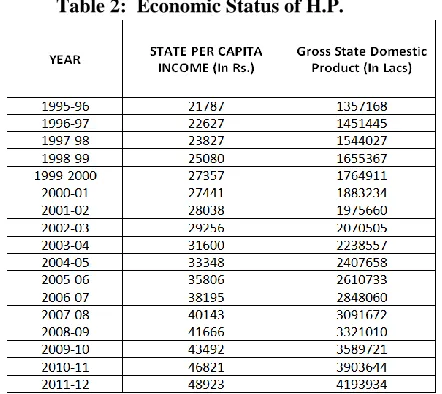
The economy of Himachal Pradesh has shown a shift from agriculture sector to industries as the percentage contribution of agriculture and allied sectors in total State Domestic Product has declined from 57.9 percent in 1950-51 to 55.5 percent in 1967- 68, 26.5 percent in 1990-91 and to 14.5 percent in 2009-10.The share of industries has increased from 1.1 percent in 1950-51 to 5.6 percent in 1967-68, 9.4 percent in 1990-91 and to 11.7 percent in 2009-10. Table 2 is showing the economic growth of the state during the time period of the study.
Table 2: Economic Status of H.P.
Source: Economic Survey (2011-12) of Himachal Pradesh
VIII. RESULTS AND FINDINGS
Table 3.1: Analysis of Difference (Descriptive statistics and paired sample t-test)
Paired Sample t-test was applied to see whether there is significant difference between above variables before and after 2003-04. P value for all the test variables is less than 0.05 (p value for small scale enterprises is 0.000, medium & large enterprises is 0.001, employment provided is 0.000 and in case of investment is 0.001). At 95% level of significance, this clearly depicts that there is
significant difference between the means of small scale enterprises, medium and large enterprises, employment provided by these enterprises and investment by these enterprises before and after 2003-04 (figures are given in table 3.1). Hence hypothesis (H1) is not accepted. Above
analysis shows that industrial package may have significant impact on industrial development of Himachal Pradesh.
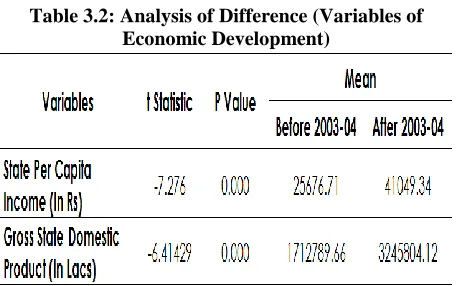
Table 3.2: Analysis of Difference (Variables of Economic Development)
This analysis shows that industrial package has significantly increased state per capita income and gross state domestic product. It clearly depicts that industrial package has brought positive significant impact on the economic development of Himachal Pradesh. Table 3.2 shows that there is significant difference between the means of Gross State Domestic products and State per capita income before and after 2003-04. This increase may be because of increase in small, medium and large enterprises, employment provided and investment by these enterprises. After the industrial package all the variable of industrial growth have shown positive increase which may result in increase of gross state domestic product and state per capita income(Kaldor(1970) and Cornwall(1977) have asserted that expansion of industries is a driving force for economic growth). P value in case of these two variables is also less than 0.05 (0.000 in both cases), it states that there is significant impact of industrial package on economic development of the state. Hence H2 is also not
supported. So we can say that industrial package have significant impact on the industrial and economic development of the state.
IX.
CONCLUSION
No doubt industrialization is playing a vital role in the development of the state and for a state like Himachal Pradesh which is mainly dependent on agriculture and horticulture it is a good sign that these industries are also contributing in the economic growth of the region. Due to seasonal agriculture, horticulture and difficult geographical situation of the state it is very important to establish the industries in all parts of the state
and to motivate entrepreneurs to establish enterprises in this part of the country, special incentive packages are very helpful. These kind of industrial packages are sound base for economic development as established in this study. Government focus should be on establishment and promotion of small scale enterprises as these are good in numbers are also established, moreover these are directly linked with the households of the state.
REFERENCES
[1] Bredow.1962.Industrial Estates and Tools for Industries, pp-9.
[2] Chang,P.K.1964).Agriculture and Industrialization. Harvard University Press, pp-69.
[3] Cornwall, J. 1977. Modern capitalism: Its growth and transformation.London.
[4] Desai, Vasant.1983.Problems and prospects of small-scale Industries.Himalya Publishing House, Bombay. [5] Dhar, P.N. and Lydall,H.F.1961.The role of small enterprises in Economic development.New Delhi, 1961. [6] Fagerberg, J.1994.Technology and international differences in growth rates. Journal of Economic Literature, Vol. 32, No.3, pp. 1147-1175.
[7] Gill, K.S.1983.Evaluation of Indian Economy.National Council of Education Research Training, Delhi, 1983. [8] Government of India, 2011. Ministry of MSMEs, Annual Report on MSMEs.
[9] Government of Himachal Pradesh, 2011-12. Economic Survey of H.P.
[10] Government of Himachal Pradesh, 2007. Economic Survey of H.P.
[11] Government of India, 2011. Economic Survey of India.
[12] Government of Himachal Pradesh, Annual Report of District Industries Centres.
[13] Government of Himachal Pradesh, Annual Report of Directorate of Industries.
[14] http://himachal.nic.in/industry/indstatus.htm.
[15] IDBI.1976. Survey on Industrial Potential of Himachal Pradesh.
[16] Kaldor, N.1970.The case for regional policies. Scottish Journal of Political Economy XVII, pp. 337-348. [17] Kniivila, Matleena.2007.Implications for povertyreduction and income inequality. Report published on Industrial development and economic growth:Industrial Development for the 21stCentury:Sustainable Development Perspectivesby United Nations.
[18] Kuchhal, S.C.1989.The Industrial Economy of India. Chetanya Publishing House, pp-2.
[19] Kuijs, Louis.2012).Economic growth patterns and strategies in China and India: Past and future, Fung Global Institute, Asian Perspectives global issue.
[20] Matoo,P.K.1976. Industrial Potential of H.P. Govt. MSMEs Development Act,2006.
[22] Prasad, P.1957. Some Economic Problems of Public Enterprises in India.H.E.
[23] Stenfert Kroese, Leiden, pp. 16-18.
[24] Rana, Kulwant,1988.Industrialisation of Hill States in India. Deep and Deep Publication, New Delhi.
[25] Rao, R.V.1978 Rural Industrialisation in India. Concept Publishing Company, Delhi, 79-80.
[26] Rao, V.Laxmana and K. Chenchi.1977.Role of Small and Cottage Industries in Rural Reconstruction. Khadi [27] Grmodyog, Vol. XXIII, No.6, pp.286-299.
[28] Reddy, K.C.1990.Financing of Small Scale Industries. Himalayan Publishing House, Delhi.
[29] Sharma, D.P.1988.Industrialization and Regional Development.Deep and Deep Publication, New Dehli. [30] Shapiro, E. 2007.Macroeconomic Analysis. Fifth edition. Galgotia Publication(P) Ltd., New Delhi.
[31] Thanulingom, N. and Natrajan.1989.Incentives, Help to Promote Small Scale Industries. Yojna, Vol.33, No.4, pp.18-21.
[32] Thomas, D.2002.Performance of Indian